 We often wonder about the childhoods of great people. We have little information about the early years of most of the people mentioned in the Bible. One delightful exception is Samuel; he came as a result of God’s answer to Hannah’s fervent prayer for a child. God shaped Samuel from the start. Like Moses, Samuel was called to fill many different roles: judge, priest, prophet, counselor, and God’s man at a turning point in the history of Israel. God worked through Samuel because Samuel was willing to be one thing: God’s servant.
As an older man (probably in his mid 50s) , Samuel appointed his sons to be judges over Israel in his place. But they turned out to be corrupt, much like Eli’s sons (2:12). We don’t know why Samuel’s sons went wrong, but we do know that Eli was held responsible for his own sons’ corruption (2:29–34).
It is impossible to know if Samuel was a bad parent. His children were old enough to be on their own and it clearly says they “chose” or “turned away.” We must be careful not to blame ourselves for the sins of our children. On the other hand, parenthood is an awesome responsibility, and nothing is more important than molding and shaping our children’s lives.
If our grown children are not following God, realize that we can’t control them any longer. Don’t blame yourself for something that is no longer your responsibility. But if your children are still in your care, know that what you do and teach can profoundly affect your children and lasts a lifetime.
Like more than one great leader, Samuel in his older age faced some painful situations and had to make some difficult decisions. He left the scene convinced that he had been rejected by the people he had served so faithfully. Samuel obeyed the Lord, but he was a man with a broken heart.
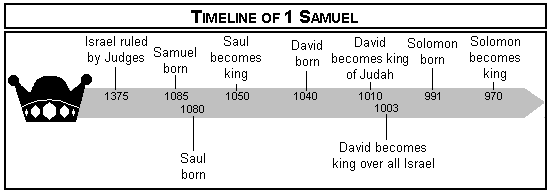 During the period of the judges, God raised up leaders here and there and gave them great victories, but nobody was in charge of the nation as a whole. “In those days there was no king in Israel; every man did that which was right in his own eyes” (Judg. 21:25; see 17:6; 18:1; 19:1). The “nation” of Israel was a loose confederation of sovereign tribes, and each tribe was expected to seek the Lord and do His will.
“Give us a King!” We want to be like Everyone Else (We Should Reject the World’s Way)
(1 Sam. 8:1–9). Knowing that Israel needed a stronger central government, the elders presented their request to Samuel and backed it up with several arguments. The first two must have hurt Samuel deeply: he was now old and had no successor, and his two sons were not godly men but took bribes (1 Sam. 8:3–5). How tragic that both Eli and Samuel had sons who failed to follow the Lord. Eli was too easy on his wayward sons (2:29), and perhaps Samuel was away from home too much as he made his ministry circuit to the cities. Samuel’s sons were miles away in Beersheba where their father couldn’t monitor their work, but if the elders knew about their sins, surely their father must have known also.
When the elders asked to have a king “like all the nations” (8:5, 20), they were forgetting that Israel’s strength was to be unlike the other nations. The Israelites were God’s covenant people and He was their King. The glory of God dwelt in their midst and the law of God was their wisdom. (See Ex. 19:3–6; 33:15–16; Lev. 18:30 and 20:26; Num. 23:9.) But the elders were concerned about national security and protection from the enemies around them. The Philistines were still a powerful nation, and the Ammonites were also a threat (1 Sam. 12:12). Israel had no standing army and no king to lead it. The elders forgot that it was the Lord who was Israel’s King and who gave her army the ability to defeat the enemy.
Samuel was a man of spiritual insight and he knew that this demand for a king was evidence of spiritual decay among the leaders. God reminded Samuel,”they weren’t rejecting him; they were rejecting God, and this grieved Samuel’s heart as he prayed to the Lord for wisdom. This wasn’t the first time the people had rejected their Lord. At Sinai, their request was “Make us gods!” (Ex. 32:1) and after their humiliating failure at Kadesh Barnea, they said, “Let us make a captain, and let us return into Egypt” (Num. 14:4). The Jewish leaders in Samuel’s day had no faith that God could defeat their enemies and protect His people, so they chose to lean on the arm of flesh.
God is never surprised by what His people do, nor is He at a loss to know what He should do. “The Lord brings the counsel of the nations to nothing; He makes the plans of the peoples of no effect. The counsel of the Lord stands forever, the plans of His heart to all generations” (Ps. 33:10–11, NKJV). There is every evidence in the Pentateuch that Israel would one day have a king. God promised Abraham, Sarah, and Jacob that kings would be among their descendants (Gen. 17:6, 16; 35:11), and Jacob had named Judah as the kingly tribe (49:10). Moses prepared the nation for a king when he spoke to the new generation preparing to enter the Promised Land (Deut. 17:14–20).
It wasn’t Israel’s request for a king that was their greatest sin; it was their insisting that God give them a king immediately. The Lord had a king in mind for them, David the son of Jesse, but the time wasn’t ripe for him to appear. So, the Lord gave them their request by appointing Saul to be king, and He used Saul to chasten the nation and prepare them for David, the man of His choice. The fact that Saul was from the tribe of Benjamin and not from Judah is evidence enough that he was never expected to establish a dynasty in Israel. “So in my anger I gave you a king, and in my wrath I took him away” (Hosea 13:11, NIV). The greatest judgment God can give us is to let us have our own way. “And He gave them their request, but sent leanness into their soul” (Ps. 106:15, NKJV).
Trust God’s Leadership
Had the Israelites submitted to God’s leadership, they would have thrived beyond their expectations (Deuteronomy 28:1). Our obedience is weak if we ask God to lead our family or personal life but continue to live by the world’s standards and values. Faith in God must touch all the practical areas of life.
However, the Lord wanted His people to go into this new venture with their eyes open, so He commanded Samuel to tell them what it would cost them to have a king.
The Price of a Human Leader (Expect Consequences for Rejecting God)
(1 Sam. 8:10–22). What’s true of individuals is true of nations: you take what you want from life and you pay for it. Under the kingship of Jehovah God, the nation had security and sufficiency as long as they obeyed Him, and His demands were not unreasonable. To obey God’s covenant meant to live a happy life as the Lord gave you all that you needed and more. But the key word in Samuel’s speech is take, not give. The king and his court had to be supported, so he would take their sons and daughters, their property, their harvests, and their flocks and herds. Their choice young men would serve in the army as well as in the king’s fields. Their daughters would cook and bake for the king. He would take their property and part of their harvest in order to feed the officials and servants in the royal household. While these things weren’t too evident under Saul and David, they were certainly obvious under Solomon (1 Kings 4:7–28). The day came when the people cried out for relief from the heavy yoke Solomon had put on them just to maintain the glory of his kingdom (12:1–4; see Jer. 22:13–17).
In spite of these warnings, the people insisted that God give them a king. Pleasing the Lord wasn’t the thing uppermost in their minds; what they wanted was guaranteed protection against their enemies. They wanted someone to judge them and fight their battles, someone they could see and follow. They found it too demanding to trust an invisible God and obey His wonderful commandments. In spite of all the Lord had done for Israel from the call of Abraham to the conquest of the Promised Land, they turned their back on Almighty God and chose to have a frail man to rule over them.
Even though Samuel carefully explained all the negative consequences of having a king, but the Israelites refused to listen. When we have an important decision to make, weigh the positives and negatives carefully, considering everyone who might be affected by our choice. When we want something badly enough, it is difficult to see the potential problems. But don’t discount the negatives. Unless you have a plan to handle each one, they will cause you great difficulty later.
8:19, 20 Israel was called to be a holy nation, separate from and unique among all others (Leviticus 20:26). The Israelites’ motive in asking for a king was to be like the nations around them. This was in total opposition to God’s original plan. It was not their desire for a king that was wrong, but their reasons for wanting a king.
Often we let others’ values and actions dictate our attitudes and behavior. Have you ever made a wrong choice because you wanted to be like everyone else? Be careful that the values of your friends or “heroes” don’t pull you away from what God says is right. When God’s people want to be like unbelievers, they are heading for spiritual disaster.
Message Audio/Video and Outline: https://upwards.church/watch-now/leander-campus-videos
Watch Messages: YouTube-Upwards Church
Sources:
Life Application Bible Notes (Tyndale, 2007), 420-21.
Warren W. Wiersbe, Be Successful, “Be” Commentary Series (Colorado Springs, CO: Victor/Cook Communications, 2001), 45–48.


 Upwards Church