 The Philistines were a people of Aegean origin who settled on the southern coast of Palestine in the 12th century BC, about the time of the arrival of the Israelites.
The first records of the Philistines are inscriptions and reliefs in the mortuary temple of Ramses III at Madinat Habu, where they appear under the name prst, as one of the Sea Peoples that invaded Egypt about 1190 BCE after ravaging Anatolia, Cyprus, and Syria. After being repulsed by the Egyptians, they settled—possibly with Egypt’s permission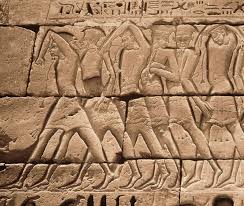 —on the coastal plain of Palestine from Joppa (modern Tel Aviv–Yafo) southward to Gaza.
*(The image depicted here is Philistine captives being led away after their failed invasion of Egypt, from a relief at Ramses III’s mortuary temple at Medinet Habu, Thebes, Egypt.)*
The name “Philistine” comes from the Hebrew word Philistia, and the Greek rendering of the name, palaistinei, gives us the modern name “Palestine.” The Philistines are first recorded in Scripture in the Table of Nations, a list of the patriarchal founders of seventy nations descended from Noah (Genesis 10:14). It is thought that the Philistines originated in Caphtor, the Hebrew name for the island of Crete and the whole Aegean region (Amos 9:7; Jeremiah 47:4). For unknown reasons, they migrated from that region to the Mediterranean coast near Gaza. Because of their maritime history, the Philistines are often associated with the “Sea Peoples.” The Bible records that the Philistines had contact with both Abraham and Isaac as early as 2000 B.C. (Genesis 21:32, 34; 26:1, 8).
After Isaac’s involvement with the Philistines (Genesis 26:18), they are next mentioned in passing in the book of Exodus shortly after the Israelites crossed the Red Sea: “When Pharaoh let the people go, God did not lead them on the road through the Philistine country, though that was shorter. For God said, ‘If they face war, they might change their minds and return to Egypt’” (Exodus 13:17).
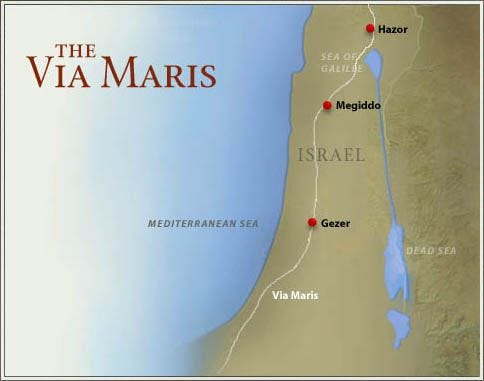 The “road through the Philistine country” refers to a route later known as the Via Maris or “the Way of the Sea,” one of three major trade routes in ancient Israel. This coastal road connected the Nile Delta with Canaan and Syria and beyond, into the Mesopotamian region of southwest Asia.
The Old Testament indicates that around the 13th century B.C., during the days of Samuel and Samson, the Philistines moved inland from the coast of Canaan. There, they built their civilization primarily in five cities: Gaza, Ashkelon, Ashdod, Gath, and Ekron (Joshua 13:3). These cities were each governed by a “king” or “lord” (from the Hebrew word seren, also rendered as “tyrant”). These kings apparently formed a coalition of equals. Each king retained autonomous control of his city, such as when Achish, king of Gath, dealt with David (1 Samuel 27:5-7), but they worked in concert in times of national emergency (Judges 16:5).
From the very beginning, the Philistines were either allies or deadly enemies of God’s people. They played a pivotal role in the lives of Samson (Judges 13:1; 14:1), Samuel (1 Samuel 4:1), Saul (1 Samuel 13:4), and David (1 Samuel 17:23).
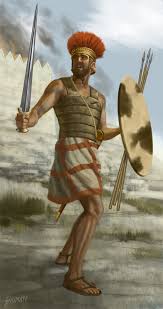 The Philistines were known for their innovative use of iron, which was superior to the bronze used by the Israelites for weapons and implements. Even as late as the time of Saul (1050 – 1010 B.C), the Israelites were forced to rely on the Philistines to sharpen or repair their iron tools (1 Samuel 13:19-21). With their more advanced armaments and aggressive military policy, the Philistines continually thwarted Israel’s development as a nation. For nearly 200 years, the Philistines harassed and oppressed the Israelites, often invading Israel’s territory. The children of Israel simply could not deal with the Philistines’ overwhelming military might. This only came to an end when Samuel and then David, through the guidance of God, were able to defeat the Philistines (1 Samuel 7:12-14; 2 Samuel 5:22-25).
The Old Testament indicates that the Philistines worshiped three gods: Ashtoreth, Dagon, and Baal-Zebub—each of which had shrines in various cities (Judges 16:23; 1 Samuel 31:10; 2 Kings 1:2). Archaeological findings show that Philistine soldiers carried images of their gods into battle (2 Samuel 5:21). Apparently, they were also a superstitious people who respected the power of Israel’s ark of the covenant (1 Samuel 5:1-12).
The Philistines were infamous for their production and consumption of alcoholic beverages, especially beer. Ancient Philistine ruins contain numerous breweries and wineries, as well as countless beer mugs and other drinking vessels. Samson’s wedding feast, recorded in the book of Judges, illustrates the Philistine practice of holding week-long drinking parties; the Hebrew word misteh, translated “feast” in Judges 14:10, means “drinking feast.”
The Israelites frequently referred to the Philistines as “uncircumcised” (Judges 15:18; 1 Samuel 14:6; 2 Samuel 1:20), meaning, at that time, those who had no relationship with God. They were not God’s chosen people and were to be strictly avoided as a contaminating evil.
Today, the word philistine is used as an epithet to refer to an unrefined, dull person. In truth, the Philistines of history were not unsophisticated or uncultured. They were an advanced seafaring people who, for several generations, were years ahead of Israel.
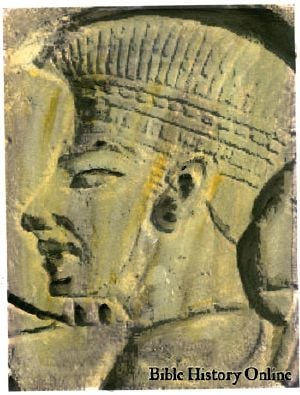 What does modern archeology reveal? Between 1997 and 2016, researchers at an excavation near Ashkelon in Israel examined the remains of more than one hundred humans, remains that dated from the 12th to 6th centuries before Christ. The researchers hoped to find human DNA in order to answer an old question: Who were the Philistines? Where did they come from?
As it turns out, the Philistines were exactly who the Bible says they were, and they came from where the Bible says they did.
Amos 9 speaks of God bringing up the Philistines from Caphtor, just as he brought Israel out of Egypt. Deuteronomy 2 tells us that “the Caphtorim, who came from Caphtor, destroyed [the original Canaanite inhabitants] and settled in their place.”
This brings us to the obvious question: “Where was Caphtor?” We just don’t know for sure, but the Bible does provide an interesting clue. Jeremiah called the Philistines “the remnant of the coastland of Caphtor.” The Hebrew word translated “coastland” can also mean “island.”
For this and other reasons, many archaeologists have concluded that biblical Caphtor was Crete. In fact, some modern Bible translations even render “Caphtor” as “Crete.” We can’t be completely certain that it is, but the Bible does tell us three additional things about the Philistines. First, they weren’t native to Iron Age Canaan. Second, they displaced the original inhabitants of the region. And, third, they came via the sea, that is, the Mediterranean.
Which brings us back to the excavation in Ashkelon. After analyzing DNA from the site, Michal Feldman, an archaeogeneticist at the Max Planck Institute, and Daniel Master, the head of the expedition, revealed the results. Master announced, “Our study has shown for the first time that the Philistines immigrated to this region in the 12th century (BC).”
And from where did they immigrate? According to Feldman, “This [DNA] ancestral component is derived from Europe, or to be more specific, from southern Europe, so the ancestors of the Philistines must have traveled across the Mediterranean and arrived in Ashkelon sometime between the end of the Bronze age and the beginning of the Iron age.”
Over time, the “ancestral component” became diluted as the Philistines mixed with the local Canaanite population. Also according to other historians, Philistine civilization disappeared after its cities were conquered by the Assyrian Empire in the late eighth century B.C.E.
All of this is pretty much in accordance with the Biblical narrative. The Philistines were ancient Israel’s principal antagonist during the period of the Judges, which coincides with the time frame Feldman and Master mention, as well as the early Monarchy. As the biblical narrative continues, they become less distinct from their Canaanite neighbors and basically drop out of the picture, except as an historical reference, as in Jeremiah.
Whenever the latest archaeological evidence confirms parts of the Biblical narrative, we are told that this does not prove the Bible is “true.” I suspect what critics are trying to say, for example in this case, is that confirming the biblical narrative’s account of the origin of the Philistines doesn’t necessarily mean the rest of the Bible is true.
Of course, it doesn’t. But the Bible is on quite a streak here, isn’t it? And, each finding further distinguishes the Biblical narrative from other religious or even ancient historical texts. The Biblical writers weren’t creating myths or recounting legends. They were relating history.
Like all history, the events it describes are interpreted within Israel’s larger story, but the events are clearly not created out of thin air to suit their agenda. These were events either witnessed or received from reliable sources.
Which is why we must say that Biblical faith is a historical faith. Many other faiths are “ways of life” or “paths to enlightenment” or something like that. The Bible is different. It tells the story of God’s dealing with His people as it unfolded in human history. Its details are grounded in real events, not in some mythological “once upon a time.”
Message Audio/Video and Outline: https://upwards.church/watch-now/leander-campus-videos
Watch Messages: YouTube-Upwards Church
Sources:
https://www.britannica.com/topic/Philistine-people
https://www.gotquestions.org/Philistines.html
https://www.breakpoint.org/archaeology-the-philistines-and-the-old-testament/


 Upwards Church