 Legacy. What is a legacy? “The long-lasting impact of particular events, actions, etc. that took place in the past, or of a person’s life.” Oxford Dictionary.
What type of legacy did your parents or grandparents leave you? What type of legacy are you leaving your children and grandchildren? And most importantly, what legacy has Christ left us?
We will see that: God’s blessings in our life through Christ are lasting.
This is one of the greatest chapters in all the Bible, one of the greatest promises ever given by God, covering the greatest hope ever given to the human race. This chapter covers the wonderful promises of God given to David and, through him, to the whole human race. J. Vernon McGee gives an excellent introduction to this chapter, an introduction that is well worth quoting in its entirety.
“Frankly, it is very difficult to understand the prophets from this point on without knowing about this covenant. One of the reasons many people find themselves so hopelessly confused in the study of prophecy is because they do not pay attention to a chapter like this. Second Samuel 7 is by far the most significant chapter thus far in the Old Testament. The New Testament opens with: “The book of the generation of Jesus Christ, the son of David.…” That is important because the promises God made to David are to be fulfilled in prophecy.
When the angel Gabriel appeared to Mary, he said, “… Fear not, Mary: for thou hast found favor with God. And, behold, thou shalt conceive in thy womb, and bring forth a son, and shall call his name JESUS. He shall be great, and shall be called the Son of the Highest: and the LORD God shall give unto him the throne of his father David” (Luke 1:30–32). You see, God is fulfilling His promise to David.
Peter began in 2 Samuel 7 when he preached on the day of Pentecost: “Men and brethren, let me freely speak unto you of the patriarch David, that he is both dead and buried, and his sepulcher is with us unto this day. Therefore being a prophet, and knowing that God had sworn with an oath to him, that of the fruit of his loins, according to the flesh, he would raise up Christ to sit on his throne” (Ac. 2:29–30; see also Ac. 2:25–31, 34–36). Peter is making reference to that which God promised to David.
Paul, in the Book of Romans, says, “Paul, a servant of Jesus Christ, called to be an apostle, separated unto the gospel of God, (Which he had promised afore by his prophets in the holy scriptures,) Concerning his Son Jesus Christ our LORD, which was made of the seed of David according to the flesh” (Rom. 1:1–3).
The New Testament closes with the Lord Jesus Christ saying, “I Jesus have sent mine angel to testify unto you these things in the churches. I am the root and the offspring of David, and the bright and morning star” (Re. 22:16). These are only a few of the fifty-nine references to David in the New Testament.1
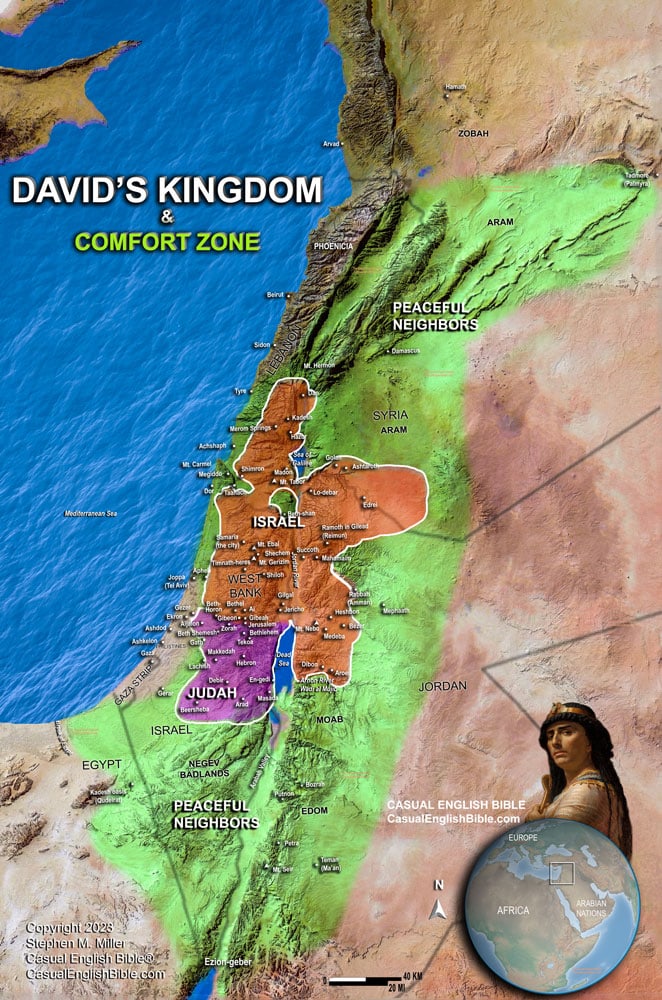 As this chapter opens, we’re reminded that throughout the years God had richly blessed David, giving him victory over all his enemies, empowering him to conquer Jerusalem and to establish it as the capital of Israel, and giving him the wealth to build a palace fit for a king and his household. For some time David had been settled in his palace and the LORD had given peace to the nation, rest from all the enemies that surrounded Israel. But David was not satisfied, for he had a burning desire to build a temple for the LORD. The LORD had provided a wonderful rest for him, but he had a fervent zeal to provide a place where the presence of the LORD could rest (He. 4:1–11). Because the LORD had blessed him so richly, David wanted to show his gratitude by building a
  temple for the Ark of God. Remember that the Ark was a symbol of God’s very own presence, His presence that dwelt between the two cherubim or angelic beings. David was obviously disturbed, troubled over the fact that he was living in a palace while the Ark, the very symbol of God’s holy presence, was being housed in a tent.
David loves the Lord dearly. He begins to contemplate all that his God has done for him. He looks at his home and where the Ark is housed and feels God deserves better. God deserves the best from us. David wants to build a house for the Lord. His attitude of gratitude should be ours too. Let’s not give the Lord the left overs of our lives.
Above all things, we must honor and glorify the LORD just as King David wished to do. It is the LORD who has created and who sustains the universe, who holds the earth and heavenly bodies together and keeps them functioning in an orderly fashion—all by the power of His Word. But there are other reasons for honoring and praising the LORD.
⇒ It is the LORD who saves us from sin, death, and hell.
⇒ It is the LORD who strengthens us either to conquer the trials and temptations of life or to walk through them victoriously and triumphantly. It is the LORD who helps us when we face some need or difficult circumstance.
⇒ It is the LORD who enables us to face hardship and misfortune such as severe disease or disabling accident.
⇒ It is the LORD who loves us when we are unlovely and who forgives us when we confess our sins and wickedness.
⇒ It is the LORD who stands by our side in moments of loneliness and in facing death.
For all these reasons and so many more, the LORD is to be honored and praised.
At some point in time, David shared his burning desire to build the temple with Nathan the prophet (v. 3). And Nathan immediately encouraged David because the LORD had always been with David in whatever he did. But note, Nathan was only encouraging David as a personal advisor, expressing his own feelings, not sharing specific instructions that had been given by the LORD.
This is the first mention of Nathan the prophet in Scripture. As a prophet in the royal court of the king, his task was to give spiritual and religious advice to David. Nathan was the prophet who corrected David when the king committed adultery with Bathsheba and had her husband killed (12:1–15). At the end of David’s life, he also helped Solomon secure the throne in obedience to David’s wishes (1 K. 1:10–45). Along with David and Gad, he helped arrange the music for the worship services in the temple (2 Chr. 29:25); he also recorded a history on the reign of David (1 Chr. 29:29) and on the reign of Solomon (2 Chr. 9:29).
The very night that David shared with Nathan his dream of building a temple for the LORD, the LORD gave Nathan a message for David, one of the most important messages ever given by God to a man. This particular message is also the longest recorded speech by God since the days of Moses, which to some degree indicates its importance.
In this message from Nathan, God is saying that he doesn’t want David to build a temple for him. God told David that his job was to unify and lead Israel and to destroy its enemies. This huge task would require David to shed a great deal of blood. In 1 Chronicles 28:3, we learn that God did not want his Temple built by a warrior. Therefore, David made the plans and collected the materials so that his son Solomon could begin work on the Temple as soon as he became king (1 Kings 5–7). David accepted his part in God’s plan and did not try to go beyond it. Sometimes God says no to our plans. When he does, we should utilize the other opportunities he gives us.
David’s request was good, but God said no. This does not mean that God rejected David. In fact, God was planning to do something even greater in David’s life than allowing him the prestige of building the Temple. Although God turned down David’s request, he promised to continue the house (or dynasty) of David forever. David’s earthly dynasty ended four centuries later, but Jesus Christ, a direct descendant of David, was the ultimate fulfillment of this promise (Acts 2:22–36). Christ will reign for eternity—now in his spiritual kingdom and in heaven, and later, on earth, in the new Jerusalem (Luke 1:30–33; Revelation 21). Have you prayed with good intentions, only to have God say no? This is God’s way of directing you to a greater purpose in your life. Accepting God’s no requires as great a faith as carrying out his yes.
David wanted to build God a house (the temple), but God promised to build David a house—a dynasty forever! The word “house” is used fifteen times in this chapter and refers to David’s palace (vv. 1–2), the temple (vv. 5–7, 13), and David’s dynasty, culminating in Messiah, Jesus Christ (vv. 11, 13, 16, 18–29).
God’s first announcement of the coming of the Savior was given in Genesis 3:15, informing us that the Savior would be a human being and not an angel. Genesis 12:3 tells us that He would be a Jew who would bless the whole world, and Genesis 49:10 that He would come through the tribe of Judah. In this covenant, God announced to David that Messiah would come through his family, and Micah 5:2 prophesied that He would be born in Bethlehem, the City of David (see Matt. 2:6). No wonder the king was so elated when he learned that Messiah would be known as “the Son of David” (Matt. 1:1)!
In this section, the Lord speaks about Solomon as well as about the Savior, who is “greater than Solomon” (Matt. 12:42). Solomon would build the temple David longed to build, but his reign would end; however, the reign of Messiah would go on forever. David would have a house forever (vv. 25, 29), a kingdom forever (v. 16), and a throne forever (vv. 13, 16), and would glorify God’s name forever (v. 26).
All of this is fulfilled in Jesus Christ, the Son of David (Ps. 89:34–37; Luke 1:32–33, 69; Acts 2:29–36; 13:22–23; 2 Tim. 2:8) and will be manifested when He returns, establishes the promised kingdom, and sits on David’s throne. The spiritual blessings God offered to David are today offered in Jesus Christ to all who will trust Him!
What a legacy we have in Jesus Christ! Forgiveness of sins, peace, salvation, purpose, direction, God’s indwelling presence, and a home in heaven for all eternity!
Message Audio/Video and Outline: https://upwards.church/watch-now/leander-campus-videos
Watch Messages: YouTube-Upwards Church
Sources:
1 J. Vernon McGee. Thru the Bible, Vol. 2. (Nashville, TN: Thomas Nelson Publishers, 1981), p. 202.
Leadership Ministries Worldwide, 2 Samuel, The Preacher’s Outline & Sermon Bible (Chattanooga, TN: Leadership Ministries Worldwide, 1996), 54–55.
Life Application Bible Notes (Tyndale, 2007), 474.
Rod Mattoon, Treasures from 2 Samuel, Treasures from Scripture Series (Springfield, IL: Rod Mattoon, 2002), 87.
Warren W. Wiersbe, Be Restored, “Be” Commentary Series (Colorado Springs, CO: Victor, 2002), 50–51.


 Upwards Church