Did Jesus Appear to Ezekiel?  

26 And above the firmament over their heads was the likeness of a throne, in appearance like a sapphire stone; on the likeness of the throne was a likeness with the appearance of a man high above it27 Also from the appearance of His waist and upward I saw, as it were, the color of amber with the appearance of fire all around within it; and from the appearance of His waist and downward I saw, as it were, the appearance of fire with brightness all around. 28 Like the appearance of a rainbow in a cloud on a rainy day, so was the appearance of the brightness all around it. This was the appearance of the likeness of the glory of the Lord. So when I saw it, I fell on my face, and I heard a voice of One speaking.  Ezekiel 1:26-28

Did Ezekiel see Jesus?  I believe so.  So do some commentators.

“The ‘man’ he saw upon the throne was probably a pre-incarnate appearance of our Lord Jesus Christ” – Warren Wiersby

This verse (“the appearance of a man”) speak of the incarnation of Christ, the fact that God became a man. – J. Vernon McGee

“This figure “whose appearance resembled a man” revealed God’s holiness and prepared Ezekiel for what God was about to tell him. The figure represented Christ revealed in human form and prepared us for his message of salvation. Christ came into history in a real, human body.  – Life Application Study Bible

When Jesus appears in the Old Testament it’s called a Christophany. A Christophany is a visible manifestation or appearance of Christ before His human incarnation.

But since the Bible consistently says that no one has ever seen God the Father and lived (Exodus 33:20John 5:376:461 Timothy 6:15-161 John 4:12), many theologians believe that all visible theophanies in the Old Testament were pre-incarnate appearances of Christ.

Jesus is the image of the invisible God (Colossians 1:15). He is at the Father’s side, and He is the only one who reveals Him (John 1:18). And here are a few more of His pre-incarnate appearances.

  1. Appearance to Abraham (Genesis 18)

Three men visited Abraham, and one of them was God Himself. We know he was God because the text says, “and the LORD appeared to him by the oaks of Mamre.” The other two men were angels.

  1. Appearance to Jacob (Genesis 32:22-32)

Jacob once wrestled with a man all night, and that man was God. He said to Jacob, “your name shall no longer be called Jacob, but Israel for you have striven with God, and with men, and have prevailed.” Afterward, Jacob named the place Peniel and said, “for I have seen God face to face, and yet my life has been delivered.

  1. Appearance to Joshua (Joshua 5:13-15)

A man with a sword in hand appeared to Joshua before the fall of Jericho. He identified himself as the commander of the army of the Lord. Joshua immediately fell to his face and worshipped the man. And the commander said, “take off your sandals from your feet for the place where you are standing is holy.” This man was another Christophany.

Theologians also believe every visit of “the angel of the Lord,” or “the angel of God,” was a Christophany.

In Exodus 23:20-21, God told Moses He would send an angel before him to guide him, and that God’s name was in the angel. As the name of God represents His nature, will, and character. A random angel can’t bear God’s name; only God himself can. And this angel of the Lord must have been Jesus because He said in John 17:7, “I have manifested your name to the people whom you gave me out of the world.”

Here are a few visits from Jesus as the angel of the Lord.

  1. Visit to Hagar (Genesis 16:7-14)

The angel of the Lord appeared to Hagar in the wilderness and said to her, “I will surely multiply your offspring so that they cannot be numbered for multitude.” The angel of the Lord spoke with the authority of God and said he would multiply her offspring. Hagar called the angel, “You are a God of seeing,” and said, “truly here I have seen him who looks after me.”

  1. Visit to Abraham and Isaac (Genesis 22:11-18)

Abraham took Isaac to Mount Moriah to sacrifice him as God commanded. But when he was about to kill Isaac, the angel of the Lord appeared and told him to stop. He said, “now I know that you fear God seeing you have not withheld your son, your only son from me.” The angel spoke as if he was God.

  1. Visit to Jacob (Genesis 31:11-13)

The Angel of God appeared to Jacob in a dream and said, “I am the God of Bethel, where you anointed a pillar and made a vow to me.” The God of Bethel is Yahweh (Genesis 28:13-22).

  1. Visit to Moses (Exodus 3:2-6)

The angel of the Lord appeared to Moses “in a flame of fire out of the midst of a bush,” and then, “God called to him out of the bush.”  He said, “I am the God of your Father, the God of Abraham, and the God of Isaac.”

It’s quite clear from these few examples that the angel of the Lord is a Christophany. Furthermore, His visits stop after the birth of Christ.

This doesn’t mean that Jesus was an angel before the incarnation. Jesus was, is, and always be God (John 8:58). The Hebrew word for angel is malak, which means a messenger. It appears 213 times in the Old Testament. It can refer to actual angels such as in Genesis 19:1, and men such as in Genesis 32:3.

Also, Christophanies do not contradict the incarnation of Christ nor the virgin birth. Jesus taking on the form of a man is not the same as becoming a man.

There are many other examples of Christophanies in the Old Testament. But some are less certain than others.

For example, many people believe the fourth man in the fire in Daniel 3:25 was a Christophany. But all we know about him is that he had the appearance of a “son of gods.” Without additional information, we can’t say for sure if he was a Christophany or an actual angel.

Melchizedek is another questionable Christophany. He appears in Genesis 14:18-20 and his name means king of righteousness, and a priest of God most High. Hebrews 7:3 says that “he is without father or mother or genealogy, having neither beginning of days nor end of life, but resembling the Son of God, he continues a priest forever.” As a result, many people believe Melchizedek was a Christophany. But he could have been a type of Christ.

Always let the Bible guide you to recognize a Christophany accurately. For instance, if the text says, “the Lord appeared,” or the “Lord came down,” it most likely a Christophany. Also, if a man speaks with the authority of God, identifies himself with God, or does things only God can do, He might be a pre-incarnate appearance of Christ.

Darrell

www.Upwards.Church

Watch Messages: YouTube-Upwards Church

Facebook: Upwards Church

Sources:
  1. Vernon McGee, Thru The Bible with J. Vernon McGee, (Nashville, TN: Thomas Nelson, 1983), WORDsearch CROSS e-book, Under: “Chapter 1” and “CHAPTERS 2 AND 3”.
Warren W. Wiersbe, The Bible Exposition Commentary – The Prophets, (Colorado Springs, CO: Victor, 2002), WORDsearch CROSS e-book, 166-167.
Life Application Study Bible, (Wheaton, IL: Tyndale, 1988), WORDsearch CROSS e-book, Under: “Chapter 2”.
https://www.wordsoffaithhopelove.com/jesus-in-the-old-testament-christophanies/
Posted in A New Heart - Ezekiel | Tagged , , , , , | 2 Comments

Introduction to Ezekiel

“Don’t worry,” Danny chided his friends. “I can get away with anything. I’m my father’s favorite.” Danny’s dad had gone out of town, leaving his new sports car in the garage. Danny was allowed to drive the family van, but not the sports car. “Come on, you guys,” he continued, “Dad will never even know.”  The drive to the movie was great. Girls honked and guys stared. “See,” Danny said. “No problem. It sure beats the old van!” His friends had to agree.  After the movie, they headed to the car. It was late, and the parking lot was no longer full. “Danny! Danny!” one of his friends suddenly yelled when he reached the car. “Oh no!” There was a broken window and wires dangled where the stereo used to be.  “What are we going to do?” another friend asked. “Your father will kill us!”  Danny smiled weakly. “Hey, I’m my dad’s favorite. No sweat!”  Israel reacted like Danny. They thought they could get away with anything. The book of Ezekiel was written to Jews who were captives in Babylon. They were “God’s favorites.” Surely Jerusalem (their capital) would not be harmed, and they would return home very soon. Ezekiel corrected their thinking: they were captives in Babylon because they had disobeyed God. Though they were his chosen people, God could not overlook sin.  Ezekiel reminds us that no one can sin without punishment. Just as God loves us, he also loves justice.  As you read Ezekiel, stand in awe of the God who judges all sin. Then thank Him for providing a way (through Jesus) to escape the judgment that we all deserve for our sins. Thank Him for a giving us a new heart to desire living for Him.

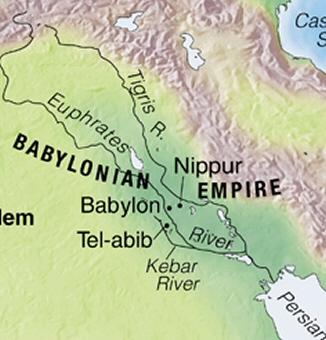
Ezekiel’s life spanned a period of significant political upheaval in the world. He lived through the decline of Assyrian domination only to see the rise of the all-powerful Babylonian Empire.  When God called him to be a prophet, Ezekiel was 30 years old and had been an exile in Babylon for five long, difficult years. The new prophet was already a leader among the exiles, and their hardships and sufferings weighed heavily upon him. From a human perspective, they were in a hopeless situation, and it looked as though their sad circumstances were not going to change. Ezekiel saw nothing on the horizon that would offer the exiles any hope that they would be set free from their captivity. Yet as a prophet, he had to make sure that they remained strong under the weight of their horrible suffering.

Unknown to Ezekiel was the fact that his entire life would be spent as an exile in Babylon. Thus his prophetic ministry was to be under the most difficult, trying circumstances imaginable, for he would never be freed from the hardships and pain of exile. Furthermore Ezekiel would suffer the additional pain of being continually rejected by the exiles who rebelled against the Lord and His Holy Word.

Purpose: To announce God’s judgment on Israel and to foretell the eventual salvation of God’s people

Author: Ezekiel

Original Audience: The Jews in captivity in Babylonia

Date Written: Approximately 571 B.C.

Setting:  Ezekiel was a younger contemporary of Jeremiah. While Jeremiah ministered to the people still in Judah, Ezekiel prophesied to those already exiled in Babylonia after the defeat of Jehoiachin. He was taken there in 597 B.C.

Key Verse:  And I will give you a new heart, and I will put a new spirit in you. I will take out your stony, stubborn heart and give you a tender, responsive heart” (Ezekiel 36:26).

Major Themes:

  1. God’s Holiness

Ezekiel saw a vision that revealed God’s absolute moral perfection. God was spiritually and morally superior to members of Israel’s corrupt and compromising society. Ezekiel wrote to let the people know that God in his holiness was also present in Babylon, not just in Jerusalem. Because God is morally perfect, he can help us live above our tendency to compromise with this world. When we focus on his greatness, he gives us the power to overcome sin and to reflect his holiness.

2. Sin

God’s people had sinned, and God’s punishment came. The fall of Jerusalem and the Babylonian exile were used by God to correct the rebels and draw them back from their sinful way of life. Ezekiel warned them that not only was the nation responsible for sin but each individual was also accountable to God. We cannot excuse ourselves from our responsibilities before God. We are accountable to God for our choices. Rather than neglect him, we must recognize sin for what it is—rebellion against God—and choose to follow him instead.

3.  Restoration

Ezekiel consoles the people by telling them that the day will come when God will restore those who turn from sin. God will be their King and shepherd. He will give his people a new heart to worship him, and he will establish a new government and a new Temple. The certainty of future restoration encourages believers in times of trial. But we must be faithful to God because we love him, not merely for what he can do for us.  Is our faith in him or merely in our future benefits?

www.Upwards.Church

Watch Messages: YouTube-Upwards Church

Facebook: Upwards Church


Sources:
The Preacher’s Outline & Sermon Bible – Ezekiel, (Chattanooga: Leadership Ministries Worldwide, 2007), WORDsearch CROSS e-book, Under: “I. The Call and Commission of Ezekiel: The Vision Necessary for Serving God, 1:1—3:27”.
Life Application Study Bible, (Wheaton, IL: Tyndale, 1988), WORDsearch CROSS e-book, 1307.
Student’s Life Application Bible: New Living Translation, (Wheaton, IL: Tyndale House, 1997), WORDsearch CROSS e-book, Under: “Ezekiel”.
Posted in A New Heart - Ezekiel | Tagged , , , , , , , | Leave a comment

A New Heart – Ezekiel

God desires to change our hearts. “I will give you a new heart and put a new spirit in you.” Ezekiel 36:26 says.

For unbelievers this new heart is salvation; and for the believer, an encouraged heart to continue even when serving God is not easy. For those of us who have grown complacent or cold in our walk with God, “A New Heart” outlines how God desires to bring us closer to him.

 Dates         Titles                  Scriptures                           

Feb. 7 – New Call, New Heart   (Ezekiel 1-2)

Feb. 14 – Stone Heart to New Heart (Ezekiel 36)

Feb. 21 – Dead Bones, New Life (Ezekiel 37)

I hope you can join us this Sunday!

Darrell

www.Upwards.Church

Watch Messages: YouTube-Upwards Church

Facebook: Upwards Church

Posted in A New Heart - Ezekiel | Tagged , , , , | Leave a comment

What is the Anti-Christ?

The meaning of the term antichrist is simply “against Christ.” As the apostle John records in First and Second John, an antichrist denies the Father and the Son (1 John 2:22), does not acknowledge Jesus (1 John 4:3), and denies that Jesus came in the flesh (2 John 1:7). There have been many “antichrists,” as 1 John 2:18 states. But there is also coming the Antichrist.

Most Bible prophecy/eschatology experts believe the Antichrist will be the ultimate embodiment of what it means to be against Christ. In the end times/last hour, a man will arise to oppose Christ and His followers more than anyone else in history. Likely claiming to be the true Messiah, the Antichrist will seek world domination and will attempt to destroy all followers of Jesus Christ and the nation of Israel.

Other biblical references to the Antichrist include the following:

The imposing, boastful king of Daniel 7 who oppresses the Jews and tries to “change the set times and the laws” (verse 25).

The leader who establishes a 7-year covenant with Israel and then breaks it in Daniel 9.

The king who sets up the abomination of desolation in Mark 13:14 (cf. Daniel 9:27).

The man of lawlessness in 2 Thessalonians 2:1–12.

The rider on a white horse (representing his claim to be a man of peace) in Revelation 6:2.

The first beast—the one from the sea—in Revelation 13. This beast receives power from the dragon (Satan) and speaks “proud words and blasphemies” (verse 5) and wages war against the saints (verse 7).

Thankfully, the Antichrist/beast, along with his false prophet, will be thrown into the lake of fire, where they will spend all eternity in torment (Revelation 19:2020:10).

What is the Antichrist? In summary, the Antichrist is the end-times false messiah who seeks, and likely achieves, world domination so that he can destroy Israel and all followers of Jesus Christ.

“Who is the antichrist?”

We don’t know specifically and shouldn’t name names.  There is much speculation about the identity of the Antichrist. Some of the more popular targets today are Vladimir Putin, Prince William, and Pope Francis I. In the United States, former Presidents Barack Obama, Donald Trump, and his son-in-law Jared Kushner (because of his role in the Middle East peace deals) are the most frequent targets. So, who is the Antichrist, and how will we recognize him?

The Bible really does not say anything specific about where the Antichrist will come from. Many Bible scholars speculate that he will come from a confederacy of ten nations and/or a reborn Roman empire (Daniel 7:24-25Revelation 17:7). Others see him as having to be a Jew in order to claim to be the Messiah. It is all just speculation since the Bible does not specifically say where the Antichrist will come from or what ethnicity he will be. One day, the Antichrist will be revealed. Second Thessalonians 2:3-4 tells us how we will recognize the Antichrist: “don’t let anyone deceive you in any way, for that day will not come until the rebellion occurs and the man of lawlessness is revealed, the man doomed to destruction. He will oppose and will exalt himself over everything that is called God or is worshiped, so that he sets himself up in God’s temple, proclaiming himself to be God.”

It is likely that most people who are alive when the Antichrist is revealed will be very surprised at his identity. The Antichrist may or may not be alive today. Martin Luther was convinced that the pope in his time was the Antichrist. During the 1940s, many believed Adolph Hitler was the Antichrist. Others who have lived in the past few hundred years have been equally sure as to the identity of the Antichrist. So far, they have all been incorrect. We should put the speculations behind us and focus on what the Bible actually says about the Antichrist. Revelation 13:5-8 declares, “The beast was given a mouth to utter proud words and blasphemies and to exercise his authority for forty-two months. He opened his mouth to blaspheme God, and to slander his name and his dwelling place and those who live in heaven. He was given power to make war against the saints and to conquer them. And he was given authority over every tribe, people, language and nation. All inhabitants of the earth will worship the beast—all whose names have not been written in the book of life belonging to the Lamb that was slain from the creation of the world.”

www.Upwards.Church

Watch Messages: YouTube-Upwards Church

Facebook: Upwards Church

Sources:

https://www.gotquestions.org/what-is-the-antichrist.html

https://www.gotquestions.org/antichrist.html


Posted in Tomorrowland- 1 & 2 Thessalonians | Tagged , , , , , | Leave a comment