
Am I Challenged Like Joseph?

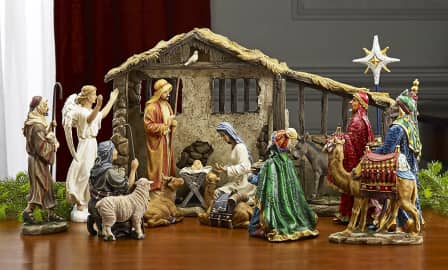
Do you put out a Nativity Set with your Christmas decorations?  With Mary, Joseph, baby Jesus, some sheep, camels, the Wiseman and some shepherds?  We have a few, but my mom has several large sets.  To me, they always look so peaceful and serene; so cute and quaint, often Mary and Joseph will have halos.

The truth is that setting was anything but calm and peaceful.  Mary and Joseph were probably tired and dirty from walking 70 miles.  This thanksgiving we went to Edna and then to Childress, a thousand miles in four days, we didn’t have halos it was more like horns!  Mary was exhausted from giving birth, Joseph was relieved it was over; he hadn’t had “Lamaze” class.

In Matthew Chapter 1 we will see the human struggles, the stresses, and the challenges of the Joseph in the Christmas story.

Christmas can be challenging time of the year,

Like Joseph I May Be Challenged By…


  • Broken Relationships

 We live in a country today of broken relationships.  Divorce is rampant, 50% of all marriages in the US end in divorce.  Most people I know have been affected by divorce.  Divorce occurs many times by the choice of one individual, sometimes both, but often one individual will make the choice and the rest of the family is left in the aftermath.  Broken relationships are painful and challenging.  This is also what Joseph had to face.

 18 This is how Jesus the Messiah was born. His mother, Mary, was engaged to be married to Joseph. But before the marriage took place, while she was still a virgin, she became pregnant through the power of the Holy Spirit. Matthew 1:18

During their engagement they were no doubt a normal couple anticipating their future together. They were making plans—ready to face the world together.  They also talked about the wedding, what they would wear, who would be in the wedding party, and which guests would be invited—all the things a couple talk about even today as they plan for their marriage.

But, one day during this betrothal period, Mary announced she was going to take a trip south to the hill country outside Jerusalem, to visit her elderly cousin, Elizabeth. Her visit stretched into a three-month stay. Joseph must have missed her terribly. When she returned home at last, he was no doubt very glad to see her. Do you remember what it is like to be separated from your true love?  Now that separation was over. They were together again. But, then came a sudden shock—a devastating discovery. As the one translation reads Mary, “was FOUND to be with child.” This wasn’t Joseph’s baby and he knew it so instantly THEIR dreams turned into HIS nightmares!

Think of how he must have felt. He had been working hard, preparing for their life together. Now he was faced with what from his perspective could only looked like unfaithfulness on her part.  Did Mary tell him about a visiting angel, and how this would be a special child?  But not only was her story unbelievable…for a pious Jew like Joseph it bordered on blasphemy. This news also meant Joseph’s reputation would be destroyed…so I’m sure that he was more than hurt. He was ANGRY. What kind of fool did Mary take Him for? To claim that she was pregnant but still a virgin?!

But Joseph couldn’t believe her. How COULD he accept such a story? Would you if you were in his circumstance? No, I think not. He came to the same conclusion you and I would have. Mary had committed adultery. Well, he no doubt endured restless days and sleepless nights trying to decide what to do.

Like Joseph I may be challenged by…

  • Tough Decisions

…. he decided to break the engagement quietly. Matthew 1:19c

If they had been living in Moses day that decision would have been taken from him, Mary would have been immediately stoned to death. But the laxness of the Jewish theocracy in Joseph’s day and the infiltration of Roman law gave him two other options.

  1. He could make her a public example…charge her with adultery in a public court.
    She would be shamed, brought to trial, convicted in front of everyone, ruined forever in terms of reputation or….
  2. …he could quietly, before two or three witnesses, write out a bill of divorce and end their relationship.
    There would be no fanfare. It would be less public and few would need know. Mary could simply go away somewhere and secretly bear and raise the child.

The Scripture tells us that after his wrestling emotionally with what he should do.  He decides to take option 2 and end their engagement discreetly. As verse 19 says, “…. he decided to break the engagement quietly.” And he would have followed through with that plan had it not been for a message delivered by an angel who appeared to Joseph in a dream. In this miraculous manner Joseph learned that Mary had been telling the truth. And we know the wonderful events that happened from then on as the Christmas event unfolded.

Back up and be sure to note that in Joseph’s part of this event we see a man who endured a great heartache but came out of it on top. This should make us pay great attention to his role in the Christmas story because you and I deal with heart-breaks or challenges all the time. We face dark and difficult situations that are unfair to us…things we don’t understand, broken relationships tough decisions.

Verse 20 says that “As he considered this.”  We usually read through things pretty quickly and think that he made up his mind in a quick way, “hum chicken or fish” but the word “consider” means he took some time, it means to “revolve in mind” or “weigh in the mind” (from Thayer’s Greek Lexicon, Electronic Database. Copyright (c) 2000 by Biblesoft)

He probably went off alone and thought about what had happened and his thoughts gave way to prayers as he poured his heart out to God. Picture him as he climbed the hills around Nazareth a solitary figure crying to the God he had faithfully served all his life, seeking wisdom to deal with his heartbreaking problem.

Have you ever done that in a challenging time? Just gone somewhere and got honest with God—told Him of your pain, your anguish, and asked for His help?  I know that I have and during those times I have felt God’s comforting presence.  When I am absolutely honest with God, honest with myself I leave that time knowing God cares and I get some direction for tough decisions.  This is because PRAYER CHANGES THINGS!

In life when it looks like everything is against us—when it looks like we can’t possibly win—when it looks like it’s the end and our dreams are crashing down around us, prayer actually changes the whole situation because prayer unleashes God’s power. This power may come in the form of wisdom, an idea we desperately need and can’t come up with ourselves. It may come in the form of courage greater than we can muster. It may come in the form of confidence or perseverance, uncommon staying power, or a changed attitude or maybe even in the form of an outright miracle…(like what happened to Joseph) but prayer does change things! Someone once wisely said, “When we work, WE work, but when we PRAY, GOD works.”  And you know, one of the most important “things” prayer changes is US. You see, as we pray we are drawn into the love of God and we begin to see people from His perspective and love them as He does. Prayer provides a perspective on life that we cannot find in any other way.

So, when we face a heartbreak, tough decision, a challenging situation as Joseph did, the first thing we must do is pray Philippians 4: 6-7 says, “Do not be anxious about anything, but in everything, by prayer and petition, with thanksgiving, present your requests to God. And the peace of God, which transcends all understanding, will guard your hearts and your minds in Christ Jesus.”  NIV

Perhaps Joseph thought he had only two options: divorce Mary quietly, or have her stoned. But God had a third option, marry her. In view of the circumstances, this had not occurred to Joseph. But God often shows us that there are more options available than we think. Although Joseph seemed to be doing the right thing by breaking the engagement, only God’s guidance helped him make the best decision. When our decisions affect the lives of others, we must always seek God’s wisdom.

In the next post we will see two more challenges that Joseph had to face and that we will more than likely face this year too.

Darrell
http://www.Upwards.Church


Posted in A Few Men & a Baby - (Isaiah | Tagged , , , , , , | Leave a comment

Why is the Virgin Birth Important?

Why is the virgin birth of Jesus important?  This is controversial but important teaching of scripture. In our upcoming series, we dive into Isaiah’s prophecy that “The virgin will conceive and give birth to a son, and[c] will call him Immanuel.[d] ”  and the gospel of Matthew’s declaration that this was fulfilled in Jesus,  but some people do not agree.

Biblical history records some amazing and spectacular births. The birth of Isaac to a previously barren woman nearly one hundred years old, who was laughing at the thought of having a child, was a miraculous event. The womb of Manoah’s barren wife was opened and she gave birth to Samson, who was to turn a lion inside out, kill a thousand men, and pull down a pagan temple. The birth of Samuel, the prophet and anointer of kings, to the barren Hannah, whose womb the Lord had shut, revealed divine providential power. Elizabeth was barren, but through the power of God she gave birth to John the Baptist, of whom Jesus said there had yet been no one greater “among those born of women” (Matt. 11:11). But the virgin birth of the Lord Jesus surpasses all of those.

Fantasy and mythology have counterfeited the virgin birth of Jesus Christ with a proliferation of false accounts intended to minimize His utterly unique birth.

For example, the Romans believed that Zeus impregnated Semele without contact and that she conceived Dionysus, lord of the earth. The Babylonians believed that Tammuz was conceived in the priestess Semiramis by a sunbeam. In an ancient Sumerian/Accadian story inscribed on a wall, Tukulti II (890-884 b.c.) told how the gods created him in the womb of his mother. It was even claimed that the goddess of procreation superintended the conception of King Sennacherib (705-681 b.c.). At the conception of Buddha, his mother supposedly saw a great white elephant enter her belly. Hinduism has claimed that the divine Vishnu, after reincarnations as a fish, tortoise, boar, and lion, descended into the womb of Devaki and was born as her son Krishna. There is even a legend that Alexander the Great was virgin born by the power of Zeus through a snake that impregnated his mother, Olympias. Satan has set up many more such myths to counterfeit the birth of Christ in order to make it seem either common or legendary.

Modern science even speaks of parthenogenesis, which comes from a Greek term meaning “virgin born” In the world of honey bees, unfertilized eggs develop into drones, or males. Artificial parthenogenesis has been successful with unfertilized eggs of silkworms. The eggs of sea urchins and marine worms have begun to develop when placed in various salt solutions. Nothing like that has ever come close to accounting for human beings; all such parthenogenesis is impossible within the human race. Science, like mythology, has no explanation for the virgin birth of Christ. He was neither merely the son of a previously barren woman nor a freak of nature. By the clear testimony of Scripture, He was conceived by God and born of a virgin.

Nevertheless, religious polls taken over the past several generations reveal the impact of liberal theology in a marked and continuing decline in the percentage of professed Christians who believe in the virgin birth, and therefore in the deity, of Jesus Christ. One wonders why they want to be identified with a person who, if their judgment of Him were correct, had to have been either deceived or deceptive—since all four gospels explicitly teach that Jesus considered Himself to be more than a man. It is clear from the rest of the New Testament as well as from historical records that Jesus, His disciples, and all of the early church held Him to be none other than the divine Son of God.

A popular religious personality said in an interview a few years ago that he could not in print or in public deny the virgin birth of Christ, but that neither could he preach it or teach it. “When I have something I can’t comprehend,” he explained, “I just don’t deal with it.” But to ignore the virgin birth is to ignore Christ’s deity. And to ignore His deity is tantamount to denying it. Real incarnation demands a real virgin birth.

Matthew’s purpose in writing his gospel account was partly apologetic—not in the sense of making an apology for the gospel but in the more traditional sense of explaining and defending it against its many attacks and misrepresentations. Jesus’ humanity was often maligned and His deity often denied. Possibly during His earthly ministry, and certainly after His death and resurrection, it is likely Jesus was slandered by the accusation that He was the illegitimate son of Mary by some unknown man, perhaps a Roman soldier garrisoned in Galilee. It was Jesus’ claim of deity; however, that most incensed the Jewish leaders and brought them to demand His death. “For this cause therefore the Jews were seeking all the more to kill Him, because He not only was breaking the Sabbath, but also was calling God His own Father, making Himself equal with God” (John 5:18).

It is surely no accident, therefore, that the beginning of Matthew’s gospel, at the outset of the New Testament, is devoted to establishing both the regal humanity and the deity of Jesus Christ. Apart from Jesus’ being both human and divine, there is no gospel. The incarnation of Jesus Christ is the central fact of Christianity. The whole superstructure of Christian theology is built on it. The essence and the power of the gospel is that God became man and that, by being both wholly God and wholly man, He was able to reconcile men to God. Jesus’ virgin birth, His substitutionary atoning death, resurrection, ascension, and return are all integral aspects of His deity. They stand or fall together. If any of those teachings—all clearly taught in the New Testament—is rejected, the entire gospel is rejected. None makes sense, or could have any significance or power, apart from the others. If those things were not true, even Jesus’ moral teachings would be suspect, because if He misrepresented who He was by preposterously claiming equality with God, how could anything else He said be trusted? Or if the gospel writers misrepresented who He was, why should we trust their word about anything else He said or did?

Jesus once asked the Pharisees a question about Himself that men have been asking in every generation since then: “What do you think about the Christ, whose son is He?” (Matt. 22:42). That is the question Matthew answers in the first chapter of this gospel. Jesus is the human Son of man and the divine Son of God.

Many people still today are willing to recognize Him as a great teacher, a model of high moral character, and even a prophet from God. Were He no more than those things, however, He could not have conquered sin or death or Satan. In short, He could not have saved the world. He would also have been guilty of grossly misrepresenting Himself.

It is interesting that certain condescending interpreters of the New Testament acknowledge that Matthew and other writers sincerely believed and taught that Jesus was conceived by the Holy Spirit, that He had no human father. But, they claim, those men were uneducated and captive to the usual superstitions and myths of their times. They simply picked up on the many virgin birth legends that were common in the ancient world and adapted them to the gospel story.

Matthew’s account of Jesus’ divine conception is straightforward and simple. It is given as history, but as history that could only be known by God’s revelation and accomplished by divine miracle. It is essential to the incarnation.

Why is the virgin birth important to our  Christian faith?

Jesus Christ, God’s Son, had to be free from the sinful nature passed on to all other human beings by Adam. Because Jesus was born of a woman, he was a human being; but as the Son of God, Jesus was born without any trace of human sin. Jesus is both fully human and fully divine. The infinite, unlimited God took on the limitations of humanity so he could live and die for the salvation of all who believe in him.

Because Jesus lived as a man, we know that he fully understands our experiences and struggles (Hebrews 4:15-16). Because he is God, he has the power and authority to deliver us from sin (Colossians 2:13-15). We can tell Jesus all our thoughts, feelings, and needs. He has been where we are now, and he has the ability to help.

I hope to see you Sunday as we learn more!

Darrell


Adapted from:
MacArthur New Testament Commentary, The – MacArthur New Testament Commentary – Matthew 1-7.
Life Application Bible Commentary, New Testament.


Posted in A Few Men & a Baby (Isaiah & Matthew) | Tagged , , , | 1 Comment

Greater Danger – Hebrews 3

Recently I read an article called, “We Can’t Help Walking in Circles.” about a study done in by a German scientist named Jan Souman. Souman in this study and others took a group of subjects out to empty parking lots and open fields, blindfolded them, and instructed them to walk in a straight line.  Some of them managed to keep to a straight course for ten or twenty paces; a few lasted for 50 or a hundred.  But in the end, all of them wound up circling back toward their points of origin. Not many of them. Not most of them. Every last one. Dr. Souman reported, “And they have no idea. They were thinking that they were walking in a straight line all the time.”  Dr. Souman’s research team explored every imaginable explanation. Some people turned to the right while others turned to the left, but the researchers could find no discernable pattern.  As a group, neither left-handed nor right-handed subjects demonstrated any predisposition for turning one way more than the other—nor did subjects tested for either right-or left-brain dominance. The team even tried gluing a rubber soul to the bottom of one shoe to make one leg longer than the other. “It didn’t make any difference at all,” explained Dr. Souman. “So again, that is pretty random what people do.”

In fact, it isn’t even limited to walking.  Ask people to swim blindfolded or drive a car blindfolded and, no matter how determined they may be to go straight—they quickly begin to describe peculiar looping circles in one direction or the other. This study shows we are prone to stray. And it’s true not just physically, but spiritually and morally.  “If we can’t see landmarks” like the son, or the Son, “we really do end up walking circles.” We are prone to wander away from the things of God.  How do we keep from wandering?

The author of Hebrews cites three ways to stop it or three ways to lock in.

  1. Focus on JESUS.

Look at verse 1. “…fix your thoughts on Jesus, the apostle and high priest who we confess.”  Hebrews 3:1  

To keep from wandering we must focus on Jesus. We must always remember who He is, what He has done and what He promises to do.

I can’t win a foot race by looking at my feet.  I have to keep my eyes on the goal. And, if we are going to finish the Christian race we need to keep our eyes on Jesus. …the Author and Perfecter of our faith (Hebrews 12:1-2) I love how the old chorus puts it: “Turn your eyes upon Jesus—look full in His wonderful face—-and the things of earth will grow strangely dim in the light of His glory and grace.”

The next thing the writer says we should do is

  1. Listen to the Holy Spirit

7  So, as the Holy Spirit says: “Today, if you hear his voice, 8  do not harden your hearts Hebrews 3:7-8 (NIV)

Please notice the urgency of this warning. Verse 7 says “today” which means now.

D. L. Moody referred to something he did in October of 1871 as the greatest blunder of his life. He was preaching in Farwell Hall in Chicago. His text that night was Pilate’s question at Jesus’ trial. “What then shall I do with Jesus which is called Christ?”(Matthew 27:22) At the end of his sermon Moody said he would give the people one week to make up their minds about Jesus. He then turned to his minister of music, Ira Sankey, asking him to sing. Ira sang a song entitled, “Today the Savior Calls” but by the third verse Sankey’s voice was drowned out by noise outside the hall. The great Chicago Fire had begun and the flames were even then sweeping through the city. The clanging of the fire bells and the noise of the engines made it impossible to continue the service as people ran for the exits. In the years that followed Moody thought of the death toll and said he wished that he had called for an immediate decision for Jesus. He wished he had not put it off for a minute.

The fact is, saying “Yes” to God’s will and the Holy Spirit’s leading is always an urgent thing. We must not let our hearts harden.

This is important because hearts that have become hard, become hearts that are no longer responsive to Jesus, they are the main cause of spiritual drift.  A hard heart is like a car without a steering wheel.

Warren Wiersbe warns, “The heart of every problem is the problem of the heart.” Just like physical heart disease, the spiritual version is gradual. We can see that in the example of the Hebrews in the Wilderness (verses 9-11) They went from information to insubordination. They heard the spies’ report and rebelled. Then from insubordination they moved to iniquity. Then they went from iniquity to immovability. Their hard hearts got them stuck in the mud of disobedience. They refused to move on.

The more we obey God and His Holy Spirit the more we see Him enable us to do so. And the more we do that, the more we see His power and then the more receptive we are to His commands.

The third thing our text tells us to resisting wandering is this:

  1. We must is Encourage one another.

Look at verse 12 and 13,

12  See to it, brothers, that none of you has a sinful, unbelieving heart that turns away from the living God. 13  But encourage one another daily, as long as it is called Today, so that none of you may be hardened by sin’s deceitfulness.

Think of how much differently things might have been for the Hebrews as they got to the entrance of the Promised land if they had encouraged one another to trust God, instead of encouraging one another to return to Egypt. We need positive encouragement to keep us on course.

This is one reason being involved in a church of Biblically-grounded believers is so important.  Isolation from the mutual encouragement of the body is a dangerous thing. When we are away from other anchored Christians we more easily succumb to the will of the world. Without that fellowship we are less likely to be transformed into the image of Christ and more likely to be conformed to the culture around us. When we are alone and unaccountable it’s tempting to take the easy course instead of the right course. We need to encourage one another to not wander, not just on Sunday but on every day.

There are amazing stories from each Olympics. A favorite of mine from the Rio Olympics came from the women’s 5000-meter event. As the runners were bunched up in the turn, New Zealand runner, Nikki Hamblin, lost her balance and fell to the track. American runner Abby D’Agostino tripped over her and fell to the track, injuring her knee. Hamblin was devastated, and momentarily thought about quitting. But she felt a hand on her shoulder. It was Abby saying, “Get up! Get up! We have to finish this race. It is the Olympics!” Then leaning on each other, they limped their way to the finish line. Neither won a medal, but they are winners in other ways because they realized the importance encouraging each other and the importance of depending on each other to stay the course and finish the race.

May you too stay the course,

Darrell


Posted in Greater - Hebrews | Tagged , , , | Leave a comment

Greater Salvation – Hebrews 2

The message of the book of Hebrews is that Jesus is greater. He’s greater than anything or anyone.  Hebrews is all about Jesus. From chapter one all the way through chapter thirteen there is a radical focus on Jesus.

Here in the second chapter, we are introduced to this Great Salvation Jesus brought. What’s so great about it? It’s great because it’s available to everyone, not just a few select people. It’s great because it is forever, it never expires. It’s not like a driver’s license you have to renew, it’s good forever. This salvation is great because of the great cost required to purchase it.

3  How shall we escape if we ignore such a great salvation? This salvation, which was first announced by the Lord, was confirmed to us by those who heard him. Hebrews 2:1-3 (NIV)

As we dig a little deeper into this great salvation, let’s learn three truths that will transform us.

  1. Jesus has made it possible for us to regain our greatest Destiny.

Speaking of mankind, the author writes

7  …you crowned him with glory and honor 8  and put everything under his feet.” In putting everything under him, God left nothing that is not subject to him. Yet at present we do not see everything subject to him.” Hebrews 2:7-8 (NIV)

The writer is quoting Psalm 8 in sort of a tongue in cheek way for it was a very familiar psalm.  The gist of what he writes is something like this: “Isn’t there a psalm somewhere that talks about God making man putting EVERYTHING under THEIR feet? Oh yes! It’s in Psalm 8!” That would have gotten the first readers’ attention and helped them to remember that we were supposed have dominion over the entire created order. According to the book of Genesis this was God’s plan, but man sinned and because of that, as verse 8 says, that God-given destiny, our intended dominion over the world, well it hasn’t worked out too well.

Inside all people we have a sense of this lost destiny. We have never forgotten this position of dominion God gave us and we long to regain it. Ray Stedman writes, “This is why we have to explore the depths of the sea. It’s why we have to get out into space. It’s why we cannot keep off the highest mountain.  We have to get up there—even though we have not lost anything up there—and know when we get there we will only see what the bear saw—the other side of the mountain. But we have to get there.” Stedman is right. We each have this remarkable vestigial recollection of God telling us we are designed to have dominion. The trouble is that—because of the fall—when we fallen beings try to exercise dominion we just mess things up more because our ability to do so is no longer there.

Deep within our DNA is a desire to achieve and conquer. David Dykes has said, “We have excelled mentally, but we have failed morally. We invented airplanes that can fly, and we turned them into fighter jets. We discovered how to split the atom, and we turned it into a bomb. We invented television, movies and the Internet and then we fill the screens with all kinds of disgusting violence and perversion. It’s as if our mental engines have sped up beyond the ability of our moral brakes to control.”

  1. Jesus Became A Man To Recover Our Lost Destiny

Then verse 9 says, “But we do see Jesus!” This sentence is a reminder that during His earthly ministry Jesus demonstrated the dominion man was intended to have. He calmed the storm. The fish of the sea obeyed Him and swam into Peter’s nets. Jesus healed the sick and even raised the dead back to life. Jesus is the picture of man as he was meant to be.

And the best evidence of that is His dominion over sin itself, the sin that frustrates our efforts to regain our destiny.  Jesus lived a sinless life, a life that was pure in thought, word, and deed from the moment He drew His first breath in that Bethlehem cave until He drew His last on that Roman Cross.

Because of that Jesus is able to restore our destiny. One thing that brings me comfort when I think of people like my grandfather, my uncle and dear friends from our church family and so many others who have died is the fact that they are not just in Heaven sitting on clouds playing harps.  No, they are enjoying the dominion God promises. They have realized their destiny! Even now God has them doing tasks of amazing eternal significance.

So part of what heaven will be like for us will be a restoration of authority over God’s creation of a new heaven and a new earth.

  1. Jesus Died to Demonstrate God’s Grace

9  But we see Jesus…now crowned with glory and honor because he suffered death, so that by the grace of God he might taste death for everyone. Hebrews 2:9 (NIV)

This is the first time in Hebrews we read about the grace of God, but it won’t be the last. My definition of grace is simple. Grace is God giving me what I need instead of what I deserve. I deserve to spend eternity separated from God in a place called hell, but what I need is forgiveness and a new life that includes being with Jesus forever in heaven.

This chapter is all about our Great Salvation. If you will accept by faith that Jesus died on the cross to take your place, then you can have paradise restored. Once you understand the tremendous cost of your great salvation, you will want to live for Jesus.

Have you read the latest statistics on death? One out of one people will die. Death is no respecter of persons. Old people die; children die; teenagers die; young adults die. As followers of Jesus Christ we don’t have to fear death because Jesus has already tasted death for us.

In ancient days, kings and rulers often had food tasters. Kings had enemies who would poison them if given a chance, so these servants tasted the food and drink, and if they didn’t fall over dead, the king could enjoy the meal. That would have been a pretty tough job. The perks were that you’d get to eat the kings’ food. The disadvantage of the job was that you had to eat the king’s food.

Jesus tasted death for every one of us. That doesn’t mean He just nibbled it, or gave it a taste test. He fully consumed the entire bitter cup of death. He was swallowed up by death, but then death was swallowed up in victory when Jesus came out of the tomb alive. And because He tasted death and survived, He lets us know that we don’t have to be afraid.

If the Lord tarries, death is inevitable. So our main concern isn’t, are we going to die, or even how are we going to die. The question we should be concerned about is what is going to happen to we after you die?

There are only two eternal destinies. I heard about a tombstone where the deceased left instructions to warn others to prepare to die. The tombstone said: Consider Young man as you walk by; as you are now, so once was I. as I am now, you soon shall be; so prepare young man to follow me.” That sounded pretty wise, but some guy came along and added these words to the tombstone: “To follow you is not my intent, until I know which way you went!”

How will we escape the judgment of God if we ignore such a great salvation? We won’t. Faith in Jesus who tasted death for us is our only hope.

Darrell


Posted in Greater - Hebrews | Tagged , , , | Leave a comment