
God Equips Us – Exodus 4

A family was awakened by their smoke detector in the middle of the night to discover that their house was on fire. The father ran into the upstairs bedroom of his children and carried his eighteen-month-old baby in his arms while dragging his four-year-old son by the hand. They were halfway down the stairs when the little boy remembered that he had left his teddy bear in the bedroom, so he broke free from his father’s hand and ran back to the bedroom to retrieve it. In the furor and confusion, the father didn’t notice that his son wasn’t with him until he got outside. By now the little boy was trapped by the flames and smoke in his second-story bedroom. Smoke swirled around him and he coughed and cried out from the upstairs window, “Daddy, Daddy! Help me!” His father yelled from below, “Jump out of the window, Andy! I’ll catch you!” In the darkness and smoke, the little boy yelled back, “But Daddy! I can’t see you!” Daddy shouted back, “That’s okay, son. I can see you! Jump!”

It’s jumping time for Moses. God has called Moses to deliver His people. Moses had an anxiety attack and began to offer a series of excuses to the Lord about God’s calling on his life. More or less he is saying, “Lord, I can’t see you!” God tells him, “I can see you through the smoke so go ahead and jump!” God has promised to meet his needs and equip him for victory, yet, he is still struggling with doubt and disbelief. Sound familiar? We do the same thing too sometimes, don’t we? In verse one of this chapter, Moses offers the third of five excuses. Let’s take a look.

Moses tells the Lord, “Suppose your people won’t believe me?”

Moses was a sensitive person. He has tasted the bitter dish of rejection and doesn’t want to taste it again.  Do you understand what he is feeling? We often build up events in our minds and then worry over what might go wrong.

Fear and worry tend to cloud our thinking and they create doubt in the promises of God. Worry makes us question God’s Word and makes us wonder if His Word works. When Moses was 40, he had considerable credentials. After 40 years in the desert, he had no credentials with the Egyptians. He was only a shepherd who was considered a nobody in Egypt. He had gone from a prince to a pauper in the eyes of the Egyptians. Authority was needed for Moses’ task, but he needed to determine whose authority was the most important, his or God’s. The same holds true for us. Are we going to run the show or trust God and let Him lead our lives?

There are several insights that we will see here. First of all, we will note the lesson of God’s grace. Moses was human just like you and me. He was timid, hesitant, fearful, unbelieving, and rebellious, yet God used this man in spite of his weaknesses.

God calls imperfect people, but he equips them for His service.  His strength is made perfect in our weaknesses. Where sin abounds, grace much more abounds.  Realize that God does want to use you for His glory and service. He knows you, your strengths and weaknesses, and He has a plan and purpose for your life if you are willing to follow it. You are not a blob in a sea of faces. You are special to Him.

When equipped we learn the difference between self-confidence and God-confidence.

Self-confidence says, “I can or can’t do this.” God-confidence says, “I can do all things through Christ.” Self-confidence relies on personal plans, or abilities. God-confidence relies on God’s power, faith, trust in His Word, and His abilities.

Moses also needed to be equipped for life from God’s point of view. He failed to see what God was attempting to accomplish in his life in spite of his personal failures. Our failures and fears tend to blind us too.

God responded to Moses’ concerns by giving him some object lessons to ease his worry, escalate his faith, and exhibit His power. The Lord asked, “What’s in your hand Moses?” He replied, “A rod.” The question was not asked to give God information He did not have. The Lord knows everything, and knew what was in Moses’ hand. The question was asked to direct Moses’ attention to what he had in his hand. If we are going to do anything for God, we must be willing to give to God what is in our hand. If we are stingy and unwilling, we will hinder God’s work, and miss out on opportunities of serving and blessing others and being blessed by God.

The rod in Moses’ hand was his shepherd crook or staff which was normally about three to six feet long. It certainly was nothing special to look at, and Moses saw nothing special in it, but the Lord did. When it was yielded to God, it would do much for God. God would use this insignificant rod to perform miracles involving snakes, plagues, parting the Red Sea, and bringing forth water out of rock.

We make the mistake, many times, in appraising what is in our hands as insignificant. We think that our abilities, talents or gifts are of no value to the Lord, but they are very valuable. God’s use of Moses’ rod demonstrates that He can use insignificant things to do great work for Him if they are yielded to His control. On the other hand, great abilities can be wasted if they are not surrendered to Christ. What are the ordinary things in your life—your voice, a pen, a hammer, a broom, a musical instrument?

The question “What is in your hand?” can also be a question of examination or probing. Do you have something in your hand that you should not have? Do you have something in your hand that will defile you, hurt you, cause trouble for yourself or others, and dishonor the Lord Jesus Christ? Are there drugs, alcohol, pornography, or another person’s things in your hands?

God gives several commands to Moses concerning the rod that he carried. The commands may have not made sense to Moses and were difficult to obey, yet, that is what Moses did. By so doing, he learned some important lessons that would help him for his coming task.

And he said, Cast it on the ground. And he cast it on the ground, and it became a serpent; and Moses fled from before it.

Moses was to throw the rod on the ground. When he did this, it turned into a snake. He responded like most of us would, he ran. Obviously, it really was a snake! The fact that it became a snake is significant since the serpent was worshiped in Egypt.

The cobra was on the headdress of the Pharaoh of Egypt. The cobra was the emblem of the goddess Buto, patroness of Lower Egypt. The cobra, with its encircling wings and disc of the sun, represented the indissoluble union of Pharaoh and his two kingdoms. The War Crown of the Pharaoh had blue leather studded with gold, and was encircled by the Uraeus or cobra symbol. So the serpent was revered in this country, being honored by adorning the king’s crowns. It was then a symbol of Pharaoh. The fact that the rod turned to a snake is significant. When Moses ran from the snake, we are reminded of his flight from Egypt.

Another thought we will address here. When Moses let go of what he was grasping and let God do what He wanted to do, the Lord then took something that was ordinary and turned it into something that was extraordinary. He took something that was dead and made it come alive. Does not the Lord do this for us? When we surrender our lives and abilities to the Lord, He takes those things and makes something extraordinary and alive out of them.

Then God instructed Moses to pick up the snake. What! Run that by me again! God wanted Moses to pick up the snake and he was to pick it up by the tail, not the head. Moses courageously, obediently, and trustingly picked up the snake. It changed into his rod again when he did this. One message from this incident was Moses needed to return to Egypt, confront the Pharaoh, and God would restore him just as he restored the rod. There are a number of other lessons and insights that are found in this miracle that we will address.

The rod was a shepherd’s rod. It gave him support as he walked. It comforted him when he was weary. It defended him when he was in danger. The rod was the extension of the owner’s right arm. It was a symbol of strength, power, and authority. This rod of Moses was a symbol of God’s spoken Word. It was the extended activity of the mind of God and His will with men as we will soon see. The rod implied the authority of God. ” The rod of God today, the tool of His power, authority, and mind is the Word of God… the written Word and the Living Word, the Lord Jesus Christ.

As the rod comforted the shepherd, our Lord and the Bible comfort us. As the shepherd would use the rod to keep the sheep from dangerous situations and poisonous weeds, God’s Word and the Holy Spirit warn us of the dangers and destruction of sin and the poisonous philosophies of this world.

When Moses cast the rod to the ground, and ran from the serpent, we are reminded of Christians who cast the Bible down in their own lives and become fearful and defeated by the old serpent, Satan.  We are to put on God’s armor in our lives. Without it, we are powerless. We also need to understand that God’s commands are not to be feared. God does what is best for us and what will bring honor and glory to Him.

God sometimes takes joy in using ordinary things for extraordinary purposes. What are the ordinary things in your life—your voice, a pen, a hammer, a broom, a musical instrument? While it is easy to assume God can use only special skills, you must not hinder his use of the everyday contributions you can make. Little did Moses imagine the power his simple staff would wield when it became the staff of God.

The rod was a symbol of foolishness to the Egyptians, yet, God used it as a tool of His authority. The Bible continues to be mocked today, yet it is the authority on life and eternal life. The Bible is the authority on creation, history, science, finances, health, marriage, child training, government, salvation, and future events. No matter who mocks it, it does not change because it is truth. Evolutionists can propagate their nonsense, but it does not change that fact that their Creator is God, whether they like it or not.

Doing what God wants us to do takes courage. Courage comes, however, from resting in Him and putting your confidence in the Lord. God’s ways do not always seem logical to us, yet, we are to trust Him by faith. We are not to question His Word, just obey it. All throughout the Bible we find verses that may seem illogical, yet, obedience to them brings blessings.

  • Bless those who persecute you.
  • Love your enemies.
  • Be the greatest by being the servant.
  • Get by giving.
  • Surrender to the Lord if you want freedom and victory.
  • Strength comes through weakness.
  • Exaltation comes through humility.
  • The first place comes by being last.

The purpose of this passage  is that God equips those He calls with His Word, with what He has put in our hands: our gifts, talents, abilities and experiences.  And His presence.

Once upon a time a group of mice lived in a large piano. They loved their piano world and the music that often came to them, filling all the dark spaces with sound and harmony. At first the mice were impressed by it. They drew comfort and wonder from the thought that there was someone who made the music. Although this someone was invisible to them, he felt close to them. They loved to think about the Unseen Player whom they could not see.

Then one day a daring mouse climbed up part of the piano and returned in a very thoughtful mood. He had made a discovery which revealed how the music was made. Wires were the secret. He had found tightly stretched wires of graduated lengths which trembled and vibrated. Now the mice had to revise all their old beliefs. Only the most conservative mice could believe any longer in the Unseen Player.

Later, another mouse explorer returned from an expedition with yet a new discovery about the origins of the music. Hammers were the true secret! There were dozens of hammers that danced and leaped upon the wires! This was a more complicated theory, but it all went to show that they lived in a purely mechanical universe. The Unseen Player came to be thought of as a myth. Meanwhile… the Unseen Player continued to play.

God is our unseen player.  He is watching over you and me.  Any attempts that men use to to discredit God as the Creator and Savior of the universe or His Word will not last.   God is in Control; He Calls and He Equips His people.

www.Upwards.Church

Message Audio/Video and Outline: https://upwards.church/watch-now/leander-campus-videos

Watch Messages: YouTube-Upwards Church
Facebook: Upwards Church

Sources:
Rod Mattoon, Mattoon’s Treasures – Treasures from Exodus, Volume 1, (Springfield, IL: Lincoln Land Baptist Church, n.d.), WORDsearch CROSS e-book, 64-70.
Life Application Study Bible, (Wheaton, IL: Tyndale, 1988), WORDsearch CROSS e-book, 101-102.
Posted in Out of Darkness - Exodus | Tagged , , , , , , , , , | 1 Comment

God Calls Us – Exodus 3

God is a God who calls people to Him.  God is a personal God and a knowable God and He desires a relationship with us.

In our passage, we see that we are called by God and are asked to serve for Him. What will you do? What will you say?

In review, Moses grew up very aware of his heritage. He may have been raised as a Prince of Egypt, but he knew injustice against his people when he saw it. As a young man he killed an Egyptian who was brutalizing another Hebrew.

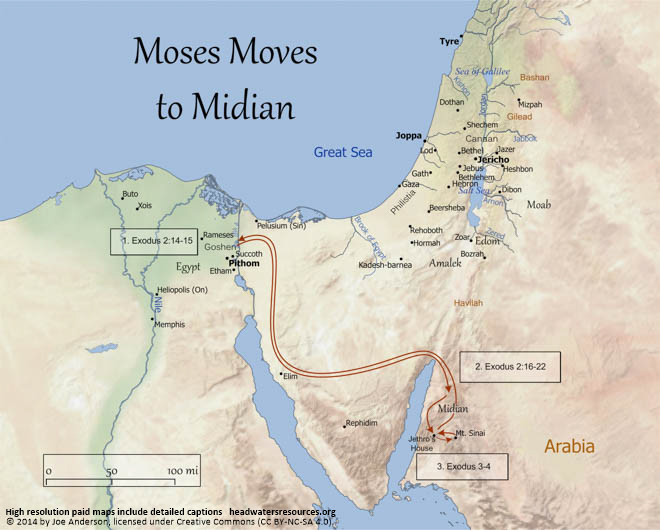
Justified or not, word got out and this lapse in judgment put Moses in hot water with Pharaoh. When a king is out to get you, it’s time to leave the kingdom, so Moses ran until he found himself in a place called Midian, located in part of what is now Western Saudi Arabia.

Moses would go on to spend 40 years there – fully 1/3 of his life – as a shepherd for his father-in-law. It was at the end of this period of time that he received the call that would change his life.

Exodus 3:1-4

During the interview that would follow his words, “Here I am,” Moses would display reverence, fear, curiosity and plenty of excuses.

Like Moses, there’s no doubt that when we hear the call of God, we’ll experience a whole range of emotions. But the measure of encounter is bound up in our willingness to respond in obedience to that call.

God knew where Moses was. He knew the concerns, the frustration and the desires of Moses’ heart. God had also heard the cries of the Children of Israel. All of this time, Moses had been on a training mission. God was preparing him for bigger and better things and making him ready to carry out the call of God in his life.

When God called Moses, Moses had plenty of questions.  One that I find interesting is this one, “who shall I say sent me?”  Do you remember God’s response?   And God said to Moses, “I AM WHO I AM.” And He said, “Thus you shall say to the children of Israel, ‘I AM has sent me to you.’ ”    In short this is the covenant name of God, the personal name of God translated later as “Yahweh.”

This designation who God is has great importance to our lives today because it’s the same term that Jesus uses to describe Himself in John 8: 58 58 Jesus said to them, “Most assuredly, I say to you, before Abraham was, I AM.” 

Did you see it?  God says to Moses through the burning bush, “I AM.”   Jesus says that He is “I AM”  This is called a Theophany or more specifically a Christophany.  “What is a theophany? What is a Christophany?”

“A theophany is a manifestation of God in the Bible that is tangible to the human senses. In its most restrictive sense, it is a visible appearance of God in the Old Testament.”   A Christophany is a pre-incarnate appearance of Christ in the Old Testament.  Jesus was speaking to Moses through the burning bush.  Jesus is still speaking and calling people to Himself.

I’ll never forget attending a revival service with my parents when I was 11 years old and through the evangelist, I understood that I knew about God, but I didn’t know Him personally and that through Jesus Christ, I could have a relationship with God.  I asked Jesus into my life that night.  My life changed from one of fear, uncertainty to one of feeling accepted and loved by Jesus, knowing my sins were forgiven and knowing that I was a child of God.  I’m thankful for Jesus calling me when I was 11.  Have you responded to Jesus call of salvation?  You can today by simply praying, “Thank you Jesus for loving me and dying on the cross for me.  I don’t understand it all, but I ask you into my life, turning from my sins and turning to you.”  Amen.

I also believe like Moses, that God calls us to serve him.   Moses had a task that God had called him to do. He was to lead God’s people out of slavery into the promise land.

As believers we are all called to ministry.  We are called to be a loving spouse.  No one can or should love Niki the way that I am called to. I have a responsibility to her, this is my ministry.  Going on a date and spending time with Niki is a ministry!  God has given me three children.  I am called to parent them, to bring them up to know God.  It is my responsibility.  Sure school, church and family may help me, but it’s my calling to parent my children.  Changing a diaper is a ministry!  We are called to be salt and light in a dark world, to make a difference where we live and work.  We have a ministry to our neighbors and co-workers.  It is our responsibility to help lead people to Jesus.  Your day to day job is a ministry! Will you accept the call to your spouse, kids, neighbors and co-workers?

We have a choice. We can make excuses like Moses did, which I have done plenty of times too.  Why wouldn’t we make excuses?  Its human nature to feel like we are out of our league, but God promises to be with us, and to teach us what to say.

Some of you are like me. I have often wondered why God would call a person like me.  I’m nothing special in my eyes; there are others who are smarter, stronger, better communicators, and better leaders.   I’m called to know Jesus, serve Jesus and another call I have had is to lead a church as a pastor.   I know that God has been with me to teach me and train me to be what he wanted me to be. All of my life has been a preparation time for this day, this hour, and this church.  And I’m still in training for the ministry that lies ahead.

Know this: God will not call you to go and give you a message and then leave you in the dark about how to get it out.  Wait on Him to finish. Moses received great detail from God concerning what he was to do and to whom he was to speak when he returned to Egypt.

We can expect similar direction. When we receive and listen to that guidance from God we won’t overreach and try to do things we’re not prepared for and we won’t underestimate what God wants to do and miss out on greater things.

When God Calls, We Must Do What He Asks of Us

There’s probably someone reading this, that has been hearing the call of God in your own life. Just like a bush that’s burning, there are unmistakable signs that He’s got your number.

Maybe you are hearing God calling you to give Him control of your life, experiencing a call to involvement in ministry or to helping people.  Wherever we are in life, if God is calling, listen to His voice. Come to him right now and find the fulfillment of being exactly where God made us to be.

I’m thankful for God’s call, that I know Jesus personally, that I have purpose as a spouse, dad and pastor.  I pray that you will answer God’s call too.

Darrell

www.Upwards.Church

Message Audio/Video and Outline: https://upwards.church/watch-now/leander-campus-videos

Watch Messages: YouTube-Upwards Church

Facebook: Upwards Church

Posted in Out of Darkness - Exodus | Tagged , , , , , , , | 2 Comments

God Provides for His People – Exodus 2 (Birth of Moses)

God provides for His people:  life, freedom, provision, salvation, direction, His presence, hope and a future.  In the last chapter, things looked pretty grim for God’s people. The Pharaoh has afflicted the people with hardship, pain, and depicted them as traitors who may join their enemies. But for every problem, God has a solution or provision. For every trial, He has a triumph at hand. For every crisis, God has a provision.

God’s provision for Israel’s problem was found in a man named Moses. Moses is among the greatest heroes of the Old Testament. He was a prophet, priest, and king in one person.
The account of Moses now begins. God provided for His people and raised up Moses…

  • to deliver Israel from slavery (Exodus 3-11).
  • to lead Israel to the promised land, guiding them through the Red Sea and through the wilderness wanderings (Exodus 12-18).
  • to give the Law and the Ten Commandments to Israel and to the world at large; to establish Israel as a nation governed by law (Exodus 19-24).
  • to plan and draw the blueprint for the tabernacle, Israel’s house of worship, and to establish the priesthood and religion of Israel (Exodus 25-31).
  • to proclaim the Word of God to Israel and to intercede for God’s forgiveness when the people sinned and went astray (Exodus 32-34).
  • to construct the tabernacle and lead the people to obey God in all they did (Exodus 35-40).

Never has one man done so much for so many as has Moses, except of course for Jesus Christ. Moses was chosen by God to single-handedly save Israel. God was to use Israel to give to the world the two greatest gifts possible: both the Word of God and the Savior, the Lord Jesus Christ.

Moses is one of the few characters in Scripture whose life is sketched from infancy to death.

A look at Moses’ life presents a series of striking contrasts.

  • Moses was the child of a slave and the son of a queen.
  • He was born in a hut, and lived in a palace.
  • He inherited poverty, yet, enjoyed unlimited wealth.
  • Moses was the leader of armies, yet a keeper of flocks.
  • This man was the mightiest of warriors and the meekest of men.
  • He was educated in the court of the king and dwelt in the desert.
  • Moses had the wisdom of Egypt and the faith of a child.
  • He was fitted for the city but wandered in the wilderness.
  • This man was tempted with the pleasures of sin and he endured the hardships of virtue.
  • Moses was backward in speech, yet talked with God.
  • He was a fugitive from Pharaoh and an ambassador of Heaven.
  • Moses was the giver of the law and the forerunner of grace.

As we look into Exodus chapter two, we find a brief account of the infancy of Moses.

The theme of Exodus is deliverance, and you can’t have deliverance without a deliverer. That’s where Moses comes in, the great liberator, legislator, and mediator. God provides for His people.

The deliverer is born (Ex. 2:1-10)

Amram and Jochebed were Moses’ parents (6:20), and while the Exodus text emphasizes the faith of the mother, Hebrews 11:23 commends both the father and the mother for trusting God. Moses became a great man of faith, and he learned it first from his godly parents/Amram and Jochebed already had two children: Miriam, who was the oldest, and Aaron, who was three years older than Moses (Ex. 7:7).

From the very first, Moses was seen to be “no ordinary child” (Acts 7:20, niv; see Heb. 11:23), and it was evident that God had a special purpose for him. Believing this to be true, the parents defied Pharaoh’s edict and kept their son alive. This wasn’t easy to do since all the Egyptians were now Pharaoh’s official spies, watching for babies to be drowned (Ex. 1:22).

Jochebed obeyed the letter of the law when she put Moses in the waters of the Nile, but certainly she was defying Pharaoh’s orders in the way she did it. She was trusting the providence of God and God didn’t fail her. When the princess came to the Nile to perform her religious ablutions, she saw the basket, discovered the baby, and heard him cry; and her maternal instincts told her to rescue the child and care for him.

God used a baby’s tears to control the heart of a powerful princess, and He used Miriam’s words to arrange for the baby’s mother to raise the boy and get paid for it! The phrase “as weak as a baby” doesn’t apply in the kingdom of God; for when the Lord wants to accomplish a mighty work, He often starts by sending a baby. This was true when He sent Isaac, Joseph, Samuel, John the Baptist, and especially Jesus. God can use the weakest things to defeat the mightiest enemies (1 Cor. 1:25-29). A baby’s tears were God’s first weapons in His war against Egypt.

The princess adopted Moses as her own son, which means that Moses had a favored position in the land and was given a special education for service in the government (Acts 7:22). In the Egyptian language, Moses means “born” or “son” and sounds like a Hebrew word that means “to draw out” (of the water). Years later, his name would remind Moses of the God who rescued him and did great things for him in Egypt. On more than one occasion, Moses would rescue his people because he trusted the Lord.

The deliverer prepared (Ex. 2:11-25)

Moses spent his first forty years (Acts 7:23) serving in the Egyptian bureaucracy. (Some students think he was being groomed to be the next pharaoh.) Egypt seems the least likely place for God to start training a leader, but God’s ways are not our ways. In equipping Moses for service, God took several approaches.

Education. “And Moses was learned in all the wisdom of the Egyptians, and was mighty in words and deeds” (Acts 7:22, nkjv). What did that involve? Egypt had a highly developed civilization for its time, particularly in the areas of engineering, mathematics, and astronomy. Thanks to their knowledge of astronomy, they developed an amazingly accurate calendar, and their engineers planned and supervised the construction of edifices that are still standing. Their priests and doctors were masters of the art of embalming, and their leaders were skilled in organization and administration. Visitors to Egypt today can’t help but be impressed with the accomplishments of this ancient people. The servant of God should learn all he can, dedicate it to God, and faithfully serve God.

Failure (vv. 11-14). Though some people were confused about his racial identity (v. 19), Moses knew that he was a Hebrew and not an Egyptian, and he couldn’t help but identify with the plight of his suffering people. One day he made a courageous decision to help his people, even if it meant losing his noble position as the adopted son of the royal princess (Heb. 11:24-26). The pleasures and treasures of Egypt faded from view as he saw himself helping to liberate God’s chosen people.

It’s possible that the Egyptian officer wasn’t just disciplining the Jewish slave but was beating him to death, because the Hebrew word can mean that, so when Moses interfered, he was probably saving a man’s life. And, if the Egyptian officer turned on Moses, which is likely, then Moses was also defending his own life.

But if Moses was planning to free the Hebrews by killing the Egyptians one by one, he was in for a shock. The next day he discovered that the Egyptians were only part of the problem because the Jews couldn’t even get along with each other! When he tried to reconcile the two Jews, they rejected his help! Even more, he learned that his secret was out and that Pharaoh was after his life. There was only one thing to do and that was to flee.

These two incidents reveal Moses as a compassionate man who was sincere in his motives but impetuous in his actions. Knowing this, you would never suspect that later he would be called “the meekest man on the earth” (Num. 12:3). Moses’ failure to help free the Jews must have devastated him. That’s why God took him to Midian and made him a shepherd for forty years. He had to learn that deliverance would come from God’s hand, not Moses’ hand (Acts 7:25; Ex. 13:3).

Solitude and humble service (vv. 15-25). Moses became a fugitive and fled to the land of the Midianites, relatives of the Jews (Gen. 25:2). True to his courageous nature, he assisted the daughters of Reuel, the priest of Midian (Ex. 2:18), and this led to hospitality in their home and marriage with one of the daughters, Zipporah, who bore him a son. Later, she would bear another son, Eliezer (18:1-4; 1 Chron. 23:15). Reuel (“friend of God”) was also known as Jethro (Ex. 3:1; 18:12,27), but Jethro (“excellence”) may have been his title as priest rather than his given name.

The man who was “mighty in word and deed” is now in the lonely pastures taking care of stubborn sheep, but that was just the kind of preparation he needed for leading a nation of stubborn people. Israel was God’s special flock (Ps. 100:3) and Moses His chosen shepherd. Like Joseph’s thirteen years as a slave in Egypt and Paul’s three years’ hiatus after his conversion (Gal. 1:16-17), Moses’ forty years of waiting and working prepared him for a lifetime of faithful ministry. God doesn’t lay hands suddenly on His servants but takes time to equip them for their work.

God’s delays aren’t evidence of unconcern, for He hears our groans, sees our plight, feels our sorrows, and remembers His promises. What He has promised, He will perform, for He never breaks His covenant with His people. When the right time comes, God immediately goes to work.  God provides for His people.

www.Upwards.Church

Message Audio/Video and Outline: https://upwards.church/watch-now/leander-campus-videos

Watch Messages: YouTube-Upwards Church

Facebook: Upwards Church

Sources:

Rod Mattoon, Mattoon’s Treasures – Treasures from Exodus, Volume 1, (Springfield, IL: Lincoln Land Baptist Church, n.d.), WORDsearch CROSS e-book, 19-20.

The Preacher’s Outline & Sermon Bible – Exodus I, (Chattanooga: Leadership Ministries Worldwide, 1996), WORDsearch CROSS e-book, Under: “II. MOSES AND GOD: GOD RAISES UP A LEADER TO DELIVER HIS PEOPLE (ISRAEL), 2:1-7:7”.

Warren W. Wiersbe, The Bible Exposition Commentary – Pentateuch, (Colorado Springs, CO: Victor, 2001), WORDsearch CROSS e-book, 180.


Posted in Out of Darkness - Exodus | Tagged , , , , , | Leave a comment

God is in Control – Exodus 1

Does it every feel like everything is spinning out of control?  One of the truths about God is that He is control.  God was in control of the situation the His people were in, and He is in control of our situation as well.

At the start of Exodus, we find God’s people going through some difficult times as the slaves of Egypt.  It might seem like God didn’t know or didn’t care about their situation.  But God was with them the entire time, and He never forgot about them.   No matter what you’re going through God knows, He cares and as a believer, He is with you.

The very first passage of Exodus deals with the great theme of Exodus: deliverance. God had delivered His people in the past. God will deliver His people in the future. No matter what the trouble may be, no matter how terrifying and hopeless, no matter how helpless the circumstances may seem—God will deliver Israel again, deliver them just as He had delivered them in the past.  God is in control.

He will even work the terrifying circumstances out for our good. This is the promise of God to His people, to those who truly love and follow Him (Romans 8:28). God will deliver us; He will save us. This is the assurance of this introductory passage of Exodus.

God used Israel’s experiences in Egypt to prepare them for the special tasks He gave them to accomplish on earth: bearing witness to the true and living God, writing the Holy Scriptures and bringing the Savior into the world.  God is in control.

Notice what God is doing,

God Prospers His People

Blessing (vv. 1-7). During the years Joseph served as second ruler in Egypt, his family was greatly respected; and even after Joseph died, his memory was honored in the way the Egyptians treated the Hebrews. God kept His covenant promise to Abraham by blessing his descendants and causing them to multiply greatly (Gen. 12:1-3; 15:5; 17:2, 6; 22:17). By the time of the Exodus, there were more than 600,000 men who were twenty years and older (Ex. 12:37; 38:26); and when you add the women and children, the total could well be nearly 2 million people, all of whom descended from the original family of Jacob. God certainly kept His promise! He is in control.

But a new Pharaoh wasn’t happy with the rapid multiplication of the Jewish people, so he took three steps to control it.  We see these same steps today used by tyrants and oppressors, but God is in control.

Step #1—Oppressing the adults (vv. 8-14). With hard labor, heavy taxes- Do you ever feel overworked, with unrealistic demands or a heavy tax load? This is what oppressors can do.  God had told Abraham that his descendants would go to a strange country and there be enslaved and mistreated, but He had promised that He would set them free by His power at the right time (Gen. 15:12-14). God compared Egypt to a smoking furnace; see Deut. 4:20) where His people would suffer, but their experience in that furnace would transform the Israelites into a mighty nation (Gen. 46:3).

During the centuries the Jews had been in Egypt (Ex. 12:40-41), they had seen several Egyptian dynasties come and go; but who was the new king who was ignorant of Joseph and his family and tried to destroy “the people of the children of Israel”? The 17th Dynasty, the Hyksos, were foreigners and “strangers” in the land as were the Jews, so they were probably sympathetic with Israel; but the 18th Dynasty was Egyptian and their rulers expelled foreigners from the land. This may have been the dynasty that began the persecution of the people of Israel.

Why would the Egyptians want to make life miserable for the Jews? Israel was a source of blessing in the land, as Joseph had been before them (Gen. 41:39-57), and they weren’t causing trouble. Pharaoh’s stated reason was that the presence of so many Jews was a security risk: since the Jews were outsiders, if there were an invasion, they would no doubt ally themselves with the enemy. However, whether Pharaoh realized it or not, the real cause was the conflict announced in Genesis 3:15, the enmity between the people of God and the children of Satan, a conflict that still goes on in the world today.

No people in recorded history have suffered as the Hebrew people have suffered, but every nation or ruler that has persecuted the Jews has been punished for it. After all, God’s promise to Abraham was, “I will bless those who bless you, and I will curse him who curses you” (12:3, nkjv). God kept that promise in the way He dealt with Egypt and Babylon in ancient days and Stalin and Hitler in modern times. God is long-suffering as He sees nations persecute His chosen people, but eventually His hand of judgment falls on the oppressors.

The Egyptian taskmasters “worked them ruthlessly” (Ex. 1:13, niv), forcing the Jewish slaves to build cities and work in the fields. But the blessing of God caused the Israelites to continue to multiply, and this frightened and enraged their captors even more. Something else had to be done to keep Israel under control.

Step #2Killing babies (vv. 15-21).  Sound like today?  Killing babies and abortion are not a modern invention.  This plan of evil has a long history.   If this plan had succeeded, Pharaoh would have wiped out the Hebrew people. The future generation of men would be dead and the girls would eventually be married to Egyptian slaves and absorbed into the Egyptian race. But Genesis 3:15 and 12:1-3 said that God would not permit such a thing to happen, and He used two Jewish midwives to outwit Pharaoh.  God is in control.

This is the first instance in Scripture of what today we call “civil disobedience,” refusing to obey an evil law because of a higher good. Scriptures like Matthew 20:21-25; Romans 13; and 1 Peter 2:11 teach Christians to obey human authorities; but Romans 13:5 reminds us that our obedience must not violate our conscience. When the laws of God are contrary to the laws of man, then “we ought to obey God rather than men” (Acts 5:29). You see this exemplified not only in the midwives but also in Daniel and his friends (Dan. 1; 3; 6) and the apostles (Acts 4-5).

Were the midwives lying to Pharaoh? We do not know.  It’s likely the babies were born before the midwives arrived because Shiphrah and Puah had told their assistants to be late. What we do know is that their actions were right.  God blessed the two leading midwives for putting their own lives on the line in order to save the Jewish nation from extinction. However, He honored these two women: He gave them children at a time when it was dangerous to have children! Perhaps all their children were daughters, or perhaps God protected their sons as He protected Moses. However, this blessing from God shows how precious children are to the Lord: He wanted to give these two women His very best reward, so He sent them children (Ps. 127:3).

Step #3Drowning the male babies (v. 22). When Pharaoh discovered he’d been deceived, he changed his plan and commanded all his people to see to it that the Jewish male babies were drowned in the sacred Nile River. It’s interesting that Pharaoh chose drowning as his method of death and that later he himself would be drowned by God. We reap what we sow.  God is in control.

Since Pharaoh’s police couldn’t check up on every Jewish midwife, he commanded that the Egyptian people keep their eyes on the Jewish slaves and report when a boy was born. But one boy would be born that Pharaoh couldn’t kill. God is in control.

We will look at his birth (Moses) in the next post.

Darrell

www.Upwards.Church

Message Audio/Video and Outline: https://upwards.church/watch-now/leander-campus-videos

Watch Messages: YouTube-Upwards Church

Facebook: Upwards Church


Sources:

The Preacher’s Outline & Sermon Bible – Exodus I, (Chattanooga: Leadership Ministries Worldwide, 1996), WORDsearch CROSS e-book, Under: “A. The Past Deliverance of Israel: The Picture of God’s Deliverance and God’s Faithfulness, 1:1-7”.

Warren W. Wiersbe, The Bible Exposition Commentary – Pentateuch, (Colorado Springs, CO: Victor, 2001), WORDsearch CROSS e-book, 180-181.


Posted in Out of Darkness - Exodus | Tagged , , , , , , , | 2 Comments