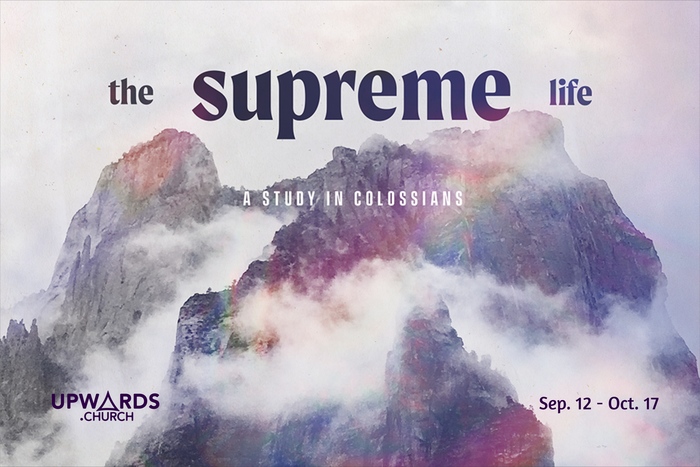
Introduction to Colossians – Supreme Life Series

Would you like to know more about Jesus? Or how to live a Christ centered life? Colossians reveals that Christ is God, Creator and Supreme over all. Knowing Christ will enable us to live the life that He has created us for.

The Apostle Paul reminds us: “Christ is the visible image of the invisible God. He existed before anything was created and is supreme over all creation, for through Him God created everything… and He holds all creation together.  Christ is also the head of the church, which is his body. He is the beginning, supreme over all who rise from the dead. So He is first in everything. Colossians 1:15-18 (NLT)

Supreme1: highest in rank or authority. 2: highest in degree or quality. Merriam Webster Dictionary

Writing from prison in Rome, Paul combatted false teachings, which had infiltrated the Colossian church. The problem was “syncretism,” combining ideas from other philosophies and religions (such as paganism, strains of Judaism, and Greek thought) with Christian truth. The resulting heresy later became known as “Gnosticism,” emphasizing special knowledge (gnosis in Greek) and denying Christ as God and Savior. To combat this devious error, Paul stressed Christ’s deity—his connection with the Father—and his sacrificial death on the cross for sin. Only by being connected with Christ through faith can anyone have eternal life, and only through a continuing connection with him can anyone have power for living. Christ is God incarnate and the only way to forgiveness and peace with God the Father. Paul also emphasized believers’ connections with each other as Christ’s body on earth.

Colossians is a book for an embattled church in the first century, but it is also has timeless truths for us today! We will gain a fresh appreciation for Christ as the fullness of God and the only source for living the Christian life. Know that He is your leader, head, and power source.

Vital Statistics

Purpose:  To combat errors in the church and to show that believers have everything they need in Christ

Author: Paul

Original Audience: The church at Colosse, a city in Asia Minor

Date Written: Approximately A.D. 60, during Paul’s imprisonment in Rome

Setting: Paul had never visited Colosse. Evidently the church had been founded by Epaphras and other converts from Paul’s missionary travels. The church, however, had been infiltrated by religious relativism, with some believers attempting to combine elements of paganism and secular philosophy with Christian doctrine. Paul confronts these false teachings and affirms the sufficiency of Christ.

Key Verses: “For in Christ lives all the fullness of God in a human body. So you also are complete through your union with Christ, who is the head over every ruler and authority” (2:9, 10).

Key People: Paul, Timothy, Tychicus, Onesimus, Aristarchus, Mark, Epaphras

Key Places: Colosse, Laodicea (4:15, 16)

Special Features: Christ is presented as having absolute supremacy and sole sufficiency. Colossians has similarities to Ephesians, probably because it was written at about the same time, but it has a different emphasis.

The Blueprint

  1. What Christ has done (1:1-2:23)
  2. What Christians should do (3:1-4:18)

In this letter Paul clearly teaches that Christ has paid for sin, that Christ has reconciled us to God, and that Christ gives us the pattern and the power to grow spiritually. Because in Christ lives all the fullness of God, when we learn what he is like, we see what we need to become. Since Christ is Lord over all creation, we should crown him Lord over our lives. Since Christ is the head of the body, his church, we should nurture our vital connection to him.

MEGATHEMES
THEMEEXPLANATIONIMPORTANCE
Christ Is GodJesus Christ is God in the flesh, Lord of all creation, and Lord of the new creation. He is the visible image of the invisible God. He is eternal, preexistent, omnipotent, equal with the Father. He is supreme and complete.Because Christ is supreme, our lives must be Christ-centered. To recognize him as God means to regard our relationship with him as most vital and to make his interests our top priority.
Christ Is Head of the ChurchBecause Christ is God, he is the head of the church, his true believers. Christ is the founder, the leader, and the highest authority on earth. He requires first place in all our thoughts and activities.To acknowledge Christ as our head, we must welcome his leadership in all we do or think. No person, group, or church can regard any loyalty as more critical than that of loyalty to Christ.
Union with ChristBecause our sin has been forgiven and we have been reconciled to God, we have a union with Christ that can never be broken. In our faith connection with him, we identify with his death, burial, and resurrection.We should live in constant contact and communication with God. When we do, we all will be unified with Christ and with one another.
HeresyFalse teachers were promoting a heresy that stressed self-made rules (legalism). They also sought spiritual growth by discipline of the body (asceticism) and visions (mysticism). This search created pride in their self-centered efforts.We must not cling to our own ideas and try to blend them into Christianity. Nor should we let our hunger for a more fulfilling Christian experience cause us to trust in a teacher, a group, or a system of thought more than in Christ himself. Christ is our hope and our true source of wisdom.

www.Upwards.Church

Watch Messages: YouTube-Upwards Church

Facebook: Upwards Church

Source: Life Application Study Bible, (Wheaton, IL: Tyndale, 1988), WORDsearch CROSS e-book, 2025-2024.

Posted in Supreme Life - Colossians | Tagged , , , , , , , , , | Leave a comment

Meaningless – Ecclesiastes Series

You’re invited to join us for our new series from the book of Ecclesiastes!

Description:  “My life has no meaning.  My life is empty and disappointing.”  These are the feelings of many us today.  As we try to fill our lives with possessions, power and pleasure we find that life has let us down.  In the book of Ecclesiastes Solomon takes us on a mental journey through his life explaining how he tried and tested everything to find meaning and enjoyment in life. He tries to spare his readers the same disappointment he learned through personal experience.  Everything apart from God is empty and meaningless.  Solomon has an honest approach to life.  His comments may come across as negative but his attempt is to lead people to center their lives around God. Not any substitutes. He affirms the value of education, pleasure, work and possessions, but only in their proper place. All of these things must be seen in the perspective of God’s purpose.  True enjoyment of life is comes from knowing that what we are doing is part of God’s purpose for our lives.

Dates           Titles                                Scriptures                        Events

Aug 1 – Meaning Beyond Education – Ecclesiastes 1:12-18

Aug 8 – Meaning Beyond Pleasure – Ecclesiastes 2                         

Aug 15 – Meaning Beyond Work – Ecclesiastes 2:17-23                   Back to School

Aug 22 – Meaningful Relationships – Ecclesiastes 4 

Aug 29 – Meaning Beyond Possessions – Ecclesiastes 5-6

Sept 5 – Finding Meaning In Life – Ecclesiastes 11-12                     Labor Day Weekend

www.Upwards.Church

Watch Messages: YouTube-Upwards Church

Facebook: Upwards Church

Posted in Meaningless - Ecclesiastes | Tagged , , , , , , , , , , | Leave a comment

God’s & Kings – 1 & 2 Chronicles

Our six-week summer series chronicles God’s kings: David, Solomon, Jehoshaphat, Hezekiah, Josiah and more.

Whether for a nation, a family, or an individual, God’s word gives us principles to live a life that honors Him, regardless of the external circumstances. Living God’s way is the best way.

I & 2 Chronicles was written to reunite the nation around the true worship of God after the Captivity. In these pages, the author reminds the people of their past. He clearly broadcasts his message through one of the best-known verses in Scripture, “If my people who are called by my name will humble themselves and pray and seek my face and turn from their wicked ways, I will hear from heaven and will forgive their sins and restore their land” (7:14). As we dig into 1 & 2 Chronicles, lets listen to God’s voice and obey him; and receive his redemptive, healing touch.

Dates           Titles            Scriptures                                  

June 20 – A Man after God’s Heart (1 Chron. 11-29)   – David  

June 27 – Asking for God’s Wisdom (2 Chron. 1) – Solomon

July 4 – Seeking God’s Face (2 Chron. 7) – God’s Promise    

July 11 – Rely on God’s Strength (2 Chron. 14-15) – Asa

July 18 – Boldness in God’s Work (2 Chron. 17-21) – Jehoshaphat    

July 25 – Doing Right in God’s Eyes (2 Chron. 29-32) Hezekiah

Posted in God's & Kings - 1 & 2 Chronicles | Tagged , , , , , , , | Leave a comment

The Mercy of God – Lamentations 3:22-23

Jeremiah turned from contemplating his misery to remembering God’s mercy in chapter 3. He still experienced pain and sorrow, but he also called to mind the faithfulness of the Lord, and this gave him hope.

22 Because of the LORD’s great love we are not consumed, for his compassions never fail. 23 They are new every morning; great is your faithfulness. 24 I say to myself, “The LORD is my portion; therefore I will wait for him.” Lamentations 3:22-24 (NIV)

Max Lucado tells the story of being dropped by his insurance company because he had one too many speeding tickets and a minor fender bender that wasn’t his fault. He received a letter in the mail, informing him to seek coverage elsewhere. As he reflected on how he wasn’t good enough for his insurance company he saw the spiritual tie-in. He writes, “Many people fear receiving such a letter [from God]. Some worry they already have.” Lucado then imagines this correspondence, straight from “The Pearly Gates Underwriting Division:”

“Dear Mr. Smith,

I’m writing in response to this morning’s request for forgiveness. I’m sorry to inform you that you have reached your quota of sins. Our records show that, since employing our services, you have erred seven times in the area of greed—and your prayer life is substandard when compared to others of like age and circumstance. Further review reveals that your understanding of doctrine is in the lower 20 percentile and you have excessive tendencies to gossip. Because of your sins you are a high-risk candidate for Heaven. You must understand that grace has its limits. Jesus sends His regrets and kindest regards and hopes that you will find some other form of coverage.

 Sincerely,

Angel in charge of Fire Insurance

We’ll never get a letter like that! As Jeremiah puts it, “God’s compassions never fail. They are new every morning; great is Your faithfulness.” The English word for “new” in this verse is the Hebrew word “hadas.” It would be translated, “never before experienced.”

God is using Jeremiah to remind us that His mercies—His compassions—His blessings—are always literally NEW. Today’s mercy is different from yesterday or the day before or the day before the day before.  Mark Batterson writes, “Just as the seasonal flu vaccine changes from year to year, God’s mercy changes from day to day. It’s a new strain of mercy. Why? Because you didn’t sin today the way you did yesterday!”

Try this little exercise: Figure out how old you are—not in years but in days. For example, today I am 19,539 days old. That’s the sum total of different kinds of “new every morning” mercy I’ve received in life—to-date.  I’m sure it’s more than that—because I sin more than once a day. But sticking with the daily model, the time you’re twenty-one, you’ve experienced 7,665 unique mercies. When you hit midlife, it numbers 14,600. And by the time you are 65, God has mercied you at least 23,725 times. God is always faithful to forgive!

In Jeremiah’s darkest moment, his hope was strengthened with this assurance: God had been faithful and would continue to be faithful. Jeremiah saw both God’s judgment and God’s steadfast love. In the time of judgment, Jeremiah could still cling to God’s love, just as in times of prosperity he had warned of God’s judgment.

Jeremiah knew from personal experience about God’s faithfulness. God had promised that punishment would follow disobedience, and it did. But God also had promised future restoration and blessing, and Jeremiah knew that God would keep that promise also. Trusting in God’s faithfulness day by day makes us confident in his great promises for the future.

In the 1950’s, a professor at Johns Hopkins University named Curt Richter conducted a series of experiments—and like many researchers he used rats as his test subjects. First, Richter took a dozen domesticated rats, put them into huge jars of water—and basically watched them drown. I know this sounds cruel—but he was trying to discover how long it would take—how long the furry—but friendly—vermin would swim before they gave up. And they did fairly well. Some swam for days before they gave up and sank to the bottom.

For the next part of his rat research, Richter took wild rats—taken straight from the sewers of Baltimore. One by one he dropped each furry but fierce rodent into the water-filled jars—and unlike their tame predecessors—they died very quickly—within minutes. Richter wondered why.

These sewer rats were supposedly renowned for their swimming ability. He theorized that the answer was a lack of hope.  He thought that perhaps the domesticated rats had learned to expect to be cared for—which fostered hope of rescue in their tiny brains. Perhaps this kept them going when the wild ones—who had never experienced that kind of care—gave up.

He wrote, “The situation of these rats scarcely seems one demanding fight or flight—it is rather one of hopelessness. These wild rats are in a situation against which they have no defense and no escape. They seem literally to ‘give up.’”

Richter decided to test his hypothesis. He took more wild rats—one at a time—and put them in one of the jars. But, just before the rat was about to drown, he picked it up, held it a little while, and then put it back in the water.  Well, this small interlude made a huge difference. This time each of the wild rats could swim and swim! He decided that this proved his hypothesis. He said—when these wild rodents learned that they were not doomed, that the situation was not lost, that there might be a helping hand at the ready—that there was hope—they would keep going.

They would not give up, and they would not go under.  At the conclusion of his experiment Richter wrote, “With the elimination of hopelessness, the rats do not die.”

I’m not saying you and I are rats—but like these furry little sewer dwellers, in order to keep going in this fearful world—to keep our heads above the water when the storms of life are raging—we need hope. We need something to cling to. We need a reason to keep “swimming”—something or someone has to motivate us to keep going.

I read a report from National Geographic magazine that says:

Humans can survive for just 2 to 3 minutes without air.

Humans can survive for up to 7 days without water.

Humans can survive for about 45 days without food.

But studies like Richter’s point to the fact that we all go down very quickly without hope.

As someone once put it, “Hope is the oxygen of the soul.” Hope is what we cling to when hurricanes come ashore destroying everything in their path or when doctors give us fearful diagnoses. Hope is what keeps us going when a friend of family member dies—and when job layoffs come our way.

Jeremiah, the “weeping prophet”— Jeremiah learned this principle. He had been through horrible trials. I imagine his life felt like the experience of those last set of rats. Time and time again things got so bad he felt like he was going under, and time and time again God lifted him up and gave him hope.

May God’s faithfulness and mercy give us hope as well.

Darrell

www.Upwards.Church

Watch Messages: YouTube-Upwards Church

Facebook: Upwards Church

Posted in God & Justice - The Prophets | Tagged , , , , | Leave a comment