
 Our passage is today is the climax or turning point to the history of the first generation of Israelites after the Exodus. This rebellious doubt was the final blow, the tenth rebellion of unbelief and grumbling within two years. In this unbelieving doubt expressed by the people, God knew their hearts would never change, never trust Him and His Word—not fully, not completely, not like they should. God had no choice. God had to judge His people and judge them permanently. Negativism, defeatism, unbelief, fear, and rebellion were all embedded too deeply within their hearts. They simply refused to enter the promised land as God lead them: through sheer faith in His Word, believing the promises of God—in particular the promises of the promised land and the promised seed (a symbol of the coming Savior of the world, Christ Jesus Himself).
The twelve spies chosen were different men from the leaders named in Numbers 1-2; 7; and 10. These spies had to be younger men who could endure the rigors and dangers involved in reconnoitering the land. We meet Caleb for the first time in 13:6, but he’ll be mentioned thirty-one more times in the Old Testament. He and Joshua were the only members of the older generation to enter the Promised Land. The rest of them died in the wilderness.
We first meet Joshua in Scripture as Israel’s general (Ex. 17:8-16), defeating the Amalekites, and then as the servant of Moses (24:13; Num. 11:28). He eventually became Moses’ successor (27:15-20) and led Israel in their conquest of the Promised Land. His original name was Hoshea, which means “salvation,” but Moses changed it to “Joshua” which means “Jehovah is salvation.” It was the kind of name that would encourage the faith of a soldier and remind him that the Lord was fighting for him.
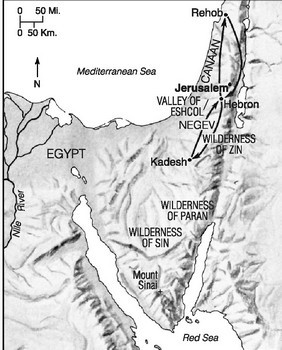 The twelve spies traveled about 500 miles during the forty days of their survey of Canaan, but they discovered nothing that God hadn’t already told them! They already knew the names of the pagan nations that lived in the land (Gen. 15:18-21), that it was a good land (Ex. 3:8) and a rich land flowing with milk and honey (vv. 8, 17). They saw the incredible fruit of the land and brought back a huge bunch of grapes for the people to see. They even visited Hebron, where the patriarchs of Israel were buried with their wives (Num. 13:22; Gen. 23:2, 19; 49:29-31; 50:13). Did the reminder of the faith of Abraham, Isaac, Jacob, and Joseph encourage their own trust in God? For ten of the spies, the answer is no.
God had already given them the land and had commanded them to go in and take it. He had promised them victory, so all they had to do was “trust and obey.” The Lord would go before them and scatter His enemies (Num. 10:33-36), but His people had to follow by faith. That was where they failed. They doubted that God was able to keep His promises and give them the land.
Discouraging God’s people (Num. 13:26-33; Deut. 1:26-28)
Someone has defined a committee as “a group of people who individually can do nothing and collectively decide nothing can be done.” Because they lacked faith, all the spies except Caleb and Joshua were discouraged at the prospect of entering the land and fighting the enemy, and their discouragement quickly spread throughout the camp. Doubt had turned into unbelief, and unbelief is rebellion against God
God told the Israelites that the Promised Land was rich and fertile. Not only that, he promised that this bountiful land would be theirs. When the scouts reported back to Moses, they gave plenty of good reasons for entering the land, but some couldn’t stop focusing on their fear. Talk of giants (descendants of Anak) and fortified cities made it easy to forget about God’s promise to help. When facing a tough decision, don’t let the negatives cause you to lose sight of the positives. Lets not let potential difficulties blind us to God’s power to help and his promise to guide.
13:28 The “descendants of Anak” were a race of abnormally large people. The family of Goliath may have been descended from these people (see 2 Samuel 21:16-22).
13:28, 29 The fortified cities the scouts talked about were surrounded by high walls as much as 20 feet thick and 25 feet tall. Guards were often stationed on top, where there was a commanding view of the countryside. Some of the inhabitants, said the scouts, were formidable men—from seven to nine feet tall—so that the Israelites felt like grasshoppers next to them (13:33). The fortified cities and the giants struck fear into the hearts of most of the scouts.
13:30-32 Imagine standing before a crowd and loudly voicing an unpopular opinion! Caleb was willing to take the unpopular stand to do as God had commanded. To be effective when you go against the crowd, you must (1) have the facts (Caleb had seen the land himself); (2) have the right attitude (Caleb trusted God’s promise to give Israel the land); (3) state clearly what you believe (Caleb said, “We can certainly conquer it!”).
13:33-14:4 The negative opinion of 10 men caused a great rebellion among the people. Because it is human nature to accept opinion as fact, we must be especially careful when voicing our negative opinions. What we say may heavily influence the actions of those who trust us to give sound advice.
What John Gardner said about the political arena can be applied to the spiritual arena and the Christian’s walk of faith: “We are continually faced with a series of great opportunities brilliantly disguised as insoluble problems.” A faith that can’t be tested can’t be trusted, and God tests our faith to help us make sure it’s genuine (1 Peter 1:1-9) and to help make it grow. “Faith comes first to the hearing ear,” said A.W. Tozer, “not to the cogitating mind.” “So then faith comes by hearing, and hearing by the word of God” (Rom. 10:17, nkjv).
To the unbelieving world, it’s unreasonable for anybody to trust a God they’ve never seen or heard, but we have all the evidence we need to convince us that God is dependable and has the power to accomplish what He says He will do. What He promises, He is able to perform (Rom. 4:21). Israel had seen what the Lord did to the Egyptians and the Amalekites (Ex. 17:8-16), and they had every assurance that He would never fail His people.
Unbelief is serious because it challenges the character of God and rebels against the will of God. “But without faith it is impossible to please [God]” (Heb. 11:6). “For whatever is not of faith is sin” (Rom. 14:23). Moses reminded the people of what God had already done for them but they wouldn’t stop complaining. They were sure that the best thing to do was return to Egypt and go back into bondage.
Defying God’s will (Num. 14:1-10)
In the camp of Israel, unbelief and discouragement spread rapidly from heart to heart, and before long “all the congregation lifted up their voice, and cried; and the people wept that night” (v. 1, and note vv. 2 and 10). The next day, the whole congregation criticized Moses and Aaron and lamented the fact that the nation hadn’t perished in Egypt or in the wilderness. When our eyes are on ourselves and our circumstances, we lose our perspective and say and do ridiculous things.
14:1-4 When the chorus of despair went up, everyone joined in.
Their greatest fears were being realized. Losing their perspective, the people were caught up in the emotion of the moment, forgetting what they knew about God’s character. What if the people had spent as much energy moving forward as they did moving back? They could have enjoyed their land—instead they never even entered it. When a cry of despair goes up around you, consider the larger perspective before you join in. You have better ways to use your energy than to complain.
14:5-9 With great miracles, God had led the Israelites out of slavery, through the desolate wilderness, and up to the very edge of the Promised Land. He had protected them, fed them, and fulfilled every promise. Yet when encouraged to take that last step of faith and enter the land, the people refused. After witnessing so many miracles, why did they stop trusting God? Why did they refuse to enter the Promised Land when that had been their goal since leaving Egypt? They were afraid. Often we do the same thing. We trust God to handle the smaller issues but doubt his ability to take care of the big problems, the tough decisions, the frightening situations. Don’t stop trusting God just as you are ready to reach your goal. He brought you this far and won’t let you down now. We can continue trusting God by remembering all he has done for us.
14:6 Tearing clothing was a customary way of showing deep sorrow, mourning, or despair. Joshua and Caleb were greatly distressed by the people’s refusal to enter the land.
14:6-10 Two wise men, Joshua and Caleb, encouraged the people to act on God’s promise and move ahead into the land. The people rejected their advice and even talked of stoning them. Don’t be too quick to reject advice you don’t like. Evaluate it carefully, comparing it to the teaching in God’s Word. The advice may be God’s message.
Defeated by Doubt – Numbers 14:17-23
14:17-20 Moses pleaded with God, asking him to forgive his people. His plea reveals several characteristics of God: (1) God is immensely patient; (2) God’s love is one promise we can always count on; (3) God forgives again and again; (4) God is merciful, listening to and answering our requests. God has not changed since Moses’ day. Like Moses, we can rely on God’s love, patience, forgiveness, and mercy.
14:20-23 The people of Israel had a clearer view of God than any people before them, for they had both his laws and his physical presence. Their refusal to follow God after witnessing his miraculous deeds and listening to his words made the judgment against them more severe. Increased opportunity brings increased responsibility. As Jesus said: “When someone has been given much, much will be required in return” (Luke 12:48). How much greater is our responsibility to obey and serve God—we have the whole Bible, and we know God’s Son, Jesus Christ.
Message Audio/Video and Outline: https://upwards.church/leander-campus/watch-now-message-videos
Watch Messages: YouTube-Upwards Church
Read Along Daily Bible Reading: You Version
Sources:
Bible Exposition Commentary (BE Series) – Old Testament – The Bible Exposition Commentary – Pentateuch.
Life Application Study Bible.
Preacher’s Outline and Sermon Bible – Commentary – The Preacher’s Outline & Sermon Bible – Numbers.


 Upwards Church