 Have you noticed that AI is getting pretty good at taking someone’s voice and making it seem real or making a person that looks real but in reality is not?
For Pastor Appreciation month, Hector sent this image of the pastors of our church, mainly from Leander. This is cute and creative, but not real. That is not Jerry, Brian, Joe or me. I do not have hairy arms like that or a cleft chin! We were never on a ship together. This image is creative and cute but it’s not real. Unfortunately many people have taken the REAL Jesus and made a counterfeit; which they think is cool, or culturally relevant but not real.
How can we discern what is real when constant counterfeits surround us?
By the time 1 John was written around AD 90, considerable events had already happened. Jesus had already lived, died, and resurrected, and the gospel had traveled into Greek territories.
As the news spread, stories about this Jewish Messiah were adapted to fit new interests and pursuits, and the newly planted churches began to call what they were originally taught into question.
Why were these stories different?
How could they know the truth of Jesus and discern what was real?
John wrote this letter to answer those very questions, and set right what was becoming chaotic. John’s experience living alongside Jesus helped the readers to see the amplified truth of Him and the fundamentals of the faith they follow.
John starts with the essential true characteristics of Christ— and the authentic message that comes from Jesus and how to walk in the Truth.
1. Christ is Eternal.
It’s possible that John starts this letter by referencing the gospel of John, which also begins with “in the beginning.” It’s meant to be a harkening back to Genesis to remind the readers that what he was talking about was true before there was time.
Consider that for a moment: they saw, heard and touched that which was from the beginning, Jesus. The eternal stepped into time; the unknowable introduced Himself to us. John is telling us that they had a personal experience with the transcendent becoming eminent. This historical thing was not merely before all things, but the generator of all things.
John continues connecting his letting with the gospel when he says “the word of life.” In his gospel, he calls Jesus “the Word.” To the Jews, they understood that the “word” was the creative expression of God— it’s how all things were made. God spoke creation into existence. He spoke to express His will. John is driving home the reminder that the very source of life showed up, and they saw that in Jesus.
2. Christ is a Historical Figure with a Staggering Amount Written About Him
If you were to make up a story, you would stick to mere ideas or concepts, careful to craft the subject matter to be just beyond the reach of truth. And yet, when we look at Scripture, we see that Jesus’ life was made manifest, and it is subject to verification. All of it— the time, places, dates, people, events—can be investigated and verified. The Bible roots itself in history.
It wasn’t formed or created, it was revealed, and they were witnesses to it.
You can tell when an event is big news by tall the new feeds, trending on Twitter, blog posts, articles and publicity it causes. These types of media frenzies give evidence that something noteworthy happened. When it comes to events that happened in our past, we can look to the eye witnesses or the written accounts. This is how history is recorded and verified, by comparing the accounts. It’s very telling when we do this for Jesus.
“There is far more evidence for the resurrection of Jesus than for any single event in the history of the world” says Ralph Muncaster an intellect with degrees in science, mathematics and logic who once was a skeptic of the Bible, of Jesus, of the Resurrection. He decided to investigate these so called fables he became startled with his findings and now is a believer and advocator of the faith. He says, “History can never be proved.” He means empirically like in science, (observable and testable, provable). Evidence is the only basis for verifying historical fact.
Magnitude of records coincides with the magnitude of the impact it made. For instance if you do a Google search you see what impact something has made by how many times it has been written about. For Sept. 11th 2001, the number is high. For Abraham Lincoln it’s higher, for Jesus Christ even more, even today he still is written about daily.
The magnitude of the record of Jesus Christ stands far above any record of anyone who has ever lived upon this planet.
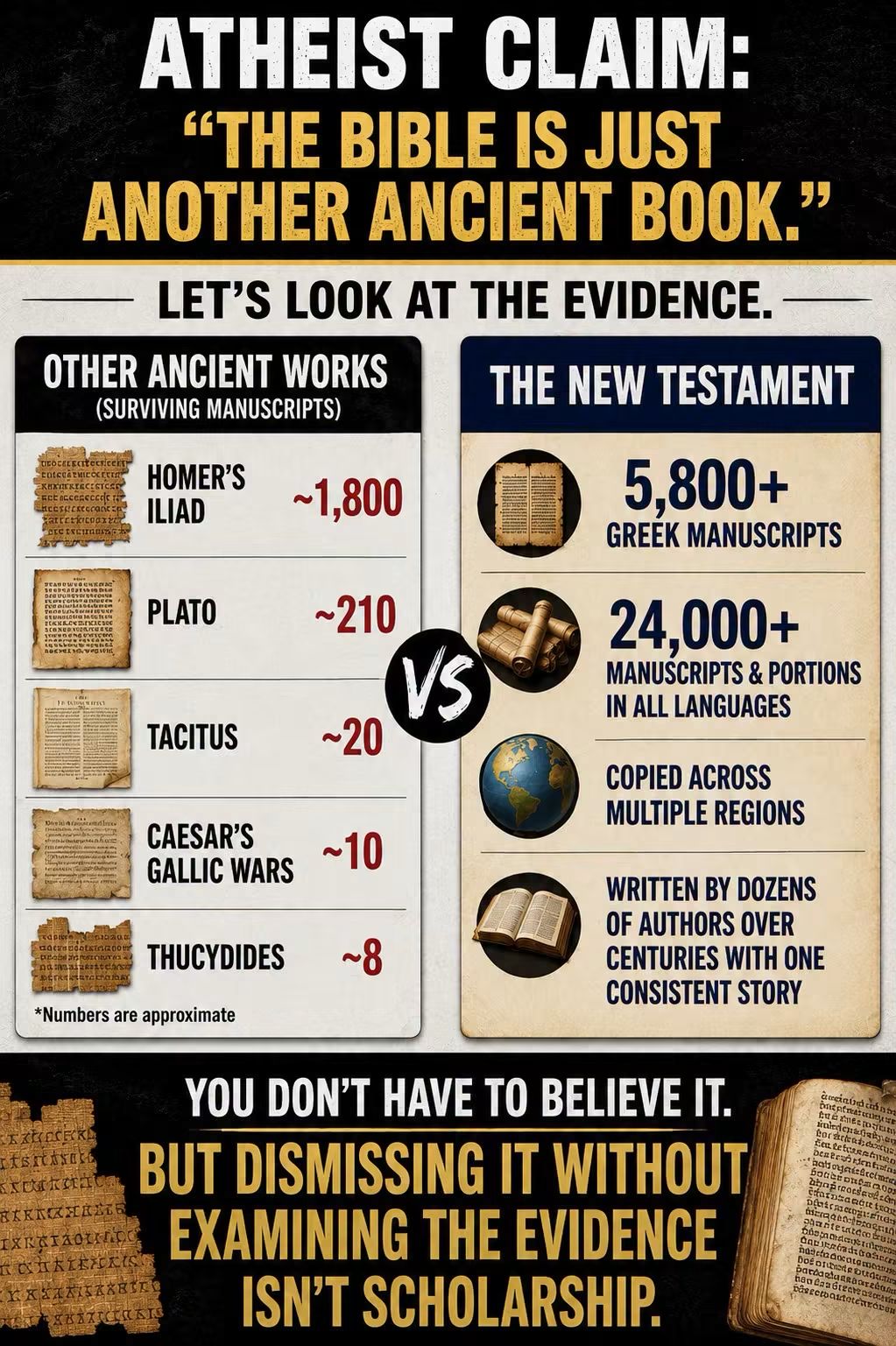 Existing early manuscripts exceed 24,000. The earliest written records were within 25 years of Jesus death. No other work of antiquity approaches Christ’s documentary vastness. This includes all works we accept as historical fact. Let’s take for instance the records, and writings of and during the Roman empire. We regard these as historical fact about the Roman empire. Of Julius Caesar and the Gaelic Wars we have 10 early records, the earliest is 900 years after Julius Caesar lived. Of the 14 books of the history of Rome by Tacitus only 4 survive, Other records and documents from Roman era by Thucydides, there are 8, from Herodotus there are 8, from Pliny the Younger we have 7. There are more but not close to the magnitude of the records of Christ. Of portions of manuscript copies of the New Testament which testify of Christ there are in existence today over 24,000. 24,000 copies verses a handful during the same time period. No other document of antiquity even begins to approach such numbers of attestation. On the other hand the original books of the New Testament were written between 25-100 AD. The earliest manuscript in existence today dates from 90-130 AD.
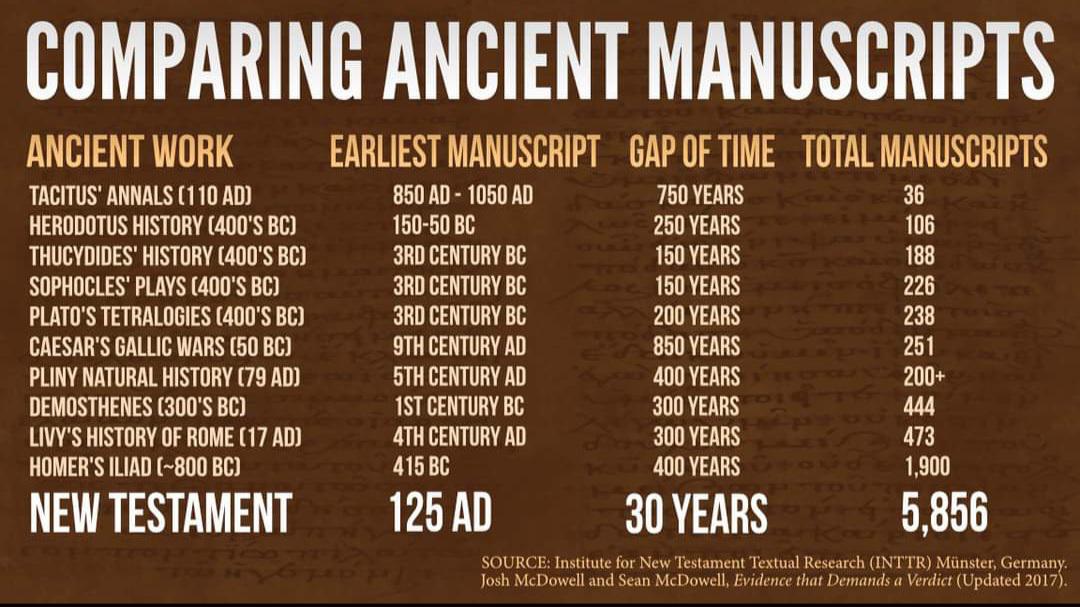 24 thousand NT manuscripts portions recording the life are in existence. The vastness of the number is particularly extraordinary considering:
- Jesus was not in a political position of power such as governor, general or dictator which are the ones usually written about. When I die there won’t be much written about me that will survive time, but if I were the president or a political power figure. Jesus was from a small, distant town and was a lowly carpenter with only three scant years of ministry. But there are 24000 manuscripts of his life, death and resurrection.
- The records survived the most intensive eradication effort. Rapidly growing in numbers Christian witnesses were executed. First by Nero beginning in 54 AD, then Domitian, Trajan, Decius, Valerian and Diocletian. They were crucified, burned thrown to the lions and gladiators in the coliseums. Any one professing belief in Christ was executed and any records found were burned. **In 303 AD an Imperial Edict was passed that ordered all scriptures burned in the entire Roman controlled world and anyone found with them executed. But still 24,000 exist.
- There was no printing press and the world population was low. The number of surviving early manuscripts is absolutely staggering considering they were all hand copied by a far smaller population base than even existed. Of 138 million people in the entire world including the far east and China , Rome was under control of half of that population and 24,000 manuscript copies exist today with no automatic duplication.
The gospel exploded because of the passionate testimony of witnesses. As fervid Jesus followers began spreading His message after His death and resurrection, this small group of people changed all of Rome within a few years. To this day, a third of the world aligns themselves with Jesus.
Now, it is our turn to proclaim what we know, have seen, heard, and touched to the world. Why? So they can fellowship with us, the Father, and Jesus.
3. Christ is Relational.
Isn’t it amazing to think that the very foundation of creation is a being you can know, and who who wants a relationship with you?
More than we need content, we need a connection.
More than we need an inspirational message, we need to know the Messenger.
When John referenced Jesus as “eternal life” in 1 John 1:2, he wasn’t calling to mind a concept, he was talking about a person. Paul wrote that “we preach Christ” in 1 Corinthians to present this same idea. Our message is the Messenger. We don’t just preach ideas about Jesus, we preach Jesus. It’s about a relationship with Him.
4. Christ’s Invitation is Open
The faith we profess is an open-invite party and not a secret club.
Wait, why do we need an invite if we are His creation?
While we are made in the image of God, we have all sinned and fallen short of the glory of God (Romans 3:23). Sin leads to death and separation, and when we take a look at the mess we have made, we don’t have to look long to know that something is off.
But the good news is that we don’t have to climb to God, He came to us through Jesus. He paid the debt of our sins and took on our death so He could offer us eternal life.
If you are in Him, wouldn’t you want others to be too? Our fellowship is with God, and we should want people to know Him and enjoy Him too.
6. Christ is Joy
John is writing this letter so his joy is made complete. This is not selfish, “I’m-doing-this-for-me” language. Rather, John is filled with joy when they know God through the grace of His Son. John knows, like we do, that life is found in Jesus. If you know that He has changed your life, your joyful invitation is to tell others that He can change theirs, too.
Let’s read John’s words again.
 “That which was from the beginning, which we have heard, which we have seen with our eyes, which we looked upon and have touched with our hands, concerning the word of life— the life was made manifest, and we have seen it, and testify to it and proclaim to you the eternal life, which was with the Father and was made manifest to us— that which we have seen and heard we proclaim also to you, so that you too may have fellowship with us; and indeed our fellowship is with the Father and with his Son Jesus Christ. And we are writing these things so that our joy may be complete.”
Jesus Christ is not just an idea or a concept, He is a Person. Jesus, the Eternal One, became historical so that He could make a way for us to be in a relationship with the Father and Him. Because we know Jesus and how He changed our lives, we tell others so they may know Him as well. We walk in the Truth of Jesus.
Message Audio/Video and Outline: https://upwards.church/leander-campus/watch-now-message-videos
Watch Messages: YouTube-Upwards Church
Read Along Daily Bible Reading: You Version


