

What Does God Control? – Jonah 1- part 2

What is God really like?  He is in control. He allows us to make our choices but still works around us to get our attention.  God continues to pursue us and unbelievers in many ways.  From Jonah chapter one we see that…

  • God is in control

Jonah ran from God and jumped on a ship in Joppa. Almost as soon as they were out of the harbor verse 4 says that …the Lord SENT a great wind on the sea and such a violent storm arose that the ship threatened to break up.   The Hebrew language implies that God “threw a storm at Jonah and his ship.”  Wow, a special storm designed just for him.  Have you been in a storm like that?  This was no typical storm. It was more perfect than the perfect storm in that George Clooney movie.  The sailors on this Tarshish-bound ship were probably Phoenicians, some of history’s greatest sailors. They were well-acquainted with storms at sea and they knew this was no NATURAL storm and that in fact it was SUPERNATURAL in origin so they cried out to their pagan gods for help and threw cargo into the sea to lighten the ship. Now while all this was going on where was Jonah? Down in below deck sound asleep. How could he sleep at a time like this?  I think the answer to this question provides us with another lesson from Jonah’s disobedience school.

  • God will Let Us Run from Him, but we’ll be exhausted.

This is because we are DESIGNED to walk in relationship with God and when we disobey Him we break that relationship. In relationship with God…in obedience to God…we have access to His strength. But when we disobey Him, when we break fellowship with Him, we are reduced to trudging through this sinful world on our own power. And you and I can’t make any headway against the storms of life on our own strength. Sin slows us down by draining our strength. It’s like trying to swim with a stone tied around your neck. In Psalm 32 verse 4 David says that when He disobeyed God his, bones wasted away…his strength was sapped as in the heat of the summer. So this is why Jonah slept. This prophet of God who was used to relying on God’s strength had lived the past few days on his own. Like an astronaut returning to earth’s gravity after weeks of weightlessness in space he quickly grew exhausted.

Another thing to note is that, as a Christ follower…

  • We can’t run from God and it not be obvious to everyone.

As Numbers 32:23 warns, You can be sure that your sins will find you out. And this is what happened to Jonah. As soon as he paid his fare, he didn’t talk to anyone or introduce himself. He headed to the hold and fell asleep. But when the storm broke the captain came to him and encouraged him to join them in praying to their individual gods for help in dealing with this perfect storm. Can you see the irony in an unbelieving captain having to beg a Hebrew prophet to pray? They cast lots to see whose fault this storm was and the lot just happened to fall on Jonah. Of course this was no coincidence. God was at work.  God is in control of storms and of dice.

I read somewhere that a coincidence is a miracle for which God chooses to remain anonymous.

And that is what happened here. God CAUSED Jonah to have the dice roll to him and spotlight fell on him. The sailors pestered him with questions, saying, Who are you? What have you done to cause this storm? And Jonah had to fess up and tell them his story. Then in verse 9 he said, I am a Hebrew and I worship the Lord, the God of heaven who made the SEA and the dry land.

We think we can sin and no one know but that is not true. God always knows! In Job 24 it says, When the daylight is gone, the murderer rises up and kills the poor and needy; in the night he steals forth like a thief. The adulterer watches for dusk, he thinks, ‘No one will see me,’ and he keeps his face concealed. In the dark, men break into houses. God may let [disobedient people] rest in a feeling of security but His eyes are on their ways. God always sees what we do and sometimes, as Jonah discovered, He allows others to see the folly of our disobedience as well. God does this because often it is the shame at being found out that drives us to repentance. I think this is why in Luke 12:3 Jesus said, What you have said in the dark will be heard in the daylight, and what you have whispered in the ear in the inner rooms will be proclaimed from the roofs. Another lesson to learn from Jonah is that…

  • When we disobey God, we aren’t the only ones who suffer.

Our sin hurts others as well.   Those sailors suffered because of Jonah. The merchants whose cargo was lost suffered. We don’t sin in seclusion. Like second-hand smoke, or an explosion our disobedience wounds the people around us. When we defy God’s law we establish a downward spiral, like a whirlpool or a funnel that seizes us and others and pulls us down.

And, Christ followers, the greatest damage we do when we disobey God is that we often push the lost away from personal faith in Christ. One of the greatest causes of unbelief today is the sinful lifestyles and hypocrisy of believers.

These sailors asked Jonah what they should do to stop the storm. He instructed them to throw him overboard which shows He would rather drown than witness to the Ninevites. Instead these men did all they could do to row back to land. They cared more about Jonah than he did about them or the Assyrians! When rowing didn’t work, they did something Jonah still had not done at this point. They prayed to God and then they followed Jonah’s instructions and threw him into the sea. Immediately the raging waves fell to serenity, like the waves in the wave pool at SIX FLAGS when the motors are turned off. Instant calm. God is in control of the sea and the waves and many of life’s circumstances.

  • God reveals himself to unbelievers in many ways.

These sailors responded to this calm by worshiping GOD.  Earlier they were praying to their “gods”  “All the sailors were afraid and each cried out to his own god.”  Jonah 1:5  Now they are praying to the one true GOD making thank offerings to Him, pledging to live lives of gratitude for His saving grace.  “At this the men greatly feared the LORD, and they offered a sacrifice to the LORD and made vows to him.  Jonah 1:16
It’s a very strange twist, if you think about it. Jonah wouldn’t go to Nineveh to prophesy to the unbelievers there, but through his own choices, when he tried to escape, he was put into a situation where unbelieving sailors put their faith in the one true God because of Jonah’s weak, brief, and halfhearted witness given under duress.

As we remember Jonah, a person like many of us who was disobedient to God, lets also remember another Man, God’s only Son Who, when commissioned by God did NOT run, even thought He was sent to a planet full of sinful people…enemies of God….people who would despise and reject Him…people who would treat Him so cruelly that He would become well-acquainted with sorrows. Jesus was the only One in fact Who has ever been perfectly OBEDIENT to God? Paul tells us that Jesus Christ was…

…in very nature God, [HE] did not consider equality with God something to be grasped, but made Himself nothing, taking the very nature of a servant, being made in human likeness. And being found in appearance as a man, He humbled Himself and became OBEDIENT to death even death on the cross. Philippians 2:6-8

Jesus faced the most difficult command God ever issued. He knew the unimaginable pain and separation He would suffer on our behalf if He were to obey. He even asked God if there were another way .but when the answer was NO Jesus was obedient and we are here today enjoying relationship with God only because of that obedience.

I believe that God DOES speak to people today…people like you and me. Today if you listen you may hear God use one of two words.

He may be telling you to “GO.” Just as He told Jonah to GO to the people of Nineveh, there may be someone God is commissioning you to GO to…and tell of His love.  To “GO” and forgive.  Perhaps there is someone you have a hard time loving, someone you need to forgive.  If that is true then I urge you not to make Jonah’s mistake. Obey God. Commit right now to go to that person. Or, you may hear another word from God, “STOP.” “Stop running.” “Stop doing things your way.  I love you, I forgive you, I have a purpose for your life.  Your way is not working, trust me.”

God may control many circumstances but he longs for you to choose to follow Him.  Will you listen as God is reaching out to you?

Darrell

www.Upwards.Church

Watch Messages: YouTube-Upwards Church
Facebook: Upwards Church


Posted in Runaway- Jonah | Tagged , , , , , , | Leave a comment

God is Speaking, Are We Listening? – Jonah 1

What is God saying?  He is reaching out to you.  He loves you.  He loves your enemies.  He loves everyone no matter what they have done.  We see these truths and more in Jonah Chapter one.

  • God is speaking to me and you.

The word of the Lord came to Jonah, son of Amittai: Jonah 1:1

We don’t know what method God used to speak to Jonah. For Moses He used a burning bush…for Elijah it came as a gentle whisper. For Obadiah and others it was through a vision. We don’t know HOW He spoke to Jonah but we DO know that He did. And this is just like God…History shows that He is always speaking to people like you and me, guiding us through life in ways that allow us to know His will. In Isaiah 58:11 it says, The LORD will guide you continually. In Psalm 32:8 God says, I will instruct you and teach you in the way you should go. One of the verses I have clung to in life is Isaiah 30:21 where it says, Whether you turn to the right or to the left, your ears will hear a voice behind you, saying, ‘This is the way; walk in it.’

I have seen these scriptures fulfilled numerous times in my own life as God has told me what vocation He wanted me to pursue, who He wanted me to marry, when to start a church and where. Each week He helps me prepare a message, lead staff, lead meetings and lead HIS church. He helps me love when I don’t want to.  When I face difficult decisions or conflict and don’t know what to say, if I ask, He always gives me the wisdom and words I need to use.

I’m not sure I can explain HOW God speaks to me but He does! It’s not usually an audible sound. In fact it’s better than that because I hear Him speak in my innermost being. This means He communicates His intent to me…even in the midst of turmoil when I might not be able to hear audible sound. I’m saying that since I am a Christ follower, God has a direct line into my heart. And it has come to the point that I yearn for His gentle voice. I can’t imagine having to guess at what I should do or say in life. I don’t think I could bear the loneliness of feeling that I’m alone and without a higher guidance. If you are a Christian who has learned to rely on God’s spoken guidance and companionship, then you know what I mean.

  • When God DOES speak to us. He may tell us things we don’t want to hear.

He may ask us to do things that we don’t want to do and that is what happened to Jonah.  God told him to go to the people of Nineveh and declare His judgement on them because of their wickedness.

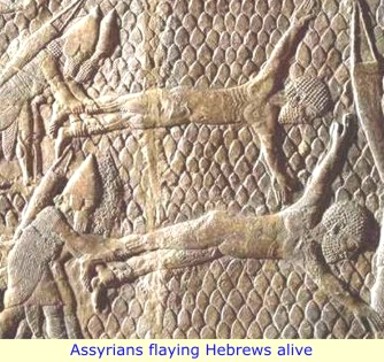
assyrian_flayingThe Assyrian Empire was well known in all of the ancient world for its wickedness and cruelty. One of their kings, Ashurbanipal was accustomed to tearing off the lips and hands of his victims Another Assyrian ruler, Tiglath-Pileser, flayed victims alive and skinned victims alive. The soldiers in the Assyrian army had no qualms about scorched earth military tactics. Typically after destroying an enemy’s fields and cities, they slaughtered the conquered people or hammered iron rods through their noses or lower lips and led them away as slaves. Now, Isaiah had prophesied earlier (7:17) that the Assyrians would successfully invade Israel; and, Jonah of course was familiar with this prophesy.

assyrian_impalementIn Jonah’s day the Assyrians were making forays into the northern kingdom of Israel…sort of pre-invasion attacks. When the Assyrians were doing this…penetrating into a nation they hoped to conquer, they would make a surprise attack upon the city, take captive the women, and then brutally slay the men and children.  Jonah lived in a northern town so perhaps he had personally witnessed some of these attacks. He may have seen his own father and mother brutally slain before his eyes or he might have seen his sisters raped by the Assyrian troops.

I tell you this so you can comprehend Jonah’s hatred of the Assyrians. He understandably wanted nothing to do with helping these brutally wicked people. He knew that if he preached the sermon God had given him to the Assyrians in their capital city of Nineveh there was a chance that they would repent. And if they repented, Jonah knew that our compassionate God would forgive them. Listen to what Jonah said in verse 2 of chapter 4 after that indeed had come to pass, I knew that You are a gracious and compassionate God, slow to anger and abounding in love, a God Who relents from sending calamity.

In his hatred for the Assyrian people Jonah did not want that to happen. Like you and me, so often when we are wronged we don’t want to forgive. Instead we want our oppressors to be punished. We want them to hurt at least as much as they hurt us.

We must learn to yearn not for the punishment of our enemies but for their repentance and the restoration that comes with it. Remember, in Ezekiel 33:11 God says, I take no pleasure in the death of the wicked, but rather that they turn from their ways and live. As author Phillip Yancey says, the reason the gospel is good news in the first place is because, …the free offer of God’s grace extends not just to the undeserving but to those who in fact deserve the opposite.

  • The book of Jonah can ALSO teach us the importance of learning to trust God’s perspective on all people no matter how depraved they may seem.

In II Corinthians 5:16 Paul reminds us that once they embrace God’s grace all believers should, …regard no one from a human point of view. This means that once we become Christians we must look at people not from our own perspectives of hostility. We no longer evaluate them based on our own sensitivities. We learn to view people—all people—the way God does—from a heart of love. We must trust that God sees more than we see. He is able to look at the heart of an individual which is how He knew that the people of Nineveh were ripe for repentance. God looked deep and saw that if the Assyrians heard from Him they would respond and this is why He sent Jonah to these wicked people in the first place. But Jonah didn’t want any part of this. In fact, his hatred of these people consumed him such he abandoned his call to be God’s prophet or spokesman.

God asking Jonah to go to Nineveh would be like him asking you to go to ISIS or North Korea. Even the threat of abuse, torture and death you had to tell them to change their ways.

Jonah couldn’t stand the thought of these people being forgiven and coming into relationship with His Heavenly Father so he reacted with the heart of a jealous, unforgiving son and disobeyed.

Now I think if we are honest with ourselves we will have to admit that we are often just like Jonah. We defy God when He guides us in directions we don’t want to go and it is for this reason that I think it is so important that we study this text because we can learn a great deal about the DANGERS of disobedience from Jonah’s experience. This leads us to another lesson we can learn from this little book:

  • When we disobey God…when we run from Him…the enemy always provides an easy way out.

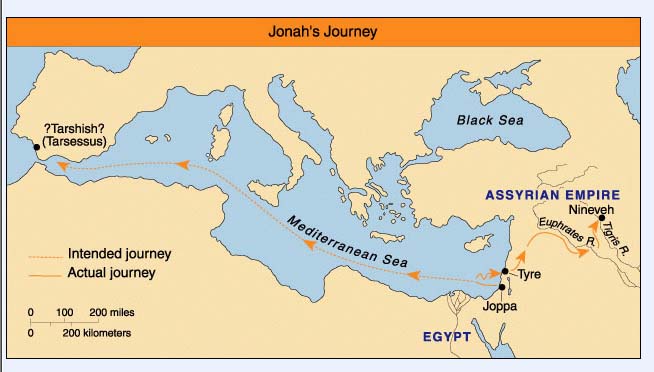
jonahs-journeyGod told Jonah to go east to Nineveh and which direction did he go? WEST. He headed for the port of Joppa and when he got there he just happened to find a boat heading in the right direction.

In fact this boat was bound for the Spanish fishing village of Tarshish which was the westernmost town in the known world at that time. To reach it would require a journey of a year and a half. It was literally as far as Jonah could go in that direction away from Nineveh.

Now, do you think it was a coincidence that there just happened to be a boat heading in that direction at that time? I don’t, because the devil always makes it easy for us to disobey God. In Matthew 7:13 Jesus warned us of this when He said, Wide is the gate, and broad is the road that leads to destruction and many enter through it. If you want to disobey God; if you want to do things that are against His will you can make that choice and count on plenty of opportunities.  But be forewarned; satan will never do anything to help you get anywhere but closer to pain and heartbreak, which is exactly what happened to Jonah.

In the next post we’ll examine more about God’s work in the world and look at the fact that he is in control:  of the ocean, of a pair of dice, a large fish and many circumstances around us.

Until next time,

Darrell

www.Upwards.Church

Watch Messages: YouTube-Upwards Church

Facebook: Upwards Church

Posted in Runaway- Jonah | Tagged , , , , , , , , | 2 Comments

Are You a Runaway? – Jonah Introduction

Have you ever tried to run away from God?  Jonah is one of the Bible’s most beloved stories but it more than a a big fish story.  It’s a big God story!  It starts with Jonah running from God.   Not running from His anger but running from His mercy.  Jonah can’t understand God’s love for sinners.  We’ll get some surprising discoveries about God from the Old Testament book of Jonah.  But Jonah is not simply about a great fish or whale (mentioned only four times), or a great city (named nine times), or even a disobedient prophet (mentioned eighteen times). It’s about God! God is mentioned thirty-eight times in these four short chapters, and that will be our focus over the next four weeks.    Here’s what we’ll discover about God:

Jonah Chapter 1

  • God still speaks to us. (We’ll learn the ways He speaks to us today.)
  • When God speaks to us, He may tell us things that we don’t want to hear initially. (It’s okay, for me and most others it takes a while to understand why God’s way is best!)
  • When we run from God he continues to pursue us.
  • God is always reaching out to unbelievers in many ways.

Jonah Chapter 2 

  • God is in control.  (There is no place that God is not at work.)
  • God sometimes gives us difficult situations to get our attention.
  • God knows that often the ONLY thing that brings us humbly to prayer is a hard situation.
  • God is there when we are broken.
  • God always hears us when we pray.

Jonah Chapter 3

  • God gives each of us second chances!
  • God uses our obedience to do great things.
  • God is working all around us.
  • God’s Judgment is changed when we decide to change.

 Jonah Chapter 4

  • God is compassionate and merciful.
  • God is patient with our bad attitudes.
  • It’s ok to be angry with God.   (But what should we do next? We’ll learn how to respond when we’re angry at God.)

 Though the Bible consists of sixty-six different books, it tells only one story; there is hope and redemption for everyone!  God keeps communicating that message to us, even though we don’t always listen, even when we run, or get angry, God is there, He is loving and He is patient.  I hope you can join us for our series and learn about God’s great love for all people, especially those who Runaway!

Darrell

www.Upwards.Church

Watch Messages: YouTube-Upwards Church
Facebook: Upwards Church

Posted in Runaway- Jonah | Tagged , , , , , , | Leave a comment

Leviticus on the Mount – Leviticus 19

Leviticus is one of the most feared books in the entire Bible. Many Christians choose not to read it at all, or else assume it is uniformly antiquated and irrelevant. Leviticus is the book where New Year’s Resolutions to read the whole bible die!  If you’ve ever picked up the Bible, intending to read it straight through, my hunch is that you got through Genesis and Exodus fairly well (possibly beginning to drag in the last part of Exodus), but when you hit Leviticus your bible reading came to a screeching halt.

I admit, it’s not the easiest book of the Bible to read, and it does contain directives that are strange and difficult to understand, let alone follow. It’s also been weaponized against gays and lesbians which back fires as crazy examples hair styles, clothing choices and stoning are fired back to show of how far from reality this book may appear.  Yet if we throw the proverbial baby out with the bath water then miss what God is trying to accomplish through it.  If we are willing to call it “God’s Word,” then what are we to do with it?  Does it apply today?  Yes! Did Jesus refer to Leviticus?  Yes!

This weekend we will hear from of Leviticus 19, which is part of what is known as the “Holiness Code.” That title comes from an oft-repeated phrase in this part of Leviticus, “You shall be holy, for I the Lord your God am holy.” Our passages in chapter 19 underscores many different actions that are indicative of holiness: compassionate treatment of others, especially the hungry and foreigners; not stealing or lying; just dealing with money and finances; resisting the lure of hatred against your neighbor. In fact, you may be surprised to learn that Leviticus 19 is where we get the “Golden Rule”: love your neighbor as yourself. Yes, this is a challenging but beautiful section of the Bible, and it unquestionably informed the life and ministry of Jesus.

Jesus took passages from Leviticus 19 and built on it in the Sermon on the Mount, which we’ll also hear this weekend. Jesus teaches that we are called not only to not hurt others, but to actually work for their betterment and peace. We are called not only to love our friends, but also our enemies. We are called not only to give to people in need, but to give generously and sacrificially. Jesus teaches us that holiness is not simply something we accomplish by going through the motions. It is what happens when our actions and our hearts are aligned, and our whole lives begin to be oriented to goodness and justice.

If this seems crazy and hard, maybe that’s the point. As we’ll hear Jesus say in the Sermon on the Mount, “If all you do is love the lovable, do you expect a bonus? Anybody can do that. If you simply say hello to those who greet you, do you expect a medal? Any run-of-the-mill sinner does that. In a word, what I’m saying is, Grow up. You’re kingdom subjects. Now live like it. Live out your God-created identity. Live generously and graciously toward others, the way God lives toward you.”

Main Idea: Jesus took passages from Leviticus 19, taught them, and applied them so that His disciples can live out the principles behind them.

Here’s my outline:

17 “Do not think that I have come to abolish the Law or the Prophets; I have not come to abolish them but to fulfill them…Matthew 5:17-19 (NIV)

  •  Deal with Anger, Seek Reconciliation

 17 “‘Do not hate your brother in your heart. Rebuke your neighbor frankly so you will not share in his guilt. 18 ‘Do not seek revenge or bear a grudge against one of your people, but love your neighbor as yourself. I am the LORD. Leviticus 19:17-18 (NIV)

 21 “You have heard that it was said to the people long ago, ‘Do not murder, and anyone who murders will be subject to judgment.’ 22 But I tell you that anyone who is angry with his brother will be subject to judgment. 23 “Therefore, if you are offering your gift at the altar and there remember that your brother has something against you, 24leave your gift there in front of the altar. First go and be reconciled to your brother; then come and offer your gift. Matthew 5:21-24 (NIV)

  • Forget Getting Even, Give and Serve.

19 If anyone injures his neighbor, whatever he has done must be done to him: 20 fracture for fracture, eye for eye, tooth for tooth. As he has injured the other, so he is to be injured. Leviticus 24:19-20 (NIV)

 38 “You have heard that it was said, ‘Eye for eye, and tooth for tooth.’ 39 But I tell you, Do not resist an evil person. If someone strikes you on the right cheek, turn to him the other also. 40 And if someone wants to sue you and take your tunic, let him have your cloak as well.  41 If someone forces you to go one mile, go with him two miles.  42 Give to the one who asks you, and do not turn away from the one who wants to borrow from you. Matthew 5:38-42 (NIV)

  • Before Judging Others, Judge Yourself

 15 “‘Do not pervert justice; do not show partiality to the poor or favoritism to the great, but judge your neighbor fairly. 16 “‘Do not go about spreading slander among your people. “‘Do not do anything that endangers your neighbor’s life. I am the LORD. Leviticus 19:15-16 (NIV)

 1  “Do not judge, or you too will be judged. 2 For in the same way you judge others, you will be judged, and with the measure you use, it will be measured to you. 3 “Why do you look at the speck of sawdust in your brother’s eye and pay no attention to the plank in your own eye? 4  How can you say to your brother, ‘Let me take the speck out of your eye,’ when all the time there is a plank in your own eye?  5 You hypocrite, first take the plank out of your own eye, and then you will see clearly to remove the speck from your brother’s eye. Matthew 7:1-5 (NIV)

Have a great weekend!

Darrell

www.Upwards.Church

Watch Messages: YouTube-Upwards Church

Facebook: Upwards Church


Sources:
http://www.transfiguration.net/leviticus-holiness-and-the-sermon-on-the-mount/
 http://www.transfiguration.net/leviticus-holiness-and-the-sermon-on-the-mount/
Posted in Hot Seat - Leviticus | Tagged , , , , , , , , , | Leave a comment