Jesus the Bread of Life – John Ch. 6

What do you want from Jesus?

Is it material gain, financial blessings or perhaps family harmony or happiness?   What about a checklist of things to do to so that you feel better about yourself? Or would you seek a miracle from Jesus to really prove his existence?

What if Jesus never gave you any of these things?  Would you walk away?

These are probing questions that hit us deeply.   In this chapter I asked myself these questions.  I also wondered what it would take for me to walk away from Jesus.  Would I still follow him if he never gave me anything else besides salvation?

In John Chapter 6 Jesus performs the miracle of feeding thousands of people.  Large crowds continue to follow Jesus, but for the wrong reasons.  Jesus reveals who he is and what he is about.  Many people deserted Jesus that day.

Jesus continues to draw people to him today but many lose interest and stop following when Jesus does not give them exactly what they demand.

 So here are the questions that Jesus addresses:

What Do I Want From Jesus? 

 1. Do I Want Jesus For Material Gain?

Many of the people who followed Jesus at this point were hoping for a political savior. They wanted political solutions, free handouts, and material goodies. For them Jesus was the latest and greatest gravy train. These people had watched Rome have limited success by instituting a sort of welfare program that they called a Bread for Peace. There were many hungry, jobless, homeless people in Rome. So the government tried to avoid riots by buying them off with goodies. The plan backfired, because the demands of the crowd simply grew and grew.

Well, Jesus knew that he faced a similar problem the day after he fed the masses with barley cakes and salt-dried fish. In fact, when the crowd arrived, look at how he greeted them. He said: 26 Jesus replied, “The truth is, you want to be with me because I fed you, not because you saw the miraculous sign.  John 6:26

On a very minor scale, I can see how Jesus felt.  When I have put out a bird feeder, I can look out the window to see a menagerie in the back yard.  Birds were all over the ground and the deck: Cardinals, finches, titmice, Chickadees and sparrows.  But do they appreciate me?  Did they have any sense of loyalty in return for my generosity? When the bird feeder is empty, the birds completely desert me.   I know as a parent, I provide and pay thousands of dollars to raise them, but for one of them it never is enough.  That hurts.  I think Jesus feels the same way.

Missionaries in third-world countries often talk about “Rice Christians.” These are people who will quickly convert to Christianity in exchange for food or some other physical benefit. The problem with Rice Christians is that when goodies are gone, so are they.
American Christians are not so different. Too many people use church for business contacts or community status. Rice Christians can be found all over the world. These people look to God only for what they can get. They are quick to turn their back on God the first time he fails to deliver.

Jesus told the crowd: 27 But you shouldn’t be so concerned about perishable things like food. Spend your energy seeking the eternal life that I, the Son of Man, can give you. For God the Father has sent me for that very purpose.”  John 6:27

Those seeking material gain turned away from his message. Others would eventually turn away also such as those wanting a set of rules to follow.

  1. Do I Want Jesus For Rules Or Religion?

They asked him, “28 They replied, “What does God want us to do?” John 6:28

If these people couldn’t get a free lunch, they at least wanted a list of rules they could hang on to. I never cease to be amazed that religion, by its very nature, draws some people who are actually looking for a dominating, charismatic leader to call the shots and take over their lives. There is a new cult group on every corner these days led by a control freak who turns his followers into some sort of robots.

Throughout Christian history, the church has often fallen into the sin of legalism. The problem is, it’s easier to make rules than to build relationships. Jesus wants to live in the heart of every individual believer. He has sent his Spirit to write His Law on our hearts. He calls every one of us to study His word for ourselves and learn from Him. When we do that, the church enjoys an amazing unity in morals and principles. That’s why you won’t find our congregation publishing a list of Do’s and Don’ts. Instead, we want to teach the scripture and to encourage everyone to seek a personal relationship with the Lord.

But some people simply don’t want a relationship with God. They’d rather find a strong leader and memorize a set of rules. Jesus had no interest in these kind of followers. Jesus came to build relationships, not rules.

When the crowd demanded a list of works, Jesus gave this surprising answer: “”This is what God wants you to do: Believe in the one he has sent.” John 6:29

As amazing as it sounds, Jesus wants a genuine love relationship with every one of us. That kind of relationship can’t be bought with goodies, and it can’t be built on rules. The material gain crowd wanted the goodies more than they wanted God. The Rules and Religion crowd wanted the law but not the giver of that law. They rejected Jesus as a replacement for the rule-keeping religion of that day. And one more group walked out on Jesus that day. They were those seeking emotional sensation.

3.  Do I Want Jesus For Emotional Sensation?

 These people asked Jesus this absurd question: 30 They replied, “You must show us a miraculous sign if you want us to believe in you. What will you do for us?  John 6:30

Think about it. Jesus had just fed over 5,000 people with 2 fish and 5 loaves of bread. The very next day, they are asking him for a SIGN! Obviously the miracle of feeding the 5,000 gave them enough faith to climb in boats and row all the way across the lake to find Jesus. But yesterday’s miracle was not enough to last until the next morning.

We have plenty of these kind of churchgoers in America today. Some have called  these kind of people “pep rally believers.” Keep them “wowed” and you’ll keep them around; bore them and they are gone. These people crave spiritual excitement. They love spectacular entertainment. They want new experiences all they time. They want Jesus to take them from one mountaintop experience to the next with no valleys in between. They want all kinds of rewards but no responsibility.

It reminds me of a quote attributed to Ronald Reagan. When the nation was mourning over his death, the news was been full of stories about his life. One commentator remembered something he said about the fickle public. Ronald Reagan said: A baby is a lot like the American public: Insatiable appetite at one end and total lack of responsibility at the other end.

Churches today are filled with these kind of people. Insatiable appetite for spiritual excitement, but total lack of responsibility toward the Lord Himself. The sad truth is that many believers are very fickle. That’s why so many people hop from church, to church, to church — always looking for the newest style, the latest seminar, the most electrifying concert, and the most exciting presentation. The American church scene is clogged full with “Forty days of this…” fifty day adventure to that… “Seven habits” of successful whatever… “21 irrefutable laws” and on and on…” It never ends.  Now, I’m not saying these things are bad. We need to focus on special emphasis now and then, and some of these programs are helpful. But it’s way too easy for church-going crowds to start chasing after the latest fad in the religious world.

Jesus did not come to give us endless spiritual highs. He came to give us a chance to know Him.

The response of the crowd tells us a lot about the difference between what people WANT and what people NEED. So often the very thing people need the most is the last thing they are looking for.   In the next post, I’ll cover what we need from Jesus.

Darrell

www.RidgeFellowship.com

Posted in Explicit Jesus - Gospel of John | Tagged , , | Leave a comment

Jesus the Living Water – John Ch. 4

Are You Satisfied?  Our bodies thirst; so do our souls. But our souls need spiritual water. We don’t generally deprive our body of water when we thirst. Why then should we deprive our soul? In John chapter 4 we see that the Jesus loves us and can satisfy our thirsty souls, like he did for the woman at the well.

 Jesus Talks to a Woman at the Well

 Jesus had to pass through Samaria on his way to Galilee. In Jesus’ encounter with the Samaritan woman and with the Samaritans in Sychar, he revealed that he is the expected Messiah.

 (Jesus) had to go through Samaria on the way. 5Eventually he came to the Samaritan village of Sychar, near the parcel of ground that Jacob gave to his son Joseph. 6 Jacob’s well was there; and Jesus, tired from the long walk, sat wearily beside the well about noontime

The trip made Jesus tired. He had walked from Judea to Sychar—a trip that probably took two days. Jesus’ weariness shows his true humanity. He waited while his disciples, more rested, or hungrier, than he, went to find food. He never seemed to worry that the limitations he took in becoming human might somehow undermine his claims to be the Son of God. Such expressions about Jesus’ humanity help us identify with him. So he sat wearily beside the well at about noontime, the hottest part of the day.

7 Soon a Samaritan woman came to draw water, and Jesus said to her, “Please give me a drink.” 8 He was alone at the time because his disciples had gone into the village to buy some food. 9 The woman was surprised, for Jews refuse to have anything to do with Samaritans. She said to Jesus, “You are a Jew, and I am a Samaritan woman. Why are you asking me for a drink?”

Where did these prejudices come from? Samaria was a region between Judea and Galilee where Jews of “mixed blood” lived. In Old Testament days, when the northern kingdom of Israel, with its capital at Samaria, fell to the Assyrians, many Jews were deported to Assyria. King Sargon of Assyria repopulated the northern kingdom with captives from other lands to settle the territory and keep the peace (2 Kings 17:24). These captives eventually intermarried with the few Jews who remained in the land to form a mixed race of people who became known as Samaritans. The Jews hated the Samaritans because they were no longer “pure” Jews. The Jews who lived in the southern Kingdom felt these Jews had betrayed their people and nation through intermarriage with foreigners. And the hatred continued down through the years.

  • Jesus Loves Me Regardless of My Past

The woman came to the well with shame on her mind. She was avoiding human contact, but the stranger at the well was probably little more than an inconvenience. How often at the supermarket, gas station, or even in church do we pass by people loaded down with guilt. They find themselves having to pursue life’s necessities, hoping to avoid anyone who knows their real needs. Dreading judgment and rejection, they live in fear. And yet, when shown real concern,     these same people find great relief in unburdening themselves. When you greet someone with “How are you?” do you stop long enough to show him or her that you really want to know? From Jesus we learn that simple caring is a gift valued infinitely more than it costs to give.

Two facts are unusual about the woman’s actions: (1) she could have gone to a closer well (scholars have identified wells that were closer to Sychar); (2) women generally drew water later in the day, when the temperature was cooler. This woman, whose reputation seems to have been well known in the small town (4:18), probably chose the well farther away from home and came to that well at an unusual hour in order to avoid contact with other women. It was also highly unusual for a man to address a woman, but Jesus said, Please give me a drink. Again, this statement reveals Jesus’ true humanity; he was really thirsty. Even though such a request startled her (4:9), it drew her into a conversation with Jesus.

No Prejudices with Jesus

This woman (1) was a Samaritan, a member of the hated mixed race, (2) was known to be living in sin, and (3) was in a public place. No respectable Jewish man would talk to a woman under such circumstances. But Jesus did. or Jesus to ask for a drink of water from a utensil belonging to a Samaritan woman was to go against the accepted prejudices of the time.

Jesus and his love is for every person, no matter what his or her race, social position, religious orientation, or past sins.  Jesus crossed all barriers to share the gospel, and we who follow him must do no less—even if misunderstood.

  • Jesus Loves to Give Me Something Lasting

10 Jesus replied, “If you only knew the gift God has for you and who I am, you would ask me, and I would give you living water.”  11 “But sir, you don’t have a rope or a bucket,” she said, “and this is a very deep well. Where would you get this living water?  12 And besides, are you greater than our ancestor Jacob who gave us this well? How can you offer better water than he and his sons and his cattle enjoyed?” 

13 Jesus replied, “People soon become thirsty again after drinking this water.

14 But the water I give them takes away thirst altogether. It becomes a perpetual spring within them, giving them eternal life.” 15 Please, sir,” the woman said, “give me some of that water! Then I’ll never be thirsty again, and I won’t have to come here to haul water.” 

Jesus makes an extraordinary offer to this woman—living water that would quench her thirst forever.    

People need water daily because they soon become thirsty again. The water from Jacob’s well would indeed satisfy the woman’s thirst, but only temporarily. So also are all the other “drinks” of life—they never satisfy. Some of them even create more thirst. The human needs for love, food, sex, security, and approval, even when met, do not give complete satisfaction. Attempts to find full satisfaction will lead only to disappointment and despair. But the water Jesus offers takes away thirst altogether. Jesus’ “water” continually satisfies the desire for God’s presence because it becomes a perpetual spring within them, giving them eternal life. The gift that Jesus gives—this perpetual spring—suggests the availability, accessibility, and abundance of the divine life for believers.

The woman’s response reveals that she took Jesus’ words literally. The woman must have been thrilled to think that this man could give her water that really quenches thirst and would not have to be drawn from a well. Obtaining water was hard work—requiring trips to the well twice a day and carrying heavy jars full of water home. If she had some of that water, she would never be thirsty again and wouldn’t have to haul water every day.

Many people who claim to be Christians admit they feel unhappy and dissatisfied over the same problems mentioned by nonbelievers. Feelings of low self-esteem, lack of love, loneliness, and struggles over sex, money, work, and position in life are often as severe with believers as with unbelievers. Are differences between Christians and non-Christians merely on the surface or even imaginary? Did Jesus overstate his claim? Questions like these come from interpreting Jesus’ words as the Samaritan woman did—expecting that physical thirst and all other life-related needs will be satisfied by Jesus’ “living water.” But that is not what Jesus promised. He offered freedom within life, not freedom from life! Later he told his disciples in no uncertain terms: “In this world you will have trouble. But take heart! I have overcome the world” (16:33 niv). Believers will experience many of the same difficulties encountered by unbelievers, but the presence of Jesus in our lives should make a significant difference in the way we respond. Living water gives us spiritual power to face the challenges of living, not escape from them.

·       Jesus Wants Me to See My Emptiness Before I Can be Filled

16 “Go and get your husband,” Jesus told her. 17 “I don’t have a husband,” the woman replied. Jesus said, “You’re right! You don’t have a husband— 18 for you have had five husbands, and you aren’t even married to the man you’re living with now.” 19 “Sir,” the woman said, “you must be a prophet….

Jesus abruptly shifted the subject from his living water to her style of living. The woman perceived her need for living water at one level; Jesus knew that her need was far deeper, so he turned the conversation to reveal his knowledge of her personal life—and her sin of adultery. By asking her to go and get her husband, Jesus wanted to make this woman see her sin and her need for forgiveness and then offer her the living water—salvation. She must have realized that this was not a man who could be fooled, for she answered transparently, “I don’t have a husband.” The woman spoke the truth without any explanation.

Although he confronted the woman’s sinful life, Jesus managed to affirm her truthfulness. He did not accuse or excuse; he simply described her life so that she could draw some clear conclusions about the mess in which she was living. The conclusions we reach without knowing the facts will usually err in one of two directions: We will accuse others and raise their defenses, or we will excuse others and enable their denial. We see in Jesus’ communication with this woman that when faced with an accepting confrontation, people will often respond positively.

The woman acknowledged the truthfulness of Jesus’ remarks about her life. At the same time, she recognized that he must be a prophet who had the power to “see” the hidden past as well as the future. The theme of people “seeing” Jesus appears several times in John.  The persons Jesus encountered saw him many different ways, but he consistently directed their attention to recognize him for who he really was—their Savior.

 The discussion had reached a point at which the Samaritan voiced her hope that someone would eventually be able to settle all her questions and problems. Sooner or later, in a conversation on life, people will reveal their hope. They will tell us what they rely on when worldly answers fail. At those times, we certainly should reveal our hope. Peter reminds us to “quietly trust yourself to Christ your Lord, and if anybody asks why you believe as you do, be ready to tell him, and do it in a gentle and respectful way” (1 Peter 3:15 tlb). Unlike Jesus, we cannot claim to be the Answer, but if we believe in Jesus, we can claim to know the Answer. When someone says, “Someday I’ll figure it all out,” we ought to respond, “I know someone who has the answers today!”

·       My Response to Jesus’ Love is to Tell Others about Him.

25 The woman said, “I know the Messiah will come—the one who is called Christ. When he comes, he will explain everything to us.” 26 Then Jesus told her, “I am the Messiah”!
27 Just then his disciples arrived. They were astonished to find him talking to a woman, but none of them asked him why he was doing it or what they had been discussing. 28 The woman left her water jar beside the well and went back to the village and told everyone, 29 “Come and meet a man who told me everything I ever did! Can this be the Messiah?” 30 So the people came streaming from the village to see him.

Beyond displaying the woman’s excited state of mind, her action of leaving her water jar beside the well as she went back to the village has several significant explanations: On the one hand, it speaks of the woman leaving behind her water jar representing her thirst for true life and satisfaction; on the other hand, it also reveals her intention to return. The water jar was a valuable and practical household object. But as useful as it was to get water from the well, it was useless for obtaining the water of life. However, she had just met someone who promised living water and who had displayed intimate knowledge of her life and profound understanding of spiritual truths. We can’t be sure how much she understood of what Jesus had told her, but she was convinced that everyone in town ought to hear what he had to say.

In essence, the Samaritan woman was saying that Jesus could have told her everything about her life, for in telling her about her relationships with various men, he revealed his knowledge about her history. She made no promises about what Jesus might know about everyone else, but she appealed to their curiosity. What was it about this stranger that could make a woman who had every reason to be ashamed of her life now speak publicly about her experience of transparency before him? Yet she said to the townspeople, “Can this be the Messiah?” Her invitation proved irresistible. She probably knew that her reputation preceded her, and any assertion on her part regarding her belief in this man would go unheeded. But her question did serve to stir up curiosity and had the desired effect—the people came streaming from the village to see him.

 What To Leave Behind

When we return to the world of family and friends after encountering Jesus, there are two kinds of “water jars” we must leave behind:

  1. We must leave behind our shame about the past. Because Jesus knows all about us, we can repent and receive his forgiveness. God may use the emptiness of our past life to help us convey to others the wonder of forgiveness. But we must not dwell on or carry guilt about the past.
  2. We must leave behind some habits and pleasures. Certain pleasures and relationships (not bad in themselves) may hinder our living for Christ and telling others about Him. The water jar would have slowed the woman down. She probably retrieved it later, but was not concerned about it in the light of her discovery.

Even though we know that our old way of living never truly satisfies, the tempter deceives us into believing that there still may be an instant, easy source of happiness in the old empty ways. Have you turned your back on old habits, old treasures, old pleasures in order to seek what only God can give?  Leave them behind and satisfy your thirst in Christ.

Darrell

www.RidgeFellowship.com

Sources:
— Life Application Bible Commentary
— Life Application Concise New Testament Commentary


Posted in Explicit Jesus - Gospel of John | Tagged , , , , | Leave a comment

Jesus Gives New Life – John Ch. 3, Part 2

I enjoy jokes about people showing up at the pearly gates, seeking entrance into Heaven and are met by Saint Peter.  Like this one:

Three men died and were standing at the pearly gates. “What have you done to deserve Heaven says Saint Peter?” The first man was a police officer who enforced law and fought crime. Peter says, “OK, go on in!”  The second man was very wealthy man and gave lots of money to charitable causes. Peter say, “OK, go on in!” The third man was a director of an HMO organization. He had helped save millions of dollars for health care and insurance companies. He had helped cut down on waste, fraud, and abuse in the system. Peter says, “OK come on in, but you can only stay for 3 days!”
While many of these jokes bring a smile to our faces, behind most of them is the false assumption that we must we can earn our way into Heaven.  It is shocking to people to hear that they can’t do anything to earn entrance into Heaven.  This is exactly the truth that Jesus is sharing with Nicodemus in John chapter 3.  It’s not about our works or religion.   Salvation and new birth is about Jesus and what he did!   That’s the message that Jesus had for Nicodemus… That’s the plan that God has for us.  In today’s post Jesus shares with Nicodemus the words that have become known as the “Gospel in a nutshell” John 3:16.

Before we get there Jesus is still explaining to Nicodemus the concept of “New Birth” spiritually.

8 The wind blows wherever it wants. Just as you can hear the wind but can’t tell where it comes from or where it is going, so you can’t explain how people are born of the Spirit.”
9 “How are these things possible?” Nicodemus asked
.

We see from this dialogue that it is OK to

  • Ask Questions    In addition to asking questions I must also…
  • Be Honest

Many times people that claim to be seeking are just looking for justification to live the way they want.  We must be honest.  Don’t let anything stand in the way of eternity, not pride, tradition or selfishness.

  • Understand My Greatest Need

What each of us needs to understand is the message that Jesus gave to Nicodemus In order to have acceptance with God into his kingdom, there has to be a personal, individual change that takes place. See, Nicodemus greatest need was not for Religion, Tradition, or Position.  His need was to be changed. He didn’t need to be taught by the Teacher; he needed to be birthed by the Spirit.
Why do you go to church, read the bible or pray? Do you want to hear some principles from God’s Word that you figure will help you live life a little more peacefully? You can find those. Do you want to make some new friends? You can find that too. Do you want some more business contacts to sell to?  Or did you come to Jesus in order to be changed by Him – not cleaned up, not overhauled, not refurbished – but completely and utterly changed. If that’s what your need is, then you’re at the right place. That is your greatest need.

I Need to Respond to Jesus      

Start my Spiritual Renewal by responding to Jesus’ invitation. Jesus answered and said to Nicodemus, “I tell you the truth, unless you are born again, you cannot see the Kingdom of God.’’ (verse 3) Jesus answered, “I assure you, no one can enter the Kingdom of God without being born of water and the Spirit.” (verse 5) Twice Jesus answered. Twice the condition given by Jesus was the new birth. Twice the ultimate fulfillment of these conditions was entrance into the kingdom of God.  Jesus gave the invitation: “Come on in!   He gives the same invitation today to you.  Come on in!

Jesus further explains who he is,
13 No one has ever gone to heaven and returned. But the Son of Man has come down from heaven.
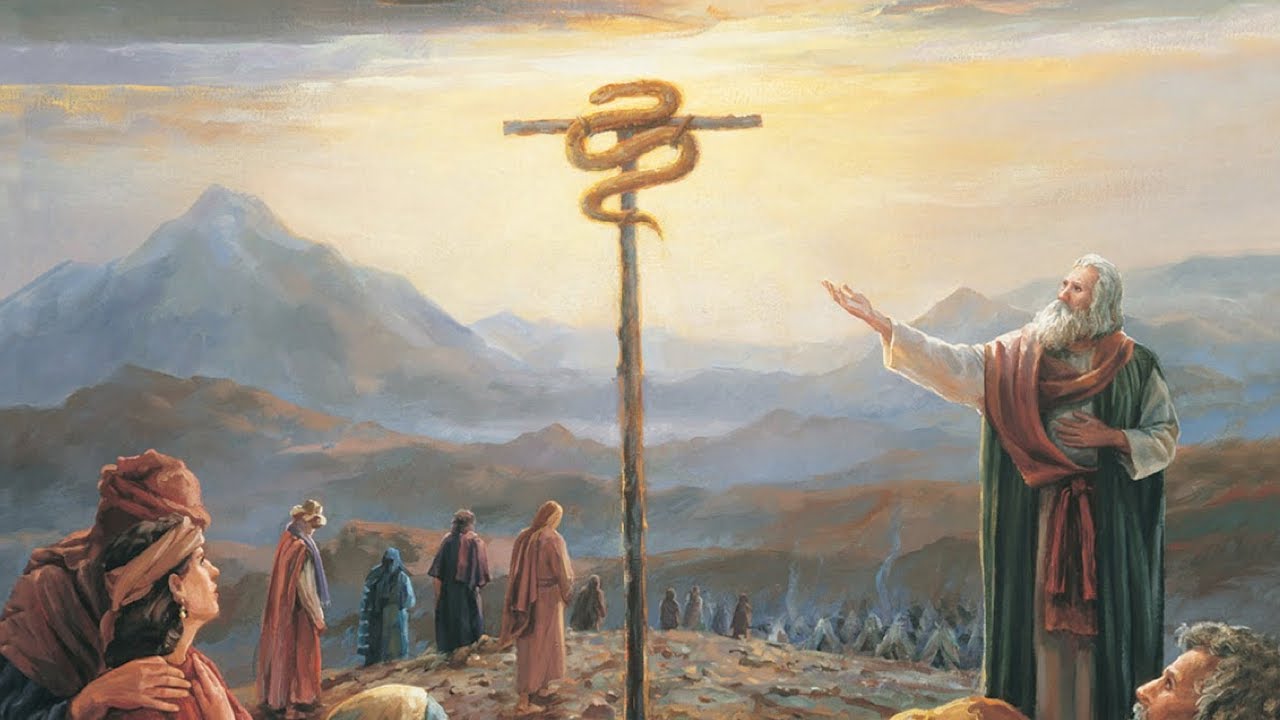
14 And as Moses lifted up the bronze snake on a pole in the wilderness, so the Son of Man must be lifted up,
15 so that everyone who believes in him will have eternal life.

To emphasize his point, Jesus turns to a familiar OT story. He refers to the desert incident when God sent venomous snakes into the Israelite’s camp because they kept complaining and not doing as God asked them to do.   The venomous snakes that lived in the region are called. “Palestinian Vipers.”    Her’s a picture of one:

As these snakes began to strike the people, the people became sick and some died.  they cried out to Moses.  Moses prayed and God instructed Moses to make and erect a bronze serpent. And all those who looked up at the serpent were saved. Even so, Jesus would be lifted up on a cross, and those who look to Him will be saved.

Like the Israelites in the desert, we have all been struck down by sin.  Sin has sunk its fangs in our spiritual souls and we are dying. The venom has made its way to our hearts and we are dying in our sins.

But God saw us in our sinful hopelessness, and He made a way. He sent a Savior, who was lifted up on the cross. And now the message is clear, “Believe in Him. Believe in Him. Believe in Him!. Look to the cross. There is healing in the cross. There is a Savior. The new birth comes through a Savior.

Our salvation is driven by the love of God based on our need for healing, and restoration.

From here we find the most popular Bible verse of all times.

16 For God loved the world so much that he gave his one and only Son, so that everyone who believes in him will not perish but have eternal life.

I read a story about an instant cake mix that was a big flop… The instructions said all you had to do was add water & bake… The company couldn’t understand why it didn’t sell – until their research discovered that the public felt uneasy about a cake mix that required only water… Apparently, people thought it was too easy…

So the company altered the formula & changed the directions to add an egg in addition to the water… The idea worked & sales increased.

That story reminds me of how people react to the plan of salvation or being born again.  To them, it sounds too easy & simple to be true.  Unlike the cake mix manufacturer, God has not changed His “formula” to make salvation more marketable… The gospel we proclaim has nothing to do with being good enough, its about Jesus and that he was good enough.  It’s not about us, its about Jesus.  It’s about grace.  Grace goes beyond human comprehension. By our nature, we want to merit God’s favor. The shocking revelation of Jesus about the scandal of grace challenges our normal way of thinking.

Here are the Steps to Spiritual Rebirth

Psychologists say that there are three steps to change.  First, realize the need to change – what they call dissonance. Second, have a desire to change. Third, commit to changing. Simply put, it is I should change, I want to Change, and I have Changed.  It’s a decision we make not a deed we do.
Christianity has talked about those same three steps for generations. The biblical words are Conviction, Repentance, and Rebirth.

  1. Conviction“I need to change”
  2. Repentance“I am moving away from my old life and towards Christ. My mind is changed!”
  3. Rebirth/Conversion“I’m committing myself to Christ. I’m breathing in the new life spiritually that Jesus offers.”

We recognize that these are not steps that we can take by ourselves. The Holy Spirit is involved in each step.  The Holy Spirit convicts us of sin in our life and our need for him.  We repent because of the Holy Spirit’s work in our life and then when we move towards God then he supernaturally gives us new life.

Nicodemus was radically challenged and went away different than he came.  This story ends well, eventually; Nicodemus experienced a spiritual renewal of his own.  We read of him defending Jesus before the Pharisees as they were plotting against him — earning him a severe rebuke (John 7:50-51). He also shows up after the crucifixion of Jesus and helps Joseph of Arimathea anoint the body of Jesus, wrap it and bury it (John 19:38-40). Both of these acts were done at great personal risk, and possibly got him expelled from the Temple. Something had happened to the heart of Nicodemus. He could have held on to his title as a religious teacher in Israel and resented that Jesus was trying to teach him something, but he humbled himself and experienced a new birth.

I hope you will do the same.  We need to see the verses after John 3:16 which are just as important:

17 God sent his Son into the world not to judge the world, but to save the world through him.
18 “There is no judgment against anyone who believes in him. But anyone who does not believe in him has already been judged for not believing in God’s one and only Son.

The choice is ours, spiritual renewal in Jesus Christ or judgment and spiritual death.  Will you chose Christ?

Darrell

www.RidgeFellowship.com


Posted in Explicit Jesus - Gospel of John | Tagged , , , , , | Leave a comment

Jesus Gives New Life – John Ch. 3

Do you enjoy spending time outside?  I do and enjoy hiking, camping, fishing hunting or any sport.  One hazard of being in the “great outdoors” is the possibility of being bitten by a venous snake.  Let me show you some pictures of what can happen.

As you can see from these pictures, to be bitten by a poisonous snake is bad news.  Snakebite victims need healing and a physician’s care.  Today we will see that we are all in need of healing, and a renewal to our souls.  We have been snake bitten spiritually.  We need to seek the Great Physician to bring renewal and healing to our poisoned spiritual lives.

As we continue to look at the Gospel of John we see a dialogue with Jesus and a man named Nicodemus about this very thing.

Jesus is in Jerusalem, he just had celebrated Passover the last verses of chapter 2 tell us.  While in Jerusalem Jesus does some more miracles that show his divine nature and gets a visit by a man by the name of Nicodemus.  

Nicodemus was a seeker – a person who was sincere in his quest for the kingdom of God but, nevertheless, a spiritual failure in spite of all his religious knowledge and enthusiasm. Here was a sincere man with a sincere hunger for truth who came to have a private talk with Jesus in the quietness of the night away from those who would distract. He was the original “Nick at Night” He came to Jesus at night so that he could have a private conversation concerning his own very personal needs.
Jesus had something he did not have. Nicodemus, like each of us, was seeking for that something more in life – looking, longing for spiritual bliss and truth to fill the hole that’s felt in the heart. Nicodemus was a man whose whole life was a religious exercise yet he realized that Jesus had something he did not have.
One of the messages of John 3 is just that! You may have all sorts of Spiritual activity having all the trappings of faith. You may have been to church more times than you can count, had a routine of Bible reading and praying, maybe even taught Sunday school or Vacation Bible School. But that is not enough to give you true eternal life that is born from above and felt deeply in the heart.
1 There was a man named Nicodemus, a Jewish religious leader who was a Pharisee.

Now, it must be said up front that Nicodemus was no ordinary citizen. He was respected. He was religious. A Pharisee who gave his life to studying and obeying the Law and traditions. He was a ruler. He had it all from an outward perspective. He was a well-respected, admired Jewish citizen that people would have considered a role model.   Nicodemus stands as a contrast to what is needed to reach heaven.

In My Quest for Spiritual Renewal know that…

  • Tradition or Heritage is not enough

Nicodemus was a Jew.  The Jewish people believed that because of their heritage, because they were children of Abraham, they were God’s people who were headed to heaven.   Jesus lets Nicodemus see that Tradition and heritage is not enough.   The same is true of you if you are depending on the faith of your parents or your citizenship.  They may be great and impressive but not enough to give you eternal life.  It would be like being at the doctor for a snake bite and saying, “but I’m an American, won’t that heal me?”

  • Position or Power is not enough

Nicodemus was one of the 70 who comprised the Sanhedrin. In essence, he was a member of the Jewish Supreme Court.  Nicodemus was a part of the religious elite. He had a distinguished religious position.

But a certain position does not save you. Being a pastor does not save you. Being a small group leader or a children’s teacher does not save you. Positions do not save or give eternal life.  Again if your at the doctor for a snake bite it does no good to say, I am a CEO of a large corporation I will not need treatment.

  • Religion or Knowledge is not enough

Nicodemus possessed great religious knowledge. As a member of the Pharisees, he knew and lived what was considered right and wrong. He was religious to the core. The Pharisees went to drastic measures to make sure they obeyed the letter of the law. They fasted and prayed and studied the Scriptures. They went to great lengths to obey not only the law but also the man-made rules of tradition that kept them from breaking the law.  They lived spiritually disciplined lives, but they were lost. He was religious and lost. The Pharisees were right in many areas of doctrine, but they made one primary mistake: they externalized religion. Outwardly, they lived above reproach.

Religion is not enough. You can come to church, tithe, go to Small Group, pray, witness, and practice spiritual disciplines and yet still be lost. You can do all the things that religious people do and be without Christ. Religion does not save. Knowledge doesn’t save you either you can read your Bible, lead a small group, even memorize the entire Bible-it is not enough.  I have heard so many people say, “I live a good life. I try to do what is right. I go to church. Etc.” It is not enough to get you to heaven.

For Spiritual Renewal I Need to Seek Jesus

2 After dark one evening, he came to speak with Jesus. “Rabbi,” he said, “we all know that God has sent you to teach us. Your miraculous signs are evidence that God is with you.”

Nicodemus is a seeker; he had deep respect and interest in Jesus. He was right in seeking Jesus for his answers.  This is the best place to start in your seeking of spiritual truth.  His designation of Jesus as Rabbi shows great admiration for Jesus. To address Jesus with the title “Teacher” reveals Nicodemus’ deep admiration for Jesus. Nicodemus makes Jesus an equal.

He even recognizes Jesus’ ministry as blessed by God. “No one can do these signs that you do unless God is with him,” he asserts. He acknowledges the divine blessing of God upon Jesus. Nicodemus falls into the category of the believers described at the end of chapter 2, he believes in Jesus, but strictly because of the miracles. He is an admirer but not a genuine believer.   There are many like that today.  Let me ask you

Do I only admire Jesus?  

We must move from admiration to action.  Jesus moves the conversation in this direction.  Have you ever been in a conversation where you were talking about one thing, and when you stopped to hear the response from the other person, they began talking about a totally different subject? It’s kind of aggravating because it gives you the impression that they either were not listening or do not consider what you had to say worthy of a reply. I don’t know what kind of response Nicodemus expected from Jesus, but he was shocked by what he heard.   We may at times be shocked by what Jesus says, but we need to listen carefully.

I Need to Listen Carefully to Jesus

Of course, Jesus knows Nicodemus’ heart so he cuts straight to the heart of the matter.   Jesus knows why Nicodemus is really there, so he immediately challenges him.

3 Jesus replied, “I tell you the truth, unless you are born again, you cannot see the Kingdom of God.”

“Born again” – back in 1976, Jimmy Carter was running against President Gerald Ford and you might recall that Jimmy Carter caused a bit of a sensation. Because during his campaign, Jimmy Carter said publicly that he was a “Born again Christian.”  It caused a stir, and it was a term that was used about him over and over again.  To say you are “born-again” has become somewhat trite. It is a familiar term.

But what Jesus is talking about here is a supernatural event. It could also be translated born “from above.” It is a spiritual new birth, a divine regeneration, a spiritual transformation. To be born again is to be made new by the Spirit of God.

Such language and teaching confuses Nicodemus. Predominant religious thought in that day affirmed that all Jews would be admitted to God’s kingdom.  But here Jesus is telling Nicodemus, a respected scholar, that he cannot enter God’s kingdom unless he is born again.

Nicodemus responds,

4 “What do you mean?” exclaimed Nicodemus. “How can an old man go back into his mother’s womb and be born again?”
5 Jesus replied, “I assure you, no one can enter the Kingdom of God without being born of water and the Spirit.
6 Humans can reproduce only human life, but the Holy Spirit gives birth to spiritual life.
7 So don’t be surprised when I say, ‘You must be born again.’

The very words “born again or born from above” tell us volumes about the process involved in becoming one of God’s children.  Think about the first birth you went through, or what you know about it. First off, you were conceived.  And it is obviously not anything you did that brings that about. So it is with our Spiritual conception–God, by the power of His Spirit, brings it about.

Our first birth is the same.  It was the work of your mother, not you.   There may be some help of course. Help from doctors and nurses who assist the mother in the case of our physical birth.  Or help from spiritual midwives, from friends, from evangelists, from neighbors, and those who have been praying for our salvation in the case of our spiritual birth.   In fact, the only thing we have to do on our own is do what our new bodies want us to do–all we have to do is breath.   Breath the air of life, breath the Spirit—which in Hebrew is translated wind or breath.   How can a person be born again?

All it takes is wanting to breath the breathe of God.  Be willing to trust the Holy Spirit.  Being born again involves surrendering.  Being willing to be pushed out of the darkness, and into God’s light.
In the next post we will continue to see what Jesus says about how to have new life.

Darrell

www.RidgeFellowship.com

Posted in Explicit Jesus - Gospel of John | Tagged , , , , | 1 Comment