
 AUTHOR: Paul: apostle of Christ, courageous missionary, gifted teacher, articulate apologist, and Christian statesman.
Having received an excellent secular and religious education (Acts 22:3), Paul was destined for leadership in Jerusalem Judaism. We first read of Paul in Acts at the stoning of Stephen, a courageous and outspoken deacon in the Jerusalem church. Paul collected the coats of the executioners (Acts 7:58) and approved of Stephen’s death (Acts 8:1). Soon afterward, Paul persecuted followers of Christ, capturing them and throwing them into prison (Acts 8:3; 22:4; Galatians 1:13-14). A Pharisee and influential member of the Jewish ruling council (the Sanhedrin), he voted to have these followers of “the Way” put to death (Acts 26:5, 10). As a zealous defender of the faith, Paul found great favor among the religious establishment. But his fast track took a U-turn on the road to Damascus, where he was confronted by the Lord (Acts 9:1-6; 22:5-10; 26:12-18).
Following his conversion, Paul immediately began to publicly proclaim Jesus as the Son of God, and he used his tremendous, now Spirit-filled, intellect to prove Jesus to be the Messiah (Acts 9:22). This enraged the Jewish leaders, Paul’s former compatriots, causing them to conspire to kill him (Acts 9:23). Paul escaped and went to Arabia, where he probably studied the Word and preached to the Gentiles (Galatians 1:15-17). Three years later, he traveled to Jerusalem with his “sponsor,” Barnabas (Acts 9:27). When Grecian Jews threatened to kill him there, Paul returned to his hometown of Tarsus (Acts 9:30). Soon Barnabas brought Paul to Antioch where they ministered together for a year in the church there (Acts 11:25-26).
In approximately a.d. 46, the believers in Antioch commissioned Barnabas and Paul to take the gospel to both Jews and Gentiles in other lands (Acts 13:1-3). Stops on this first missionary journey included Paphos (on Cyprus), Perga, Attalia, Pisidian Antioch, Iconium, Lystra, and Derbe (Acts 13:4-14:28). When word came to Jerusalem of the ministry among the Gentiles, a controversy arose over whether non-Jewish converts had to be circumcised and had to obey the law of Moses (Acts 15:1). So Paul and Barnabas, along with other believers, were sent to Jerusalem to see the apostles and elders in order to settle the dispute (Acts 15:2-4). After hearing their testimony, the Jerusalem Council affirmed the ministry to the Gentiles (Acts 15:12-35).
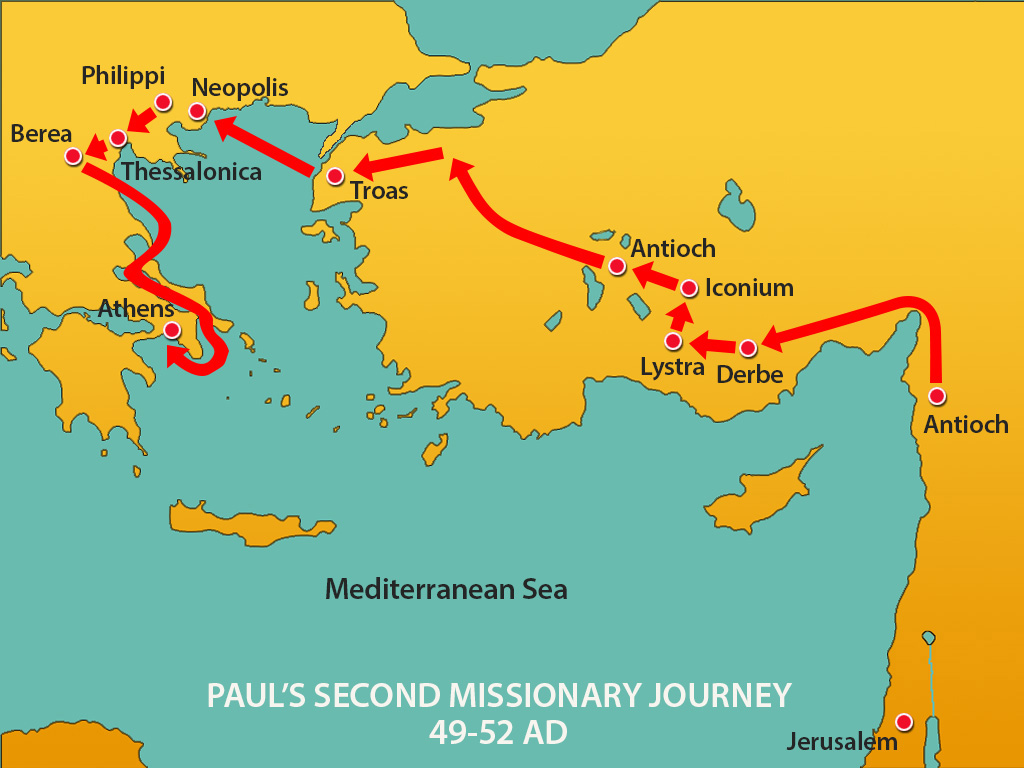 A few months later, in approximately a.d. 50, Paul and Barnabas discussed a second trip, to visit the churches they had established on their first missionary journey (Acts 15:36). But because of a disagreement over Mark, they went separate ways: Barnabas and Mark sailed for Cyprus, while Paul and Silas went through Syria and Cilicia (Acts 15:37-41). On this trip, Paul and Silas visited the believers at Derbe, Lystra, and Iconium. Then, passing through the region of Phrygia and Galatia, they journeyed to Troas. There, through a vision, God told Paul to travel to Macedonia (Acts 16:1-10). Obeying the Holy Spirit, Paul and Silas sailed to Samothrace and then to Neapolis. From there they traveled to Philippi, where they ministered for several days (Acts 16:11-40). Upon leaving Philippi, Paul and Silas traveled through Amphipolis and Apollonia to Thessalonica. Next they went to Berea, and then to Athens and Corinth, where they stayed for some time (Acts 17:1-18:18). Leaving Macedonia, they traveled to Ephesus. Then they sailed to Caesarea and made their way back to Antioch.
SETTING
Written from prison in Rome in approximately a.d. 61 Paul wanted to get to Rome (Acts 19:21), not only to teach and fellowship with the believers there (Romans 1:8-13), but also because Rome stood as the center of the civilized world. It was a strategic city for the spread of the gospel. To reach the Roman Empire, the gospel had to reach Rome.
In God’s sovereign plan, Paul did sail to Rome, but not as a prominent citizen, missionary statesman, or even itinerant preacher. He arrived, rather, as a prisoner, in chains (Acts 28:11-16). Even as a prisoner, however, Paul was free to teach, preach, and write (Acts 28:17-31). During these years of house arrest, Paul wrote what have come to be known as the “Prison Epistles”—Ephesians, Philippians, Colossians, and Philemon.
It is clear that Paul was a Roman prisoner when he wrote this letter because of his words in 1:12-17. He wrote of being “in chains” (1:13, 17) and of being a witness for Christ to the “whole palace guard” (1:13 niv).
Some have surmised that Paul wrote this letter to the Philippians during his imprisonment in Caesarea (Acts 23:23-26:32). After all, Paul was imprisoned there for about two years (a.d. 57-59), interrupted by hearings before Felix, Festus, and Agrippa. He would have had the freedom and the time to write. The uncertain and menacing situation in Caesarea seems to fit Paul’s indication that death was an imminent possibility (1:20-23, 30; 2:17). And references to a “palace guard” (niv) or “praetorian guard” (rsv) could fit this location.
AUDIENCE : The believers in Philippi
 The Macedonian (northern Greece today) city of Philippi was named after Philip of Macedon (the father of Alexander the Great). Surrounded by mountains and close to the sea, Philippi became a strategic city in the Greek empire. In 167 b.c. it became part of the Roman Empire, but it did not achieve real importance until after 31 b.c. when Octavian defeated Antony at the battle of Actium. After that decisive battle, Philippi received a number of Italian colonists who had favored Antony and had been dispossessed of their property. The colony was then renamed Colonia Iulia Philippensis to honor Julius Caesar. Later, in 27 b.c., when Octavian was designated Augustus, the colony’s name was changed again to Colonia Augusta Iulia (Victrix) Philippensium, equating the cause of Augustus with that of Caesar. At that time, Philippi was given the right to the Law of Italy together with many rights and privileges, including immunity from taxation. The residents of Philippi were very conscious and proud of their Roman citizenship and heritage (see Acts 16:20-21). Philippi also boasted a fine school of medicine.
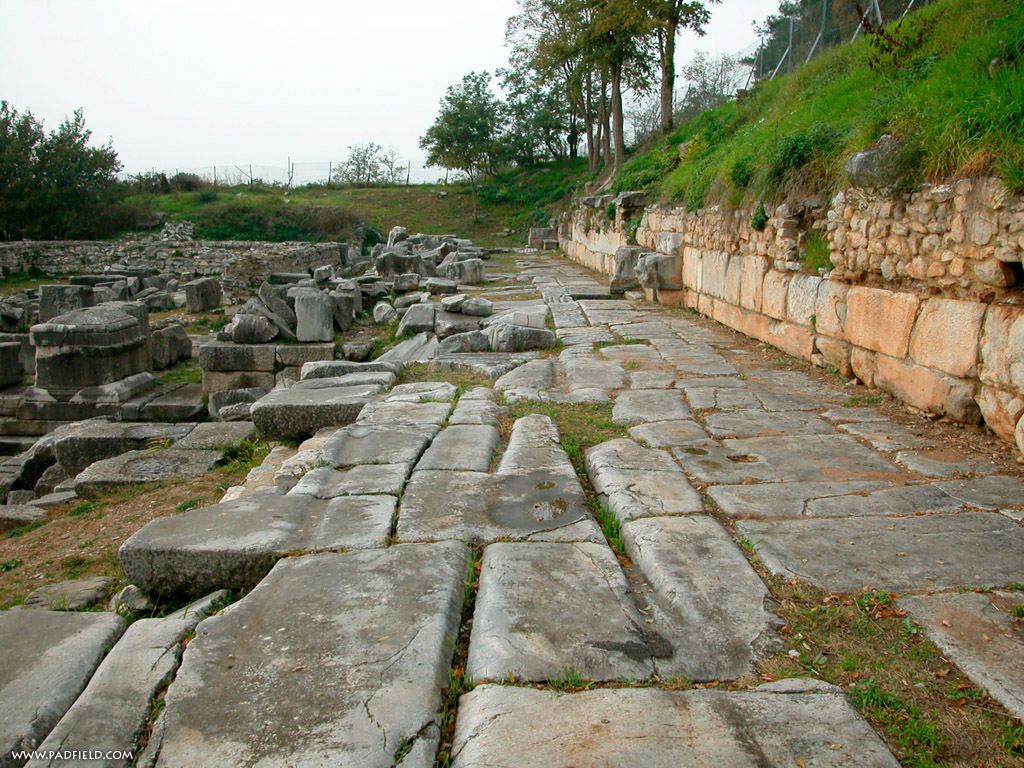 Paul visited Philippi on his second missionary journey, in a.d. 51, about ten years previous to this letter. By the time of Paul’s visit, Philippi had become a thriving commercial center because of its strategic location as the first city on the Egnatian Way, an important ancient highway linking the Aegean and Adriatic Seas. Travelers to Rome would cross the Adriatic and then continue up to Rome on the Appian Way. Thus, Philippi was the gateway to the East. Although thoroughly colonized by the Romans after 31 b.c., Philippi was still more Greek in culture than Roman. Luke refers to Philippi as “a Roman colony and the leading city of that district of Macedonia” (Acts 16:12 niv). Although Philippi was not the capital city of the region (subprovince of Macedonia), it certainly was the “leading city.” Luke’s statement also reflects civic pride in his hometown.
The church at Philippi in ancient Macedonia was the first European church founded by Paul. Thus, it represents the first major penetration of the gospel into Gentile territory (see Philippians 4:14-15).
Acts 16:9-40 tells how the church began. On the second missionary journey in about a.d. 51, prevented by the Holy Spirit from preaching in Asia and in Bythynia, Paul and Silas traveled to Troas, the farthest Asian port on the Aegean Sea. While there, God spoke to Paul through a vision, telling him to take the gospel to Europe. In this vision, a Greek man begged, “Come over to Macedonia and help us” (Acts 16:9 niv). Immediately, Paul and his traveling companions set sail for Samothrace and Neapolis, continuing on to Philippi.
 In every city, Paul and his party would go to the synagogue to share the gospel with the Jews. So on their first Sabbath in Philippi, Paul and Silas probably looked for a synagogue. Instead, they found a group of women who had gathered outside the city on the banks of a river. The fact that Philippi had no synagogue indicates that there were few Jews in that city. Therefore, from its inception, the church at Philippi consisted mainly of Gentiles. Acts 16:14-34 tells of two of the first converts in Philippi: Lydia, a businesswoman who may have been a Jew or a Jewish proselyte; and a Roman jailer. The response of these three provided clear demonstration that God’s Good News was for all classes, sexes, races, and nationalities.
OLYMPUS DIGITAL CAMERA
Luke also mentions that when Lydia responded to Paul’s message, so did the members of her household (Acts 16:15). The same was true for the jailer—his family responded with him (Acts 16:34). No other specific converts are mentioned in this account in Acts, but the chapter concludes with: “After leaving the prison they [Paul and Silas] went to Lydia’s home; and when they had seen and encouraged the brothers and sisters, they departed” (Acts 16:40 nrsv). “Brothers and sisters” seems to indicate that a small but vital group of believers had been forged. Clement, Euodia, and Syntyche may have been won to Christ during this time (see 4:2-3).
When Paul and Silas departed from Philippi, they left Luke there, in his hometown, to carry on the ministry. A few years later, at the end of his third missionary trip, Paul visited Philippi prior to spending the winter in Corinth. When Paul wrote this epistle, the church in Philippi was thriving, and he felt very close to the believers there.
OCCASION AND PURPOSE FOR WRITING
To thank the Philippians for their gift and to strengthen the believers in their faith
This is a very personal epistle. It is obvious from Paul’s opening comments that he enjoyed a close friendship with the Philippian believers: “I thank my God every time I remember you. In all my prayers for all of you, I always pray with joy because of your partnership in the gospel from the first day until now” (1:3-5 niv). During their visit to Philippi, Paul and Silas had witnessed immediate and dramatic response to their message. And despite the fact that they were attacked and imprisoned, they had seen the church begin and then grow into a strong core of believers (Acts 16:40). During the course of Paul’s ministry, the Philippian believers had continually come to his assistance through their gifts (4:15-18). At this time, nearly ten years later, the Philippians had again sent a gift to Paul to help him in his time of need: “I rejoice greatly in the Lord that at last you have renewed your concern for me. . . . It was good of you to share in my troubles” (4:10, 14 niv). Perhaps their donated funds were helping to pay for the rented house to which Paul was confined (Acts 28:30). In response to this gift and to their relationship over the years, Paul wrote to express his deep appreciation for their love, faithfulness, and generosity.
Paul also took the opportunity of this letter to deal with important issues in the church. He had heard of divisive rivalry and selfish ambition (2:3-4), so he gave strong counsel and even named names (4:2). Paul knew that the Judaizers could be a problem, so he gave clear instructions to avoid those men (3:2-3). He also warned of those who would go to the opposite extreme and live totally without the law or any personal discipline (3:17-19). None of these issues were full-blown problems that were threatening the life of the church, but Paul knew their destructive pattern. So he warned his beloved Christian brothers and sisters, encouraging and challenging them to continue to stand strong and united and to live for Christ (1:27; 4:1, 4-9).
Paul’s sensitivity to the needs at Philippi stands as a great example. He didn’t wait for a crisis; instead, he confronted potential problems early, before they could fester and infect the whole body. When we see a fellow believer begin to struggle or stray, we should follow Paul’s example and lovingly confront that person, urging him or her to stay on track.
MESSAGE
Joy (1:3-6, 12-26; 2:1-4, 17-18; 3:1; 4:4-13). Although Paul had suffered much for the cause of Christ and was writing this letter as a prisoner of Rome, still he was filled with joy because of what God had done for him, because of his hope in God’s plan for the future, and because of the faithfulness of the Philippian believers. Paul knew that his beloved brothers and sisters in Christ would be tempted and tested, so he urged them to stay strong in their faith, to be content, and to “rejoice in the Lord always” (4:4 niv). Regardless of the circumstances, believers can have profound contentment, serenity, and peace. This joy comes from knowing Christ personally, depending on his strength, and trusting in his plan for our lives.
Importance for Today. Far from content, people today truly believe that they need every new product, toy, or appliance. Or they think that they will find happiness and personal fulfillment through relationships, travel, adventure, or something else. Thus, most people are discontent and continually seeking meaning and peace. But true, lasting contentment comes only through knowing Christ. With sins forgiven, our future secure, and our lives in God’s control, we can be content . . . and have joy. Yes, we can have joy, even in hardship. Joy does not come from outward circumstances but from inward strength.
In addition to discontent, Paul highlights other joy stealers: selfish ambition (1:17; 2:3), complaining and arguing (2:14), self-centeredness (2:21), hedonism (3:18-19), anxiety (4:6), and bad thoughts (4:8). What steals your joy?
Rely on Christ within you to give you joy, not on what you own, who you know, or what you experience.
Humility (1:15-18; 2:5-11; 3:7-14). If anyone had the right to boast, it was Paul. Yet he continued to lay aside personal ambition and glory in order to know Christ (3:7-11) and to glorify him (3:12-14). Paul knew that Jesus had left glory to come to earth in order to live as a man and to die on the cross. Paul held up Jesus as the example to follow, urging the Philippians to humble themselves as Christ had done.
Jesus showed true humility when he laid aside his rights and privileges as God to become a human being (2:5-11). He poured out his life to pay the penalty that we deserve. Laying aside self-interest is essential to being Christlike.
Importance for Today. We naturally worry about ourselves first, making sure that we are comfortable and that we get the credit and glory we deserve. But as Christ’s representatives, we should live as he would. This means putting others first and renouncing personal recognition. It also means serving others and looking out for their best interests. When we give up our self-interest, we can serve the Lord with joy, love, and kindness. True humility is a by-product of seeing ourselves from Christ’s perspective and recognizing that we are nothing without him.
What can you do to see yourself and the world from Christ’s point of view? What can you do to give your life for others?
Self-Sacrifice (1:15-26; 2:4, 17, 25-30; 3:7-14; 4:14-19). Christ suffered and died so that all who believe might have eternal life. Following Christ’s example, with courage and faithfulness, Paul sacrificed himself for the ministry, taking every chance to tell others God’s Good News, preaching and teaching even while in prison. For Paul, living meant opportunities for serving the Lord, but dying would mean going to live with the Lord (1:20-24). So Paul lived with his goal always before him, motivating him to forget the past and press on to win the prize (3:13-14).
Importance for Today. “Sacrifice” seems like a dirty word these days. Instead, people want to indulge themselves and do everything they can to have a comfortable and easy life. Unfortunately, this cultural attitude can carry into the church. For example, many believers are more concerned about not having padded pews than the fact that people are headed for hell. But reaching people for Christ, helping those in need, and changing our world will involve personal sacrifice. Christ gives us the power to do that. We must follow the example of Jesus and of godly leaders like Paul who demonstrate self-denying concern for others.
What will it take—what sacrifices will you have to make—for you to be an effective witness for Christ in your neighborhood? at work? What will it take for your church to make a difference for Christ in your community?
Unity (1:15-18, 27-30; 2:1-4, 14-16; 4:2-3). In every church, in every generation, controversial issues, personality conflicts, and other divisive issues arise. The tendency toward arguments and division intensifies during hard times, when people can turn against each other. Although the church at Philippi was strong, it was not immune to these problems and, in fact, had experienced some internal conflicts. Paul encouraged the Philippians to get along, agree with one another, stop complaining, and work together.
Importance for Today. Christians should contend against their common enemy—Satan and his work in the world—and not against each other. We need all our resources, focus, and energy for the battle. When we are unified in love, Christ works through us, and we can make a difference for him. We need to keep before us the ideals of teamwork, consideration of others, and unselfishness.
What tends to break your unity with other believers? What issues threaten to divide your church? Keep your focus on Christ and his mission in the world; don’t be sidetracked by petty jealousies, competition, hurt feelings, or minor irritations. Work together with your brothers and sisters in Christ to make a difference in the world.
Christian Living (1:6, 9-11, 21-29; 2:12-13; 3:12-21; 4:4-13). Paul could not stay in Philippi, teaching the new believers, encouraging them to live for Christ, and holding them accountable. When he was with the Philippians, they were careful to obey the Lord (2:12) because they were aware of Paul’s powerful example and strong encouragement. But now, in his absence, they should be even more careful to live the Christian life (work out their own salvation—2:12). They could be confident that God was with them and in them, changing them from the inside out (2:13). Certainly God would complete his good work in them (1:6).
Paul also explained the steps these believers could take to live for Christ: be unified with other Christians (1:27-30), remember Christ’s work on the cross (2:5-11), rejoice in God’s work for them and in them (3:1), keep focused on the goal (3:12-14), guard their thoughts (4:8-9), be content with what they have (4:10-13), and help those in need (4:14-19).
Importance for Today. In this day of media evangelists, celebrity Bible teachers, and articulate preachers, it can be easy to depend on others for our spiritual nourishment and motivation. Yet the Christian life always depends on the relationship an individual believer has with the Lord Jesus. Instead of relying on others for our “faith,” we must depend on Christ and the Holy Spirit working within us. And instead of expecting growth to happen because we have a strong Christian environment, we must keep our focus on Christ, discipline ourselves to pray and to read the Bible, and apply God’s Word to our lives.
On whom do you depend for your motivation to live for Christ? Where do you find your spiritual nourishment? Christian living depends on Christ living in you and you then living in obedience to him.
For more about the series, Hope Again or watch messages go to www.RidgeFellowship.com
Source: Life Application Bible Commentary – Philippians, Colossians, & Philemon.


 Upwards Church