
Living as a New Person – Ephesians 4:19-24

People should be able to see a difference between Christians and non-Christians because of the way Christians live. The section from 4:17-24 appeals to believers to leave behind the old life of sin because they are followers of Christ—which should result in a radical change in their behavior. This change is further detailed in the section from 4:25-5:2, which lists negative characteristics that have no place in the church and positive characteristics that will reflect Christ’s character.

Living the Christian life is a process. Although we have a new nature, we don’t automatically think all good thoughts and express all right attitudes. But if we keep listening to God, we will be changing all the time. We must trust God to change us on the inside—our character, values, attitudes, perspective, and motives.

4:17 So I tell you this, and insist on it in the Lord, that you must no longer live as the Gentiles do, in the futility of their thinking.NIV Believers are to be maturing in their faith and using their gifts to benefit the church (4:11-16); therefore, they have a privilege as well as a responsibility. Paul could not stress too much the significant responsibility given to believers as they live in a sinful world. So, he wrote, I tell you . . . and insist. The words “in the Lord” provide the basis for the authority of what Paul was about to write.

The believers in Ephesus must no longer live as the Gentiles do. Many of the believers to whom Paul was writing were Gentiles by racial background. Because Paul was writing to many Gentiles, why did he say not to live “as the Gentiles do”? Paul was stressing that the Ephesian believers must abandon what had been their former way of life, not living any longer as the other Gentiles around them who were pagans, not Christians (see 1 Corinthians 12:2). How did the Gentiles live? In the futility of their thinking, referring to the natural tendency of human beings to employ intellectual pride, rationalizations, and excuses (Romans 1:21). Their thinking was “futile” because their lives were being wasted on worthless objects (idols), untrue teachings, and immoral behavior. The results of this futile way of thinking are described in the following verses.

4:18 They are darkened in their understanding and separated from the life of God because of the ignorance that is in them due to the hardening of their hearts.NIV This describes the unfortunate state of the unbelievers surrounding this core of believers in the church. The believers could no longer live as they previously did, for their prior lifestyle had been completely opposite of what they were presently experiencing. The unbelievers are darkened in their understanding, while the believers have found the light of Christ and are given his wisdom. The unbelievers are separated from the life of God, while the believers have been made one with him through Christ. The unbelievers are in ignorance, while the believers have access to the full knowledge of the truth. The unbelievers have refused to believe after hardening . . . their hearts, while the believers have welcomed Christ into their hearts. A fully hardened person is unable to respond to God (see Exodus 8:15; Mark 8:17-18; Romans 11:8; Hebrews 3:7-8).

 LIFE APPLICATION – TURN ON THE LIGHTS
Having described mature believers in 4:13-16, Paul followed with a brief description of nonbelievers. The first characteristics are “futility of their thinking” and “darkened in their understanding.” They have “darkened minds.” Have you ever tried to share your faith in Christ with nonbelieving friends, even very intelligent ones, and they have looked at you as though you were from Mars? Your friends aren’t stupid; they have darkened, unregenerate minds. Of course, you should continue to give them a reasoned defense of your faith if they’re interested, but the struggle is not really a matter of explanation. It’s more a need for “illumination”— for God to “turn the lights on.” Continue to be ready to give a defense to everyone who asks you (1 Peter 3:15), but even more urgently, pray that God will lift the darkness.
The next characteristic of nonbelievers is that they have “hardened hearts.” The problem is not only intellectual; it is willful, too. That’s why it’s almost impossible to argue someone into the kingdom of heaven. People don’t often reject Christ on intellectual grounds; they reject him (or ignore him) because they don’t want to surrender their wills to his. If you are presenting Christ and you receive an objection to every statement or truth claim, step back and ask: Is this really an intellectual problem? Or is it just that this person does not want to submit to Christ? If it’s truly intellectual, try to answer the objection. If it’s more willful, recognize that and deal with it on the heart level. Pray that God will turn on the lights and illumine the darkened, hardened heart.

4:19 Having lost all sensitivity, they have given themselves over to sensuality so as to indulge in every kind of impurity, with a continual lust for more.NIV These unbelievers have lost all sensitivity, or have no feeling about their degenerate condition. Such people are beyond feeling either shame for their evil or hope for anything better concerning their condition before God.

The logical next step for people who have lost all conscience is that they have given themselves over to sensuality (lewd behavior, lowest morals possible), indulge in every kind of impurity (they work toward moral decadence as if it were their occupation), and lust for more (also translated “greediness,” extreme selfishness without regard for others).

While these terms seem strong, we must understand the culture that surrounded the believers in and around Ephesus. The temple to the goddess Artemis (the Roman name was Diana) stood in Ephesus. Artemis was the goddess of fertility in women, animals, and nature. On occasion, human sacrifices were given to Artemis. She was believed to be a moon goddess who helped women in childbirth. She is portrayed as the many-breasted earth mother. Her temple had a hierarchy of religious personnel, including eunuch priests, young virgins, and prostitute priestesses. One month every year was devoted to ceremonies honoring Artemis. A carnival atmosphere that included concerts, feasts, athletic games, and plays created opportunities for immorality, drunkenness, and sensuality. To the Jews, worship at the temple of Artemis was extremely corrupt. Christians, as well, were not to take part in its practices.

 LIFE APPLICATION – IN THE DARK
How had these Gentiles gone wrong? Their hearts and minds were rebellious against God. After darkened minds and darkened hearts comes . . . darkened behavior. Of course, what else would unregenerate hearts and minds generate? Like our own world, the Roman culture that formed the backdrop to Paul’s writings had accomplished much and yet was in a moral free fall. Sexual immorality was rampant, including homosexuality; graft in political offices was the norm; violence and cruelty were commonplace; the arts featured lewdness and suggested sexual excess. And into the face of this howling moral wasteland, Paul wrote,
Darkened minds + darkened hearts = darkened behavior
Sin has a narcotic effect on persons and cultures. It feels good and is fun for a while, but then it begins to break us down and deaden us to what is good, right, and true. As you deal with moral and ethical darkness, remember that that kind of behavior is merely consistent with darkened, deadened hearts and minds. Lovingly shine the light of God’s love and truth on those behaviors, and pray for God to bring about change. Start with yourself. Don’t let the culture define your moral standards. Help to keep the church a citadel of proper moral conduct. Make your family a place where you teach and uphold high moral standards.

4:20 But that isn’t what you were taught when you learned Christ. NLT In great contrast to the unbelieving Gentiles (referred to as “they” in the previous verses) stands the word “you” in this verse. The Ephesian believers had been taught and had learned Christ from Paul himself as well as from other teachers. To know Christ is the greatest knowledge that anyone can have.

That knowledge is the truth; that knowledge opposes what the evil world teaches and applauds. Therefore, what the Ephesians and the other believers were taught should make all the difference in their lifestyles. “To know” is not a mere exercise of the head. Nothing is “known” until it has also passed over into obedience.

J. A. Motyer


 LIFE APPLICATION – NEW AND IMPROVED
In direct contrast to the preceding description of the unregenerate person, Paul next described the new life of the believer. He wrote of:
l our new minds: “But that isn’t what you were taught when you learned about Christ. Surely you heard of him and were taught in him in accordance with the truth that is in Jesus. You were taught . . . to be renewed in the spirit of your minds.”
l our new hearts: “[You were taught] to put off your old self, which is being corrupted by its deceitful desires.”
l our new behavior: “Clothe yourselves with the new self, created according to the likeness of God in true righteousness and holiness.”
From darkened minds, hearts, and behavior, to new ones—this is the stark contrast from the old self to the new. Does your life reflect this contrast, the marks of the new life of the believer? Are there evidences of it in your thinking, desires, will, and behavior?

4:21 Surely you heard of him and were taught in him in accordance with the truth that is in Jesus.NIV The phrase translated heard of him is literally “heard him,” referring to the individual’s hearing the call to salvation and responding. This only happened because they had been taught in him by those who shared the gospel in accordance with the truth that is in Jesus. Jesus is the truth (John 14:6). Paul rarely used the name “Jesus” and generally did so when referring to the death and resurrection of the man Jesus. Here it may not indicate any theological distinction but may merely be a stylistic change. This is the truth that the Ephesians heard and believed. This is the truth that brings salvation.

4:22 You were taught, with regard to your former way of life, to put off your old self, which is being corrupted by its deceitful desires.NIV While unbelievers live in darkness and sensuality, believers were taught in Christ a whole new manner of living, which must leave behind the former way of life. Paul explained that believers must decisively put off the old self. The “old self” (literally, “old man,” also translated “old nature”) describes each person before he or she comes to know Christ. The person was enslaved to sin, bound to the world, and without hope. Those who have accepted Christ are still susceptible to temptations and the evils of the sinful nature. Paul does not distinguish between two parts or two natures within a person. The old self describes those areas of rebellion against God. We must forsake this former lifestyle. Like old clothes, we must shed our identification with our sinful past and live as new people. To “put off” that old self will take conscious, daily decisions to remove anything that supports or feeds the old self’s desires.

The person’s old self is being corrupted by its deceitful desires (which Paul described in 4:17-19 above). The verb form “is being corrupted” reveals a continuous process that ends in complete degeneration and death. Like a cancer, the evil nature of the old self spreads and destroys. Christ came to offer each person a new self (4:23-24), but he or she must desire Christ’s help to “put off” the old self. As a person takes off an old, dirty garment in exchange for something clean and new, so the believer can take off the old, filthy “self” and exchange it for the clean and pure “self” provided by Christ. The verb “put off” is in the aorist tense, so it describes a definite act.

This “putting off” is a once-and-for-all decision when we decide to accept Christ’s gift of salvation (2:8-10). Although this putting off of the old takes place at conversion, we must drive out the remaining parts of it day by day. See also Romans 6:6; Colossians 3:5-10; and James 1:21. Repentance is primarily a change of moral purpose, a sudden and often violent reversal of the soul’s direction.

A. W. Tozer


4:23-24 And to be renewed in the spirit of your minds, and to clothe yourselves with the new self, created according to the likeness of God in true righteousness and holiness.NRSV We cannot “put off” without also “putting on.” Believers must “put off the old self” (4:22), but then they should follow with two specific actions: (1) to be renewed in the spirit of your minds, and (2) to clothe yourselves with the new self.

The verb “to clothe” (like the verb “to put off” in 4:22) refers to a once-and-for-all action. When believers put off the old self and clothe themselves with the new self, they don’t keep on changing back into old clothes once in a while. The old clothes have been thrown away. While we are still on this earth, we will struggle with our old way of life. Paul understood this struggle clearly (see Romans 7:14-25). In explaining these concepts, some people have wrongly given the idea that there are two selves or two equal-but-opposite poles in our life (old and new) warring against each other. This is not how the New Testament used these words. Christ sees his people as redeemed. The other verb, “to be renewed,” describes a continuous activity. The “self” has been exchanged, but the process of renewal, of becoming like Christ, is a continual daily process. Transformation begins in the mind and results in renewed behavior.

How are believers “to be renewed in the spirit of [their] minds”? They must:

  • be involved in activities that renew their minds (Philippians 4:8-9);
  • desire to pattern themselves after God, not the world (Romans 12:2);
  • study and apply God’s Word so that it changes their behavior from within (2 Timothy 3:15-16).

As just noted, the tense of the verb indicates a daily act. The “spirit” refers to the Holy Spirit controlling the believers’ minds, or it may refer to the spiritual side of each person’s mind-set, which is where renewal must begin (Romans 12:2; Colossians 3:10). Most likely, the meaning may be a combination of both, for the human spirit can only be renewed by the divine Spirit. (See also 2 Corinthians 5:17; Galatians 6:15; Colossians 3:10; Titus 3:5.)

This new self with which believers are to clothe themselves is a new creation, created according to the likeness of God in true righteousness and holiness. This new self However holy or Christlike a Christian may become, he is still in the condition of “being changed.”

John R. W. Stott


(literally, “new man”) is the new relationship we have with Christ that gives us a new orientation to life. The new self is according to the likeness of God with the characteristics of true righteousness and holiness. We have a right relationship with God that results in right behavior, creates an aversion to sin, and prompts us to devote ourselves to his service. These qualities are “true,” meaning they cannot be faked. This is totally opposite of the old way of living characterized by sin and corruption. Finally, the new self refers not to a split in one’s personality; instead, it pictures the new direction, attitude, and mind-set away from self and toward God and his will.

www.Upwards.Church

Message Audio/Video and Outline: https://upwards.church/leander-campus/watch-now-message-videos

Watch Messages: YouTube-Upwards Church

Facebook: Upwards Church

Read Along Daily Bible Reading: YouVersion (https://www.bible.com/organizations/370f8a6e-16bc-464f-8c43-0b7623fd2952)

Source: Bruce B. Barton et al., Life Application Bible Commentary – Ephesians, (Wheaton, IL: Tyndale, 1996), WORDsearch CROSS e-book, Under: “EPHESIANS 4:1-5:5”.

Posted in Masterpiece - Ephesians | Tagged , , , , | Leave a comment

Masterpiece – Ephesians 2:1-10 Commentary

Made Alive With Christ / 2:1–10

The style of using lengthy sentences continues from chapter 1 into this chapter, in which verses 1–7 are one sentence in the Greek. To help understand the first seven verses, note that the subject of that Greek sentence is “God” (2:4) and that there are three main verbs: (1) “gave us life” (2:5), (2) “raised us from the dead” (2:6), and (3) “seated with” (2:6). The object of each of these verbs is “us,” referring to believers. God has made us alive, raised us up, and seated us with Christ.

2:1 This verse is a continuation of 1:19–23, which speaks of the resurrection power imparted to Christ’s body, the church. These believers once were dead and doomed before they met Christ. This refers not only to eventual physical death or to the sinners’ ultimate eternal state; it also refers to a very real “death” in this life. People who are spiritually dead have no communication with God. These people are physically alive, but their sins have rendered them spiritually unresponsive, alienated from God, and thus incapable of experiencing the full life that God could give them.

2:2–3 Sin reveals spiritual death but is acted out by people who are physically alive. Before the believers came to Christ, they used to live in their sins. They could not and did not follow God. Paul described three marks of unbelievers:

  1. They lived like the rest of the world, referring to the world’s accepted, but immoral, lifestyles and godless motives. People who live like the world that is full of sin cannot also follow Jesus (Romans 12:2; Galatians 1:4).
  2. They obeyed Satan. The passage focuses on Satan’s reality as an evil power with a certain amount of control in the world. The Bible pictures Satan as ruling an evil spiritual kingdom—the demons and those who are against Christ. He is the mighty prince of the power of the air referring to the space around the earth, and thus, this is Satan’s sphere of influence. Though Satan’s influence is great among unbelievers, his power is limited because he is a defeated enemy. He cannot separate believers from the love of God. Satan is also called the spirit at work in the hearts of those who refuse to obey God. People who have not surrendered to God or decided to obey are energized by the power of evil. The force of the evil spirit is seen in those who actively disobey God both in faith and action (2 Thessalonians 1:8). These people live in constant rebellion and opposition to God.
  3. They followed the passions and desires of their evil nature. All of us (Jews and Gentiles alike) were at one time separated from God because of disobedience, born with an evil nature. That nature puts us under God’s anger. When we become believers, our sinful nature still exists. But when we submit our lives to the Holy Spirit, he transforms us and our sinful natures. This is a supernatural process. We must never underestimate the power of our sinful nature, and we must never attempt to subdue it in our own strength. God provides for victory over sin—he sends the Holy Spirit to live in us and give us power. But our ability to restrain the desires of the sinful nature depends on how much we’re willing to depend on God and his mercy (2:4–5).

2:4–5 The first three verses of this chapter present a hopeless humanity—trapped in sin, under Satan’s power, unable to save itself. Then follow the small but glorious words but God. Behind those two words lies a cosmic plan so huge in scope and so vast in love that the human mind cannot fully comprehend it—all we can do is humbly receive it. Instead of leaving sinful humanity to live worthless and hopeless lives ending only in death, God acted on behalf of humanity because he is so rich in mercy. As God is rich in kindness (1:7), so he is rich in mercy. The word “rich” indicates the bountiful nature of God’s mercy—beyond our comprehension, an inexhaustible storehouse. What is “mercy”? It is an attribute of God, sometimes called “loving-kindness” or “compassion.” This word describes the outworking of God’s love toward people and is shown in his lovingkindness toward them even though they do not deserve it (Psalm 51:1; Jeremiah 9:24; Hosea 2:19; Jonah 4:2).

God also acted on behalf of humanity because he loved us so very much. The Greek word for love, agape, is used. It means the selfless love that seeks the best for others. While God could have simply destroyed all people because of their sin, he chose instead to show mercy and love. While we once were dead because of our sins (2:1), God gave us life when he raised Christ from the dead. That we have been given life means that we are “saved” (this phrase is repeated in 2:8 and elaborated on there). When Christ rose from the dead, so did all the members of his body by virtue of God’s uniting them with Christ. The only way spiritually dead people can have a relationship with God is to be made alive. And God is the only person who can accomplish that, which he did through his Son, Jesus Christ. Christ defeated sin and death through his death and resurrection, thus offering spiritual life to those dead in sins.

The verb form have been saved refers to a past event (accomplished by Christ because of God’s special favor) with present and ongoing results. Believers have already passed from death to life. Salvation is not something to be waited for but something that has already been delivered.

2:6 In addition to being given life (2:5), believers are also raised from the dead. Christ was raised from death and left the tomb—an act accomplished by God’s power alone. Believers have also been “raised.” In addition to assurance of physical resurrection and glorification at the end of the age, believers participate in a new “resurrection” life from the moment they believe (see Colossians 2:12).

Finally, believers are seated with him in the heavenly realms. Christ has taken his seat at the right hand of the Father, indicating his finished work and his victory over sin. Christ has been exalted by God’s great power (1:20). Christians have tended to see this seating with Christ as a future event, based on Jesus’ words in Matthew 19:28 and Luke 22:30 as well as other verses that point to our future reign with Christ (such as 2 Timothy 2:12; Revelation 20:4; 22:5). Yet Ephesians teaches that we are seated with Christ now. We share with Christ in his victory now. This view of our present status should help us face our work and trials with greater hope! Believers, as heirs of the Kingdom along with Christ, are spiritually exalted from the moment of salvation. We have a new citizenship—in heaven, no longer just on earth: The power that raised and exalted Christ also raised and exalted his people because we are one with him. That same power works daily in believers, helping us live and work for God during our time in the world.

2:7 Here is the final and definitive reason for God’s action on behalf of humanity, his reason for making us alive, raising us, and seating us along with his Son in the heavenly realms. God wants quite simply to point to us as examples of the incredible wealth of his favor and kindness. The Greek word for “point to” comes from legal terminology. God closes the case by presenting the astounding evidence of his church, his people. The church could only exist by God’s love; the fact of its existence, the fact that people have been offered salvation, reveals the abundance of God’s favor and kindness (see also 1:7; 2:4). Again, this was accomplished only through Christ Jesus. Without Christ’s sacrifice, there would be no hope for a relationship with God.

2:8 Our salvation comes from God’s special favor alone. It was appropriated when people believed. However, lest anyone should think that belief is a necessary work that must be performed in order to receive salvation, Paul added that people can’t take credit for believing, for it too is a gift from God. Paul is firm that absolutely nothing is of our own doing—not salvation, not grace, not even the faith exercised to receive salvation. Instead, everything is the gift of God. Salvation does not come from our self-reliance or individualism but from God’s initiative. It is a gift to be thankfully accepted (see Romans 3:24–28; 1 Corinthians 1:29–31; Galatians 2:16).

2:9 We can’t take credit for our salvation (2:8), and it is not a reward for the good things we have done. In other words, people can do nothing to earn salvation, and a person’s faith itself also is not to be considered a “work” or grounds that anyone should boast.

People find it difficult to accept something so free, so willingly given, so available to anyone. We want to feel as though we did something, that we somehow earned our salvation by our merit. That was how the Judaizers (false teachers who said Christians had to obey all the Jewish laws) regarded their laws and why they tried to impose them on the Gentiles—there had to be a certain amount of law keeping and goodness on people’s part in order for them to receive salvation. But Paul’s words are unmistakable—if salvation is by God’s grace and is accepted through faith, then it is “not a reward.” If salvation could be earned by good works, then people would, by nature, “boast” about their good works, compare the goodness of their works to others’ good works, and do good only to boast about it. Then, what would be “good enough” for salvation? But no one could ever be good enough to please a holy God. He casts aside all human effort and pride by offering salvation for free to all people by simple acceptance. People are given salvation on the grounds of God’s grace alone.

2:10 But wait, there’s more. We are God’s masterpiece. Salvation is something only God can do—it is his powerful, creative work in us. People are recreated into new people, and those new people form a new creation—the church.

The verb created is used only of God—for only God can truly create. As he created the universe from nothing, so he creates new, alive, spiritual beings from the old, dead, sinful creatures we were (2 Corinthians 5:17). Then God forms believers into a unified body, his church (see 2:15; 4:24; Colossians 3:10). In Christ Jesus emphasizes the source of this creation, as in 2:6–7—Christ has provided it.

People become Christians through God’s undeserved favor (his grace), not as the result of any efforts, abilities, intelligent choices, personal characteristics, or acts of service. Out of gratitude for this free gift, however, believers will seek to do good things—to help and serve others with kindness, love, and gentleness. While no action or work we do can help us obtain salvation, God’s intention is that our salvation will result in acts of service. We are saved not merely for our own benefit but to serve Christ and build up the church (4:12). This solves the so-called conflict between faith and works. Works do not produce salvation but are the evidence of salvation (see James 1:22; 2:14–26).

The Greek word translated do means “to walk about in.” We move ahead in this life of grace doing the good works that God planned for us long ago. The new life that God gives cannot help but express itself in good works. This does not necessarily mean that God has set up all the specific good works each person will do—although there would be no point arguing against the possibility of our omniscient God doing just that. Just as God planned salvation in Jesus Christ before the foundation of the world, so he planned that believers should do good to others (see 1 Timothy 6:18; Titus 2:7; 1 Peter 2:12).[1]

www.Upwards.Church

Message Audio/Video and Outline: https://upwards.church/leander-campus/watch-now-message-videos

Watch Messages: YouTube-Upwards Church

Facebook: Upwards Church

Read Along Daily Bible Reading: YouVersion (https://www.bible.com/organizations/370f8a6e-16bc-464f-8c43-0b7623fd2952)

Source:

[1] Bruce Barton et al., Life Application New Testament Commentary (Wheaton, IL: Tyndale, 2001), 809–811.

Posted in Masterpiece - Ephesians | Tagged , , , , , , , , , , , | 1 Comment

Spiritual Blessings – Ephesians 1 Commentary

Greetings From Paul / 1:1–2

Paul wrote to the believers in Ephesus and the surrounding churches to give them in-depth teaching about how to nurture and maintain the unity of the church. He wanted to put this important information in written form because he was in prison for preaching the gospel and could not visit the churches himself. Paul apparently received reports that the Ephesian church held up well against false teachers. However, perhaps the love, care, and unity Paul had called for were lacking. Thus, this letter speaks much of love and unity and the out-workings of these in relationships in the home and in the church. Paul knew that such teaching was needed not only in Ephesus but in every church—again pointing to the probable circular nature of this letter. Indeed Paul’s words applied in Ephesus and in all the Asian churches—and they apply to our churches today.

1:1 Paul was a Jew from the tribe of Benjamin. He was raised as a strict Pharisee (Philippians 3:5), grew up in Tarsus, and was educated under a well-known teacher, Gamaliel (Acts 22:3). However, he was also a Roman citizen, a fact that he used to great advantage at times (Acts 22:27–29). Out of this diverse background, God formed and called a valuable servant, using every aspect of Paul’s upbringing to further the gospel. He was not one of the original twelve disciples (later called apostles), but the risen Christ Jesus confronted him on the road to Damascus and called him to be an apostle (Acts 9:3–19). The apostles’ mission was to be God’s representatives: They were envoys, messengers, delegates, directly under the authority of Christ Jesus. They had authority to set up and supervise churches and to discipline them if necessary, which Paul did on all three of his missionary journeys and after his release from this first imprisonment in Rome. God chose Paul for special work, saying that Paul would be his “chosen instrument to take my message to the Gentiles and to kings, as well as to the people of Israel” (Acts 9:15). Paul did not seek this apostleship; instead, God had chosen him.

Paul wrote this letter to the Ephesian believers—God’s holy people in Ephesus, the faithful followers of Christ Jesus. The words “in Ephesus” are not present in the three earliest manuscripts. Therefore, this was very likely a circular letter, meaning the name of each local church would be filled in as the letter circulated from church to church. Ephesus, the leading church in the region of Asia Minor, was probably the first destination for this epistle. Paul mentioned no particular problems or local situations, and he offered no personal greetings as he might have done if this letter were intended for the Ephesian church alone. (For more about Ephesus, see the Audience section in the Introduction.)

Clearly, Paul had a deep love for the church in Ephesus. His last words to the Ephesian elders focused on two items: (1) warning them about false teachers (Acts 20:29–31), and (2) exhorting them to show love and care toward one another (Acts 20:35).

1:2 Grace means God’s undeserved favor. It is through God’s kindness alone that anyone can become acceptable to God. Peace refers to the peace that Christ established between believers and God through his death on the cross. True peace is available only in Christ (John 14:27).

Paul used “grace and peace” as a standard greeting in all of his letters. He wanted his readers to experience God’s grace and peace in their daily living. Only God our Father and Jesus Christ our Lord can grant such wonderful gifts. By mentioning Jesus Christ along with God, Paul was pointing to Jesus as a full person of the Godhead. He recognized Jesus’ deity and lordship over all of creation. Both God the Father and Jesus Christ the Lord are coequal in providing the resources of grace and peace.

Spiritual Blessings / 1:3–14

Here begins a lengthy passage that praises God for what he has done for us in Jesus Christ. Paul, writing in Greek, wrote one long sentence from 1:3 to 1:14 (which is not reflected in English). It forms the longest sentence ever found in ancient Greek. In this sentence, Paul introduced most of the themes he develops in this epistle. This complex sentence is very difficult to analyze. Paul heaped praise upon praise, one thought leading into another, which then would remind him of another. This section forms a blessing, in Hebrew called a berakah, frequently used in Jewish liturgy. It is a eulogy for God and for all the blessings he gives his people.

1:3 Paul first praised God, saying that all believers praise God. God alone is worthy of praise and worship. He is the Father of our Lord Jesus Christ. Because believers belong to Christ, God has blessed us. The verb “blessed” occurs hundreds of times in the Old Testament, revealing that God enjoys blessing his people. Here Paul used the past tense (“has blessed”), indicating that this prospering of believers had already occurred—even from eternity past. God has blessed us by allowing us to receive the benefits of Christ’s redemption (1:7) and resurrection (1:19–20). God blessed us through Christ’s death on the cross on our behalf.

Because by faith we belong to Christ, we have every spiritual blessing—that is, every benefit of knowing God and everything we need to grow spiritually. These are spiritual blessings, not material ones. Because God has already blessed believers, we need not ask for these blessings but simply accept them and apply them to our lives. Because we have an intimate relationship with Christ, we can enjoy these blessings now and will enjoy them for eternity.

The phrase heavenly realms occurs five times in this letter (1:3, 20; 2:6; 3:10; 6:12) and refers to the sphere beyond the material world—the place of spiritual activity where the ultimate conflict between good and evil takes place. This conflict continues but has already been won by Christ’s death and resurrection. This is the realm in which the spiritual blessings were secured for us and then given to us. Our blessings come from heaven, where Christ now lives (1:20), and Christ’s gift of the Holy Spirit, the source of all spiritual blessings, came as a result of his ascension to heaven (4:8). Paul was making the point that these blessings are spiritual and not material; thus, they are eternal and not temporal.

1:4 That God chose us forms the basis of the doctrine of election—defined as God’s choice of an individual or group for a specific purpose or destiny. The doctrine of election teaches that we are saved only because of God’s grace and mercy; as believers we are not saved by our own merit. It focuses on God’s purpose or will (1:5, 9, 11), not on ours. God does not save us because we deserve it but because he graciously and freely gives salvation. We did not influence God’s decision to save us; he saved us according to his plan. Thus, we may not take credit for our salvation or take pride in our wise choice.

The doctrine of election runs through the Bible, beginning with God’s choosing Abraham’s descendants as his special people. Although the Jews were chosen as special recipients and emissaries of God’s grace, their opportunity to participate in that plan arrived with the coming of Christ, their promised Messiah. But many didn’t recognize Christ and so rejected him. God’s “chosen” and elected people are now, also Christians, the body of Christ, the church—all who believe on, accept, and receive Jesus Christ as Messiah, Savior, and Lord. Jesus himself called his followers “the chosen ones” (see Matthew 24:22, 24, 31; Mark 13:20, 22, 27).

God chose his people before he made the world. The mystery of salvation originated in the timeless mind of God (2 Thessalonians 2:13; 2 Timothy 1:9). Before God created anything, his plan was in place to give eternal salvation to those who would believe on his Son. Before God created people, he knew sin would occur, he knew a penalty would have to be paid, and he knew that he himself (in his Son) would pay it.

Election is in Christ because of his sacrifice on our behalf. We have blessings and election only because of what Christ has done for us. Election is done for a specific purpose—that we would be holy and without fault in his eyes. What God began in eternity past will be completed in eternity future. God’s purpose in choosing us was that we would live changed lives during our remaining time on earth. To be “holy” means to be set apart for God in order to reflect his nature. God chose us, and when we belong to him through Jesus Christ, God looks at us as though we had never sinned. Our appropriate responses are love, worship, and service—in thankfulness for his wonderful grace. We must never take our privileged status as a license for sin.

1:5 In his infinite love, God chose to adopt us as his own children. People were created to have fellowship with God (Genesis 1:26), but because of their sin, they forfeited that fellowship. Through Jesus’ sacrifice, God brought us back into his family and made us heirs along with Jesus (Romans 8:17). God did not do this as an emergency measure after sin engulfed creation; instead, this has been his unchanging plan from the beginning. Under Roman law, adopted children had the same rights and privileges as biological children. Even if they had been slaves, adopted children became full heirs in their new family. Paul used this term to show the strength and permanence of believers’ relationship to God. This adoption occurs through Jesus Christ, for only his sacrifice on our behalf enables us to receive what God intended for us.

1:6 God’s goal in the election of believers was that they would praise him. Therefore, the ultimate purpose of believers’ lives is to praise God because of his wonderful kindness. Without it, we would have no hope, and our lives would be nothing more than a few years on earth. Instead, we have purpose for living and hope of eternal life. His kindness was poured out on us. It was a free gift, not something we could earn or deserve. God’s favor to us is realized by our union with his dearly loved Son. We could say that God’s love for his only Son motivated him to have many more sons—each of whom would be like his Son (Romans 8:28–30) by being in his Son and by being conformed to his image.

1:7 All people are enslaved to sin, but God, so rich in kindness, purchased our freedom through the blood of his Son. Jesus paid the price to redeem us, to buy our freedom from sin. The purchase price was his blood. To speak of Jesus’ blood was an important first-century way of speaking of Christ’s death. Our freedom was costly—Jesus paid the price with his life. Through his death, Jesus released us from slavery and our sins are forgiven. When we believe, an exchange takes place. We give Christ our sins, and he gives us freedom and forgiveness. Our sin was poured into Christ at his crucifixion. His righteousness was poured into us at our conversion. God’s forgiveness means that he no longer even remembers believers’ past sins. We are completely forgiven. Jesus became the final and ultimate sacrifice for sin. Instead of an unblemished lamb slain on the altar, the perfect Lamb of God was slain on the cross, a sinless sacrifice so that our sins could be forgiven once and for all.

1:8 God’s kindness is showered on believers. When God gives, he gives abundantly and extravagantly. In the phrase with all wisdom and understanding, the word “wisdom” is the ability to see life from God’s perspective. Proverbs 9:10 teaches that the fear (respect and honor) of the Lord is the beginning of wisdom. The word “understanding” could also be translated “insight,” referring to the ability to discern the right action to take in any given situation. Wisdom and understanding are given to believers for them to know God’s will.

1:9 Paul had been praising God’s wonderful kindness in 1:7–8. Thoughts of kindness led Paul to praise God for the entire plan of salvation. God had purposed to offer salvation to humanity “before he made the world” (1:4). How this would happen had not been revealed (made clear, understood) until the death and resurrection of Jesus Christ.

What God “revealed” was his plan to bring people (both Jews and Gentiles) back into fellowship with himself through their faith in Christ and then to keep them with him for all eternity. Paul called this the secret plan which was centered on Christ. The word “secret” has two meanings in Hellenistic Greek. One meaning referred to something known to only a select few. The word described heathen religions or “mystery religions” with their secret rites and practices. As used in the Septuagint (a Greek version of the Jewish Old Testament writings), a second meaning of the word describes what God reveals (as in Daniel 2:19). The Jews used the word to describe some secret plan that God would reveal at the end of the age. In the New Testament, the word refers to a truth formerly hidden but now made known to people—in this case, to us, meaning all believers. As with our being chosen (1:4), so the revelation of the secret plan of salvation is according to God’s good pleasure.

1:10 The Greek word oikonomia (translated bring everything together) refers to the management of a household or estate. In this context, it refers to large-scale management, as in administration or economy. In God’s timing, God brings everything together under the authority of Christ. With his first coming, Christ completed part of this mystery, but there are promises yet to be fulfilled. The mystery of salvation does not end with a person’s acceptance of Jesus Christ—God promises a glorious future in a glorious Kingdom (see Revelation 21–22). This time is unknown to everyone but God.

God is planning a universal reconciliation—all of creation will be reinstated to its rightful owner and creator. Just as Christ administered God’s plan of redemption by carrying it out as a human on this earth, so he will ultimately be in charge of everything in heaven and on earth. All of creation (spiritual and material) will be brought back under one head.

Sin holds people in bondage. That fact is clearly established throughout Paul’s letters. Sin has also caused all creation to fall from the perfect state in which God created it. The world physically decays and experiences conflict so that it cannot fulfill its intended purpose. One day God will liberate and transform all creation. Until then, it waits in eager expectation for the right time. Christ provided the means for this restoration. When the time arrives, all of creation (meaning every created thing and being) will be as God created it to be—perfect, eternal, and fulfilling its intended function to praise God.

This verse does not teach that God will eventually save everyone, although many would like to believe this. The doctrine of Universalism, as this belief is called, seems to make God a little easier to understand and a little less harsh on sinners. In the end, every knee will bow, but for some, it will be too late. Christ will bring those elected and saved, and all creation with them, to be united under him in this glorious Kingdom. Those who have refused to believe (whether Jews or Gentiles) will face the consequences of their unbelief (Matthew 25:31–46).

1:11 Up until this verse, Paul was speaking to Jews and Gentiles alike. In 2:11, Paul made a distinction between the backgrounds of the Jewish believers and Gentile believers. In verses 11–14, however, he identified the two separate groups with the pronouns he used. The wording in these verses includes both the first person (we, our) and the second person (you). The word “we” refers specifically to Jewish believers (Paul being one of them). While it is true that believing Jews and Gentiles alike will receive God’s blessings, the Jews were called first (Romans 1:16); they were chosen. Christ will be the Head of all things (1:10), including a body of believers made up of Jews (“we”) and Gentiles (“you,” 1:13).

The Jews were chosen from the beginning and had received an inheritance from God that would ultimately be accomplished in Jesus Christ (born into the nation of Israel) and finalized at the end of time. God chose the Jews to be the people through whom the rest of the world could find salvation. But this did not mean that the entire Jewish nation would be saved; only those who receive Jesus Christ as their Messiah and Savior will receive God’s blessings (see Romans 9–11). When God offered salvation to the Gentiles, he did not exclude the Jews. God’s Kingdom will include all Jews and Gentiles who have accepted the offer of salvation. Both Jews and Gentiles will also make up the group that does not believe and so receives God’s punishment. The inclusion of Jewish believers in salvation was the plan of God, for all things happen just as he decided long ago. In the same way that God planned for Israel to be the elect nation, he planned for the spiritual Israelites, the believers in Christ, to be an eternal gift to himself. As a refrain carried through from 1:5 and 1:9, Paul repeated that everything is under God’s sovereign control. The words reinforce the certainty of these events. Because God controls everything, he will carry out his plan according to his purpose and will, bringing it to completion in his time.

1:12 The word we refers to Jewish believers—those who recognized their promised Messiah. The Jews were the first to trust in Christ. This could mean that ages before the arrival of Christ, the Jews had set their hope on their coming Messiah (see Acts 28:20), or it could mean that the Jews were the first to believe in Christ because the gospel was preached first to them (see, for example, John 1:11; 8:30; Acts 1:8; 3:26; 13:45–46).

1:13 Because the word “we” in 1:12 most likely refers to Jews, the words you also refer to Gentile believers who were identified as Christ’s own along with the Jewish believers. The believers, both Jews and Gentiles, heard the truth (see also Colossians 1:5; 2 Timothy 2:15; James 1:18), also called the Good News. These people believed and were given the Holy Spirit. God marks his people as his own through the presence of the Holy Spirit in their lives. The Holy Spirit fills us with a sense of God’s love (Romans 5:5), assures us that God has adopted us as his children (Romans 8:15–16), and helps us to manifest our Christlikeness. The Spirit is a once-and-for-all identification that gives us continued assurance that we are God’s children, entitled to his riches and goodness, now as well as in eternity.

The Holy Spirit had been promised in the Old Testament (Isaiah 32:15; 44:3; Joel 2:28;) and was promised by Jesus to his disciples (John 14:16–17, 25–26; 15:26; 16:7–15; Acts 1:4–5; 2:38–39). After Christ returned to heaven, he would be spiritually present everywhere through the Holy Spirit. The Holy Spirit came so that God would be within his followers after Christ returned to heaven. At Pentecost (Acts 2) the Holy Spirit came upon all who believed in Jesus. Believers received the Holy Spirit when they received Jesus Christ. The transformation that the Holy Spirit makes in a believer’s life (as described in Galatians 5:22–23) undeniably marks God’s presence in and ownership of that life.

1:14 The word guarantee was used in ancient times to describe a down payment, promising that the buyer would complete the transaction and pay the full amount. The guarantee was binding. In the same way, the Holy Spirit is God’s guarantee that he will give us everything he promised. He is the first payment of all the treasures that will be ours because he has purchased us to be his own people. The presence of the Holy Spirit in us demonstrates the genuineness of our faith, proves that we are God’s children, and secures eternal life for us. His power works in us to transform us now, and what we experience now is a taste of the total change we will experience in eternity.

As a final ringing note echoing 1:6 (praising God) and 1:12 (praising Jesus Christ), Paul declared that the Holy Spirit’s presence in believers is one more reason for us to praise our glorious God.

Paul’s Prayer for Spiritual Wisdom / 1:15–23

As verses 3–14 are one long sentence in the Greek, so are verses 15–23. As verses 3–14 are an extended eulogy, verses 15–23 are an extended thanksgiving. Verses 15–16 are the thanksgiving proper; verses 17–19 are an intercessory prayer; verses 20–23 are a confession of praise for God’s power.

1:15–17 After describing the glorious blessings given to believers (1:3–14), thoughts of the great promises of God led Paul to give praise and to pray for the church—the people chosen to receive those blessings. The phrase ever since I first heard of your strong faith in the Lord Jesus could mean that Paul had heard a good report of the Ephesians’ growth in the faith. It could also be a way of including the believers in the surrounding churches. Paul knew the Ephesian church well but not all the surrounding churches. Yet he may have heard a positive report of all the churches in the area, and thus he could thank God for their faith and remember them in his prayers.

Paul never stopped thanking God for these believers. That Paul prayed for them constantly demonstrates personal attention. Paul was truly a prayer warrior—remembering the churches in his personal prayers: for example, the Romans (Romans 1:9), the Philippians (Philippians 1:3–4), the Colossians (Colossians 1:3–4), and the Thessalonians (1 Thessalonians 1:2–3). Paul kept asking on behalf of these believers that God would give them spiritual wisdom and understanding. The Holy Spirit gives “wisdom” (see also 1:8)—the ability to see life from God’s perspective, to have discernment. He also gives “understanding,” which refers to enlightened understanding in their knowledge of God and the mysteries of divine truth. (See 1 Corinthians 2:14, 16 and Colossians 1:9.)

1:18 For the Jew, the heart was the core of personality, the total inner person, the center of thought and moral judgment. The imagery of hearts flooded with light pictures an ability to see the reality of our wonderful future. Believers look forward to a glorious inheritance (Colossians 1:5) as well as blessings in this present world (1:19; Colossians 1:27) because of an action by God in the past (those he called).

1:19–21 Paul prayed that the believers would begin to understand the incredible greatness of God’s power on behalf of those who believe him. Because of his power, believers know that:

  • God is on their side, ready to help them meet each and every obstacle
  • God’s power is never stagnant or out of commission—it is always actively working on their behalf
  • God is always fighting against the forces of evil on believers’ behalf
  • no human strength or spiritual power from the evil world (not even Satan himself) can deter or change God’s inherent power.

Only God’s power can change weak human beings into strong believers who are willing to sacrifice everything for the God who loves them. After impressively describing the completeness of God’s power, Paul pointed out three instances of God’s power: (1) he raised Christ from the dead, (2) he seated Christ in the place of honor in the heavenly realms, and (3) he is far above any ruler or authority. Christ has no equal and no rival. He is supreme over all other beings. These words ought to encourage believers, because the higher the honor of Christ, the Head, the higher the honor of his people.

1:22–23 Paul probably had a psalm in mind as he wrote these words. This alludes to Psalm 8:6, a kingly messianic psalm describing sovereign power and enthronement. Christ is the obvious application for the verse. Just as the psalm writer described people as having dominion on earth, so Paul described Christ as having authority over all of creation—all things (1 Corinthians 15:20–28). The church receives the benefit of his universal headship because the church is his body. Paul used the analogy elsewhere when he wrote about the interrelationships of believers in the church (Romans 12:4–5; 1 Corinthians 12:22–27; Colossians 1:18–19). This passage focuses on Christ as the head of that body, the church (see also 4:4, 12, 16; 5:30). The church is not a building (or all the church buildings on earth)—it includes all believers in a living, growing, moving, working organism deriving existence and power from Christ. The church obeys Christ’s commands to carry out his work in the world.

All believers, as part of Christ’s body, are filled by Christ who fills everything everywhere with his presence. Christ fills all things with himself and with his blessings, bringing all believers to the state of obedience and praise for which God created them (as in 1:10; 4:10, 13, 16). The church is being filled with and by Christ, who fills all things totally. Thus, Christ, who is the fullness of God (Colossians 1:19), finds full expression in the church.

By Christ’s resurrection and exaltation, he is head over all things for the church. Christ fills the church and then uses the gifts he bestows to fulfill his mission—revealing himself to the world and drawing people to himself by that witness. The image of the body shows the church’s unity. Each member is involved with all the others as they go about doing Christ’s work on earth. We should not attempt to work, serve, or worship on our own. We need the entire body.[1]

www.Upwards.Church

Message Audio/Video and Outline: https://upwards.church/leander-campus/watch-now-message-videos

Watch Messages: YouTube-Upwards Church

Facebook: Upwards Church

Read Along Daily Bible Reading: YouVersion (https://www.bible.com/organizations/370f8a6e-16bc-464f-8c43-0b7623fd2952)

Source: [1] Bruce Barton et al., Life Application New Testament Commentary (Wheaton, IL: Tyndale, 2001), 804–809.

Posted in Masterpiece - Ephesians | Tagged , , , , , , , , , | 1 Comment

The Significance of Ephesus

We’re starting our brand new message series in the book of Ephesians. It a great time to look at the city of Ephesus. You can also see this post: 10 Facts You May not know about Ephesus.

Ephesus was the capital city of a Roman province in Asia. Ephesus was a significant center of trade, located near a harbor at the mouth of the Cayster River in western Asia Minor. The city lay in a long, fertile valley. Major roads connected Ephesus to all the other significant cities in Asia Minor.

Ephesus was known for its amphitheater, the largest in the world, designed to hold up to 50,000 spectators. Ephesus was also the location of the great temple of Artemis, or Diana, built in 550 BC. This temple, one of the Seven Wonders of the Ancient World, was “425 ft. long and 220 ft. wide; each of its 127 pillars which supported the roof of its colonnade was 60 ft. high” (International Standard Bible Encyclopedia). Much Ephesian industry was related to this temple. Craftsmen sold shrines and household images of the goddess that worshipers could take with them on long journeys. The Ephesians were proud of their religious heritage and its accompanying legends (Acts 19:35).

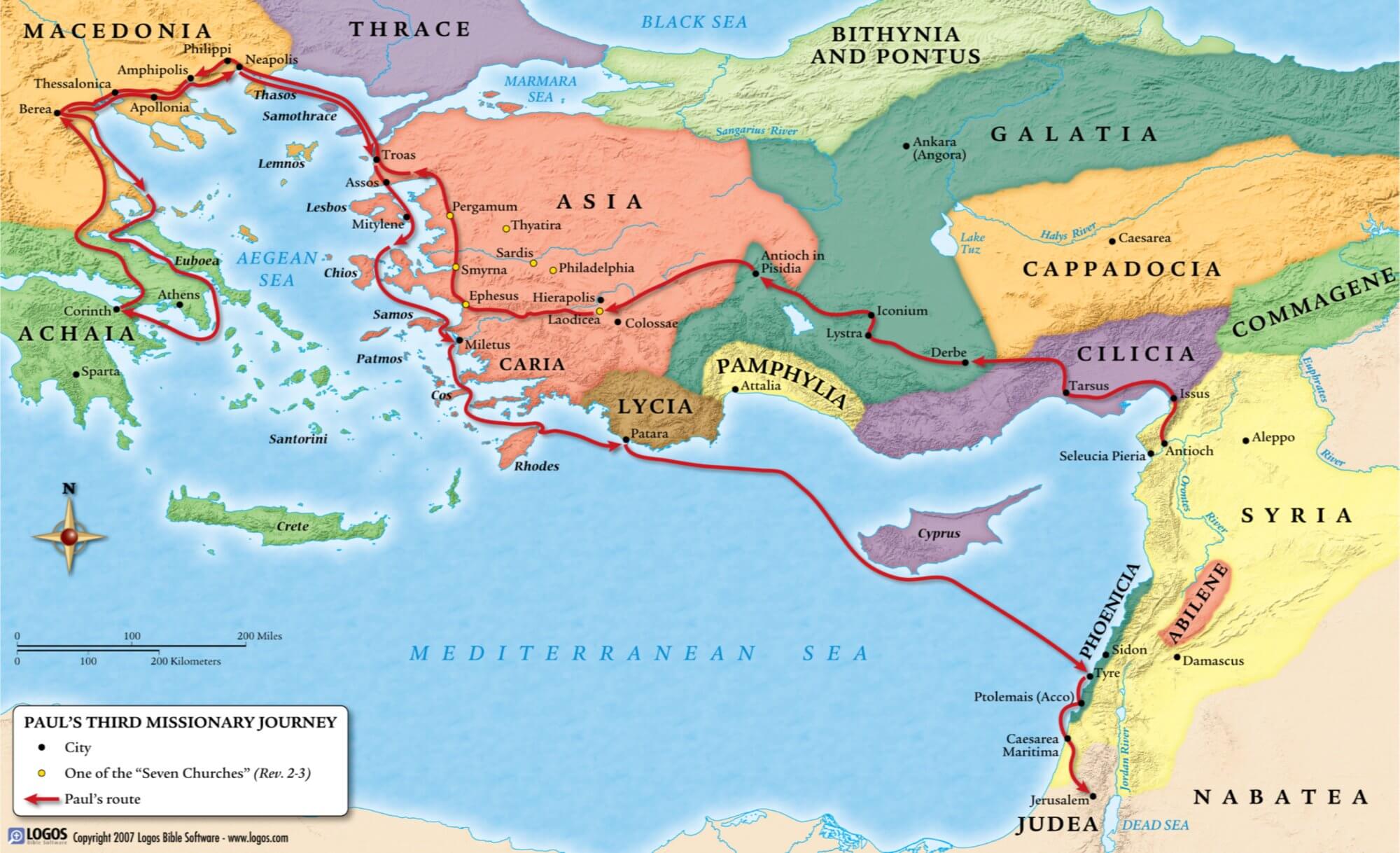
Ephesus is mentioned often in Scripture. Paul journeyed to Ephesus during his third missionary trip and stayed there for more than two years so that “all the Jews and Greeks who lived in the province of Asia heard the word of the Lord” (Acts 19:10). Ephesus was a prime site for evangelizing the whole province, due to the city’s accessibility and prominence in the region. It was in Ephesus that Paul’s companions were taken into the massive amphitheater where for two hours the mob shouted, “Great is Artemis of the Ephesians” (Acts 19:23–41). Despite the strong objections to the gospel, many Ephesians came to faith in Christ through the faithful ministry of Paul and his companions. A church began there, and a few years later, Paul wrote to them a letter that we now call the book of Ephesians. Four hundred years later, Ephesus was the site of a major church meeting known as the Council of Ephesus.

Ephesus was the setting for many New Testament events:

• God did extraordinary miracles through Paul, such that even handkerchiefs and aprons touched by him healed sickness and cast out demons (Acts 19:11).
• Paul wrote the epistle of 1 Corinthians.
• The seven sons of Sceva, Jewish exorcists, attempted to imitate Paul’s power and were attacked by demons because the demons did not recognize their spiritual authority (Acts 19:13–16).
• Many new believers “who had practiced magic arts brought their books and burned them in front of everyone” (Acts 19:19, BSB). The total value of the sorcery books they destroyed was 50,000 silver pieces.
• Priscilla and Aquilla discipled Apollos (Acts 18:24–26).
• Timothy had his first pastorate (1 Timothy 1:3).
• It’s thought that the apostle John and Jesus’ mother, Mary, lived in Ephesus after Jesus returned to heaven (see John 19:26–27).
• Paul may have faced wild beasts in the amphitheater (1 Corinthians 15:32).
• Jesus directed to Ephesus one of His seven letters in the book of Revelation (Revelation 2:1–7).

Jesus’ letter to the church at Ephesus contains Jesus’ famous rebuke: “You have left your first love” (Revelation 2:4). The believers at Ephesus, struggling beneath the weight of a godless and immoral culture, had maintained the letter of the law but had lost the Spirit of the law (see Romans 2:29). Jesus commended them for their hard work, perseverance, rejection of false teaching, and hatred of sin. But He was grieved that they had become routine in their service for Him rather than serve Him with the passion they once had. Their actions were there, but their hearts were not.

Jesus’ words to the believers in Ephesus should challenge all servants of the Lord. It is easy to get caught up in the busyness of ministry, church work, or volunteering and not realize our passion for the Lord has cooled. We are no longer propelled into service by love, but by some other selfish or worldly motivation. We may think God doesn’t mind, as long as we are outwardly obeying, but He does mind. It hurts Him, and it violates the greatest commandment: “You shall love the Lord your God with all your heart, soul, mind, and strength” (Mark 12:30).

Jesus gave the church at Ephesus time to repent, and He gives us time as well. Every moment we resist His call to humble ourselves and return to our first love is one more moment that we forfeit the love, joy, and peace He offers (1 Peter 5:6Galatians 5:22–23). Jesus was so concerned about the church at Ephesus that He dictated a letter through the apostle John (Revelation 1:1–2). And He is so concerned about the church of today that He made certain that letter was preserved for us (Revelation 1:322:18–19).

www.Upwards.Church

Message Audio/Video and Outline: https://upwards.church/leander-campus/watch-now-message-videos

Watch Messages: YouTube-Upwards Church

Facebook: Upwards Church

Read Along Daily Bible Reading: YouVersion (https://www.bible.com/organizations/370f8a6e-16bc-464f-8c43-0b7623fd2952)

Source: https://www.gotquestions.org/Ephesus-in-the-Bible.html

Posted in Masterpiece - Ephesians | Tagged , , | Leave a comment