
Working on our Words – James 3:1-12

Our words have power, use them wisely.

We love to talk.  There are talk shows everywhere.  Everybody seems to have something to say. Statistics on the average American: you have at least 30 conversations a day and you’ll spend 1/5 of your life talking.  In one year your conversations will fill 66 books of 800 pages a book.  If you’re a man you speak an average of 5 to 15,000 words a day.  If you’re a woman you speak 10-20,000 words a day.  Like the guy who was asked, “Do you resent that your wife has the last word?”  He replied, “No, I’m just glad when she finally gets to it!”  Or the wife who broke her jaw.  When they took an X ray it turned out to be a motion picture.

Our mouths can get us into a lot of trouble.  James talks more about the tongue than anybody else in the New Testament.  Every chapter in the book of James says something about managing your mouth, but chapter 3 the most.

The first warning James gives is fairly surprising. James says that “not many should  become teachers.” This seems counterintuitive. Why would James say that Christians should rethink the idea of becoming teachers? James cannot be saying that no one should be a teacher because then there would be no one to preach the gospel. In fact, Paul said that “God gave shepherds, evangelists, and teachers for the equipping of the saints.” God wants teachers. I think we can infer that there were Christians who were saying, “Why don’t I get my turn to be a teacher? I should be a teacher.” I think there were people then, as there can be today, who see teachers as having a glorious position, with the opportunity to stand in front of the group, as if there is personal glory in that. But James begins with a warning that easily overlooked. Do you also want to be judged more strictly? Are you prepared to be judged with a greater strictness? It is certainly true that teachers are judged by other Christians more strictly. But that is not what James is talking about. James is referring to God’s judgment.

Why will teachers be judged with a greater strictness? James explains in verse 2, and the sentence begins with the word, “for,” showing us that James is explaining this teaching. The reason teachers will be judged with a stricter judgment is because “we all stumble in many ways.” One of the ways we stumble is in our words. How true! We have many areas of weaknesses and points of falling short of God’s desire and will. But one area in which we stumble is in what we say. The implication is fairly clear. Teachers must talk more. Therefore, teachers will be under a stricter judgment not only because they speak the truths of God and that matters but also because they likely have said more words than those who are not teachers.

  1. Our Words have Power

James says, if you can control your mouth, you’re perfect.  He’s not talking about sinless.  The word “perfection” in Greek literally means “mature, healthy“.

When you go to the doctor and say, I’m not feeling good.  The first thing he says is “Stick out your tongue.”  Your tongue reveals what’s going on inside of you, not just physically but spiritually.

“The proof that God’s Spirit is in your life is not that you speak in an unknown tongue but you control the tongue you do know.”   Sidlow Baxter:

James now explains why the tongue must be controlled. The tongue is a very important part of the body. James uses three illustrations to express what the tongue is like and why it must be controlled.

(1) A bit in the horse’s mouth. The first comparison is that of a bit in the horse’s mouth. Horses obey their riders because the bit is put in the horses’ mouths and the riders pull the reigns so that the bit moves the horse. That bit is what riders use to control the whole body. This is an important observation that James is making. The bit controls the whole body of the horse.

(2) The rudder of a ship. Large ships are driven by strong waves and wind. However, though the ship is large and is tossed by the winds, it has a very small rudder that guides the boat by the will of the pilot. The first observation is similar to the first illustration. The bit controls the whole body. The rudder controls the whole ship. The second observation was implied in the first illustration but is expressly stated in this illustration. James implied that the rider of the horse has control over the animal. James now expressly states that the pilot of the ship has control over the large ship with the rudder. In both illustrations someone has control over the whole body.

(3) A fire. The final illustration is how a small spark can set ablaze a great forest. We see this in California all the time.  A careless camper or a cigarette butt and millions of acres have burned because of it.  However, the fire illustration adds one more dimension to James’s teaching. A fire is a devastating and destructive thing.

I wonder how many people because of a careless word have destroyed their marriage, or their career, or their reputation, or the reputation of another, or their church, or a friendship.  The tongue not only has the power to direct where you go but also to destroy what you have if you don’t learn to control it.  It’s like a fire.

The conclusion is at the beginning of verse 5. So also the tongue is a small member but it boasts of great things. The tongue is this small member but it gets us in a lot of trouble. A modern comparison would be that the tongue is like a steering wheel. It is small, but it controls where we go. The first important point that James wants us to take away from these illustrations is that if we can master our words, we can also master our lives.

Winning the battle of the tongue goes a long way to winning all of our other battles. By controlling the tongue we will exercise greater mastery over the other members of our body.

Set on fire by hell itself.  A couple comes in for marriage counseling.  “I said this and then she said that, then I said this…”  Then what happened?  “All hell broke loose”.   Our words can cause “all hell to break loose.”  James says you’ve got to learn to manage your mouth, not only because it can direct where you go but it can destroy what you have.  You can loose your family, your kids, your career simply by what you say.  It’s like a fire and its a source of evil.

James uses another illustration.  He talks about a zoo.  “All kinds of animals have been tamed by man, but no man can tame the tongue.  It’s humanly impossible.  Only God can do it.

It is a restless evil, full of deadly poison.”  (vs.7-8)  Of all the animals we’ve tamed, no man can tame the tongue, humanly speaking.  He says it’s restless.  That means it’s always liable to break out at any moment.   Restless, always liable to break out.  You never know what your mouth is going to say.

It’s like poison.  The word in Greek is literally “snake venom”. Just a few drops can kill.  You can assassinate somebody with your words.  Assassinate their character.  The tongue is a deadly weapon.

2. Our Words cause Problems.

James observes how inconsistent we are with our tongues. With our tongues we bless the Lord, but then we curse people who were made in the very image and likeness of God. From the same mouth flows blessings and curses. How is this possible? Why do we do this? But this is most certainly what happens. One moment we can be saying beautiful, upbuilding words and at the next moment tear a person down with our words.

Let us feel force of James’s words. “My brothers, these things ought not to be so.” This is just plain wrong. This has a connection back to the double-minded person in James 1:8. We are not fully dependent and loyal to Jesus. We have not surrendered our tongue to Jesus. We have not decided to bridle our tongues. We just speak our minds. We cannot be God-focused and have a critical, filthy, or impure tongue. Our words of worship should condemn our consciences for all the things we have used our mouths for this week. How is it that our mouths are praising God when we said the kinds of things we said to other people yesterday? How can our mouths claim Jesus to be the Lord when last week we said all kinds of improper things?

Let no corrupting talk come out of your mouths, but only such as is good for building up, as fits the occasion, that it may give grace to those who hear. Ephesians 4:29 ESV

Verses 11-12 drives a stake into our hearts. A spring cannot pour out fresh water and salt water. Also, a fig tree cannot bear olives. A grapevine cannot produce figs. A salt pond cannot yield fresh water. What is the point with all of these examples? A disciple cannot have a mouth that speaks curses, hurtful words, inconsiderate words, impure words, or words that do not build up. James’s implication is very clear. Springs do not produce fresh and salt water. Christians should not speak blessings and curses. Fig trees don’t bear olives and Christians do not allow their tongues to go unchecked or uncontrolled.

My problem is not really my tongue.  My problem is my heart.  What’s inside is what comes out.  My mouth eventually betrays what is really on the inside of me.  I can fool you and pretend but eventually my tongue is going to catch me.  It’s going to let you know what’s really inside.

Have you heard this excuse?  Someone says something really mean or hurtful and they say, “I don’t know what got into me.  It’s not like me to say that.  I don’t know why I said that.  It’s totally out of character.  I didn’t really mean it.”   James would say, Yes, it is.  It’s just like you.  You meant it.  Quit kidding yourself.  What’s inside is going to come out.  You don’t have a spring that one minute gives salt water and the next gives fresh water.  That’s inconsistent.  It’s a natural law:  what comes out of the well is what is inside of it.

If I have a problem with my mouth, I have a problem with my HEART

Jesus said in Matthew 12:34 “For out of the overflow of the heart the mouth speaks.”  Jesus explained the Freudian slip years before Freud even existed.  He said what’s inside of you is what’s going to come out.  My tongue just displays what I am.  It directs where I go.  It can destroy what I have.  But most of all, it simply displays what I am.  It reveals my character.

If you’ve got a problem with your tongue, it’s much more serious that you think.  You have a heart problem.  A person with a harsh tongue has an angry heart.  A person with a negative tongue has a fearful heart.  A person with an overactive tongue has an unsettled heart.  A person with a boasting tongue has an insecure heart.  A person with a filthy tongue has an impure heart.  A person who is critical all the time has a bitter heart.

On the other hand, a person who is always encouraging has a happy heart.  A person who speaks gently has a loving heart.  A person who speaks truthfully has an honest heart.

What do we need?   Ezekiel 18:31 “Rid yourself of all the offenses you have committed and get a new heart and a new spirit!”  Painting the outside of the pump doesn’t make any difference if there is poison in the well.  I can change the outside externals, I can turn over a new leaf, but what I really need is a new life.  What I need is a fresh start. I need to let go of all the past and be born again and start over.  I need to get a new heart.

How do I get a new heart?  2 Corinthians 5:17 “Therefore if any man be in Christ, he is a new person.  The old has passed away. Behold all things have become new.”  New life, new heart, new spirit.  When you come to Jesus Christ, He wipes out everything you’ve done in the past.  He says You’re starting over.  It’s like being born again.  You need a new heart.

We need to pray like David prayed in Psalm 51 “Create in me a clean heart, O God” because what’s in my heart is going to come out in my mouth.

A bit and a rudder must be under the hand of a strong arm.  James is saying that the only way to get control of your tongue is let Jesus Christ have control of your heart.  What’s in your heart is going to come out in your mouth.  You let Christ’s hand be on your bit, your rudder and let Him direct your life.

Darrell

www.Upwards.Church

Message Audio/Video and Outline: https://upwards.church/watch-now/leander-campus-videos

Watch Messages: YouTube-Upwards Church

Facebook: Upwards Church

Read Along Daily Bible Reading: YouVersion (https://www.bible.com/organizations/370f8a6e-16bc-464f-8c43-0b7623fd2952)
Posted in James - A Faith that Works | Tagged , , , , , , , , , , , , | Leave a comment

Faith that Works – James 2:14-26

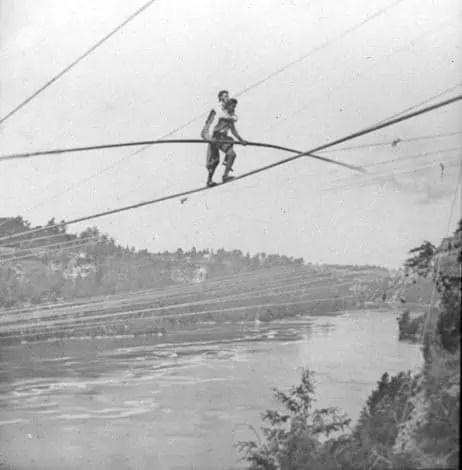
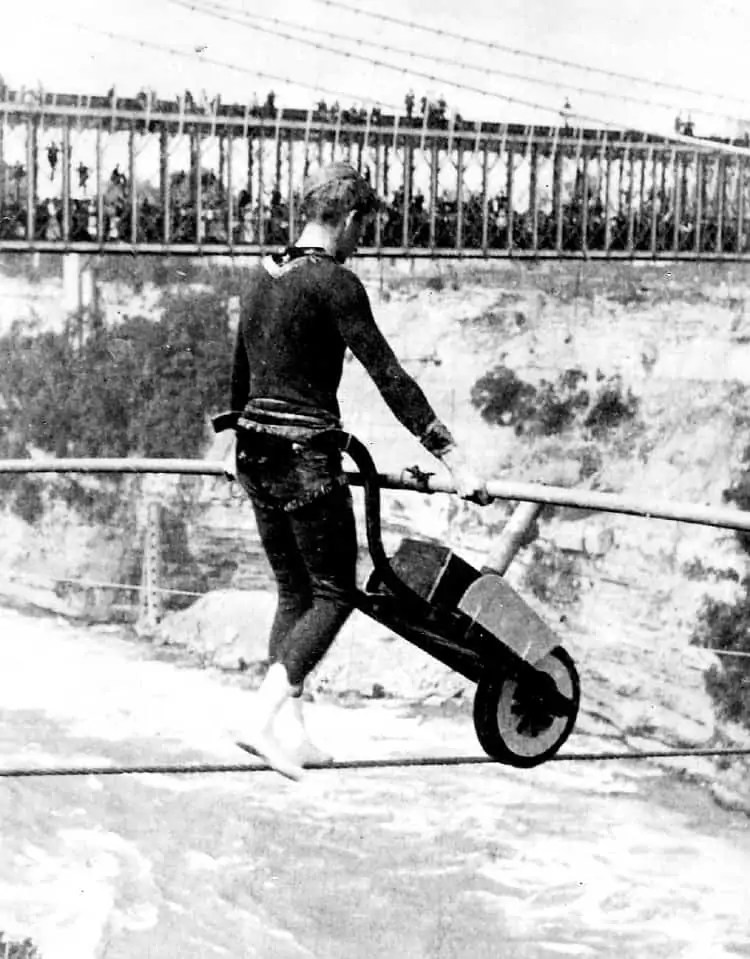
There is a historical account of a tight rope walker by the name of Blondin who stretched a long steel cable across Niagara Falls. During high winds and without a safety net, he walked and did stunts across the tightrope to the amazement and delight of the large crowd of people who watched on both the American and Canadian side.

Once he took a wheelbarrow and amazed the crowd by pushing it effortlessly across the cable, from one side of the falls to the other. Blondin then turned to the crowd and asked, “Now, how many of you believe that I could push a person across the wire in the wheelbarrow?”

The vote was unanimous. Everyone cheered and held their hands high. They all believed he could do it!

“Then,” asked Blondin, “who would volunteer to be that person?”

As quickly as the hands went up, they went back down. Not a single person would volunteer to ride in the wheelbarrow and to trust his life to Blondin.

Many people say about Jesus, “Yes, I believe!” If you are among those who say that, are you willing to demonstrate your belief by trusting your life to Him? Are you willing to get in the wheelbarrow and to risk everything on your faith? That’s what it means to believe. Faith is not just an intellectual exercise. It involves total commitment.

Faith is our topic from James 2 today.  What is faith? What does it look like? How does it work?  James will unpack the answers.

Have you ever heard someone say, “I’m a Christian,” but you don’t see any proof of it? There’s a lot of  people who think they are Christians and really aren’t.  In this passage James talks about the difference between real and counterfeit Christians.  Authentic believers and fake believers. He talks about how do you have a real faith.

Sometimes this passage is misunderstood.  The entire New Testament teaches that we are saved by faith.   James helps us understand what faith looks like; the fruit of salvation.   Some say that James and Paul are at odds, that they disagree.   Lets look at a well known passage by Paul on faith.

For it is BY GRACE you have been saved, THROUGH FAITH-and this not from yourselves, it is the gift of God not by works, so that no one can boast.  For we are God’s workmanship, created in Christ Jesus TO DO GOOD WORKS, which God prepared in advance for us to doEphesians 2:8-10

There are three prepositions in this passage — “by grace”, “through faith”, “to do good works”. If you get those out of order, you’re in trouble.

Let’s look at 3 aspects of Faith that Works:

  1. Faith Must be put into Action (14-17)

14 What good is it, my brothers, if a man claims to have faith but has no deeds? 

It doesn’t say he  actually has faith; he just claims to have it.  He talks about it.  He knows all the right phrases.  There are a lot of people who claim to be Christians.  George Gallup says that 50 million Americans say “I’m born again.”  But you don’t see anything in their lifestyle.  Today we tend to label people as Christians if they make the slightest sound of being a believer. It’s more than just talk that is involved in real faith.  Not everybody with a Christian bumper sticker is a believer.  Not everybody who is a professor of Christianity is a possessor of Christianity.  “Can such faith save him?   Talk is cheap.

Jesus agrees…

(Jesus) “Not everyone who says to me, ‘Lord, Lord,’ will enter the kingdom of heaven, but only he who does the will of my Father who is in heaven. Matthew 7:21

Faith is more than a desire.

“Suppose a brother or sister is without clothes and daily food.  If one of you says to him, `Go, I wish you well; keep warm and well fed,’ but does nothing about his physical needs, what good is it?”  (vs. 15-16)

There’s a Peanuts cartoon. Charlie Brown and Linus are inside all bundled up and Snoopy’s out in the cold shivering in front of an empty dog food bowl. Charlie and Linus are having a discussion on how sad it is that Snoopy is hungry and cold.  “He’s cold and hungry.  We ought to do something about it.”  They walk outside and say to Snoopy, “Be of good cheer, Snoopy.”  Do you know where Charles Schultz got that idea?  From this verse.  Wishing is not faith at work.

Real faith is visible.  You can see it.  It’s apparent.  If you claim to be a Christian, people will be able to see it.  It’s visible.   Faith is odorless, weightless, invisible so anybody can claim to have it.  How do you know for sure?  James says, show me.  If you claim to be a Christian I have a right to ask you to prove it by looking at your lifestyle.  Somebody said, “Faith is like calories.  You can’t see them but you can sure see the results.” You can’t see faith but you can see the results.

Jimmy Carter in his book Why Not the Best? said that somebody asked him the question, `If you were arrested for being a Christian, would there be enough evidence to convict you?'”

2. Faith is More than Belief (18-19)

There are a lot of people who have strong beliefs in God, the Bible, and Jesus.  They can recite creeds to you and catechisms, quote bible verses.  James says, “big deal!”  Just saying I believe in God is not enough to get you to heaven.  Even the devil believes that.  The devil is a great theologianHe knows a lot more about the Bible than you do.  He’s been around a whole lot longer.  He knows theology backwards and forwards.  He believes.

His demons believe and shudder.  The Greek word is the strongest word describing fear “to bristle” — their hair stands up on end.  It’s the kind of word you’d use reading a Steven King novel.  Why?  Because the devils understand the majesty and awesomeness of God, the power of God the Glory of God. They believe in God and they tremble.

There’s a difference between recognition and repentance. Demons recognize God but do not repent before God.

The word believe in Greek means “to trust in, to cling to, to rely on, to commit yourself completely.”  I believe in Hitler but I’m not a Nazi.  I believe in Karl Marx, but I’m not a communist, I believe in Osama Bin Laden but I’m not a terrorist.  I’m a Christian because I believe in Jesus.  But it’s more than just a head knowledge.  Billy Graham says, “A lot of folks are going to miss heaven by 18 inches.  They’ve got it in their head but not their heart.”

Real faith is commitment

I dated other girls before I married Niki, they were good looking, they were funny, they were interesting.  But there’s a huge difference in my relationship Niki and to any other woman that is alive.   I am committed to Niki,, in sickness and in health in good time or bad time, for better or for worse.  Are you committed to Christ and no one else?  Or are you just like a demon?  You say you believe but are not committed. Your real commitment is work.  You real commitment is recreation.

Real faith is not just saying “I believe”.  There is so much easy believeism in America.   “Many in America believe but don’t practice.”  Surveys by Gallup and Barna asked people and they found a high degree of belief.  “Sure, I’m a believer.  I’m a Christian.”  Do you attend church.  No.  “Do you donate your time.”  No.  “Do you tithe.” No.  James would say that’s a phony belief.  You’re just conning yourself.  A lot of people are doing that.

James asks, Do we have a Dead Faith?  Do we have a Demonic Faith?  Or do we have a Demonstrated Faith?

3. Faith is Demonstrated (20-26)

James gives us two examples of two very different people:

Abraham is a man.  Rahab is a woman. Abraham  is Jewish.  Rahab is a Gentile.  Abraham is a patriarch. Rahab is a prostitute.  Abraham is a somebody.  Rahab is a nobody.  Abraham is a major character in the Bible.  Rahab is a minor character.  He uses these illustrations to say, it doesn’t matter who you are as long as you’ve got the important thing. They only had one thing in common — their faith in God.  Their faith in God led them to action.

For Abraham it was the ultimate test where God asked Abraham to give up his own son.  This has nothing to do with salvation.  Abraham was already a believer.  Twenty five years earlier God had said, You’re righteous.  He’s not talking about being saved by his works.  He saying, this just shows how much you believe.  Abraham obeyed God.  He followed Him.  He took his son up.  He did all those faith steps.  He cut the wood, built the altar and was ready to sacrifice his own son.  Abraham says to his son while walking up the mountain, “We [not I] will return“. He knew that God would provide somehow even if it meant raising him from the dead.  The fact is God did raise him from the dead, figuratively speaking.  Abraham was about to sacrifice him and God says, I was just testing you to see what’s most important in your life.  It was an action.  His works proved his faith.  He held nothing back from God.

And he talks about Rahab.  The story is in Joshua 2.  It’s the story how a prostitute helped a couple of spies when they were coming into Jericho.  Rahab ends up in the family line of Jesus. She risks her life to save the spies.

Our faith is not determined by what we do, it is demonstrated by what we do.

Talk is cheap. Put your money where your mouth is.  “I believe in Jesus!”  Prove it.  Our faith is demonstrated by our actions.  Actions speak louder than words.  Our behavior shows what we really believe.

A few questions as we close:

Am I really a Christian after all?  In the light of what James says, am I really a Christian?What changes can I point to in my life?  Is my life style any different at all from unbelievers?  So many people think  it doesn’t matter what you do as long as you believe.  James says that’s not true.  He’s not saying you work your way to heaven. He’s not saying works deliver salvation.  He’s saying they demonstrate it.  He’s saying, if your faith doesn’t work, what good is it?

Are you absolutely sure that if you died you’d go to heaven?  The fact is you can be sure.

How do you do that?  Ephesians 2:8-10 “For it is by grace you have been saved, through faith, for a life of good works God has already prepared for us to do.”  God’s grace.  God reaches down. He says, “I want you to know Me.  I want to have a relationship with you. You’re a sinner, I’m your Savior.”  That’s grace.  And you look up and say “I want to know You, Lord.  I repent of my sins and trust You.”  When God’s hand of grace comes down and your hand of faith goes up, that’s called salvation.  That’s what it means to be a believer.  Saved by grace, through faith to do exactly what God made you to do in the first place.  He has a plan for your life.

Christ died for you, will you live for Him?

Darrell

www.Upwards.Church

Message Audio/Video and Outline: https://upwards.church/watch-now/leander-campus-videos

Watch Messages: YouTube-Upwards Church

Facebook: Upwards Church

Read Along Daily Bible Reading: YouVersion (https://www.bible.com/organizations/370f8a6e-16bc-464f-8c43-0b7623fd2952)

Posted in James - A Faith that Works | Tagged , , , , , , , , , , | Leave a comment

God’s Word at Work – James 1: 19-25

Do you own a bible?  How many? In America, Bibles are everywhere.  You can find them in grocery stores, book stores, motel rooms, everywhere.  They’re available in all sizes, shapes, translations, versions, leather bound, paper back.  Every year the Bible out sales every other major best seller.  Last year there were 500 million Bibles published in the world in 18,000 different languages portions of the Bible. In America we are glutted with the word of God on the airways, radio, TV, books, magazines.  It’s everywhere.  Yet millions of people still miss the blessing of the Bible.

It promises comfort, strength, hope, wisdom, joy, power, and purpose.  But just because you have a bible doesn’t mean you’re going to get the benefit from it.    Niki and I had a treadmill at our house.  It became a place we draped our clothes!  Just because we had it doesn’t mean we are going to be fit.  I’ve got dumbbells under my bed. Just because I have them doesn’t mean I will be muscle bound.  When I was pastor in Eagle Pass, TX a man at men’s group told me that he wants to lose weight so he buys salads, but after a while they wilt in the refrigerator because when he opens the refrigerator he reaches for tortilla’s not salad.  Like a Bible, having and buying it doesn’t mean you will get a blessing from it.

  1. Receive God’s Word (vs. 19-21)

       “My dear brothers, take note of this:”

  •  Listen (vs. 19a)

              “Be quick to listen, slow to speak…”

Concentrate on listening.   Like the two Aggies in the grocery store.  One was staring at the frozen orange juice.  What are you doing said the other Aggie?  I’m making orange juice, see it says orange juice from concentrate”     v. 19 “Be quick to listen…” Give it your full attention.  Be alert.  Don’t miss it. “quick to listen… slow to speak …”  When I’m talking, I’m not listening.  God gave us two ears and one mouth for a reason.  We ought to listen twice as much as we talk.  Your mouth has the ability to close your ears stay open and never close.  That’s for a reason.  In order to save face we need to keep the bottom half of it shut.  Many of our problems are caused because we’re quick to speak rather than being quick to listen. Concentrate.  Be ready.   Be ready to receive God’s word.

” … and slow to become angry … “

We don’t hear much when we’re angry, upset, bitter, resentful.  Bitterness is a barrier, an emotional block that keeps us from hearing God’s word.  Some may ask, “How come God never speaks to me.”  Maybe you’ve got some resentment in your life you need to get rid of.  An article in Reader’s Digest said when you listen it actually lowers your blood pressure; when you speak it raises your blood pressure.  James says, “be slow to anger.”

What is your emotional state, normally, when you come to church on Sunday morning?  In many homes on Sunday morning it’s hectic.  Frustrating. Anger flares.  Niki and I used to get into fights on Sunday mornings for about the first two years of our marriage.  “Grrreat Lords Day!”   Then we come at the last minute, frantic, frustrated and expect God to speak to us.  Our problems ceased when I would make the right preparations and get up earlier.  Do you prepare for Sundays? In order to do that maybe plan ahead.

              “Get rid of all moral filth and the evil that is so prevalent …”

Before you can plant the seed you need to do a little weeding.  Ear wax can block your hearing and when you have a filth /sin in your life it blocks your hearing.  It prevents God’s word from getting into your heart.  He says get rid of the evil, anything that we know that isn’t right in our lives.  God says, Lay aside all of the emotional garbage, the old habits, the junk in your life so that God’s word can get through to you.

How can we be clean?  By confession.  “If we confess our sins, He’s faithful and just to forgive us and cleanse us from all unrighteousness.”

              “humbly accept the Word planted in you …”

Teachable, yielded, humble, willing to be changed.  He says “humbly accept the word of God planted in you…”  Don’t act like you know it all.  If you know it all, God’s word can’t get through to you.  Pray, “God, do what You need to do in my life.”

James gives an illustration.  He says it’s planted in you.  He gives the illustration of a garden and seed.  The Bible, all through Scripture, compares itself to seed.  Jesus told the parable of the sower and said, the word of God is a seed and it’s planted in our hearts.  How is it you can take two seeds that are exactly the same and plant them in two different locations and get two different crops in fruitfulness?  One soil is prepared and the other is not.

How is it that you can take two people and put them in the same service and hear the same message.  “Two people went to a church service.  One complained the music was bad, people unfriendly and the message unhelpful.  The next said, the music was moving, the people were loving and the message was helpful.  They actually went to the same service!    How can one person get blessed by it and the other person says he didn’t?    One heart was prepared and one wasn’t. James says we must receive the word of God with the right attitude.

2. Respond to God’s Word (vs. 22-24)

       “Do not merely listen to the word, and so deceive yourselves. Do what it says.” (vs. 22)

I must do something about it, act on it, live it, practice it.

The word “listen” is the word for “auditor”.  In Seminary some people were scared of Masters level classes, the research papers and tests so they would audited the classes. It can be done in college.  You don’t take it for credit, no tests, no responsibility, no research.  You were totally relaxed.  You just listened, you didn’t have any intention of applying it.  We have a lot of auditors in the church.  They come to church, walk in, hear the word of God, walk out with no intention of ever being changed.  I did it too, but it never changed me.  We must respond to God’s word, let it change us if we’re going to be blessed by it.

  • I use a mirror to evaluate myself (vs. 23-24)

“ like a man who looks at his face in a mirror and, after looking at himself, goes away and immediately forgets what he looks like.

James uses an illustration here.  God’s word is like a mirror.  The purpose of a mirror is to evaluate us.  We use them to evaluate ourselves.  We look in a mirror to access the damage from the night before.  Then you do something about it.  What good is a mirror if you don’t do anything about it?   Niki has a saying that I hear when we get around large groups of people and someone will be wearing something that is questionable.   She says,  “Does their mirror not work?”  God says a mirror reflects what we’re like on the outside. God’s word reflects what we’re like on the inside.

Have you ever seen yourself in the Bible?  Hebrews says, “God’s word detects the thoughts, intents, motives and desires of the heart.”  Some people don’t read the Bible because they’re afraid. They’re unwilling to face themselves and see themselves as they really are.  They don’t want to look at the mirror of God’s word.

 James says it’s self deception when we don’t let it change us. We think that just listening to content is making us spiritually mature.  The test of maturity is not knowledge.  The test of maturity is character and life change.  “Knowledge puffs up”  I need to practice it, apply it, put it in my life.

And knowledge increases responsibility.  The more we know the more we’re accountable for.  What am I doing about what I know? Jesus said, “To whom much is given, much is required.”  And James said, “To him who knows to do good and doesn’t do it, it’s sin.”

 Illustration:  Let’s say you gave a friend a best selling book on body building because they wanted to work out and get healthy.   You say, this book can change your life.  It’s fantastic.  It has changed the lives of millions of people.  It will keep you strong.   They say, “Great” Then you don’t see them for 6 months and then come back and they look unfit and unhealthy!  You say, “What happened?  Didn’t you read the book?” What if  they said to you, “I read the book.  I enjoyed it.  This is the greatest book I’ve ever read.  I loved it.  I even underlined portions of it with colored markers and memorized sections of it and even started a group study of the book and looked at the etymology of every single word of the book.  Every night I would spend a couple hours studying it.”

How often does that happen with the word of God?  We give awards for memorizing Scripture but we don’t give awards for doing Scripture.  We hear people say, “I read through the Bible” but don’t  hear, “I did the Bible.”

We need to mark our Bibles, but we need to let the Bible mark us.  It’s not how many times you’ve been through the word of God it’s how many times it’s been through you.  We’ve got to be a doer of the word.  I deceived myself in thinking that because I had knowledge that made me mature.  Having knowledge of a body building book doesn’t produce muscles.  Just because we know something doesn’t mean we act on it.

 Barna and Gallup polls show that “Many many Americans believe.” Some of the top Bible teachers of the nation are on the radio at any time of day and you can hear godly men teaching the word.  You can hear the Word of God 24 hours a day. A lot of us are lulled into the fact that because we’re hearing a lot abut God, we are maturing.  The truth is, your young children or grandchildren may be more spiritual than you.  They may know little but if they doing it they eclipse you in spiritual maturity.

That is what James is addressing.  He’s saying, If you want to be blessed, you’ve got to live the word of God, not just hear it. Not just know it.

Depth is doing!   I try to make messages practical so we can put it into practice.

I heard about the guy who came to church late.  He walked in just as the service was completing.  He said to an usher, “Is the sermon done, yet?”  The usher was wise and said, “The sermon has been preached, but it is yet to be done.”  Be doers of the word, don’t merely listen.  Put it into practice.

I pray that our church church will develop the reputation that people say, “They’re doers of the Word.  They practice what everybody else talks about.  They live it.”

People have a Living Bible.  You ought to be a Living Bible.

What’s the best translation of Scripture? The translation that translates into your life.

3. Remember God’s Word (vs. 25)

Three ways to Remember

  • Pay Attention

“… the man who looks intently into the perfect law…” (vs. 25a)

Investigating.  Focus intently on the word of God.

There are two ways you can look at a mirror.  You can gaze at it or you can glance at it.  All of us have done both.  It’s human nature that you can’t walk by a mirror and not look at it.  When you glance at it, you immediately walk away and forget what you’ve seen.  It didn’t do you any good.  Many people try to have a quiet time that way or read the Bible that way.  They don’t want to gaze at it, but glance at it.  Give God five minutes.  God says He wants us to gaze at the word.  Look at it intently in detail.

Questions to ask yourself”

  • Is there an Attitude to change?
  • Is there a Command to obey?
  • Is there an Error to avoid?
  • Is there an Example to follow?
  • Is there a Promise to claim? Look for promises, there are over 7000 promises in the               word of God.
  • Is there a Prayer to pray?  There are lots of prayers in the Bible.  You can take those prayers and pray them for yourself and for others.  You can know they’ll be answered because they’re in the Word of God.
  • Is there a Sin to confess?


  •  Meditate

              “… and continues to do so …”  (vs. 25b)

That means over and over and over.  The Bible calls this meditation.  When you think about something over and over its meditation. Meditation is not put your mind in neutral and contemplate lint in your navel.  Yoga and all this Eastern Religious mindlessness has warped our thinking.  Meditation means to think seriously about something over and over.

If you know how to worry you can meditate.  Take a negative idea and think about it over and over it’s called worry.  Take God’s word and think about it over and over, it’s called meditation.  The Bible says, meditate on God’s word.  Jesus said, “…if you continue in My word, then you’re truly My disciples.”  Read it and review it.  The outlines I give each week are not only that you can keep up with me, it’s so that you can review it during the week.  God says, You want to be blessed by the word?  Review it.

We need to fill our minds with the word of God.  James says, You want to be blessed?  Reflect on the word.  Think about it by reading it and reviewing it.

  • Memorize

       “… not forgetting what he has heard.”  (vs. 25c)

In Psalms 119 it says “Your word I have hidden  in my heart that I might not sin against your.”  Memorize God’s word if you want to be blessed by it.  *We remember what’s important to us.

A Little boy saw his Grandfather reading his Bible and asked Grandpa are you studying for your final exam?  You see two things will remain for eternity.  Your soul and God’s word, its worth knowing and remembering because it will always be around.

Take notes, write things down.  If you value God’s word you’re going to take notes on it.   The United States Air Force did a study and found that we forget 95% of what we hear within 72 hours.  This statistic depresses a pastor.  I spend all week preparing a message to give on Sunday.  By Wednesday you’ve forgotten 95% of what I’ve said unless you’ve written it down. Mark up your bible, write in it.  James says receive God’s word with the right attitude, reflect on God’s word by reading it, reviewing it, remembering it.

What is James saying to us?  He’s saying “What are you going to do about what you already know?”  What are you going to do about it today?  Maybe some of you need to decide to start preparing better for worship.  Get up a little earlier so you’re not so rushed, come in late half way through the songs.  I sit down, here for the whole service, I tune in to God and get calm and collected and I’m quiet and ready.  I can say, “Lord, here I am. Teach me.  So I can be blessed by God’s word.”

Maybe some of you need to say, “I’m going to read through the Bible daily.”  Join our reading plan. Scan this code and read along through each book of the bible.

“I’m going to start memorizing Scripture.  I’ll pick a verse a week and hide God’s word in my heart.

You need to find a place of ministry where I can get involved.”  Impression without expression leads to depression.  If you’re always taking in, one study after another, and never get out in ministry, it’s going to  rot your spiritual life. *You will sit, soak and sour!

James is saying that the blessing of the Bible comes when we start living it.

Will you join me?

Darrell

www.Upwards.Church

Message Audio/Video and Outline: https://upwards.church/watch-now/leander-campus-videos

Watch Messages: YouTube-Upwards Church

Facebook: Upwards Church

Read Along Daily Bible Reading: YouVersion (https://www.bible.com/organizations/370f8a6e-16bc-464f-8c43-0b7623fd2952)


Posted in James - A Faith that Works | Tagged , , , , , , | Leave a comment

James – A Faith That Works – Invitation and Introduction

You’re invited to our new  message series!

James (A Faith that Works) 5 weeks  

Description: The book of James is a letter that serves as a how-to manual for the Christian life. When we deal with trials temptations, pride, doubt, division and conflict, James teaches us how to take godly action in our lives. The foundation of the book is the importance of faith and how it works.


Dates  Titles                Scriptures                                       Events 

 Sep. 8 – God’s Word at Work (James 1:16-25)
Sep. 15 – Faith that Works (James 2:14-26)                           *Communion

Sep. 22 – Working on our Words (James 3:1-18)
Sep. 29 – Working Through Conflict (James 4:1-12)

Oct. 6 – Patience at Work (James 5: 7-12)

Introduction: 

“Miraculous!” … “Revolutionary!” … “Greatest ever!” We are inundated by a flood of extravagant claims as we channel surf the television or flip magazine pages. The messages leap out at us. The products assure that they are new, improved, fantastic, and capable of changing our lives. For only a few dollars, we can have “cleaner clothes,” “whiter teeth,” “glamorous hair,” and “tastier food.” Automobiles, perfume, diet drinks, and mouthwash are guaranteed to bring happiness, friends, and the good life.
And just before an election, no one can match the politicians’ promises. But talk is cheap, and too often we soon realize that the boasts were hollow, quite far from the truth.
“Jesus is the answer!” … “Believe in God!” … “Follow me to church!” Christians also make great claims but are often guilty of belying them with their actions. Professing to trust God and to be his people, they cling tightly to the world and its values. Possessing all the right answers, they contradict the gospel with their lives.
With energetic style and crisp, well-chosen words, James confronts this conflict head-on. It is not enough to talk the Christian faith, he says; we must live it. “What good is it, dear brothers and sisters, if you say you have faith but don’t show it by your actions? Can that kind of faith save anyone?” (2:14). The proof of the reality of our faith is a changed life.
Genuine faith will inevitably produce good deeds. This is the central theme of James’ letter, around which he supplies practical advice on living the Christian life.
James begins his letter by outlining some general characteristics of the Christian life (1:1–27). Next, he exhorts Christians to act justly in society (2:1–13). He follows this practical advice with a theological discourse on the relationship between faith and action (2:14–26). Then James shows the importance of controlling one’s speech (3:1–12). In 3:13–18, James distinguishes two kinds of wisdom—earthly and heavenly. Then he encourages his readers to turn from evil desires and obey God (4:1–12). James reproves those who trust in their own plans and possessions (4:13–5:6). Finally, he exhorts his readers to be patient with each other (5:7–11), to be straightforward in their promises (5:12), to pray for each other (5:13–18), and to help each other remain faithful to God (5:19, 20).
This letter could be considered a how-to book on Christian living. Confrontation, challenges, and a call to commitment await you in its pages. Read James and become a doer of the Word (1:22–25).

Vital Statistics

Purpose: To expose hypocritical practices and to teach right Christian behavior

Author: James, Jesus’ brother, a leader in the Jerusalem church

Original Audience: First-century Jewish Christians residing in Gentile communities outside Palestine

Date Written: Probably A.D. 49, prior to the Jerusalem council held in A.D. 50

Setting: This letter expresses James’ concern for persecuted Christians who were once part of the Jerusalem church.

Key Verse: “Now someone may argue, ‘Some people have faith; others have good deeds.’ But I say, ‘How can you show me your faith if you don’t have good deeds? I will show you my faith by my good deeds’ ” (2:18).

The Blueprint
1. Genuine religion (1:1–27)
2. Genuine faith (2:1–3:12)
3. Genuine wisdom (3:13–5:20)

James wrote to Jewish Christians who had been scattered throughout the Mediterranean world because of persecution. In their hostile surroundings they were tempted to let intellectual agreement pass for true faith. This letter can have rich meaning for us as we are reminded that genuine faith transforms lives. We are encouraged to put our faith into action. It is easy to say we have faith, but true faith will produce loving actions toward others.

I hope you can join us in the book of James and learn to have a “faith that works.”

Darrell


Source: Life Application Bible Notes (Tyndale, 2007), 2113.
Posted in James - A Faith that Works | Tagged , , , , | Leave a comment