24 Days with Jesus – Intro

How would you like grow spiritually in 24 days?  Join us as we are going to read a chapter day from the book of Luke.  24 chapters about Jesus in 24 days!  It’s going to be a great journey with lots of discovery, insight and fun. 

Each day’s post will contain expanded thoughts, some background, and commentary for each chapter in Luke.   If you see a verse reference in blue underlined text (1:2), you may click on it to read it immediately.  Your life will change after 24 days with Jesus.

 For those who like to read introductions this next section is for you.  Here is general overview of the book of Luke.   Although it was written in the past be sure to see the sections, “Importance for Today”   We will look at the following questions:

 1.        Who is the Author?

Luke: he was a doctor, a Gentile (non Jewish) Christian, a traveling companion of Paul, a historian and the writer of the book of Acts.  His name occurs in the New Testament in Colossians 4:14; 2 Timothy 4:11; and Philemon 24. Luke also referred to himself directly in the “we” sections of Acts (16:10-17; 20:5-21:18; 27:1-28:16).

2.        What Sources did Luke use?

Luke claimed to be a historian (Luke 1:1-4). He carefully researched his material for specific reasons. He consulted eyewitnesses for information (1:2). He seems to have gathered certain details, such as facts on Jesus’ youth, from Mary herself (cf. 2:51). Luke also seemed to have had contacts with the Herodian court (cf. 3:1, 19; 8:3; 9:7-9; 13:31; 23:7-12). He had various source materials that he used in order to create a unified whole, written in his style, which reflected his purpose. All this, of course, was done under the inspiration of the Holy Spirit.

3.        When was it written?

Most biblical scholars agree the book of Luke was written between a.d. 58 and 60.  Paul was martyred in the time of Nero’s persecution (a.d. 64). Acts closes with Paul still alive and in prison. The Book of Luke was written several years before that, since Acts was Luke’s second book.  

4.        What was the Purpose of writing this book?

Luke had two purposes in writing this book. One was to show that faith in Christ rested on firm historical fact (1:3-4). His other purpose was to present Jesus as the Son of Man for all people, not just Jewish people.

5.        Was Luke really written for a non Jewish audience?

Several truths point to the fact that Luke wrote primarily for Gentiles.

  1. Luke frequently explained Jewish localities (4:31; 8:26; 21:37; 23:51; 24:13). This would be unnecessary if he were writing to Jews.
  2. He traced Jesus’ genealogy (3:23-38) all the way back to Adam (rather than to Abraham, as in Matthew’s Gospel). The implication is that Jesus was representing all mankind rather than just the Jewish nation.
  3. Luke referred to Roman emperors in designating the dates of Jesus’ birth (2:1) and of John the Baptist’s preaching (3:1).
  4. Luke used a number of words which would be more familiar to Gentile readers than the comparable Jewish terms found in Matthew’s Gospel. An example is Luke’s use of the Greek didaskalos rather than rabbi for “teacher.”
  5. Little is said about Jesus’ fulfilling prophecies because that theme was not nearly so important to Gentile readers as it was to Jewish readers.

 6.        How does Luke compare with the other Gospels?

Luke has some material in common with the gospels of Matthew and Mark. But, Luke has a lengthy section that is only found in his book (9:51-19:27), which includes 15 parables of Jesus not found an any other gospel.   He also has written the most about Jesus birth, and the record of Jesus at age 12 (1:5-2:52). It is assumed that Luke knew of and used both Matthew and Mark or sources common to Matthew and/or Mark. (John was written after Matthew, Mark and Luke)  The differences in accounts we read in each gospel can be explained on the basis of the purposes of the various authors. 

 7. What are the characteristics of the Book?

1.  Luke emphasized the universal message of the gospel more than the other Gospel writers. He often wrote about sinners, the poor, and outcasts from Jewish society. He also referred many times to Gentiles who shared in the blessings of the Messiah. Samaritans were presented as coming to faith in the Messiah. And Luke wrote frequently of women and children and their faith.

Importance for today: Jesus’ love for people is good news for everyone. His message is for all people in every nation, and each person has the opportunity to respond to him in faith. In addition, Jesus’ example teaches that his followers should love people, regardless of their sex, race, age, or worldly status.  You may feel as if you are a second-class citizen in your community or neighborhood, but not in Jesus’ eyes. Regardless of your status in society, know that you are important to him.

 2. Luke’s Gospel gives a reader a more comprehensive grasp of the history of the period than the other Gospels. He presented more facts about the earthly life of Jesus than did Matthew, Mark, or John.

Importance for today:  Christians today can believe in the reliability of Luke’s history of Jesus’ life. Even if approached as a secular document, this Gospel presents solid evidence for its historicity and accuracy.

3. Luke emphasized forgiveness (3:3; 5:18-26; 6:37; 7:36-50; 11:4; 12:10; 17:3-4; 23:34; 24:47).

Importance for today: Jesus is the unique Son of God, humanity’s perfect leader and only Savior. He offers forgiveness to all who will accept him as Lord of their lives and who believe that what he says is true. Christians know this profound truth. Christ has changed their lives, forever. They also have the great responsibility to share the Good News with others. The world is lost, with millions heading for eternal separation from God. These men, women, and children need to meet and know the Savior. What can you do to share this news of forgiveness with others?

 4. Luke emphasized prayer. At many points in His ministry Jesus prayed (3:21; 5:16; 6:12; 9:18, 29; 22:32, 40-41).

Importance for today:  We can approach our heavenly father as Jesus taught us and modeled. He cares about our needs, our concerns and listens to us.  Do you pray often?

5.  Luke often spoke of joy that accompanies faith and salvation (1:14; 8:13; 10:17; 13:17; 15:5, 9, 32; 19:6, 37).

Importance for today:  Salvation in Jesus Christ the best news in the world.  All of our sins were placed on Jesus Christ at the cross.  We are forgiven.  The angels throw a party; we should celebrate too when someone comes to faith in Christ.   

Until tomorrow, Darrell

 Sources:   Bible Background Commentary, Bible Knowledge Commentary,  Life Application Bible Commentary

For more about The Ridge Fellowship or Darrell Koop, go to www.ridgefellowship.com

Posted in 24 Days with Jesus (Luke) | 9 Comments

Schedule Boundaries

There’s a great illustration of a time management speaker who set a Mason jar on the table and began placing rocks inside. “Is the jar full?” he asked.
Everyone said, “Yes.”
“Really?” He took a bucket of gravel, dumped it in and shook the jar so the gravel sank in. He asked, “Is the jar full?”
“Probably not,” said most of his listeners.
“Good!” He poured in sand. “Now-full?”
“No!” shouted all.
He poured a pitcher of water into the jar. Now it was truly filled.

“What’s my point?” he asked.
“You may think your schedule’s full, but you can always fit something else into it,” a man said
“No!” said the leader.

“It’s this: put in the big rocks first or you’ll never fit them in at all.”  

(From Stephen Covey, First Things First)

So like that illustration here’s what I have learned the hard way.  In order for my family and my God to not get my leftovers I HAVE to:  Schedule what’s Most Important before anything else.  But I have to move from “saying” it’s important to actually scheduling it.

 For instance, if I have a doctor’s appointment I put in on my schedule.  If we have someone coming over to fix the ac or plumbing we schedule it.  Why?  Because nothing happens until you schedule it.  You may say spending time with God is important.  Is it on your schedule?  You may say spending time with your kids is important.  You may say quality time with your spouse is important.  You may say exercise or anything else is important, but if you don’t schedule it, it’s not really important.  I have found that the schedule is where the rubber hits the road.  Nothing happens until I put it on my schedule.  

 I have found that I had to schedule time with Niki (my wife) and guard that time like Fort Knox. My day off is on Thursday. This is also Niki’s day off.  It’s our time together.   We try hard to not check our email or answer the phone (unless the school calls to say one of kids is sick).  Now that this time has been on the schedule so long it is unmovable, which is good.  We need that time as a couple.  

To read my Bible regularly, I have to have a specific time and stay with it.  For me it’s right before bed.  That’s the time that consistently works best -I have tried other times in the day and failed, just pick a time that will work best for you, schedule it and stick with it.   I have my Bible on my nightstand beside my lamp –it’s always there reminding me.  (I just have to make sure the Sports Illustrated doesn’t cover it!)  It’s now like brushing my teeth, if it doesn’t get done; it feels like something is missing.   

 I am thankful to Niki because she has scheduled dinner at 6:30 every night.  And that is “family time” a great time to catch up with the kids.   Now it’s a no brainer, but it had to be scheduled.

Scheduling:  it’s a matter of making time.  I’m never going to find the time. There’s a saying I think is so true, “If the devil can’t make you his, he’ll make you busy.”  Make time for the things that are important in life — God and the people He’s placed around you.    

We’ll talk more about this on Sunday in our series, Schedule Boundaries.

Here’s to a healthy schedule!  Darrell

For more about The Ridge Fellowship or Darrell Koop, go to www.ridgefellowship.com
Posted in Boundaries | Leave a comment

What are the plants at church & can I grow them?

Often people will ask regarding the landscaping at our church, “What kind of plant is that?” and “Can I grow that?”  The following is a list of the most common plants at our church.  They have worked great year after year.  Though blistering summers, drought, below freezing weather and hungry deer populations they never fail to grow, flower, stay beautiful and attract wildlife.  And yes, you can grow them!

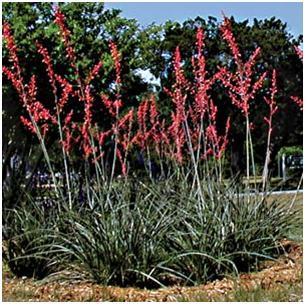
1.   Red Yucca

Benefits:  drought tolerant (can live off central TX rainfall –as little as 10 inches a year) attracts humming birds, deer resistant, nice flowers spring-summer Needs little to no fertilizer, survives our winters.   Evergreen Can find at all garden stores, Home Depot, Lowes, etc.

Mature Size & Habit:  4’x4’ give that much room for each plant.  Loves full sun can tolerate partial shade.

Spacing – if you put them together you can choose to put them 4’ apart. Or 5’ would give 1’ between each one.  They look good alone or massed two or more together.   Care & Maintenance: Very little -just break off or cut old flower stalks in winter.

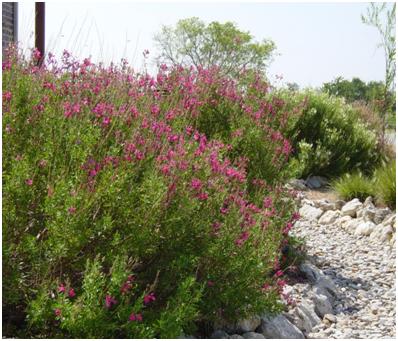
2.   Salvia Greggi    

 Benefits:  drought tolerant (can live off central TX rainfall) attracts humming birds & butterflies deer resistant, flowers –early in spring to late in fall. Needs little to no fertilizer. Almost Evergreen -survives our winters.   Can find at all garden stores, Home Depot, Lowes, etc.

Many flower types:  red, pink, purple, white, coral, and raspberry.

Mature Size & Habit:  3’x3’ give that much room for each plant.  Loves full sun can tolerate partial shade.

Spacing – if you put them together you can choose to put them 3’ apart. Or 4’ would give 1’ between each one.  They look good alone or better massed two or more together.

Care & Maintenance:  Little – just cut back (by 1/3) in the winter to help the plant stay compact and have greater flowering.

3.  Cenizo or Purple Sage  

Benefits:  extremely drought tolerant (can live off central TX rainfall – even as low as 8 inches a year) attracts humming birds, butterflies, deer resistant, nice flowers purple especially after a rain.  Evergreen Needs little to no fertilizer. Survives our winters.      Can find at all garden stores, Home Depot, Lowes, etc.

Mature Size & Habit:  2 main types *read the label.

Silverado:  more silver 6’x6’  Loves full sun can tolerate partial shade.   Green Cloud:  more green 8’ x 8’

Spacing – if you put them together you can choose to put them 6’ or 8’ apart. Or 5’ would give 1’ between each one.  They look good alone or massed two or more together.   Care & Maintenance: very little – just trim back if you want them to be more compact.

4.  Texas Sotol (1st picture)   

and Nolina (2nd picture)

  Benefits:  Both are great but not easy to find.  They are evergreen, drought and deer tolerant.  They have very interesting foliage and flowering stalks in the spring.  Little to no fertilizer.

Mature Size & Habit:  both 4’x4’

Spacing –  I think they look best alone but it’s not  uncommon for two or more together.   

Care & Maintenance: very little – just trim back flower stalks in winter.

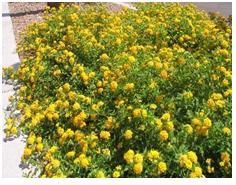
5.  Lantana

Benefits:  drought tolerant (can live off central TX rainfall) attracts humming birds & butterflies deer resistant, flowers –summer to late in fall. Needs little to no fertilizer. Deciduous-freezes to ground -survives our winters.   Can find at all garden stores, Home Depot, Lowes, etc.

Many flower types:  red, orange, pink, purple, white, 

Mature Size & Habit:  2 types;   upright and trailing

3’x3’ for red and orange & 4’x4’pink varieties upright,  spreading up to 4-5’ for yellow, purple and white. Give that much room for each plant.  Loves full sun can tolerate partial shade.

 Spacing – if you put them together you can choose to put them 3’ apart. Or 4’ would give 1’ between each one.  They look good alone.  I wouldn’t put too many together or in winter when they are dormant, it will look like a big blank spot.

Care & Maintenance:  Little – just cut back the dead stems in the winter.

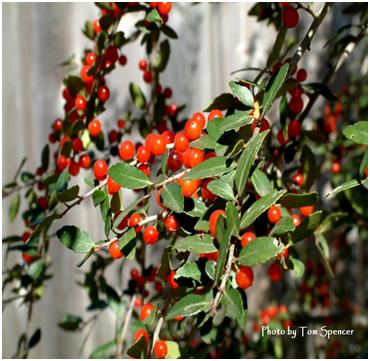
6. Yaupon Holly  (tree and shrub)

Benefits:  drought tolerant (can live off central TX rainfall –best to water at first to get established) attracts bees, when flowering, and birds when it has berries in the fall. Deer resistant, nice berries.  Evergreen Needs little to no fertilizer. Survives our winters.  Can find at all garden stores, Home Depot, Lowes, etc.

Can be a shrub, but looks best as a small tree grows to about 15’ tall.  Can take full sun or total shade

Also there is a miniature version or dwarf version.  3-4’ x 3-4’ Can survive our rainfall once  established, needs water about once a week during the summer to get established. Can take full sun or total shade  Looks best massed together.

7. Grasses: 

Mexican Feather Grass  

Benefits:  drought tolerant (can live off central TX rainfall) deer resistant, Needs little to no fertilizer. Almost Evergreen or year round interest-survives our winters.   Can find at all garden stores, Home Depot, Lowes, etc.

 Mature Size & Habit:  3’x3’ give that much room for each plant.  Loves full sun can tolerate partial shade.

Spacing – if you put them together you can choose to put them 3’ apart. Or 4’ would give 1’ between each one.  They look good alone or better massed two or more together.

Care & Maintenance:  Very little – can cut back or leave alone.

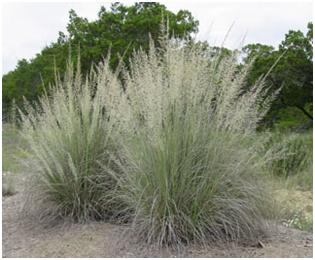
Lindheimer’s Muhly Grass 

Benefits:  drought tolerant (can live off central TX rainfall) deer resistant, Needs little to no fertilizer. Almost Evergreen or year round interest-survives our winters.   Can find at all garden stores, Home Depot, Lowes, etc.

 Mature Size & Habit:  4’ wide x5  tall’ give that much room for each plant.  Loves full sun can tolerate partial shade.

Spacing – if you put them together you can choose to put them 4’ apart. Or 5’ would give 1’ between each one.  They look good alone or massed two or more together.

Care & Maintenance:  Little – cut back in winter.


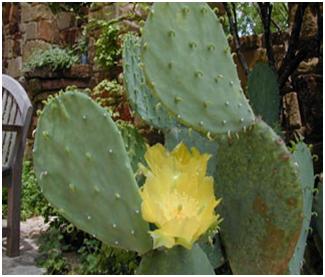
8. Spineless Prickly Pear 

Benefits:  drought tolerant (can live off central TX rainfall) deer resistant, Needs little to no fertilizer. Evergreen -survives our winters.   Yellow flowers in summer, attracts bees and humming birds.

 Mature Size & Habit:  4’x4’ but can spread over the years to 6’-6’ give that much room for each plant.  Loves full sun can tolerate partial shade.

Care & Maintenance:  Very little –leave alone.


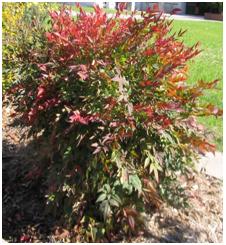
9.  Nandina’s -Several Varieties  

Benefits– all are tough, evergreen, interesting foliage and turn red in the winter (a very nice effect when everything is brown) Can survive in our Texas climate with our natural rainfall.  Water to get established the first year.  Not as deer resistant and the other plants listed here.  Not a humming bird or major butterfly attractor but its winter foliage makes up for that.

Mature Size & Habit:  *Read labels – some are dwarf (2’-3’ x 2’-3’) some are medium sized 4’x4’.  Some are large 4’x8’ tall.  Large varieties have berries.  Can find at all garden stores, Home Depot, Lowes, etc. 

Spacing:  I prefer them massed together, especially the dwarf varieties in rows.

Care & Maintenance:  Very little –leave alone.  If needed cut them back to the ground, they do not like to be trimmed or sheared.

10. Texas Mountain Laurel

 Benefits: evergreen, fragrant and stunning purple flowers in spring. drought tolerant (can live off central TX rainfall)  but water to get established. deer resistant, Needs little to no fertilizer. Evergreen -survives our winters.   Can find at all garden stores, Home Depot, Lowes, etc.

*Be aware TX Mountain Laurel grows very slowly and its red seeds are poisonous if ingested.

Mature Size & Habit:  15’x15’ in 15 years.  Full sun or partial shade

Care & Maintenance:  Very little – can leave alone.


11.  Wax Myrtle (can be a tree or shrub)

 Benefits: Evergreen and fragrant.   Tolerant of our climate (can live off central TX rainfall in a good year – be sure to water in drought conditions.)  Water to get established Deer resistant, Needs little fertilizer. Evergreen –survives our winters.   Can find at all garden stores, Home Depot, Lowes, etc.   Grows fast.

Mature Size & Habit:  15’x15’.  Full sun, partial shade or mostly shade.

Care & Maintenance:  Very little – can leave alone.  Or trim into a hedge or shrub or let become a tree

 12.   Rosemary (upright or trailing) 

Benefits: Evergreen and fragrant.   Tolerant of our climate once established.   (can live off central TX rainfall  Deer resistant, Needs little fertilizer.  Survives most of our winters, can get freeze damage.   Can find at all garden stores, Home Depot, Lowes, etc.   Grows fast.   Blue flowers in spring and fall.  Attracts butterflies and bees.

Mature Size & Habit:  5’x5’.  Full sun or partial shade (upright) Trailing says it can get up to 2’x 8’  I have found it to be around 1.5’ tall x 5’ wide. 

 Care & Maintenance:  –Moderate – can leave alone but I have found it grows floppy (upright varieties) its best to keep trimmed.   I find the upright to be more sun and drought tolerant than the trialing variety.

Enjoy!   Darrell

For more about The Ridge Fellowship or Darrell Koop, go to www.ridgefellowship.com
Posted in Landscaping | Leave a comment

Boundaries

We are doing a series called “Boundaries – when to say yes, how to say no, to take control of your life.”   It is based on a book by the same name by Dr. Cloud and Townsend.  I feel this book literally saved my life twelve years ago.  I struggled with trying to do too much as if my self- worth depended on how busy I was.  Can anyone relate?

 When Niki and I got married I was a Youth Minister, managing a ranch, teaching Drivers Ed and taking a full class load at Seminary.  With Niki’s encouragement we moved to Fort Worth to get away, focus on our marriage and my school.  Surely I would not ever take on too much again?  : )

Wishful thinking!  A year later as the pastor in Eagle Pass, Texas I took on way too much.  In addition to teaching Sunday school, doing the Sunday morning sermon, Sunday night teaching , the Wednesday night teaching, plus visit all members and lead the church.  I thought I had to do more.   There was no Children’s Ministry outside of Sunday morning so I began a Sunday afternoon ministry.  We worked on a Children’s Musical and I took them to Children’s Camp.  At Children’s Camp they asked me to be the director and plan next year’s camp for 20 churches.   “YES!” 

There was no youth ministry, so I started something for the youth and took them to camp twice a year. The hospital asked me to be a volunteer chaplain, “YES!”  The local radio station asked if I wanted to do a Sunday morning program: “YES!” Our association of churches asked me to be the Christian Life Director.  “Why YES!” I was doing weddings and funerals for people I didn’t even know.  Need something? Just call Pastor Darrell.    I was the village idiot!

The bottom began to fall out and I was only 30 years old.  Our church was going to sponsor a soccer team. The director said it would sure mean a lot if I could coach it.  “Why YES.” About that time someone thought it would be a good idea for us to start a Christian School out of our church and for me to be the director.  I actually considered it, even though I was burning out.   “I’ve got to help people right?” so I thought.

About that time God led me to the book BOUNDARIES.  (I think Niki put it in my truck!) It was an audio book and I listened to it on the way to a meeting in Uvalde.  I learned that it was not unchristian to say, “No.”  Even to legitimate need.  I needed to realize that I was human and I would not be in the ministry two months longer unless I paced myself.  I couldn’t please everyone in the community, everyone at the hospital, in the association and especially at my church.  It’s such slavery.  I can only please God.  God doesn’t want me dead by age 31.

 Jesus left some people unhealed, he left some needs unmet.  He pleased God, not everyone else.  “I can’t please everyone.”   That was a hard realization.  You ought to say that to yourself every now and then.  “I can’t please everyone.   I have limits.”  Would you be honest enough to say that?  “I can’t please everyone.  I have limits.”    

 If you struggle with Boundaries like I did, (and still do!) then this series is for you.

Here’s to healthy boundaries in 2011.    Darrell

For more about The Ridge Fellowship or Darrell Koop, go to www.ridgefellowship.com

Posted in Boundaries | Leave a comment