What is the Ark of the Covenant? – 2 Samuel 6

The Ark of the Covenant was one of the most instrumental symbols of faith and God’s presence.

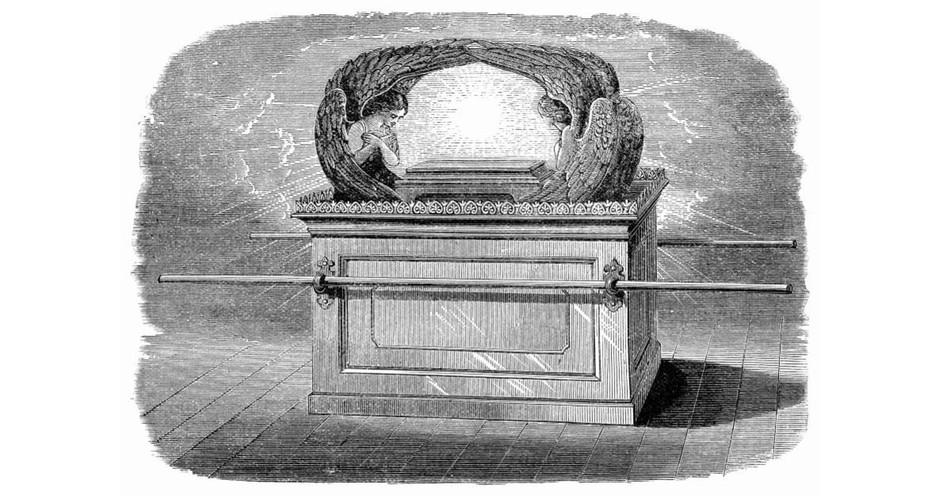
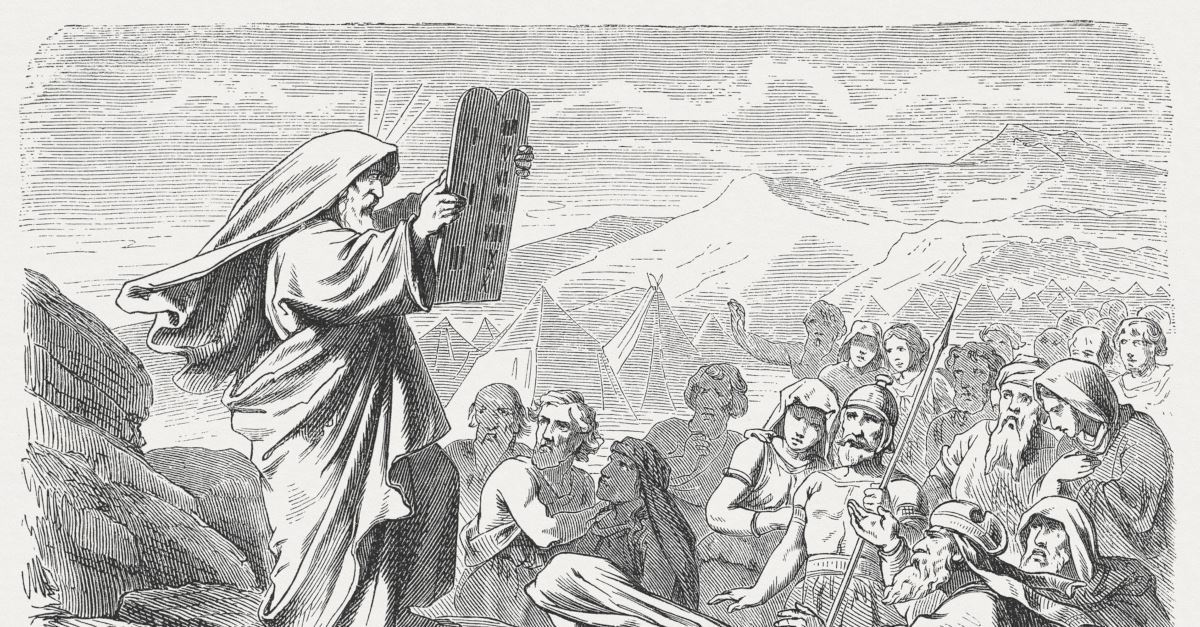
God made a covenant with the children of Israel through His servant Moses. He promised good to them and their children for generations if they obeyed Him and His laws; but He always warned of despair, punishment, and dispersion if they were to disobey. As a sign of His covenant He had the Israelites make a box according to His own design, in which to place the stone tablets containing the Ten Commandments. This box, or chest, was called an “ark” and was made of acacia wood overlaid with gold. The Ark was to be housed in the inner sanctum of the tabernacle in the desert and eventually in the Temple when it was built in Jerusalem. This chest is known as the Ark of the Covenant.

The real significance of the Ark of the Covenant was what took place involving the lid of the box, known as the “Mercy Seat.” The term ‘mercy seat’ comes from a Hebrew word meaning “to cover, placate, appease, cleanse, cancel or make atonement for.” It was here that the high priest, only once a year (Leviticus 16), entered the Holy of Holies where the Ark was kept and atoned for his sins and the sins of the Israelites. The priest sprinkled blood of a sacrificed animal onto the Mercy Seat to appease the wrath and anger of God for past sins committed. This was the only place in the world where this atonement could take place.

The Mercy Seat on the Ark was a symbolic foreshadowing of the ultimate sacrifice for all sin—the blood of Christ shed on the cross for the remission of sins. The Apostle Paul, a former Pharisee and one familiar with the Old Testament, knew this concept quite well when he wrote about Christ being our covering for sin in Romans 3:24-25: “…and are justified by his grace as a gift, through the redemption that is in Christ Jesus, whom God put forward as a propitiation by his blood, to be received by faith.” Just as there was only one place for atonement of sins in the Old Testament—the Mercy Seat of the Ark of the Covenant—so there is also only one place for atonement in the New Testament and current times—the cross of Jesus Christ. As Christians, we no longer look to the Ark but to the Lord Jesus Himself as the propitiation and atonement for our sins.

What Is the Ark of the Covenant in the Bible?

Ark of the Covenant Summary

For a tabernacle was prepared: the first part, in which was the lampstand, the table, and the showbread, which is called the sanctuary; and behind the second veil, the part of the tabernacle which is called the Holiest of All, which had the golden censer and the ark of the covenant overlaid on all sides with gold, in which were the golden pot that had the manna, Aaron’s rod that budded, and the tablets of the covenant; and above it were the cherubim of glory overshadowing the mercy seat. Of these things we cannot now speak in detail. (Hebrews 9:2-5)

The Ark originated from Exodus 25:10 when God commanded Moses to “make an ark of acacia wood.”

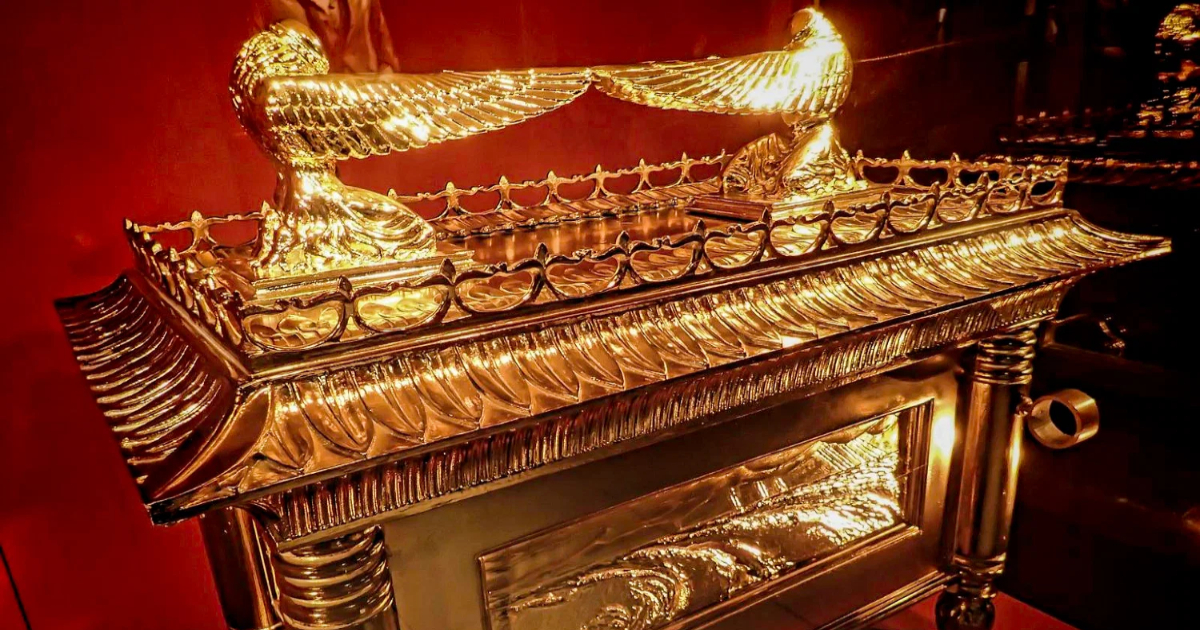
Ark of the Covenant*

*Steven Spielberg’s artistic rendition of the Ark of the Covenant from the film Indiana Jones and the Raiders of the Lost Ark. Photographed at the “Indiana Jones and the Adventure of Archaeology” exhibit at the National Geographic Museum in Washington D.C., 2015. Original image by Mary Harrsch.

The Ark of the Covenant Bible Verses

In Exodus 25:10-22, the specifics of the Ark were laid out. It needed to be two cubits and a half in length (one cubit is about 19.8-20.6 in.), a cubit and a half in breadth, and a cubit and a half in height. The Ark was overlaid inside and out with pure gold with a molding of gold around it.

For transportation, the Ark had four rings of gold with two rings on each side. A pole of acacia wood overlaid with gold was placed into the rings to carry the ark. These poles for transportation were to be permanent fixtures and never removed.

Constructing the ArkExodus 37:1-9

Bezalel made the ark of acacia wood. Two cubits and a half was its length, a cubit and a half its breadth, and a cubit and a half its height. And he overlaid it with pure gold inside and outside, and made a molding of gold around it. And he cast for it four rings of gold for its four feet, two rings on its one side and two rings on its other side. And he made poles of acacia wood and overlaid them with gold and put the poles into the rings on the sides of the ark to carry the ark. And he made a mercy seat of pure gold. Two cubits and a half was its length, and a cubit and a half its breadth. And he made two cherubim of gold. He made them of hammered work on the two ends of the mercy seat, one cherub on the one end, and one cherub on the other end. Of one piece with the mercy seat he made the cherubim on its two ends. The cherubim spread out their wings above, overshadowing the mercy seat with their wings, with their faces one to another; toward the mercy seat were the faces of the cherubim.

The Ark Brought to Jerusalem2 Samuel 6:1-4

David again gathered all the chosen men of Israel, thirty thousand. And David arose and went with all the people who were with him from Baale-judah to bring up from there the ark of God, which is called by the name of the Lord of hosts who sits enthroned on the cherubim. And they carried the ark of God on a new cart and brought it out of the house of Abinadab, which was on the hill. And Uzzah and Ahio, the sons of Abinadab, were driving the new cart, with the ark of God, and Ahio went before the ark.

The Earthly Holy PlaceHebrews 9:1-5

Now even the first covenant had regulations for worship and an earthly place of holiness. For a tent was prepared, the first section, in which were the lampstand and the table and the bread of the Presence. It is called the Holy Place. Behind the second curtain was a second section called the Most Holy Place, having the golden altar of incense and the ark of the covenant covered on all sides with gold, in which was a golden urn holding the manna, and Aaron’s staff that budded, and the tablets of the covenant. Above it were the cherubim of glory overshadowing the mercy seat. Of these things we cannot now speak in detail.

The Ark of the Covenant Outside the Tabernacle

For the Israelites, the Ark of the Covenant meant God’s presence. Throughout the Old Testament, we see stories of how God provided safety and success using the symbol of the Ark.

In the Book of Joshua, we learn of the safety the Ark provided the Israelites as they passed over the Jordan into the Promised Land. In Joshua 3:6, “Joshua said to the priests, ‘Take up the ark of the covenant and pass before the people.’”  When the priests came to the Jordan, just as was commanded, the waters were “completely cut off and the people passed over opposite Jericho” when the Ark neared.

In the sixth chapter of Joshua, the Ark was instrumental in the Battle of Jericho. The Ark was taken around the city six times in six days and was preceded by seven priests who sounded seven trumpets made of rams’ horns (Joshua 6:7). On the seventh day, the Ark with the armed men and priests did the same, but the “people shouted a great shout, and the wall fell down flat” (Joshua 6:20).

The Philistines captured the Ark when Israel summoned possession of the Ark following a brutal defeat. They felt the mere possession of the Ark would give them the favor of God. Israel suffered another defeat and lost the Ark to the Philistines, who were not intimidated by the shouts and the supposed presence of “a god” in the camp (1 Samuel 4:11).

A Cover for the Ark of the Covenant: The Mercy Seat 

The Ark required “an atonement cover,” called the Mercy Seat, to be built with pure gold and with the same dimensions in length and breadth as the Ark. There had to be one cherubim of gold on both ends of the Mercy Seat. It was important to have the cherubim spread their wings and face one another, symbolizing the angels’ attention and readiness to do God’s will.

The Mercy Seat was where God would dwell. He said, “There, above the cover between the two cherubim that are over the ark of the covenant law, I will meet with you and give you all my commands for the Israelites” (Exodus 25:22).

Unlike the statutes of gods idolized by many of the Israelites, the Ark of the Covenant served as a religious symbol where the people could meet with God. He hovered over the Ark when the priests were present. If the priests were absent, the presence of the law tablets reflected God’s presence. Thus, the Ark of the Covenant was aptly named because of the commandments written on the tablets.

Contents of the Ark of the Covenant

As God gave instructions on how to build the Ark, he also instructed Moses to put in the tablets of the 10 Commandments (the law). We see later in Numbers 17:10, “The LORD said to Moses, ‘Put back Aaron’s staff in front of the ark of the covenant law, to be kept as a sign to the rebellious.’” And Moses and Aaron already had set aside a jar of manna in it, which the Lord commanded them to put “with the tablets of the covenant law, so that it might be preserved” (Exodus 16:34).

Hebrews 9:4 confirms these three items were inside the Ark of the Covenant: “Behind the second curtain was a room called the Most Holy Place, which had the golden altar of incense and the gold-covered ark of the covenant. This ark contained the gold jar of manna, Aaron’s staff that had budded, and the stone tablets of the covenant.

10 commandments

Ark of the Covenant Symbolism and Meaning 

The Ark and the Tablets

Unlike the statutes of gods idolized by many of the Israelites, the Ark of the Covenant served as a religious symbol where the people could meet with God. He hovered over the Ark when the priests were present. If the priests were absent, the presence of the law tablets reflected God’s presence. Thus, the Ark of the Covenant was aptly named because of the commandments written on the tablets.

The Manna and Aaron’s Rod

The presence of the jar of manna symbolized God’s constant provision for His people. Aaron’s rod was dead, yet grew buds, and was placed inside the ark to symbolize God’s approval as Aaron for High Priest.

The Veil 

The Ark of the Covenant was often inside the Tabernacle behind a curtain or veil. This veil separated veil was made of blue, purple and scarlet yarns and hung on “four pillars of acacia overlaid with gold, with hooks of gold, on four bases of silver” (Exodus 26:32). It hung from clasps and served as a separation between of the “Holy Place from the Most Holy Place,” where the Ark of the Covenant and the Mercy Seat, symbolizing God’s presence, were (Exodus 26:33-34).

This veil is also significant in the New Testament. In Mark 15:37-38, we see at the moment Jesus died on the cross, “The curtain of the temple was torn in two from top to bottom.”

Hebrews 10:19-22 explains the significance of this event:

“Therefore, brothers and sisters, since we have confidence to enter the Most Holy Place by the blood of Jesus, by a new and living way opened for us through the curtain, that is, his body, and since we have a great priest over the house of God, let us draw near to God with a sincere heart and with the full assurance that faith brings, having our hearts sprinkled to cleanse us from a guilty conscience and having our bodies washed with pure water.”

Before, Israelites could not enter the Most Holy Place where the Ark of the Covenant, God’s presence, was. Now, all who believe in Christ Jesus can have the confidence to draw near to God.

The Ark of the Covenant Today

Contrary to the Indiana Jones movies, the Ark was not relocated in 1936. The last recorded mention of the Ark of the Covenant’s location in the Bible was in 2 Chronicles 35. King Josiah assigned the priests to their offices and “encouraged them in the service of the house of the Lord” (2 Chronicles 35:2). He then instructed the Levites to “put the holy ark in the house that Solomon the son of David, king of Israel, built. You need not carry it on your shoulders. Now serve the Lord your God and his people Israel” (2 Chronicles 35:3).

The fate of the Ark of the Covenant is a mystery, as its whereabouts are unknown in historical records. The Bible says that the Ark was housed in the Temple of Solomon in Jerusalem for centuries. However, it is not mentioned in the accounts of the Babylonian conquest of Jerusalem in 587 BCE, when the Temple was destroyed. Some theories suggest that the Ark was hidden or taken away before the destruction of the Temple to protect it. Others believe it may have been captured or destroyed.

One popular theory about the whereabouts of the Ark of the Covenant is that it was taken to Ethiopia. According to Ethiopian tradition, the Ark was brought to Ethiopia by Menelik I, the son of the Queen of Sheba. It is said to be kept in the Church of Our Lady Mary of Zion in Axum, Ethiopia. However, the Ark is not shown to the public, and its presence there has not been verified by independent sources.

Despite various claims and theories, the Ark’s fate remains one of the great unsolved mysteries of history.

Ark of the Covenant in Revelation

John wrote in Revelation 11:19 that after the Great White Throne Judgment, “God’s temple in heaven was opened, and the ark of his covenant was seen within his temple.” At this time, the veil over the hearts of all Christians, Jews, and Gentiles will be eliminated. This new state of the church will reveal the mysteries of the Word and its truths fully illuminated.

www.Upwards.Church

Message Audio/Video and Outline: https://upwards.church/watch-now/leander-campus-videos

Watch Messages: YouTube-Upwards Church

Facebook: Upwards Church

Sources:  https://www.christianity.com/wiki/bible/what-was-the-ark-of-the-covenant-its-meaning-and-significance.html

https://www.gotquestions.org/ark-of-the-covenant.html

Posted in 2 Samuel - Rebellion & Mercy | Tagged , , , | Leave a comment

You’re Invited! 2 Samuel Message Series

Series: 2 Samuel (Rebellion & Mercy)

Description: We all need good role models to help us live out our faith. David, a larger-than-life hero had big successes as well as big failures. He is someone that we can easily relate to; through family problems, heartbreak and rebellion, he drew close to God and experienced His mercy, direction and lasting promises. Like David through the highs and lows, the good and bad we can hold onto our faith and keep living for God.

Dates Titles (Scripture) Events:

June 23 – Honor (2 Samuel 1 -2) Communion, Worship night 06/29 6-7:30

June 30 – Worship (2 Samuel 6) Both campus potluck

July 7– Legacy (2 Samuel 7)

July 14 – Confession (2 Samuel 12) CG, Communion

July 21 – Betrayal (2 Sam. 15-18)

Introduction to 2 Samuel:

The child enters the room with long gown flowing, trailing well behind her high-heeled shoes. The wide-brimmed hat rests precariously atop her head, tilted to the right, and the long necklace swings like a pendulum as she walks. Following close is the “man.” His fingertips peek out of the coat sleeves that are already pushed upward six inches. With feet shuffling in the double-sized boots, his unsteady steps belie his confident smile. Children at play, dressing up—they copy Mom and Dad, having watched them dress and walk. Models … everyone has them … people we emulate, people who are our ideals. Unconsciously, perhaps, we copy their actions and adopt their ideas. Among all the godly role models mentioned in the Bible, probably no one stands out more than King David. Born halfway between Abraham and Jesus, he became God’s leader for all of Israel and the ancestor of the Messiah.

David was “a man after [God’s] own heart” (1 Samuel 13:14). What are the personal qualities that David possessed that pleased God? The book of 2 Samuel tells David’s story. As you read, you will be filled with excitement as he is crowned king over Judah and then king over all of Israel (5:1–5), praising God as he brings the Ark of the Covenant back to the Tabernacle (6:1–23) and exulting as he leads his armies to victory over all their enemies and completes the conquest of the Promised Land begun by Joshua (8–10). David accomplished much.

But David was human, and during dark times he stumbled and fell into sin. The record of lust, adultery, and murder is not easy to read (11–13) and reveals that even great people who try to follow God are susceptible to temptation and sin.

Godliness does not guarantee an easy and carefree life. David had family problems—his own son incited the entire nation to rebellion and crowned himself king (14:1–18:33). And greatness can cause pride, as we see in David’s sinful act of taking a census in order to glory in the strength of his nation (24:1–25).

But the story of this fallen hero does not end in tragedy. Through repentance, his fellowship and peace with God were restored, but he had to face the consequences of the sins he committed (12–20). These consequences stayed with him the rest of his life as a reminder of his sinful deeds and his need for God.

As we read 2 Samuel, look for David’s godlike characteristics—his faithfulness, patience, courage, generosity, commitment, honesty—as well as other God-honoring characteristics, such as modesty and penitence. Valuable lessons can be learned from his sins and from his repentance. You and, like David, can become a person after God’s own heart.

Purposes:

(1) to record the history of David’s reign; (2) to demonstrate effective leadership under God; (3) to reveal that one person can make a difference; (4) to show the personal qualities that please God; (5) to depict David as an ideal leader of an imperfect kingdom, and to foreshadow Christ, who will be the ideal leader of a new and perfect kingdom (chapter 7)

Author:  Unknown. Some have suggested that Nathan’s son Zabud may have been the author (1 Kings 4:5). The writings of Nathan and Gad and are found in 1 Chronicles 29:29.

Original Audience: The people of Israel and believers today.

Date: Written:930 B.C.; written soon after David’s reign, 1010–970 B.C.

Setting: The land of Israel under David’s rule

Key Verse: “And David realized that the Lord had confirmed him as king over Israel and had blessed his kingdom for the sake of his people Israel” (5:12).

Key People: David, Joab, Bathsheba, Nathan, Absalom

Special Features: This book was named after the prophet who anointed David and guided him in living for God.

Outline:

A. DAVID’S SUCCESSES (1:1–10:19)

1. David becomes king over Judah

2. David becomes king over Israel

3. David conquers the surrounding nations.  David took the fractured kingdom that Saul had left behind and built a strong, united power. Forty years later, David would turn this kingdom over to his son Solomon. David had a heart for God. He was a king who governed God’s people by God’s principles, and God blessed him greatly. We may not have David’s earthly success, but following God is, ultimately, the most successful decision we can make.

B. DAVID’S STRUGGLES (11:1–24:25)

1. David and Bathsheba

2. Turmoil in David’s family

3. National rebellion

4. The later years of David’s rule

David sinned with Bathsheba and then tried to cover his sin by having her husband killed.

Although he was forgiven for his sin, the consequences remained—he experienced trouble and distress, both with his family and with the nation. God is always ready to forgive, but we must live with the consequences of our actions. Covering up our sin will only multiply sin’s painful consequences.

I hope you can join us!

Darrell

www.Upwards.Church

Posted in 2 Samuel - Rebellion & Mercy | Tagged , , , , , , , | Leave a comment

Trust God & Respect Leaders 1 Samuel 24-26

David had great respect for Saul, in spite of the fact that Saul was trying to kill him. Although Saul was sinning and rebelling against God, David still respected the position he held as God’s anointed king. David knew he would one day be king, and he also knew it was not right to strike down the man God had placed on the throne. If he assassinated Saul, he would be setting a precedent for his own opponents to remove him some day.
Romans 13:1–7 teaches that God has placed the government and its leaders in power. We may not know why, but, like David, we are to respect the positions and roles of those to whom God has given authority. There is one exception, however. Because God is our highest authority, we should not allow a leader to pressure us to violate God’s law.

David had prayed in Psalm 54 that the Lord would vindicate him and give him opportunity to prove to Saul that he wasn’t an outlaw who was trying to kill him and seize the throne. After all, Saul was not only David’s king, but he was also his commander and his father-in-law, and regardless of Saul’s evil attitude, David never considered Saul to be his enemy.  God answered David’s prayer when Saul and his troops came to find him at Engedi.

  • Respect is Challenging Sometimes

(1 Sam. 24:1–4). David and his men were hiding in a large cave, of which there were many in that area, and Saul chose to use that very cave as a place where he could relieve himself. The Law of Moses was very strict when it came to matters of sanitation, especially in the army camp (Deut. 23:12–14). Each soldier was required to leave the camp to relieve himself, and he had to carry a small shovel or trowel among his weapons so he could dig a hole and cover his excrement. This meant that Saul was away from the camp and therefore quite vulnerable. He naturally wanted privacy and he felt that he was not in danger. The fact that he walked right into David’s hiding place not only proved that his spies were incompetent but also that the Lord was still in control.
As David and his men pressed to the walls in the back of the cave, they quietly discussed the meaning of this remarkable occurrence. The men assured David that Saul’s presence in the cave was the fulfillment of a promise God gave him that He would deliver Saul into David’s hands.2  But when did God say this? Were they referring to Samuel’s words to Saul in 1 Samuel 15:26–29, or to God’s message to Samuel in 16:1? Perhaps the idea came from Jonathan’s words in 20:15, which some of the men might have heard personally. It’s likely that the leaders of the 600 men discussed these matters among themselves, for their future was wrapped up in David’s future, and obviously they came to some false conclusions. David never planned to kill Saul, for he was sure that the Lord would remove him from the scene in His own way and His own time (26:9–11).
To David’s men, it seemed providential that Saul was at their mercy (24:4; Ex. 21:13), and both David and Saul agreed with them (1 Sam. 24:10, 18). But that wasn’t the issue. The major question was, “How does the Lord want us to use this occasion?” David’s men saw it as an opportunity for revenge, while David saw it as an opportunity to show mercy and prove that his heart was right. God was giving him an opportunity to answer his own prayer for vindication (Ps. 54:1). David stealthily crept up to the garment that Saul had laid aside, cut off a corner of the robe, and went back into the cave. Saul left the cave not realizing what had happened.

(1 Sam. 24:5–7) David was too wise in the truth of God’s word to interpret this event as a signal for him to kill Saul, for the law says, “You shall not murder” (Ex. 20:13, NIV). Slaying an enemy on the battlefield or an attacker in self-defense was one thing, but to assassinate an unsuspecting king was quite something else. David reminded his men that Saul was the anointed of the Lord, and that no Jew had the right to attack him. The Jews were not even to curse their rulers, let alone kill them, for cursing a ruler was in the same category as blaspheming the name of the Lord (22:28).
However, David’s conscience bothered him because he had cut off the corner of Saul’s robe. His action sent out three messages. First, it was an insolent act of disrespect that humiliated Saul, but it was also a symbolic gesture not unlike what Saul did to Samuel’s robe after the Amalekite fiasco (1 Sam. 15:27–28). By cutting off a part of the royal robe, David was declaring that the kingdom had been transferred to him. Finally, the piece of cloth was proof that David did not intend to kill the king and that the flatterers in the court were all liars. David’s men would have killed Saul in a moment, but their wise captain restrained them. Leaders must know how to interpret events and respond in the right way.

  • Respect Those God Has Placed Over Me

(1 Sam. 24:8–15). When Saul was far enough away from the cave that it was safe, David left the cave and called to him. By using the title “my lord the king” and bowing to the earth, David emphasized what he had said to his men and let Saul know that he was not a rebel. Even if you can’t respect the man or woman in office, you must show respect to the office (Rom. 13:1–7; 1 Peter 2:13–17). David showed his respect by calling Saul “my master” (1 Sam. 24:6), “the Lord’s anointed” (vv. 6, 10), “my lord” (vv. 8, 10), “the king” (vv. 8, 14) and “my father” (v. 14). David’s bold public appearance also let Saul and his army know that their official spy system was most ineffective.
Using the piece of Saul’s robe as evidence, David opened his defense by exposing the deception of the courtiers who slandered David to Saul. The logic was irrefutable: David had an opportunity to kill Saul and refused to do so. David even admitted that some of his men urged him to slay the king, but he rebuked them. David was not guilty of any evil against Saul or any transgression against the Lord, but Saul was guilty of trying to kill David. “The Lord will judge between us,” said David, “and prove that your officers are liars, but I will not lift my hand against you.” Saul had hoped that the hand of the Philistines (18:17) or the hands of David’s soldiers (19:20–21) would kill David, but they failed. Ultimately, Saul died by his own hand on the battlefield (31:1–6).
David quoted a familiar proverb5 to prove his point: “Wickedness proceeds from the wicked” (24:13, NKJV), which simply means that character is revealed by conduct. The fact that David did not slay the king indicated that David did not have the character of a rebel or a murderer. But at the same time, David was strongly suggesting that Saul’s character was questionable because he wanted to kill his son-in-law! But what was the king really doing as he pursued David? Only chasing a dead dog and a flea that was jumping from one place to another! (Fleas and dogs go together.) The phrase “dead dog” was a humiliating term of reproach in those days (17:43; 2 Sam. 3:8; 9:8; 16:9), so David was humbling himself before the Lord and the king. David closed his defense by asserting a second time (1 Sam. 24:12, 15) that the Lord was the righteous judge and would plead the cause of His faithful servant (Pss. 35:1; 43:1; see 1 Peter 2:23).

(1 Sam. 24:16–22). King Saul once again revealed his confused mental state by lifting up his voice and calling to David, who had certainly spoken long enough for Saul to discern that it was indeed his son-in-law.6 As for Saul’s weeping, he had manifested temporary emotional reactions like that before, but they never brought about repentance or a change of heart.
Saul described three possible levels of life: the divine level, where we return good for evil; the human level, where we return good for good and evil for evil; and the demonic level, where we return evil for good. Saul admitted that David was a godly man who, by not slaying him, returned good for evil. But Saul was possessed by demonic forces and did evil to the one man who could have destroyed him. Now Saul openly confessed that he knew David would be the next king (23:17) and would consolidate the nation of Israel that Saul had torn apart. Even then, Saul’s major concern was his own name and descendants, not the spiritual welfare of the people; he made David swear that he wouldn’t wipe out his family when he became king. David had made a similar covenant with Jonathan (20:14–17, 42) and he was willing to make the same promise to Saul. How tragic that Saul’s own sins destroyed his family, all but Jonathan’s crippled son, Mephibosheth, whom David adopted (2 Sam. 9).
Because David knew God’s calling and believed God’s promise, he was able to be so bold before Saul and his army. It was indeed a holy boldness that came from a heart that was right with God. The day would come when David and his cause would be vindicated and the Lord would judge those who had opposed him. Saul went back home to Gibeah, but in spite of his tears and emotional speech, he took up his pursuit of David again (1 Sam. 26:2, 21).
David had won many battles, but one of his greatest victories occurred in that cave when he restrained himself and his men from killing Saul. “He who is slow to anger is better than the mighty, and he who rules his spirit than he who takes a city” (Prov. 16:32, NKJV). This is a good example for all of us to follow, but especially those to whom the Lord has entrusted leadership.

  • Respect Brings Big Blessings

(1 Sam. 26:1–15)

Some students of the Old Testament have tried to prove that the account in this chapter is merely an adaptation of the one in chapter 24, but the evidence stands against this interpretation. There are differences in locations (a cave in En Gedi; Saul’s camp near Hachilah), times (day; night), activities (Saul came to the cave; David went to the camp), David’s responses (cutting off part of Saul’s robe; taking Saul’s spear and water jug), and David’s words (spoke only to Saul; spoke to Abner and Saul). This second experience with Saul was certainly more daring on David’s part since he was actually in Saul’s camp. David’s recent experience with Nabal and Abigail had reassured him of his future reign and had taught him a profitable lesson about revenge.

(1 Sam. 26:1–4). Like Nabal, the Ziphites were related to Caleb (1 Chron. 2:42), but being members of the tribe of Judah, they should have been loyal to David. Hoping to gain the king’s approval, for a second time they betrayed David to Saul (1 Sam. 23:19ff; see Ps. 54). Saul had learned to appreciate David’s skill as a tactician, so he took his 3,000 soldiers to search for David in the wilderness. But David was already far ahead of him, for his spies had located Saul’s camp, and David was safe in the desert. The Lord kept David safe and delivered him whenever Saul was near. “He delivered me from my strong enemy, from those who hated me, for they were too strong for me” (Ps. 18:17, NKJV).
(1 Sam. 26:5–12). The Lord must have instructed David to go to Saul’s camp that night, because He sent a deep sleep upon Saul and his men. Saul and Abner, who was Saul’s captain (14:10) and cousin (v. 50), were sleeping at the heart of the camp, surrounded by the wagons and baggage (“the trench” KJV). Because of the supernatural sleep sent by the Lord, David and his nephew Abishai were able to penetrate to where Saul and Abner lay.4 This is the first mention of Abishai in Scripture. As usual, Saul’s spear was at hand, the symbol of his office and his authority (26:7, 11; 22:6; 18:10; 19:9; 20:33).
Abishai was sure that it was God’s will that he kill Saul and put an end to his selfish rule and his relentless persecution of Israel’s true king, but David stopped him. David had settled this matter in the cave (24:1–6) and there was no need to consider it again. He had also seen what the Lord did to Nabal. David was sure that Saul’s life would end at the right time and in the right way, either by natural death or by a judgment from God, and then the throne would be his. When Abishai looked at Saul, he saw an enemy, but David looked at him and saw “the Lord’s anointed.” Instead of taking Saul’s life, David took his spear and water jug, just so he could prove to Saul a second time that he didn’t have designs on the king’s life. David didn’t let Abishai take the spear lest he be tempted to use it.
It would have been easy to argue that David had been wrong in the cave and that God was giving him a second chance to kill Saul, but David’s decision was based on principle and not circumstances. David knew that it was wrong to lay hands on God’s anointed, even though the king wasn’t serving as God wanted him to serve. David might not have been able to respect the man, but he did respect the office and the God who gave that office to Saul.

(1 Sam. 26:13–16). David and his nephew made their way to the hill opposite Saul’s camp where they were safe and from which they could be heard, and David called back to the soldiers in the camp and especially to Abner, the king’s bodyguard. He was careful not to humiliate Saul in the presence of his men, although Saul couldn’t easily escape the embarrassment of the situation. David didn’t identify himself to Abner but only referred to himself as “one of the people” (v. 15). The absence of the spear and water jug was evidence enough that someone indeed had been close to the king and could have killed him. Abner was guilty and could have been disciplined for not doing his duty.
Dishonesty (vv. 17–25). Saul recognized David’s voice and responded by calling him “my son, David,” but David didn’t call him “my father” as he had before (24:11). His address was only “my lord, O king.” Saul’s daughter Michal was no longer David’s wife (25:44), so David was no longer son-in-law to the king. Furthermore, Saul certainly hadn’t treated David like a son.
Once again, David tried to reason with Saul and show him how wrong he was in his thinking and acting. David wanted to know what his crime was that Saul had to pursue him and seek to kill him. If David had broken one of God’s laws, then he was willing to bring a sacrifice and have his sin forgiven by the Lord. But if Saul was treating David like a criminal because of the lies his officers had told him, then they were the offenders, not David, and they would pay for their sins. Saul and his officers had driven David out of his own land, the very inheritance that the Lord had given his family, and if David moved to other lands, how could he worship Jehovah away from the priesthood and the sanctuary?

But if David wasn’t guilty of any crime or sin, why should Saul invest so much time and energy in pursuing him? The king of Israel was chasing a partridge just for the privilege of shedding its blood! (Partridges don’t like to fly. They run from one cover to another.)
Once again, Saul lapsed into one of his sentimental moods (see 24:17) and confessed that he was a fool and a sinner. He promised that he wouldn’t harm David, but David didn’t believe him. His only reply was, “Behold the king’s spear! Let one of the young men come over and fetch it” (26:22). When David cut Saul’s robe in the cave, he reminded him that his kingdom would be severed from him, but in taking the spear, he humiliated the king and robbed him of the symbol of his authority.
For the second time, David had spared Saul’s life, and David knew that the Lord would reward him for what he had done (Ps. 7:8). But David didn’t expect Saul to value his life as he had valued Saul’s life, because he knew Saul couldn’t be trusted. Rather, he asked that the Lord reward him with protection and safety just as he had protected the king. See Psalm 18:20–27.

The last recorded words of Saul to David are in 1 Samuel 26:25, a statement that affirms the greatness of David’s deeds and the certainty of his kingship. The two men parted, Saul heading for ultimate disgrace and death, and David to ultimate glory and victory. However, David’s unbelief would take him to the land of the Philistines and the city of Ziklag, where he would live for about a year and a half. Soon David’s years of wandering and testing would end and he would be ready to sit on the throne of Israel and rule God’s people. One day David would look back on those difficult years and see in his painful experiences only the goodness, mercy and blessing of the Lord (Ps. 23:6).

www.Upwards.Church

Message Audio/Video and Outline: https://upwards.church/watch-now/leander-campus-videos

Watch Messages: YouTube-Upwards Church

Facebook: Upwards Church


Sources:

Life Application Bible Notes (Tyndale, 2007), 449.

Warren W. Wiersbe, Be Successful, “Be” Commentary Series (Colorado Springs, CO: Victor/Cook Communications, 2001), 127–131 & 140 – 145

Posted in 1 Samuel - Kings & Covenants | Tagged , , , , , , , , , , , | Leave a comment

Trust God Against Giants- 1 Samuel 17 Commentary

Easily the most beloved accounts in the Bible is the account of David and Goliath.  So compelling and well-known is the drama that it has become the primary historical metaphor in Western culture for describing any individual or group who overcomes seemingly insurmountable odds to defeat an oppressor.

But the biblical narrative is not primarily a story about human courage and effort; instead, it is about the awesome power of a life built around bold faith in the Lord and ultimately it points us to Jesus. McCarter states, “It is Yahweh who gives victory, and he may give it to the weak (Israel) in order that his power might be known to all.”

The popularity and power of this historical account from David’s life is not accidental. The writer deliberately employed certain narrative techniques that cause this story to achieve special prominence in the reader’s/listener’s mind. First of all, he made the account longer than any other Davidic narrative relating to a single battle with a foreign enemy (912 words in Hebrew).  Second, he placed more quotations in it than in other stories (twenty-two), including the longest quotation in 1, 2 Samuel placed on the lips of a named foreigner (Goliath, thirty-three words; 17:8–9). He also provided descriptions of normally omitted aspects of the narrative; for example, the pieces and weight of Goliath’s armor, the number of cheeses and loaves of bread brought to the commander, the process of David’s acquisition of sling stones, and David’s removal of a sword from its scabbard. Furthermore, the account contains details that create apparent tensions with its narrative context: for example, David’s absence from Saul’s court after he was made a permanent courtier (v. 17; cf. 16:22) and Saul’s nonrecognition of David (v. 55; cf. 16:21). These details force the reader to ponder the narrative after its reading and thus make the story more memorable and more likely to be studied further. 2

17:1–3 We cannot know how soon the events of this chapter occurred after the previous events. However, enough time must have passed for Saul to have changed his policy toward David, permitting him to return to Bethlehem. It also may have been long enough for the youthful David to mature and change significantly in appearance, though not long enough for David to have become old enough for military service (=age twenty; cf. Num 1:3; also 1 Sam 17:33).

As this account opens, the Philistines had assembled their army in the west frontiers of Judah about eight miles east of Gath and fifteen miles west of Bethlehem, and then “pitched camp” two miles west of Socoh at “Ephes Dammim.” Though no free-flowing water exists here, the camp’s proximity to a major Philistine city meant that provisions would not be a problem for Israel’s enemy.

In response to the Philistine invasion, Saul’s army assembled in the Valley of Elah (v. 2; lit., “Valley of the [cultically significant] Tree”), directly opposite the Philistine camp. Separating the two camps geographically was a wadi, a usually dry river bed. Separating the Israelites from the Philistines psychologically, as the following verses indicate, was a chasm of fear.

17:4–7 Among the Philistine ranks was a remarkable soldier named Goliath, a name of possibly Hittite or Lydian origin.  He was a “man between the two” (NIV, “champion”). This phrase, used only here in the Old Testament, apparently refers to an individual who fought to the death in representative combat with an opponent from a foreign army. One-on-one combat as a substitute for combat between two full armies apparently was not regularly practiced in Semitic societies; it probably was more commonly employed by the Philistines.3

Goliath’s most remarkable featue was his height; he was (lit.) “six cubits and a span” (= nine feet, nine inches) tall. Whether this measure refers to Goliath in or out of uniform is immaterial; his physical stature was awesome and psychologically overpowering, especially to the typically small Israelites.

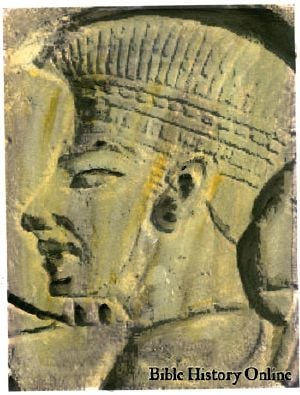
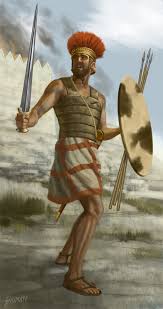
Adding to Goliath’s overwhelming appearance as a fighter was his combat gear. At a time when most Israelite soldiers wore only basic clothing in battle (cf. 13:22), Goliath was sheathed in metal. His head was covered with “a bronze helmet” (v. 5). In ancient Egyptian artwork Philistine soldiers are depicted wearing a feathered headdress, not a helmet;50 Goliath’s headgear therefore was apparently atypical, designed for the special needs of representative combat. Protecting his trunk was “a coat of scale armor weighing five thousand shekels” (= 126 pounds). Completing his body armor were “bronze greaves” (v. 6) or knee and shin protectors. A covering of this weight and composition would have drastically reduced Goliath’s ability to respond with quickness and agility in close combat and suggests that he did not expect a skirmish involving hand-to-hand combat.
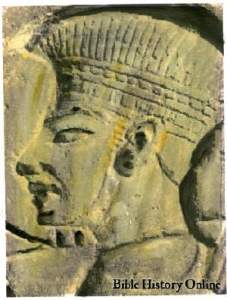
Goliath’s weaponry was as overwhelming in appearance as his height and armor. He had “a bronze scimitar” (Hb. kîdôn; NIV, “javelin”), a curved sword, “slung on his back.” In addition, he had a spear whose “shaft was like a weaver’s rod.” This description may relate to the size and weight of the spear’s shaft or, more probably, to the fact that it had a loop of cord attached to it.51 At the head of Goliath’s spear was a massive “iron point” that weighed “six hundred shekels” (= 15.1 lbs.). Iron was the preferred metal for implements of warfare because it was strong, nonmalleable, and could retain a sharp edge much better than bronze. A weapon of this massive weight, while intimidating in appearance, would have been quite awkward to use; it was apparently designed mainly to intimidate.

As if all this were not enough, Goliath also had a “shield bearer” who “went ahead of him.” Two primary styles of shields were used in ancient Near Eastern warfare; a smaller, round shield (Hb. māgēn) and a larger, rectangular body shield (ṣinnâ). Goliath’s assistant protected him with the second type.
This passage presents the longest description of military attire in the Old Testament. Goliath’s physical stature, armor, weaponry, and shield bearer must have made him appear invincible. However, the reader has just been warned against paying undue attention to outward appearances. The detailed description of Goliath’s external advantages here suggests that chap. 17 was intended in part to serve as an object lesson in the theology of the previous chapter (cf. 16:7).

17:8–11 As Goliath stepped forth between the two armies, he spoke insolently to the Israelites. First, he questioned their resolve in defending themselves against the army now camped on their lands: if they were unwilling to engage in combat with Goliath, why did they line up for battle? (v. 8).

Second, he educated them concerning the practice of representative combat. The concept was simple: a soldier chosen from the Israelite ranks was to fight to the death with Goliath. The results of the high-stakes contest were also clear-cut: the nation represented by the dead soldier would become subject to the nation represented by the victor. The fact that Goliath is recorded as explaining the practice to the Israelites suggests that they had not previously participated in a contest like this; the fact that the Philistines later reneged on the agreement (cf. 18:30) suggests that representative combat was not taken seriously even by those who advocated it.

Third, Goliath insulted the Israelites: “I heap shame on [Hb. ḥrp; NIV, “defy”] the ranks of Israel!” The giant’s dramatic presentation, complete with costume, actions, and words, achieved its desired effect: “Saul and all the Israelites were dismayed and terrified” (v. 11; cf. also Deut 1:21; 31:8; Josh 8:1; 10:25; 2 Chr 20:15, 17; 32:7; Isa 51:7; Ezek 2:6).

17:12–15 The narrative focus shifts to David, who is reintroduced to the reader in this section. Here David’s genealogical record is stated explicitly for the first time—it was only implicit prior to this point. Ephrathah, an important matriarch in the Judahite clan (cf. 1 Chr 2:19; 4:4), was the mother of Hur, who was an influential figure in the history of Bethlehem, and a relative of Jesse.

“Jesse had eight sons,” and “David was the youngest” (v. 14); these assertions are in tension with 1 Chr 2:13, though not contradicted by it. Though 1 Chr 2:13 notes only seven sons of Jesse and states that David was the seventh, the differences between the passages may simply be a matter of reckoning. If Jesse had a son who died, especially one who died as a minor, the Chronicler’s omission of that son could merely be the result of a difference in criteria for inclusion in the genealogical record.

Jesse “was old and well advanced in years” (v. 12) at the time of this Philistine incursion into Judahite territory. Consequently, he was exempted from military service. His sending only “the three oldest” (v. 14) of his sons to serve in Saul’s army suggests one or both of two possibilities. The other sons, including David, may have been under the age of twenty, the minimum age for military service in Israel (cf. Num 1:3, 19); or perhaps families were required to provide no more than three sons for military service, in which case the three eldest would have been given preference for this task.4

Though David had earlier been called a warrior (16:18) and was made a permanent courtier (16:22), he was denied a role in Saul’s army assembled at the Valley of Elah. Instead he played a support role, “going back and forth from Saul” (v. 15) in short-term stints (note his use of a tent for a temporary residence, v. 54) that required David to be gone perhaps as little as one night (cf. v. 54). David’s responsibilities within Saul’s army may have been reduced when three of Jesse’s other sons went on active duty. This certainly would have helped Jesse, who needed David to “tend his … sheep” now that the other sons had to be away for a lengthy period of time.

17:16–24 The standoff between the encamped armies of the Philistines and Israelites continued for at least “forty days” (v. 16), a situation that would have strained the resources of the impoverished Israelite monarchy. This lengthy standoff also would have made life difficult for individual Israelite families since this event would have occurred during the spring or summer, when adult males would have been needed for agricultural chores. At the beginning and end of each day during that time, Goliath stepped forward to taunt the Israelites.

The families of the soldiers supplied the rations for their relatives and others in the ranks. David bore the responsibility of transporting the foodstuffs to his three brothers as well as “the leader of the thousand” (“commander of their unit”). Meat, a rarity in the typical ancient Israelite diet, was not included among the provisions.

Jesse also asked David to check to see how the patriarch’s sons were faring and to “take their token” (NIV, “bring back some assurance from them”). The “token” (Hb. “ʿarubbâ) probably was a form of compensation given to families who helped underwrite the army’s expenses, perhaps a sort of promissory note redeemable for a certain portion of plunder that might be taken from the Philistines in the event of an Israelite victory; alternatively, it was “to confirm the safe delivery of the gifts and that his brothers are still alive.”

At the first sign of morning light on the horizon David “left the flock with a shepherd.” The inclusion of this subtle detail in the text highlights the fact that David was a “good shepherd”—a significant metaphorical image of a good leader (cf. John 10:1–21)—and increases the contrast between David and Saul (cf. previous notes on chap. 9).

Though the journey exceeded fifteen miles, David arrived at the Israelite camp early in the morning, “as the army was going out to its battle positions shouting the war cry” (v. 21; cf. Josh 6:16) but avoiding any open conflict. Matching the Israelites’ movements were the Philistines, who “were drawing up their lines” to create a standoff. Dutifully, David first handed the provisions over to the supply officer and then “ran to the battle lines” and “checked on his brothers’ condition” (v. 22; NIV, “greeted his brothers”).

Being on the front lines at this hour of the morning, David was able to witness Goliath, “the champion from Gath” (v. 23), as he took his place between the two armies. David heard Goliath’s words, and perhaps for the first time in his life he heard the Lord being ridiculed. David also saw his fellow Israelites’ reactions to this desecration: “they all ran from him in great fear” (v. 24).

17:25–30 Word had been spread among the soldiers that Saul had determined that Israel should take up Goliath’s challenge. Though the king would not personally fight the giant, he would handsomely reward anyone who successfully did so. The offer to “give him his daughter in marriage” (v. 25) was particularly appealing, for it would provide access to additional, unnamed privileges reserved for the royal household.

David was deeply disturbed that a Philistine, who was uncircumcised and therefore outside of a covenant relationship with the Lord, would so boldly heap shame on (NIV, “defy”; v. 26) “the armies of the living God.” Goliath’s words were not just an insult directed against the Israelite army; they were also an assault on “the living God,”54 since the army was composed of members of the Lord’s covenant community. Having missed out on the details of the king’s response to Goliath because of his duties in Bethlehem, David asked for and received further information from “the men standing near him” (v. 26).

David’s interest in this matter proved irritating to Eliab, perhaps because of his fear of Goliath, and he caustically accused David of having a haughty and wicked heart that motivated him to abandon his duty to the family’s livestock for the sake of watching others die in battle. Of course, Eliab’s accusation was false. The author perhaps included it in the narrative to demonstrate the correctness of the Lord’s decision to reject Eliab as Israel’s next king (cf. 16:7). Like Eli and Saul, Eliab lacked the ability to make proper judgments about others—his “heart” was not right. Eliab’s harsh words against his younger brother also strengthen the parallels that exist between David and Joseph, a young man in the Torah who also experienced family criticism prior to saving the Israelites (cf. Gen 37:8).

The concluding clause of David’s response to Eliab is brief but problematic. The literal Hebrew—“[Is] it not [a] word/matter?”—is translated variously by major contemporary versions: NKJV: “Is there not a cause?” NRSV: “It was only a question”; NIV: “Can’t I even speak?” I am inclined to translate David’s response to Eliab loosely in the following way: “What have I done to offend you now? I happen to have been asking about a very important matter.” Having ended his brief conversation with Eliab, David returned to his investigation of the matter and received confirmation of the details.

17:31–37 David’s outrage sparked by Goliath’s blasphemies, as well as his keen interest in the particulars of the royal offer, did not escape the attention of others. Details of David’s reaction were even “reported to Saul, and Saul sent for him” (v. 31).

David’s words to the king express youthful idealism in its full flower. First he exhorted those around him—all of whom were older than he—to stop being disheartened (lit., “Let not the human heart fall”). Then he proposed an astonishing solution to Israel’s dilemma: he himself would “go and fight” Goliath.

Saul immediately rejected David’s offer. Then, speaking with the battle-tested voice of reason, he reminded David of some obvious but apparently overlooked facts: “You are only a boy, and he has been a fighting man from his youth” (v. 33). Saul’s reference to David’s adolescence suggests that David was under twenty years of age, the earliest age at which an Israelite was permitted to serve in the military (cf. Num 1:3; 26:2).

Saul’s royal rejection of David’s offer should have concluded the meeting. However, David’s idealism was exceeded only by his determination and his faith in the Lord. Consequently, he continued his efforts to change the king’s heart. This time David dropped his sermonizing, choosing instead to emphasize his credentials and experience: literally, “[A] shepherd was your servant” (v. 34) who had already been victorious in two previous mortal combats, one with a lion and one with a bear. In each case David “went after” the marauding beast and “struck it.” Then, when the enraged animal “turned on” David, he “seized it by its hair, struck it, and killed it.”

To David’s way of thinking, “the uncircumcised Philistine” had reduced himself to the level of a brutish animal “because he … defied the armies of the living God” (v. 36). Thus, fighting Goliath would be just another fight with a wild beast. The Lord had delivered David “from the hand [“paw”] of the lion and the hand [“paw”] of the bear,” and he would deliver him “from the hand of this Philistine” (v. 37).

David’s faith and courage were as extraordinary as his logic was simple. The king, disarmed by David’s impressive presentation, decided to make what was perhaps the greatest military gamble of his career and accept David’s offer. In a word of blessing that was certainly also a prayer, Saul asked that “the Lord be with” David in his fight.

17:38–40 In addition to the prayerful blessing, Saul also gave David the use of Israel’s finest offensive and defensive military gear, the king’s own. Saul’s battle gear included a basic “tunic” worn next to the skin, “a coat of armor” worn over the cloth garment,55 a helmet, and a sword.

David allowed Saul to put the armor on him. Ironically, Saul’s actions confirmed and foreshadowed the royal status God promised David: the Lord had clothed David with the Spirit that enabled kingship; now Saul clothed David with the symbols that exemplified kingship. Yet David was unable to grow accustomed to Saul’s military gear, and he removed it. The writer’s inclusion of the clothing incident probably was meant to serve two functions: first, to preserve an unusual but interesting occurrence in the background of the Goliath event, indicating the greater value of divine enablement over human devices; second and more importantly, to symbolize David’s rejection of Saul’s approach to kingship. Saul chose to dress in royal clothing “such as all the other nations have”; David would wear none of it. Instead, he would identify with the great shepherd-leaders of the Torah—Abraham, Isaac, Jacob, and especially Moses—and live by faith in the promises of God (cf. Heb 11).

Accordingly, David armed himself as a shepherd would have, with a stick and a sling. He “took his staff in his hand” (v. 40). The stick, while a crude weapon, could have afforded some protection in close combat. David also took some stones from the bottom of the wadi. Because the stones were intended for use “with his sling” in battle, they probably were about the size of typical ancient Near Eastern slingstones—as big as tennis balls.5

The weapons David gathered for use against Goliath—the stick and the stones—were not products of human artifice; rather, they were shaped by God. As such, the author may have included these details as a counterpoint to 13:19–22; the Philistines feared and relied on weapons pulled from human forges, but David would conquer them with divinely manufactured weapons. Armed with these provisions, David “approached the Philistine.”

17:41–44 The events of the fatal confrontation now unfold rapidly as Goliath and his shield bearer advanced toward David. As Goliath drew near, he noticed for the first time the details of his opponent. Looking David in the face, he “saw that he was only a boy, ruddy and handsome” (v. 42). Winning a contest against a crudely armed, underage challenger would not be particularly prestigious for the Philistine giant, “and he despised” David.

In order to make the most of the contest, however, Goliath began a psychological assault. First, he insulted David’s most prominent weapon—the stick in his hand, suggesting that it was an instrument fit only for spanking a dog. Next, he “cursed David by his gods” (v. 43). The author’s use of the term “cursed” (Hb. qālal) here is theologically significant;57 readers knowledgeable of the Torah would know that by cursing this son of Abraham, Goliath was bringing down the Lord’s curse on himself (cf. Gen 12:3)—a favorable outcome to the battle (from an Israelite perspective!) was thus assured. Finally, Goliath threatened to kill David, dishonor his corpse, and then deny him an honorable burial.

17:45–47 Undaunted by the Philistine’s words, David launched a verbal counterattack. He began by demonstrating that he was not going into the battle ignorantly: he was fully aware of Goliath’s arsenal—“sword, spear, and scimitar” (v. 45; “javelin”). David also proved he was aware of the greatest of his own military resources, “the name of the Lord Almighty, the God of the armies of Israel” (cf. Ps 18:10–12).

Furthermore, David expressed an awareness that Goliath had committed a capital crime by insulting, and thus blaspheming, the God of Israel. According to the Law, any individual guilty of blasphemy—even a non-Israelite—must be stoned (Lev 24:16). Perhaps this was an underlying reason why David chose the weapon he did in confronting the Philistine; even before serving as Israel’s king, David would prove himself to be a diligent follower of the Law and thus a man after the Lord’s heart. At the same time, of course, David’s use of the sling and stone also must have been motivated by the fact that he was skillful in their use and the weapon was especially suited for exploiting Goliath’s vulnerabilities.

As David viewed it, Goliath was outnumbered and would soon be overpowered, for the Lord would fight with David against the giant. In the battle that would occur “this day” (v. 46), the Lord would “hand [Goliath] over” to David; then for his part the young shepherd would “strike [Goliath] down and cut off [his] head.” David’s efforts would not be limited to slaying Goliath; he also would slaughter and humiliate the Philistine army. Yet the Philistines would not die in vain. In fact, their destruction would serve a high theological purpose; it would be a revelatory event by which “the whole world will know that there is a God in Israel” (cf. Josh 2:10–11). Achieving a depth of insight remarkable for a person of any age, young David perceived that the events of this day would give rise to narrative accounts that would reveal the Lord’s power and reality to all who might hear them. Eyewitnesses to the ensuing battle would learn an additional truth from the Lord, “that it is not by sword or spear that the Lord saves, for the battle is the Lord’s” (v. 47; cf. 2:9–10; 13:22; Jer 9:23–24; Zech 4:6).

David, the Lord’s anointed one, discerned a theological purpose in warfare. This perspective is one that must be examined because it is of utmost importance for understanding the mind-set of orthodox Israelites in the Old Testament. For David—and, we judge, for all Old Testament Israelites of true faith in God—armed conflict was fundamentally a religious event. Only when the Lord willed it were Israelites under David’s command to engage in it (cf. 2 Sam 5:19). And when the Lord ordained battle for David’s troops, it was to be performed in accordance with divine directives (cf. 2 Sam 5:23–25). Furthermore, because soldiers were performing God’s work, only individuals who were in a state of ritual purity were to participate in military missions (cf. 1 Sam 21:5). The Lord was the one who gave victory to David and his troops in battle (cf. v. 47; 2 Sam 22:30, 36, 51), and thus the Lord alone was worthy of praise for David’s and Israel’s military successes (2 Sam 22:47–48).

17:48–51 The conflict reached a climax as words ceased and both parties moved toward one another for battle. David was clearly the more dynamic combatant; whereas as Goliath merely “walked” (Hb. hālak; v. 48), David “ran quickly” (lit., “hastened and ran”) to meet him.

David’s weapon of choice against Goliath (the sling) provided him with a tremendous advantage over the weapons at Goliath’s disposal. All of Goliath’s weapons were of value only in close combat; even the giant’s spear, because it weighed over fifteen pounds, could not have been used effectively against an opponent standing more than a few feet away. On the other hand, David could use his sling with deadly force from comparatively great distances. With his youthful vigor and unencumbered by heavy armor and weaponry, David could quickly move to locations from which he could hurl the tennis-ball-sized stones directly at Goliath.

Taking a single stone, David felled the Philistine with facility and deadly accuracy.  The rock was hurled with such great force that it crushed the frontal bone of Goliath’s cranium and “sank into his forehead.” In accordance with the requirement of the Torah (cf. Lev 24:16), “without a sword in his hand he struck down the Philistine and killed him” (1 Sam 17:50).

David had achieved a stunning victory over the Philistine. Immediately after Goliath died, David followed the battlefield customs of the day (cf. 31:9) by stripping the dead man of his weapon and decapitating the corpse. These final acts against the giant served as undeniable proof to the Philistines “that their hero was dead.” In shock and confusion, “they turned and ran” in a westerly direction, away from the Israelites.

It’s unfortunate that this dramatic account is considered primarily a children’s story or the basis for an allegory about defeating the “giants” in our lives. While there are many applications of a Bible passage, there is only one basic interpretation, and the interpretation here is that David did what he did for the glory of God. David came to the contest in the name of the Lord, the God of the armies of Israel, and he wanted Goliath, the Philistine army, and all the earth to know that the true and living God was Israel’s God (v. 46). Goliath had ridiculed Israel’s God and blasphemed His name, but David was about to set the record straight. David saw this as a contest between the true God of Israel and the false gods of the Philistines.  God wants to use His people to magnify His name to all the nations of the earth.

www.Upwards.Church

Message Audio/Video and Outline: https://upwards.church/watch-now/leander-campus-videos

Watch Messages: YouTube-Upwards Church

Facebook: Upwards Church

Notes & Sources:

McCarter, I Samuel, 297.

W. F. Albright, CAH II:30.

3 Cf. R. de Vaux, “Single Combat in the Old Testament,” in The Bible and the Ancient Near East, trans. D. McHugh (Garden City: Doubleday, 1971), 122–35, who cites numerous examples from the ancient world in which such contests took place.

Cf. J. B. Pritchard, ed., The Ancient Near East: Volume I: An Anthology of Texts and Pictures (Princeton: Princeton University Press, 1958), plate 92.

For further discussion cf. Y. Yadin, “Goliath’s Javelin,” PEQ 86 (1955): 58–69; and L. Krinzetki, “Ein Beitrag zur Stilanalyse der Goliathperikope (1 Sam 17, 1–18, 5),” Bib 54 (1973): 187–236.

Hertzberg, 1 and 2 Samuel, 150.

The appellation אֱלֹהִים חַיִים was first used in the Torah (Deut 5:26) in a context that emphasizes God’s immanence and power. Perhaps David’s use of it here was meant to highlight those ideas as well.

5 Examples of ancient Near Eastern slingstones are on display in the Lachish exhibit at the British Museum. Photographs of slingstones from Middle Eastern cultural sites can be seen in The Ancient Near East: An Anthology of Texts and Pictures, ed. J. B. Prichard (London: Princeton: 1958), plate 101; and New Encyclopedia of Archaeological Excavations in the Holy Land, ed. E. Stern (New York: Simon & Schuster, 1993), 2:463. A Middle Eastern slingstone from the private collection of D. Dorsey at the Evangelical School of Theology weighs approximately 450 grams, very much in line with those on display elsewhere.

 K. A. Mathews explains that קלל can mean to “despise” or “show contempt” but like ארר can have the force of verbal imprecation as here (Genesis 1–11, NAC [Nashville: Broadman & Holman, 1996], 394–95). V. P. Hamilton notes that at least six different Hb. words are translatable as “curse”: ארר, קלל, אלה, קבב, נקב, זעם. Given this fact, the author’s decision to render a non-Hebrew’s insult with קלל seems all the more deliberate and theologically relevant.

 Brueggemann suggests that David’s employment of the name יהוה צְבָאוֹת “means to allude to the entire memory of Yahweh’s deliverances of Israel in the past” (First and Second Samuel, 132).

 Whether or not Goliath’s blasphemy was the primary reason for David’s use of the sling stone to kill Goliath, the writer of 1, 2 Samuel has certainly gone to considerable lengths elsewhere in the presentation of David’s life to demonstrate that this future king was scrupulous in his observance of Torah regulations—with one tragic exception (2 Sam 11:3–4).

 See T. Longman III and D. G. Reid, God Is a Warrior (Grand Rapids: Zondervan, 1996).

Robert D. Bergen, 1, 2 Samuel, vol. 7, The New American Commentary (Nashville: Broadman & Holman Publishers, 1996), 186–197.

Warren W. Wiersbe, Be Successful, “Be” Commentary Series (Colorado Springs, CO: Victor/Cook Communications, 2001), 94–95.

Posted in 1 Samuel - Kings & Covenants | Tagged , , , , , , , | Leave a comment