Trust God in Prayer – 1 Samuel 1

The people of God were facing chaos and big problems during this period (the judges), because they lacked godly leadership. The priesthood was defiled, there was no sustained prophetic message from the Lord (3:1), and the Law of Moses was being ignored throughout the land. As He often did in Israel’s history, God began to solve the problem by sending a baby. Babies are God’s announcement that He knows the need, cares about His people, and is at work on their behalf. The arrival of a baby ushers in new life and a new beginning; babies are signposts to the future, and their conception and birth is a miracle that only God can do (Gen. 30:1–2). To make the event seem even greater, God sometimes selects barren women to be the mothers, as when He sent Isaac to Sarah, Jacob and Esau to Rebekah, and Joseph to Rachel.  How and when should we pray?

  1. Pray Through Opposition  (1 Sam. 1:1–8).

Elkanah was a Levite, a Kohathite from the family of Zuph (1 Chron. 6:22–28, 34–35). The Levites were scattered throughout the land and went to Shiloh to minister at the tabernacle whenever they were needed. Elkanah lived in Ramah on the border of Ephraim and Benjamin (see Josh. 18:25). Elkanah’s famous son Samuel would be born in Ramah (1 Sam. 1:19–20), live there (7:17), and be buried there when he died (25:1).1
In many ways, Elkanah seems to be a good and godly man, except that he had two wives. Apparently Hannah was his first wife, and when she proved barren, he married Peninnah so he could have a family. We don’t know why Elkanah didn’t wait on the Lord and trust Him to work out His plan, but even Abraham married Hagar (Gen. 16) and Jacob ended up with four wives! While bigamy and divorce were not prohibited by Jewish law (Deut. 21:15–17; 24:1–4), God’s original plan was that one man be married to one woman for one lifetime (Mark 10:1–9).
Each year Elkanah took his family to Shiloh to worship (Ex. 23:14–19), and together they ate a meal as a part of their worship (Deut. 12:1–7). This annual visit to the tabernacle should have been a joyful event for Hannah, but each year Peninnah used it as an opportunity to irritate her rival and make fun of her barrenness. When Elkanah distributed the meat from the sacrifice, he had to give many portions to Peninnah and her children, while Hannah received only one portion. Elkanah gave her a generous share, but his generosity certainly didn’t compensate for her infertility.2
The name “Hannah” means “a woman of grace,” and she did manifest grace in the way she dealt with her barrenness and Peninnah’s attitude and cruel words. Elkanah was able to have children by Peninnah, so Hannah knew that the problem lay with her and not with her husband. It seemed unfair that a woman with Peninnah’s ugly disposition should have many children while gracious Hannah was childless. She also knew that only the Lord could do for her what he did for Sarah and Rachel, but why had God shut up her womb? Certainly this experience helped to make her into a woman of character and faith and motivated her to give her best to the Lord. She expressed her anguish only to the Lord and she didn’t create problems for the family by disputing with Peninnah. In everything she said and did, Hannah sought to glorify the Lord. Indeed, she was a remarkable woman who gave birth to a remarkable son.

2. Pray to Change Things  (1 Sam. 1:9–18).

During one of the festive meals at Shiloh, Hannah left the family and went to the tabernacle to pray. She had determined in her heart that the Lord wanted her to pray for a son so that she might give him back to the Lord to serve Him all his life. It’s an awesome fact that, humanly speaking, the future of the nation rested with this godly woman’s prayers; and yet, how much in history has depended on the prayers of suffering and sacrificing people, especially mothers.
The original tabernacle was a tent surrounded by a linen fence, but from the description in the text we learn that God’s sanctuary now included some sort of wooden structure with posts (1:9) and doors (3:2, 15) and in which people could sleep (vv. 1–3). This structure and the tabernacle together were called “the house of the Lord” (1:7), “the temple,” “the tabernacle of the congregation,” and God’s “habitation” (2:32). It was here that aged Eli, the high priest, sat on his priestly throne to oversee the ministry, and it was there that Hannah went to pray. She wanted to ask the Lord for a son and to promise the Lord her son would serve Him all the days of his life.

What an example Hannah is in her praying! It was a prayer born out of sorrow and suffering, but in spite of her feelings, she laid bare her soul before the Lord. It was a prayer that involved submission, for she presented herself to the Lord as His handmaid, to do whatever He wanted her to do (see Luke 1:48). It was a prayer that also involved sacrifice, because she vowed to give her son back to the Lord, to be a Nazirite (Num. 6) and serve the Lord all his life. In praying like this, was Hannah “bargaining” with the Lord? I don’t think so. Bearing a son would have removed her disgrace and perhaps ended her rival’s persecution, but giving up the son was another matter. Perhaps it would have been easier for her to go on living in barrenness than to have a child for three years and have to give him up forever. I wonder if God had given Hannah an inner conviction that her son would play an important part in the future of the nation.
Hannah’s faith and devotion were so strong that they rose above the misunderstanding and criticism of the nation’s highest spiritual leader. When you give your best to the Lord, it’s not unusual to be criticized by people who ought to encourage you. Moses was criticized by his brother and sister (Num. 12), David by his wife (2 Sam. 6:12–23), and Mary of Bethany by an apostle (John 12:1–8), yet all three were commended by the Lord. In the first four chapters of 1 Samuel, Eli comes across as a poor example of a believer, let alone a high priest. He was probably self-indulgent (4:18) and definitely tolerant of the sins of his two sons (2:22–36), and yet he was quick to judge and condemn the devotions of a godly woman. “In prayer it is better to have a heart without words, than words without a heart,” said John Bunyan, and that’s the way Hannah prayed.

Those who lead God’s people need spiritual sensitivity so they can “rejoice with those who rejoice, and weep with those who weep” (Rom. 12:15 NKJV). Eli accused her of pouring out too much wine, when all she was doing was pouring out her soul to God in prayer (1 Sam. 1:15). Five times Hannah called herself a “handmaid,” which signified her submission to the Lord and His servants. We don’t read that Eli apologized to her for judging her so severely, but at least he gave her his blessing, and she returned to the feast with peace in her heart and joy on her countenance. The burden was lifted from her heart and she knew that God had answered her prayer.

3. Pray and Give Back to God  (1 Sam. 1:19–28).

When the priests offered the burnt offering early the next morning, Elkanah and his family were there to worship God, and Hannah’s soul must have been rejoicing, for she had given herself as a living sacrifice to the Lord (Rom. 12:1–2). When the family arrived home, God answered her prayers and gave her conception, and when her child was born, it was a son whom she named Samuel. The Hebrew word sa-al means “asked,” and sama means “heard,” and el is one of the names for God, so Samuel means “heard of God” or “asked of God.” All his life, Samuel was both an answer to prayer and a great man of prayer.3
Certainly Hannah told Elkanah about her vow, because she knew that Jewish law permitted a husband to annul a wife’s vow if he disagreed with it (Num. 30). Elkanah agreed with her decision and allowed her to remain at home with her son when the rest of the family went on its annual trip to Shiloh. We can’t help but admire Elkanah for what he said and did, for this was his firstborn son by his beloved Hannah and father and son would be separated for the rest of their lives. A firstborn son had to be redeemed by a sacrifice (Ex. 13:11–13), but Elkanah was giving his son as a living sacrifice to the Lord. As a Levite, a Nazirite, a prophet, and a judge, Samuel would faithfully serve the Lord and Israel and help to usher in a new era in Jewish history.

Mothers usually weaned children at the age of three, and surely during those precious years, Hannah taught her son and prepared him for serving the Lord. He did not have a personal knowledge of the Lord until later when God spoke to him (1 Sam. 3:7–10). Hannah was a woman of prayer (1:27) and taught her son to be a man of prayer. When she and Elkanah took their son to Shiloh to give him to the Lord, they brought along the necessary sacrifices so they could worship the Lord. The Authorized Version reads “three bullocks” while other translations read “a three-year-old bull” (NIV, NASB). However, the fact that the parents took a skin of wine and an ephah of meal, enough to accompany three sacrifices, suggests that three bullocks is the correct number, for three-tenths of an ephah of grain was needed for each bull sacrificed (Num. 28:12).

When Elkanah and Hannah presented their son to the Lord, Hannah reminded Eli that she was the woman who had prayed for a son three years before.4 Did the old man remember the occasion and did he recall how unfairly he had dealt with this sorrowing woman? If he did, there’s no record of it; but he received the boy to become a servant of the Lord at the tabernacle and be trained in the law of the Lord.
Considering the low level of spiritual life in Eli and the wicked ways of his sons, it took a great deal of faith for Elkanah and Hannah to leave their innocent son in their care. But the Lord was with Samuel and would preserve him from the pollution around him. Just as God protected Joseph in Egypt, so He would protect Samuel in Shiloh, and so He can protect our children and grandchildren in this present evil world. Judgment was coming to Eli and his family, but God would have Samuel prepared to guide the nation and move them into the next stage of their development.

The story so far makes it clear that the life and future of a nation depends on the character of the home, and the character of the home depends on the spiritual life of the parents. An African proverb says, “The ruin of a nation begins in the homes of its people,” and even Confucius taught, “The strength of a nation is derived from the integrity of its homes.” Eli and his sons had “religious” homes that were godless, but Elkanah and Hannah had a godly home that honored the Lord, and they gave Him their best. The future hope of the people of Israel rested with that young lad in the tabernacle learning to serve the Lord. Never underestimate the power of the home or the power of a little child dedicated to God.

www.Upwards.Church

Message Audio/Video and Outline: https://upwards.church/watch-now/leander-campus-videos

Watch Messages: YouTube-Upwards Church

Facebook: Upwards Church

Sources: 

1 Ramah means “height” and Ramathaim means “the two heights.” A number of cities had “ramah” in their names (Josh 13:26; 19:29; 21:38; Judg. 4:5; 1 Sam. 30:27), but it’s likely that Elkanah and his family lived in Ramathaim (“double heights”) on the border of Benjamin and Ephraim. Elkanah was a Levite by birth but an Ephraimite by residence.

2 The NIV and NASB both read “a double portion” and the NLT says “a special portion,” but some  translate 1:5 “only one portion.” It seems, however, that Elkanah was trying to show special love to his wife at a difficult time, so the gift must have been special.

3 Psalm 99:6 and Jeremiah 15:1 identify Samuel as a man of prayer, and he’s named in Hebrews 11:32 as a man of faith. For instances of special prayer on his part, see 1 Samuel 7:8–9; 8:6; 12:18–19, 23; 15:11.

4 In her brief speech recorded in 1:25–28, Hannah frequently used different forms of the Hebrew word sa-al, which means “asked” and is a basis for the name “Samuel.” The word “lent” in v. 28 (KJV) means “given.” Hannah’s surrender of Samuel to the Lord was final.

Warren W. Wiersbe, Be Successful, “Be” Commentary Series (Colorado Springs, CO: Victor/Cook Communications, 2001), 14–19.
Posted in 1 Samuel - Kings & Covenants | Tagged , , , , , , , , | Leave a comment

You’re Invited! 1 Samuel Series – “Kings & Covenants”

You’re invited to our new series in 1 Samuel, “Kings and Covenants!”

Some of the most beloved historical accounts in the bible such as David and Goliath, David and Jonathan, Hannah and Samuel, Eli and his rotten sons, and the life and times of King Saul are found in 1 Samuel.

Series Description: Life is full of challenges and complications.  What do we do when we face these overwhelming obstacles? 1 Samuel tells the stories of women and men who trusted in God and discovered that He is enough. Like them we can embrace the fact that God’s guidance and goodness can be trusted.

Dates                      Titles            Scriptures                        Events

May 12 – Trust God in Prayer (I Samuel 1)                            Mothers’ Day,
May 19 – Trust God’s Leadership (1 Samuel 8)                     *Communion
May 26 – Trust God in Obedience (1 Samuel 15)                   School Ends (all)

June 2 – Trust God for the Future (1 Samuel 16)                   School/Graduation
June 9 –Trust God Against Giants (1 Samuel 17)

June 16 – Trust God & Respect Leaders (1 Samuel 26)          Father’s Day

“Runners, take your marks,” the starter barks his signal, and the crowd turns quiet attention to the athletes walking toward the line. “Get set” … in position now, muscles tense, nervously anticipating the sound of the gun. It resounds! And the race begins. In any contest, the start is important, but the finish is even more crucial. Often a front-runner will lose strength and fade to the middle of the pack. And there is the tragedy of the brilliant beginner who sets the pace fora time, but does not even finish. He quits the race burned out, exhausted, or injured.
First Samuel is a book of great beginnings … and tragic endings. It begins with Eli as high priest during the time of the judges. As a religious leader, Eli certainly must have begun his life with a close relationship to God. In his communication with Hannah, and in his training of her son Samuel, he demonstrated a clear understanding of God’s purposes and call (chapters 1; 3). But his life ended in ignominy as his sacrilegious sons were judged by God, and the sacred Ark of the Covenant fell into enemy hands (chapter 4). Eli’s death marked the decline of the influence of the priesthood and the rise of the prophets in Israel.
Samuel was dedicated to God’s service by his mother, Hannah. He became one of Israel’s greatest prophets. He was a man of prayer who finished the work of the judges, began the school of the prophets, and anointed Israel’s first kings. But even Samuel was not immune to finishing poorly. Like Eli’s family, Samuel’s sons turned away from God, taking bribes and perverting justice. The people rejected the leadership of the judges and priests and clamored for a king “like all the other nations have” (8:5).
Saul also started quickly. A striking figure, this handsome (9:2) and humble (9:21; 10:22) man was God’s choice as Israel’s first king (10:24). His early reign was marked by leadership (chapter 11) and bravery (14:46–48). But he disobeyed God (chapter 15), became jealous and paranoid (chapters 18–19), and finally had his kingship taken away from him by God (chapter 16). Saul’s life continued steadily downward. Obsessed with killing David (chapters 19–30), he consulted a medium (chapter 28) and finally committed suicide (chapter 31).
Among the events of Saul’s life stands another great beginner—David. A man who followed God (13:14; 16:7), David ministered to Saul (chapter 16), killed Goliath (chapter 17), and became a great warrior. But we’ll have to wait until the book of 2 Samuel to see how David finished.
As you read 1 Samuel, note the transition from theocracy to monarchy; exult in the classic stories of David and Goliath, David and Jonathan, David and Abigail; and watch the rise of the influence of the prophets. But in the midst of reading all the history and adventure, determine to run your race as God’s person from start to finish.

Vital Statistics

Purpose: To record the life of Samuel, Israel’s last judge; the reign and decline of Saul, the first king; and the choice and preparation of David, Israel’s greatest king

Author: Possibly Samuel, but also includes writings from the prophets Nathan and Gad (1 Chronicles 29:29)

Original Audience: The people of Israel

Setting: The book begins in the days of the judges and describes Israel’s transition from a theocracy (led by God) to a monarchy (led by a king).

Key Verses: “’Do everything they say to you,’ the LORD replied, ‘for it is me they are rejecting, not you. They don’t want me to be their king any longer.… Do as they ask, but solemnly warn them about the way a king will reign over them’ ” (8:7, 9).

Key People: Eli, Hannah, Samuel, Saul, Jonathan, David

The Outline 

A. ELI AND SAMUEL (1:1–7:17)
1. Samuel’s birth and childhood
2. War with the Philistines
We see a vivid contrast between young Samuel and Eli’s sons. Eli’s sons were selfish, but Samuel was helpful. Eli’s sons defrauded people, but Samuel grew in wisdom and gave the people messages from God. As an adult, Samuel became a prophet, priest, and judge over Israel. A person’s actions reflect his character. This was true of Samuel and of Eli’s sons. It is also true of us. Strive, like Samuel, to keep your heart pure before God.

B. SAMUEL AND SAUL (8:1–15:35)
1. Saul becomes king of Israel
2. God rejects Saul for disobedience
Saul showed great promise. He was strong, tall, and modest. God’s Spirit came upon him, and Samuel was his counselor. But Saul deliberately disobeyed God and became an evil king. We must not base our hopes or future on our potential. Instead, we must consistently obey God in all areas of life. God evaluates obedience, not potential.

C. SAUL AND DAVID (16:1–31:13)
1. Samuel anoints David
2. David and Goliath
3. David and Jonathan become friends
4. Saul pursues David
5. Saul’s defeat and death
David quickly killed Goliath but waited patiently for God to deal with Saul. Although David was anointed to be Israel’s next king, he had to wait years to realize this promise. The difficult circumstances in life and the times of waiting often refine, teach, and prepare us for the future responsibilities God has for us.

Biblical Themes: 1 Samuel

King – Because Israel suffered from corrupt priests and judges, the people wanted a king. They wanted to be organized like the surrounding nations. Though it was against his original purpose, God chose a king for them.
Establishing a monarchy did not solve Israel’s problems. What God desires is the genuine devotion of each person’s mind and heart to him. No government or set of laws can substitute for the rule of God in your heart and life.

God’s Control – Israel prospered as long as the people regarded God as their true king. When the leaders strayed from God’s law, God intervened in their personal lives and overruled their actions. In this way, God maintained ultimate control over Israel’s history.
God is always at work in this world, even when we can’t see what he is doing. No matter what kinds of pressures we must endure or how many changes we must face, God is ultimately in control of our situation. Being confident of God’s sovereignty, we can face the difficult situations in our lives with boldness.

Leadership – God guided his people using different forms of leadership: judges, priests, prophets, kings. Those whom he chose for these different offices, such as Eli, Samuel, Saul, and David, portrayed different styles of leadership. Yet the success of each leader depended on his devotion to God, not his position, leadership style, wisdom, age, or strength.
When Eli, Samuel, Saul, and David disobeyed God, they faced tragic consequences. Sin affected what they accomplished for God and how some of them raised their children. Being a real leader means letting God guide all aspects of your activities, values, and goals, including the way you raise your children.

Obedience – For God, “obedience is better than sacrifice” (15:22). God wanted his people to obey, serve, and follow him with a whole heart rather than to maintain a superficial commitment based on tradition or ceremonial systems.
Although we are free from the sacrificial system of the Jewish law, we may still rely on outward observances to substitute for inward commitment. God desires that all our work and worship be motivated by genuine, heartfelt devotion to him.

God’s Faithfulness – God faithfully kept the promises he made to Israel. He responded to his people with tender mercy and swift justice. In showing mercy, he faithfully acted in the best interest of his people. In showing justice, he was faithful to his word and perfect moral nature.
Because God is faithful, he can be counted on to be merciful toward us. Yet God is also just, and he will not tolerate rebellion against him. His faithfulness and unselfish love should inspire us to dedicate ourselves to him completely. We must never take his mercy for granted.

I hope you can join us for this wonderful series.

Darrell

www.Upwards.Church

Message Audio/Video and Outline: https://upwards.church/watch-now/leander-campus-videos

Watch Messages: YouTube-Upwards Church

Facebook: Upwards Church

Source:  Life Application Bible Notes (Tyndale, 2007), 404–405.

Posted in 1 Samuel - Kings & Covenants | 1 Comment

Obadiah Overview

Of all human conflict, the most painful and difficult to resolve are those between blood relatives. But if family feuds are tragic, national feuds are even worse. Almost every nation has experience a civil war, with brother killing brother in order to perpetuate a longstanding disagreement that nobody fully understands or wants to settle. History records that the roots of these disputes are bitter, long, and deep, and that every attempt to pull them up and destroy them usually meets with failure.

Esau and Jacob were twin brothers who had been competitors from before birth (Gen. 25:19—26). Unfortunately, their parents disagreed over the boys, with Isaac partial to Esau and Rebekah favoring Jacob. God had chosen Jacob, the younger son, to receive the blessing attached to the Abrahamic Covenant (Rom. 9:10-12), but Jacob and Rebekah decided to get this blessing by scheming instead of trusting God (Gen. 27).

When Esau learned that his clever brother had stolen the blessing, he resolved to kill him after their father was dead, and this led to Jacob’s leaving home to find a wife among his mother’s relatives (vv. 41-46). Years later, the two brothers experienced a brief time of reconciliation (Gen. 32), and they both faithfully attended the burial of Isaac (35:27-29), but the animosity was never removed. Esau established the nation of Edom (25:30; 35:1, 8; 36:1ff), and his descendants carried on the family feud that Esau had begun years before.

The Law of Moses commanded the Jews treat the Edomites like brothers: “You shall not abhor an Edomite, for he is your brother” (Deut. 23:7 nkjv). In spite of this, the Edomites “harbored an ancient hostility” against Israel (Ezek. 35:5 niv) and used every opportunity to display it.

Vital Statistics

Purpose:  To show that God judges those who have harmed his people

Author: Obadiah. Very little is known about this man, whose name means “servant (or worshiper) of the Lord.”

Original Audience: The Edomites and the Jews in Judah (the southern kingdom)

Date Written: Possibly during the reign of Jehoram in Judah, 855-840 B.C., or possibly during Jeremiah’s ministry, 627-586 B.C.

Setting: Historically, Edom had constantly harassed the Jews. Prior to the time this book was written, they had participated in attacks against Judah. Given the dates above, this prophecy came after the division of Israel into the northern and southern kingdoms and before the conquering of Judah by Nebuchadnezzar in 586 B.C.

Key Verse: The day is near when I, the Lord, will judge all godless nations! As you have done to Israel, so it will be done to you. All your evil deeds will fall back on your own heads” (1:15).

Key People: The Edomites

Key Places: Edom, Jerusalem

Special Features: The book of Obadiah uses vigorous poetic language and is written in the form of a dirge of doom.

The Blueprint

  1. Edom’s destruction (1:1-16)
  2. Israel’s restoration (1:17-21)

The book of Obadiah shows the outcome of the ancient feud between Edom and Israel. Edom was proud of its high position, but God would bring her down. Those who are high and powerful today should not be overconfident in themselves, whether they are a nation, a corporation, a church, or a family. Just as Edom was destroyed for its pride, so will anyone be who lives in defiance of God.

MEGATHEMES
THEME EXPLANATION IMPORTANCE
Justice Obadiah predicted that God would destroy Edom as punishment for standing by when Babylon invaded Judah. Because of their treachery, Edom’s land would be given to Judah in the day when God rights the wrongs against his people. God will judge and fiercely punish all who harm his people. We can be confident in God’s final victory. He is our champion, and we can trust him to bring about true justice.
Pride Because of their seemingly invincible rock fortress, the Edomites were proud and self-confident. But God humbled them and their nation disappeared from the face of the earth. All those who defy God will meet their doom as Edom did. Any nation who trusts in its power, wealth, technology, or wisdom more than in God will be brought low. All who are proud will one day be shocked to discover that no one is exempt from God’s justice.

In this brief book, Obadiah the prophet delivered three messages from the Lord.

1. God’s message to Nations (Obad. 1)

Like Isaiah (1:1), Micah (1:1), Nahum (1:1), and Habakkuk (1:1), the Prophet Obadiah received his message from the Lord by means of a vision. “Surely the Lord God does nothing unless He reveals His secret counsel to His servants the prophets” (Amos 3:7 nasb). Obadiah wrote the vision so it could be shared with others and eventually become a part of the Holy Scriptures.

The Lord enabled Obadiah to know what was going on among the nations that were allied with Edom against Judah. Thanks to today’s international media coverage and the instant transmission of information, very little can happen in political and diplomatic arenas without the world knowing about it. But in Obadiah’s day, the travels of national leaders and their political discussions were secret. There were no newspapers or press conferences.

God told His servant that an ambassador from a nation allied with Edom was visiting the other nations to convince their leader to join forces and attack Edom. Actually, it was the Lord who had ordained this change in policy, and what appeared to be just another diplomatic visit was actually the working out of the Lord’s judgments against Edom. This was the beginning of the fulfillment of the prophecy in Obadiah 7, “All your allies will force you to the border” (niv).

God rules over kingdoms and nations (2 Chron. 20:6; Dan. 5:21); and as A. T. Pierson used to say, “History is His story.” This doesn’t mean that God is to blame for the foolish or wicked decisions and deeds of government officials, but it does mean that He is on the throne and working out His perfect will.

The God who knows the number and the names of the stars (Ps. 147:4) and who sees when the tiniest bird falls dead to the ground (Matt. 10:29) is mindful of the plans and pursuits of the nations and is working out His divine purposes in human history.

Knowing that the Lord reigns over all things ought to encourage the people of God as we watch world events and grieve over the decay of people and nations. The sovereignty of God isn’t an excuse for believers to be indifferent to evil in the world, nor is it an encouragement to slumber carelessly and do nothing. God’s ways are hidden and mysterious, and we sometimes wonder why He permits certain things to happen, but we must still pray “Thy will be done” (Matt. 6:10) and then be available to obey whatever He tells us to do.

2. God’s message about Pride  (Obad. 2-16)

There are two parts to this message. First, the prophet declared that God would judge Edom and take away everything the nation boasted about and depended on for security (vv. 2-9). Second, Obadiah explained why God was judging Edom and named four ways in which the Edomites had sinned against the Jews and the Lord (vv. 10-16).

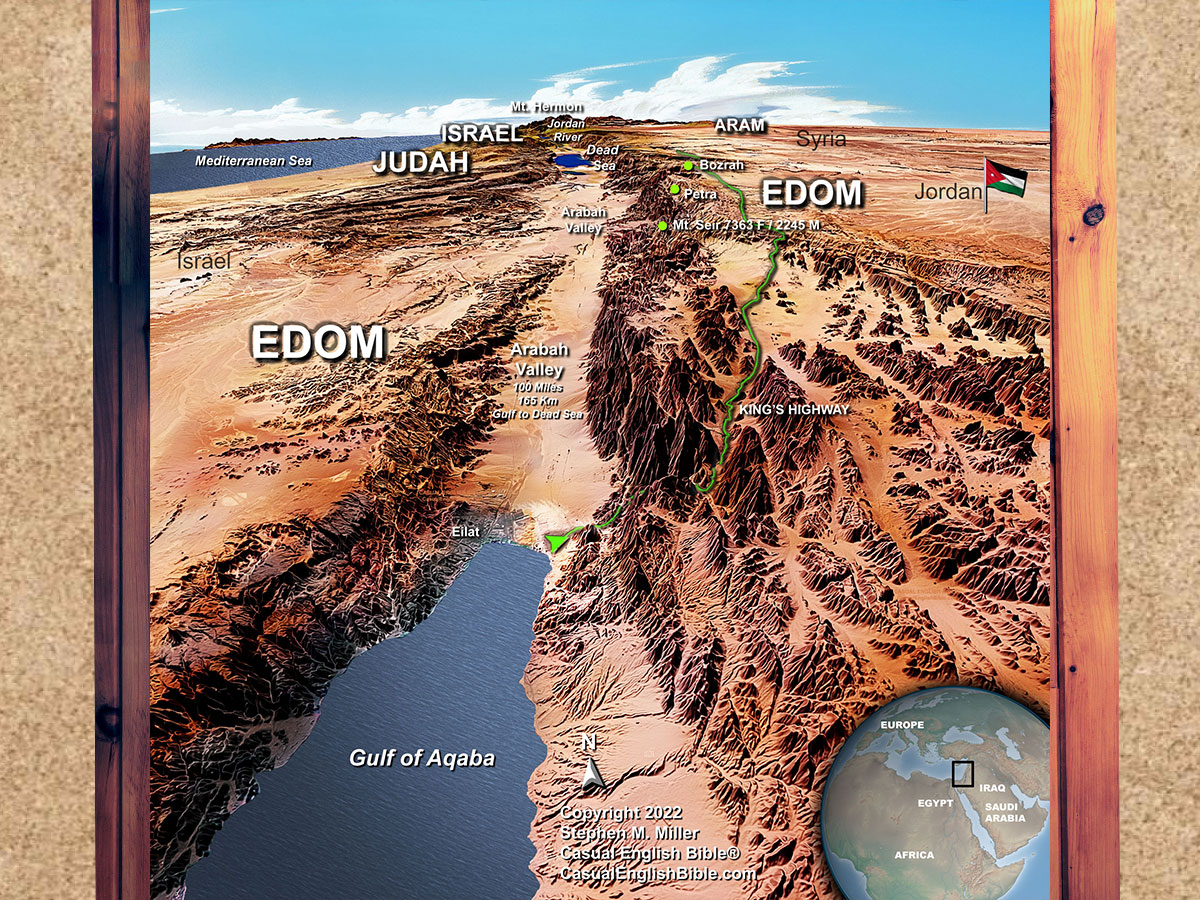
Divine judgment declared (Obad. 2-9). What kind of judgment did God promise to send to the nation of Edom? To begin with, He said He would bring down their pride (vv. 2-4). Edom was a proud nation that considered itself impregnable and invulnerable because it was situated “in the clefts of the rock” (v. 3), a region of rugged mountains with high cliffs and narrow valleys that would dissuade any invader from attacking. Like the eagles, the Edomites lived on the rocks and looked down from the heights with disdain upon the nations around them. The Edomites thought they were a great people, but God said He would make them small, which means “paltry.” “Pride goes before destruction, a haughty spirit before a fall” (Prov. 16:18 niv).

The prophet also said that their wealth would be plundered (Obad. 5-6). Located on several major trade routes, Edom could amass the riches of other nations; and out of their mountains, they could dig copper and other minerals. Because of their isolation, they didn’t have to worry about making treaties with the larger nations or helping to finance expensive wars. But their wealth would be no more. Unlike ordinary thieves, their plunderers would take everything they could find, and unlike grape harvesters, they would leave nothing behind for others. This would be the end of Edom and its boasted wealth.

Third, the Lord would work so that their alliances would be broken (v. 7). Though protected by their lofty heights, the Edomites were smart enough to know that they needed friends to help them stand against the great empires that frequently threatened the smaller eastern nations. Edom would also want allies to assist them in their constant feud with Israel (see Ps. 83:5-8). But God would turn these friends into enemies, and those who had eaten with them and made covenants of peace would break those covenants. While pretending to be friends, their allies would turn into traitors, set a trap, and catch Edom by surprise.

Nations today that boast of their political alliances and their formidable military establishments should take heed to what happened to Edom long ago, for that proud nation is no more. About 300 B.C., the Nabataean Arabs drove out the Edomites and occupied their key city Petra, the “rose red city” carved out of solid rock. The Romans took Petra in a.d. 105, but the decline in the caravan routes eventually led to the nation’s demise.

God also warned that Edom’s wisdom would be destroyed (Obad. 8). The people of the east were known for their wisdom (1 Kings 4:30), and this included the Edomites. Located as they were on the great trade routes, the leaders of Edom could get news and views from many nations. Job’s friend Eliphaz was from Teman in Edom (Job 2:11; see Jer. 49:7). Without wisdom, the leaders of Edom couldn’t make the right decisions, and the result would be confusion.

Finally, Obadiah announced that Edom’s army would be defeated (Obad. 9). Without wisdom, the military leaders wouldn’t know how to command their troops, and their mighty men would be defeated. This may have happened when the Babylonians took Jerusalem, or this promise may have been fulfilled when the Arabs invaded Edom and took over their cities, driving the Edomites to the west. The Greeks and Romans called these Edomites “Idumeans” (Mark 3:8), and from them came Herod the Great.

Having announced what God was going to do to Edom, Obadiah then proceeded to defend God’s judgment of the nation (Obad. 10-16). The Edomites were guilty of at least four abominable sins, the first of which was using violence against their brothers, the Jews (vv. 10-11). When their founder Esau discovered he was deprived of his father’s blessing, he determined to kill his brother Jacob (Gen. 27:41), and this malicious attitude was passed along to his descendants. If you had asked them, “Are you your brother’s keeper?” they would have replied, “No! We’re our brother’s killer!”

Instead of assisting their brothers in their plight, the Edomites stood “on the other side” (see Luke 10:30-32) and watched the enemy soldiers cast lots for the spoils, including the captive Jews, who would become slaves. The Edomites acted like the enemy instead of behaving like blood brothers of the Jews.

A word from Solomon is appropriate here: “Deliver those who are drawn toward death, and hold back those stumbling to the slaughter. If you say, ‘Surely we did not know this,’ does not He who weighs the hearts consider it? He who keeps your soul, does He not know it?” (Prov. 24:11-12 nkjv) Also, a word from the Prophet Amos: “For three sins of Edom, even for four, I will not turn back my wrath. Because he pursued his brother with a sword, stifling all compassion, because his anger raged continually and his fury flamed unchecked” (Amos 1:11 niv).

Not only did the Edomites ignore the plight of the Jews, but also they rejoiced at what the enemy was doing (Obad. 12; see Ezek. 35:15; 36:5). For the Jews, this was a day of destruction and distress; but for the Edomites, it was a day of delight and rejoicing. In their pride, Edom looked down on the Jews and gloated over their misfortune. Again, Solomon has counsel for us: “Do not gloat when your enemy falls; when he stumbles, do not let your heart rejoice, or the Lord will see and disapprove and turn his wrath away from him” (Prov. 24:17-18 niv). God didn’t spare the Jews but He did send judgment on Edom in due time.

Edom’s third great sin was assisting the enemy in attacking the Jews (Obad. 13-14). It was bad enough for people to do nothing to help their brothers, and to stand and rejoice at their brothers’ calamities, but when they gave aid to the enemy, that was carrying their ancient “family feud” too far. The Edomites entered the city and shared in dividing up the spoils, thus robbing their brothers of their wealth. (Later, Edom’s wealth would be taken.) The Edomites also stood at the forks in the roads, ready to capture the fugitives who were trying to escape; and they turned them over to the enemy to be imprisoned or slain.

What the Prophet Jehu asked King Jehoshaphat is applicable here: “Should you help the wicked and love those who hate the Lord and so bring wrath on yourself from the Lord?” (2 Chron. 19:2 nasb). As God’s people, we must love our enemies and pray for them (Matt. 5:44-48), but we certainly shouldn’t assist sinners in opposing and persecuting believers. To do so is to turn traitor in the army of the Lord.

Edom’s fourth sin was that of ignoring the impending wrath of God (Obad. 15-16).For the day of the Lord draws near on all the nations” (v. 15 nasb), and that included Edom, but Edom was proud and didn’t care about what the Lord might do to them. “The Day of the Lord” is a phrase that describes the time when God will pour His wrath out upon a wicked world, judge the nations, and then establish His kingdom, thus fulfilling the promises made to Israel. However, the phrase was also used to describe God-ordained calamities sent to punish people at any time, and these judgments were foretastes of the future worldwide “Day of the Lord.”

Therefore, whatever you want men to do to you, do also to them, for this is the Law and the Prophets” (Matt. 7:12 nkjv). We call this statement “the Golden Rule,” and it points out a positive approach to personal relationships. But Obadiah 15 gives the negative side: “As you have done, it will be done to you. Your dealings will return on your own head” (nasb). Or, as Paul expressed it, “Do not be deceived, God is not mocked; for whatever a man sows, that he will also reap” (Gal. 6:7 nkjv).

Edom had drunk in joyful celebration at Jerusalem’s fall, but all the nations will one day drink of the cup of wrath that God will hand them—a cup they cannot refuse (see Isa. 51:17, 21-23; Jer. 25:15-33). No matter how discouraging the day may be for God’s people, there is a just God in heaven who pays sinners back in kind: what they did to others is ultimately done to them. Since Pharaoh ordered all the Jewish boy babies drowned, God drowned the Egyptian army (Ex. 1; 14:26-31). The men who lied about Daniel in order to have Daniel thrown to the lions were themselves thrown to the lions (Dan. 6). The unbelievers on earth who shed the blood of God’s servants will one day drink water turned into blood (Rev. 16:5-6). “The righteous is delivered from trouble, and it comes to the wicked instead” Prov. 11:8 nkjv). Indeed, God’s judgments are true and righteous (Rev. 16:7).

3. God’s message to His people (Obad. 17-21)

Now that the prophecy about Edom has been delivered, Obadiah turns to His own people and announces three divine promises.

God will deliver you (Obad. 17-18). God did deliver His people from Babylonian captivity, and He will again deliver them in the last days and establish His kingdom. Mount Zion will be consecrated to the Lord and all defilement removed. “Jacob” refers to the Southern Kingdom and “Joseph” the Northern Kingdom. They will be united into one nation and enter the Messianic Kingdom together, possessing the inheritance promised to them. It appears from Isaiah 11:10-16, a parallel passage, that Moab and Edom will be restored as nations in the last days, but the Jews will burn them as stubble (see Ex. 15:7; Isa. 10:17; Matt. 3:12 for parallels).

God will defeat your enemies (Obad. 19-20). Israel will reclaim the land formerly inhabited by the Edomites (the Negev), the Philistines (the Shephelah), and the Samaritans (Ephraim). The Jews have been struggling to possess their inheritance for centuries, but other powers have always stood in the way. The Jews will “possess their possessions” without the help of any nation, but only through the help of the Lord their God. Israel has returned to their land in unbelief, and the nation was established in 1948. However, one day they shall see their Messiah and believe on Him, and the nation will be “born in a day” (Isa. 66:8; Zech. 12:10-13:1; 14:1-9).

God will establish the kingdom (Obad. 21). The Lord will reign from Mount Zion, where His temple will stand, “and all the nations will stream to it” (Isa. 2:2 nasb). It’s interesting to note that King Messiah will have “deliverers” (“saviors” kjv) assist Him in His rule over the nations. This fact should be studied with reference to our Lord’s promises to His apostles (Matt. 19:27-30) and those who are faithful to Him today (24:42-51; 25:14-30; Luke 19:11-27). Jesus teaches that faithfulness to Him today will mean reigning with Him in the kingdom.

All of God’s children look forward to the day when the kingdoms of this world will become the kingdom of our Lord, and He shall reign forever and ever (Rev. 11:15). Then every knee shall bow to Him and every tongue confess that He is Lord of all.

Meanwhile, God’s people must do all they can to get the Gospel out to the billions of people in this world who have never had the opportunity to hear the name of Jesus or learn how to trust Him and be saved. When the great and terrible Day of the Lord dawns, the nations of the world will be judged for the way they have treated one another and the nation of Israel. Until that day dawns, God’s church must keep praying “Your kingdom come” and seek to obey His command to take the Gospel to the whole world.

www.Upwards.Church

Message Audio/Video and Outline: https://upwards.church/watch-now/leander-campus-videos

Watch Messages: YouTube-Upwards Church

Facebook: Upwards Church

Sources:

Life Application Study Bible, (Wheaton, IL: Tyndale, 1988), WORDsearch CROSS e-book, 1451-1452.

Warren W. Wiersbe, The Bible Exposition Commentary – The Prophets, (Colorado Springs, CO: Victor, 2002), WORDsearch CROSS e-book, 371-375.

Posted in Return - Joel, Amos & Obadiah | Tagged , , , , , | Leave a comment

Amos Overview

When we hear, “He’s a man of God,” we think of some famous evangelist, a “Reverend,” a missionary, or the campus minister—professionals, Christian workers, those who preach and teach the Word as a vocation.

Surely Amos was a man of God, a person whose life was devoted to serving the Lord and whose lifestyle reflected this devotion—but he was a layperson. Herding sheep and tending sycamore-fig trees in the Judean countryside, Amos was not the son of a prophet; he was not the son of a priest. As a humble shepherd, he could have stayed in Tekoa, doing his job, providing for his family, and worshiping his God. But God gave Amos a vision of the future (1:1) and told him to take his message to Israel, the northern kingdom (7:15). Amos obeyed and thus proved he was a man of God.

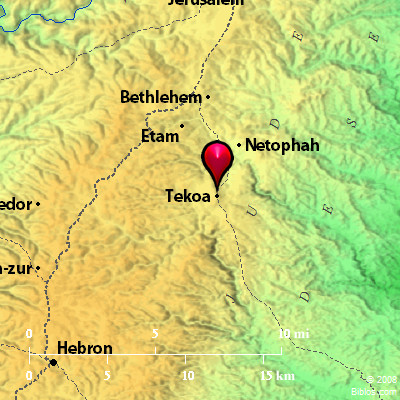
Amos (“burden bearer”) was a herdsman and a cultivator of sycamore trees (Amos 1:1; 7:14) when the Lord called him to be a prophet. He lived in the village of Tekoa, about eleven miles from Jerusalem, during the reigns of Uzziah in Judah (790-740 B.c.) and Jeroboam II in the Northern Kingdom of Israel (793-753). Amos was a “layman,” a humble farmer and shepherd who was not an official member of the Jewish religious or political establishment.

At this time, both Judah and Israel were enjoying prosperity and security. Luxury abounded (3:10-15; 5:1-6), and “religion” was popular. Israel flocked to the royal chapel at Bethel (4:4-5), and Judah celebrated the feasts enthusiastically (5:21-22), but the sins of both nations were eroding the religious and moral fiber of the people. Making money was more important than worshiping God (8:5); the rich exploited the poor, the judicial system was corrupt, and injustice flourished (5:11-15, 24; 8:4-6).

Amos presents God as the ruler of this world and declares that all nations are responsible to Him. The measure of a nation’s responsibility is the light which a nation has. The final test for any nation (or individual) is found in Amos 3:3, “Can two walk together, except they be agreed?” They knew of God’s covenants or agreements and chose to be unfaithful. In a day of prosperity, Amos pronounced punishment. The judgment of God awaited nations which were living in luxury and loving immorality.

Amos’s message has impacted God’s people throughout the centuries, and it needs to be heard today by individuals and nations. Though divided from their southern brothers and sisters in Judah, the northern Israelites were still God’s people. But they were living beneath a pious veneer of religion, worshiping idols and oppressing the poor. Amos, a fiery, fearless, and honest shepherd from the south, confronted them with their sin and warned them of the impending judgment.

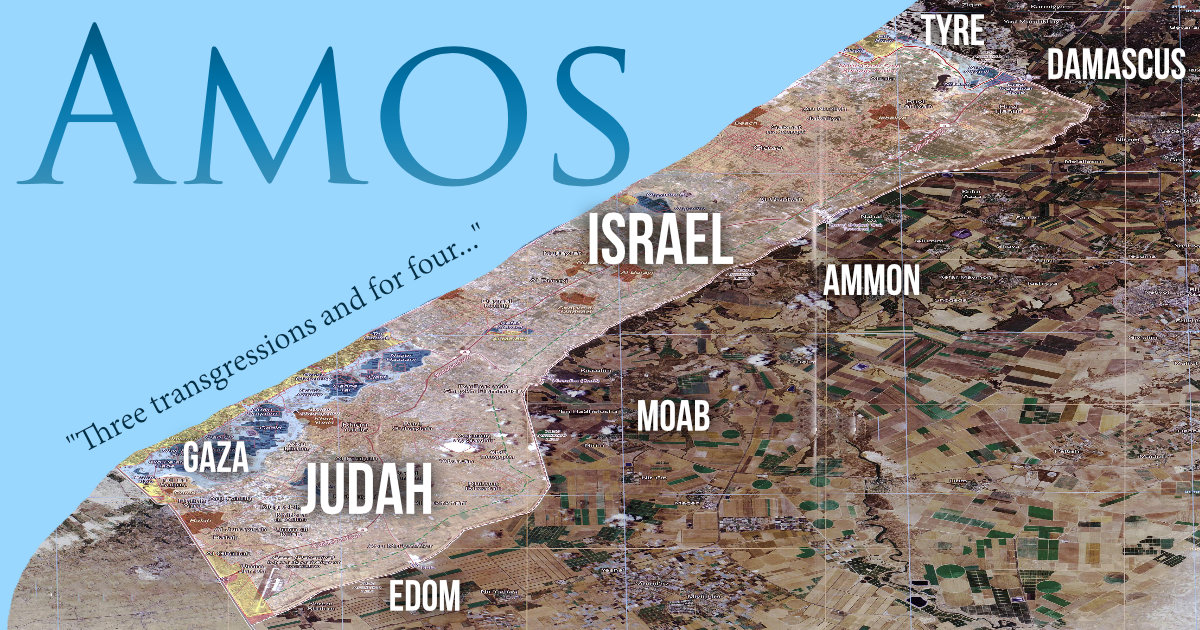
The book of Amos opens with this humble shepherd watching his sheep. God then gave him a vision of what was about to happen to the nation of Israel. God condemned all the nations who had sinned against him and harmed his people. Beginning with Damascus (Syria), he moved quickly through Gaza, Tyre, Edom, Ammon, and Moab. All were condemned, and we can almost hear the Israelites shouting, “Amen!” And then, even Judah, Amos’s homeland, was included in God’s scathing denunciation (2:4, 5). How Amos’s listeners must have enjoyed hearing those words! Suddenly, however, Amos turned to the people of Israel and pronounced God’s judgment on them. The next four chapters enumerate and describe their sins. It is no wonder that Amaziah the priest intervened and tried to stop the preaching (7:10-13). Fearlessly, Amos continued to relate the visions of future judgment that God gave to him (chapters 8-9). After all the chapters on judgment, the book concludes with a message of hope. Eventually God will restore his people and make them great again (9:8-15).

As you read Amos’s book, put yourself in the place of those Israelites and listen to God’s message. Have you grown complacent? Have other concerns taken God’s place in your life? Do you ignore those in need or oppress the poor? Picture yourself as Amos, faithfully doing what God calls you to do. You, too, can be God’s person. Listen for his clear call and do what he says, wherever it leads.

Vital Statistics

Purpose:  To pronounce God’s judgment upon Israel, the northern kingdom, for its complacency, idolatry, and oppression of the poor

Author: Amos

Original Audience: The people of Israel (the northern kingdom)

Date Written: During the reigns of Jeroboam II of Israel and Uzziah of Judah (approximately 760-750 B.C.)

Setting: The wealthy people of Israel were enjoying peace and prosperity. They were quite complacent and were oppressing the poor, even selling them into slavery. Soon, however, Israel would be conquered by Assyria, and the rich would themselves become slaves.

Key Verse:  “Instead, I want to see a mighty flood of justice, an endless river of righteous living” (5:24).

Special Features:  Amos uses striking metaphors from his shepherding and farming experience—a loaded wagon (2:13), a roaring lion (3:8), a mutilated sheep (3:12), fat cows (4:1), and a basket of ripe fruit (8:1, 2).

Outline 

1. Announcement of judgment (1:1-2:16)

2. Reasons for judgment (3:1-6:14)

3. Visions of judgment (7:1-9:15)

Amos speaks with brutal frankness in denouncing sin. He collided with the false religious leaders of his day and was not intimidated by priest or king. He continued to speak his message boldly. God requires truth and goodness, justice and righteousness, from all people and nations today as well. Many of the conditions in Israel during Amos’s time are evident in today’s society. We need Amos’s courage to ignore danger and stand against sin.

MEGATHEMES
THEME EXPLANATION IMPORTANCE
Everyone Answers to God Amos pronounced judgment from God on all the surrounding nations. Then he included Judah and Israel. God is in supreme control of all the nations. Everyone is accountable to him. All people will have to account for their sin. When those who reject God seem to get ahead, don’t envy their prosperity or feel sorry for yourself. Remember that we all must answer to God for how we live.
Complacency Everyone was optimistic, business was booming, and people were happy (except for the poor and oppressed). With all the comfort and luxury came self-sufficiency and a false sense of security. But prosperity brought corruption and destruction. A complacent present leads to a disastrous future. Don’t congratulate yourself for the blessings and benefits you now enjoy. They are from God. If you are more satisfied with yourself than with God, remember that everything is meaningless without him. A self-sufficient attitude may be your downfall.
Oppressing the Poor The wealthy and powerful people of Samaria, the capital of Israel, had become prosperous, greedy, and unjust. Illegal and immoral slavery came as the result of over-taxation and land-grabbing. There was also cruelty and indifference toward the poor. God is weary of greed and will not tolerate injustice. God made all people; therefore, to ignore the poor is to ignore those whom God loves and whom Christ came to save. We must go beyond feeling bad for the poor and oppressed. We must act compassionately to stop injustice and to help care for those in need.
Superficial Religion Although many people had abandoned real faith in God, they still pretended to be religious. They were carrying on superficial religious exercises instead of having spiritual integrity and practicing heartfelt obedience toward God. Merely participating in ceremony or ritual falls short of true religion. God wants simple trust in him, not showy external actions. Don’t settle for impressing others with external rituals when God wants heartfelt obedience and commitment.

www.Upwards.Church

Message Audio/Video and Outline: https://upwards.church/watch-now/leander-campus-videos

Watch Messages: YouTube-Upwards Church

Facebook: Upwards Church

Sources:

Life Application Study Bible, (Wheaton, IL: Tyndale, 1988), WORDsearch CROSS e-book, 1435-1436.

J. Vernon McGee, Thru The Bible with J. Vernon McGee, (Nashville, TN: Thomas Nelson, 1983), WORDsearch CROSS e-book, Under: “AMOS”.

Posted in Return - Joel, Amos & Obadiah | Tagged , , , , , , | Leave a comment