
God is with Us! – Exodus 25-40 – Tabernacle

This week we’re wrapping up Exodus and it ends on a positive note.  There’s been ups and downs such as  the Golden Calf debacle, a real low point for the people of God.  Many of you know that I attended Texas A&M and love a good aggie joke.  The Israelites, like many of us can’t help but make some boneheaded decisions from time to time. It reminds me of… the aggie that interviewed for a job painting highway stripes.  The foreman said, “to get this job, we have to have an agreement.  I need for you to paint at least 3 miles of stripes a day.”  The aggie said, “no problem, I can do that.”   The first day, he painted 5 miles of stripes. The foreman was impressed. His second day on the job, the aggie painted 3 miles of stripes. The third day, the aggie only painted 1 mile of stripes and the fourth day a ½ mile. The foreman said, “I don’t think this is working out. What’s the deal? Your first day you did so well, but now it’s bad.”  The frustrated aggie replied, “I’m sorry boss, the bucket just keeps getting farther and farther away!”

The Israelites learned from their mistake.  As Exodus closes, they have been faithful, helpful and generous. They would follow God’s instructions, build the Tabernacle and experience God’s blessings upon them.

I love this quote from Skip Heitzig, he says, “Exodus starts out in the brickyards of Egypt, but ends in the tabernacle with God living at the center of his people. In the same way God wants to take us out of the slavery of sin and live at the center of our lives.”

In Exodus 25-40, God told Moses how to build the Tabernacle, and Moses delegated jobs in order to do it. God allows people to participate with him in carrying out his will. Our task is not just to sit and watch God work, but to give our best effort when work needs to be done.

The physical care of the Tabernacle required a long list of tasks, and each was important to the work of God’s house. This principle is important to remember today when God’s house is partly represented by the church. There are many seemingly unimportant tasks that must be done to keep our church buildings maintained. Cleaning, mowing, printing, washing dishes, changing diapers, painting walls, or pulling weeds may not seem very spiritual. But they are vital to the ministry of the church and are an important part of our worship of God.

I was amazed as I studied the Tabernacle how much it is mentioned in the bible.  Did you know that 1/3 of the book of Exodus deals with the Tabernacle?!  Chapter 25 to chapter 40 (leaving out 32 & 33 the Golden Calf) gives us 13 chapters.  Leviticus has 18 chapters devoted to the Tabernacle. Numbers has 13 chapters devoted to the Tabernacle. Deuteronomy has 2 chapters devoted to the Tabernacle. Hebrews has 4 chapters devoted to the Tabernacle.

50 Bible chapters devoted to the Tabernacle!   It must be important.

Each aspect of the Tabernacle teaches us about Christ. The tabernacle was designed specifically, in detail by God, and pointed to the Person and the ministry of Jesus Christ.

We will look at this in more detail when we get into Leviticus next year but briefly I’ll share how a few parts point to Christ.
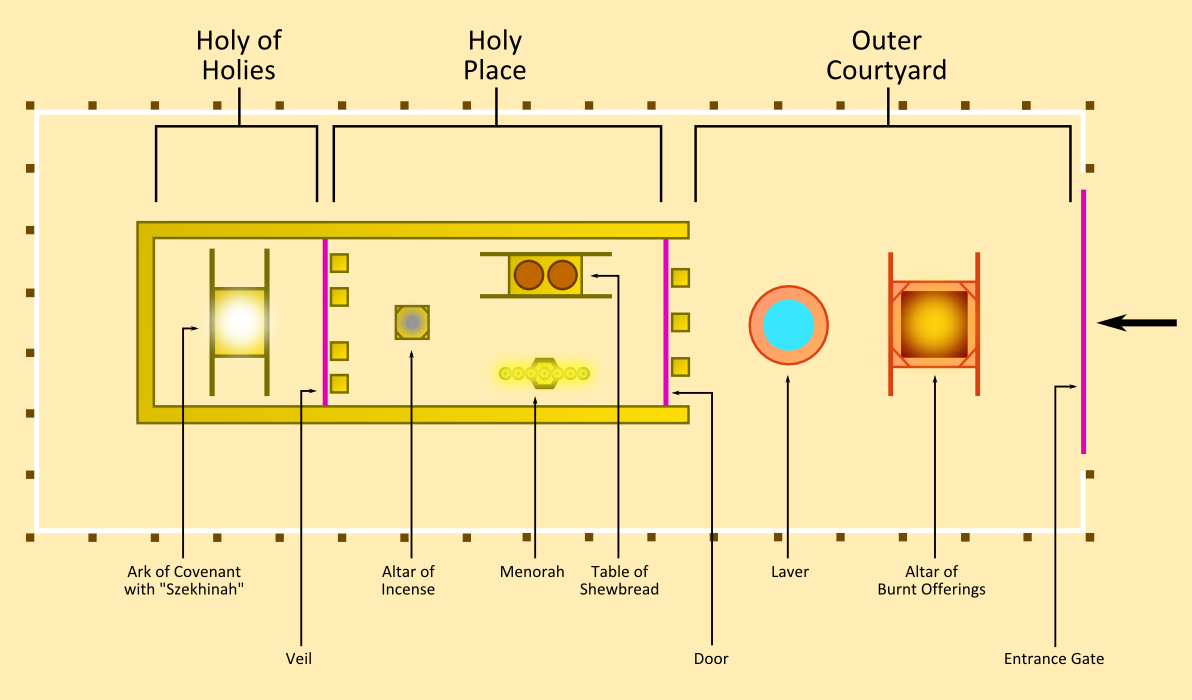
By looking at the image of the Tabernacle, see that there was only one way in.  This reminds us of Jesus who said, “I am THE way, no one comes to the father but by me.” John 14: 6  In John 10, Jesus says that he is THE gate, whoever enters through me will be saved.”

After the entrance we come face to face with the altar, a place of death and sacrifice. Sheep, goats and bulls were sacrificed at the altar and their blood atoned for the sins of the people.  When John the Baptist sees Jesus he reminds us, “Look, the Lamb of God, who takes away the sin of the world!  Jesus’ death on the cross, his shed blood is our atonement “once for all.”

Then we see a large basin for washing. The washing symbolized spiritual cleansing and forgiveness of sins. The basin reminds us that we are washed and cleansed by Christ.  The basin is also a picture of baptism, we are dead in our sins as we go down into the water but come up raised to walk in new life with Christ.

Next, entering the Holy Place and Most Holy Place we see that the décor changes from bronze on the outside to gold on the inside.  Gold symbolizes royalty and deity. The articles in the Holy Place reminds us of how we are to live with Christ in our lives.

The menorah represents the perfect light of Christ that guides us. Jesus said, “I am the light of the world, whoever follows me shall not walk in darkness but shall have the light of life.”  The bread of Presence reminds us that Christ is our sustenance and living bread. Jesus said, “I am the bread of life. Whoever comes to me will never go hungry.”

The Altar of Incense pointed to Jesus Christ as the great Intercessor and Mediator who represents us before God and makes our prayers acceptable to God.

The Holy Place and the Most Holy Place were divided by a large (shielding) curtain.  Do you remember what happened to the curtain when Jesus died on the cross?  “At that moment the curtain of the temple was torn in two from top to bottom.” Because of Jesus, “we can approach God’s throne of grace with confidence.”

As the Moses and the people finish the work of the Tabernacle, God is pleased.  Let’s look at what happens.

Then Moses set up the courtyard around the tabernacle and altar and put up the curtain at the entrance to the courtyard. And so Moses finished the work.

34 Then the cloud covered the tent of meeting, and the glory of the Lord filled the tabernacle

God’s presence is with His people!  He is living or dwelling at the center of his people.  The people see and experience the glory of God.   Every day when they woke up and they looked out and saw God and his glory in their presence.  Isn’t that what Jesus also did?

The Word (Jesus) became flesh and made his dwelling among us. We have seen his glory, the glory of the one and only Son, who came from the Father, full of grace and truth.

Christ was born and came to “tabernacle” (dwell) with us.

As Exodus closes, not only was God with the people, He also guided them.

In all the travels of the Israelites, whenever the cloud lifted from above the tabernacle, they would set out; 37 but if the cloud did not lift, they did not set out—until the day it lifted. 38 So the cloud of the Lord was over the tabernacle by day, and fire was in the cloud by night, in the sight of all the Israelites during all their travels.

The Israelites were once Egyptian slaves making bricks without straw. Here they were following the presence of God, carrying the Tabernacle or place of worship that they had built for God.

Exodus begins in gloom and ends in glory. This parallels our progress through the Christian life. We begin as slaves to sin and are redeemed by God.  He guides us through life with His word, the Holy Spirit, the church, and other believers.  We always have his presence and guidance.  We end our pilgrimage living with God forever.

Darrell

www.Upwards.Church

Message Audio/Video and Outline: https://upwards.church/watch-now/leander-campus-videos

Watch Messages: YouTube-Upwards Church

Facebook: Upwards Church

Sources: Life Application Study Bible, (Wheaton, IL: Tyndale, 1988), WORDsearch CROSS e-book, 156.
The Preacher’s Outline & Sermon Bible – Exodus II, (Chattanooga: Leadership Ministries Worldwide, 1996), WORDsearch CROSS e-book, Under: “F. The Assembly and Dedication of the Tabernacle, the Center of Worship: Experiencing the Presence of the Lord, 40:1-38”.
Posted in Out of Darkness - Exodus | Tagged , , , , , , | 1 Comment

God’s 10th Commandment – Exodus 20: 17

Be Content:  Exodus 20:17 “You shall not covet…anything that belongs to your neighbor.”

We don’t often use the word “Covet” in everyday conversation.

“Covet” to intensely desire something that belongs to someone else.

Sadly enough, these days our society encourages coveting, and I struggle to fight this pull like anyone else.  In the United States alone the advertising industry spends over six billion dollars a day. The typical U.S. consumer is the recipient of 5,000 advertisements daily.

The general message in all this merchandising is that all of our problems can be solved immediately by the consumption of the proper product. Buying this will take care of everything from a bad budget to baldness! All these TV, Radio, computer, and mass media ads we receive cause far too many of us to live in a perpetual state of longing, wanting more and more and more. A “Dennis the Menace” cartoon strip, which showed Dennis looking through a Christmas Toy catalogue saying, “This catalog’s got a lot of toys I didn’t even know I wanted.”

Coveting Causes…

  1. Overspending

“Whoever loves money never has money enough;” Ecclesiastes 5:10a

Coveting destroys budgets.  We think the problem is I just don’t make enough money.  No, it’s that we want too much.  A lot of things we think are needs are really greeds.  The average American puts $1300 on credit for every $1000 he makes.  So because we want more we get further and further in debt.  It always costs more to have more.

A pastor once dropped by to visit a family of the congregation in his church. When he got there, the mother of the house, wanting to make a good impression, said to her daughter, “Honey, who don’t you go and get that good book that we all love so much.” The daughter brought back the Sears’ catalog.

  1. Dissatisfaction

       “Whoever loves wealth is never satisfied with his income. Ecclesiastes 5:10b

The famed poet Mick Jagger described our plight with these words:
“I can’t get no satisfaction, I can’t get no satisfaction ’Cause I try and I try and I try and I try …”

Coveting is built on the idea that if we get what we do not have, if we get what we desire, we’ll be happy.   Things don’t give permanent happiness.  Like a tire with a hole in it, it quickly loses its ability to bring us happiness. But we never seem to learn this lesson. When the thrill fades we just covet another THING, hoping that it will bring us lasting happiness and the process begins all over again. One example of this vicious cycle is seen every Christmas when we’re presented with those “must” items that we simply have to buy for our kids or ourselves. And every year the “Big Thing” to find under the tree is something new. Years ago the gift of choice was a Tickle Me Elmo. People stampeded through stores to get one. In past years there have also been Pet Rocks, Cabbage Patch Dolls, Beanie Babies, Furbies, and GameBoys to name a few. When our kids get these things they enjoy them for a few days or weeks but then those things that they wanted so bad, those toys that they absolutely had to have to be happy….lose their appeal. And then the next year the big thing to have is something else.

Tickle Me Elmo isn’t giggling anymore; he’s on the top shelf of the closet in most homes between a Salad Shooter and a Vega-Matic. Coveting is deceptive, it promises happiness but it always leaves us wanting more.

  1. Anxiety

       The abundance of a rich man permits him no sleep. Eccl 5:12

When we focus on things we always inevitably worry.  The more you have, the more we have to worry about.  How am I going to protect it?  How am I going to save it?  How am I going to invest it?  How am I going to insure it?  How am I going to avoid taxes on it?  How am I going to keep from losing it?  I read a study that said insomnia increases with income.  Like a dog chasing its tail, people who covet never quite catch lasting joy.

  1. Exhaustion

Do not wear yourself out to be rich; have the wisdom to show restraint.”   Pr. 23:4

In our push to get more (and never in history have we been so pushed to get so much so quickly) we overwork and take on second jobs.  Everybody in the family works.  It’s the material rat-race and everybody’s tired.

  1. Bickering

“What causes fights and quarrels among you?  Don’t they come from the desires that battle with you?”        James 4:1

Conflict comes when we’re always wanting more.  The number one cause of divorce is financial tension; arguments over money and possessions.

People will sacrifice values, morals, integrity, all kinds of things in order to get more.  They’ll even sacrifice relationships to get an additional dollar.

A true story: At the end of the Civil War. John Wilkes Boothe, the man who killed Abraham Lincoln in Ford’s Theater was the brother of one of America’s most famous actors, Edwin Booth. John Wilkes Booth was consumed with jealousy. He bitterly coveted the popularity of his brother. Now, he knew there was a growing dislike for Abraham Lincoln in certain areas of the United States. So he killed the President, thinking to become a national hero. The assassination of this beloved man started with one covetous thought.

How to Be Content?

  1. I shouldn’t compare myself to others. We do not dare classify or compare ourselves … it is not wise.” 2 Cor. 10:12

In our society it seems the way we keep score is by possessions.  We often look around and ask “How am I doing?” as if net worth and self-worth were the same thing.   Our net worth has absolutely no relationship to our self-worth.   This “Someone else is having a better life” is a myth.

  1. I should be thankful for what I have.  “Always give thanks to God…  for everything” Eph 5:20

We wouldn’t have anything if it weren’t for God.   It’s all a gift from God.  The happiest people are not those who have the most but those who are thankful for what they have. What am I waiting on to make me happy? When I get married then I’ll be happy.  When I get out of this marriage then I’ll be happy.  When I have kids then I’ll be happy.  We are as happy as we want to be.  We should forget the “When and Then Thinking.”  Happiness is not getting whatever we want.  Happiness is enjoying whatever we have.

  1. I should be generous.

Command those who are rich in this present world not to be arrogant nor to put their hope in wealth, which is so uncertain, but to put their hope in God, who richly provides us with everything for our enjoyment.  Command them to do good, to be rich in good deeds, and to be generous and willing to share.  In this way they will lay up treasure for themselves as a firm foundation for the coming age, so that they may take hold of the life that is truly life.  1 Tim 6:17-19

As an American I am rich, wealthier than the vast majority of the world.  Even if you’re on welfare; if you’re an American you’re in the top 1% of income of the world.

I’ll never forget reading the economist Robert Heilbroner’s walk-through of what it would take to transform the average American home into the typical dwelling of the majority of the world’s inhabitants. “We would have to begin by invading our house to strip it of its furniture. Everything goes: beds, chairs, tables, TV, lamps. All that can be left for the family is a few old blankets, a kitchen table, and a wooden chair. When it comes to clothing, each member of the family may keep his oldest suit or dress and one shirt or blouse. The head of the family gets a pair of shoes, but not the wife or children.
Then comes the kitchen.  All the appliances would have to come out, and the cabinets would have to be emptied. All that can stay is a box of matches, a small bag of flour, and some sugar and salt. A few moldy potatoes, already in the garbage can, have to be taken back out, for they will provide much of that night’s meal. We can add a handful of onions and a dish of dried beans, but that’s all. Everything else goes: meat, fresh vegetables, canned goods, any crackers or candy. All gone.
But not only do we have to strip the house this way, but we also have to dismantle the bathroom, shut off the running water, and take out all electric wires. Next, we take away the house itself. The family must move into the tool shed. Everything related to communication goes too. No more newspapers, magazines, books – not that they are missed, since we must also take away the family’s literacy. Instead, all that can be left is one small radio. Then government services are removed. No more mail delivery, no more fire department. There is a school, but it is three miles away and consists of only two classrooms. There can’t be any hospitals or doctors nearby. The nearest clinic will be ten miles away and tended by no more than a midwife. It can be reached by bicycle, provided that the family has a bicycle, which is unlikely.  Finally, we come to money.
The family can only be allowed a cash hoard of five dollars. That is only allowed to prevent the main breadwinner of the family from experiencing the tragedy that came upon one poor laborer who went blind because he could not raise the $3.94 that he mistakenly thought he needed to receive admission to a hospital where he could have been cured.   James Emery White, You Can Experience an Authentic Life (Nashville: Word Publishing, 2000), 150-152

  1. I should shift my values to what will last.

Everything we see in the world is eventually going to decay or rust or wear out or fall apart.  It will eventually not exist, because all possessions are temporary.  The only things that really last for eternity are things we can’t see, our relationship to God and our relationship to others.  Jesus reminds us:

“Do not store up for yourselves treasures on earth, where moth and rust destroy, and where thieves break in and steal.  But store up for yourselves treasures in heaven, where moth and rust do not destroy, and where thieves do not break in and steal.  For where your treasure is, there your heart will be also. Matt 6:19-21

I think we need to do a periodic checkup and ask the tough questions: “What am I really living for?  Is the primary goal of my life just to get more?  Happiness does not come from possessions, it comes from knowing Jesus.

Darrell

www.Upwards.Church

Message Audio/Video and Outline: https://upwards.church/watch-now/leander-campus-videos

Watch Messages: YouTube-Upwards Church

Facebook: Upwards Church

Posted in Out of Darkness - Exodus | Tagged , , , , , , , , , , , , | Leave a comment

God’s 9th Commandment – Exodus 20:16

Tell the Truth:  “You shall not give false testimony against your neighbor.”  Exodus 20:16

Lie:  An untrue statement made deliberately.  To give a false impression (Webster)

The Lies We Tell (a partial list)   Mark Twain said there are 869 different kind of lies. I don’t know about that but there are lots of ways to not tell the truth. Here are a few:

  1. Exaggeration: To represent as greater than actually is

Or in relationships we blow out of proportion.  Statements like:  You always make a mess”  “You never…”   Each time we tell that fish story the fish gets bigger and bigger.

Our motive:  try to inflate our low self-image or our case, make ourselves look better.

In 1993 the Port Authority of New York and New Jersey ran a help wanted ad in the paper. They advertised for electricians with expertise at using Sontag connectors. The ad got 170 responses even though there is no such thing as a Sontag connector.  The Authority ran the ad to find out how many applicants falsify resumes.

  1. Excuse: Misrepresenting the truth about a failure on my part.

There’s a story of friends decided to go for a drive instead of showing up to class on time. When they did arrive, the girls explained to the teacher they had had a flat tire. The teacher accepted the excuse, much to the girls’ relief. “Since you missed this morning’s quiz, you must take it now,” she said. “Please sit in the four corner seats in this room without talking.” When they were seated, the teacher said, “On your paper write the answer to one question: ’Which tire was flat?’

Our motive:  to get out of consequences for our mistakes

  1. Silence: Deception by remaining silent when I should have spoken.

Just by silently listening to people say things about another person that you know are not true and not speaking up and coming to their defense is to bear false witness.

  1. White Lie: Perceived as good for both teller and the victim of the lie.

“Do you like this dress?”  “Yes” when you don’t.

Our motive:  Disrespect, (they can’t handle the truth) laziness, we don’t want to explain.

Famous American Fibs
– The check is in the mail.
– I’ll start my diet tomorrow.
– We service what we sell.
– Give me your number and the doctor will call you right back.
– Money cheerfully refunded.
– One size fits all.
– Your luggage isn’t lost, it’s only misplaced.
– Leave your resume and we’ll keep it on file.
– I just need a few seconds of your time.

– This will be a short meeting
– Your table will be ready in a few minutes.
– Open wide, it won’t hurt a bit.
– Let’s have lunch sometime. (Bits & Pieces, December 9, 1993, pp. 12-13.)

  1. Slander: Misrepresenting the truth with the intention to hurt someone.

This reminds me of a lady who was very resentful and bitter toward the new young minister in her church, so she shared with a few women falsely that he was having an affair with one of the young married ladies in the congregation. Of course, like all gossip the false rumors spread throughout the church and the community.

Once confronted by the minister, the young lady and her husband about the lie she admitted her sin, repented and asked for forgiveness.
However, to make his point to the woman about the damage she had caused the minister said, he had one condition she must fulfill.
He said, “Take a bag of feathers and release them from the bell tower on a windy day.” Then the next day, go around the town and pick up every feather.” She said, “there’s no way to get every feather.”  The minister said, “The same is true when you speak falsely about another person.”

Our motive:  Hurt another.  Make our self look better

6.  Gossip: Telling information about someone that is not first hand.

7.  Half lie: Telling the truth, but not the whole truth. Half-truth is a whole lie.

8. Spin: Retelling facts to my favor, ignoring or downplaying facts

I heard about a teen age boy who was supposed to be home at midnight and came in at two a.m. in the morning, but everyone was asleep.  He crept up the stairs and as he did so he hit a stair that squeaked and his dad woke up.  “Is that you Bobby?”  “Yes.”  “What time is it?”  Before he could say a word the coo-coo clock struck twice.  He said it was the most ingenious moment of my life when I stood there a coo-cooed ten more times.

  1. Deception: Statement(s) intended to deceive (even the truth)

A school principal received a phone call. The voice said, “Thomas Bradley won’t be in school today.” The principal was a bit suspicious of the voice. He asked, “Who is speaking?” The voice came back, “My father.” –James S. Hewett, Illustrations Unlimited (Wheaton: Tyndale House Publishers, Inc, 1988) p. 288.

We could make a truthful statement, but say it in a way that you deceive another person. Pastor Adrian Rogers tells of a time when he was driving home with full knowledge of a burned out headlight. He was pulled over by a policemen who asked, “Did you know your headlight is out?”  Wanting to avoid a ticket he raised his eyebrows and in a surprised tone said, “My headlight is burned out?”  He says, the officer let him go with a warning, but God did not.

  1. Flattery: Telling what another wants to hear, but I don’t believe.

Insincere praise: saying something to someone’s face that you wouldn’t think of saying behind their back. To a woman’s face you say, “That’s the prettiest dress I have ever seen!” but behind her back you would say, “She looked like a mess in that dress!” Or to your minister you might say, “Wonderful sermon, pastor.” but in the car on the way home you would say, “That’s the most boring thing I have ever heard.”

This reminds me of a story about two brothers who were well-known in their community to be two of the most evil men in the entire county. They were cruel, abusive, and involved in just about every kind of crime from gambling, to drugs, etc. But they had lawyers who were more than capable of twisting the truth to help them avoid prosecution. One day one of the brothers died. And his surviving sibling went to see the pastor of the local church to ask him to do the funeral. He said, “Reverend I will write your church a check right now for one million dollars. All you have to do is promise to say at the funeral that my brother was a saint.” Now, he was asking this pastor to lie about his brother, to share false compliments, insincere flattery, in his funeral message — but the pastor accepted the check and agreed. Finally the day of the funeral dawned and the pastor stepped to the pulpit. Then with great conviction, He said, “This man in the casket before you was one of the most cruel men I have ever known.  He was a liar and a thief. He had his filthy hands into just about every kind of crime you can think…but…compared to his brother….He was a saint.”

  1. Hypocrisy: Attempts to deceive another about something I am not

A pastor announced one Sunday that next Sunday he was going to preach on lying. And as preparation for the message he wanted the congregation to read the 17th chapter of Mark. The next Sunday the preacher began by asking those who read the 17th chapter of Mark to raise their hands. More than ½ of the people raised their hands. “Very good,” the preacher said. “You are the very people I need to speak to. There is no 17th chapter of Mark.”

In Boston a minister noticed a group of boys standing around a small stray dog. “What are you doing, boys?” “Telling lies,” said one of the boys. “The one who tells the biggest lie gets the dog.” “Why, when I was your age,” the shocked minister said, “I never ever thought of telling a lie.” The boys looked at one another, a little crestfallen. Finally one of them shrugged and said, “I guess he wins the dog.” –James S. Hewett, Illustrations Unlimited (Wheaton: Tyndale House Publishers, Inc, 1988) p. 287.

Let’s end with another survey.  How many of us have been hurt by someone’s lie?   How many of us get angry when lied to? In theory we all agree that honesty is the best policy. But how do we learn to consistently tell the truth?  According to Jesus we need to know where the lies begin.

Jesus said, “For out of the heart comes evil thoughts, murder, adultery, fornication, lying and slander.”  Matthew 15:19.  The heart of the issue when it comes to lying is an issue of the heart.  This is the problem.  If I am going to live as an honest person, I have to deal not with what I say, but with what motivates me to lie.    My grandfather had two open heart surgeries to address his physical heart problems.  I needed spiritual heart surgery that Jesus offers:  “If anyone is in Christ, He is a new creation.”  2 Cor. 5:17.  My heart is under construction by the great physician.

We should all pray as David did, “Create in me a pure heart, oh God.”  Psalm 51:10

Darrell

www.Upwards.Church

Message Audio/Video and Outline: https://upwards.church/watch-now/leander-campus-videos

Watch Messages: YouTube-Upwards Church

Facebook: Upwards Church


Posted in Out of Darkness - Exodus | Tagged , , , , , , , , , , , , , , , | Leave a comment

God’s 8th Commandment – Exodus 20:15

Respect the Property of Others:  “You shall not steal.”  Exodus 20:15

“Steal” – to take the property of another without permission or right (Webster)

Let’s start by taking a little informal survey. Have you ever had money stolen? Ever had a car stolen? What about having something stolen from your car? One time someone broke the window of Niki’s car and stole three CD’s.  It cost more to fix the window than what was taken.   Have you ever had your home broken into? There is something intensely personal about having an object stolen. It is a violation and we feel hurt, confused and angry.

Stealing creates victims. As we have suffered at the hand of a thief, we feel exposed, vulnerable and exploited.

There are 138 synonyms for synonyms for stealing.  Here is a partial list:

Deceit – charging for work not done, adding to expenses, false advertising

The Lord hates dishonest scales and dishonest weights” Prov. 20:23

When a repairman makes unnecessary repairs, a doctor makes unnecessary tests, a salesman skips over the fine print, when a car is sold and the problems are not shared this is form of stealing.

A law firm threw a surprise birthday party for one of its lawyers, on the cake was happy 80th birthday.  The lawyer said.  “I’m only forty, where did you get 80?”  “Oh your secretary must have added up your billing hours!”

A salesman dies and is given a tour of heaven and hell, heaven looks nice, beautiful scenery, people picnicking, but in hell he sees people partying, getting drunk.  He thinks that looks like more fun.    He chooses hell.  Next thing he knows, he’s being poked with a hot pitchfork and tormented.  He exclaims this is not what I chose, the Devil says, “Oh, you must have seen the demo”

Seize. Using without permission, using and abusing another’s possession

They covet fields and seize them, and houses, and take them. They defraud a man of his home, a fellowman of his inheritance.  Therefore, the LORD says: “I am planning disaster against this people, from which you cannot save yourselves. Mic 2:2-3

Defraud – to deprive of something by deception

Insurance Fraud

More than one-third of people hurt in auto accidents exaggerate their injuries, adding $13 – $18 billion to America’s annual insurance bill. (Rand Institute for Civil Justice)
PA’s Insurance Fraud Prevention Authority estimated that insurance fraud cost the average American household over $5,000 year in the form of higher premiums and higher prices for goods and services.

Employee Stealing
In a 1999 book, Michael Mortiarty said, “Workers around America frankly admit that they spend more than 20 percent of their time (seven hours a week) at work goofing off. That amounts to a four-day work week across the nation.  When an employer is paying for our time and we come in late, leave early, take three coffee breaks and a long lunch it’s a form of stealing.
Almost half of Americans admit that they regularly call in sick when they’re not. One in six Americans regularly drinks or uses drugs on the job.

I read about one young man who went to look for a job at a place where they really weren’t looking to hire anyone. The conversation went something like this. Manager: “I’m sorry I can’t hire you, but there isn’t enough work to keep you busy.”  Applicant: “You’d be surprised how little it takes.”

Embezzlement:  The American economy loses $40 billion annually from theft on the job.

Withholdhold back or deny

“‘Do not hold back the wages of a hired man overnight.” Lev 19:13

If we owe someone money we need to pay it back.

Taxes

This is also why you pay taxes, for the authorities are God’s servants, who give their   full time to governing.  Give everyone what you owe him: If you owe taxes, pay taxes; if revenue, then revenue.”  Rom. 13:6-7

Tax avoidance is good stewardship.  There’s no reason we should overpay on taxes. Tax evasion is illegal.  God says it’s stealing,

A man who had cheated the IRS out of hundreds of dollars developed a guilty conscience so that he couldn’t sleep. He wrote a check for $500 dollars and enclosed a note that said, “I underpaid my taxes last year and I’m feeling guilty. Please accept the enclosed payment I owe you. And, if I still can’t sleep, I’ll send you the rest that I owe you.”

Borrowing with no intention of paying back

The wicked borrow and do not repay” Ps 37:21

A lot of people have no intention of paying back.  The worst loans are made to friends and relatives.  This applies to anything, not just bankruptcy.  Anything borrowed:  Tools, skies, punch bowls.  What is it in our garages you need to go home and return to somebody?

Thief – one who takes illegally by secret.

“A thief is disgraced when he is caught.” Jer 2:26

Billions of dollars are lost every year in this country over the theft of goods and services. One estimate says that 1 out of every 52 shoppers carries something out of the supermarket for which they haven’t paid. According to the U.S. Department of Commerce, 4 million people are caught shoplifting every year.

A couple in Chula Vista, California went on a shoplifting spree at a local discount store, swiping a variety of items from the store’s shelves, and hiding them in the baby carriage they were pushing. The haul got so big that the carriage finally collapsed, spilling couple’s baby onto the store floor, along with the loot. The baby wasn’t injured, but the commotion attracted the attention of store security officers, who made a quick arrest.

What’s shocking is that only 10% of all shoplifters come from low incomes. 70% are middle class and 20% are classified as wealthy.

America is a country of thieves. One new hotel reported that in their first ten months of operation they lost 38,000 spoons, 18,000 towels, 355 silver coffee pots, 1500 finger bowls and 100 Bibles.

Rob -to take illegally by force

True story from our dim-witted criminals department: A man walked into a convenience store, put a $20 bill on the counter and asked for change. When the clerk opened the drawer, the man pulled a gun and asked for all the cash in the register. The man took the cash from the clerk and fled, leaving his $20 bill on the counter. So how much did he get from the drawer? Fifteen bucks.

They practice deceit, thieves break into houses, bandits rob in the streets; but they do not realize that I remember all their evil deeds. Hosea 7:1-2

A guy walked into a little corner store with a shotgun and demanded all of the cash from the cash drawer. After the cashier put the cash in a bag, the robber saw a bottle of Scotch that he wanted behind the counter on the shelf. He told the cashier to put it in the bag as well, but the cashier refused and said, “Because I don’t believe you are over 21.” The robber said he was, but the clerk still refused to give it to him because he didn’t believe him. At this point, the robber took his driver’s license out of his wallet and gave it to the clerk. The clerk looked it over and agreed that the man was in fact over 21 and he put the Scotch in the bag. The robber then ran from the store with his loot. The cashier promptly called the police and gave the name and address of the robber that he got off the license. They arrested the robber two hours later.

Robbing God

In the Old Testament, the prophet Malachi writes: “Will a man rob God? Yet you rob me. “But you ask, ‘How do we rob you?’ “In tithes and offerings. You are under a curse” Mal 3:8-9

God says if I’m not tithing then I’m paying my bills with stolen money that belongs to God.

We’ve taken what was supposed to be spent on God’s work, and we bought toys and trinkets, and bought houses and clothes and gone on vacation and bought computers with it and God says “I’ve been robbed”

I asked earlier about how you feel when you realize that you’ve been robbed.  How would you feel if it was someone you knew, someone you trusted someone you loved, and someone you thought loved you?  How much more would it hurt? Can you imagine how God feels when his own children defraud him?   What if I came home with $100 dollars and I said, Kaleb you have been a good boy so I give him 90.  Then all night he is mad because there is still $10 in my wallet.  So he sneaks in while I am sleeping and takes the other $10. How would I feel about a son like that?

Cheatconspire or sneak        “Cursed is the cheat” Mal 1:14

In 1969, 58% of high school students let someone else copy their work, In 1989, 98% did so Almost 80% of college students admit to cheating at least once.

Piratecopy illegallyany thing that is copy righted  

It is our church policy to be legal in all we do.  That’s why we pay an annual sum to CCLI, which gives us permission to print and display songs.  We also have a CCVL, which gives us permission to show movie clips in church.  For all small groups we either buy a book for each participant or we copy if we have permission.  When someone says, “Let’s just buy one book for the small group and make copies.”  That’s stealing.   If they were to say, “It will save the church money!” Is that what we are all about?   If that’s what we’re all about lets shoplift the donuts and coffee we need for Sundays! It would be a lot cheaper.  Let’s shoplift the paper we need for bulletins!  Let’s heist the sound equipment we need!  While we’re at it, forget the offering let’s just rob the bank.  It’s not a matter saving money or  not getting caught, it’s wrong.

If you make a copy of a DVD , CD or share an MP3 or Video File for a friend so they don’t have to buy it, it’s stealing.

It’s estimated that 400-600,000 copies of films are traded digitally every day. Many movies are available on the Internet before they hit the theaters, thanks to illegally copied pre-release versions which are offered to the press.
A cover of a U. S. News & World Report has a picture of an All-American teenage boy wearing a pair of headphones –looking pretty much like millions of teenage boys in any city and town in America. The caption says, “Wanted.” And in smaller letters, asks “Got a digital pirate in your house? Got a lawyer?”

Notice That with Stealing God Will Take Action

With some sins, God gets involved.  On the verses listed, we see that “God remembers”, “God will repay”, I am planning disaster, “they are under a curse”  The Hebrew word for curse means to “take away” It’s not voodoo or anything.  God chooses to bless and when he curses he removes his blessing.  Like the in the Garden of Eden, it’s a garden, everything is blessed, it’s great, When Adam says I don’t think I’ll obey you.  The ground is cursed, the blessing is removed.  It makes things more difficult.  Things will grow, but so will the weeds, thistles and thorns.   When we choose to go our own way and disregard God’s way.  We live in the absence of his blessing.  It makes things a lot harder.  We are living cursed instead of blessed.

When it comes to stealing, I’ll leave us with this statement: “I can live blessed or I can live cursed.”   Which will we choose?

Darrell

www.Upwards.Church

Message Audio/Video and Outline: https://upwards.church/watch-now/leander-campus-videos

Watch Messages: YouTube-Upwards Church

Facebook: Upwards Church

Posted in Out of Darkness - Exodus | Tagged , , , , , , , , , , , , , , , , | 2 Comments