God Will Deliver Me – Exodus 12 (The Passover)

1938, a man in New England went into an Abercrombie and Fitch store and purchased a new barometer. He took it home and proudly placed it upon a window sill. He consulted it to see what the weather would be like that day. He couldn’t believe it. The barometer said, “hurricane.” Here he was in New England. Hurricanes are usually in Florida. He grabbed the barometer and took it back down to the store to return it. The store clerk asked him, “What’s the matter?” He said, “The barometer you sold me is defective. It’s reading “hurricane.” The store owner said, “Oh, well we will happily refund your money.” He got his money back and started home. By the time he got home, his house had been blown away by the hurricane that hit New England in 1938. The barometer wasn’t wrong at all.

God’s Word is the barometer for mankind. It is always accurate.  For people without Christ, it reads, “the storm of Judgement is coming.” You can tap it, say it is broken or wrong, but it is still accurate. The barometer for Egypt read, “Death of the First Born.” This was God’s warning, whether you were an Egyptian or Hebrew. As we will see, if God’s instructions were not followed, the firstborn in that house would die.

At this event, God would deliver His people.

Deliverance the action of being rescued or set free.

This Passover chapter is a wonderful chapter because it continually points to the Lord Jesus Christ, as our deliverer, our Passover Lamb. He is “the Lamb of God that took away the sin of the world.”

Exodus 12 is also important because it is birth chapter of Israel as a NATION. They entered Egypt as a family and exit as a nation. Their national existence basically starts from this point. It was the month of Abib (April) which means “green ear month.” It is when the corn is in the ear. After the Babylonian captivity, Abib was called Nisan. The month of Tisri (October), which was the first month, is now changed to the seventh month of the calendar year. All of the other feasts of the year are based upon the Passover.

The Passover lamb begins the chronology of Israel as a nation. They have a new beginning, a new start. In the Lord Jesus Christ, we have the same new beginning! The Passover lamb is a picture of Jesus Christ. The birth of Christ changed our calendar just like the death of the Passover lamb. Anno Domini which means “year of the Lord.”

Christ will deliver His people and everything will change.  How does deliverance occur?

  • Deliverance Requires a Spotless Lamb

The night of the first Passover was the night of the tenth plague. On that fateful night, God told the Israelites to sacrifice a spotless lamb and mark their doorposts and lintels with its blood (Exodus 12:21–22). Then, when the Lord passed through the nation, He would “pass over” the households that showed the blood (verse 23). In a very real way, the blood of the lamb saved the Israelites from death, as it kept the destroyer from entering their homes. The Israelites were saved from the plague, and their firstborn children stayed alive. From then on, every firstborn son of the Israelites belonged to the Lord and had to be redeemed with a sacrifice (Exodus 13:1–212; cf. Luke 2:22–24).

The children of Israel in Egypt followed God’s command and kept the first Passover. However, none of the Egyptians did so. All through Egypt, behind the unmarked, bloodless doorways of the Egyptians, the firstborn children died at midnight (Exodus 12:21–29). “There was loud wailing in Egypt, for there was not a house without someone dead” (verse 30). This dire judgment finally changed the Egyptian king’s heart, and he released the Israelite slaves (verses 31–32).

  • Deliverance Happens When we Follow God’s Instructions.

Along with the instruction to apply the Passover lamb’s blood to their doorposts and lintels, God instituted a commemorative meal: fire-roasted lamb, bitter herbs, and unleavened bread (Exodus 12:8). The Lord told the Israelites to “observe this rite as a statute for you and for your sons forever” (Exodus 12:24, ESV), even when in a foreign land.

The Israelites were safe from the plague because they followed God’s instructions to sacrifice a lamb and paint its blood over their doors. In this way, God passed over their homes, and the Israelites’ firstborns were protected from the plague.

This is why the holiday is now called “Passover” because God passed over their homes. Out of their praise and thanks to God for protecting them as well as the freedom that He gave them through their exodus, the Israelites celebrated Passover in remembrance of God’s faithfulness.

Those within Judaism still celebrate Passover in remembrance of God bringing his children out of slavery. Christians today do not celebrate Passover because Jesus fulfilled Passover by His death on the cross.

We too must recognize that we are sinners needing deliverance from our slavery to sin. We must follow God’s instructions to repent, ask Jesus to be the Lord of our lives and be baptized.

Then Peter said to them, “Repent, and let every one of you be baptized in the name of Jesus Christ for the remission of sins; and you shall receive the gift of the Holy Spirit. Acts 2:38

When we follow God’s instructions we experience a day of deliverance as well—the day we were delivered from spiritual death and slavery to sin. The Lord’s Supper is our Passover remembrance of our new life and freedom from sin. The next time struggles and trials come, remember how God has delivered you in the past and focus on his promise of new life with him.

Deliverance from Death is found Only in Jesus.

The Apostle Paul tells us, “Get rid of the old yeast, so that you may be a new unleavened batch — as you really are. For Christ, our Passover lamb has been sacrificed.” The fulfillment of Passover is found in Christ.

Just as the blood of the lamb painted across the Israelites’ door spared their firstborn from death, the blood of Christ covers our sin and saves us from eternal condemnation. Out of pure joy, devotion, and thankfulness, we should worship Jesus always and forever.

The death Jesus experienced on the cross was the most painful death anyone has ever had to go through.  Not only did Jesus experience physical death, but he also experienced the pain of being separated from the Father as he shouted, “‘Eli, Eli, lema sabachthani?’ (which means ‘My God, my God, why have you forsaken me?’” (Matthew 27:46).

Jesus experienced the pain of separation from the Father on the cross in order for us to not have to suffer eternal separation from the Father. The Lord loves us so much that He willingly died on the cross in order to restore our relationship with Him.

Therefore, as Christians today, we still acknowledge the importance of Passover, yet Jesus fulfilled the Passover through His death.

There is no longer any need for us to offer sacrifices to cover our sins as the Israelites had to do in the Old Testament because our Passover Lamb has already been sacrificed for our sins.

Through the sacrifice of Jesus on the cross, all of our sins are forgiven, and we are granted salvation. This does not happen automatically or “by default.”

Rather, a person has to place faith in Jesus by believing that He died for their sins, was buried, and rose again (1 Corinthians 15:1-4). Once a person does this, they are eternally forgiven of their sins and are given eternal life in Christ.

 Passover comes from the Old Testament, in which God led His people out of slavery in Egypt. The Israelites had been in slavery to Pharaohs for 400-430 years and the Passover marked the beginning of the Israelites’ freedom.

This freedom was only given to them because of God and His love. In the same way, Jesus’ death on the cross gives us the freedom to live the life God has planned for us. Freedom is only found in Christ and His ever-present love.

Passover celebrates Israel’s exodus out of Egypt, freedom from slavery, and the providence of God. Passover is still celebrated among Jewish circles in celebration of God bringing their people out of slavery.

As Christians, we don’t celebrate this holiday; however, we do celebrate Jesus every day because He is our Passover Lamb, who redeems us, gives us forgiveness, and blesses us with eternal life.


www.Upwards.Church

Message Audio/Video and Outline: https://upwards.church/watch-now/leander-campus-videos

Watch Messages: YouTube-Upwards Church

Facebook: Upwards Church


Sources:

Rod Mattoon, Mattoon’s Treasures – Treasures from Exodus, Volume 1, (Springfield, IL: Lincoln Land Baptist Church, n.d.), WORDsearch CROSS e-book, 244-245.

Life Application Study Bible, (Wheaton, IL: Tyndale, 1988), WORDsearch CROSS e-book, 113-114.

https://www.christianity.com/wiki/holidays/what-does-passover-celebrate.html

https://www.gotquestions.org/what-is-Passover.html


Posted in Out of Darkness - Exodus | Tagged , , , , , , , , , , , | 2 Comments

God is Powerful – Exodus 7-10 (Ten Plagues)

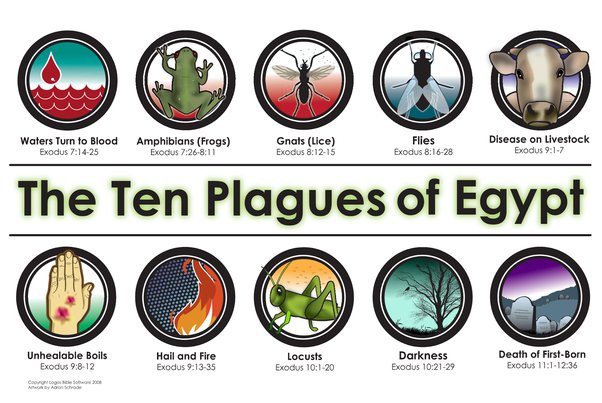
The Ten Plagues of Egypt are described in Exodus 7—12. The plagues were ten disasters sent upon Egypt by God to convince Pharaoh to free the Israelite slaves from the bondage and oppression they had endured in Egypt for 400 years. When God sent Moses to deliver the children of Israel from bondage in Egypt, He promised to show His wonders as confirmation of Moses’ authority (Exodus 3:20). This confirmation was to serve at least two purposes: to show God’s people that the God of their fathers was alive and worthy of their worship (Exodus 6:6–812:25–27) and to show the Egyptians that their gods were nothing (Exodus 7:512:12Numbers 33:4).

The Israelites had been enslaved in Egypt for about 400 years and in that time had lost faith in the God of their fathers. They believed He existed and worshiped Him, but they doubted that He could, or would, break the yoke of their bondage. The Egyptians, like many pagan cultures, worshiped a wide variety of nature-gods and attributed to their powers the natural phenomena they saw in the world around them. There was a god of the sun, of the river, of childbirth, of crops, etc. Events like the annual flooding of the Nile, which fertilized their croplands, were evidences of their gods’ powers and good will. When Moses approached Pharaoh, demanding that he let the people go, Pharaoh responded by saying, “Who is the Lord, that I should obey his voice to let Israel go? I know not the Lord, neither will I let Israel go” (Exodus 5:2). Thus began the challenge to show whose God was more powerful.

1. The first plague, turning the Nile to blood, was a judgment against Apis, the god of the Nile, Isis, goddess of the Nile, and Khnum, guardian of the Nile. The Nile was also believed to be the bloodstream of Osiris, who was reborn each year when the river flooded. The river, which formed the basis of daily life and the national economy, was devastated, as millions of fish died in the river and the water was unusable. Pharaoh was told, “By this you will know that I am the LORD” (Exodus 7:17).

2. The second plague, bringing frogs from the Nile, was a judgment against Heqet, the frog-headed goddess of birth. Frogs were thought to be sacred and not to be killed. God had the frogs invade every part of the homes of the Egyptians, and when the frogs died, their stinking bodies were heaped up in offensive piles all through the land (Exodus 8:13–14).

3. The third plague, gnats, was a judgment on Set, the god of the desert. Unlike the previous plagues, the magicians were unable to duplicate this one and declared to Pharaoh, “This is the finger of God” (Exodus 8:19).

4. The fourth plague, flies, was a judgment on Uatchit, the fly god. In this plague, God clearly distinguished between the Israelites and the Egyptians, as no swarms of flies bothered the areas where God’s people lived (Exodus 8:21–24).

5. The fifth plague, the death of livestock, was a judgment on the goddess Hathor and the god Apis, who were both depicted as cattle. As with the previous plague, God protected His people from the plague, while the cattle of the Egyptians died. God was steadily destroying the economy of Egypt, while showing His ability to protect and provide for those who obeyed Him. Pharaoh even sent investigators (Exodus 9:7) to find out if  God’s people were suffering along with the Egyptians, but the result was a hardening of his heart against God’s people.

6. The sixth plague, boils, was a judgment against several gods over health and disease (Sekhmet, Sunu, and Isis). This time, the Bible says that the magicians “could not stand before Moses because of the boils.” Clearly, these religious leaders were powerless against the God of Israel.

Before God sent the last three plagues, Pharaoh was given a special message from God. These plagues would be more severe than the others, and they were designed to convince Pharaoh and all the people “that there is none like me in all the earth” (Exodus 9:14). Pharaoh was even told that he was placed in his position by God, so that God could show His power and declare His name through all the earth (Exodus 9:16). As an example of His grace, God warned Pharaoh to gather whatever cattle and crops remained from the previous plagues and shelter them from the coming storm. Some of Pharaoh’s servants heeded the warning (Exodus 9:20), while others did not.

7.  The seventh plague, hail, attacked Nut, the sky goddess; Osiris, the crop fertility god; and Set, the storm god. This hail was unlike any that had been seen before. It was accompanied by a fire which ran along the ground, and everything left out in the open was devastated by the hail and fire. Again, the children of Israel were miraculously protected, and no hail damaged anything in their lands.

Before God brought the next plague, He told Moses that God’s people would be able to tell their children of the things they had seen God do in Egypt and how it showed them God’s power.

8.  The eighth plague, locusts, again focused on Nut, Osiris, and Set. The later crops, wheat and rye, which had survived the hail, were now devoured by the swarms of locusts. There would be no harvest in Egypt that year.

9. The ninth plague, darkness, was aimed at the sun god, Re, who was symbolized by Pharaoh himself. For three days, the land of Egypt was smothered with an unearthly darkness, but the homes of God’s people had light.

10. The tenth and last plague, the death of the firstborn males, was a judgment on Isis, the protector of children. In this plague, God was teaching the Israelites a deep spiritual lesson that pointed to Christ. Unlike the other plagues, which  God’s people survived by virtue of their identity as God’s people, this plague required an act of faith by them. God commanded each family to take an unblemished male lamb and kill it. The blood of the lamb was to be smeared on the top and sides of their doorways, and the lamb was to be roasted and eaten that night. Any family that did not follow God’s instructions would suffer in the last plague. God described how He would send the destroyer through the land of Egypt, with orders to slay the firstborn male in every household, whether human or animal. The only protection was the blood of the lamb on the door. When the destroyer saw the blood, he would pass over that house and leave it untouched (Exodus 12:23). This is where the term Passover comes from. Passover is a memorial of that night in ancient Egypt when God delivered His people from bondage. First Corinthians 5:7 teaches that Jesus became our Passover when He died to deliver us from the bondage of sin. While God’s people found God’s protection in their homes, every other home in the land of Egypt experienced God’s wrath as their loved ones died. This grievous event caused Pharaoh to finally release God’s people.

By the time God’s people left Egypt, they had a clear picture of God’s power, God’s protection, and God’s plan for them. For those who were willing to believe, they had convincing evidence that they served the true and living God. Sadly, many still failed to believe, which led to other trials and lessons by God. The result for the Egyptians and the other ancient people of the region was a dread of the God of Israel. Even after the tenth plague, Pharaoh once again hardened his heart and sent his chariots after  God’s people. When God opened a way through the Red Sea for  God’s people, then drowned all of Pharaoh’s armies there, the power of Egypt was crushed, and the fear of God spread through the surrounding nations (Joshua 2:9–11). This was the very purpose that God had declared at the beginning. We can still look back on these events today to confirm our faith in, and our fear of, this true and living God, the Judge of all the earth.

www.Upwards.Church

Message Audio/Video and Outline: https://upwards.church/watch-now/leander-campus-videos

Watch Messages: YouTube-Upwards Church

Facebook: Upwards Church

Sources:    https://www.gotquestions.org/ten-plagues-Egypt.html

PLAGUES OF EGYPYT (INTRO)

Posted in Out of Darkness - Exodus | Tagged , , , , , , | Leave a comment

God’s Word is Rejected – Exodus 5-6

Moses delivers God’s message as instructed. Pharaoh, however unleashes his fury and increases the pressure on the people of God. He removes their straw for the brick production and tells them to get their own. In this section of Exodus, we address the difficulties that may arise from obeying God. It is not all rosy. Serving Christ, especially in the ministry, may require hardships. If we are not committed to face them and keep going forward, or if we quit easily, it would be better for us to not get into the ministry in the first place. Sharing the truth of God’s Word is not a task for people who wet their finger and put it in the air to see which way the winds of opinion are blowing.

God is looking for people who will serve him whether they have straw or stubble. Whether we are enjoying the straw of provision and abundance or the stubble of hardship and suffering, God is looking for men and women who will not quit serving and obeying Him.

In our passage today, Moses and Aaron stood before the ruler of one of the greatest kingdoms of the ancient world. They were sent by God to inform Pharaoh that if he didn’t release the Jewish people, Yahweh would declare war on him and his gods and wouldn’t stop attacking Egypt until the people of Israel were set free. God’s two ambassadors had one message from the Lord: “Let My people go—or else!” Pharaoh’s responses to Moses and Aaron were predictable: he rejected God’s command, disdained the miracles Moses and Aaron performed, and deliberately hardened his heart against the Lord.

Pharaoh rejects God’s Word (Ex. 5:1-6:27)

Their request was a simple one: Moses and Aaron wanted permission to take the Jewish people three-days’ journey into the desert to a place where they could worship the Lord. Six days of travel and one day of worship would add up to a week away from their work, but Moses said nothing about how long they would be gone or when they would return. This omission made Pharaoh suspicious, and he wondered if the purpose of their journey was escape rather than worship. Three questions are involved in this episode.

Pharaoh: “Why should I obey the Lord?” (5:1-3) This was a reasonable question because the Egyptian people considered Pharaoh to be a god, and why should their king obey a strange god that neither Pharaoh nor the Egyptians knew? Furthermore, what right did this new god have to call the Israelites “My people” when the Jews were the slaves of Pharaoh? If Pharaoh obeyed the edict, he would be acknowledging a deity greater than himself, and he wasn’t about to do that. In his pride and false security, Pharaoh wouldn’t listen to the words of the living God.

Moses mentioned that the Israelites might be in danger of being killed if they failed to obey the Lord. Why bring that up? Perhaps Moses was hinting that Pharaoh’s stubbornness might cost him his slaves and that he’d be better off to give the Jews a week off and thereby protect his cheap labor. However, there’s another factor involved: Moses was telling Pharaoh that the God of the Hebrews was a powerful God who could kill the Egyptians as well as the Jews. Pharaoh needed to understand that the demands Moses and Aaron were making were not to be taken lightly, for this was a matter of life and death.

Pharaoh: “Why should the work stop?” (vv. 4-21) The enslavement of the Israelites was a great boost to the economy of Egypt, and Pharaoh wasn’t about to give up a good thing. As dictators have done for centuries, Pharaoh exploited a captive people and was unconcerned about their welfare. Unknown to the king, God was working out His perfect plan to free His people and glorify His great name; and nothing Pharaoh could do would prevent God’s plan from succeeding.

Instead of giving the Jews relief from their toil, Pharaoh made their labor even harder. He refused to give them the straw they needed for the manufacturing of the clay bricks, but he demanded that they still reach their assigned daily quotas. “If they have so much time on their hands that they can take a week off,” he argued, “then let them find their own straw. The extra work will take their minds off such foolish ideas.” God’s message to Pharaoh through Moses and Aaron was only “vain words” as far as the king was concerned (v. 9; “lies,” niv).

When their work became unbearable because of the new rules, the Hebrews sent their foremen to protest to Pharaoh. It’s unusual that slaves would have access to the king, but Pharaoh knew what he was doing. He told them what Moses and Aaron had demanded of him, and this turned the Jewish foremen against the leaders God had given them. The foremen told Moses and Aaron what they thought of them and then slandered them among the Jews. This wouldn’t be the last time Moses would be opposed by his own people who didn’t understand what the Lord was doing.

Instead of going to Pharaoh to complain, the foremen should have gone to Moses and Aaron and suggested that they summon the elders and have a prayer meeting. They should have reminded themselves of the promises God had given Israel and claimed them by faith. What a difference that would have made for them and for their leaders! Alas, during the next forty years, complaining about God’s will and criticizing God’s leaders would be characteristic of the people of Israel; but are God’s people much different today?

Moses: “Why have You sent me?” (5:22-6:27) Moses did what all spiritual leaders must do when the going is tough: he took his burden to the Lord and honestly talked to Him about the situation. It’s easy to see that Moses was disappointed and distressed. He blamed God for the way Pharaoh was mistreating the Jews, and he accused Him of doing nothing. “Is this why You sent me?” he asked (5:22, niv). In other words, “Are You going to keep Your promises to me or not?”

God’s chosen servants must expect opposition and misunderstanding, because that’s part of what it means to be a leader; and leaders must know how to get alone with God, pour out their hearts, and seek His strength and wisdom. Spiritual leaders must be bold before people but broken before God (see Jer. 1) and must claim God’s promises and do His will even when everything seems to be against them.

How did the Lord encourage His struggling servant? To begin with, God spoke to him and gave him great promises (Ex. 6:1-8). Today we have the written Word of God, but it’s likely that Moses heard God speak in an audible voice (33:11; Deut. 34:10). Four times in this speech, God reminded Moses, “I am the Lord

(Ex. 5:2, 6, 7, 8) and used His covenant name “Yahweh”; and seven times, God said, “I will.” When we know that God is in control and we claim His promises, then we can experience peace and courage in the battles of life. God promised to bring Israel out of Egypt, free them from bondage, and take them into their Promised Land. At the heart of the seven “I will” promises is “And I will take you to Me for a people” (v. 7), which is the basis for all that God did for the Jews.

God also reminded Moses of His covenant name “Yahweh” (6:3). One way to get to know God better is to pay attention to His names. The patriarchs knew God as “God Almighty,” which in the Hebrew is “El Shaddai—the all-sufficient and all-powerful God,” and they knew that God’s name was “Yahweh”; but they didn’t understand the full implications of the name. God had explained the name “Yahweh” to Moses when He called him in Midian (3:13-14), but now He associated His name with the covenant He would make with His people (6:4). Yahweh is the special name of God that links Him with Israel and His covenants, and it is so sacred to Jews even today that they will not speak it when they read the Scriptures in the synagogue. Instead, they substitute “Adonai” (Master) or simply say “the Name.”

Third, the Lord assured Moses that He felt the burdens of His people and was working on their behalf (v. 5; see 2:24). God wasn’t ignorant of their need or unconcerned about their suffering, nor was He adding to their problems by delaying their deliverance. Everything was working according to His plan and nothing God had planned would fail. Whenever we feel the Lord has abandoned us and doesn’t really care, we need to remember His assuring words, “Casting all your care upon Him, for He cares for you” (1 Peter 5:7).

Fourth, the lord commanded Moses to speak to Pharaoh again (Ex. 6:9-13). Moses reached the depths of discouragement when the Jewish elders wouldn’t even listen to him. They had forgotten the signs and promises that Moses and Aaron had given them (4:29-31) and in their anguish were convinced that the situation was hopeless. Moses and the elders had given up, but God hadn’t given up on Moses. Moses was still God’s servant, and He commissioned him to return to the palace and confront Pharaoh again. In times of despair, it’s best to ignore our feelings and simply do what God tells us to do, leaving the consequences with Him.

The genealogy (6:14-27) isn’t there by accident, for it’s the Lord’s way of reminding us, the readers, that God had prepared Moses and Aaron for their ministry in Egypt. Their arrival in Jacob’s family was part of His providential working. Reuben was Jacob’s firstborn, then Simeon, and then Levi, the ancestor of Moses and Aaron. “Before I formed you in the womb I knew you; before you were born I sanctified you; and I ordained you a prophet to the nations” (Jer. 1:5, nkjv). God’s calling means God’s enabling, and what He begins He always completes (Eph. 2:10; Phil. 1:6).

Pharaoh belittles God’s miracles (Ex. 6:28-8:7)

Up to this point in their confrontation with Pharaoh, Moses and Aaron had simply delivered God’s ultimatum. Now the time had come for them to reveal God’s power and perform the miraculous signs that proved they were truly sent by God. Still somewhat discouraged, Moses maintained that he wasn’t a competent speaker; so God reminded him that Aaron could be his spokesman (6:26-7:2; 4:15-16). However, the Lord advised Moses and Aaron that it would take more than one or two miracles to accomplish His purposes, for He would multiply His signs and wonders in the land of Egypt.

Before we look at this remarkable series of miracles, we must focus on the reasons why the Lord took this approach in dealing with Pharaoh and sent these sign judgments to the land of Egypt. The ultimate purpose, of course, was to bring Pharaoh and the Egyptians to their knees so they’d be willing for the Jews to leave the land. But at the same time, the Lord was revealing Himself to both the Israelites and the Egyptians and proving that He alone is God (7:5).

The miracles and plagues were also God’s way of judging the gods of Egypt and proving them false and futile. “Against all the gods of Egypt I will execute judgment: I am the Lord” (12:12; and see 18:11 and Num. 33:4). More than eighty different deities were worshiped in Egypt, but they could do nothing to deliver the land and the people from the terrible judgments Yahweh sent. If nothing else, the Egyptians learned that Yahweh was the true and living God.

But the people of Israel also needed to learn this lesson. According to Ezekiel 20:1-9, some of the Jews had begun to worship the Egyptian gods; and when they were delivered from Egypt, they took their gods with them! Did they compromise their faith in an attempt to please their captors and receive better treatment? But how could they forsake Yahweh after seeing all the demonstrations of His power? “Our fathers in Egypt did not understand Your wonders; they did not remember the multitude of Your mercies” (Ps. 106:7, nkjv).


www.Upwards.Church

Message Audio/Video and Outline: https://upwards.church/watch-now/leander-campus-videos

Watch Messages: YouTube-Upwards Church

Facebook: Upwards Church


Sources:
Rod Mattoon, Mattoon’s Treasures – Treasures from Exodus, Volume 1, (Springfield, IL: Lincoln Land Baptist Church, n.d.), WORDsearch CROSS e-book, 92.
Warren W. Wiersbe, The Bible Exposition Commentary – Pentateuch, (Colorado Springs, CO: Victor, 2001), WORDsearch CROSS e-book, 186-188.
Posted in Out of Darkness - Exodus | Tagged , , , , , , , , , , , , | Leave a comment

God Equips Us – Exodus 4

A family was awakened by their smoke detector in the middle of the night to discover that their house was on fire. The father ran into the upstairs bedroom of his children and carried his eighteen-month-old baby in his arms while dragging his four-year-old son by the hand. They were halfway down the stairs when the little boy remembered that he had left his teddy bear in the bedroom, so he broke free from his father’s hand and ran back to the bedroom to retrieve it. In the furor and confusion, the father didn’t notice that his son wasn’t with him until he got outside. By now the little boy was trapped by the flames and smoke in his second-story bedroom. Smoke swirled around him and he coughed and cried out from the upstairs window, “Daddy, Daddy! Help me!” His father yelled from below, “Jump out of the window, Andy! I’ll catch you!” In the darkness and smoke, the little boy yelled back, “But Daddy! I can’t see you!” Daddy shouted back, “That’s okay, son. I can see you! Jump!”

It’s jumping time for Moses. God has called Moses to deliver His people. Moses had an anxiety attack and began to offer a series of excuses to the Lord about God’s calling on his life. More or less he is saying, “Lord, I can’t see you!” God tells him, “I can see you through the smoke so go ahead and jump!” God has promised to meet his needs and equip him for victory, yet, he is still struggling with doubt and disbelief. Sound familiar? We do the same thing too sometimes, don’t we? In verse one of this chapter, Moses offers the third of five excuses. Let’s take a look.

Moses tells the Lord, “Suppose your people won’t believe me?”

Moses was a sensitive person. He has tasted the bitter dish of rejection and doesn’t want to taste it again.  Do you understand what he is feeling? We often build up events in our minds and then worry over what might go wrong.

Fear and worry tend to cloud our thinking and they create doubt in the promises of God. Worry makes us question God’s Word and makes us wonder if His Word works. When Moses was 40, he had considerable credentials. After 40 years in the desert, he had no credentials with the Egyptians. He was only a shepherd who was considered a nobody in Egypt. He had gone from a prince to a pauper in the eyes of the Egyptians. Authority was needed for Moses’ task, but he needed to determine whose authority was the most important, his or God’s. The same holds true for us. Are we going to run the show or trust God and let Him lead our lives?

There are several insights that we will see here. First of all, we will note the lesson of God’s grace. Moses was human just like you and me. He was timid, hesitant, fearful, unbelieving, and rebellious, yet God used this man in spite of his weaknesses.

God calls imperfect people, but he equips them for His service.  His strength is made perfect in our weaknesses. Where sin abounds, grace much more abounds.  Realize that God does want to use you for His glory and service. He knows you, your strengths and weaknesses, and He has a plan and purpose for your life if you are willing to follow it. You are not a blob in a sea of faces. You are special to Him.

When equipped we learn the difference between self-confidence and God-confidence.

Self-confidence says, “I can or can’t do this.” God-confidence says, “I can do all things through Christ.” Self-confidence relies on personal plans, or abilities. God-confidence relies on God’s power, faith, trust in His Word, and His abilities.

Moses also needed to be equipped for life from God’s point of view. He failed to see what God was attempting to accomplish in his life in spite of his personal failures. Our failures and fears tend to blind us too.

God responded to Moses’ concerns by giving him some object lessons to ease his worry, escalate his faith, and exhibit His power. The Lord asked, “What’s in your hand Moses?” He replied, “A rod.” The question was not asked to give God information He did not have. The Lord knows everything, and knew what was in Moses’ hand. The question was asked to direct Moses’ attention to what he had in his hand. If we are going to do anything for God, we must be willing to give to God what is in our hand. If we are stingy and unwilling, we will hinder God’s work, and miss out on opportunities of serving and blessing others and being blessed by God.

The rod in Moses’ hand was his shepherd crook or staff which was normally about three to six feet long. It certainly was nothing special to look at, and Moses saw nothing special in it, but the Lord did. When it was yielded to God, it would do much for God. God would use this insignificant rod to perform miracles involving snakes, plagues, parting the Red Sea, and bringing forth water out of rock.

We make the mistake, many times, in appraising what is in our hands as insignificant. We think that our abilities, talents or gifts are of no value to the Lord, but they are very valuable. God’s use of Moses’ rod demonstrates that He can use insignificant things to do great work for Him if they are yielded to His control. On the other hand, great abilities can be wasted if they are not surrendered to Christ. What are the ordinary things in your life—your voice, a pen, a hammer, a broom, a musical instrument?

The question “What is in your hand?” can also be a question of examination or probing. Do you have something in your hand that you should not have? Do you have something in your hand that will defile you, hurt you, cause trouble for yourself or others, and dishonor the Lord Jesus Christ? Are there drugs, alcohol, pornography, or another person’s things in your hands?

God gives several commands to Moses concerning the rod that he carried. The commands may have not made sense to Moses and were difficult to obey, yet, that is what Moses did. By so doing, he learned some important lessons that would help him for his coming task.

And he said, Cast it on the ground. And he cast it on the ground, and it became a serpent; and Moses fled from before it.

Moses was to throw the rod on the ground. When he did this, it turned into a snake. He responded like most of us would, he ran. Obviously, it really was a snake! The fact that it became a snake is significant since the serpent was worshiped in Egypt.

The cobra was on the headdress of the Pharaoh of Egypt. The cobra was the emblem of the goddess Buto, patroness of Lower Egypt. The cobra, with its encircling wings and disc of the sun, represented the indissoluble union of Pharaoh and his two kingdoms. The War Crown of the Pharaoh had blue leather studded with gold, and was encircled by the Uraeus or cobra symbol. So the serpent was revered in this country, being honored by adorning the king’s crowns. It was then a symbol of Pharaoh. The fact that the rod turned to a snake is significant. When Moses ran from the snake, we are reminded of his flight from Egypt.

Another thought we will address here. When Moses let go of what he was grasping and let God do what He wanted to do, the Lord then took something that was ordinary and turned it into something that was extraordinary. He took something that was dead and made it come alive. Does not the Lord do this for us? When we surrender our lives and abilities to the Lord, He takes those things and makes something extraordinary and alive out of them.

Then God instructed Moses to pick up the snake. What! Run that by me again! God wanted Moses to pick up the snake and he was to pick it up by the tail, not the head. Moses courageously, obediently, and trustingly picked up the snake. It changed into his rod again when he did this. One message from this incident was Moses needed to return to Egypt, confront the Pharaoh, and God would restore him just as he restored the rod. There are a number of other lessons and insights that are found in this miracle that we will address.

The rod was a shepherd’s rod. It gave him support as he walked. It comforted him when he was weary. It defended him when he was in danger. The rod was the extension of the owner’s right arm. It was a symbol of strength, power, and authority. This rod of Moses was a symbol of God’s spoken Word. It was the extended activity of the mind of God and His will with men as we will soon see. The rod implied the authority of God. ” The rod of God today, the tool of His power, authority, and mind is the Word of God… the written Word and the Living Word, the Lord Jesus Christ.

As the rod comforted the shepherd, our Lord and the Bible comfort us. As the shepherd would use the rod to keep the sheep from dangerous situations and poisonous weeds, God’s Word and the Holy Spirit warn us of the dangers and destruction of sin and the poisonous philosophies of this world.

When Moses cast the rod to the ground, and ran from the serpent, we are reminded of Christians who cast the Bible down in their own lives and become fearful and defeated by the old serpent, Satan.  We are to put on God’s armor in our lives. Without it, we are powerless. We also need to understand that God’s commands are not to be feared. God does what is best for us and what will bring honor and glory to Him.

God sometimes takes joy in using ordinary things for extraordinary purposes. What are the ordinary things in your life—your voice, a pen, a hammer, a broom, a musical instrument? While it is easy to assume God can use only special skills, you must not hinder his use of the everyday contributions you can make. Little did Moses imagine the power his simple staff would wield when it became the staff of God.

The rod was a symbol of foolishness to the Egyptians, yet, God used it as a tool of His authority. The Bible continues to be mocked today, yet it is the authority on life and eternal life. The Bible is the authority on creation, history, science, finances, health, marriage, child training, government, salvation, and future events. No matter who mocks it, it does not change because it is truth. Evolutionists can propagate their nonsense, but it does not change that fact that their Creator is God, whether they like it or not.

Doing what God wants us to do takes courage. Courage comes, however, from resting in Him and putting your confidence in the Lord. God’s ways do not always seem logical to us, yet, we are to trust Him by faith. We are not to question His Word, just obey it. All throughout the Bible we find verses that may seem illogical, yet, obedience to them brings blessings.

  • Bless those who persecute you.
  • Love your enemies.
  • Be the greatest by being the servant.
  • Get by giving.
  • Surrender to the Lord if you want freedom and victory.
  • Strength comes through weakness.
  • Exaltation comes through humility.
  • The first place comes by being last.

The purpose of this passage  is that God equips those He calls with His Word, with what He has put in our hands: our gifts, talents, abilities and experiences.  And His presence.

Once upon a time a group of mice lived in a large piano. They loved their piano world and the music that often came to them, filling all the dark spaces with sound and harmony. At first the mice were impressed by it. They drew comfort and wonder from the thought that there was someone who made the music. Although this someone was invisible to them, he felt close to them. They loved to think about the Unseen Player whom they could not see.

Then one day a daring mouse climbed up part of the piano and returned in a very thoughtful mood. He had made a discovery which revealed how the music was made. Wires were the secret. He had found tightly stretched wires of graduated lengths which trembled and vibrated. Now the mice had to revise all their old beliefs. Only the most conservative mice could believe any longer in the Unseen Player.

Later, another mouse explorer returned from an expedition with yet a new discovery about the origins of the music. Hammers were the true secret! There were dozens of hammers that danced and leaped upon the wires! This was a more complicated theory, but it all went to show that they lived in a purely mechanical universe. The Unseen Player came to be thought of as a myth. Meanwhile… the Unseen Player continued to play.

God is our unseen player.  He is watching over you and me.  Any attempts that men use to to discredit God as the Creator and Savior of the universe or His Word will not last.   God is in Control; He Calls and He Equips His people.

www.Upwards.Church

Message Audio/Video and Outline: https://upwards.church/watch-now/leander-campus-videos

Watch Messages: YouTube-Upwards Church

Facebook: Upwards Church

Sources:
Rod Mattoon, Mattoon’s Treasures – Treasures from Exodus, Volume 1, (Springfield, IL: Lincoln Land Baptist Church, n.d.), WORDsearch CROSS e-book, 64-70.
Life Application Study Bible, (Wheaton, IL: Tyndale, 1988), WORDsearch CROSS e-book, 101-102.
Posted in Out of Darkness - Exodus | Tagged , , , , , , , , , | 1 Comment