
 Do you have questions about God? Do you have questions about how or where to worship God? Jesus has answers. As the account of the Woman at the Well continues, she shifts the conversation from her past to religion. Jesus made no attempt to turn the discussion back to her lifestyle; rather, he entered into a dialogue about the true place of worship. Jesus kept the woman’s interest by demonstrating his willingness to let her direct the discussion.
4:20 The unspoken question is, If you are a prophet, who’s right? The Samaritans had set up a place for worship on Mount Gerizim, basing their authority to do so on Deuteronomy 11:26-29; 27:1-8; the Jews had followed David in making Jerusalem the center of Jewish worship. The split had come in the days of Ezra and Nehemiah (Ezra 4:1-2; Nehemiah 4:1-2) when the Samaritans had offered to help rebuild the Temple in Jerusalem but had been rebuffed. So there was an ongoing debate between the two groups as to who was correct. The Scriptures authenticated Jerusalem as the place of worship (Deuteronomy 12:5; 2 Chronicles 6:6; 7:12; Psalm 78:67-68); thus, the Jews were correct and the Samaritans in error. The Samaritan woman wanted to hear what a Jewish prophet had to say about this.
*LIFE APPLICATION: WORSHIP-FULL
Do you depend on a physical building or a specific setting for the proper worship environment? God is Spirit and cannot be confined to a building. The location of worship is not nearly as important as the attitude of the worshipers. The specific conditions that enhance worship tend to be quite individual and should not be legislated. By emphasizing where we worship, we may neglect the substance of our worship where we are.
4:21 Both the Jews and the Samaritans were convinced the correct way to worship God depended on a particular geographical location. But Jesus pointed to a new realm—not at Mount Gerizim or in Jerusalem, but in the Spirit of God. He also knew that the Temple in Jerusalem soon would be destroyed. The first readers of John would have known this as a historical fact because it would have already happened!
4:22 The Samaritans worshiped, but their system of worship was incomplete and flawed because it had no clear object. Because the Samaritans only used the Pentateuch (Genesis through Deuteronomy) as their Scriptures, they did not know what the rest of the Old Testament taught about worship. The Jews, with whom Jesus explicitly identified himself here, did know whom they worshiped, for they had the full revelation in the Old Testament Scriptures. These Scriptures revealed that salvation comes through the Jews, for the Messiah would come from the Jewish race (Genesis 12:3). The message is: “You are demonstrating a good quality in desiring to worship, but your worship is misdirected; the perfect object to be worshiped, the Messiah, has come.” The living water that comes from Christ and is ever present in the believer makes the idea of continual worship a possibility. Worship becomes, at least in part, the enjoyment of our relationship with Christ wherever we are at any moment.
*LIFE APPLICATION-WORSHIPING IN TRUTH
If we are not worshiping “in spirit,” our worship will be dry and lifeless. Worship not done “in truth” becomes deceitful or irrelevant. “In spirit” reminds us who we are worshiping. “In truth” exposes the required genuineness of those doing the worshiping. To paraphrase Jesus, “True worshipers worship truthfully.” By contrast, fleshly or false worship would be: pretending to be someone or something we are not; displaying prejudice toward others who are also made in God’s image; practicing self-righteousness by denying our constant need for God’s mercy and grace; worshiping in ignorance or superstition without knowing the reality for ourselves; blindly worshiping out of habit with no heartfelt devotion.
4:23-24 The new worship is already here among Jesus’ followers (including both Jews and Samaritans who are united in Christ), although the end of worship in the Temple or on Mount Gerizim is still future—is coming. Jesus announced that a new time had come, a time in which true worshipers will worship the Father in spirit and in truth. True worshipers are to be recognized by the way they worship. After making the place of worship and order of worship secondary to our spiritual relationship with God, Jesus defined real worship. According to him, worship would take on two new aspects: It would be in spirit and in truth (see also 4:24).
The expression “in spirit” refers to the human spirit—the immaterial, inner being in each person, the God-breathed entity that corresponds to the nature of God himself, who is Spirit. Using the terms of Jesus’ conversation, worship involves the person’s awareness of that personal “spring of living water” that God has planted in him or her. God indwells believers—that is where true worship takes place. Our body can be anywhere, yet worship occurs as our attention and praise are turned toward God. We need to consciously focus on God when we are in a house of worship because we easily assume that our presence in church is all that we need in order to worship. We can usually remember how long the worship service lasted, but can we remember exactly when we actually worshiped the Lord?
The phrase in truth means “in a true way” or “with genuineness.” This would speak to all people—Jews, Samaritans, and even Gentiles; all need to worship God by recognizing God’s character and nature as well as our common need for him. We worship in truth because we worship what is true.
In the Greek text, the word Spirit comes first for emphasis: “Spirit is what God is.” Here is a simple yet sublime definition of the nature of God. He is Spirit. God is not a physical being limited to place and time as we are. He is present everywhere, and he can be worshiped anywhere, anytime.
*LIFE APPLICATION: WHAT GOD ISN’T
As spirit, God relates to us without the limitations that we possess:
He is never tired.
He is never distant.
He is never distracted.
He is not limited by time and space.
He can be present in all people.
He cannot be destroyed or overpowered.
In Christ, God experienced all our weaknesses firsthand. He knows them, but they do not control him. Someday we will leave our present limitations behind and be fully in God’s spiritual presence. Worship includes saying to God, “Thank you for understanding where I am; I can hardly wait to be where you are!”
*LIFE APPLICATION: ON HIS TERMS
When Jesus taught that worship must be “in spirit,” he was emphasizing the proper relationship with God. We approach him on his terms, not ours. But his terms are for our benefit. If God were to invade our world openly with his glory and holiness, we would be overwhelmed. Instead, God has chosen to reveal himself generally through his creation, specifically through the prophets and writers of the Bible, and fully (though humanly) in his Son, Jesus. We worship in submission to what God has revealed of himself. Worship includes our praise to God for the ways that he has revealed himself, our confession for the sins he has allowed us to see, our thanksgiving for all he has done for us, and our requests to learn more. True spiritual worship must have God at its center.
4:25 Talk of a new kind of worship must have reminded the Samaritan woman about the coming of the Messiah. Her comment was only loosely related to what Jesus had just said. She probably uttered it with a sigh, revealing her uncertainty about an unknown future. The Samaritans believed in the coming of “the Prophet” predicted by Moses (Deuteronomy 18:15-18), whom they called “the Restorer.” The Samaritans may have also heard of the coming Messiah from John the Baptist who had been baptizing in northern Samaria (3:23). They, as with the Jews, probably did not consider “the Prophet” and “the Messiah” to be the same person. Either way, both groups were expecting someone who would be a political liberator. They could not accept the idea that the long-awaited one would be a suffering servant before he would become the conquering king.
The woman had already perceived that Jesus was a prophet (4:19); his comments made her wish for the coming Prophet who would explain everything.
*LIFE APPLICATION: ANSWER MAN
The discussion had reached a point at which the Samaritan voiced her hope that someone would eventually be able to settle all her questions and problems. Sooner or later, in a conversation on life, people will reveal their hope. They will tell us what they rely on when worldly answers fail. At those times, we certainly should reveal our hope. Peter reminds us to “quietly trust yourself to Christ your Lord, and if anybody asks why you believe as you do, be ready to tell him, and do it in a gentle and respectful way” (1 Peter 3:15 tlb). Unlike Jesus, we cannot claim to be the Answer, but if we believe in Jesus, we can claim to know the Answer. When someone says, “Someday I’ll figure it all out,” we ought to respond, “I know someone who has the answers today!”
4:26 Although Jesus avoided telling the Jews directly that he was the Christ, he told this Samaritan woman that he, the one who sat there with her on the well, was the promised Messiah.
Jesus Tells about the Spiritual Harvest / 4:27-30
The sudden arrival of the disciples interrupted the conversation. Jesus seems to have made no effort to continue the exchange. He had placed himself before the woman as the one she was expecting. What the woman would have said in response to Jesus’ revelation is unknown. But what she did is clear. She immediately went and told her neighbors that she had just encountered a unique and wonderful person whom they should also meet.
4:27 The disciples returned from getting food (4:8) and were astonished to find Jesus talking to a woman. Jesus had broken two cultural taboos: (1) Jews did not speak with Samaritans, and (2) a male did not normally speak with a female stranger. Yet the disciples did not query him concerning his motives, for they must have come to realize that all of his motives were good. Anyone else would have been called to account.
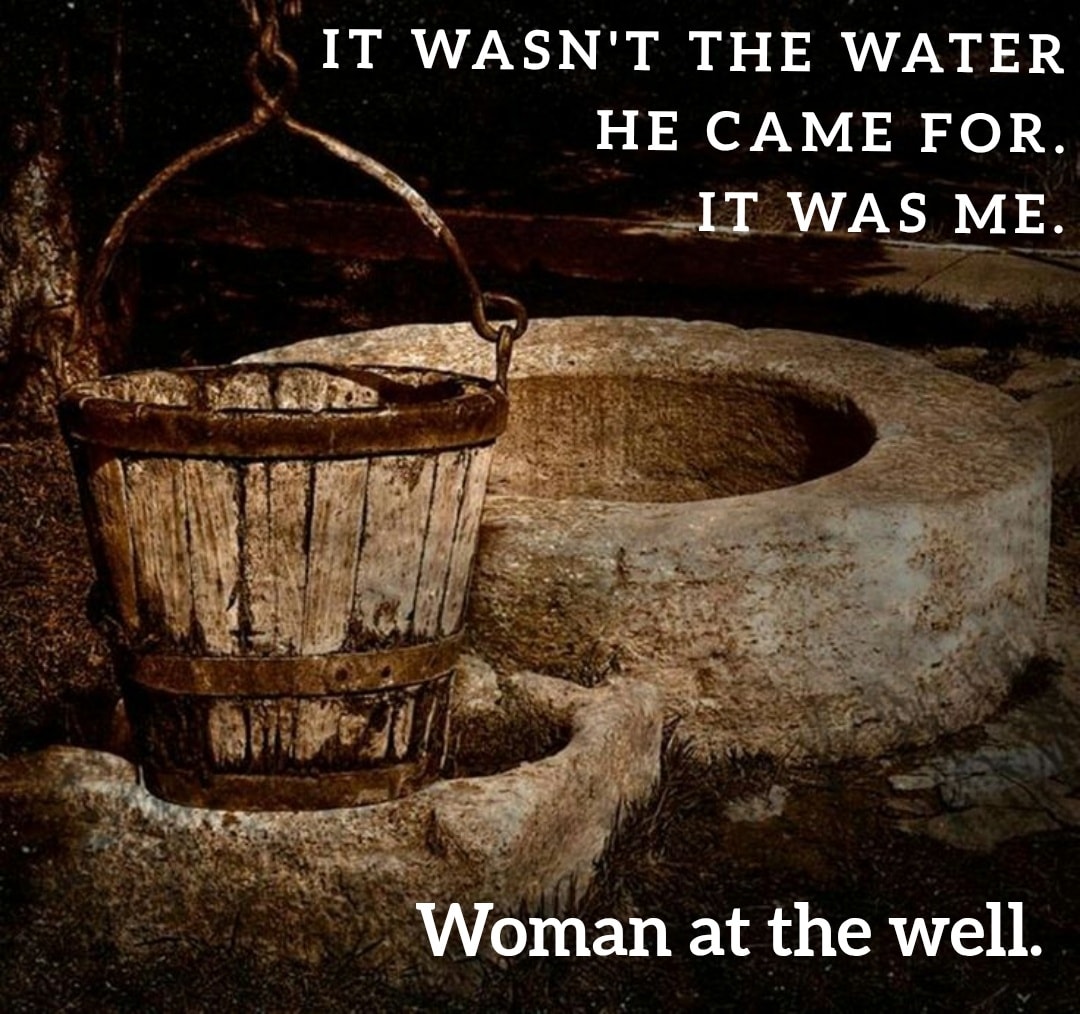 4:28 Beyond displaying the woman’s excited state of mind, her action of leaving her water jar beside the well as she went back to the village has several significant explanations: On the one hand, it speaks of the woman leaving behind her water jar representing her thirst for true life and satisfaction; on the other hand, it also reveals her intention to return. The water jar was a valuable and practical household object. But as useful as it was to get water from the well, it was useless for obtaining the water of life. However, she had just met someone who promised living water and who had displayed intimate knowledge of her life and profound understanding of spiritual truths. We can’t be sure how much she understood of what Jesus had told her, but she was convinced that everyone in town ought to hear what he had to say.
4:29-30 In essence, the Samaritan woman was saying that Jesus could have told her everything about her life, for in telling her about her relationships with various men, he revealed his knowledge about her history. She made no promises about what Jesus might know about everyone else, but she appealed to their curiosity. What was it about this stranger that could make a woman who had every reason to be ashamed of her life now speak publicly about her experience of transparency before him? Yet she said to the townspeople, “Can this be the Messiah?” Her invitation proved irresistible. She probably knew that her reputation preceded her, and any assertion on her part regarding her belief in this man would go unheeded. But her question did serve to stir up curiosity and had the desired effect—the people came streaming from the village to see him.
*LIFE APPLICATION: WHAT TO LEAVE BEHIND
When we return to the world of family and friends after encountering Jesus, there are two kinds of “water jars” we must leave behind:
- We must leave behind our shame about the past. Because Jesus knows all about us, we can repent and receive his forgiveness. God may use the emptiness of our past life to help us convey to others the wonder of forgiveness. But we must not dwell on or carry guilt about the past.
- We must leave behind some habits and pleasures. Certain pleasures and relationships (not bad in themselves) may hinder our telling others about Christ. The water jar would have slowed the woman down. She probably retrieved it later, but was not concerned about it in the light of her discovery.
Message Audio/Video and Outline: https://upwards.church/leander-campus/watch-now-message-videos
Watch Messages: YouTube-Upwards Church
Read Along Daily Bible Reading: You Version
Sources:
— Life Application Bible Commentary
— Life Application Concise New Testament Commentary


