1 John Overview

“A GOOD man… yes… perhaps one of the best who ever lived… but just a man,” say many. Others disagree, claiming that he suffered from delusions of grandeur—a “messiah complex.” And the argument rages over the true identity of this man called Jesus. Suggestions have ranged from “simple teacher” to “egomaniac” and “misguided fool.” Whoever he was, all would agree that Jesus left his mark on history.

Hearing these discussions, even Christians can begin to wonder and doubt. Is Jesus really God? Did he come to save sinners like us? Does God care about me?

First John was written to dispel doubts and to build assurance by presenting a clear picture of Christ. Entering history, Jesus was and is God in the flesh and God in focus—seen, heard, and touched by the author of this letter, John the apostle. John walked and talked with Jesus, saw him heal, heard him teach, watched him die, met him arisen, and saw him ascend. John knew God—he had lived with him and had seen him work. And John enjoyed fellowship with the Father and the Son all the days of his life.

The elder statesman in the church, John wrote this letter to his “dear children.” In it he presented God as light, as love, and as life. He explained in simple and practical terms what it means to have fellowship with God.

At the same time, false teachers had entered the church, denying the incarnation of Christ. John wrote to correct their serious errors. So John’s letter is a model for us to follow as we combat modern heresies.

John opens this letter by presenting his credentials as an eyewitness of the Incarnation and by stating his reason for writing (1:1-4). He then presents God as “light,” symbolizing absolute purity and holiness (1:5-7), and he explains how believers can walk in the light and have fellowship with God (1:8-10). If they do sin, Christ is their advocate (2:1, 2). John urges them to obey Christ fully and to love all the members of God’s family (2:3-17). He warns his readers of “antichrists” and the Antichrist who will try to lead them away from the truth (2:18-29).

In the next section, John presents God as “love”—giving, dying, forgiving, and blessing (3:1-4:21). God is love, and because God loves us, he calls us his children and makes us like Christ (3:1, 2). This truth should motivate us to live close to him (3:3-6). We can be sure of our family relationship with God when our lives are filled with good deeds and love for others (3:7-24). Again, John warns of false teachers who twist the truth. We should reject these false teachers (4:1-6) as we continue to live in God’s love (4:7-21).

In the last section, John presents God as “life” (5:1-21). God’s life is in his Son. To have his Son is to have eternal life.

Do you know God? Do you know Christ? Do you know that you have eternal life? First John was written to help you know the reality of God in your life through faith in Christ, to assure you that you have eternal life, and to encourage you to remain in fellowship with the God who is light and love. Read this letter written by one overwhelmed by God’s love, and with renewed confidence, pass on his love to others.

Vital Statistics

Purpose: To reassure Christians in their faith and to counter false teachings

Author: The apostle John

Original Audience: The letter is untitled and was written to no particular church. It was sent as a pastoral letter to several Gentile congregations.

Date Written: Probably between A.D. 85 and 90 from Ephesus

Setting: John was an older man and perhaps the only surviving apostle at this time. He had not yet been banished to the island of Patmos, where he would live in exile. As an eyewitness of Christ, he wrote authoritatively to give this new generation of believers assurance and confidence in God and in their faith.

Key Verse: “I have written this to you who believe in the name of the Son of God, so that you may know you have eternal life” (5:13).

Key People: John, Jesus

Special Features: John is the apostle of love, and love is mentioned throughout this letter. There are a number of similarities between this letter and John’s Gospel—in vocabulary, style, and main ideas. John uses brief statements and simple words, and he features sharp contrasts—light and darkness, truth and error, God and Satan, life and death, and love and hate.

The Blueprint

  1. God is light (1:1-2:29)
  2. God is love (3:1-4:21)
  3. God is life (5:1-21)

John wrote about the most vital aspects of faith so that his readers would know Christian truth from error. He emphasizes the basics of faith so that we can be confident in our faith. In our dark world, God is light. In our cold world, God brings the warmth of love. In our dying world, God brings life. When we lack confidence, these truths bring us certainty.

MEGATHEMES
THEME EXPLANATION IMPORTANCE
Sin Even Christians sin. Sin requires God’s forgiveness, and Christ’s death provides it for us. Determining to live according to God’s standards in the Bible shows that our life is being transformed. We cannot deny our sin nature, maintain that we are “above” sinning, or minimize the consequences of sin in our relationship with God. We must resist the attraction of sin, yet we must confess when we do sin.
Love Christ commands us to love others as he loved us. This love is evidence that we are truly saved. God is the Creator of love; he cares that his children love each other. Love means putting others first and being unselfish. Love is action—showing others we care—not just saying it. To show love we must give sacrificially of our time and money to meet the needs of others.
Family of God We become God’s children by believing in Christ. God’s life in us enables us to love our fellow family members. How we treat others shows who our Father is. Live as a faithful, loving family member.
Truth and Error Teaching that the physical body does not matter, false teachers encouraged believers to throw off moral restraints. They also taught that Christ wasn’t really a man and that we must be saved by having some special mystical knowledge. The result was that people became indifferent to sin. God is truth and light, so the more we get to know him, the better we can keep focused on the truth. Don’t be led astray by any teaching that denies Christ’s deity or humanity. Check the message; test the claims.
Assurance God is in control of heaven and earth. Because his word is true, we can have assurance of eternal life and victory over sin. By faith we can be certain of our eternal destiny with him. Assurance of our relationship with God is a promise, but it is also a way of life. We build our confidence by trusting in God’s Word and in Christ’s provision for our sin.

www.Upwards.Church

Watch Messages: YouTube-Upwards Church

Facebook: Upwards Church

Source: Life Application Study Bible, (Wheaton, IL: Tyndale, 1988), WORDsearch CROSS e-book, 2143-2144.

Posted in Hold Fast (1, 2, 3 John & Jude) | Tagged , , , | Leave a comment

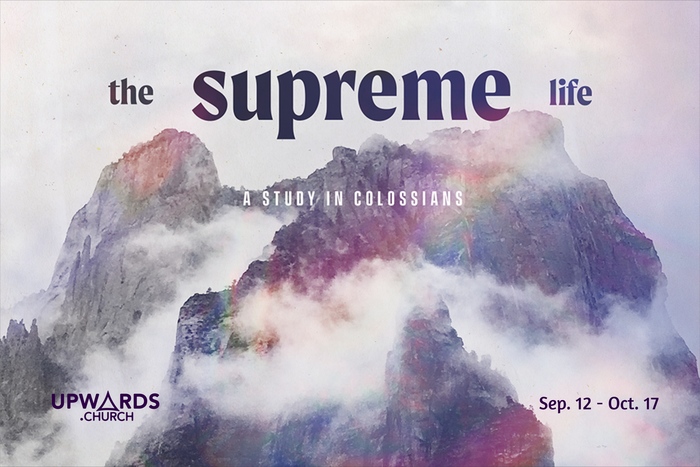
Supreme Relationships – Colossians 3:18- 4:1

Today we’re going wrap up our study in the book of Colossians. We’ve seen who Jesus really is:  that He is supreme, eternal, the creator, sustainer and He is all we need for salvation and spiritual growth. Then we looked at how to live our new life in Christ.

Why would you have a new life in Christ and the same old things keep going on?  Today we’re going to take a look at some of the most vital things in our lives, our relationships.  Doesn’t it make sense that if I have a new life in Christ things will change in our relationships?

The great thing about this passage is it gives us guidance on our closest relationships.  Be careful to not think about what this says about somebody else.  Listen to what it has to say to you.

New relationships mean I make the choice to be loving not selfish.

There are three family relationships that Colossians talks about beginning in 3:18.  The first couple we’re real familiar with – wives and husbands, and children and fathers, but all the time in the Bible when it talks about families it talks about servants and masters.  Why?  It does it in Ephesians and 1 Peter.  Why does the Bible do that?

In that day the house servants or slaves were a part of the family.  In the Roman Empire of that day there was just about as many slaves in the Empire as there were people who were not slaves.  Every person had a slave and these people were a part of the family.  They were there in the household.  So part of Christian relationships was how do I relate to all the relationships in my life. Today we can apply these to employer and employee relationships.

Let’s get some key words in each of these areas that make these relationships work.  That’s what this passage is based on.

A key word for wives that the Bible uses is submit.”  Submit has the idea of unselfish love.  But the Bible word is the word “submit”.  That’s gotten a lot of bad press lately.  The idea of submission to somebody else who tells me what to do who doesn’t really care about me, they’re always ordering me around is not the biblical idea of submission.  In fact, the idea is no one can force it on you.  It has to be something that you choose in your life.

So when the Bible says, “Wives submit to your husbands” there’s four truths about submission.

  1. Submission does not cancel out our equality. Any time the Bible tells you to submit to somebody else it doesn’t mean you’re therefore unequal with them.  Here’s the greatest proof of that.  In the book of Hebrews the Bible tells us that Jesus submitted Himself to the Father.  Are the Father, the Son and the Holy Spirit equal?    Our whole faith is built on that.  Jesus made the willing choice to submit Himself to the Father in some areas.  So it doesn’t mean you’re not equal.  The Bible tells us we are equal, equal partners in grace.
  2. Everyone is to submit in some way or another. This isn’t just for women, just for wives.  Every one of us have relationships in which we have to submit to other people.  That’s the way that life works.  In fact, some of the ways you and I have to submit: to the governing authorities, believers submit to fellow laborers in Christ, we’re all commanded to submit to one another in Christ, wives to husbands, Jesus submitted to the Father, believers submit to the Father, as Christians we submit to God, angels submit themselves to Jesus it says in the Bible, believers to spiritual leaders, young men to older men.  The Bible says those are all relationships of submission.  It’s not a one way thing that we talk about a lot of times.
  3. Submission doesn’t mean disobedience God. A lot of people think if you’re really submissive you have to do whatever they say.  Not true, God is our highest allegiance.  There’s an interesting story about this in Acts 4 when they told the disciples they had to stop preaching the gospel.  They said, “We’ve got to do it.  So if you have to punish us, punish us.  But we’ve got to do it.”  It’s a great story because it said we have to obey God but we still respect you.  Sometimes when somebody says you have to disobey God whether it’s a governing authority or husband or wife, instead of saying, “No, I have to obey God,” we get real resistant.  We get resistant to the point of bitterness.  And somehow the early disciples were able to say, “We realize you can throw us into jail but we have to do what we have to do.”  They said they’re going to obey God but they still respected those people who were authorities in their life.   Sometimes we have to do that in our lives.
  4. Submission is voluntary. Husband, anytime you say to your wife, “You have to submit to me!” it’s not going to work.  Does that work with any of us?  You can’t impose submission on somebody, a willing choice to respect somebody else.  You can’t impose that.  It says “Wives, submit yourself to your husbands.”  It doesn’t say, “Husbands, get your wives to submit themselves to you.”

The real key of submission in marriage (Ephesians talks a little more about it) is there’s a leadership responsibility that husbands have that they don’t take sometimes.  There’s a need to let them take that responsibility before God.  I like this definition of submission:  “Submission is the wife ducking out of the way so God can hit her husband.”  There’s some deep spiritual truth in that.

The key word for husbands is “love”.  Guys – love, not make love.  Somebody said that marriage is when you agree to spend the rest of your life sleeping in a room that’s too warm beside someone who’s sleeping in a room that’s too cold.  We’re very different from each other.  Love and respect for each other are incredibly important.  Paul’s just saying, Let’s just lay it out here: If you’re a new person here’s the new kind of relationships that you’re going to have.  You’re going to be able to respect somebody like you never have before because you’ve got the strength of the love of Christ in your life.  You’re going to be able to love someone, guys, sacrificially, like you never have before because you’ve got the strength of Christ in your life.  Are you going to be perfect at it?  No.  You’re going to work the rest of your life at that.  But we’re growing in it.

I like what Paul says as he talks about the love that husbands express.  He points to the fact that especially as you’re expressing love you should not be harsh.  That’s where the Bible is honest.  He says it’s easy to be harsh sometimes – it’s the end of the day and you’re tired and the conversation is going on and on and you know how you can stop it real quick so you do.  Or you’ve got the logical answer – “Here it is, just do it!  Why talk about it any more?  Just do it!”  It’s so easy to be harsh.  The Bible says that one of the keys to expressing love is not be harsh.

A survey was done by a couple of psychologists who studied newlyweds over the first decade of their marriage.  They discovered that couples who stayed together uttered five or fewer put-downs in every hundred comments to each other.  But couples who inflicted twice as many verbal wounds, ten or more in a hundred comments, were later much more likely to split up.  That makes sense.  There’s something about our words that build our relationships in very powerful ways.

On the positive side of that, I read a survey where some German physicians and psychologists got together and did a study of what happened with men who kissed their wives right before they left their house each day and men who just walked out.  The study found out that those who kissed their spouse each morning missed less work because of illness.  They had fewer auto accidents on the way to work.  They earned ten to thirty percent more monthly.  And they lived about five years longer than those who don’t at least get a peck on the cheek on the way to work.  It couldn’t hurt!  What they concluded from the study was that simple encouragement that says,  “We love each other,” made an incredible difference in people’s lives.

So just the gentleness of words and the actions towards one another of love is a real key.

My favorite advice to read when it comes to marriage is not from psychologists.  A lot of psychologists have been divorced multiple times, what do they know? But whenever I see “On their golden wedding anniversary they said…” that’s the advise that I want to read.  If somebody can stick together for fifty years.  I read this one this week.  Somebody asked a grandmother on her golden wedding anniversary the secret of a long and happy marriage.  She said, “On my wedding day I decided to choose ten of my husband’s faults which for the sake of our marriage I would overlook.”  One of the guests said, “Can you tell us one of the ten that you had?”  She said, “To tell you the truth I never did get around to listing them.  Whenever my husband did something that made me really mad I’d say to myself, ‘Lucky for him that’s one of the ten!’”

It’s the little things that count in relationships.  It’s the little things that change my attitude – this willingness to submit to another, this willingness to sacrificially love another person.

What’s the word for kids?  “Obey”.  The Greek word “obey” literally means “to hear under someone.”  That means to obey someone you have to listen to them.  We sort of intuitively know this with our kids.  They don’t listen to us so they can’t obey us.  We’ve all had this conversation.  “Can you take out the garbage?”  Ugh!  Did they hear you?  No.  Then they can’t obey.  Obviously the Bible here says “Children, you have a responsibility to obey,” but this is saying to you and I we have the responsibility to make sure that they hear.  If obedience means you listen under somebody, if we don’t say it in the way they can hear it, we don’t give them the opportunity to be obedient.

Here’s the key word for fathers.  It doesn’t say anything necessarily about mothers.  This could be said to both parents, I think.  The key word: don’t.  Both here and Ephesians it says, Dads, there’s some things that we do that we shouldn’t do that irritate our kids.  As a dad there’s some things I do that irritate my kids.  Don’t exasperate your children, it says in Ephesians 5.  Don’t embitter your children. Three things that tend to really exasperate kids from fathers.  This is particularly to dads.  Moms, you might fit into this too but this is particularly to us dads.

  1. Avoid insulting them.  It’s easy to say an insult but there’s something about our words as dads that carry greater weight than we realized.  Instead of words of insult, obviously our kids need words of encouragement.  That doesn’t mean you can’t ever be negative.  Sometimes something negative happens but it’s so easy to share words of insult.
  2. Avoid ignoring them.  This is probably the one we do the most.   That is one of those things that exasperate them.  Maybe the practical thing is to make a date with one of your kids this week, one that you’ve been ignoring.  The easiest one to ignore is the on that’s most like you.  They irritate you the most because they’re most like you.  We have our favorites and they’re usually not the ones that are most like us.
  3. Avoid indulging them.  Because we’ve ignored them we feel we have to indulge them with stuff.  We think that giving them gifts, toys, or electronics will cancel out the time we missed.  Material things are a poor substitute for our presence.

What do they really want from us?  They want our time.  They want our encouragement.  And dads, if you haven’t said, “I love you,” to your kids today you need to.  Maybe you say, “My dad never said that to me!”  You can break that pattern and teach your sons and daughters to say that to their kids.  They need that.

A key word for servants that comes up again and again in this passage is the word “master”.  How does this relate to us?  If you and I are going to have a relationship with the boss and we’re reading this passage that says treat them as your master how would your boss react if you came in and called him “master”?  Some of your bosses would really like it.  Obviously for us Christians we have only one master or Lord and that’s Jesus.  But there’s really an attitude of who you’re really working for here.  We don’t work for a boss as the master of our lives.  We work for the Lord Jesus Christ as the lord of our lives.  That’s why this says again and again don’t do your work for anyone else.  Work as for the Lord Jesus Christ whom you’re serving.  Don’t do it to please other people.  Do it to please the Lord Jesus Christ.  Wherever you are, whatever you’re doing you’re working for the Lord Jesus Christ.

Colossians talks about the attitude that you and I do that with.  I like some of the words he uses.  If I’m going to work for this person and yet my attitude is really towards the Lord what should my attitude be?  Verse 23 “Whatever you do work at it with all your heart as working for the Lord not for men since you know that we will receive an inheritance from the Lord as a reward.”  There’s some good news.  The pay that you’re getting at your work, that’s not the only benefit that comes.  That’s good news isn’t it?  We receive a reward from the Lord also.

Then he goes on and says, “It’s the Lord Christ whom you are serving.”  Verse 22 “Servants obey your earthly masters in everything and do it not only when their eye is on you to win their favor but with sincerity of heart and reverence for the Lord.” 

This is a Bible study tip: Sometimes when you’re doing Bible study, sometimes you learn just as much by studying what the English words mean as Greek words.  The word “sincere” in our language comes originally from the Latin language.  It came from a habit that they used to have when they made marble.  Marble was very difficult to polish without all the machinery that we have today.  So instead of going to all the work to polish the marble, oftentimes they’d put this wax on the marble that would cover all the blemishes and scratches that might be on it and make it look as smooth as glass like polished marble.  But when it got out in the heat, the wax would melt and you’d see all the blemishes.  Marble that didn’t have the wax on it, that had been polished smooth was “without wax”.

The Bible says that you and I should serve with a sincere heart, genuine, “without wax,” not faking it.  The only way to do that is to have a genuine relationship with Christ even at work.  How are you going to serve the Lord at work if you’re not thinking about Him at work?  How is He going to be your boss if He’s not on your mind all the time?  That’s the great benefit that comes out of this.

The key word for masters – you who are  “masters”, bosses, company owners, here’s the key word for you – “provide.”  As a believer in Christ you’re responsible to provide for your workers in the best way that you can.  With excellence.  Not to be excessive, not to do things that are outside the bounds of reason but the best way you possibly can.  That’s one of the things the Bible teaches us about our relationships.

There’s really a single word behind all this – “unselfish love.”  That’s the attitude I have in all my relationships.  This is what makes them work.  Christ loved us, we should love others. That’s how to have supreme relationships.

Darrell

www.Upwards.Church

Watch Messages: YouTube-Upwards Church

Facebook: Upwards Church


Posted in Supreme Life - Colossians | Tagged , , , , , , , , , | Leave a comment

Supreme Living – Colossians 3:1-10

We’ve turned the corner in Colossians 3.  These two chapters – Colossians 3 and 4 are in many ways the ways you live out the truth that were taught to us in Colossians 1 and 2.  Much of the New Testament is that way.  First half of the letter is “Here’s the truth,” and the second half of the letter is “Here’s how to live it out.

What we have to realize is that it’s no good being able to declare the truth and defend the truth if you can’t demonstrate the truth.  What’s the use of somebody saying, “I know that’s right and that’s wrong,” if they can’t show it in their lives?  Because that’s how God changes the world.  There’s a lot of Christians out there who are real good at chapters 1 and 2 of Colossians but not as good at chapters 3 and 4.  I don’t want to be like that.  I want to spend my life finding out what the truth is and then living it out.  Both of them are incredibly important.

How do we start to live out this truth of being a new person?  Colossians 3, the first eleven verses tell us.  How can I be a new person in Christ?

Get “Set”

Colossians 3:1    “Since then we’ve been raised with Christ, set your hearts on things above where Christ is seated at the right hand of God.  Set your mind on things above not on earthly things.”  Set your heart and set your mind.

Remember, “On your Mark! Get SET!…”.  In a race the runner knows where they start, which lane they are running, where they are running, what they are running for and that they run to a finish line.  We too, must “set our hearts,” (emotionally), “set our minds” (mentally) and we will see that we are physically and spiritually involved as well!     A lot of times we think, “now that I’m a Christian it’s all up to God.”  He’s going to perfect a good work in me.  And, yes, He is working to do it.  But we must also “set our hearts and set our mind.”

That means that both our affections and our thoughts are involved in our growth.  Our affections – what I really enjoy, really love.  And our thoughts.  Our heart shapes our passions, our thoughts shape our priorities.  They’re both involved and they’re both important.  It’s affection (what you really love) plus thoughts (what you really think about all the time) equal action, what you really do.  That’s what God’s really interested in: what we think, what our heart’s after and what we do.

How do you do that?  Why do we do that?  Paul goes on to give us some very practical advice about this.

Set your heart and set your mind so you can grow… where?  “Set your heart on things above.”  What does that mean?  It means that you and I start to think about life like God thinks about life.  It means that you and I start to see things in this world from His perspective in a brand new way.

What He asks us to do is get our mind off the “earthly,” that means the world’s way of thinking about things.  The world has a way of thinking about things that’s a little bit different than God’s way of thinking about things.  Material things: does the world think differently than God?  Sex: does the world think differently than God?  You could go right down the list of everything’s that important to us.  God has a different way of thinking about it.

Paul says if you really want to start to grow “set your mind” on God and His way of thinking about things and not on the world’s way of thinking about things.

What is the “Spiritual Compass” in our lives?   CHRIST

He says where you set it “where Christ is seated at the right and of God.”

When I set my mind above, I’m setting my mind on a throne where Christ is seated.  A throne is a place of authority.  God sits in a place of authority.

When I set my mind on things above it reminds me that no matter what happens God is in control.  Do you need to be reminded of that this week?  It reminds me that no matter what I’m facing in my life God has the power to make a difference.  Setting my mind on God’s throne in heaven is setting my mind on a different kind of authority.  It’s a place of both authority and security.  I need that in my life.  Sometimes it feels like the world’s kicking us around.  We need a place of authority where we recognize that God’s power and not mine can make it through everyday life.  And I need a place of security where I realize that no matter what, I know that Christ loves me.

How do we do this?   Paul gives us some ideas.

What power is there to help set them?

The power to do it is found in one word and this has to be our focus.  “Since then you’ve been raised with Christ set your mind on things above.”  The one word is Resurrection.  The power to do it is to realize that when I became a believer in Christ that I share His resurrection life now.  I’ve got a brand life.  We have the power to live a new kind of life.

Think about Jesus and what He did, the kind of person that He was, the kind of life that He lived.  What do you really admire about Him?  The way He treated people?  The boldness He had in difficult situations?  What is it about Jesus that you admire?  The way that He prayed?  What is it that really captures your heart about Jesus Christ?  We say, We share the resurrection life of Jesus Christ, the Bible’s teaching us that you and I can start to share in those very things.  We can’t become God.  We can’t become Jesus.  But He wants to share His character, His power with us.  It doesn’t happen overnight.  It happens step by step as we’re going to see.  But He wants to change our lives.  He wants to make us new people.

Colossians 3:3 says, “For you have died…”

There’s a couple who came to know Christ.  They had gone to a lot of wild parties before they were Christians.  They decided they shouldn’t do that.  They got an invitation to one of those parties.  They sent back “We regret that we cannot attend because we recently died.”  There’s just a change that happens in our lives.

3:3 For you died, and your life is hidden with Christ in God.  I’m going to quote New Testament Scholar Bruce Barton here:  “The Greek aorist tense in the phrase, for you died connotes that we died when Christ died. It happened at a point in history. In Christ’s death, all believers died.  Like a seed buried in the earth, believers’ real lives are hidden from the world, just as Christ’s glory is hidden, only to be revealed when he returns.  The spiritual lives of believers are hidden inner lives that are in union with Christ who has brought them to be with him in God. Their new life is a mystery, a secret.

Paul often wrote about how believers already possess the life of Christ, having died and risen with him, yet do not fully possess the perfection and eternal body they will have upon Christ’s return. In the meantime, they are “not yet.” That their lives are “hidden” means they are concealed and safe, hidden from public view. Just as Christ’s glory was real but hidden until the Mount of Transfiguration, so we have a glory that is hidden and will be revealed when Christ returns. This is not only a future hope; it is an accomplished fact. Believers’ salvation is sure, so they are to live each day for Christ and in expectation of his promises.”[i]

One of the stories from war history comes from Napoleon.  He had a favorite horse.  One day his horse got away.  It was running towards the enemy lines.  A private ran after the horse, risking his life, jumped on it and brought it back.  When the private got off the horse, Napoleon shakes his hand and says, “Thank you, Captain!”  This Private immediately went back to his barracks, took everything out, moved into the officers’ quarters, took off the Private clothes that he had, changed into a Captain’s uniform and began ordering men around.  He completely changed everything about who he was because of what one person said.

Everything about you and I changed because of what you and I did, what Jesus Christ did.  it takes a little while to catch up with it.  It doesn’t happen overnight.  But don’t let the fact that it isn’t happening overnight fool you into believing that it’s not real because it is.  You are a new person in Jesus Christ if you trust Him.  Because of that new life in Christ we’re dead to sin.  You’ve experienced this somewhat already as believers.  The things that used to bring you joy, the things that used to be really something you looked forward to, they don’t bring you a moment’s joy now.  But there are new things that bring you joy.  Why?  Because you’re a different person.  Not just different beliefs but because you’re a new person in Jesus Christ.

 Live for Christ, not our Earthy Nature

What part of the earthy nature needs to die?  Paul gives a quick list.  Here’s a list of some of the things I want to put to death by recognizing I’m not alive to those things any more.  I’m alive to God in Jesus Christ.

Two sets of sins are listed. The first five refer to sexual sin; the second five to sins of speech. These first five were related to the cultural background of the Colossians and were particularly deadly to the life of the church.  Here’s more from Dr. Barton:

Sexual immorality (porneia). Any form of illicit sexual relationship. The term serves to spotlight forbidden sexual behavior between people or indirect participation as an audience. We derive our term “pornography” from this Greek word. In contrast to the loose morals of the ancient Greek world, believers ought to show self-discipline and obedience to God in this area.

Impurity (akatharsia). Moral uncleanness. Perhaps no sexual act has taken place, but the person exhibits a crudeness or insensitivity in sexual matters. Like the other characteristics mentioned on this list, impurity points to activities before knowing Christ and should have no place in a believer’s life.

Lust (pathos). Evil sexual passion that leads to excessive sexual immorality and perversion.

Evil desire (epithumia). Wanting something that is sinister and vile in order to satisfy one’s desires. Sinful human nature cannot help but have evil desires. Thus Paul admonished the Colossian believers to get rid of the evil desires that could easily control them and which had been part of their lives before Christ.

Greed [pleonexia] (which is idolatry) Relentless urge to get more for oneself. In this context, Paul may have been focusing on greed for satisfying evil desires and for sexual immorality. The greed is described as idolatry because its focus is on filling desires rather than on God.

He gets a little bit more practical about some of these things.  Why do we put these attitudes to death?  Why is it so important?  Verses 6 and 7 “Because of these the wrath of God is coming.  You used to walk in these ways in that life that you once lived.”

3:6 On account of these the wrath of God is coming. The wrath of God refers to God’s judgment on these kinds of behavior.  The final culmination of God’s wrath is coming—with future and final punishment of evil. People may try to get around it, but there is punishment for evil for those who have not believed in Christ as Savior. This wrath is described in other references:

  • Whoever believes in the Son has eternal life; whoever disobeys the Son will not see life, but must endure God’s wrath” John 3:36.
  • But by your hard and impenitent heart you are storing up wrath for yourself on the day of wrath, when God’s righteous judgment will be revealed” Romans 2:5
  • When the Lord Jesus is revealed from heaven with his mighty angels in flaming fire, inflicting vengeance on those who do not know God and on those who do not obey the gospel of our Lord Jesus. These will suffer the punishment of eternal destruction, separated from the presence of the Lord and from the glory of his might2 Thessalonians 1:7-9
  • “Anyone whose name was not found written in the book of life was thrown into the lake of fireRevelation 20:15

Two reasons to put these things to death.

  1. We should put them to death because they hurt the heart of God. God takes sin very personally.  It hurts His heart because He knows what it does to His children.  Don’t you take personally anything that hurts your kids?   God does too.
  2. They no longer fit who we really are. We’re not those people anymore. He goes on and says, “You used to walk in these ways.  That’s the life that you once lived.  But you’re different people now.”

Here’s the practical strategy:

3:8 But now you must get rid of all such things

It’s like taking out the garage. We must get rid of some things. “Get rid of” means to put off or disrobe. The old, filthy clothes must be taken off before the new clothes can be put on. The believer “removes” the old life of sin and “puts on” the new life of Christ. Not only did they need to deal with sexual immorality in all its variations, they also needed to deal with misused anger that often spilled over into evil speech.

Here’s another list of natural behaviors that need to change:

Anger (orge). A continuous attitude of hatred that remains bottled up within. This could refer to what is under the surface, while “rage” (below) refers to what bursts out.

Rage (thumos). Outbursts of anger or quick temper for selfish reasons. This could mean continual and uncontrolled behavior.

Malice (kakia). Doing evil despite the good that has been received. This word is a general term referring to an evil force that destroys relationships. It can mean anything from trouble to wickedness. It is a deliberate attempt to harm another person.

Slander (blasphemia). Destroying another person’s good reputation by lies, gossip, spreading rumors, etc. Malice often manifests itself through slander. From the Greek word we get our word “blasphemy,” a term used to describe speaking against God. The Greeks used the word for defamation of character. Again, this destroys human relationships.

Filthy language (aisxrologia). Crude talk, abrasive language, expletives. Paul admonished the believers that such language must be caught and stopped before it escapes their mouths.

These behaviors have no place in any Christian or in any church. These are part of the “old life” before knowing Christ. Christians must resolutely “put off” these repulsive sins of anger and speech so that they can “put on” Christ’s attitudes and actions.

Sometimes Christians and churches fall into the trap of concentrating on one of these lists to the exclusion of the other. Some churches might be horrified at sexual sin in the congregation, all the while ignoring backbiting and gossip. On the other hand, some churches want so much to keep peace and quiet that they will not confront sin, even sexual sin. But Paul doesn’t leave room for any such behavior. The believers were called to get rid of it all.

 10 and have put on the new self, which is being renewed in knowledge in the image of its Creator.

The truth is you’ve got to put off before you put on usually.  When your kid comes in and they’ve been playing out in the mud and you tell them, “Go put on some new clothes.”  What if they go upstairs and they just get some new clothes and put them on over the muddy clothes.  That’s not the way to do it.  You’ve got to take off and then put on.

Growth in my life is an ongoing process:  Put off the old.  Put on the new.

Think about a little baby – 9 -14 months old – getting ready to take it’s first steps.  It’s ready to go.  The baby takes one step, then other step, says “Wow!  I did it!” then sits down the rest of his life and never takes another step.  You and I – it’s a continual journey of steps. We will fall down, we will get dirty and need to change.   If you want to walk the daily life with Christ, you put off the old, put on the new.  Then you repeat it: put off the old, put on the new.  Then you repeat it: put off the old, put on the new.

Because of Christ, we’re able to say, “God made me a new person in Christ and it changed my life.  The cross changed my life.  It changed who I am at the minute of salvation.  It means I’ll spend eternity with God in heaven.  It’s also changing my life everyday as I look to Him and have faith in Him and become more what He wants me to be.  It’s a lifetime process.

Darrell

www.Upwards.Church

Watch Messages: YouTube-Upwards Church

Facebook: Upwards Church

[i] Bruce B. Barton et al., Life Application Bible Commentary – Philippians, Colossians, & Philemon, (Wheaton, IL: Tyndale, 1995), WORDsearch CROSS e-book, 205-206.


Posted in Supreme Life - Colossians | Tagged , , , , , , | 1 Comment

Supreme Freedom – Colossians 2:8-21 – Part 2

In the last post we looked at the fact that we can be captured, kidnapped or hauled away by deceptive, hollow, human philosophy.  These along with  legalism, mysticism and asceticism will take away our freedom and put us in a bondage of:  following rules, praying to spirits and angels, and harming our bodies.

In today’s post we will see that we also have:

Freedom from Sin and Death

11 In him you were also circumcised, in the putting off of the sinful nature, not with a circumcision done by the hands of men but with the circumcision done by Christ,
12 having been buried with him in baptism and raised with him through your faith in the power of God, who raised him from the dead. 13 When you were dead in your sins and in the uncircumcision of your sinful nature, God made you alive with Christ. He forgave us all our sins, 14 having canceled the written code, with its regulations, that was against us and that stood opposed to us; he took it away, nailing it to the cross. 15 And having disarmed the powers and authorities, he made a public spectacle of them, triumphing over them by the cross
Colossians 2:11-15

External Circumcision Vs. Internal Circumcision.

The Jews had a really hard time believing that the Gentiles didn’t have to be circumcised.  The Jews, because they had for centuries lived a certain way, circumcision was a part of life, it’s what it meant to be a Jew, to believe that the Gentiles didn’t have to go through that ceremony was very hard for them to accept.  So many of them wanted to continue to have the Gentile believers, if they were going to be Christians, be circumcised first.

Circumcision symbolized an external sign of a covenant between God and Israel, it showed the Jews that the Gentiles were different from them.  They had a physical sign that showed that she was different than all the other nations in the world at that time.  Even though the early church finally decided that the Gentiles didn’t have to become circumcised to become Christians there were obviously some people who were still trying to make Gentile believers be circumcised.

Galatians 6:15 “Neither circumcision nor uncircumcision means anything; what counts is a new creation.

Here Paul speaks to this idea that it’s not the external that matters but what happens in the heart.  It was always that way.  God had the Jews be circumcised externally but just because you were circumcised externally did not mean hat you were a true believer in the Messiah.  God was always asking them to have their heart circumcised, to love Him, to obey Him, to serve Him.  And Paul contrasts that here.

Paul said that is no good!  Verse 11 “In Him you also were circumcised in the putting off of sinful nature not with the circumcision done by the hands of men but with the circumcision done by Christ.  Having been buried with Him in baptism and raised with Him through your faith in the power of God who raised Him from the dead.”

Circumcision in this passage represents the cutting away of our carnal nature and we see this in Jesus’ death on the cross.  When He died He was cast out, He was cut away from God and all of human efforts ceased.  No longer any reason to try by human effort because Jesus took care of it on the cross.  He pictures that on the cross.

Then He goes into baptism and says baptism is the new outward symbol of our internal faith in Christ.  That we have a new life in Christ that allows us to have that circumcision of the heart that’s always been there for us.  It gives us that new heart that’s able, has the capacity to love God, to obey Him and to serve Him.  We have that new circumcision of the heart that gives us the ability to love God.

The Legal Code Condemned Us. 

The next set of contrasts in this passage was a legal code.  Verse 14 “Having canceled the written code with its regulations that were against us and that stood opposed to us, He took it away and nailed it to the cross.  And having disarmed the powers and authorities He made a public spectacle of them triumphing over them by the cross.”  This third comparison we see was the Law of Moses, a legal code and it condemned us.  But the contrast is that Christ doesn’t condemn us.  He forgives us.

Most Christians tend to think of the law as bad.  The law is Old Testament and grace is New Testament.  But the law had a planned purpose by God that was good.  In Galatians 3:24 it says, “The law was put in charge to lead us to Christ that we might be justified by faith.”  The Bible says that the purpose of the law was to tell us God has standards and lays them out very clearly.  The law also tells us the penalty if you break one of those laws.  And it also points out the impossibility of any one of us keeping that law perfectly.  It shows us that we need a savior.  The law had a purpose that God used that was very effective.

The thing about the law that caused the problem here is that the law did require perfection.  Absolutely.  The law says you must keep this law perfectly every day of your life or you will stand condemned.  But I have a real hard time being perfect no matter how hard I try.  So every one of us stand condemned by this law that requires perfection.  None of us can live up to it.  It was God’s standard, it’s the way it had to be, but we all stand condemned by it.

But the contrast is what Jesus did with that condemnation.  What it says in verse 14 that He did is He canceled the written code that was over us.  We deserved the condemnation.  We are imperfect.  We have broken God’s laws.  So we stand condemned.  He took that and He did something different with it.  Verse 14 “When I was dead (and here’s another contrast) in the uncircumcision of my sinful nature He made me alive with Christ.  He forgave all my sins having cancelled the written code with its regulations that was against us and stood opposed to us.  He took it away by nailing it to the cross.” 

Sin is no longer an issue in my relationship with Jesus Christ because He took the code that was against me, took the condemnation on Himself so I am no longer condemned.  That is news that I have to remind myself every day of my life.  Because I am so aware of my sin.  I am so aware of my inadequacies, my failures, of the areas that I struggle with.  I struggle and struggle and I still blow it and I make these vows to God that this will never happen again and yet it does.  I’m so aware every day about how far I fall short of that code.  What I have to remind myself is that in Jesus Christ there is no condemnation.  Romans 8:1 says, “Therefore there is now no condemnation.”  It doesn’t say a little pinch of it is still there.  There is no condemnation for those who are in Christ Jesus because through Christ Jesus the law of the Spirit of life set me free from the law of sin and death.

In that time it was the custom when someone was executed, when they were crucified to write on the placard what the person had done wrong.  Then they would take that placard and put it above the person on the cross, nail it above their head, so that everybody who walked by could see what this person had done and Rome was punishing them.  They could see the kind of punishment Rome took out on people who didn’t obey her laws.  Pilate wrote on the placard that was above Jesus “Jesus of Nazareth, King of the Jews.”  He wrote that in three languages.  What he was saying was “This man’s sin?  Disloyalty to Caesar.  He thinks he’s king.”  Everybody who walked by could see, “This man claimed to be king instead of Caesar.”  When God looked down do you really think that God was impressed by Pilate’s little sign, as if that’s the reason Jesus died?  No.  Pilate may have put a sign that said, “Jesus of Nazareth, King of the Jews,” and think that’s why He died.  But God saw instead a sign that read, “The Law, the broken Law.”

So when Jesus Christ died what God saw was the broken law that Jesus was dying for all of us to pay that penalty.  By His dying, Jesus settled every claim against us.  There are no more claims to be thrown at us.  Jesus settled them by dying under that placard of broken law.

Because our sins was nailed to the cross there’s no more condemnation.  The code has been cancelled.  Why did He do it?  Because He loved us.

Evil Authorities and Christ’s Triumph Over Them. 

In verse 15 he says, “And having disarmed the powers He made a public spectacle of them triumphing over them by the cross.”  Paul teaches frequently in his writing that there was an unseen world and it’s filled with spirits.  Not dead spirits.  I’m not teaching that people who die are now these spirits wandering around.  The Bible doesn’t teach that at all.  But the Bible does teach that when Satan fell from heaven a third of the angels fell with him that they are the ones who wander, they are the evil spirits and then there are God’s spirits – the angels – the good spirits that are angels and they are also in this unseen world.

Paul calls them authorities and powers and spiritual beings.  Ephesians 6:12 “Our struggle is not against flesh and blood but against the rulers, against the authorities, against the powers of this dark world and against the spiritual forces of evil in the heavenly realm.”  They are there.  The Bible makes it clear that spirits good and evil are around us whether we can see them or not.  And they had power over us before we came to Christ.  So here’s the contrast.  Verse 15 “Christ has triumphed over them.”  When it says that He disarmed them, that’s the word he stripped them.  He stripped them of their power, He stripped them of their ability to hurt us any more, to have anything to do with us.

Evidently these evil spirits were gloating when Jesus died on the cross.  I just know that Satan and all of his army of evil angels were gloating to think that they had won.  But in the ultimate Jesus went to those spirits and proclaimed His victory, “You didn’t win!  God won!  I’m here!  I’m back.  You guys are history.”  And the Bible says in Gen 3:15  “he will crush your head,

and you will strike his heel.”   & Rev 20:10   And the devil, who deceived them, was thrown into the lake of burning sulfur, Colossians 2:15 says that He disarmed those powers and authorities and He took captive.  He did a parade in the unseen world of all those evil spirits dragging them through the streets saying, “I won!  Forget it guys!  I won!  You didn’t win.”  The Bible says He disarmed them.  He made sport of them.  He made fun of them.  They have no power over us anymore.  Jesus has triumphed!

Because of Christ, we have freedom from sin and death.

Darrell

www.Upwards.Church

Watch Messages: YouTube-Upwards Church

Facebook: Upwards Church

Posted in Supreme Life - Colossians | Tagged , , , , , , , | 2 Comments