
 You’re Invited!
Series: A Church in Crisis – 1st Corinthians
Description: There were troubling reports that pride, division, sexual immorality, selfishness, drunkenness and hypocrisy, had corrupted this influential fellowship. They were a church in crises. Sound familiar? We face a similar crisis in our churches today. In response, Paul wrote his first epistle to the Corinthians to help anchor them back to Christ. There’s no perfect church but there is a perfect savior. In Jesus every church finds the source of unity, purity, hope, purpose love and life. As followers of Christ, we have a choice of staying in crisis or becoming more like Jesus. What will you choose?
Dates Titles Scriptures EVENTS
Oct. 1 – Divided or United? 1 Cor. 1-3
Oct. 8 – Sexual Immorality or Purity? (1 Cor. 6-7)
Oct. 15 – Drunkenness or Reverence? (1 Cor. 11) Communion Oct. 22 – Selfish or Serving? (1 Cor. 12) Ministry Teams
Oct. 29 – Apathy or Love? (1 Cor. 13) Potluck
Nov. 5 – Dead or Alive? (1 Cor. 15) Communion
Introduction:
On A bed of grass, a chameleon’s skin turns green. On the earth, it becomes brown. The animal changes to match the environment. Many creatures blend into nature with God-given camouflage suits to aid their survival.
It’s natural to fit in and adapt to the environment. But followers of Christ are new creations, born from above and changed from within, with values and lifestyles that confront the world and clash with accepted morals. True believers don’t blend in very well.
The Christians in Corinth were struggling with their environment. Surrounded by corruption and every conceivable sin, they felt the pressure to adapt. They knew they were free in Christ, but what did this freedom mean? How should they view idols or sexuality? What should they do about marriage, women in the church, and the gifts of the Spirit? These were more than theoretical questions—the church was being undermined by immorality and spiritual immaturity. The believers’ faith was being tried in the crucible of immoral Corinth, and some of them were failing the test.
Paul heard of their struggles and wrote this letter to address their problems, heal their divisions, and answer their questions. Paul confronted them with their sin and their need for corrective action and clear commitment to Christ.
After a brief introduction (1:1-9), Paul immediately turns to the question of unity (1:10-4:21). He emphasizes the clear and simple gospel message around which all believers should rally, he explains the role of church leaders, and he urges them to grow up in their faith.
Paul then deals with the immorality of certain church members and the issue of lawsuits among Christians (5:1-6:8). He tells the believers to exercise church discipline and to settle their internal matters themselves. Because so many of the problems in the Corinthian church involved sex, Paul denounces sexual sin in the strongest possible terms (6:9-20).
Next, Paul answers some of the Corinthians’ questions. Because prostitution and immorality were pervasive, marriages in Corinth were in shambles, and Christians weren’t sure how to react. Paul gives pointed and practical answers (7:1-40). Concerning the question of meat sacrificed to idols, Paul suggests that they show complete commitment to Christ and sensitivity to other believers, especially weaker brothers and sisters (8:1-11:1).
Paul goes on to talk about worship, and he carefully explains the role of women, the Lord’s Supper, and spiritual gifts (11:2-14:40). Sandwiched in the middle of this section is his magnificent description of the greatest gift—love (chapter 13). Then Paul concludes with a discussion of the resurrection (15:1-58), some final thoughts, greetings, and a benediction (16:1-24).
This letter confronts the Corinthians about their sins and shortcomings. And 1 Corinthians calls all Christians to be careful not to blend in with the world and accept its values and lifestyles. We must live Christ-centered, blameless, loving lives that make a difference for God. As you read 1 Corinthians, examine your values in light of complete commitment to Christ.
Vital Statistics
Purpose: To identify problems in the Corinthian church, to offer solutions, and to teach the believers how to live for Christ in a corrupt society
Author: Paul
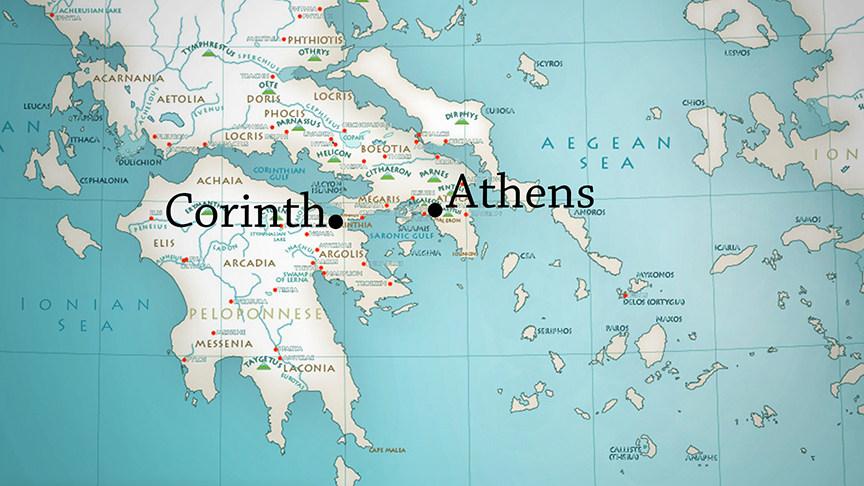 Original Audience: The church in Corinth
Date Written: Approximately A.D. 55, near the end of Paul’s three-year ministry in Ephesus, during his third missionary journey
Setting: Corinth was a major cosmopolitan city, a seaport and major trade center—the most important city in Achaia. It was also filled with idolatry and immorality. The church was largely made up of Gentiles. Paul had established this church on his second missionary journey.
Key Verse: “I appeal to you, dear brothers and sisters, by the authority of our Lord Jesus Christ, to live in harmony with each other. Let there be no divisions in the church. Rather, be of one mind, united in thought and purpose” (1:10).
Key People: Paul, Timothy, members of Chloe’s household
Key Places: Worship meetings in Corinth
Special Features: This is a strong, straightforward letter.
The Blueprint
- PAUL ADDRESSES CHURCH PROBLEMS (1:1-6:20)
- Divisions in the church
- Disorder in the church
Without Paul’s presence, the Corinthian church had fallen into divisiveness and disorder. This resulted in many problems, which Paul addressed squarely. We must be concerned for unity and order in our local churches, but we should not mistake inactivity for order and cordiality for unity. We, too, must squarely address problems in our churches.
- PAUL ANSWERS CHURCH QUESTIONS (7:1-16:24)
- Instruction on Christian marriage
- Instruction on Christian freedom
- Instruction on public worship
- Instruction on resurrection
The Corinthians had sent Paul a list of questions, and he answered them in a way meant to correct abuses in the church and to show how important it is that they live what they believe. Paul gives us a Christian approach to problem solving. He analyzed the problem thoroughly to uncover the underlying issue and then highlighted the biblical values that should guide our actions.
| MEGATHEMES | ||
|---|---|---|
| THEME | EXPLANATION | IMPORTANCE |
| Loyalties | The Corinthians were rallying around various church leaders and teachers—Peter, Paul, and Apollos. These loyalties led to intellectual pride and created a spirit of division in the church. | Our loyalty to human leaders or human wisdom must never divide Christians into camps. We must care for our fellow believers, not fight with them. Your allegiance must be to Christ. Let him lead you. |
| Immorality | Paul received a report of uncorrected sexual sin in the church at Corinth. The people had grown indifferent to immorality. Others had misconceptions about marriage. We are to live morally, keeping our bodies for God’s service at all times. | Christians must never compromise with sinful ideas and practices. We should not blend in with people around us. You must live up to God’s standard of morality and not condone immoral behavior, even if society accepts it. |
| Freedom | Paul taught freedom of choice on practices not expressly forbidden in Scripture. Some believers felt certain actions—like eating the meat of animals used in pagan rituals—were corrupt by association. Others felt free to participate in such actions without feeling that they had sinned. | We are free in Christ, yet we must not abuse our Christian freedom by being inconsiderate and insensitive to others. We must never encourage others to do something they feel is wrong just because we have done it. Let love guide your behavior. |
| Worship | Paul addressed disorder in worship. People were taking the Lord’s Supper without first confessing sin. There was misuse of spiritual gifts and confusion over women’s roles in the church. | Worship must be carried out properly and in an orderly manner. Everything we do to worship God should be done in a manner worthy of his high honor. Make sure that worship is harmonious, useful, and edifying to all believers. |
| Resurrection | Some people denied that Christ rose from the dead. Others felt that people would not physically be resurrected. Christ’s resurrection assures us that we will have new, living bodies after we die. The hope of the Resurrection forms the secret of Christian confidence. | Since we will be raised again to life after we die, our life is not in vain. We must stay faithful to God in our morality and our service. We are to live today knowing we will spend eternity with Christ. |
Message Audio/Video and Outline: https://upwards.church/watch-now/leander-campus-videos
Watch Messages: YouTube-Upwards Church
Source: Life Application Study Bible , (Wheaton, IL: Tyndale, 1988), WORD search CROSS e-book, 1925-1926.


 Upwards Church