
 Why is Galatians so important?

In advance of the Jerusalem Council, Paul’s letter speaks wisdom and clarity into the first real controversy that plagued the church in its early years—the relationship between Christian Jews and Christian Gentiles. Paul’s aggressive tone shows just how important it was to him that the people embrace unity in Christ, no matter their racial distinctions. For him, this was no minor issue, as he went so far as to call the Galatians deserters of Christ, people turning from the truth toward a gospel contrary to the one they had received from Paul (Galatians 1:6–9).
About the Author?
The Epistle to the Galatians was written by the Apostle Paul. Paul identifies himself as the author in the first line of the letter, and virtually all scholars affirm Pauline authorship, due to the style and theology of the epistle.1 In addition, Paul reveals a great deal of autobiographical information in this epistle. Much of this information is not shared in his other known correspondence, and Paul uses the material to address the Galatians, thus making it more authoritatively Pauline.2
When and Where Did the Author Write?
There is no unanimous consensus about when Paul wrote the Epistle to the Galatians. The general range given for the date of this epistle is circa AD 48 -50.3 If this is true, then Paul had already concluded his first missionary journey.4
If one accepts the early 48 date, then Paul would have written this letter from Corinth during his Aegean mission. if a little later, Paul would have written from Ephesus or Macedonia during the latter portion of his Aegean mission.5
Who Was the Original Audience?
There is some debate regarding whom this epistle was written to. Some argue that this letter was written to a region, rather than to a specific city. The debate is whether this region is North Galatia or South Galatia.6 The debate of north versus south has found traction in different groups in different eras. There is evidence for either region, but the south seems to have some distinct advantages.7 Despite the regional debate, Paul made it clear that the people in Galatia were primarily gentiles. There was a cultural milieu of Roman, Greek, and indigenous influences throughout the region of Galatia.8
Genre
What type of book is this?
The book of Galatians is an epistle. An epistle is an ancient letter that was used for correspondence purposes. The biblical epistles were typically used on an as-needed basis, such as addressing issues within the body of Christ. They were most often used to teach theology and offer ethical instruction for behavior.14 It’s helpful for modern-day readers of the epistles to acknowledge that Paul’s world is very different from our world today. The modern-day reader must pursue the historical context of the period in order to most effectively grasp Paul’s words.15
Thematic Language
What words does the Author regularly use in this book?
- Christ (38 times)
- Law (32 times)
- Faith (21 times)
- Spirit (18 times)
- Flesh (16 times)
Why did the Author Write?
Paul wrote Galatians because he received word that some Jewish Christian missionaries had come to the region of Galatia to preach a different gospel from what he preached to the Galatians (1:6–7).This epistle was not written to protect the flock from some non-Christian invasion of false teaching, but rather, it was a letter of rebuke to those who had preached a false gospel and those who believedit.9 This “gospel” taught that in order to truly become a Christian and be a part of the people of God, a person must be circumcised. This was clearly against the gospel of salvation by Christ alone that Paul preached.10
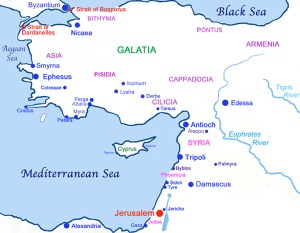 Where did the Audience Live?

As mentioned previously, there was great diversity within the region of Galatia. This region was originally founded in the third century BC by Celts who migrated to the northern portion of Asia Minor.11 Much like the rest of the known world at this time, Galatia was under Roman control. As a province, Galatia was much more rural and agrarian as a society. As a result, the people were not dependent on other regions for their provision but were able to provide for their own needs.12 Galatia was quite large in Paul’s day and covered much territory; therefore, it seems that Paul was reaching a sizable audience.13
Key Verses
What are some key verses in this letter?
1:11 (ESV): For I would have you know, brothers, that the gospel that was preached by me is not man’s gospel.
2:15-16 (ESV): We ourselves are Jews by birth and not Gentile sinners; yet we know that a person is not justified by works of the law but through faith in Jesus Christ, so we also have believed in Christ Jesus, in order to be justified by faith in Christ and not by works of the law, because by works of the law no one will be justified.
2:20 (ESV): I have been crucified with Christ. Itis no longer I who live, but Christ who lives in me. And the life I now live in the flesh I live by faith in the Son of God, who loved me and gave himself for me.
3:28 (ESV): There is neither Jew nor Greek, there is neither slave nor free, there is no male and female, for you are all one in Christ Jesus.
5:1 (ESV): For freedom Christ has set us free; stand firm therefore, and do not submit again to a yoke of slavery.
6:9 (ESV): And let us not grow weary of doing good, for in due season we will reap, if we do not give up.
Illustration
What’s an illustration that will help readers understand the context and message of the book?
The Apostle Paul wrote the book of Galatians in order to address issues within the church. To help us understand Paul’s intentions, imagine someone like Gordon Ramsay. Gordon Ramsay is notorious for his television programs where he shows up to a dysfunctional restaurant and helps correct the issues causing the eatery to fail. Ramsay often does this in a harsh tone, much like we see in Paul’s Epistle to the Galatians (though Paul acts with more love while writing his letter). Ramsay’s ultimate concern is not to be angry at someone for running a business poorly, but rather that they correct the issues and become a healthy restaurant again. Paul desires that the church in Galatia become healthy again, too.
Overview
A succinct overview of the book to introduce the book to readers.
Paul, the founder of the churches in Galatia, received word of some Jewish Christians attempting to preach a different gospel from the one he originally presented to the local congregations. This “gospel” argued that people must follow the Law of Moses (and, specifically, be circumcised) to become a part of the people of God. Enraged because of his passion for Christ, the believers, and the gospel, Paul wrote a harsh rebuke defending the gospel that he preached against the “gospel” of these opponents. Paul did not want control of these people; rather, he wanted them to remain faithful to the gospel that he preached and to protect one another from the false “gospel. ”Paul’s vehement rebuke was done in love and as a form of discipline from this loving pastor to the congregations of the churches that he planted and nurtured. It is discipline that emanates from relationship, not that of an emperor disciplining unruly subjects.
How do I apply this?
Unfortunately, the false teaching brought to the Galatian churches by the Judaizers has been extremely difficult to root out even today. We must walk a fine line—on one hand, we do not want to fall into the legalism that the Galatians struggled with, but on the other, we cannot just live as if anything goes. The Christian’s commitment to Christ is based on the free gift of grace through faith, but as Paul articulated at the end of Galatians, it also results in a life of walking by the Spirit.
Is the fruit of the Spirit evident in your life, or do you find yourself living according to the flesh or “the compulsions of selfishness” (Galatians 5:16–26 MESSAGE) Too often we lose ourselves at the extremes, ending in a legalistic attempt to earn our salvation or a devil-may-care attitude about our sin.
Use Paul’s words in Galatians as an encouragement to pursue a life of holiness, not in your own strength but in the knowledge of God’s empowering grace in your life.
Message Audio/Video and Outline: https://upwards.church/watch-now/leander-campus-videos
Watch Messages: YouTube-Upwards Church
Read Along Daily Bible Reading: YouVersion (https://www.bible.com/organizations/370f8a6e-16bc-464f-8c43-0b7623fd2952)
Sources:
- G. W. Hansen, “Galatians, Letter to the,” in Dictionary of Paul and His Letters, eds. Gerald F. Hawthorne, Ralph P. Martin, and Daniel G. Reid (Downers Grove, IL: InterVarsity Press, 1993), 326.
- “James D. G. Dunn, “The Epistle to the Galatians,” in Black’s New Testament Commentary, ed. Henry Chadwick (Grand Rapids: Baker Academic, 1993), 2–3.
- Craig S. Keener, “Galatians,” in New Cambridge Bible Commentary, ed. Ben Witherington III (New York: Cambridge University Press, 2018), 4.
- N. T. Wright and Michael F. Bird, The New Testament in Its World (Grand Rapids: 2019), 400.
- Ibid., 400.
- Thomas R. Schreiner, “Galatians,” in Zondervan Exegetical Commentary on the New Testament (Grand Rapids: Zondervan, 2010), 23.
- Keener, “Galatians,” 8–12.
- Gary M. Burge, Lynn H. Cohick, and Gene L. Green, The New Testament in Antiquity(Grand Rapids: 2009), 270.
- Richard B. Hays, “Galatians,” in The New Interpreter’s Bible Commentary, ed. Leander Keck (Nashville, TN: Abingdon Press, 2015), 1022.
- Craig S. Keener, The IVP Bible Background Commentary: New Testament (Downers Grove, IL: InterVarsity Press, 1993), 518.
- Burge, Cohick, and Green, New Testament in Antiquity, 268.
- Hansen, “Galatians, Letter to the,” 326.
- Schreiner, “Galatians,” 23.
- William W. Klein, Craig L. Blomberg, and Robert L. Hubbard, Jr., Introduction to Biblical Interpretation (Nashville, TN: Thomas Nelson Publishers, 2004), 426–427.
- Wright and Bird, New Testament in Its World, 475.
- Bruce Hurt, Galatians: Precept Austin 2020], https://www.preceptaustin.org/galatians_commentaries
Unless otherwise indicated, all Scripture quotations are from The Holy Bible, English Standard Version® (ESV®), copyright © 2001 by Crossway, a publishing ministry of Good News Publishers. Used by permission. All rights reserved.


 Upwards Church