
 Do you know anyone who is broken? Are you? Or have you been broken? The same Jesus who sits with a lonely, outcast, broken woman will sit with you, love you and offer you what is eternal and lasting.
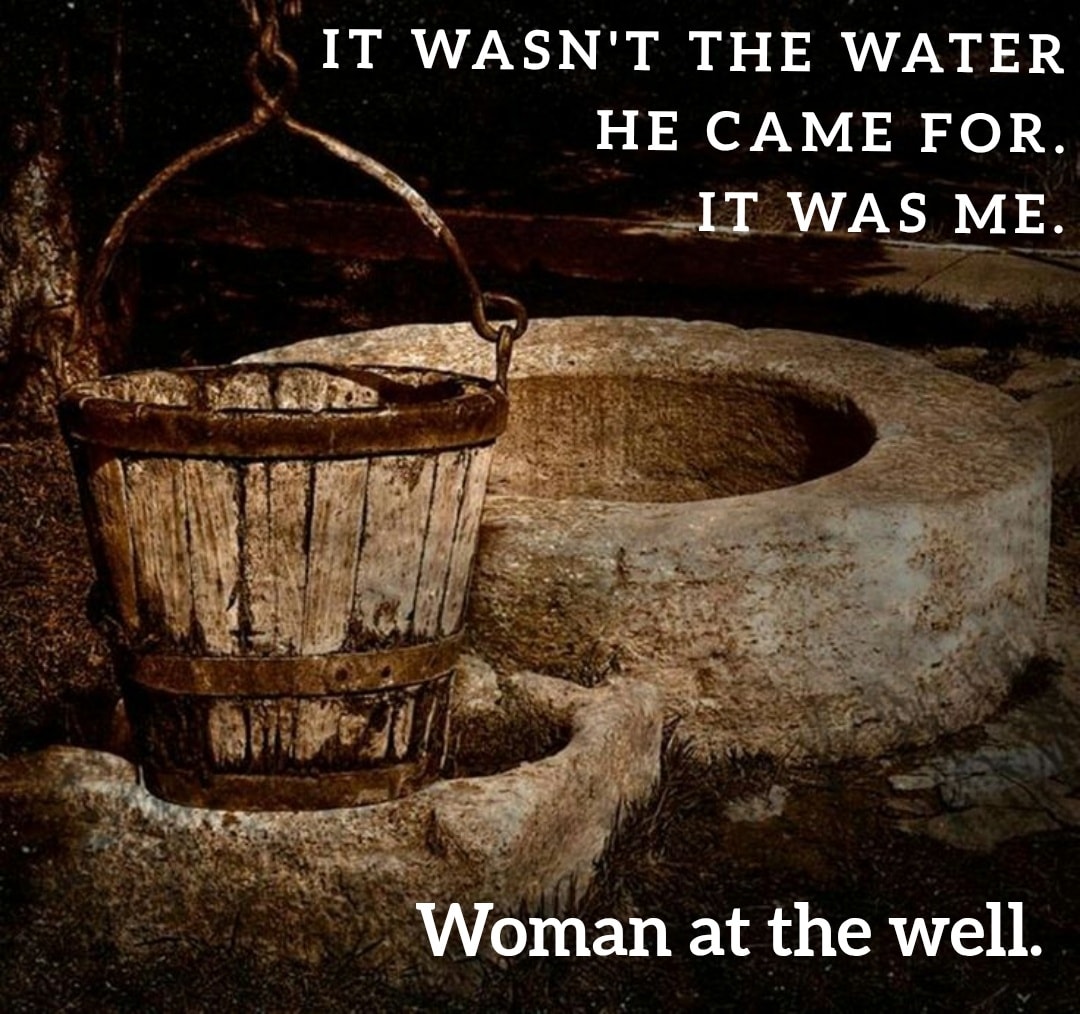
The woman came to the well with shame on her mind. She was avoiding human contact, but the stranger at the well was probably little more than an inconvenience. How often at the supermarket, gas station, or even in church do we pass by people loaded down with guilt. They find themselves having to pursue life’s necessities, hoping to avoid anyone who knows their real needs. Dreading judgment and rejection, they live in fear. And yet, when shown real concern as Jesus does and we can too; these same people find great relief in unburdening themselves. Simple caring is a gift valued infinitely more than it costs to give.
4:7 Two facts are unusual about the woman’s actions: (1) she could have gone to a closer well (scholars have identified wells that were closer to Sychar); (2) women generally drew water later in the day, when the temperature was cooler. This woman, whose reputation seems to have been well known in the small town (4:18), probably chose the well farther away from home and came to that well at an unusual hour in order to avoid contact with other women. It was also highly unusual for a man to address a woman, but Jesus said, “Please give me a drink.” This statement reveals Jesus’ true humanity; he was really thirsty. Even though such a request startled her (4:9), it drew her into a conversation with Jesus.
4:8 This statement serves to inform the reader that Jesus was alone with this woman. Jesus could not ask his disciples to help him get water, for they had gone into Sychar to buy food. Thus, we see Jesus, weary from his journey, depending on others for food and drink.
4:9 The Samaritan woman was very surprised—first, that a Jew would even speak to a Samaritan; second, that a Jewish male would speak to a Samaritan woman (she also had a bad reputation and this was a public place); third, that a Jew would drink from a Samaritan’s cup. The Jewish ceremonial laws described not only certain people as ceremonially unclean, but also anything they touched. In strict religious terms, many Jews of Jesus’ time considered the Samaritans to be permanently unclean.
LIFE APPLICATION: NO PREJUDICES ALLOWED
This woman (1) was a Samaritan, a member of the hated mixed race, (2) was known to be living in sin, and (3) was in a public place. No respectable Jewish man would talk to a woman under such circumstances. But Jesus did. The attitude of the Jews toward the Samaritans in Jesus’ day is not unlike that which has been frequently displayed in America. Sadly, in the past, some have not allowed others they perceive as “lesser” to share the same public facilities with them. For Jesus to ask for a drink of water from a utensil belonging to a Samaritan woman was to go against the accepted prejudices of the time.
 The gospel is for every person, no matter what his or her race, social position, religious orientation, or past sins. We must be prepared to share this gospel at any time and in any place. We must also be prepared to deal with those who may be accustomed to being ill-treated and who are not sure of our motives. Jesus crossed all barriers to share the gospel, and we who follow him must do no less—even if misunderstood.
4:10 The woman was not aware of the gift God had for her—the gift of life, represented by living water—and she did not know the giver, Jesus the Messiah. Jesus makes an extraordinary offer to this woman—living water that would quench her thirst forever.
4:11-12 Jesus’ remark concerning “living water” produced several practical questions in the mind of the Samaritan woman. Like Nicodemus, she did not immediately sense the depth of Jesus’ words. Obviously, if this living water was at the bottom of the well, Jesus was in no position to offer it because he had no rope or bucket for drawing it. She began to wonder if Jesus had access to some source of water other than Jacob’s well. She asked if he thought he was greater than their ancestor Jacob and could somehow offer better water. Perhaps the woman sensed in Jesus’ words a possible dishonoring of the well provided by their great ancestor. Or perhaps the woman was beginning to have some inkling of who Jesus was claiming to be. He certainly accepted her in a way that must have challenged her thinking.
Jesus Offers Us What is Lasting
4:13-14 People need water daily because they soon become thirsty again. The water from Jacob’s well would indeed satisfy the woman’s thirst, but only temporarily. So also are all the other “drinks” of life—they never satisfy. Some of them even create more thirst. The human needs for love, food, sex, security, and approval, even when met, do not give complete satisfaction. Attempts to find full satisfaction will lead only to disappointment and despair. But the water Jesus offers takes away thirst altogether. Jesus’ “water” continually satisfies the desire for God’s presence because it becomes a perpetual spring within them, giving them eternal life. The gift that Jesus gives—this perpetual spring—suggests the availability, accessibility, and abundance of the divine life for believers.
*LIFE APPLICATION: ARE YOU SATISFIED?
Spiritual functions often parallel physical functions. Our bodies hunger and thirst; so do our souls. But our souls need spiritual food and water. The woman confused the two kinds of water, perhaps because no one had ever told her about her spiritual hunger and thirst before. Do we deprive our souls? The living Word, Jesus Christ, and the written Word, the Bible, can satisfy our hungry and thirsty souls.
4:15 The woman’s response reveals that she took Jesus’ words literally. The woman must have been thrilled to think that this man could give her water that really quenches thirst and would not have to be drawn from a well. Obtaining water was hard work—requiring trips to the well twice a day and carrying heavy jars full of water home. If she had some of that water, she would never be thirsty again and wouldn’t have to haul water every day.
*LIFE APPLICATION: TROUBLED WATERS
Many people who claim to be Christians admit they feel unhappy and dissatisfied over the same problems mentioned by nonbelievers. Feelings of low self-esteem, lack of love, loneliness, and struggles over sex, money, work, and position in life are often as severe with believers as with unbelievers. Are differences between Christians and non-Christians merely on the surface or even imaginary? Did Jesus overstate his claim? Questions like these come from interpreting Jesus’ words as the Samaritan woman did—expecting that physical thirst and all other life-related needs will be satisfied by Jesus’ “living water.” But that is not what Jesus promised. He offered freedom within life, not freedom from life! Later he told his disciples in no uncertain terms: “In this world you will have trouble. But take heart! I have overcome the world” (16:33 niv). Believers will experience many of the same difficulties encountered by unbelievers, but the presence of Jesus in our lives should make a significant difference in the way we respond. Living water gives us spiritual power to face the challenges of living, not escape from them.
4:16-18 Jesus abruptly shifted the subject from his living water to her style of living. The woman perceived her need for living water at one level; Jesus knew that her need was far deeper, so he turned the conversation to reveal his knowledge of her personal life—and her sin of adultery. By asking her to go and get her husband, Jesus wanted to make this woman see her sin and her need for forgiveness and then offer her the living water—salvation. She must have realized that this was not a man who could be fooled, for she answered transparently, “I don’t have a husband.” The woman spoke the truth without any explanations, excuses or justifications.
Although he confronted the woman’s sinful life, Jesus managed to affirm her truthfulness. He did not accuse or excuse; he simply described her life so that she could draw some clear conclusions about the mess in which she was living. The conclusions we reach without knowing the facts will usually err in one of two directions: We will accuse others and raise their defenses, or we will excuse others and enable their denial. We see in Jesus’ communication with this woman that when faced with an accepting confrontation, people will often respond positively. When we speak to others about themselves, we must limit our words to what we know.
4:19 The woman acknowledged the truthfulness of Jesus’ remarks about her life. At the same time, she recognized that he must be a prophet who had the power to “see” the hidden past as well as the future. The theme of people “seeing” Jesus appears several times in John. The persons Jesus encountered saw him many different ways, but he consistently directed their attention to recognize him for who he really was—their Savior.
Many commentators have pointed out that the woman may have been purposely attempting to avert any further disclosure of her personal, sinful life by shifting the conversation to religion. Notice how Jesus responded to her change of direction. He was not presenting a system or a gospel outline; he was having a conversation with someone who needed the living water. Jesus made no attempt to turn the discussion back to her lifestyle; rather, he entered into a dialogue about the true place of worship. Jesus kept the woman’s interest by demonstrating his willingness to let her direct the discussion.
In the next post we will look at Jesus’ answer and His answers to the questions of “worship.”
Darrell
Message Audio/Video and Outline: https://upwards.church/leander-campus/watch-now-message-videos
Watch Messages: YouTube-Upwards Church
Read Along Daily Bible Reading: You Version
Sources:
— Life Application Bible Commentary
— Life Application Concise New Testament Commentary


