
New Call, New Heart – Ezekiel 1-2

When Jesus shows up, everything changes.

 I fell on my face, and I heard a voice of One speaking. (Ezek. 1:28). Here’s what he heard.

He said to me, ‘Son of man, stand up on your feet . . .'” (Ezek. 2:1).  Jesus wanted Ezekiel to be fully alert. He was about to receive orders.

“‘. . . and I will speak with you.’ As He spoke to me, the Spirit entered me and set me on my feet, and I listened to the One who was speaking to me” (Ezek. 2:2). It was God’s way of saying, “Now that I have your attention, listen to me. I don’t want you to miss my instructions.”

An Appearance of Christ is Moving

He said to me: ‘Son of man, I am sending you to the Israelites . . .'” (Ezek. 2:3). God was saying, “Ezekiel, the task that I have for you requires action.” Have you ever noticed that two-thirds of God is go. Always, there is an action component to the call of God. Rarely can we stay where we are, do what we’ve always been doing, and fulfill the call of God upon our lives. Ezekiel came to realize this and so must we.

‘The children are obstinate and hardhearted. I am sending you to them, and you must say to them: This is what the Lord GOD says. Whether they listen or refuse [to listen] – for they are a rebellious house – they will know that a prophet has been among them. “But you, son of man, do not be afraid of them or their words” (Ezek. 2:4-6). God said, “I’ve got a message for my people. You will communicate that message. It’s not your message. It’s my message. Your job is to deliver it, whether they listen or not, and whether you are afraid or not.” God’s truth is not dependent on human response. God would not judge Ezekiel for how well others responded to his message, but for how faithful he was in presenting it. Ezekiel was a spokesperson for God, his very mouthpiece. God appointed Ezekiel as “a watchman over the house of Israel” (Ezek. 3:17). A watchman stood on the city wall and warned the people of approaching danger. Ezekiel’s role was to be a spiritual watchman, warning people of coming judgment. There is a fundamental connection between being a watchman and warning, between being a spokesperson and speaking, between being a mouthpiece and opening our mouths to let words come out.

‘Open your mouth and eat what I am giving you’ . . . So I opened my mouth, and He fed me the scroll” (Ezek. 2:8, 3:2). I find it interesting that the name Ezekiel means “God is strong” or “God makes strong.” For him to be strong, he had to feed on the nourishment of God’s Word. For The Word of God is life giving. Just as we need food for physical life, we need God’s Word for spiritual life. When we digest God’s Word, we find that not only does it make us stronger in our faith, but also its wisdom sweetens our lives. This means doing more than simply giving God’s message a casual glance, like looking through a bakery window. It means making the Word part of our lives, like eating a balanced diet that sustains and nourishes us to health and productivity.

An Appearance of Christ is Empowering

This was Ezekiel’s call to be a prophet.

Often we think of a prophet as being a foreteller, one who predicts the future. Actually, most biblical prophets were not foretellers, they were “forth tellers.” They had a message from God to tell, usually a message of warning and judgment. And often prophets had to tell it to a less than receptive audience, in a less than pleasant time. It pained them to tell of impending judgment. Like the beloved preacher, they proclaimed their warnings, with tears in their eyes.

So why would someone want to be a prophet? Why would someone want to share a message to a group of people who would rather have their head on a platter than hear the message? Why would someone pronounce a judgment that brought such hurt and pain to them and their audience? The answer is because the prophet was called.

What ambassador would think of going to a country as representative of his homeland, without being sent? What solider would go to a war torn country risking life and limb, without orders? What missionary would go to a foreign country to endure the pain and hardships of a sacrificed life, without being commissioned?

An Appearance of Christ is Compelling

What does all of this have to do with most people? All are not prophets, preachers or pastors. So what’s the point?

In the movie The Blues Brothers, a couple of ex-convict-wanna-be-musicians were trying to raise money for an orphanage. Anytime they were asked about their work, they had a standard response: “We’re on a mission from God.” They always said it, as if they believed it. The very idea that two inept, unworthy human beings could be on a mission from God was, of course, the central joke of the whole story.

Here is the story of our lives: We are on a mission from God.

God is calling us. God’s calls are not exclusive to pastors and missionaries. He calls plumbers and managers as well. For that matter, he calls some to be electricians, doctors, lawyers, teachers, chemists, sales persons, and housewives. He calls some to secular vocations, others to sacred vocations. A calling is not something reserved for those going into full-time Christian service.

Granted, we don’t hear much about calling anymore, because our society is educated to think in terms of career. A calling is something God chooses for me. A career is something I choose for myself. A career promises status, money, or power; a calling generally promises difficulty and even some suffering – but it’s a mission, an opportunity to be used by God. A career is about upward mobility; a calling generally leads to downward mobility. A career ends with retirement and lots of “toys.” A calling isn’t over until the day you die. The rewards of a career may be quite visible, but temporary. The results of a calling may never be seen on this side of eternity.

Often we think that ministry requires a calling and the marketplace is choosing a career. But that is not true. It is quite possible to turn a ministry into a career that focuses on advancement and achievement. On the other hand, it is quite possible to make a business a calling that is truly done to serve God and others.

In the eleventh century, King Henry III of Bavaria grew tired of court life and the pressures of being a monarch. He made application to Prior Richard at a local monastery, asking to be accepted as a contemplative and spend the rest of his life in the monastery.

“Your Majesty,” said Prior Richard, “do you understand that the pledge here is one of obedience? That will be hard, because you have been a king.”

“I understand,” said Henry. “The rest of my life I will be obedient to you, as Christ leads you.”

“Then I will tell you what to do,” said Prior Richard. “Go back to your throne and serve faithfully in the place where God has put you.”

When King Henry died, a statement was written: “The king learned to rule by being obedient.”

Ezekiel was obedient to the call of God upon his life. Are you being obedient to the call of God upon your life? God can turn our career into a calling. Sometimes the end of a career is the beginning of a calling. At other times, God chooses to take people out of the security of their careers and call them into a Christian ministry. Since everyone has one, what is your mission from God?

Is God trying to break through to us? Is he waking us up to a specific calling? Do you need to humble yourself before God? Get in a posture to really hear from God? Or maybe you have heard from God, you know the call of God upon your life, it’s time to stand up, listen up and move in that direction.  When Jesus shows up, everything changes.

Darrell

www.Upwards.Church

Watch Messages: YouTube-Upwards Church

Facebook: Upwards Church


Posted in A New Heart - Ezekiel | Tagged , , , , , | Leave a comment

Did Jesus Appear to Ezekiel?  

26 And above the firmament over their heads was the likeness of a throne, in appearance like a sapphire stone; on the likeness of the throne was a likeness with the appearance of a man high above it27 Also from the appearance of His waist and upward I saw, as it were, the color of amber with the appearance of fire all around within it; and from the appearance of His waist and downward I saw, as it were, the appearance of fire with brightness all around. 28 Like the appearance of a rainbow in a cloud on a rainy day, so was the appearance of the brightness all around it. This was the appearance of the likeness of the glory of the Lord. So when I saw it, I fell on my face, and I heard a voice of One speaking.  Ezekiel 1:26-28

Did Ezekiel see Jesus?  I believe so.  So do some commentators.

“The ‘man’ he saw upon the throne was probably a pre-incarnate appearance of our Lord Jesus Christ” – Warren Wiersby

This verse (“the appearance of a man”) speak of the incarnation of Christ, the fact that God became a man. – J. Vernon McGee

“This figure “whose appearance resembled a man” revealed God’s holiness and prepared Ezekiel for what God was about to tell him. The figure represented Christ revealed in human form and prepared us for his message of salvation. Christ came into history in a real, human body.  – Life Application Study Bible

When Jesus appears in the Old Testament it’s called a Christophany. A Christophany is a visible manifestation or appearance of Christ before His human incarnation.

But since the Bible consistently says that no one has ever seen God the Father and lived (Exodus 33:20John 5:376:461 Timothy 6:15-161 John 4:12), many theologians believe that all visible theophanies in the Old Testament were pre-incarnate appearances of Christ.

Jesus is the image of the invisible God (Colossians 1:15). He is at the Father’s side, and He is the only one who reveals Him (John 1:18). And here are a few more of His pre-incarnate appearances.

  1. Appearance to Abraham (Genesis 18)

Three men visited Abraham, and one of them was God Himself. We know he was God because the text says, “and the LORD appeared to him by the oaks of Mamre.” The other two men were angels.

  1. Appearance to Jacob (Genesis 32:22-32)

Jacob once wrestled with a man all night, and that man was God. He said to Jacob, “your name shall no longer be called Jacob, but Israel for you have striven with God, and with men, and have prevailed.” Afterward, Jacob named the place Peniel and said, “for I have seen God face to face, and yet my life has been delivered.

  1. Appearance to Joshua (Joshua 5:13-15)

A man with a sword in hand appeared to Joshua before the fall of Jericho. He identified himself as the commander of the army of the Lord. Joshua immediately fell to his face and worshipped the man. And the commander said, “take off your sandals from your feet for the place where you are standing is holy.” This man was another Christophany.

Theologians also believe every visit of “the angel of the Lord,” or “the angel of God,” was a Christophany.

In Exodus 23:20-21, God told Moses He would send an angel before him to guide him, and that God’s name was in the angel. As the name of God represents His nature, will, and character. A random angel can’t bear God’s name; only God himself can. And this angel of the Lord must have been Jesus because He said in John 17:7, “I have manifested your name to the people whom you gave me out of the world.”

Here are a few visits from Jesus as the angel of the Lord.

  1. Visit to Hagar (Genesis 16:7-14)

The angel of the Lord appeared to Hagar in the wilderness and said to her, “I will surely multiply your offspring so that they cannot be numbered for multitude.” The angel of the Lord spoke with the authority of God and said he would multiply her offspring. Hagar called the angel, “You are a God of seeing,” and said, “truly here I have seen him who looks after me.”

  1. Visit to Abraham and Isaac (Genesis 22:11-18)

Abraham took Isaac to Mount Moriah to sacrifice him as God commanded. But when he was about to kill Isaac, the angel of the Lord appeared and told him to stop. He said, “now I know that you fear God seeing you have not withheld your son, your only son from me.” The angel spoke as if he was God.

  1. Visit to Jacob (Genesis 31:11-13)

The Angel of God appeared to Jacob in a dream and said, “I am the God of Bethel, where you anointed a pillar and made a vow to me.” The God of Bethel is Yahweh (Genesis 28:13-22).

  1. Visit to Moses (Exodus 3:2-6)

The angel of the Lord appeared to Moses “in a flame of fire out of the midst of a bush,” and then, “God called to him out of the bush.”  He said, “I am the God of your Father, the God of Abraham, and the God of Isaac.”

It’s quite clear from these few examples that the angel of the Lord is a Christophany. Furthermore, His visits stop after the birth of Christ.

This doesn’t mean that Jesus was an angel before the incarnation. Jesus was, is, and always be God (John 8:58). The Hebrew word for angel is malak, which means a messenger. It appears 213 times in the Old Testament. It can refer to actual angels such as in Genesis 19:1, and men such as in Genesis 32:3.

Also, Christophanies do not contradict the incarnation of Christ nor the virgin birth. Jesus taking on the form of a man is not the same as becoming a man.

There are many other examples of Christophanies in the Old Testament. But some are less certain than others.

For example, many people believe the fourth man in the fire in Daniel 3:25 was a Christophany. But all we know about him is that he had the appearance of a “son of gods.” Without additional information, we can’t say for sure if he was a Christophany or an actual angel.

Melchizedek is another questionable Christophany. He appears in Genesis 14:18-20 and his name means king of righteousness, and a priest of God most High. Hebrews 7:3 says that “he is without father or mother or genealogy, having neither beginning of days nor end of life, but resembling the Son of God, he continues a priest forever.” As a result, many people believe Melchizedek was a Christophany. But he could have been a type of Christ.

Always let the Bible guide you to recognize a Christophany accurately. For instance, if the text says, “the Lord appeared,” or the “Lord came down,” it most likely a Christophany. Also, if a man speaks with the authority of God, identifies himself with God, or does things only God can do, He might be a pre-incarnate appearance of Christ.

Darrell

www.Upwards.Church

Watch Messages: YouTube-Upwards Church

Facebook: Upwards Church

Sources:
  1. Vernon McGee, Thru The Bible with J. Vernon McGee, (Nashville, TN: Thomas Nelson, 1983), WORDsearch CROSS e-book, Under: “Chapter 1” and “CHAPTERS 2 AND 3”.
Warren W. Wiersbe, The Bible Exposition Commentary – The Prophets, (Colorado Springs, CO: Victor, 2002), WORDsearch CROSS e-book, 166-167.
Life Application Study Bible, (Wheaton, IL: Tyndale, 1988), WORDsearch CROSS e-book, Under: “Chapter 2”.
https://www.wordsoffaithhopelove.com/jesus-in-the-old-testament-christophanies/
Posted in A New Heart - Ezekiel | Tagged , , , , , | 2 Comments

Introduction to Ezekiel

“Don’t worry,” Danny chided his friends. “I can get away with anything. I’m my father’s favorite.” Danny’s dad had gone out of town, leaving his new sports car in the garage. Danny was allowed to drive the family van, but not the sports car. “Come on, you guys,” he continued, “Dad will never even know.”  The drive to the movie was great. Girls honked and guys stared. “See,” Danny said. “No problem. It sure beats the old van!” His friends had to agree.  After the movie, they headed to the car. It was late, and the parking lot was no longer full. “Danny! Danny!” one of his friends suddenly yelled when he reached the car. “Oh no!” There was a broken window and wires dangled where the stereo used to be.  “What are we going to do?” another friend asked. “Your father will kill us!”  Danny smiled weakly. “Hey, I’m my dad’s favorite. No sweat!”  Israel reacted like Danny. They thought they could get away with anything. The book of Ezekiel was written to Jews who were captives in Babylon. They were “God’s favorites.” Surely Jerusalem (their capital) would not be harmed, and they would return home very soon. Ezekiel corrected their thinking: they were captives in Babylon because they had disobeyed God. Though they were his chosen people, God could not overlook sin.  Ezekiel reminds us that no one can sin without punishment. Just as God loves us, he also loves justice.  As you read Ezekiel, stand in awe of the God who judges all sin. Then thank Him for providing a way (through Jesus) to escape the judgment that we all deserve for our sins. Thank Him for a giving us a new heart to desire living for Him.

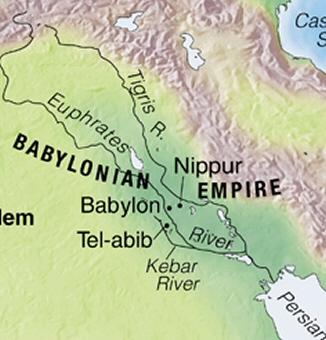
Ezekiel’s life spanned a period of significant political upheaval in the world. He lived through the decline of Assyrian domination only to see the rise of the all-powerful Babylonian Empire.  When God called him to be a prophet, Ezekiel was 30 years old and had been an exile in Babylon for five long, difficult years. The new prophet was already a leader among the exiles, and their hardships and sufferings weighed heavily upon him. From a human perspective, they were in a hopeless situation, and it looked as though their sad circumstances were not going to change. Ezekiel saw nothing on the horizon that would offer the exiles any hope that they would be set free from their captivity. Yet as a prophet, he had to make sure that they remained strong under the weight of their horrible suffering.

Unknown to Ezekiel was the fact that his entire life would be spent as an exile in Babylon. Thus his prophetic ministry was to be under the most difficult, trying circumstances imaginable, for he would never be freed from the hardships and pain of exile. Furthermore Ezekiel would suffer the additional pain of being continually rejected by the exiles who rebelled against the Lord and His Holy Word.

Purpose: To announce God’s judgment on Israel and to foretell the eventual salvation of God’s people

Author: Ezekiel

Original Audience: The Jews in captivity in Babylonia

Date Written: Approximately 571 B.C.

Setting:  Ezekiel was a younger contemporary of Jeremiah. While Jeremiah ministered to the people still in Judah, Ezekiel prophesied to those already exiled in Babylonia after the defeat of Jehoiachin. He was taken there in 597 B.C.

Key Verse:  And I will give you a new heart, and I will put a new spirit in you. I will take out your stony, stubborn heart and give you a tender, responsive heart” (Ezekiel 36:26).

Major Themes:

  1. God’s Holiness

Ezekiel saw a vision that revealed God’s absolute moral perfection. God was spiritually and morally superior to members of Israel’s corrupt and compromising society. Ezekiel wrote to let the people know that God in his holiness was also present in Babylon, not just in Jerusalem. Because God is morally perfect, he can help us live above our tendency to compromise with this world. When we focus on his greatness, he gives us the power to overcome sin and to reflect his holiness.

2. Sin

God’s people had sinned, and God’s punishment came. The fall of Jerusalem and the Babylonian exile were used by God to correct the rebels and draw them back from their sinful way of life. Ezekiel warned them that not only was the nation responsible for sin but each individual was also accountable to God. We cannot excuse ourselves from our responsibilities before God. We are accountable to God for our choices. Rather than neglect him, we must recognize sin for what it is—rebellion against God—and choose to follow him instead.

3.  Restoration

Ezekiel consoles the people by telling them that the day will come when God will restore those who turn from sin. God will be their King and shepherd. He will give his people a new heart to worship him, and he will establish a new government and a new Temple. The certainty of future restoration encourages believers in times of trial. But we must be faithful to God because we love him, not merely for what he can do for us.  Is our faith in him or merely in our future benefits?

www.Upwards.Church

Watch Messages: YouTube-Upwards Church
Facebook: Upwards Church


Sources:
The Preacher’s Outline & Sermon Bible – Ezekiel, (Chattanooga: Leadership Ministries Worldwide, 2007), WORDsearch CROSS e-book, Under: “I. The Call and Commission of Ezekiel: The Vision Necessary for Serving God, 1:1—3:27”.
Life Application Study Bible, (Wheaton, IL: Tyndale, 1988), WORDsearch CROSS e-book, 1307.
Student’s Life Application Bible: New Living Translation, (Wheaton, IL: Tyndale House, 1997), WORDsearch CROSS e-book, Under: “Ezekiel”.
Posted in A New Heart - Ezekiel | Tagged , , , , , , , | Leave a comment

A New Heart – Ezekiel

God desires to change our hearts. “I will give you a new heart and put a new spirit in you.” Ezekiel 36:26 says.

For unbelievers this new heart is salvation; and for the believer, an encouraged heart to continue even when serving God is not easy. For those of us who have grown complacent or cold in our walk with God, “A New Heart” outlines how God desires to bring us closer to him.

 Dates         Titles                  Scriptures                           

Feb. 7 – New Call, New Heart   (Ezekiel 1-2)

Feb. 14 – Stone Heart to New Heart (Ezekiel 36)

Feb. 21 – Dead Bones, New Life (Ezekiel 37)

I hope you can join us this Sunday!

Darrell

www.Upwards.Church

Watch Messages: YouTube-Upwards Church

Facebook: Upwards Church

Posted in A New Heart - Ezekiel | Tagged , , , , | Leave a comment