
Storm Shelter – Introduction to Psalms

How often you check the weather forecast? I find myself doing this often to be prepared for rain, sleet, wind or storms. Wouldn’t it be nice if there were an app giving a forecast for the real storms of life?  Although no such app exists we do know that storms are a part of life.  In our series from the book of Psalms we will learn that God provides shelter from life’s storms. He does not just provide shelter, God is our shelter.

At the center of the Bible is the book of Psalms. This great collection of songs and prayers expresses the heart and soul of humanity. In them we find the whole range of human experiences expressed.

Dr. J Vernon McGee has written, “Someone has said that there are 126 psychological experiences, I don’t know how they arrived at that number, but I do know that all of them are recorded in the Book of Psalms. It is the only book which contains every experience of a human being. The Psalms run the psychological gamut. Every thought, every impulse, every emotion that sweeps over the soul is recorded in this book.”

I’m grateful to John Piper for compiling this list of emotions found in the Psalms:

  • Loneliness: “I am lonelyand afflicted” (Psalms 25:16).
  • Love: “I loveyou, O Lord, my strength” (Psalms 18:1).
  • Awe: “Let all the inhabitants of the world stand in aweof him” (Psalms 33:8).
  • Sorrow: “My life is spent with sorrow” (Psalms 31:10).
  • Regret: “I am sorryfor my sin” (Psalms 38:18).
  • Contrition: “A broken and contriteheart, O God, you will not despise” (Psalms 51:17).
  • Discouragement and turmoil: “Why are you cast down, O my soul, and why are you in turmoilwithin me” (Psalms 42:5)?
  • Shame: “Shamehas covered my face” (Psalms 44:15).
  • Exultation: “In your salvation how greatly he exults” (Psalms 21:1).
  • Marveling: “This is the Lord’s doing; it is marvelousin our eyes” (Psalms 118:23).
  • Delight: “His delightis in the law of the Lord” (Psalms 1:2).
  • Joy: “You have put more joyin my heart than they have when their grain and wine abound” (Psalms 4:7).
  • Gladness: “I will be gladand exult in you” (Psalms 9:2).
  • Fear: “Serve the Lord with fear” (Psalms 2:11).
  • Anger: “Be angry, and do not sin” (Psalms 4:4).
  • Peace: “In peaceI will both lie down and sleep” (Psalms 4:8).
  • Grief: “My eye wastes away because of grief” (Psalms 6:7).
  • Desire: “O Lord, you hear the desireof the afflicted” (Psalms 10:17).
  • Hope: “Let your steadfast love, O Lord, be upon us, even as we hopein you” (Psalms 33:22).
  • Brokenheartedness: “The Lord is near to the brokenheartedand saves the crushed in spirit” (Psalms 34:18).
  • Gratitude: “I will thankyou in the great congregation” (Psalms 35:18).
  • Zeal: “Zealfor your house has consumed me” (Psalms 69:9).
  • Pain: “I am afflicted and in pain” (Psalms 69:29).
  • Confidence: “Though war arise against me, yet I will be confident” (Psalms 27:3).

More explicitly than all the other books in the Bible, the Psalms are designed to awaken and shape our emotions in line with the instruction they give.

The Gospels tell us that Jesus was crucified, but the Psalms tell us what went on in His own heart during the Crucifixion. The Gospels tell us He went back to heaven, but the Psalms begin where the Gospels leave off and show us Christ seated in heaven.

There are sixteen messianic psalms that speak specifically about Christ, but all 150 of point to Christ. “The Book of Psalms is a hymnbook and a HIM book — it is all about Him.”

“Out of 219 quotations of the Old Testament in the New Testament, 116 of them are from the Psalms,” says Dr. McGee.

Psalms has the more chapters of any book in the bible.

Purpose of Psalms:  To provide poetry for the expression of praise, worship, and confession to God

Authors: David wrote 73 psalms; Asaph wrote 12; the sons of Korah wrote 9; Solomon wrote 2; Heman (with the sons of Korah), Ethan, and Moses each wrote one; 51 psalms are anonymous. The New Testament ascribes two of the anonymous psalms (Psalms 2 and 95) to David (see Acts 4:25; Hebrews 4:7).

Date Written: Between the time of Moses (approximately 1440 B.C.) and the Babylonian captivity (586 B.C.)

Christ (the Messiah) is prominent throughout. The King and the Kingdom are the theme songs of the Psalms.

The key word in the Book of Psalms is Hallelujah, that is, Praise the Lord. This phrase has become a Christian cliché, but it is one that should cause a swelling of great emotion in the soul. Hallelujah, praise the Lord!

Different types of psalms were written to communicate different feelings and thoughts regarding a psalmist’s situation.

Psalms of Lament express the author’s crying out to God in difficult circumstances. Psalms of Praise, also called hymns, portray the author’s offering of direct admiration to God. Thanksgiving psalms usually reflect the author’s gratitude for a personal deliverance or provision from God. Other types of psalms are referred to today as Wisdom psalms.

Did you know that Psalms is found at the center of your bible?

The very center of the Bible when measured by chapter count is Psalms 118.

Here are some other fun facts surrounding Psalm 118:

  • The longest chapter of the Bible falls just after this center chapter– Psalm 119.
  • The shortest chapter of the Bible falls just after this center chapter– Psalm 117.
  • There are exactly 594 chapters before Psalm 118, and exactly 594 chapters after it. When you add the number of chapters before Psalms 118 and those after, the sum is 1,118. And the verse at the very center of the Bible is Psalms 118:8.

The Center Verse

Psalm 118:8 – “It is better to take refuge in the Lord than to trust in man.” (NIV)

God is our refuge and shelter!   I hope that you will join us in our series, Storm Shelter.

We’ll cover:

  • The Shelter of God’s Word -Psalm 1
  • The Shelter of God’s Leading -Psalm 23
  • The Shelter of God’s Presence -Psalm 84
  • The Shelter of God’s Power -Psalm 95
    The Shelter of God’s Encouragement -Psalm 42
  • The Shelter of God’s Forgiveness-Psalm 51

Darrell

http://www.Upwards.Church

Sources:

https://www.desiringgod.org/messages/songs-that-shape-the-heart-and-mind
  1. Vernon McGee, Thru The Bible with J. Vernon McGee, (Nashville, TN: Thomas Nelson, 1983), WORDsearch CROSS e-book, Under: “PSALMS”.
Life Application Study Bible, (Wheaton, IL: Tyndale, 1988), WORDsearch CROSS e-book, 841-842.

 

Posted in Storm Shelter- Psalms | Tagged , , , | Leave a comment

God is With Us – The Tabernacle, Ex. 40

This week we’re wrapping up Exodus and it ends on a positive note.  Last week, we examined the Golden Calf debacle, a real low point for the people of God.  Many of you know that I attended Texas A&M and love a good aggie joke.  The Israelites, like many of us can’t help but make some boneheaded decisions from time to time. It reminds me of… the aggie that interviewed for a job painting highway stripes.  The foreman said, “to get this job, we have to have an agreement.  I need for you to paint at least 3 miles of stripes a day.”  The aggie said, “no problem, I can do that.”   The first day, he painted 5 miles of stripes. The foreman was impressed. His second day on the job, the aggie painted 3 miles of stripes. The third day, the aggie only painted 1 mile of stripes and the fourth day a ½ mile. The foreman said, “I don’t think this is working out. What’s the deal? Your first day you did so well, but now it’s bad.”  The frustrated aggie replied, “I’m sorry boss, the bucket just keeps getting farther and farther away!”

The Israelites learned from their mistake.  As Exodus closes, they have been faithful, helpful and generous. They would follow God’s instructions, build the Tabernacle and experience God’s blessings upon them.

I love this quote from Skip Heitzig, he says, “Exodus starts out in the brickyards of Egypt, but ends in the tabernacle with God living at the center of his people. In the same way God wants to take us out of the slavery of sin and live at the center of our lives.”

In Exodus 25-40, God told Moses how to build the Tabernacle, and Moses delegated jobs in order to do it. God allows people to participate with him in carrying out his will. Our task is not just to sit and watch God work, but to give our best effort when work needs to be done.

The physical care of the Tabernacle required a long list of tasks, and each was important to the work of God’s house. This principle is important to remember today when God’s house is partly represented by the church. There are many seemingly unimportant tasks that must be done to keep our church buildings maintained. Cleaning, mowing, printing, washing dishes, changing diapers, painting walls, or pulling weeds may not seem very spiritual. But they are vital to the ministry of the church and are an important part of our worship of God.

I was amazed as I studied the Tabernacle how much it is mentioned in the bible.  Did you know that 1/3 of the book of Exodus deals with the Tabernacle?!  Chapter 25 to chapter 40 (leaving out 32 & 33 the Golden Calf) gives us 13 chapters.  Leviticus has 18 chapters devoted to the Tabernacle. Numbers has 13 chapters devoted to the Tabernacle. Deuteronomy has 2 chapters devoted to the Tabernacle. Hebrews has 4 chapters devoted to the Tabernacle.

50 Bible chapters devoted to the Tabernacle!   It must be important.

Each aspect of the Tabernacle teaches us about Christ. The tabernacle was designed specifically, in detail by God, and pointed to the Person and the ministry of Jesus Christ.

We will look at this in more detail when we get into Leviticus next year but briefly I’ll share how a few parts point to Christ.

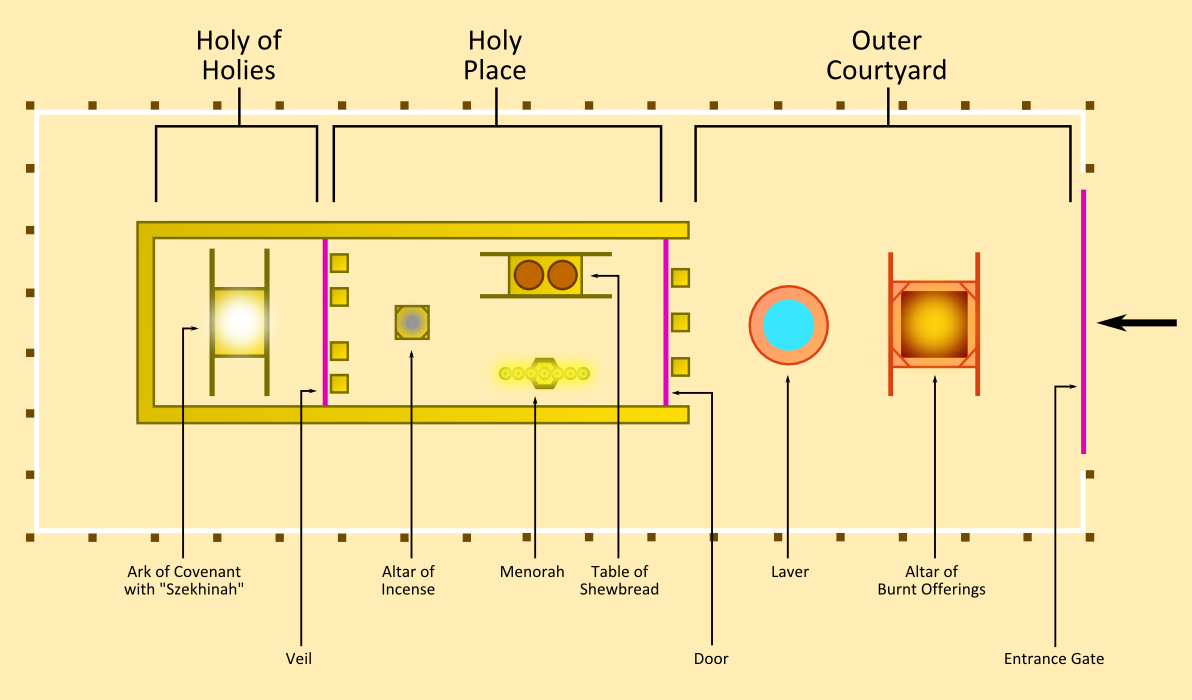
By looking at the image of the Tabernacle, see that there was only one way in.  This reminds us of Jesus who said, “I am THE way, no one comes to the father but by me.” John 14: 6  In John 10, Jesus says that he is THE gate, whoever enters through me will be saved.”

After the entrance we come face to face with the altar, a place of death and sacrifice. Sheep, goats and bulls were sacrificed at the altar and their blood atoned for the sins of the people.  When John the Baptist sees Jesus he reminds us, “Look, the Lamb of God, who takes away the sin of the world!  Jesus’ death on the cross, his shed blood is our atonement “once for all.”

Then we see a large basin for washing. The washing symbolized spiritual cleansing and forgiveness of sins. The basin reminds us that we are washed and cleansed by Christ.  The basin is also a picture of baptism, we are dead in our sins as we go down into the water but come up raised to walk in new life with Christ.

Next, entering the Holy Place and Most Holy Place we see that the décor changes from bronze on the outside to gold on the inside.  Gold symbolizes royalty and deity. The articles in the Holy Place reminds us of how we are to live with Christ in our lives.

The menorah represents the perfect light of Christ that guides us. Jesus said, “I am the light of the world, whoever follows me shall not walk in darkness but shall have the light of life.”  The bread of Presence reminds us that Christ is our sustenance and living bread. Jesus said, “I am the bread of life. Whoever comes to me will never go hungry.”

The Altar of Incense pointed to Jesus Christ as the great Intercessor and Mediator who represents us before God and makes our prayers acceptable to God.

The Holy Place and the Most Holy Place were divided by a large (shielding) curtain.  Do you remember what happened to the curtain when Jesus died on the cross?  “At that moment the curtain of the temple was torn in two from top to bottom.” Because of Jesus, “we can approach God’s throne of grace with confidence.”

As the Moses and the people finish the work of the Tabernacle, God is pleased.  Let’s look at what happens.

Then Moses set up the courtyard around the tabernacle and altar and put up the curtain at the entrance to the courtyard. And so Moses finished the work.

34 Then the cloud covered the tent of meeting, and the glory of the Lord filled the tabernacle

God’s presence is with His people!  He is living or dwelling at the center of his people.  The people see and experience the glory of God.   Every day when they woke up and they looked out and saw God and his glory in their presence.  Isn’t that what Jesus also did?

The Word (Jesus) became flesh and made his dwelling among us. We have seen his glory, the glory of the one and only Son, who came from the Father, full of grace and truth.

Christ was born and came to “tabernacle” (dwell) with us.

As Exodus closes, not only was God with the people, He also guided them.

In all the travels of the Israelites, whenever the cloud lifted from above the tabernacle, they would set out; 37 but if the cloud did not lift, they did not set out—until the day it lifted. 38 So the cloud of the Lord was over the tabernacle by day, and fire was in the cloud by night, in the sight of all the Israelites during all their travels.

The Israelites were once Egyptian slaves making bricks without straw. Here they were following the presence of God, carrying the Tabernacle or place of worship that they had built for God.

Exodus begins in gloom and ends in glory. This parallels our progress through the Christian life. We begin as slaves to sin and are redeemed by God.  He guides us through life with His word, the Holy Spirit, the church, and other believers.  We always have his presence and guidance.  We end our pilgrimage living with God forever.

Darrell

Sources: Life Application Study Bible, (Wheaton, IL: Tyndale, 1988), WORDsearch CROSS e-book, 156.
The Preacher’s Outline & Sermon Bible – Exodus II, (Chattanooga: Leadership Ministries Worldwide, 1996), WORDsearch CROSS e-book, Under: “F. The Assembly and Dedication of the Tabernacle, the Center of Worship: Experiencing the Presence of the Lord, 40:1-38”.
Posted in Journey with God - Exodus | Tagged , , , , , , | 1 Comment

What’s Your Golden Calf? – Exodus 32

Do you find it easy to forget all that God has done for you?  I do.  Instead of being thankful for eternal life in Christ, peace, forgiveness and purpose, I’m ashamed to say I wish for more.  Surrounded by the blessings of family, freedom, convenience and abundance I find myself thinking, “When are you really going to bless me?”  I have so much yet selfishly long for more.

I can relate to our text today.  The people of God had been delivered out of slavery, had seen the power and miracles of God’s ten plagues against the Egyptians and their gods.  They had seen God part the Red Sea, give them manna and quail from heaven, water from a rock, and receive the Ten Commandments from directly from God at Mt. Sinai. Yet when Moses goes up at the people’s request to get more instructions from God they get impatient at his absence.  They quickly turn from all that God had said and done and decide to make an image, a false god to follow and worship instead.  Wow!

Their decent into chaos begins with impatience.  “When the people saw that Moses was so long in coming down from the mountain, they gathered around Aaron and said, “Come, make us gods who will go before us. As for this fellow Moses who brought us up out of Egypt, we don’t know what has happened to him.” Exodus 32:1 (NIV)

Where is this Moses fellow? They feel that they have waited long enough and it is now time to take action, now it is time to take matters into their own hands.  “How long do I wait?” is a question that I am asked a lot.  We ask that question of God don’t we? “How long is this going to continue? Which direction do I take Lord? At what point do we stop this waiting thing, and just do something?  It’s hard to wait on God and easy to get impatient.

How many bad decisions have we made because of impatience?  We want God to work on our behalf now, not later.  We hate to wait.  I’ve seen people marry in haste because God didn’t bring them someone on their time table or they didn’t think anything better would come along or that their biological clock was ticking.   I’ve seen people cut corners morally to get ahead because God wasn’t blessing them on their time table. I’ve seen people give up on God all together because He didn’t seem to answer their prayers as they had laid out.   We like them turn away from God to an image of our own creation because of our impatience.

The Israelites were tired of waiting on the true God and decided to find one who was more accommodating.   I find a tendency in the human heart to do the same thing with our relationship with God. We try to formulate a god who will accommodate us.

Some people want a god that only requires them to sit one hour a week.

Some people want a god that does not require them to give any of their money.

Some people want a god that does not require them to change their behavior.

Notice the use of the plural personal pronoun “us“:  “make us gods who will go before us”; “this fellow Moses who brought us”;  (NIV) These people wanted a comfortable, convenient god they could control because they were self-focused.  Many people want a god that caters to them.

We make the same mistake that the Hebrews did, and we do it over and over.  We mold God into who we want Him to be, rather than seeking out who he truly is.

We are not necessarily interested in who God is; We are interested in what God can do for us.

I don’t know about you, but that is not where I want to be. I want to know who God is, and worship and serve the true God rather than something I have pieced together; a conglomeration of ideas about God that I like and feel comfortable with.  I don’t want God only for what He can do for me.

How do we avoid falling into the same trap that the Hebrews fell into? Let’s look more at our Scripture and see what took place and how it applies to us today.

As the story continues the people complain to Aaron.  This is not his best day, Aaron caves in and gives them what they want.  He makes a god fashioned to their liking.  A golden calf, why a calf? A popular Egyptian god, Hapi (Apis) was thought of as a bull and a heifer. The Canaanites around them worshiped Baal, thought of as a bull. Baal was their sacred symbol of power and fertility and was closely connected to immoral sexual practices.  They were weary of a god without a face. But in doing so, they were ignoring the command he had just given them: “You must not make for yourself an idol of any kind” (20:4).

They are used to having images of gods around them, they grew up with this kind of thing. So, Moses, he’s out of the picture, and this Moses was their link to God. They need another link, another mediator, so they create one. They worship like the pagan culture they came out of. Never mind that the festival they created had several violations of the Ten Commandments, this is what their idea of God is.

Aaron built an altar in front of the calf and announced, “Tomorrow there will be a festival to the Lord.” So the next day the people rose early and sacrificed burnt offerings and presented fellowship offerings. Afterward they sat down to eat and drink and got up to indulge in revelry.

The festival got out of hand. The Hebrew word for revelry (tsachaq) has the idea of loose conduct, the kind of loose behavior that happens when a person has been drinking or taking drugs. The word has the idea of crude language and laughter, of sexual misconduct, of engaging in a wild dancing party or a wild drinking party.

The bottom line here is this: Are you in your life as a Christian going to follow the biblical reality (what God says in His word) or the cultural reality you live in? This is the choice that was set before the Hebrews, and they chose the cultural reality. It was familiar, it was fun, it was a good time and many seemed to agree it was ok.   Our golden calf today may be money, success, a house, power or position.  We may have a golden car or a golden child.  Whatever is a priority of our time, emotions and money is likely our golden calf.

What is God’s response?   What if you came home from out of town and found that your kids threw a wild party and you walk in to see you house trashed, your kids drunk and naked?

God was ready to destroy the whole nation because of their sin. But Moses pleaded for mercy, and God spared them. This is one of the countless examples in the Bible of God’s mercy. Although we deserve his anger, he is willing to forgive and restore us to himself. We can receive God’s forgiveness from sin by asking him. Like Moses, we can pray that he will forgive others and use us to bring them the message of his mercy.  Who is God leading you to pray for?  Who do you need to intercede for?

How could God relent? God did not change his mind in the same way that a parent decides not to discipline a child. Instead, God changed his behavior to remain consistent with his nature. When God first wanted to destroy the people, he was acting consistently with his justice. When Moses interceded for the people, God relented in order to act consistently with his mercy.

Let’s tie this in with the New Testament.  Moses stood as the intercessor between God and the people. Moses is a picture of the great Intercessor, the Lord Jesus Christ.

Jesus intercedes on our behalf.  He took our punishment.

Isaiah 53 explains this beautifully…

Surely he took up our pain
    and bore our suffering,
yet we considered him punished by God,
    stricken by him, and afflicted.
But he was pierced for our transgressions,
    he was crushed for our iniquities;
the punishment that brought us peace was on him,
    and by his wounds we are healed.
We all, like sheep, have gone astray,
    each of us has turned to our own way;
and the Lord has laid on him
    the iniquity of us all.

He was oppressed and afflicted,
    yet he did not open his mouth;
he was led like a lamb to the slaughter,
    and as a sheep before its shearers is silent,
    so he did not open his mouth.
For he was cut off from the land of the living;
    for the transgression of my people he was punished.[b]
He was assigned a grave with the wicked,
    and with the rich in his death,
though he had done no violence,
    nor was any deceit in his mouth.

10 Yet it was the Lord’s will to crush him and cause him to suffer,
    and though the Lord makes[c] his life an offering for sin,
he will see his offspring and prolong his days,
    and the will of the Lord will prosper in his hand.
11 After he has suffered,
    he will see the light of life[d] and be satisfied[e];
by his knowledge
[f] my righteous servant will justify many,
    and he will bear their iniquities.
12 Therefore I will give him a portion among the great,[g]
    and he will divide the spoils with the strong,[h]
because he poured out his life unto death,
    and was numbered with the transgressors.
For he bore the sin of many,
    and made intercession for the transgressors.

Thank you Jesus for interceding for me!

Darrell

www.Upwards.Church


Sources:   Life Application Study Bible, (Wheaton, IL: Tyndale, 1988), WORDsearch CROSS e-book, 144.

Posted in Journey with God - Exodus | Tagged , , , , | 4 Comments

10th Commandment – Be Content

#10 Exodus 20:17 “You shall not covet…anything that belongs to your neighbor.”

We don’t often use the word “Covet” in everyday conversation.

“Covet” to intensely desire something that belongs to someone else.

Sadly enough, these days our society encourages coveting, and I struggle to fight this pull like anyone else.  In the United States alone the advertising industry spends over six billion dollars a day. The typical U.S. consumer is the recipient of 5,000 advertisements daily.

The general message in all this merchandising is that all of our problems can be solved immediately by the consumption of the proper product. Buying this will take care of everything from a bad budget to baldness! All these TV, Radio, computer, and mass media ads we receive cause far too many of us to live in a perpetual state of longing, wanting more and more and more. A “Dennis the Menace” cartoon strip, which showed Dennis looking through a Christmas Toy catalogue saying, “This catalog’s got a lot of toys I didn’t even know I wanted.”

Coveting Causes…

  1. Overspending

“Whoever loves money never has money enough;” Ecclesiastes 5:10a

Coveting destroys budgets.  We think the problem is I just don’t make enough money.  No, it’s that we want too much.  A lot of things we think are needs are really greeds.  The average American puts $1300 on credit for every $1000 he makes.  So because we want more we get further and further in debt.  It always costs more to have more.

A pastor once dropped by to visit a family of the congregation in his church. When he got there, the mother of the house, wanting to make a good impression, said to her daughter, “Honey, who don’t you go and get that good book that we all love so much.” The daughter brought back the Sears’ catalog.

  1. Dissatisfaction

       “Whoever loves wealth is never satisfied with his income. Ecclesiastes 5:10b

The famed poet Mick Jagger described our plight with these words:
“I can’t get no satisfaction, I can’t get no satisfaction ’Cause I try and I try and I try and I try …”

Coveting is built on the idea that if we get what we do not have, if we get what we desire, we’ll be happy.   Things don’t give permanent happiness.  Like a tire with a hole in it, it quickly loses its ability to bring us happiness. But we never seem to learn this lesson. When the thrill fades we just covet another THING, hoping that it will bring us lasting happiness and the process begins all over again. One example of this vicious cycle is seen every Christmas when we’re presented with those “must” items that we simply have to buy for our kids or ourselves. And every year the “Big Thing” to find under the tree is something new. Years ago the gift of choice was a Tickle Me Elmo. People stampeded through stores to get one. In past years there have also been Pet Rocks, Cabbage Patch Dolls, Beanie Babies, Furbies, and GameBoys to name a few. When our kids get these things they enjoy them for a few days or weeks but then those things that they wanted so bad, those toys that they absolutely had to have to be happy….lose their appeal. And then the next year the big thing to have is something else.

Tickle Me Elmo isn’t giggling anymore; he’s on the top shelf of the closet in most homes between a Salad Shooter and a Vega-Matic. Coveting is deceptive, it promises happiness but it always leaves us wanting more.

  1. Anxiety

       The abundance of a rich man permits him no sleep. Eccl 5:12

When we focus on things we always inevitably worry.  The more you have, the more we have to worry about.  How am I going to protect it?  How am I going to save it?  How am I going to invest it?  How am I going to insure it?  How am I going to avoid taxes on it?  How am I going to keep from losing it?  I read a study that said insomnia increases with income.  Like a dog chasing its tail, people who covet never quite catch lasting joy.

  1. Exhaustion

Do not wear yourself out to be rich; have the wisdom to show restraint.”   Pr. 23:4

In our push to get more (and never in history have we been so pushed to get so much so quickly) we overwork and take on second jobs.  Everybody in the family works.  It’s the material rat-race and everybody’s tired.

  1. Bickering

“What causes fights and quarrels among you?  Don’t they come from the desires that battle with you?”        James 4:1

Conflict comes when we’re always wanting more.  The number one cause of divorce is financial tension; arguments over money and possessions.

People will sacrifice values, morals, integrity, all kinds of things in order to get more.  They’ll even sacrifice relationships to get an additional dollar.

A true story: At the end of the Civil War. John Wilkes Boothe, the man who killed Abraham Lincoln in Ford’s Theater was the brother of one of America’s most famous actors, Edwin Booth. John Wilkes Booth was consumed with jealousy. He bitterly coveted the popularity of his brother. Now, he knew there was a growing dislike for Abraham Lincoln in certain areas of the United States. So he killed the President, thinking to become a national hero. The assassination of this beloved man started with one covetous thought.

How to Be Content?

  1. I shouldn’t compare myself to others. We do not dare classify or compare ourselves … it is not wise.” 2 Cor. 10:12

In our society it seems the way we keep score is by possessions.  We often look around and ask “How am I doing?” as if net worth and self-worth were the same thing.   Our net worth has absolutely no relationship to our self-worth.   This “Someone else is having a better life” is a myth.

  1. I should be thankful for what I have.  “Always give thanks to God…  for everything” Eph 5:20

We wouldn’t have anything if it weren’t for God.   It’s all a gift from God.  The happiest people are not those who have the most but those who are thankful for what they have. What am I waiting on to make me happy? When I get married then I’ll be happy.  When I get out of this marriage then I’ll be happy.  When I have kids then I’ll be happy.  We are as happy as we want to be.  We should forget the “When and Then Thinking.”  Happiness is not getting whatever we want.  Happiness is enjoying whatever we have.

  1. I should be generous.

Command those who are rich in this present world not to be arrogant nor to put their hope in wealth, which is so uncertain, but to put their hope in God, who richly provides us with everything for our enjoyment.  Command them to do good, to be rich in good deeds, and to be generous and willing to share.  In this way they will lay up treasure for themselves as a firm foundation for the coming age, so that they may take hold of the life that is truly life.  1 Tim 6:17-19

As an American I am rich, wealthier than the vast majority of the world.  Even if you’re on welfare; if you’re an American you’re in the top 1% of income of the world.

I’ll never forget reading the economist Robert Heilbroner’s walk-through of what it would take to transform the average American home into the typical dwelling of the majority of the world’s inhabitants. “We would have to begin by invading our house to strip it of its furniture. Everything goes: beds, chairs, tables, TV, lamps. All that can be left for the family is a few old blankets, a kitchen table, and a wooden chair. When it comes to clothing, each member of the family may keep his oldest suit or dress and one shirt or blouse. The head of the family gets a pair of shoes, but not the wife or children.
Then comes the kitchen.  All the appliances would have to come out, and the cabinets would have to be emptied. All that can stay is a box of matches, a small bag of flour, and some sugar and salt. A few moldy potatoes, already in the garbage can, have to be taken back out, for they will provide much of that night’s meal. We can add a handful of onions and a dish of dried beans, but that’s all. Everything else goes: meat, fresh vegetables, canned goods, any crackers or candy. All gone.
But not only do we have to strip the house this way, but we also have to dismantle the bathroom, shut off the running water, and take out all electric wires. Next, we take away the house itself. The family must move into the tool shed. Everything related to communication goes too. No more newspapers, magazines, books – not that they are missed, since we must also take away the family’s literacy. Instead, all that can be left is one small radio. Then government services are removed. No more mail delivery, no more fire department. There is a school, but it is three miles away and consists of only two classrooms. There can’t be any hospitals or doctors nearby. The nearest clinic will be ten miles away and tended by no more than a midwife. It can be reached by bicycle, provided that the family has a bicycle, which is unlikely.  Finally, we come to money.
The family can only be allowed a cash hoard of five dollars. That is only allowed to prevent the main breadwinner of the family from experiencing the tragedy that came upon one poor laborer who went blind because he could not raise the $3.94 that he mistakenly thought he needed to receive admission to a hospital where he could have been cured.   James Emery White, You Can Experience an Authentic Life (Nashville: Word Publishing, 2000), 150-152

  1. I should shift my values to what will last.

Everything we see in the world is eventually going to decay or rust or wear out or fall apart.  It will eventually not exist, because all possessions are temporary.  The only things that really last for eternity are things we can’t see, our relationship to God and our relationship to others.  Jesus reminds us:

“Do not store up for yourselves treasures on earth, where moth and rust destroy, and where thieves break in and steal.  But store up for yourselves treasures in heaven, where moth and rust do not destroy, and where thieves do not break in and steal.  For where your treasure is, there your heart will be also. Matt 6:19-21

I think we need to do a periodic checkup and ask the tough questions: “What am I really living for?  Is the primary goal of my life just to get more?  Happiness does not come from possessions, it comes from knowing Jesus.

Darrell

www.Upwards.Church

Posted in Journey with God - Exodus | Tagged , , , , , , | Leave a comment