

Invitation & Introduction – A People in Crisis – Jeremiah

You’re invited to our new message series:  Jeremiah (A People in Crisis)

Description: How can we remain faithful to God even when many of the people around us are not?  This four-week series explores the life and ministry of the prophet Jeremiah. Jeremiah’s ministry was characterized by opposition, suffering, and a message that his people did not want to hear. We can learn much from his faithful journey, deep faith and the message that God gave his rebellious people.  We too are “A People in Crisis.”

 Dates – Titles (Scriptures)                                                      Events 

Mar. 3 – Calling Out the Called (Jeremiah 1)
Mar. 10 – Blessed or Cursed? (Jeremiah 17)                                    Spring Break

Mar. 17 – The Lord Knows (Jeremiah 29)

Mar. 24 – A New Covenant (Jeremiah 31)                               Palm Sunday/ Communion

 Introduction:

What is success? Most definitions include references to achieving goals and acquiring wealth, prestige, favor, and power. “Successful” people enjoy the good life—being financially and emotionally secure, being surrounded by admirers, and enjoying the fruits of their labors. They are leaders, opinion makers, and trendsetters. Their example is emulated; their accomplishments are noticed. They know who they are and where they are going, and they stride confidently to meet their goals.

By these standards, Jeremiah was a miserable failure. For 40 years he served as God’s spokesman to Judah, but when Jeremiah spoke, nobody listened. Consistently and passionately he urged them to act, but nobody moved. And he certainly did not attain material success. He was poor and underwent severe deprivation to deliver his prophecies. He was thrown into prison (chapter 37) and into a cistern (chapter 38), and he was taken to Egypt against his will (chapter 43). He was rejected by his neighbors (11:19–21), his family (12:6), the false priests and prophets (20:1, 2; 28:1–17), friends (20:10), his audience (26:8), and the kings (36:23). Throughout his life, Jeremiah stood alone, declaring God’s messages of doom, announcing the new covenant, and weeping over the fate of his beloved country. In the eyes of the world, Jeremiah was not a success.
But in God’s eyes, Jeremiah was one of the most successful people in all of history. Success, as measured by God, involves obedience and faithfulness. Regardless of opposition and personal cost, Jeremiah courageously and faithfully proclaimed the word of God. He was obedient to his calling. Jeremiah’s book begins with his call to be a prophet. The next 38 chapters are prophecies about Israel (the nation united) and Judah (the southern kingdom). Chapters 2–20 are general and undated, and chapters 21–39 are particular and dated. The basic theme of Jeremiah’s message is simple: “Repent and turn to God, or he will punish.” Because the people rejected this warning, Jeremiah then began predicting the destruction of Jerusalem. This terrible event is described in chapter 39. Chapters 40–45 describe events following Jerusalem’s fall. The book concludes with prophecies concerning a variety of nations (chapters 46–52).

As you read Jeremiah, feel with him as he agonizes over the message he must deliver, pray with him for those who refuse to respond to the truth, and watch his example of faith and courage. Then commit yourself to being successful in God’s eyes.
Vital Statistics: 

Purpose: To urge God’s people to turn from their sins and back to God

Author: Jeremiah

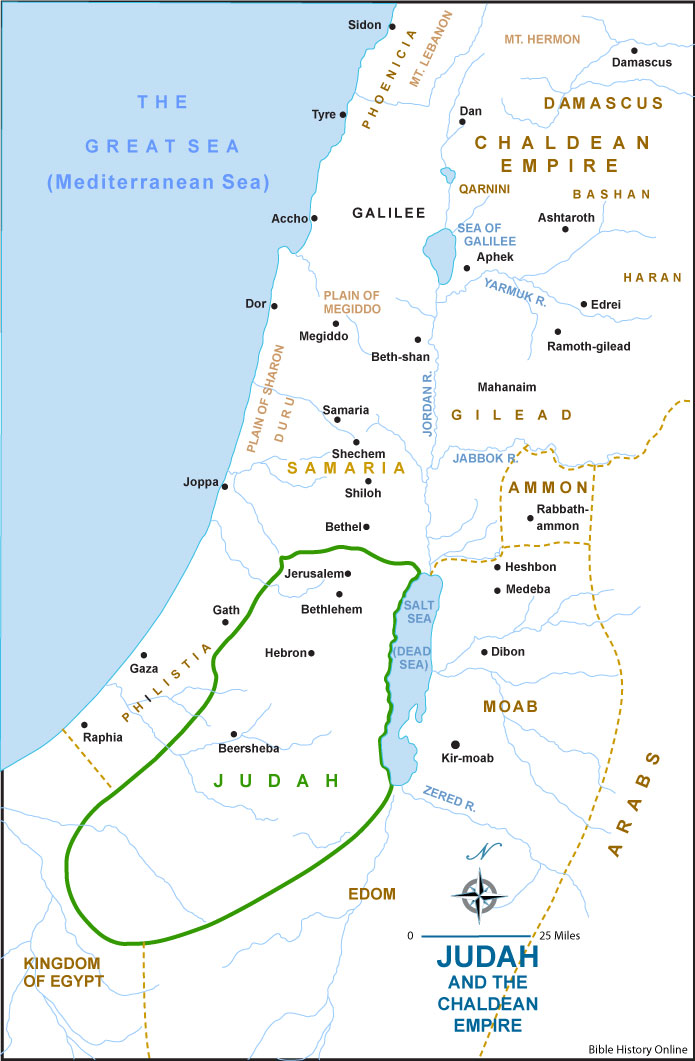
Original Audience: Judah (the southern kingdom) and its capital city, Jerusalem

Date Written: During Jeremiah’s ministry, approximately 627–586 B.C.

Setting: Jeremiah ministered under Judah’s last five kings—Josiah, Jehoahaz, Jehoiakim, Jehoiachin, and Zedekiah. The nation was sliding quickly toward destruction and was eventually conquered by Babylon in 586 B.C. (see 2 Kings 21–25). The prophet Zephaniah preceded Jeremiah, and Habakkuk was Jeremiah’s contemporary.

Key Verse: “Your wickedness will bring its own punishment. Your turning from me will shame you. You will see what an evil, bitter thing it is to abandon the LORD your God and not to fear him. I, the Lord, the LORD of Heaven’s Armies, have spoken!” (2:19)

jeremiah-timleline

Key People: Judah’s kings (listed above), Baruch, Ebed-melech, King Nebuchadnezzar, the Recabites

Key Places: Anathoth, Jerusalem, Ramah, Egypt

Special Features: This book is a combination of history, poetry, and biography. Jeremiah often used symbolism to communicate his message.

The Blueprint

A. GOD’S JUDGMENT ON JUDAH (1:1–45:5)
1. The call of Jeremiah
2. Jeremiah condemns Judah for its sins
3. Jeremiah prophesies destruction
4. Jeremiah accuses Judah’s leaders
5. Restoration is promised
6. God’s promised judgment arrives
Jeremiah confronts many people with their sins: kings, false prophets, those at the temples, and those at the gates. A lack of response made Jeremiah wonder if he was doing any good at all. He often felt discouraged and sometimes bitter. To bring such gloomy messages to these people was a hard task. We, too, have a responsibility to bring this news to a fallen world: Those who continue in their sinful ways are eternally doomed. Although we may feel discouraged at the lack of response, we must press on to tell others about the consequences of sin and the hope that God offers. Those who tell people only what they want to hear are being unfaithful to God’s message.

B. GOD’S JUDGMENT ON THE NATIONS (46:1–52:34)

1. Prophecies about foreign nations
2. The fall of Jerusalem
Jeremiah lived to see many of his prophecies come true—most notably the fall of Jerusalem. The fulfillment of this and other prophecies against the foreign nations came as a result of sin. Those who refuse to confess their sin bring judgment upon themselves.

MEGATHEMES
THEME EXPLANATION IMPORTANCE
Sin King Josiah’s reformation failed because the people’s repentance was shallow. They continued in their selfishness and worship of idols. All the leaders rejected God’s law and will for the people. Jeremiah lists all their sins, predicts God’s judgment, and begs for repentance. Judah’s deterioration and disaster came from a callous disregard and disobedience of God. When we ignore sin and refuse to listen to God’s warning, we invite disaster. Don’t settle for half measures in removing sin.
Punishment Because of sin, Jerusalem was destroyed, the Temple was ruined, and the people were captured and carried off to Babylon. The people were responsible for their destruction and captivity because they refused to listen to God’s message. Unconfessed sin brings God’s full punishment. It is useless to blame anyone else for our sin; we are accountable to God before anyone else. We must answer to him for how we live.
God Is Lord of All God is the righteous Creator. He is accountable to no one but himself. He wisely and lovingly directs all creation to fulfill his plans, and he brings events to pass according to his timetable. He is Lord over all the world. Because of God’s majestic power and love, our only duty is to submit to his authority. By following his plans, not our own, we can have a loving relationship with him and serve him with our whole heart.
New Hearts Jeremiah predicted that after the destruction of the nation, God would send a new shepherd, the Messiah. He would lead them into a new future, a new covenant, and a new day of hope. He would accomplish this by changing their sinful hearts into hearts of love for God. God still transforms people by changing their hearts. His love can eliminate the problems created by sin. We can have assurance of a new heart by loving God, trusting Christ to save us, and repenting of our sin.
Faithful Service Jeremiah served God faithfully for 40 years. During that time the people ignored, rejected, and persecuted him. Jeremiah’s preaching was unsuccessful by human standards, yet he did not fail in his task. He remained faithful to God. People’s acceptance or rejection of us is not the measure of our success. God’s approval alone should be our standard for service. We must bring God’s message to others even when we are rejected. We must do God’s work even if it means suffering for it.

www.Upwards.Church

Message Audio/Video and Outline: https://upwards.church/watch-now/leander-campus-videos

Watch Messages: YouTube-Upwards Church

Facebook: Upwards Church

Sources:

Life Application Study Bible , (Wheaton, IL: Tyndale, 1988), WORD search

CROSS e-book, 1197-1198.

Life Application Bible Notes (Tyndale, 2007), 1197–1198.
Posted in Jeremiah - A People in Crisis | Tagged , , , , , | 1 Comment

Redemption and New Beginnings – Ruth 4

At last, Boaz and Ruth get married, and Naomi finds her empty heart full of joy and her empty hands full of a baby boy!

The Book of Ruth opens with three funerals but closes with a wedding and birth.  There is a good deal of weeping recorded in the first chapter, but the last chapter records an overflowing of joy in the little town of Bethlehem. “Weeping may endure for a night, but joy comes in the morning” (Ps. 30:5, KJV). Not all of life’s stories have this kind of happy ending; but this little book reminds us that, for the Christian, God still writes the last chapter. We don’t have to be afraid of the future.

This chapter focuses on three persons or for us, three truths: the redeemer, the redeemed, and new life.

  1. The Redeemer (Ruth 4:1–10)

The law of the kinsman redeemer is given in Leviticus 25:23–34, and the law governing levirate marriage is found in Deuteronomy 25:5–10. The purpose of these laws was to preserve the name and protect the property of families in Israel. God owned the land and didn’t want it exploited by rich people who would take advantage of poor people and widows. When obeyed, these laws made sure that a dead man’s family name did not die with him and that his property was not sold outside the tribe or clan. The tragedy is that the Jewish rulers didn’t always obey this law, and the prophets had to rebuke them for stealing land from the helpless (1 Kings 21; Isa. 5:8–10; Hab. 2:9–12). The nation’s abuse of the land was one cause for their Captivity (2 Chron. 36:21).

The meaning of redemption. The word redeem means “to set free by paying a price.” In the case of Ruth and Naomi, Elimelech’s property had either been sold or was under some kind of mortgage, and the rights to the land had passed to Ruth’s husband Mahlon when Elimelech died. This explains why Ruth was also involved in the transaction. She was too poor, however, to redeem the land.

When it comes to spiritual redemption, all people are in bondage to sin and Satan (Eph. 2:1–3; John 8:33–34) and are unable to set themselves free. Jesus Christ gave His life as a ransom for sinners (Mark 10:45; Rev. 5:9–10), and faith in Him sets the captive free.

In a nation that’s enjoying more freedom than ever before, millions of people are in bondage to food, sex, drugs, alcohol, gambling, work, and dozens of other “masters.” While we thank God for the help counselors and therapists can give, it is Jesus Christ who alone can give freedom to those who are enslaved. “If the Son makes you free, you shall be free indeed” (John 8:36, NKJV).

The marks of the redeemer. Not everybody could perform the duties of a kinsman redeemer. To begin with, he had to be a near kinsman (Lev. 25:25). This was the major obstacle Boaz had to overcome because another man in Bethlehem was a nearer relative to Ruth than he was (3:12–13). When we see this as a type of Jesus Christ, it reminds us that He had to become related to us before He could redeem us. He became flesh and blood so He could die for us on the cross (Heb. 2:14–15). When He was born into this world in human flesh, He became our “near kinsman”; and He will remain our “kinsman” for all eternity. What matchless love!

In order to qualify, the kinsman redeemer also had to be able to pay the redemption price. Ruth and Naomi were too poor to redeem themselves, but Boaz had all the resources necessary to set them free. When it comes to the redemption of sinners, nobody but Jesus Christ is rich enough to pay the price. Indeed, the payment of money can never set sinners free; it is the shedding of the precious blood of Christ that has accomplished redemption (1 Peter 1:18–19; see Ps. 49:5–9). We have redemption through Christ’s blood (Eph. 1:7), because He gave Himself for us (Titus 2:14) and purchased eternal redemption for us (Heb. 9:12).

There was a third qualification: The kinsman redeemer had to be willing to redeem. As we shall see in this chapter, since the nearer kinsman was not willing to redeem Ruth, Boaz was free to purchase both the property and a wife. The nearer kinsman had the money but not the motivation: He was afraid he would jeopardize his own family’s inheritance.

The method of redemption. In ancient times, the city gate was the official court where judicial business was transacted in the presence of the elders (Deut. 21:18–21; 2 Sam. 15:2; Job 29:7ff). When Boaz arrived at the gate, he gathered ten men to witness the transaction. Just then, the nearer kinsman walked by—another evidence of God’s providence—and Boaz hailed him. Now everything was ready for the great transaction that would ultimately involve the coming of the Son of God into the world.

The key theme of this chapter is redemption. The words “redeem,” “buy,” and “purchase” are used at least fifteen times. There can be no redemption without the paying of a price. From our point of view, salvation is free to “whosoever shall call on the name of the Lord” (Acts 2:21, KJV); but from God’s point of view, redemption is a very costly thing.

The other kinsman was willing to buy the land until he learned that Ruth was a part of the transaction, and then he backed out. His explanation was that, in marrying Ruth, he would jeopardize his own inheritance. If he had a son by Ruth, and that son were his only surviving heir, Mahlon’s property and part of his own estate would go to Elimelech’s family. The fact that Ruth was a Moabitess may also have been a problem to him. (Both Mahlon and Chilion had married Moabite women and died!)

Boaz was undoubtedly relieved when his relative stepped aside and opened the way for Ruth to become his wife. It’s worth noting that the nearer kinsman tried to protect his name and inheritance; but we don’t even know what his name was or what happened to his family! Boaz took the risk of love and obedience, and his name is written down in Scripture and held in honor. “He who does the will of God abides forever” (1 John 2:17, NKJV). This also explains why Orpah’s name is missing in Ruth 4:9–10.

The custom of taking off the shoe probably relates to the divine commandment to walk on the land and take possession (Gen. 13:17; Deut. 11:24; Josh. 1:3). In years to come, the ten witnesses would be able to testify that the transaction had been completed because they saw the kinsman hand his shoe to Boaz. It symbolized the kinsman’s forfeiture of his right to possess the land. Boaz now had the land—and Ruth!

I have mentioned before that Boaz is a picture of Jesus Christ, our Kinsman Redeemer; and this scene is no exception to that. Like Boaz, Jesus wasn’t concerned about jeopardizing His own inheritance; instead, He made us a part of His inheritance (Eph. 1:11, 18). Like Boaz, Jesus made His plans privately, but He paid the price publicly; and like Boaz, Jesus did what He did because of His love for His bride.

However, there are also some contrasts between Boaz and the Lord Jesus Christ. Boaz purchased Ruth by giving out of his wealth, while Jesus purchased His bride by giving Himself on the cross. Boaz didn’t have to suffer and die to get a bride. Boaz had a rival in the other kinsman, but there was no rival to challenge Jesus Christ. Boaz took Ruth that he might raise up the name of the dead (Ruth 4:10), but we Christians glorify the name of the living Christ. There were witnesses on earth to testify that Ruth belonged to Boaz (vv. 9–10), but God’s people have witnesses from heaven, the Spirit, and the Word (1 John 5:9–13).

Five times in Ruth 4:1–2 you find people sitting down. When Jesus Christ finished purchasing His bride, He sat down in heaven (Heb. 1:3; Mark 16:19) because the transaction was completed. “It is finished!”

  1. The Redeemed (Ruth 4:11–12)

It’s a wonderful thing when the covenant community sincerely rejoices with the bride and groom because what they are doing is in the will of God. Contrary to what some people believe, marriage is not “a private affair.” This sacred union includes God and God’s people, and every bride and groom should want the blessing of God and God’s people on their marriage.

The people prayed that Ruth would be fruitful in bearing children, for in Israel children were considered a blessing and not a burden (Ps. 127:3–5).  Unfortunately, that’s not the attitude in society today. In the United States each year, a million and a half babies are legally destroyed in the womb, and the pieces of their bodies removed as though they were cancerous tumors. A Christian nurse once said, “In one part of our hospital, we’re working day and night to keep little babies alive. In another part, we’re murdering them. What is God going to say?”

It was important that the Jewish wives bear children, not only to perpetuate the nation, but also because it would be through Israel that God would send the Messiah to earth. The use of the word Ephrathah in Ruth 4:11 is significant, for the Hebrew word means “fruitful.” The people wanted Ruth to be fruitful and famous and bring honor to their little town. It was the place where Rachel was buried (Gen. 35:19), but more importantly, it would be known as the place where Jesus Christ was born.

The neighbors also wanted the house of Boaz to be like that of Perez (Ruth 4:12; see Matt. 1:3). The family of Perez had settled in Bethlehem (1 Chron. 2:5, 50–54), and Boaz was a descendant of Perez (v. 18). Tamar, the mother of Perez, was not a godly woman; but her name is found in our Lord’s genealogy (Matt. 1:3).

What wonderful changes came into Ruth’s life because she trusted Boaz and let him work on her behalf! She went from loneliness to love, from toil to rest, from poverty to wealth, from worry to assurance, and from despair to hope. She was no longer “Ruth the Moabitess,” for the past was gone, and she was making a new beginning. She was now “Ruth the wife of Boaz,” a name she was proud to bear.

One of the many images of the church in the Bible is “the bride of Christ.” In Ephesians 5:22–33, the emphasis is on Christ’s love for the church as seen in His ministries: He died for the church (past), He cleanses and nourishes the church through the Word (present), and He will one day present the church in glory (future). Christ is preparing a beautiful home for His bride and one day will celebrate His wedding (Rev. 19:1–10; 21–22).

  1. New Life (Ruth 4:13–22)

God had been gracious to Ruth back in Moab by giving her the faith to trust Him and be saved. His grace continued when she moved to Bethlehem, for He guided her to the field of Boaz where Boaz fell in love with her. God’s grace continued at the town gate where the nearer kinsman rejected Ruth and Boaz purchased her. After the marriage, God poured out His grace on Ruth and Boaz by giving her conception (Gen. 29:31; 30:1–2; 33:5) and then by giving her the safe delivery of a son, whom they named Obed (“servant”).

God would use this baby to be a source of blessing to many.

Obed was a blessing to Boaz and Ruth. This was no ordinary baby, for it was God’s special gift to Boaz and Ruth; and what a blessing little Obed was to their home! But every baby is a special gift from God and should be treated that way. Every baby deserves a loving home and caring parents who want to raise the child “in the training and admonition of the Lord” (Eph. 6:4, NKJV). What a great privilege it is to bring new life into the world and then to guide that life so it matures to become all that God has planned!

Obed was also a blessing to Naomi. His grandmother informally “adopted” him as her own son and became his foster mother. The women of Bethlehem shared Naomi’s joy when they said, “Praise be to the Lord, who this day has not left you without a kinsman-redeemer” (Ruth 4:14, NIV). The reference is to Obed, not Boaz.

Obed was a “restorer of life” to Naomi. Every grandparent can bear witness that grandchildren are better than the Fountain of Youth, for they “get young again” when the grandchildren come to visit. Though not all grandparents agree with it, they all know the saying: “They’re called ‘grandchildren’ because they’re grand when they come and grand when they leave.” There’s no better way to get a new lease on life than to start investing yourself in the younger generation. Every baby that is born into this world is a part of the future, and grandparents need to focus on the future and not on the past. When you’re holding a baby, you’re holding the future in your arms.

Obed would be a blessing to Naomi in another way: He would one day care for the family that brought him into the world, including his grandmother Naomi. Boaz had redeemed the family inheritance; now Obed would continue the family line, protect the inheritance, and use it to sustain Naomi. He would live up to his name and be a “servant” to Naomi, his “foster mother.”

The guarantee for this ministry would not be the law of the land but the love of Ruth for her mother-in-law. Obed would early learn to love Naomi even as Ruth loved her. Obed was an only son, but his affection for his mother and grandmother would be equal to that of seven sons.

Obed would bring blessing to Bethlehem. The child would bring fame to both the family name and the name of his native town. Elimelech’s name almost disappeared from Israel, but Obed would make that name famous and bring glory to Bethlehem. This happened, of course, through the life and ministry of King David (v. 22) and of David’s greater Son, Jesus Christ. Naomi would have the comfort of knowing that the family name would not perish but increase in fame.

Obed would bring blessing to Israel. Obed was the grandfather of King David, one of Israel’s greatest rulers. When the name of David is mentioned, we usually think of either Goliath or Bathsheba. David did commit a great sin, but he was also a great man of faith whom God used to build the kingdom of Israel. He led the people in overcoming their enemies, expanding their inheritance and, most of all, worshiping their God. He wrote worship songs for the Levites to sing and devised musical instruments for them to play. He spent a lifetime gathering wealth for the building of the temple, and God gave him the plans for the temple so Solomon could do the job. Whether he had in his hand a sling or sword, a harp or hymnal, David was a great servant of God who brought untold blessings to Israel.

Obed would bring blessing to the whole world. The greatest thing God did for David was not to give him victory over his enemies or wealth for the building of the temple. The greatest privilege God gave him was that of being the ancestor of the Messiah. David wanted to build a house for God, but God told him He would build a house (family) for David (2 Sam. 7). David knew that the Messiah would come from the kingly tribe of Judah (Gen. 49:8–10), but nobody knew which family in Judah would be chosen. God chose David’s family, and the Redeemer would be known as “the son of David” (Matt. 1:1).

Little did those in Bethlehem know that God had great plans for that little boy! Obed would have a son named Jesse; and Jesse would have eight sons, the youngest of which would be David the king (1 Sam. 16:6–13).1 Remember that the next time you behold a baby or a child, that little one might be one for whom God has planned a great future. The wise teacher who always tipped his hat to his students had the right idea, for among them perhaps was a future general or president.

The Moabites were not to enter the congregation of the Lord “even to the tenth generation” (Deut. 23:3). But the little Book of Ruth closes with a ten-generation genealogy that climaxes with the name of David!

Never underestimate the power of the grace of God.[1]

We have a redeemer and His name is Jesus. He’s also give us a new beginning.

www.Upwards.Church

Message Audio/Video and Outline: https://upwards.church/watch-now/leander-campus-videos

Watch Messages: YouTube-Upwards Church

Facebook: Upwards Church

1 In 1 Chronicles 2:13–15, the writer states that Jesse had seven sons, but this is not an error or contradiction. The unnamed son must have died either unmarried or without posterity. Therefore, his name was dropped out of the official genealogy.

[1] Warren W. Wiersbe, Be Committed, “Be” Commentary Series (Wheaton, IL: Victor Books, 1993), 50–59.


Posted in Redeeming Love - Ruth | Tagged , , , , , , , , , , , , | Leave a comment

The Matchmaker – Ruth 3

Naomi played matchmaker to bring Ruth and Boaz together. Behind the scenes, however, we know that God inspired her plans and prepared two hearts for romance.

Ever since Boaz came into Ruth’s life, Naomi has been a different person. Her concern is no longer for herself and her grief but for Ruth and her future. It’s when we serve others that we ourselves receive the greatest joy and satisfaction.

When the two widows came to Bethlehem, their plan was that Ruth take care of Naomi and both of them eke out an existence the best they could. But now Naomi has a new plan: Ruth is to marry Boaz, and then all of them can live happily ever after. Naomi could tell from Ruth’s report that Boaz would be in favor of the plan, so she began to set things in motion. In that day, it was the parents who arranged marriages; so Naomi was not out of place in what she did.

Keep in mind that the Book of Ruth is much more than the record of the marriage of a rejected alien to a respected Jew. It’s also the picture of Christ’s relationship to those who trust Him and belong to Him. In the steps that Ruth takes, recorded in this chapter, we see the steps God’s people must take if they want to enter into a deeper relationship with the Lord. Like Ruth, we must not be satisfied merely with living on leftovers (2:2), or even receiving gifts (2:14, 16). We must want Him alone; for when we have Him, we also have all that He owns. It’s not the gifts that we seek, but the Giver.

  1. Ruth prepared to meet Boaz (Ruth 3:1–5)

There were other men who would gladly have married Ruth (v. 10), but they could not have redeemed her. Only a kinsman could do that, and Boaz was that kinsman. Since Naomi knew that Boaz would be using the threshing floor that night and staying there to guard his grain, she instructed Ruth to prepare herself to meet him. Ruth made a fivefold preparation before she presented herself to Boaz.

First, she washed herself (v. 3a). Every day in the United States, 450 billion gallons of water are used for homes, factories, and farms, enough water to cover Manhattan to a depth of ninety-six feet. In the Middle East, the heat and the dust made frequent washing a necessity; but water was not always plentiful. With regard to the Jews, the Law of Moses required ceremonial washings, and taking a bath and changing clothes usually preceded a special event (Gen. 35:1–3). Actually, Naomi was telling Ruth to act like a bride preparing for her wedding (Ezek. 16:9–12).

The next thing Ruth did to prepare was to anoint herself (Ruth 3:3b). Eastern peoples used fragrant oils to protect and heal their bodies and to make themselves pleasant to others. A bride would especially take care to wear fragrant perfume that would make her “nice to be near” (see Song 1:3, 12–14; 4:11–16).

Ruth’s third act of preparation was to change clothes (Ruth 3:3c). She was to put off the garments of a sorrowing widow and dress for a wedding (see Isa. 61:1–3). Ruth probably didn’t have a large wardrobe, but she would have one special garment for festive occasions. Naomi had the faith to believe that Ruth would soon be going to a wedding!

In Scripture, clothing carries a spiritual meaning. After they had sinned against God, our first parents tried to cover themselves; but only the Lord could forgive them and clothe them acceptably, and He had to shed blood to do it (Gen. 3:1–8, 21). The Jewish priests wore special garments that nobody else was permitted to wear (Ex. 28). Salvation is pictured as a change of clothes (Luke 15:22; Isa. 61:10), and Christian living means taking off the “graveclothes” of the old life and putting on the “grace clothes” of the new life (Col. 3:1–17; see John 11:44).

We can’t come into God’s presence in our own righteousness, for “Our righteousness is like filthy rags” (Isa. 64:6, KJV). We can only come in the righteousness of Jesus Christ (2 Cor. 5:21), for we are “accepted in the beloved” (Eph. 1:6, KJV). If we are obedient to His will and seek to please Him, then our garments will be white (Rev. 19:8); but if we’ve sinned, we must confess our sins and seek His cleansing (Zech. 3). If you want to enter into a deeper fellowship with your Lord, then “let your garments always be white, and let your head lack no oil” (Ecc. 9:8, KJV).

Ruth prepared herself to meet Boaz by learning how to present herself to him (Ruth 3:3–4). There was nothing improper about this procedure, for it was the only way Ruth could offer herself to her kinsman redeemer. She had to put herself at the feet of the lord of the harvest, and he would do the rest.

Suppose that on her way to the threshing floor, Ruth decided to take a different approach. Why lie at the feet of the man you want to marry? Why uncover his feet and then ask him to put a corner of his mantle over you? Certainly there ought to be a better way! Had she used another approach, Boaz would have been confused; and the entire enterprise would have failed.

Like the Prodigal Son (Luke 15:11–24), lost sinners can come to the Lord just as they are; and He will receive them and change them. But God’s own children must “conform to the rules” if they want to fellowship with their Father (Heb. 10:19–25). When the people of God assemble for worship, we must be careful to worship Him “in spirit and in truth” (John 4:24), following the principles given in the Scriptures. When it comes to worshiping God, too often people do that which is right in their own eyes and substitute human inventions for divine instructions.

Finally, Ruth promised to obey (Ruth 3:5). “All that you say to me I will do” (NKJV). She was not only a hearer of the Word, but she was a doer. A willingness to obey the Lord is the secret of knowing what He wants us to do and being blessed when we do it.

  1. Ruth was humble to Boaz (Ruth 3:6–9)

The harvest season was an especially joyful time for the Jews (Isa. 9:3; 16:10), which is the way God wanted it. “Most people today live separated from the sources of their daily bread and don’t realize all that’s involved in producing food. Perhaps our table prayers would be more joyful and more grateful if we realized all that a farmer goes through to help keep us alive.

Harvesting and threshing were cooperative enterprises. The men of a village would take turns using the threshing floor, which was usually a raised platform outside the village and often on a hill where it could catch the evening breeze. The men would deposit the sheaves on the floor and then separate the grain from the stalks by having oxen walk on it (Deut. 25:4) or by beating the stalks (see Ruth 2:17). Once the grain was separated, the workers would throw the grain into the air; and the breeze would carry the chaff away while the grain fell to the floor. The grain would then be heaped up to be carried away for marketing or storage. The men often worked in the evening when the breeze was up, and they slept at the threshing floor to protect the harvest.

Four times in this chapter there is mention of feet (3:4, 7–8, 14). Ruth had fallen at the feet of Boaz in response to his gracious words (2:10), but now she was coming to his feet to propose marriage. She was asking him to obey the law of the kinsman redeemer and take her as his wife.

We may ask, “Why didn’t Ruth wait for Boaz to propose to her?” His statement in 3:10 suggests the first reason: He fully expected that she would marry one of the younger bachelors in Bethlehem. Boaz was an older man, and Ruth was a young woman (4:12). Evidently he concluded that he was out of the running. But the most important reason is given in verse 12: There was a nearer kinsman in town who had first option on Ruth and the property, and Boaz was waiting for him to act. Ruth had forced the issue, and now Boaz could approach this kinsman and get him to decide.

“Life is full of surprises!” Adam went to sleep and woke up to discover he’d been through surgery and was now a married man. Jacob woke up to discover he was married to the wrong woman! Boaz woke up at midnight to find a woman lying at his feet.

When he asked who she was, Ruth replied that she was Ruth; but she did not call herself “the Moabitess.” Now she was the “handmaid” of Boaz. She was making a new beginning. You find Ruth named twelve times in this little book, and in five of these references she is identified with Moab (1:22; 2:2, 21; 4:5, 10).

To spread one’s mantle over a person meant to claim that person for yourself (Ezek. 16:8; 1 Kings 19:19), particularly in marriage. The word translated “skirt” also means “wing.” Ruth had come under the wings of Jehovah God (Ruth 2:12); and now she would be under the wings of Boaz, her beloved husband. What a beautiful picture of marriage!

  1. Ruth listened to Boaz (Ruth 3:10–14)

In the responses of Boaz to Ruth, we see how the Lord responds to us when we seek to have a deeper fellowship with Him. Just as Boaz spoke to Ruth, so God speaks to us from His Word.

He accepts us (Ruth 3:8–10). Boaz might have refused to have anything to do with Ruth; but in his love for her, he accepted her. He even called her “my daughter” (see 2:8) and pronounced a blessing on her (see Eph. 1:3). Our Heavenly Father and our Redeemer are seeking for a closer relationship with us, and we should not be afraid to draw near and share Their love (John 14:21–24; James 4:7–8). If we could only realize in even a small way the great love our Kinsman Redeemer has for us, we would forsake everything else and enjoy His fellowship.

He assures us (Ruth 3:11–13). In the midnight darkness, Ruth couldn’t see the face of Boaz, but she could hear his voice; and that voice spoke loving assurance to her: “Fear not!” Our assurance is not in our feelings or our circumstances but in His Word.

Not only did Boaz calm Ruth’s fears, but he also made a promise to her concerning the future: “I will do for you all that you request” (Ruth 3:11, NKJV). Whatever God starts, He finishes; and what He does, He does well (Phil. 1:6; Mark 7:37). It was not Ruth’s obligation to do for herself what only Boaz could do.

What seemed to Naomi to be a simple procedure has now turned out to be a bit more complicated, because there was a man in Bethlehem who was a nearer kinsman. Boaz didn’t withhold this problem from Ruth, for he didn’t want her to return home with false hopes in her heart. Joy and peace that are based on ignorance of the true facts are but delusions that lead to disappointments. The great concern of Boaz was the redemption of Ruth, even if another kinsman redeemer had to do it.

This is a picture of our redemption in Jesus Christ. God obeyed His own law when He accomplished our salvation in Christ. His law said, “The soul who sins shall die” (Ezek. 18:4, NKJV), and God didn’t seek for some way to evade this. “He who did not spare His own Son, but delivered Him up for us all” (Rom. 8:32). Of course, there was no other “kinsman” who could redeem a lost world. “Neither is there salvation in any other: for there is none other name under heaven given among men, whereby we must be saved” (Acts 4:12, KJV).

  1. Ruth received gifts from Boaz (Ruth 3:15–17)

During her days as a gleaner, Ruth had received generous treatment from Boaz. His workers had allowed her to follow the harvesters; they protected her from harm; they deliberately dropped sheaves for her to pick up. Boaz had shared the noon meal with Ruth, even handing her the parched grain with his own hands (2:14). On that first day of gleaning, Ruth had gone home with a little more than half a bushel of grain; but now Boaz filled her cloak with two bushels of grain, which would be more than two weeks’ supply.

Boaz not only calmed Ruth’s fears and gave her assurance for the future, but he also met her present needs in a gracious and generous way. She had not asked him for anything, but he gave the grain to her because he loved her. He was about to marry her, and he didn’t want his prospective bride gleaning in the fields like a poor laborer.

The spiritual lesson is that we get far more from the Lord’s working than what we do in our own strength. Our Lord can do far more than what we could ever accomplish in our own power. Paul said He is ABLE to do exceedingly, abundantly, above all we ask or think (Ephesians 3:20).
Jesus not only assures us and accepts us, but also assists us. Boaz is working on Ruth’s behalf. In chapter one, Ruth and Naomi reap what they have sown. In chapter three, they reap what Boaz has sown. In our case, Jesus Christ has finished the work of salvation on the cross. Now we as believers reap the blessing of what He has sown for us. He works on our behalf. The Lord intercedes for us, works in us and through us building our lives, and He is preparing a home for us.

Naomi’s question in 3:16 in both the NIV and the NASB read, “How did it go, my daughter?” But the Authorized Version translates the Hebrew text as it stands: “Who are you, my daughter?” In other words, “Are you still Ruth the Moabitess, or are you the prospective Mrs. Boaz?

Ruth remembered Boaz’s words, as she had done before (2:19–21); and she shared with Naomi all that Boaz had promised. Then Ruth showed Naomi the generous gift Boaz had given them. A man who sends a generous gift to his prospective mother-in-law is certainly a good choice for a husband.

Naomi could no longer say that her hands were empty (1:21). Now they were full because of the grace of the kinsman redeemer. Ruth’s faith and obedience had brought about a complete transformation in their lives, and now they were living by grace.

  1. Ruth waited for Boaz to work (Ruth 3:18)

Since Naomi and Ruth believed that Boaz would accomplish what he said he would do, they waited patiently until they received the good news that Ruth would be a bride.

“Sit still” was Naomi’s counsel to Ruth, and wise counsel it was. Ruth would have accomplished nothing by following Boaz around Bethlehem, trying to help him keep his promises. “Their strength is to sit still” (Isa. 30:7). Our human nature gets nervous and wants to help God out; and when we try, we only make matters worse.

“Stand still” was the command of Moses to the people of Israel when the Egyptian army was pursuing them. There was no need to panic, for God had the situation well in hand. Then the Lord commanded the people to “go forward” (Ex. 14:15), and He led them safely through the sea. There is a time to stand and a time to march, and we must be alert to know which one God wants us to do.

“Be still, and know that I am God” (Ps. 46:10, KJV) is a wonderful antidote for a restless spirit. The Hebrew word translated “be still” means “take your hands off, relax.” It’s so easy for us to get impatient with the Lord and start meddling in matters that we ought to leave alone. He is God, and His hands can accomplish the impossible. Our hands may get in the way and make matters worse.

Boaz was busy working for Ruth, and Naomi was confident that he wouldn’t rest until he had settled the matter. “Being confident of this very thing, that He which hath begun a good work in you will perform [complete] it until the day of Jesus Christ” (Phil. 1:6, KJV). It encourages my heart to know that Jesus Christ is working unceasingly for His people as He intercedes in heaven (Heb. 8:3–4), and that He is working in us, seeking to conform us to His perfect will (13:20–21; Phil. 2:12–13).

Have you put yourself at the feet of the Jesus and are you trusting Him to work?

www.Upwards.Church

Message Audio/Video and Outline: https://upwards.church/watch-now/leander-campus-videos

Watch Messages: YouTube-Upwards Church

Facebook: Upwards Church

Sources:

Warren W. Wiersbe, Be Committed, “Be” Commentary Series (Wheaton, IL: Victor Books, 1993), 38–50.

Rod Mattoon, Treasures from Ruth, Treasures from Scripture Series (Springfield, IL: Rod Mattoon, 2000), 156–157.

Lenya Heitzig and Penny Pierce Rose, Pathway to God’s Plan: Ruth & Esther, Women’s Bible Journal (WORDsearch, 2004), Ru 3.

Posted in Redeeming Love - Ruth | Tagged , , , , , , , , , , | Leave a comment

Family Matters – Ruth 2: 1-10

At the dawn of chapter two, the atmosphere in this book drastically begins to change. The storm clouds of sorrow begin to blow away. The rays of the light of hope peak through the darkness. Gloom is turning to glee; helplessness is peeking at hope; sorrow is giving way to serenity and satisfaction in the lives of Ruth and Naomi. The changes begin to take place as we go from focusing upon Naomi to focusing upon Ruth. We’re reminded again that the institution of Family was created by God and that family matters.  Family is the place where there is connection, love, support, care, learning and worship.  God is also building a family of believers, which he calls, “children.” We have a heavenly father, who has adopted us through Christ and we have brothers and sisters in Christ.   Let’s look at:

The Family of Naomi (2:1)

Naomi has a kinsman of the family of Elimelech whose name was Boaz. He was a mighty man of wealth meaning he was a man of valor. This term described Gideon and Jephthah too. Boaz was mighty in fortune, fame, and in fight. He was not a weakling or sissy.

Ruth Acts in Faith (2:2)

Ruth demonstrated her faith in the word of God which granted her the privilege to glean the fields for food. The word “glean” means to pick up what the harvesters left behind. No welfare program of getting something for nothing was offered in that day. If you needed assistance you had to work for what you received. God knows that the character of a person is destroyed when they continually get something for nothing. That kind of philosophy destroys the desire to work. Getting something for nothing creates dependence but work develops character and independence. God made it clear, if you are able to work and unwilling to do so, you don’t eat (2 Thess. 3:10). Hunger is a great motivation to work.

God’s word provided guidelines for the property owners to care for the poor. Leviticus 19:9, 10—And when you reap the harvest of your land, you shall not wholly reap the corners of thy field, neither shall you gather the gleanings of thy harvest. (10) And you shall not glean thy vineyard, neither shall you gather every grape of thy vineyard; thou shalt leave them for the poor and stranger: I am the Lord your God. A field was not to be gleaned a second time. The Bible also says in Deut. 24:19—When you cut down the harvest in your field, and have forgot a sheaf in the field, you shalt not go again to get it: it shall be for the stranger, for the fatherless, and for the widow: that the Lord your God may bless you in all the work of thine hands. As high as thirty percent of the harvest could be left in the fields.

The fact that Ruth needed to glean indicates her condition of poverty. She demonstrates her initiative by going out and working for her food. She doesn’t have her hand out and waits to be served. She does not go around blubbering that society owes her money. She WORKS and EARNS her food! Many lazy Americans could learn some lessons from Ruth’s example.

The second change in this chapter is the change in attitude from sedition to submission and from rebellion to reverence. Naomi rebelled by going to Moab, allowing her sons to marry Moabites, and trying to cover her sin. Ruth shows an attitude of submission by asking Naomi if she could glean. As we will see in the following verses, she shows her submissive attitude by asking the reapers if she could glean in the field and by obeying Boaz when he told her not to glean in any other field. It is a submissive spirit to the Lord that leads to blessing in our life. In Ruth’s case, her application of the word of God lead to her provision. She found out what God’s law said and trusted that law. She acted upon it by faith and we are to do the same. Applying God’s word in our life is how we grow in our faith and mature in our character and service for Jesus Christ. The Bible says in Hebrews 11:6—But without faith it is impossible to please him: for he that cometh to God must believe that he is, and that he is a rewarder of them that diligently seek him.

It” just so happened” (2:3)

Ruth has no idea where to go. She sets out on her journey to the fields and happens to end up in the field of Boaz who just happens to be a close relative. This word “hap” is an Anglo-Saxon word. It comes from the same word stem as “perhaps” or “happens.” This event was not an accident, however, but an appointment. It was not a mistake, but a meeting planned by the Lord. It was not an error, but an engagement. Ruth was trusting the Lord to guide her path and that is exactly what the Lord was doing. The Bible says in Psalm 37:23—The steps of a good man are ordered by the Lord: and he delights in his way. God was leading in Ruth’s life. When we submit to the Lord He leads and feeds as we glean in the right field. Are you where God wants you to be? God’s working in our life is delightful and mysterious too.

* He is constantly working WITH US—Mark 16:20

* He is constantly working IN US—Philippians 2:12, 13

* He is constantly working FOR US—accomplishing His purpose in our life. Romans 8:28

When we submit to the Lord’s will in our lives, we never know where your little decisions will lead you. For Ruth, her decision leads to being ancestor of kings and the Messiah.

The Character of Boaz (2:4-6)

Boaz provides a good example for us here in the matter of the treatment of an employer for his employees. The Lord be with you” are words of faith. They are words which remind us of God’s presence in the life of the believer. These words are Boaz’s first recorded words in Scripture and are an indication of how he lived and whom he served. It will be obvious as we continue to read this story that the Lord is with Boaz and also with Ruth and that Boaz’s walk did match his talk.

When Boaz sees Ruth he enquires about her. “Whose young woman is this?” Who is this woman and who does she belong too are matters on his mind. Could it be that Boaz is taken with Ruth? It seems he is.

Ruth is Polite, Not Entitled (2:7)

Ruth asked for permission to glean and worked all day long. She was willing to work and God provided for her needs. She was a diligent hard worker and it was noticed by others. The beauty of Ruth is not described, but her character is displayed.

The great need of our day is character because little emphasis is given to it. Society lauds beauty and talent but pays little attention to character. God’s people ought to be people of character. Character is what you are in your heart. It is what you are when no one else is around. Character is what you are, and reputation is what people think you are. Our character affects our decisions, words, attitudes, actions, relationships with others, and goals. If a person concentrates on having character, on inward beauty, their outward beauty will be seen by others. On the other hand, a beautiful person can lose their appeal with an inward ugliness and lack of character.

One of the best things a parent, an employer, teacher, or pastor can do is praise people for their character instead of their talents or looks. When character is praised, it places importance on it. Not everyone can be a great athlete, genius, or beauty, but everyone can work on having character. Character is not the same as achievement. Character is the motivating force in the decisions people make. Accomplishments are the effects of the choices we make. While a person’s achievements should not be ignored, an accomplishment should not be recognized without praising the character of the person who did the accomplishing. Praise the traits of people such as: responsibility, diligence, alertness, generosity, patience, attentiveness, etc. The achievements of people are influenced by their talents, abilities, opportunities, and skills which are going to be different from person to person. The character of a person, however, is not based upon ability but who the person is inwardly. Character qualities can and should be developed by everybody no matter what their position, training, or age. If you want to achieve, then make sure you have the character to achieve. You will find that the great men and women of history were people just like us, but their character made them respond nobly to the unexpected challenges that carried them to fame and notoriety. The character of Ruth motivated her to confront the challenges she faced after the death of her husband and led to her prominence in Scripture.

* Harvesting

When the fields were being harvested, the grain was cut with sickles, bundled into sheaves, tied, and then taken to the threshing floor where it was beaten to loose the grain from the stalk. The gleaning was done at the time of harvest. When the gleaning was complete, the harvest ended.

Christians are also to be harvesting now for the souls of men and women. The harvest is till the end of the age. The stalks of grain are the souls of mankind. The field is the world and the Lord of the harvest is the Lord Jesus Christ. The church of Jesus Christ is to bring in the stalks or people.

The Care Of Boaz (2:8- 9)

Boaz addresses Ruth by the term “my daughter” which was a term of endearment but also reveals the age difference between the two. Boaz seems to be older than Ruth based on verse ten of chapter three. It is believed he was a contemporary of Elimelech.

Boaz’s actions are a demonstration of grace and remind us of God’s grace toward us. Ruth’s first recorded words in Scripture after she arrived in the promised land were words that expressed the desire to find grace (2:2). She did find grace in the person of Boaz as we will see. Grace means God makes the first move to come to our aid. John said in 1 John 4:19—We love him, because he first loved us. Boaz took the initiative and spoke to Ruth, providing for her needs. Jesus Christ took the initiative in providing for our real need of salvation when we were spiritually dead. Paul said in Romans 5:6—For when we were yet without strength, in due time Christ died for the ungodly. Verse 8 says, But God commendeth his love toward us, in that, while we were yet sinners, Christ died for us. Ruth found grace by gleaning in the right field. God’s grace is not found by following this world but by following the Lord Jesus Christ.

Boaz instructed Ruth to not glean in any other field. The field seems to be one massive portion of land with different sections belonging to owners. There were no fences only rocks for borders. It would be easy to drift on someone elses land which could have created a problem for Ruth. The fact that Ruth is a Moabitess shows again that she is there by grace because Moabites were not to be a part of the congregation (Deut. 23:3). The grace and kindness of Boaz demonstrated that his walk did match his talk. Boaz wanted Ruth in his field because he was concerned for her safety. Dangers did exist for Ruth. She was a widow, an unpopular Moabitess, and it was harvest time which was a time of drunkenness and revelry.

The Gratitude of Ruth (2:10)

Ruth falls on her face in reverence for Boaz. “Why have I found grace”, she asked. Ruth was grateful for the grace bestowed upon her. She did not expect to be noticed. Foreigners were not usually welcomed with cheer. Ruth, however, was welcomed and we will see why in a moment.

Boaz extended his grace to her. Grace is the favor bestowed upon someone who doesn’t deserve it or cannot earn the favor. As a woman, a poor woman, and a foreigner, Ruth could have no claim upon anyone. She was on the lowest rung on the ladder of that society. Yet, Boaz extended grace upon her. The kindness of Boaz and goodness overwhelmed her and confused her.

God did the same thing for us too when while we were yet sinners, Christ died for us (Romans 5:8). The Bible says in Psalm 84:11—For the Lord God is a sun and shield: the Lord will give grace and glory: no good thing will he withhold from them that walk uprightly. Solomon records in Proverbs 3:34—Surely he scorns the scorners: but he gives grace unto the lowly.

Ruth’s comments here indicate a change of direction in the book. The focus shifts from grudges to gratitude. In chapter one, Naomi has bitterness. She has been living in the past. She is bitter, complaining, and out of fellowship with the Lord. Her ungratefulness made her miserable. It will make us miserable too. Does this describe you? Are you ungrateful to the Lord for what He has done for you?

Ruth could have been bitter too with the death of her husband. Instead, her heart is grateful. She had put her faith in the Lord and her past behind her. She trusted the Lord to take care of her and He did. He will do the same for you and I. Peter instructs us to cast all our care upon the Lord for He cares for us (1 Peter 5:7). Ruth was an example of one who put her cares in God’s hands and he healed her hurts and supplied her needs.

www.Upwards.Church

Message Audio/Video and Outline: https://upwards.church/watch-now/leander-campus-videos

Watch Messages: YouTube-Upwards Church

Facebook: Upwards Church

Source: Rod Mattoon, Treasures from Ruth, Treasures from Scripture Series (Springfield, IL: Rod Mattoon, 2000), 99–100.
Posted in Redeeming Love - Ruth | Tagged , , , , , , , , , , | Leave a comment