Ruth: Major Themes and Big Ideas

The book of Ruth is one of two books in the Bible named after women. It is a book that gleams like a beautiful pearl. It takes place during the times of the Judges when every man did that which was right in his own eyes. The events of the book possibly indicate it occurred near the time of Gideon (1300 B.C.). The famine referred to in Ruth may have been the one caused by Midianites when they plundered the land for seven years.
The book of Ruth serves as a bridge from the book of Judges to 1 & 2 Samuel. This book provides us background insights of how people lived in this time period.
There was apostasy in the nation of Israel at this time, yet, there were people of conviction, consistency, and commitment to the Lord. Their godly lives were like lilies, perfuming their environment with their fragrant life and displaying the purity of their character as a lily displays its petals of ivory. The contrast between Israel, Ruth, and Boaz is obvious.

Israel Contrasted With Ruth/Boaz

Israel                                    Ruth & Boaz

1. A life of rebellion.               1. Lives of righteousness.
2. Immorality                          2 . Integrity
3. Ignorance of the Lord       3. Insights into God’s Ways.
4. Period of Irresponsibility 4. Demonstrated Responsibility
5. Idolatry                                 5. Idolized the Lord

The book of Ruth reminds us that God NEVER leaves Himself without a witness. He always has a flame for the darkness, whether it is Moses in Egypt, Elijah in Israel, or John the Baptist who prepared the way for the ministry of Jesus Christ. God has His men!
The author of this book is unknown. Tradition says it is the prophet Samuel. The genealogy at the end of the book proves the book was not written prior to the time of David. It is possible it was written during the reign of David.

FACTS ABOUT THE BOOK OF RUTH
There are four chapters in this book with eighty-five verses and more than 2500 words. The time period covered about twelve years. The three key people the book revolves around are Ruth, Naomi, and Boaz. The two words that continually ring out like the bells of the Tower of London are redemption and kinsman. They appear around twenty times in one form or another. The key verse is Ruth 4:14 And the women said unto Naomi, Blessed be the Lord, which hath not left thee this day without a kinsman, that his name may be famous in Israel.

The Stages of the Story
The setting of the book takes place on two stages, Moab and Bethlehem. At this time there were three countries into which the people of Israel went when they were in a backslidden condition.
1. Egypt—A picture of bondage, worldliness, and sin.
2. Babylon—A place of cultural and spiritual apostasy.
3. Moab—Jeremiah described Moab.

Jeremiah 48:11 Moab hath been at ease from his youth, and he hath settled on his lees, and hath not been emptied from vessel to vessel, neither hath he gone into captivity: therefore his taste remained in him, and his scent is not changed. Moab is unfaithful, unconcerned, unengaged, undiscernible, and unmoved toward the things of God.

The story begins in Moab which was located east of the Dead Sea. It a place of sin and idolatry and was nicknamed “God’s Washpot” (Psalm 60:8). It was off limits to the Jews. From Moab the scene changes to Bethlehem of Judea. This was a town surrounded by grainfields that gave it its name “House of Bread.”

THE PURPOSE OF THE BOOK OF RUTH
God uses this book to teach the providence of God in blessing His children even in the area of finding a spouse. The story reveals the great love the Lord has for women as well as men. It shows God has a special unique purpose for the family. The pages of this book have God’s fingerprints everywhere. In the midst of trouble, trials, and tragedy His salvation shines as brilliantly as the noonday sun. We have seen this truth time and again throughout the pages of Scripture.

♦ Joseph was a slave for about twenty-two years in Egypt. His father was grieved, Joseph was rejected, falsely accused, and even forgotten by those he assisted. He was using the greenhouse of tragedy to grow a savior, knock off the sharp thorns of his life, and develop the roots of patience, trust, and faith in the Lord for the great task he would encounter in the future.
♦ Moses as a baby was placed in a basket and put upon the Nile River to escape the massacre of the Pharaoh of Egypt. He was found by the daughter of the killer king who takes him as her own son, naming him Moses … drawn out of the water. All the trials Moses endured in Egypt and in the wilderness were used by the Lord to develop him as a great man of God and leader to lead His people out of the bondage of Egypt.
♦ In Ruth, God was preparing the house of King David. It was Ruth who would become the great-grandmother of King David. Ruth is one of five women mentioned in Matthew’s genealogy of Christ. Three of the women had a bad past: Tamar, Rahab, and Bathsheba. Three of the women were Gentiles: Tamar, Rahab, and Ruth.

This book shows how three people remained strong in character and true to God when the society around them was collapsing morally and spiritually. The nation was permissive, but Ruth remained pure. The nation was irresponsible, but Boaz was responsible. It was a dark period for Israel, yet, in spite of the nations condition, God was still working in people’s lives. This story also demonstrated God’s grace in the midst of difficult circumstances. The time of the Judges was a period of disobedience, idolatry, and violence. Every man did that which was right in his own eyes. God continued to bless those devoted to Him.

The Kinsman Redeemer
The book of Ruth also teaches us the concept of what a Kinsman Redeemer was. The kinsman redeemer is a picture of the person and work of Jesus Christ on behalf of the bride … His Church. The name for a kinsman redeemer was a goel or levirate. He could redeem a widow, orphan, or slave. There were several QUALIFICATIONS he had to meet.

♦ The kinsman had to be related to the individual that needed redeeming. Jesus Christ became our kinsman after the flesh by taking on a human nature and becoming related to mankind. He was God and man. Paul said in Galatians 4:4–5: But when the fulness of the time was come, God sent forth his Son, made of a woman, made under the law, [5] To redeem them that were under the law, that we might receive the adoption of sons. The Bible says in John 1:14: And the Word was made flesh, and dwelt among us, (and we beheld his glory, the glory as of the only begotten of the Father,) full of grace and truth.
♦ The kinsman had to be FREE. Jesus Christ was free from the sin that has cursed the human race.
♦ The goel had to pay the price of redemption. Christ alone by His sinless life was able to pay the price for our sin in order that we could be saved. Peter put it this way in 1 Peter 1:18–19 Forasmuch as ye know that ye were not redeemed with corruptible things, as silver and gold, from your vain conversation received by tradition from your fathers; [19] But with the precious blood of Christ, as of a lamb without blemish and without spot: Paul spoke of Christ paying the price for us in 1 Cor. 6:20: For ye are bought with a price: therefore glorify God in your body, and in your spirit, which are God’s.
♦ The redeemer had to be WILLING to pay the price. When our Lord agonized in the Garden of Gethsemane, He demonstrated His willingness to the pay the price for sin. John 10:15–18 As the Father knoweth me, even so know I the Father: and I lay down my life for the sheep. [16] And other sheep I have, which are not of this fold: them also I must bring, and they shall hear my voice; and there shall be one fold, and one shepherd. [17] Therefore doth my Father love me, because I lay down my life, that I might take it again. [18] No man taketh it from me, but I lay it down of myself. I have power to lay it down, and I have power to take it again. This commandment have I received of my Father. In the epistle of John the Bible says Hereby perceive we the love of God, because he laid down his life for us: and we ought to lay down our lives for the brethren (1 John 3:16).
♦ The kinsman had to be prepared to marry the widow. The result of redemption is Christ was married to the Church … His Bride. If Jesus Christ is your personal Lord and Savior, you are a part of the Bride of Christ.
♦ As Boaz would come forth from Bethlehem to take a Gentile bride (Ruth), so Jesus would come forth from Bethlehem to take His Gentile bride … the Church.

Another purpose for the book of Ruth is it traces the ancestry of King David and verifies ten generations had passed since the illegitimate conception of Pharez to Judah (Genesis 38). The Bible says in Deut. 23:2, A bastard shall not enter into the congregation of the Lord; even to his tenth generation shall he not enter into the congregation of the Lord.
You and I are affected by the events of this book. Through Ruth, David came into the world. Through David our Savior came into the world. No Ruth … No Savior!? Ruth played an important role in God’s plan for mankind.

 LITTLE KNOWN NOTES ABOUT THE BOOK OF RUTH
Ruth was second among five Jewish festival scrolls.

1. At Passover—Song of Solomon is read.
2. At Pentecost—Ruth is read.
3. On the 9th of Ab (Memorial of Jerusalem’s destruction)—Lamentations is read.
4. At the Feast of Tabernacles—Ecclesiastes is read.
5. At the Feast of Purim—Esther is read.

Notice that at the Feast of Pentecost the book of Ruth is read. The Feast of Pentecost commemorates the giving of the Law on Mt. Sinai. It occurs at the time of the beginning of the offering called the First Fruits of the Harvest. At this time the barley was being winnowed, separated from the chaff. The significance of Pentecost for us as believers is it is the day the Church begins with the giving of our Comforter, the Holy Spirit. Pentecost is the day of engagement or betrothal for the Church. The Holy Spirit is our engagement ring if you please. Paul said in Ephesians 1:13–14, In whom ye also trusted, after that ye heard the word of truth, the gospel of your salvation: in whom also after that ye believed, ye were sealed with that holy Spirit of promise, [14] Which is the earnest of our inheritance until the redemption of the purchased possession, unto the praise of his glory. The word “earnest” means down payment or engagement ring. As Boaz took a Gentile wife unto himself, redeemed her, Jesus Christ has taken a Gentile bride for Himself too … His Church which just so happens to have begun on Pentecost.

THEMES IN THE BOOK OF RUTH
There are several key themes found within the borders of the book of Ruth.

♦ Faithfulness—Ruth demonstrated faithfulness to Naomi. Ruth, Naomi, and Boaz were all three faithful to God and His law. God was faithful to His people. Ruth’s life was guided by her faithfulness to the Lord. Are you faithful to the Lord?
♦ Kindness—Boaz was very kind to Naomi and also to Ruth who was without any money and from the land of Moab. God was kind in bringing all three together.
♦ Grace—Boaz was not in the immediate circle of Levirate responsibility. He was not a brother of Mahlon. God worked it out where Boaz could marry the woman he loved.
♦ God’s Care—God demonstrated His care by protecting Ruth and Naomi and by providing for their needs. Ruth went from poverty to prosperity.
♦ The Perils of Backsliding—This book is the story of a Jewish family, who like the prodigal son of Luke 15, went into a far country of Moab and there began to be in want. Chapter one is about a prodigal family who left Israel and returns to the house of Bread broken and barren. A look at chapter one reveals what Naomi lost in Moab … the place of disobedience and sin.
1. Spouse—vs. 3
2. Sons—vs. 5
3. Her Statement for the Lord (her witness or testimony)—vs. 8, 15
4. The Support of the Lord—“the Lord’s hand is against me” vs. 13
5. Strength and Semblance—Her appearance had changed. vs. 19
6. Spirit and Serenity—She lost her joy. vs. 20
7. Satisfaction of the Lord—vs. 21
8. She gained Suffering from the Lord’s hand.—vs. 21

TYPES IN THE BOOK OF RUTH

♦ Ruth—She is a picture of a Sinner that believes in the Lord. She cast herself at Boaz feet (3:4–6). She claimed him as her redeemer (3:9). She received the promises of Boaz (3:10–13). She accepted her redeemer and became his bride (4:13). She bore fruit or children (4:13). She was a Moabite under a curse, yet, believed in the Lord. We as sinners are under the curse of sin and must believe in the Lord Jesus Christ too.
♦ Boaz—Boaz is a picture of the Lord Jesus Christ.
1. He is the Kinsman Redeemer—Romans 3:24—Being justified freely by his grace through the redemption that is in Christ Jesus:
2. He is the Restorer of Life—John 11:25—Jesus said unto her, I am the resurrection, and the life: he that believeth in me, though he were dead, yet shall he live:
3. The Provider of Grace—John 1:17—For the law was given by Moses, but grace and truth came by Jesus Christ.
4. The Giver of Rest—Matthew 11:28–29—Come unto me, all ye that labour and are heavy laden, and I will give you rest. [29] Take my yoke upon you, and learn of me; for I am meek and lowly in heart: and ye shall find rest unto your souls.
5. The Lord of the Harvest—John 4:35—Say not ye, There are yet four months, and then cometh harvest? behold, I say unto you, Lift up your eyes, and look on the fields; for they are white already to harvest.
6. The Supplier of Needs—Philip. 4:19—But my God shall supply all your need according to his riches in glory by Christ Jesus.
7. The Bridegroom—Rev. 19:7—Let us be glad and rejoice, and give honour to him: for the marriage of the Lamb is come, and his wife hath made herself ready.
8. Boaz means “In Him is Strength”—1 Peter 5:10—But the God of all grace, who hath called us unto his eternal glory by Christ Jesus, after that ye have suffered a while, make you perfect, stablish, strengthen, settle you.
♦ Naomi—Naomi is a picture of a backslider whose life was restored. She left the “House of Bread”, Bethlehem, and returned to find God’s restoring grace. The book of Ruth is about the Lord putting our life back together after our will and way has broken it to pieces.

www.Upwards.Church

Message Audio/Video and Outline: https://upwards.church/watch-now/leander-campus-videos

Watch Messages: YouTube-Upwards Church

Facebook: Upwards Church

Source: Rod Mattoon, Treasures from Ruth, Treasures from Scripture Series (Springfield, IL: Rod Mattoon, 2000), 1–9.

Posted in Redeeming Love - Ruth | Tagged , , , , , , , | Leave a comment

You’re Invited! – Ruth Introduction – Redeeming Love Series

You’re invited to our new series: Redeeming Love in the book of Ruth

Series Description:
The book of Ruth is a fascinating account of romance, intrigue, loss, disobedience, and ultimately of faith. Ruth’s and Naomi’s journey from heartbreak to hope offers an Old Testament glimpse into God’s redemptive power as He transforms a bitter widow and a former idolater into a family legacy that would eventually lead to the birth of Christ, Himself. Along the way we can learn much from Ruth about what God wants from our relationships as we walk with Him in faith.

Dates – (Chapters) Events

Feb. 11 – Moving On After Loss (Ruth. 1)
Feb. 18 – Faith & Family (Ruth. 2)
Feb. 25 – Redemption & New Beginnings (Ruth 3-4) Communion

Introduction: 

When someone says, “Let me tell you about my mother-in-law,” we expect some kind of negative statement or humorous anecdote because the mother-in-law caricature has been a standard centerpiece of ridicule or comedy. The book of Ruth, however, tells a different story. Ruth loved her mother-in-law, Naomi. Recently widowed, Ruth begged to stay with Naomi wherever she went, even though it would mean leaving her homeland. In heartfelt words, Ruth said, “Your people will be my people, and your God will be my God” (1:16). Naomi agreed, and Ruth traveled with her to Bethlehem.

Not much is said about Naomi except that she loved and cared for Ruth. Obviously, Naomi’s life was a powerful witness to the reality of God. Ruth was drawn to her—and to the God she worshiped. In the succeeding months, God led this young Moabite widow to a man named Boaz, whom she eventually married. As a result, she became the great-grandmother of David and an ancestor in the line of the Messiah. What a profound impact Naomi’s life made!

The book of Ruth is also the story of God’s grace in the midst of difficult circumstances. Ruth’s story occurred during the time of the judges—a period of disobedience, idolatry, and violence. Even in times of crisis and deepest despair, there are those who follow God and through whom God works. No matter how discouraging or antagonistic the world may seem, there are always people who follow God. He will use anyone who is open to him to achieve his purposes. Ruth was a Moabite, and Boaz was a descendant of Rahab, a former prostitute from Jericho. Nevertheless, their offspring continued the family line through which the Messiah came into our world.

Read this book and be encouraged. God is at work in the world, and he wants to use you. God could use you, as he used Naomi, to bring family and friends to him.

Vital Statistics

Purpose: To show how three people remained strong in character and true to God even when the society around them was collapsing

Author: Unknown. Some think it was Samuel, but internal evidence may suggest that it was written after Samuel’s death.

Chronology. Ruth Takes Place During the Judges Era. Ruth is. somewhere. in this period. Your people will be my people and your God my God. Ruth 1:16.

Date Written: Sometime after the period of the judges (1375-1050 B.C.)

Setting: A dark time in Israel’s history when people lived to please themselves, not God (Judges 17:6)

Key Verse: “But Ruth replied, ‘Don’t ask me to leave you and turn back. Wherever you go, I will go; wherever you live, I will live. Your people will be my people, and your God will be my God‘” (1:16).

Key People:  Ruth, Naomi, Boaz

Key Places: Moab, Bethlehem

The Blueprint

  1. Ruth remains loyal to Naomi (1:1-22)
    When we first meet Ruth, she is a destitute widow. We follow her as she joins God’s people, gleans in the grainfields, and risks her honor at the threshing floor of Boaz. In the end, we see Ruth becoming the wife of Boaz. What a picture of how we come to faith in Christ. We begin with no hope and are rebellious aliens with no part in the kingdom of God. Then as we risk everything by putting our faith in Christ, God saves us, forgives us, rebuilds our lives, and gives us blessings that will last through eternity. Boaz’s redeeming of Ruth is a picture of Christ redeeming us.
  2. Ruth gleans in Boaz’s field (2:1-23)
  3. Ruth follows Naomi’s plan (3:1-18)
  4. Ruth and Boaz are married (4:1-22)
MEGATHEMES
THEME EXPLANATION IMPORTANCE
Faithfulness Ruth’s faithfulness to Naomi as a daughter-in-law and friend is a great example of love and loyalty. Ruth, Naomi, and Boaz are also faithful to God and his laws. Throughout the story we see God’s faithfulness to his people. Ruth’s life was guided by faithfulness toward God and showed itself in loyalty toward the people she knew. To be loyal and loving in relationships, we must imitate God’s faithfulness in our relationships with others.
Kindness Ruth showed great kindness to Naomi. In turn, Boaz showed kindness to Ruth—a despised Moabite woman with no money. God showed his kindness to Ruth, Naomi, and Boaz by bringing them together for his purposes. Just as Boaz showed his kindness by buying back land to guarantee Ruth and Naomi’s inheritance, so Christ showed his kindness by dying for us to guarantee our eternal life. God’s kindness should motivate us to love and honor him.
Integrity Ruth showed high moral character by being loyal to Naomi, by her clean break from her former land and customs, and by her hard work in the fields. Boaz showed integrity in his moral standards, his honesty, and by following through on his commitments. When we have experienced God’s faithfulness and kindness, we should respond by showing integrity. Just as the values by which Ruth and Boaz lived were in sharp contrast to those of the culture portrayed in Judges, so our lives should stand out from the world around us.
Protection We see God’s care and protection over the lives of Naomi and Ruth. His supreme control over circumstances brings them safety and security. He guides the minds and activities of people to fulfill his purposes. No matter how devastating our present situation may be, our hope is in God. His resources are infinite. We must believe that he can work in the life of any person—whether that person is a king or a stranger in a foreign land. Trust his protection.
Prosperity/Blessing Ruth and Naomi came to Bethlehem as poor widows, but they soon became prosperous through Ruth’s marriage to Boaz. Ruth became the great-grandmother of King David. Yet the greatest blessing was not the money, the marriage, or the child; it was the quality of love and respect between Ruth, Boaz, and Naomi. We tend to think of blessings in terms of prosperity rather than the high-quality relationships God makes possible for us. No matter what our economic situation, we can love and respect the people God has brought into our lives. In so doing, we give and receive blessings. Love is the greatest blessing.

I hope you can join us in this wonderful series in the book of Ruth!

Darrell

www.Upwards.Church

Message Audio/Video and Outline: https://upwards.church/watch-now/leander-campus-videos

Watch Messages: YouTube-Upwards Church

Facebook: Upwards Church

Source: Life Application Study Bible, (Wheaton, IL: Tyndale, 1988), WORDsearch CROSS e-book, 396.
Posted in Redeeming Love - Ruth | Tagged , , , , , , , , , , , | Leave a comment

Moses, a Type of Christ

Have you noticed that God has a way of repeating His redemptive story?  Have you picked up that there are people whose lives remind us of Jesus, such as Moses?  There are parallels to the life of Moses and Jesus.  In theological terms these are called “types” or “typology.”

A. W. Pink in his book, Gleanings in Genesis lists some similarities between Moses and Christ.  He has listed 75!  Let’s examine each:

  1. His nationality. Moses was an Israelite (Ex. 2:12). So, according to the flesh, was Christ.
  2. His Birth. This occurred when his nation was under the dominion of a hostile power, when they were groaning under the rule of a Gentile king (Ex. 1). So the Jews were in bondage to the Romans when Christ was born (Matthew 2:1cf. Luke 24: 21).
  3. His Person. “In which time Moses was born, and was exceeding fair to God” (Acts 7:20). How blessedly did he, in this, foreshadow the Beloved of the Father! His estimate of the “fairness” of that Child which lay in Bethlehem’s manger, was evidenced by the sending of the angels to say unto the shepherds, “Unto you is born this day in the city of David a Savior, which is Christ the Lord” (Luke 2:11).
  4. His Infancy. In infancy his life was endangered, imperiled by the reigning king, for Pharaoh had given orders that, “Every son that is born ye shall cast into the river” (Ex. 1:22). How this reminds us of Matthew 2:16: “Then Herod . . . sent forth and slew all the children that were in Bethlehem, and in all the coasts thereof!”
  5. His Adoption. Though, previously, he was the child of another, he yet was made the son of Pharaoh’s daughter: “And became her son” (Ex. 2:10). Thus he had a mother, but no father! What anointed eye can fail to see prefigured here the mystery of the Virgin-birth! Christ was the Son of Another, even the Son of God. But, born into this world, He had a mother, but no human father. Yet was He, as it were, adopted by Joseph: see Matthew 1:19-21.
  6. His Childhood. This was spent in Egypt. So also was Christ’s: “Behold the angel of the Lord appeared to Joseph in a dream, saying, “Arise, and take the young Child and His mother, and flee into Egypt, and be thou there until I bring thee word” (Matthew 2:13). Thus was fulfilled God’s ancient oracle, ” And called My Son out of Egypt.” (Hosea 11:1).
  7. His Sympathy for Israel. He was filled with a deep compassion for his suffering kinsmen according to the flesh, and he yearned for their deliverance. Beautifully does this come out in Acts 7:2324, “And when he was full forty years old, it came into his heart to visit his brethren of the children of Israel. And seeing one of them suffer wrong, he defended him.” So too Christ was filled with pity toward His enslaved people, and love brought Him here to deliver them.
  8. His early knowledge of his Mission. Long years before he actually entered upon his great work, Moses discerned, “how that God by his hand would deliver them” (Acts 7:25). So as a Boy of twelve, Christ said to His perplexed mother, “Wist ye not that I must be about My Father’s business?” (Luke 2:49).
  9. His condescending Grace. Though legally the “son of Pharaoh’s daughter,” yet he regarded the Hebrew slaves as his brethren: “And it came to pass in those days, when Moses was grown, that he went out unto his brethren” (Ex. 2:11). So it is with Christ: “He is not ashamed to call them brethren” (Heb. 2:11).
  10. His great Renunciation. “By faith Moses, when he was come to years, refused to be called the son of Pharaoh’s daughter; Choosing rather to suffer affliction with the people of God, than to enjoy the pleasures of sin for a season; Esteeming the reproach of Christ greater riches than the treasures in Egypt” (Heb. 11:24-26). What a foreshadowing was this of Him “Who, being in the form of God, thought it not robbery to be equal with God; But made Himself of no reputation, and took upon Him the form of a servant” (Phil. 2:67)! Like Moses, Christ too voluntarily relinquished riches, glory, and a kingly palace.
  11. His Rejection by his brethren. “And the next day he showed himself unto them as they strove, and would have set them at one again, saying, Sirs, ye are brethren; why do ye wrong one to another? But he that did his neighbor wrong thrust him away, saying, Who made thee a ruler and a judge over us?” (Acts 7:2627). This is very sad; sadder still is it to read of Christ, “He came unto His own, and His own received Him not” (John 1:11). This same line in the typical picture was before us when we considered Joseph. But mark this difference: In the case of Joseph, it was his brethren’s enmity against his person (Gen. 37:4); here with Moses, it was his brethren’s enmity against his mission. Joseph was personally hated; Moses officially refused – who made thee a ruler and a judge over us?” So it was with Christ. Israel said, “We will not have this Man to reign over us” (Luke 19:14).
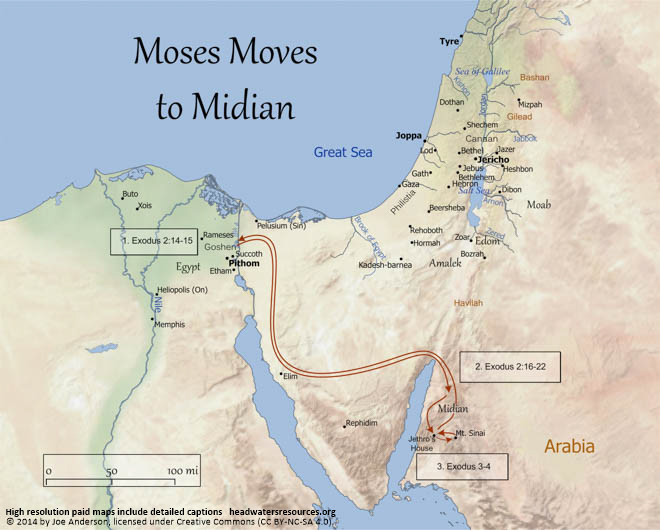
  12. His Sojourning among the Gentiles. “But Moses fled from the face of Pharaoh, and dwelt in the land of Midian (Ex. 2:15). Following Christ’s rejection by the Jews, we read, “God at the first did visit the Gentiles, to take out of them a people for His name” (Acts 15:14).
  13. His Seat on the well. Away from his own land, we read of Moses, “And he sat down by a well” (Ex. 2:15). So the only time we read of the Lord Jesus seated by the well, was when He was outside Israel’s borders, in Samaria (John 4:46).
  14. His Shepherdhood. “Now Moses kept the flock of Jethro his father-in-law” (Ex. 3:1). This is the character which Christ sustains to His elect among the Gentiles: “And other sheep I have, which are not of this fold, them also I must bring, and they shall hear My voice; and there shall be one flock, one Shepherd” (John 10:16).
  15. His Season of Seclusion. Before he entered upon his real mission, Moses spent many years in obscurity. Who had supposed that this one, there “at the backside of the desert,” was destined to such an honorable future? So it was with the incarnate Son of God. Before He began His public ministry, He was hidden away in despised Nazareth. Who that saw Him there in the carpenter’s shop, dreamed that He was ordained of God to the work of redemption!
  16. His Commission from God. He was called of God to emancipate His people from the house of bondage: “Come now therefore, and I will send thee unto Pharaoh, that thou mayest bring forth My people the children of Israel out of Egypt” (Ex. 3:10). So Christ was sent forth into this world to “seek and to save that which was lost” (Luke 19:10).
  17. His Apostleship. Thus he was God’s apostle unto Israel, for “apostle” signifies one “sent forth”: “Now therefore go” (Ex. 4:12). So Christ was the Sent One of God (John 9:4etc); yea, in Hebrews 3:1He is designated the Apostle.”
  18. His Credentials. His commission from God was confirmed by power to work miracles. So also Christ’s mission was authenticated by wondrous signs (Matthew 11:45). It should be noted that Moses is the first one mentioned in the O. T. that performed miracles; so is Christ in the N. T. – John the Baptist performed none (John 10:41).
  19. His first Miracles. Moses wrought many wonders, but it is most striking to observe that his first two miraculous signs were power over the serpent, and power over leprosy (Ex. 4:6-9). So after Christ began His public ministry, we read first of His power over Satan (Matthew 4:1011), and then His power over leprosy (Matthew 8:3).
  20. His Return to his own land. In Exodus 4:19we read, “And the Lord said unto Moses in Midian, Go, return into Egypt: for all the men are dead which sought thy life.” The antitype of this is found in Matthew 2:19, “An angel of the Lord appeareth in a dream to Joseph in Egypt, saying, Arise, and take the young Child and His mother, and go into the land of Israel: for they are dead which sought the young Child’s life!”
  21. His Acceptance by his brethren. This is recorded in Exodus 4:29-31. How different was this from his first appearing before and rejection by the Hebrews (Ex. 2)! How beautifully it prefigured Israel’s acceptance of their Messiah at His second appearing!
  22. His powerful Rod. Moses now wielded a rod of mighty power: see Exodus 9:2310:1314:16. So also it is written of Christ, “Thou shalt break them with a rod of iron” (Ps. 2:9).
  23. His Announcing solemn Judgments. Again and again he warned Pharaoh and his people of the sore punishment of God if they continued to defy him. So also Christ declared, “Except you repent, you shall all likewise perish” (Luke 13:3).
  24. His deliverance of Israel. Moses perfectly fulfilled his God-given commission and led Israel out of the house of bondage: “The same did God send to be a ruler and a deliverer” (Acts 7:35). So Christ affirmed, “If the Son therefore shall make you free, ye shall be free indeed” (John 8:36).
  25. His Headship. Remarkably is this brought out in 1 Corinthians 10:12, “All our fathers were under the cloud, and all passed through the sea; and were all baptized unto Morea.” So obedient Christians are “baptized unto Jesus Christ” (Rom. 6:3).
  26. His Leadership of Israel’s Praise. “Then sang Moses and the children of Israel” (Ex. 15:1) Of Christ too it is written, “In the midst of the congregation will I praise Thee” (Ps. 22:22).
  27. His Authority challenged. This is recorded in Numbers 16:3; the antitype in Matthew 21:23.
  28. His person Envied. See Psalm 106:16, and compare Mark 15:10.
  29. His person opposed. Though Israel were so deeply indebted to Moses, yet again and again we find them “murmuring” against him: Exodus 15:2416:2, etc. For the N. T. parallel see Luke 15:2John 6:41.
  30. His life Threatened. So fiercely did the ungrateful Hebrews oppose Moses that, on one occasion, they were ready to “stone” him (Ex. 17:4). How this brings to mind what we read of in John 8:5910:31!
  31. His Sorrows. Moses felt keenly the base ingratitude of the people. Mark his plaintive plea as recorded in Numbers 11:1114. So too the Lord Jesus suffered from the reproaches of the people: He was “the Man of sorrows and acquainted with grief.”
  32. His unwearied Love. Though misunderstood, envied, and opposed, nothing could alienate the affections of Moses from his people. “Many waters cannot quench love, neither can the floods drown it” (Song 8:7). Beautifully is this seen in Exodus 32. After Israel repudiated Jehovah and had worshipped the golden calf, after the Lord has disowned them as His people (Ex. 32:7), Moses supplicates God on their behalf, saying “Oh, this people have sinned a great sin, and have made them gods of gold. Yet now, if Thou wilt forgive their sin – ; and if not, blot me, I pray Thee, out of Thy book which Thou hast written” (vv. 31:32). How this reminds us of Him who “having loved His own which were in the world, He loved them unto the end” (John 13:1)!
  33. His Forgiving spirit. “And Miriam and Aaron spake against Moses… Hath the Lord indeed spoken only by Moses? Hath He not spoken also by us?” (Num. 12:12). But he answered not a word. How this pointed to Him who, when He was reviled, reviled not again” (1 Pet. 2:23). When Miriam was stricken with leprosy because of her revolt against her brother, we are told, ” Moses cried unto the Lord, saying, Heal her now, O God, I beseech Thee” (Num. 12:13).
  34. His Prayerfulness. An example of this has just been before us, but many other instances are recorded. Moses was, pre-eminently, a man of prayer. At every crisis he sought unto the Lord: see Exodus 5:228:129:3314:1515:2517:4, etc. Note how often in Luke’s Gospel Christ is also presented as a Man of prayer.
  35. His Meekness. “Moses was very meek, above all the men which were upon the face of the earth” (Num. 12:3) cf. Matthew 11:29.
  36. His Faithfulness. “Moses verily was faithful in all his house” (Heb. 3:5). So Christ is “The faithful and true Witness” (Rev. 3:14).
  37. His providing Israel with water. See Numbers 20:11and compare John 4:147:37.
  38. His Prophetic officeDeuteronomy 18:18and compare John 7:168:28.
  39. His Priestly activities. “Moses and Aaron among His priests” (Ps. 99:6). Illustrations are found in Leviticus 8: “And Moses took the blood, and put it upon the horns of the altar… and he took all the fat… and burned it upon the altar” (vv. 15, 16 and see 19:23). So Christ, as Priest, “offered Himself without spot to God” (Heb. 9:14).
  40. His Kingly rule. “Moses commanded us a law, even the inheritance of the congregation of Jacob. And he was king in Jeshurun” (Deut. 33:45). So Christ is King in Zion, and will yet be over the Jews (Luke 1:3233).
  41. His Judgeship. “Moses sat to judge the people: and they stood by Moses from the morning until the evening” (Ex. 18:13). Compare 2 Corinthians 5:10.
  42. His Leadership. Moses was the head and director of God’s people, as He said to him, “Lead the people unto the place of which I have spoken” (Ex. 32:34). So Christ is called, “The Captain of their salvation” (Heb. 2:10).
  43. His Mediation. What a remarkable word was that of Moses to Israel, “I stood between the Lord and you” (Deut. 5:5): “There is one God, and one Mediator between God and men, the Man Christ Jesus” (1 Tim. 2:5).
  44. His Election. In Psalm 106:23he is called, ” Moses His chosen.” So God says of Christ, “Behold My Servant, whom I uphold, Mine elect” (Isa. 42:1).
  45. His Covenant-engagement. “And the Lord said unto Moses, Write thou these words: for after the tenor of these words I have made a covenant with thee and with Israel” (Ex. 34:27): so Christ is denominated, “The Mediator of a better covenant” (Heb. 8:6).
  46. His sending forth of the Twelve. “These are the names of the men which Moses sent to spy out the land” (Num. 13:16see previous verses). So Christ sent forth twelve apostles (Matthew 10:5).
  47. His Appointing of the Seventy. ” And Moses went out and told the people the words of the Lord, and gathered the seventy men of the elders of the people” (Num. 11:24). So Christ selected seventy (Luke 10:1).
  48. His Wisdom. “Moses was learned in all the wisdom of the Egyptians” (Acts 7:22). Compare Colossians 2:3.
  49. His Might. “And was mighty in words and in deeds” (Acts 7:22). Behold the antitype of this in Matthew 113:34: “They were astonished, and said, Whence hath this Man this wisdom, and these mighty works?”
  50. His Intercession. “And Moses brought their cause before the Lord” (Num. 27:5). Compare Hebrews 7:25.
  51. His Intimate Communion with God. “And there arose not a prophet since in Israel like unto Moses, whom the Lord knew face to face” (Ex. 34:10). So, on earth, Christ was “The only-begotten Son, which is in the bosom of the Father” (John 1:18). It is striking to behold in Exodus 31 to 34 how Moses passed and re-passed between Jehovah in the mount and the camp of the congregation: expressive of his equal access to heaven and earth – compare John 3:13.
  52. His Knowledge of God. See Psalm 103:7and cf. John 5:20.
  53. His holy Anger. See Exodus 32:19and cf. Mark 3:5, etc.
  54. His Message. He was the mouthpiece of God: “And Moses came and told the people all the words of the Lord” (Ex. 24:3). Compare Hebrews 1:2.
  55. His Commandments. See Deuteronomy 4:2and cf. Matthew 28:20.
  56. His Written Revelation. See Exodus 31:13and cf. Revelation 1:1.
  57. His Fasting. See Exodus 34:28and cf. Matthew 4:2.
  58. His Transfiguration on the mount. See Exodus 34:2935and cf. Matthew 17:2.
  59. His Place Outside the Camp. See Exodus 33:7and cf. Hebrews 13:13.
  60. His Arraigning of the responsible head. See Exodus 32:21and cf. Revelation 2:1213.
  61. His Praying for Israel’s Forgiveness. See Numbers 14:19and cf. Luke 23:34.
  62. His Washing his Brethren with Water. “And Moses brought Aaron and his sons, and washed them with water” (Lev. 8:6). Who can fail to see in that a foreshadowing of what is recorded in John 13:5: “After that He poured water into a basin and began to wash the disciples’ feet!”
  63. His Prophecies. See Deuteronomy 28 and 33 and cf. Matthew 24 and Luke 21.
  64.  His Rewarding God’s servants. See Numbers 7:632:3340and cf. Revelation 22:12.
  65. His perfect Obedience. “Thus did Moses according to all that the Lord commanded, so did he” (Ex. 40:16). What a lovely foreshadowing was this of Him who could say, “I have kept My Father’s commandments” (John 16:10)!
  66. His erecting the Tabernacle. See Exodus 40:2, and cf. Zechariah 6:12.
  67. His Completing of his Work. “So Moses finished the work” (Ex. 40:33). What a blessed prefiguration was this of Him who declared, “I have finished the work which Thou gavest Me to do” (John 17:4).
  68. His Blessing of the People. “And Moses blessed them” (Ex. 39:43). So too we read in Luke 24:50, “And He led them out as far as to Bethany, and He lifted up His hands, and blessed them.”
  69. His Anointing of God’s House. “And Moses took the anointing oil (the O. T. emblem of the Holy Spirit), and anointed the tabernacle and all that was therein” (Lev. 8:10). Carefully compare Acts 2:1-333.
  70. His Unabated Strength. “His eye was not dim, nor his natural force abated” (Deut. 34:7): compare Matthew 27:50, and note the loud voice.”
  71. His Death was for the benefit of God’s people. It went ill with Moses for their sakes” (Ps. 106:32); “But the Lord was wroth with me for your sakes” (Deut. 3:26). What marvelous foreshadowings of the Cross were these!
  72. His Appointing of another Comforter. Moses did not leave his people comfortless, but gave them a successor: see Deuteronomy 31:23and cf. John 14:1618.
  73. His giving an Inheritance. “The land which Moses gave you on this side of Jordan” (Josh. 1:14): in Christ believers “have obtained an inheritance” (Eph. 1:11).
  74. His Death necessary before Israel could enter Canaan. “Moses My servant is dead; now therefore arise, go over this Jordan, thou, and all this people, unto the land which I do give to thee” (Josh. 1:2). “Except a corn of wheat fall into the ground and die, it abideth alone: but if it die, it bringeth forth much fruit” (John 12:24).
  75. His Second Appearing. Moses was one of the two Old Testament characters which returned to this earth in New Testament times (Matthew 17:3) – type of Christ’s second coming to the earth. Our space is already exhausted so we shall leave it with our readers to search the Scriptures for at least twenty-five other points in which Moses foreshadowed our Lord. The subject is exhaustless. And a most blessed subject it is, demonstrating anew the Divine authorship of the Bible. May the Lord bless to many this very imperfect attempt to show that “in the volume of the Book” it is written of Christ.

It’s amazing how God lets us see Jesus throughout the Old Testament.  Thank you Jesus for all You’ve done.

Darrell

www.Upwards.Church

Message Audio/Video and Outline: https://upwards.church/watch-now/leander-campus-videos

Watch Messages: YouTube-Upwards Church

Facebook: Upwards Church

Source:  special thanks to  Dr. Joseph R. Nally, Jr. 
Dr. Joseph R. Nally, Jr., D.D., M.Div. is the Theological Editor at Third Millennium Ministries (Thirdmill).   Who compiled this list.
Posted in Out of Darkness - Exodus | Tagged , , , , , , | Leave a comment

God is with Us! – Exodus 25-40 – Tabernacle

This week we’re wrapping up Exodus and it ends on a positive note.  There’s been ups and downs such as  the Golden Calf debacle, a real low point for the people of God.  Many of you know that I attended Texas A&M and love a good aggie joke.  The Israelites, like many of us can’t help but make some boneheaded decisions from time to time. It reminds me of… the aggie that interviewed for a job painting highway stripes.  The foreman said, “to get this job, we have to have an agreement.  I need for you to paint at least 3 miles of stripes a day.”  The aggie said, “no problem, I can do that.”   The first day, he painted 5 miles of stripes. The foreman was impressed. His second day on the job, the aggie painted 3 miles of stripes. The third day, the aggie only painted 1 mile of stripes and the fourth day a ½ mile. The foreman said, “I don’t think this is working out. What’s the deal? Your first day you did so well, but now it’s bad.”  The frustrated aggie replied, “I’m sorry boss, the bucket just keeps getting farther and farther away!”

The Israelites learned from their mistake.  As Exodus closes, they have been faithful, helpful and generous. They would follow God’s instructions, build the Tabernacle and experience God’s blessings upon them.

I love this quote from Skip Heitzig, he says, “Exodus starts out in the brickyards of Egypt, but ends in the tabernacle with God living at the center of his people. In the same way God wants to take us out of the slavery of sin and live at the center of our lives.”

In Exodus 25-40, God told Moses how to build the Tabernacle, and Moses delegated jobs in order to do it. God allows people to participate with him in carrying out his will. Our task is not just to sit and watch God work, but to give our best effort when work needs to be done.

The physical care of the Tabernacle required a long list of tasks, and each was important to the work of God’s house. This principle is important to remember today when God’s house is partly represented by the church. There are many seemingly unimportant tasks that must be done to keep our church buildings maintained. Cleaning, mowing, printing, washing dishes, changing diapers, painting walls, or pulling weeds may not seem very spiritual. But they are vital to the ministry of the church and are an important part of our worship of God.

I was amazed as I studied the Tabernacle how much it is mentioned in the bible.  Did you know that 1/3 of the book of Exodus deals with the Tabernacle?!  Chapter 25 to chapter 40 (leaving out 32 & 33 the Golden Calf) gives us 13 chapters.  Leviticus has 18 chapters devoted to the Tabernacle. Numbers has 13 chapters devoted to the Tabernacle. Deuteronomy has 2 chapters devoted to the Tabernacle. Hebrews has 4 chapters devoted to the Tabernacle.

50 Bible chapters devoted to the Tabernacle!   It must be important.

Each aspect of the Tabernacle teaches us about Christ. The tabernacle was designed specifically, in detail by God, and pointed to the Person and the ministry of Jesus Christ.

We will look at this in more detail when we get into Leviticus next year but briefly I’ll share how a few parts point to Christ.

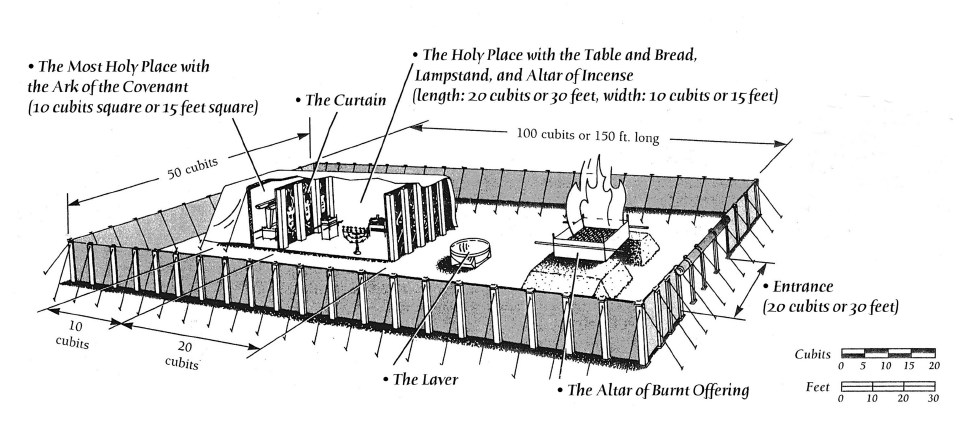
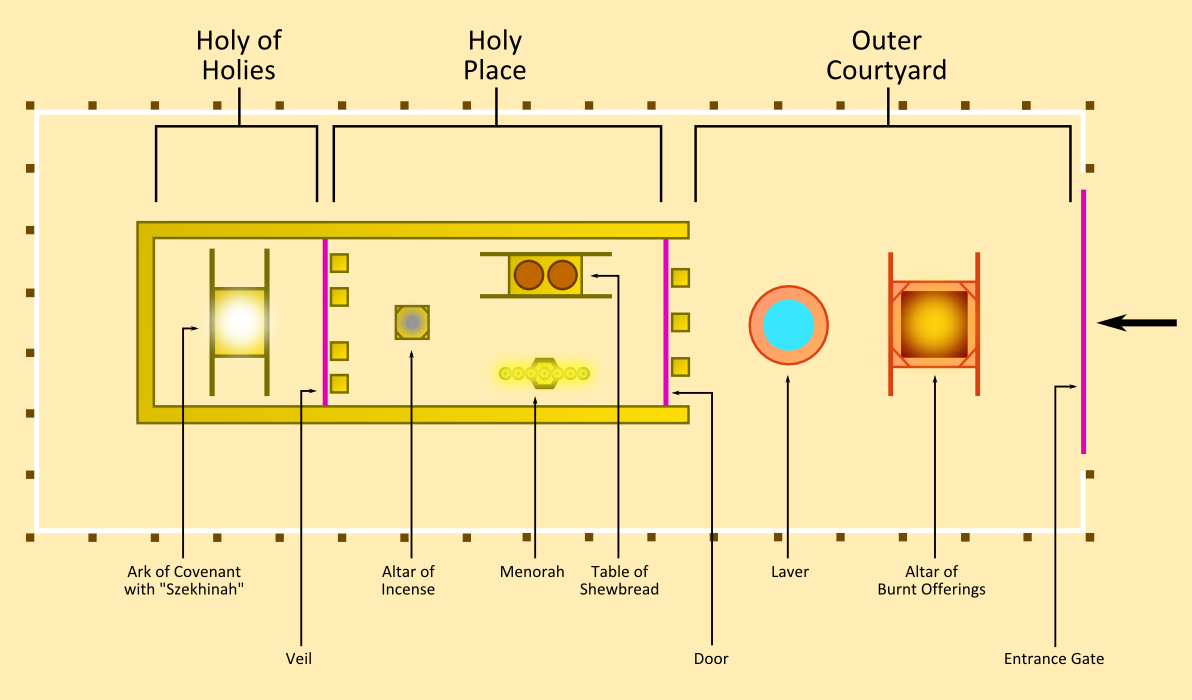
By looking at the image of the Tabernacle, see that there was only one way in.  This reminds us of Jesus who said, “I am THE way, no one comes to the father but by me.” John 14: 6  In John 10, Jesus says that he is THE gate, whoever enters through me will be saved.”

After the entrance we come face to face with the altar, a place of death and sacrifice. Sheep, goats and bulls were sacrificed at the altar and their blood atoned for the sins of the people.  When John the Baptist sees Jesus he reminds us, “Look, the Lamb of God, who takes away the sin of the world!  Jesus’ death on the cross, his shed blood is our atonement “once for all.”

Then we see a large basin for washing. The washing symbolized spiritual cleansing and forgiveness of sins. The basin reminds us that we are washed and cleansed by Christ.  The basin is also a picture of baptism, we are dead in our sins as we go down into the water but come up raised to walk in new life with Christ.

Next, entering the Holy Place and Most Holy Place we see that the décor changes from bronze on the outside to gold on the inside.  Gold symbolizes royalty and deity. The articles in the Holy Place reminds us of how we are to live with Christ in our lives.

The menorah represents the perfect light of Christ that guides us. Jesus said, “I am the light of the world, whoever follows me shall not walk in darkness but shall have the light of life.”  The bread of Presence reminds us that Christ is our sustenance and living bread. Jesus said, “I am the bread of life. Whoever comes to me will never go hungry.”

The Altar of Incense pointed to Jesus Christ as the great Intercessor and Mediator who represents us before God and makes our prayers acceptable to God.

The Holy Place and the Most Holy Place were divided by a large (shielding) curtain.  Do you remember what happened to the curtain when Jesus died on the cross?  “At that moment the curtain of the temple was torn in two from top to bottom.” Because of Jesus, “we can approach God’s throne of grace with confidence.”

As the Moses and the people finish the work of the Tabernacle, God is pleased.  Let’s look at what happens.

Then Moses set up the courtyard around the tabernacle and altar and put up the curtain at the entrance to the courtyard. And so Moses finished the work.

34 Then the cloud covered the tent of meeting, and the glory of the Lord filled the tabernacle

God’s presence is with His people!  He is living or dwelling at the center of his people.  The people see and experience the glory of God.   Every day when they woke up and they looked out and saw God and his glory in their presence.  Isn’t that what Jesus also did?

The Word (Jesus) became flesh and made his dwelling among us. We have seen his glory, the glory of the one and only Son, who came from the Father, full of grace and truth.

Christ was born and came to “tabernacle” (dwell) with us.

As Exodus closes, not only was God with the people, He also guided them.

In all the travels of the Israelites, whenever the cloud lifted from above the tabernacle, they would set out; 37 but if the cloud did not lift, they did not set out—until the day it lifted. 38 So the cloud of the Lord was over the tabernacle by day, and fire was in the cloud by night, in the sight of all the Israelites during all their travels.

The Israelites were once Egyptian slaves making bricks without straw. Here they were following the presence of God, carrying the Tabernacle or place of worship that they had built for God.

Exodus begins in gloom and ends in glory. This parallels our progress through the Christian life. We begin as slaves to sin and are redeemed by God.  He guides us through life with His word, the Holy Spirit, the church, and other believers.  We always have his presence and guidance.  We end our pilgrimage living with God forever.

Darrell

www.Upwards.Church

Message Audio/Video and Outline: https://upwards.church/watch-now/leander-campus-videos

Watch Messages: YouTube-Upwards Church

Facebook: Upwards Church

Sources: Life Application Study Bible, (Wheaton, IL: Tyndale, 1988), WORDsearch CROSS e-book, 156.
The Preacher’s Outline & Sermon Bible – Exodus II, (Chattanooga: Leadership Ministries Worldwide, 1996), WORDsearch CROSS e-book, Under: “F. The Assembly and Dedication of the Tabernacle, the Center of Worship: Experiencing the Presence of the Lord, 40:1-38”.
Posted in Out of Darkness - Exodus | Tagged , , , , , , | 1 Comment