
The Good News of God – Romans 1:1

The Good News of God (Romans 1:1) Paul, a bond-servant of Christ Jesus, called as an apostle, set apart for the gospel of God, (1:1)

A quick look at any news outlet reminds us that in our world most news is bad and seems to be getting worse. What is happening on a national and worldwide scale is simply the magnification of what is happening on an individual level. As personal problems, animosities, and fears increase, so do their counterparts in society at large.

Human beings are in the hold of a terrifying power that grips them at the very core of their being. Left unchecked, it pushes them to self-destruction in one form or another. That power is sin, which is always bad news.

Sin is bad news in every dimension. Among its consequences are four inevitable byproducts that guarantee misery and sorrow for a world taken captive. First, sin has selfishness at its heart. The basic element of fallen human nature is exaltation of self, the ego. When Satan fell, he was asserting his own will above God’s, five times declaring, “I will…” (Isa. 14:13-14). Man fell by the same self-will, when Adam and Eve asserted their own understanding about right and wrong above God’s clear instruction (Gen. 2:16-17; 3:1-7).

By nature man is self-centered and inclined to have his own way. He will push his selfishness as far as circumstances and the tolerance of society will allow. When self-will is unbridled, man consumes everything and everyone around him in an insatiable quest to please himself. When friends, fellow workers, or a spouse cease to provide what is wanted, they are discarded like an old pair of shoes. Much of modern western society has been so imbued with the propriety of self-esteem and self-will that virtually every desire has come to be considered a right.

The ultimate goal in many lives today is little more than perpetual self-satisfaction. Every object, every idea, every circumstance, and every person is viewed in light of what it can contribute to one’s own purposes and welfare. Lust for wealth, possessions, fame, dominance, popularity, and physical fulfillment drives people to pervert everything they possess and everyone they know. Employment has become nothing more than a necessary evil to finance one’s indulgences. As is often noted, there is constant danger of loving things and using people rather than loving people and using things. When that temptation is succumbed to, stable and faithful personal relationships become impossible. A person engulfed in self-will and self-fulfillment becomes less and less capable of loving, because as his desire to possess grows, his desire to give withers. And when he forfeits selflessness for selfishness, he forfeits the source of true joy.

Selfish greed progressively alienates a person from everyone else, including those who are closest and dearest. The end result is loneliness and despair. Everything that is craved soon yields to the law of diminishing returns, and the more one has of it the less it satisfies.

Second, sin produces guilt, another form of bad news. No matter how convincingly one tries to justify selfishness, its inevitable abuse of things and other people cannot escape generating guilt.

Like physical pain, guilt is a God-given warning that something is wrong and needs correcting. When guilt is ignored or suppressed, it continues to grow and intensify and with it come anxiety, fear, sleeplessness, and countless other spiritual and physical afflictions. Many people try to overcome those afflictions by masking them with possessions, money, alcohol, drugs, sex, travel, and psychoanalysis. They try to assuage their guilt by blaming society, parents, a deprived childhood, environment, restrictive moral codes, and even God Himself. But the irresponsible notion of blaming other persons and things only aggravates the guilt and escalates the accompanying afflictions.

Third, sin produces meaninglessness, still another form of bad news and one that is endemic to modern times. Trapped in his own selfishness, the self-indulgent person has no sense of purpose or meaning. Life becomes an endless cycle of trying to fill a void that cannot be filled. The result is futility and despair. To questions such as, “Why am I here? What is the meaning of life? What is truth?” he finds no answers in the world but the lies of Satan, who is the author of lies and prince of the present world system (cf. John 8:44; 2 Cor. 4:4). In the words of Edna St. Vincent Millay in her poem “Lament,” he can only say “Life must go on; I forget just why.” Or, like the central character in one of Jean-Paul Sartre’s novels, he may say nihilistically, “I decided to kill myself to remove at least one superfluous life.”

A fourth element in sin’s chain of bad news is hopelessness, which is the companion of meaninglessness. The consumptively selfish person forfeits hope, both for this life and for the next. Although he may deny it, he senses that even death is not the end, and for the hopeless sinner death becomes therefore the ultimate bad news.

Millions of babies are born every day into a world filled with bad news. And because of the boundless selfishness that permeates modern society, millions of other babies are not allowed to enter the world at all. That tragedy alone has made the bad news of the modern world immeasurably worse.

The tidbits of seemingly good news are often merely a brief respite from the bad, and sometimes even what appears to be good news merely masks an evil. Someone once commented cynically that peace treaties merely provide time for everyone to reload!

But the essence of Paul’s letter to the Romans is that there is good news that is truly good. The apostle was, in fact, “a minister of Christ Jesus to the Gentiles, ministering as a priest of the gospel of God” (Rom. 15:16). He brought the good news that in Christ sin can be forgiven, selfishness can be overcome, guilt can be removed, anxiety can be alleviated, and life can indeed have hope and eternal glory.

In his Romans letter Paul speaks of the good news in many ways, each way emphasizing a uniquely beautiful facet of one spiritual gem. He calls it the blessed good news, the good news of salvation, the good news of Jesus Christ, the good news of God’s Son, and the good news of the grace of God. The letter begins (1:1) and ends (16:25-26) with the good news.

The entire thrust of the sixteen chapters of Romans is distilled into the first seven verses. The apostle apparently was so overjoyed by his message of good news that he could not wait to introduce his readers to the gist of what he had to say. He burst into it immediately.

In Romans 1:1-7 Paul unfolds seven aspects of the good news of Jesus Christ. He first identifies himself as the preacher of the good news (v. 1), which will be discussed in this present chapter. He then tells of the promise (v. 2), the Person (vv. 3-4), the provision (v. 5a), the proclamation (v. 5b), the purpose (v. 5c), and the privileges of the good news (vv. 6-7).

The Preacher of the Good News Paul, a bond-servant of Christ Jesus, called as an apostle, set apart for the gospel of God, (1:1)

God called a unique man to be the major spokesman for His glorious good news. Paul was God’s keynote speaker, as it were, for heralding the gospel. A singularly gifted man, he was given divine “insight into the mystery of Christ” (Eph. 3:4), “the mystery which has been hidden from the past ages and generations; but has now been manifested to His saints” (Col. 1:26). That remarkable Jew with Greek education and Roman citizenship, with incredible leadership ability, high motivation, and articulate expression, was specially and directly called, converted, and gifted by God.

Paul crisscrossed much of the Roman Empire as God’s ambassador of the good news of Christ. He performed many healing miracles, yet was not relieved of his own thorn in the flesh. He raised Eutychus from the dead but was at least once left for dead himself. He preached freedom in Christ but was imprisoned by men during many years of his ministry.

In the first verse Paul discloses three important things about himself in regard to his ministry: his position as a servant of Christ, his authority as an apostle of Christ, and his power in being set apart for the gospel of Christ.

Paul’s Position as a Servant Of Christ  a bond-servant of Christ Jesus, (1:1a)

Doulos (bond-servant) carries the basic idea of subservience and has a wide range of connotations. It was sometimes used of a person who voluntarily served others, but most commonly it referred to those who were in unwilling and permanent bondage, from which often there was no release but death.

The Hebrew equivalent (ʾebed) is used hundreds of times in the Old Testament and carries the same wide range of connotations. The Mosaic law provided for an indentured servant to voluntarily become a permanent bond-slave of a master he loved and respected. “If a slave plainly says, ‘I love my master, my wife and my children; I will not go out as a free man,’ then his master shall bring him to God, then he shall bring him to the door or the doorpost. And his master shall pierce his ear with an awl; and he shall serve him permanently” (Ex. 21:5-6).

That practice reflects the essence of Paul’s use of the term doulos in Romans 1:1. The apostle had given himself wholeheartedly in love to the divine Master who saved him from sin and death.

In New Testament times there were millions of slaves in the Roman Empire, the vast majority of whom were forced into slavery and kept there by law. Some of the more educated and skilled slaves held significant positions in a household or business and were treated with considerable respect. But most slaves were treated much like any other personal property of the owner and were considered little better than work animals. They had virtually no rights under the law and could even be killed with impunity by their masters.

Some commentators argue that because of the great difference between Jewish slavery as practiced in Old Testament times and the slavery of first-century Rome, Paul had only the Jewish concept in mind when speaking of his relationship to Christ. Many of the great figures in the Old Testament were referred to as servants. God spoke of Abraham as His servant (Gen. 26:24; Num. 12:7). Joshua is called “the servant of the Lord” (Josh. 24:29), as are David (2 Sam. 7:5) and Isaiah (Isa. 20:3). Even the Messiah is called God’s Servant (Isa. 53:11). In all of those instances, and in many more in the Old Testament, the term servant carries the idea of humble nobility and honor. But as already noted, the Hebrew word (ʾebed) behind servant was also used of bond-slaves.

In light of Paul’s genuine humility and his considering himself the foremost of sinners (1 Tim. 1:15), it is certain that he was not arrogating to himself the revered and noble title of servant of the Lord as used in the citations above. He considered Himself Christ’s bond-servant in the most unassuming sense.

Here Paul uses the term diakonos to describe his position as servant, a term commonly used of table waiters. But as in his use of doulos, the emphasis here is on subservience and insignificance, not honor. Later in the same letter he asks his readers to regard him as a galley slave (4:1). The term used here is hupēretēs (“servants”) which literally means “underrowers,” referring to the lowest level of rowers in the large galley of a Roman ship. This was perhaps the hardest, most dangerous, and most demeaning work a slave could do. Such slaves were considered the lowest of the low.

Because he was called and appointed by Christ Himself, Paul would never belittle his position as an apostle or even as a child of God. He plainly taught that godly leaders in the church, especially those who are diligent in preaching and teaching, are “worthy of double honor” by fellow believers (1 Tim. 5:17). But he continually emphasized that such positions of honor are provisions of God’s grace.

Paul’s Authority as an Apostle  called as an apostle, (1:1b)

Paul next establishes the authority of his ministry, based on his being called as an apostle. Perhaps a better rendering would be “a called apostle,” which more clearly points up the fact that his position as an apostle was not of his own doing. He did not volunteer for that office, nor was he elected by fellow believers. He was divinely called by the Lord Jesus Christ Himself.

While Paul, then called Saul, was still blinded from his miraculous encounter with Jesus on the Damascus Road, the Lord said to Ananias about Paul: “He is a chosen instrument of Mine, to bear My name before the Gentiles and kings and the sons of Israel” (Acts 9:15). In relaying the message to Paul, Ananias said, “The God of our fathers has appointed you to know His will, and to see the Righteous One, and to hear an utterance from His mouth. For you will be a witness for Him to all men of what you have seen and heard” (Acts 22:14-15). Paul later gave the additional revelation that Christ already had given that message directly to him, saying,

Arise, and stand on your feet; for this purpose I have appeared to you, to appoint you a minister and a witness not only to the things which you have seen, but also to the things in which I will appear to you; delivering you from the Jewish people and from the Gentiles, to whom I am sending you, to open their eyes so that they may turn from darkness to light and from the dominion of Satan to God in order that they may receive forgiveness of sins and an inheritance among those who have been sanctified by faith in Me. (Acts 26:16-18)

Paul told the Corinthian believers, “I am under compulsion; for woe is me if I do not preach the gospel” (1 Cor. 9:16). God had given him a task he had never dreamed of and had never asked for, and he knew he would be in serious trouble if he was not obedient to his divine commission.

Paul was “an apostle (not sent from men, nor through the agency of man, but through Jesus Christ, and God the Father, who raised Him from the dead)” (Gal. 1:1). He went on to declare, “Am I now seeking the favor of men, or of God? Or am I striving to please men? If I were still trying to please men, I would not be a bond-servant of Christ” (v. 10).

Apostle translates apostolos, which has the basic meaning of a person who is sent. It referred to someone who was officially commissioned to a position or task, such as an envoy or ambassador. Cargo ships were sometimes called apostolic, because they were dispatched with a specific shipment for a specific destination.

The term apostle appears some seventy-nine times in the New Testament and is used in a few instances in a general, nontechnical sense (see Rom. 16:7; Acts 14:14). In its broadest sense, apostle can refer to all believers, because every believer is sent into the world as a witness for Christ. But the term is primarily used as a specific and unique title for the thirteen men (the Twelve, with Matthias replacing Judas, and Paul) whom Christ personally chose and commissioned to authoritatively proclaim the gospel and lead the early church.

The thirteen apostles not only were all called directly by Jesus but all were witnesses of His resurrection, Paul having encountered Him on the Damascus Road after His ascension. Those thirteen apostles were given direct revelation of God’s Word to proclaim authoritatively, the gift of healing, and the power to cast out demons (Matt. 10:1). By these signs their teaching authority was verified (cf. 2 Cor. 12:12). Their teachings became the foundation of the church (Eph. 2:20), and their authority extended beyond local bodies of believers to the entire believing world.

Paul’s Power in Being Set Apart for the Gospel set apart for the gospel of God, (1:1c)

Because Paul was called and sent by God as an apostle, his whole life was set apart in the Lord’s service. Even a person who has been called by God to a special type or place of service cannot be effective if he is not also separated unto God for the gospel of God.

Throughout the Old Testament, God provided for the setting apart of His chosen people. To the entire nation He declared, “You are to be holy to Me, for I the Lord am holy; and I have set you apart from the peoples to be Mine” (Lev. 20:26). Just before He delivered His people from Pharaoh’s Army the Lord commanded: “You shall devote to the Lord the first offspring of every womb, and the first offspring of every beast that you own; the males belong to the Lord” (Ex. 13:12). God also demanded the firstfruits of their crops (Num. 15:20). The Levites were set apart as the priestly tribe (Num. 8:11-14).

Paul was now set apart divinely, not humanly. God revealed to him that he had been set apart by God’s grace even from his mother’s womb (Gal. 1:15). When he and Barnabas were set apart and commissioned for missionary work by the church in Antioch, it was on the direct instruction of the Holy Spirit (Acts 13:2).

The term euangelion (gospel) is used some sixty times in this epistle. William Tyndale defined it as “glad tidings” (Doctrinal Treatises and Introductions to Different Portions of the Holy Scriptures by William Tyndale, Henry Walter, ed. [Cambridge: University Press, 1848], p. 484). It is the good news that God will deliver us from our selfish sin, free us from our burden of guilt, and give meaning to life and make it abundant.

The most important thing about the gospel is that it is of God. Paul makes that clear in the first sentence of his epistle in order that his readers have no confusion regarding the specific good news about which he was speaking. Euangelion was a common term used in the cult of emperor worship that was common in Paul’s day. Many of the caesars claimed deity for themselves and demanded worship from every person in the empire, free or slave, rich or poor, renowned or unknown. Favorable events relating to the emperor were proclaimed to the citizens as “good news.” The town herald would stand in the village square and shout, “Good news! The emperor’s wife has given birth to a son,” or, “Good news! The emperor’s heir has come of age,” or, “Good news! The new emperor has acceded to the throne.”

Especially because he was writing to believers in the Roman capital, Paul wanted to be certain that his readers understood that the good news he proclaimed was of an entirely different order than the trivial and vain proclamations concerning the emperors. The fact that it was of God meant that God was the source of it. It was not man’s good news, but God’s good news for man.

One cannot help wondering why God would condescend to bring good news to a world that rejects and scorns Him. No one deserves to hear it, much less to be saved by it.

Paul himself was living proof of God’s great love and mercy. Though he had opposed Christ and persecuted the church, God had made him the Church’s chief spokesman. He could imagine no greater role than being set apart to God for the proclamation of His gospel, the good news of salvation in Christ. Perhaps that is one reason he was so effective. Who knew better than Paul just how good the good news really was?

www.Upwards.Church

Message Audio/Video and Outline: https://upwards.church/watch-now/leander-campus-videos

Watch Messages: YouTube-Upwards Church

Facebook: Upwards Church

Sources: adapted from MacArthur New Testament Commentary, The – MacArthur New Testament Commentary – Romans 1-8.

Life Application Study Bible.
Posted in Romans - Foundation of our Faith | Tagged , , , , , , , , | Leave a comment

Romans Invitation and Introduction

You’re Invited to our New Series in the Book of Romans!

Series:  Romans (Foundation of Our Faith)   5 weeks

 Description:  There is not any letter that is more foundational to Christian faith than Paul’s letter to the Romans. It is the greatest, longest and widest in its scope of all of Paul’s letters.  Our series is bird’s-eye view examining the sinfulness of humanity, the atoning work of Christ, the transforming power of the Spirit, and the new ethic for a Christian life.

 Dates                      Titles (Scriptures)                                          Events

 Aug. 27 – Without Excuse (Romans 1-2)

Sep. 3 –– The Roman’s Road (Romans 3-10)                                    Communion

Sep. 10 – The Struggle is Real (Romans 7)

Sep. 17 – Life in the Spirit (Romans 8)

Sep. 24 – Personal Responsibility (Romans 12)

Introduction to the Book of Romans: 

A knowledgeable and experienced, the district attorney makes his case. Calling key witnesses to the stand, he presents the evidence. After discrediting the testimonies of witnesses for the defense by skillfully cross-examining them, he concludes with an airtight summary and stirring challenge for the jury. The announced verdict is no surprise. “Guilty” states the foreman, and justice is served. The apostle Paul was intelligent, articulate, and committed to his calling. Like a skilled lawyer, he presented the case for the gospel clearly and forth rightly in his letter to the believers in Rome.

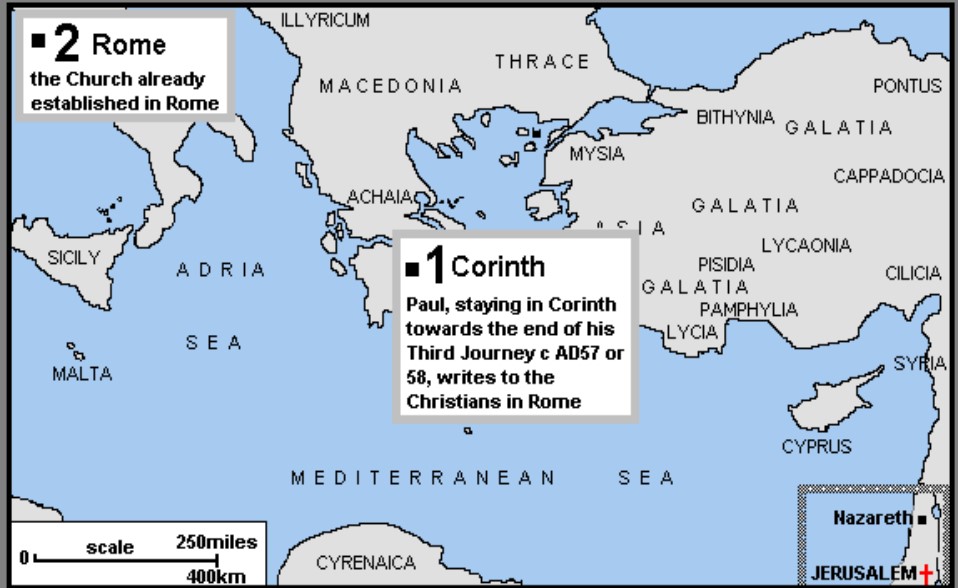
Paul had heard of the church at Rome, but he had not yet been there, nor had any of the other apostles. Evidently the church had been started by Jews who had come to faith during Pentecost (Acts 2). They had spread the gospel on their return to Rome, and the church had grown.

Although many barriers separated them, Paul felt a bond with these believers in Rome. They were his brothers and sisters in Christ, and he longed to see them face to face. He had never met most of the believers there, yet he loved them. He sent this letter to introduce himself and to make a clear declaration of the faith.

After a brief introduction, Paul presents the facts of the gospel (1:3) and declares his allegiance to it (1:16, 17). He continues by building an airtight case for the lostness of humanity and the necessity for God’s intervention (1:18-3:20).

Then Paul presents the Good News: Salvation is available to all, regardless of a person’s identity, sin, or heritage. We are saved by grace (unearned, undeserved favor from God) through faith (complete trust) in Christ and his finished work. Through him we can stand before God justified, “not guilty” (3:21-5:21). With this foundation Paul moves directly into a discussion of the freedom that comes from being saved—freedom from the power of sin (6:1-23), freedom from the domination of the law (7:1-25), freedom to become like Christ and discover God’s limitless love (8:1-39).

Speaking directly to his Jewish brothers and sisters, Paul shares his concern for them and explains how they fit into God’s plan (9:1-11:12). God has made the way for Jews and Gentiles to be united in the body of Christ; both groups can praise God for his wisdom and love (11:13-36).

Paul explains what it means to live in complete submission to Christ: Use spiritual gifts to serve others (12:3-8), genuinely love others (12:9-21), and be good citizens (13:1-14). Freedom must be guided by love as we build each other up in the faith, being sensitive and helpful to those who are weak (14:1-15:4). Paul stresses unity, especially between Gentiles and Jews (15:5-13). He concludes by reviewing his reasons for writing, outlining his personal plans (15:22-33), greeting his friends, and giving a few final thoughts and greetings from his traveling companions (16:1-27).

As we discover Romans, lets reexamine our commitment to Christ, and reconfirm our relationships with other believers in Christ’s body.

Vital Statistics 

Purpose:  To introduce Paul to the Romans and to give a sample of his message before he arrives in Rome

Author: Paul

Original Audience: The Christians in Rome

Date Written: About A.D. 57, from Corinth, as Paul was preparing for his visit to Jerusalem.

Setting: Apparently Paul had finished his work in the east, and he planned to visit Rome on his way to Spain after first bringing a collection to Jerusalem for the poor Christians there (15:23-28). The Roman church was mostly Jewish but also contained a great number of Gentiles.

Key Verse: “Therefore, since we have been made right in God’s sight by faith, we have peace with God because of what Jesus Christ our Lord has done for us” (5:1).

Key People: Paul, Phoebe

Key Place: Rome

Special Features:  Paul wrote Romans as an organized and carefully presented statement of his faith—it does not have the form of a typical letter. He does, however, spend considerable time greeting people in Rome at the end of the letter.

The Blueprint

  1. WHAT TO BELIEVE (1:1-11:36)
    1. Sinfulness of humanity
    2. Forgiveness of sin through Christ
    3. Freedom from sin’s grasp
    4. Israel’s past, present, and future

    Paul clearly sets forth the foundations of the Christian faith. All people are sinful; Christ died to forgive sin; we are made right with God through faith; this begins a new life with a new relationship with God. Like a sports team that constantly reviews the basics, we will be greatly helped in our faith by keeping close to these foundations. If we study Romans carefully, we will never be at a loss to know what to believe.

  2. HOW TO BEHAVE (12:1-16:27)
    1. Personal responsibility
    2. Personal notes

    Paul gives clear, practical guidelines for the believers in Rome. The Christian life is not abstract theology unconnected with life, but it has practical implications that will affect how we choose to behave each day. It is not enough merely to know the gospel; we must let it transform our life and let God impact every aspect of our lives.

MEGATHEMES
THEME EXPLANATION IMPORTANCE
Sin Sin means refusing to do God’s will and failing to do all that God wants. Since Adam’s rebellion against God, our nature is to disobey him. Our sin cuts us off from God. Sin causes us to want to live our own way rather than God’s way. Because God is morally perfect, just, and fair, he is right to condemn sin. Each person has sinned, either by rebelling against God or by ignoring his will. No matter what our background or how hard we try to live good and moral lives, we cannot earn salvation or remove our sin. Only Christ can save us.
Salvation Our sin points out our need to be forgiven and cleansed. Although we don’t deserve it, God, in his kindness, reached out to love and forgive us. He provides the way for us to be saved. Christ’s death paid the penalty for our sin. It is good news that God saves us from our sin. But in order to enter into a wonderful new relationship with God, we must believe that Jesus died for us and that he forgives all our sin.
Growth By God’s power, believers are sanctified—made holy. This means we are set apart from sin, enabled to obey and to become more like Christ. When we are growing in our relationship with Christ, the Holy Spirit frees us from the demands of the law and from fear of judgment. Because we are free from sin’s control, the law’s demands, and fear of God’s punishment, we can grow in our relationship with Christ. By trusting in the Holy Spirit and allowing him to help us, we can overcome sin and temptation.
Sovereignty God oversees and cares about his people—past, present, and future. God’s ways of dealing with people are always fair. Because God is in charge of all creation, he can save whomever he wills. Because of God’s mercy, both Jews and Gentiles can be saved. We all must respond to his mercy and accept his gracious offer of forgiveness. Because he is sovereign, let him reign in your heart.
Service When our purpose is to give credit to God for his love, power, and perfection in all we do, we can serve him properly. Serving him unifies all believers and enables them to show love and sensitivity to others. None of us can be fully Christlike by ourselves—it takes the entire body of Christ to fully express Christ. By actively and vigorously building up other believers, Christians can be a symphony of service to God.

Hope your can join us! Darrell

www.Upwards.Church

Message Audio/Video and Outline: https://upwards.church/watch-now/leander-campus-videos

Watch Messages: YouTube-Upwards Church

Facebook: Upwards Church

Source: adapted from Life Application Study Bible, (Wheaton, IL: Tyndale, 1988), WORDsearch CROSS e-book, 1890-1889.
Posted in Romans - Foundation of our Faith | Tagged , , , , , , | Leave a comment

Boundless Love – Hosea Introduction & Invitation

You’re invited to our new series in the book of Hosea called “Boundless Love!”

Series:  Boundless Love   (Hosea)

Bible Book:  Hosea, 1st of the Minor Prophets in the Old Testament

DESCRIPTION:  Are you a fan of love stories?  How about this one: a guy marries a prostitute and she breaks his heart.  He takes her back again and she does it again.  This true story is also the story of God’s love for us.  His love for you and me is not logical.   Join us as we discover God’s Boundless love from the book of Hosea.  It’s a love for each of us and a love to share with our community.

 Dates           Titles (Chapters)                                  Events

 Aug. 6           Crazy Love (Hosea 1)                            Communion

Aug. 13         Redeeming Love (Hosea 2-3)

Aug. 20         Boundless Love (Hosea 11-14)

Introduction: 

GROOMSMEN stand at attention as the music swells and the bride begins her long walk down the aisle, arm in arm with her father. The smiling, but nervous, husband-to-be follows every step, his eyes brimming with love. Then happy tears are shed, vows stated, and families merged. A wedding is a joyous celebration of love. It is the holy mystery of two becoming | one, of beginning life together, and of commitment. Marriage is ordained by God and illustrates his relationship with his people. Thus, there is perhaps no greater tragedy than the violation of those sacred vows.

God told Hosea to find a wife and revealed to him ahead of time that she would be unfaithful to him. Although she would bear many children, some of these offspring would be fathered by others. In obedience to God, Hosea married Gomer. His relationship with her, her adultery, and their children became living, prophetic examples to Israel.

The book of Hosea is a love story—real, tragic, and true. Transcending the tale of young man and wife, it tells of God’s love for his people and the response of his “bride.” A covenant had been made, and God had been faithful. His love was steadfast, and his commitment unbroken. But Israel, like Gomer, was adulterous and unfaithful, spurning God’s love and turning instead to false gods. Then after warning of judgment, God reaffirmed his love and offered reconciliation. His love and mercy were overflowing, but justice would be served.

The book begins with God’s marriage instructions to Hosea. After Hosea’s marriage, children were born, and each given a name signifying a divine message (chapter 1). Then, as predicted, Gomer left Hosea to pursue her lusts (chapter 2). But Hosea (whose name means “salvation”) found her, redeemed her, and brought her home again, fully reconciled (chapter 3). Images of God’s love, judgment, grace, and mercy were woven into their relationship. Next, God outlined his case against the people of Israel: Their sins would ultimately cause their destruction (chapters 4; 6-7; 12) and would rouse his anger, resulting in punishment (chapters 5; 8-10; 12-13). But even in the midst of Israel’s immorality, God was merciful and offered hope, expressing his infinite love for his people (chapter 11) and the fact that their repentance would bring about blessing (chapter 14).

The book of Hosea dramatically portrays our God’s constant and persistent love. As you read this book, watch the prophet submit himself willingly to his Lord’s direction; grieve with him over the unfaithfulness of his wife and his people; and hear the clear warning of judgment. Then reaffirm your commitment to being God’s person, faithful in your love and true to your vows.

Vital Statistics

Purpose:  To illustrate God’s love for his sinful people

Author: Hosea son of Beeri (“Hosea” means “salvation”)

Original Audience: The people of Israel (the northern kingdom)

Date Written: Approximately 715 B.C., recording events from about 753-715 B.C.

Setting: Hosea began his ministry during the end of the prosperous but morally declining reign of Jeroboam II of Israel (the upper classes were doing well, but they were oppressing the poor). He prophesied until shortly after the fall of Samaria in 722 B.C.

Key Verse: “Then the Lord said to me, ‘Go and love your wife again, even though she commits adultery with another lover. This will illustrate that the Lord still loves Israel, even though the people have turned to other gods and love to worship them‘” (3:1).

Key People:  Hosea, Gomer, their children

Key Places: The northern kingdom (Israel), Samaria, Ephraim

Special Features: Hosea employs many images from daily life: God is depicted as husband, lion, leopard, bear, dew, rain, moth, and others; Israel is pictured as wife, sick person, vine, grapes, early fruit, olive tree, woman in childbirth, oven, morning mist, chaff, and smoke, to name a few.

The Blueprint

  1. HOSEA’S WAYWARD WIFE (1:1-3:5)

    Hosea was commanded by God to marry a woman who would be unfaithful to him and would cause him many heartaches. Just as Gomer lost interest in Hosea and ran after other lovers, we, too, can easily lose appreciation for our special relationship with God and pursue dreams and goals that do not include him. When we compromise our Christian lifestyles and adopt the ways of the world, we are being unfaithful.

  2. GOD’S WAYWARD PEOPLE (4:1-14:9)
    1. Israel’s sinfulness
    2. Israel’s punishment
    3. God’s love for Israel

God wanted the people in the northern kingdom to turn from their sin and return to worshiping him alone, but they persisted in their wickedness. Throughout the book, Israel is described as ignorant of God, with no desire to please him. Israel did not understand God at all, just as Gomer did not understand Hosea. Like a loving husband or patient father, God wants people to know him and to turn to him daily.

MEGATHEMES
THEME EXPLANATION IMPORTANCE
The Nation’s Sin Just as Hosea’s wife, Gomer, was unfaithful to him, so the nation of Israel had been unfaithful to God. Israel’s idolatry was like adultery. They sought illicit relationships with Assyria and Egypt in pursuit of military might, and they mixed Baal worship with the worship of God. Like Gomer, we can chase after other loves—love of power, pleasure, money, or recognition. The temptations in this world can be very seductive. Are we loyal to God, remaining completely faithful, or have other loves taken his rightful place?
God’s Judgment Hosea solemnly warned Judah against following Israel’s example. Because Judah broke the covenant, turned away from God, and forgot her Maker, she experienced a devastating invasion and exile. Sin has terrible consequences. Disaster surely follows ingratitude toward God and rebellion. The Lord is our only true refuge. If we harden our hearts against him, there is no safety or security anywhere else. We cannot escape God’s judgment.
God’s Love Just as Hosea went after his unfaithful wife to bring her back, so the Lord pursues us with his love. His love is tender, loyal, unchanging, and undying. No matter what, God still loves us. Have you forgotten God and become disloyal to him? Don’t let prosperity diminish your love for him or let success blind you to your need for his love.
Restoration Although God will discipline his people for sin, he encourages and restores those who have repented. True repentance opens the way to a new beginning. God forgives and restores. There is still hope for those who turn back to God. No loyalty, achievement, or honor can be compared to loving him. Turn to the Lord while the offer is still good. No matter how far you have strayed, God is willing to forgive you.


www.Upwards.Church

Message Audio/Video and Outline: https://upwards.church/watch-now/leander-campus-videos

Watch Messages: YouTube-Upwards Church

Facebook: Upwards Church

Source: Life Application Study Bible.

Posted in Boundless Love - Hosea | Tagged , , , , , , , | 1 Comment

Isaiah Introduction and Invitation

You’re Invited!  New series:  Isaiah – 6 weeks

 Description:  Sound familiar?  As we study the prophet Isaiah, we notice that many of the problems that Israel had were similar to the problems that we have in our country today.  God’s people have rebelled and forgotten the great work of the One who saved them, guided them and blessed them. Through a series of prophecies, God warns His children of the consequences of their disobedience, while ensuring them future hope and comfort through the coming Messiah.

  Dates                      Titles (Scriptures)                                                               Events

June 25 – Experiencing God (Isa. 6)

July 2 – By His Wounds We are Healed (Isa. 53)                                      Communion
July 9 – On the Wings of Eagles (Isa. 40)

July 16 – Sins like Scarlet, White as Snow (Isa. 1)                            Youth Camp Jul 17-21
July 23 – Fallen One (Isaiah 14)                                  Pre-Teen & Kids Camp Jul 24-29
July 30 – Come You who are Thirsty (Isa. 55)

Introduction to Isaiah

SLOWLY he rose, and the crowd fell silent. Those at the back leaned forward, straining to hear. The atmosphere was electric. He spoke, and his carefully chosen words flew like swift arrows and found their mark. The great man, a spokesman for God, was warning—and condemning. The crowd became restless—shifting positions, clenching fists, and murmuring. Some agreed with his message, nodding their heads and weeping softly. But most were angry, and they began to shout back insults and threats.

Such was the life of a prophet.

The “office” of prophet was instituted during the days of Samuel, the last of the judges. Prophets stood with the priests as God’s special representatives. The prophet’s role was to speak for God, confronting the people and their leaders with God’s commands and promises. Because of this confrontational stance and the continuing tendency of people to disobey God, true prophets usually were not very popular. But though their message often went unheeded, they faithfully and forcefully proclaimed the truth.

The book of Isaiah is the first of the writings of the prophets in the Bible, and Isaiah, the author, is generally considered to be the greatest prophet. He was probably reared in an aristocratic home and was married to a prophet. In the beginning of his ministry he was well liked. But, like most prophets, he soon became unpopular because his messages were so difficult to hear. He called the people to turn from their lives of sin and warned them of God’s judgment and punishment. Isaiah had an active ministry for 60 years before he was executed during Manasseh’s reign (according to tradition). As God’s special messenger to Judah, Isaiah prophesied during the reigns of several of its rulers. Many of those messages are recorded in his book: Uzziah and Jotham, chapters 1-6; Ahaz, chapters 7-14; and Hezekiah, chapters 15-39.

The first half of the book of Isaiah (chapters 1-39) contains scathing denunciations and pronouncements as he calls Judah, Israel, and the surrounding nations to repent of their sins. The last 27 chapters (40-66), however, are filled with consolation and hope as Isaiah unfolds God’s promise of future blessings through his Messiah.

As you read Isaiah, imagine this strong and courageous man of God, fearlessly proclaiming God’s word, and listen to his message in relation to your own life—return, repent, and be renewed. Then trust in God’s redemption through Christ and rejoice. Your Savior has come, and he’s coming again!

Vital Statistics

Purpose:  To call the nation of Judah back to God and to tell of God’s salvation through the Messiah

Author: The prophet Isaiah son of Amoz

Date Written: The events of chapters 1-39 occurred during Isaiah’s ministry, so they were probably written about 700 B.C. Chapters 40-66, however, may have been written near the end of his life, about 681 B.C.

Setting: Isaiah is speaking and writing mainly in Jerusalem

Key Verse: But he was pierced for our rebellion, crushed for our sins. He was beaten so we could be whole. He was whipped so we could be healed” (53:5).

Key People: Isaiah; his two sons, Shear-jashub and Maher-shalal-hash-baz

Special Features: The book of Isaiah contains both prose and poetry and uses personification (attributing personal qualities to divine beings or inanimate objects). Also, many of the prophecies in Isaiah contain predictions that foretell a soon-to-occur event and a distant future event at the same time.

The Blueprint

  1. WORDS OF JUDGMENT (1:1-39:8)
    1. The sins of Israel and Judah
    2. Judgment against heathen nations
    3. God’s purpose in judgment
    4. Jerusalem’s true and false hopes
    5. Events during the reign of Hezekiah

The 39 chapters in the first half of Isaiah generally carry the message of judgment for sin. Isaiah brings the message of judgment to Judah, Israel, and the surrounding pagan nations. The people of Judah had a form of godliness, but in their hearts they were corrupt. Isaiah’s warnings were intended to purify the people by helping them understand God’s true nature and message. However, they ignored the repeated warnings that Isaiah brought. We need to heed the prophetic voice and not repeat their error.

  1. WORDS OF COMFORT (40:1-66:24)
    1. Israel’s release from captivity
    2. The future Redeemer
    3. The future Kingdom

The 27 chapters in the second half of Isaiah generally bring a message of forgiveness, comfort, and hope. This message of hope looks forward to the coming of the Messiah. Isaiah speaks more about the Messiah than does any other Old Testament prophet. He describes the Messiah as both a suffering Servant and a sovereign Lord. The fact that the Messiah was to be both a suffering Servant and a sovereign Lord could not be understood clearly until New Testament times. Based on what Jesus Christ has done, God freely offers forgiveness to all who turn to him in faith. This is God’s message of comfort to us because those who heed it find eternal peace and fellowship with him.

MEGATHEMES
THEME EXPLANATION IMPORTANCE
Holiness God is highly exalted above all his creatures. His moral perfection stands in contrast to evil people and nations. God is perfect and sinless in all his motives and actions, so he is in perfect control of his power, judgment, love, and mercy. His holy nature is our standard for morality. Because God is without sin, he alone can help us with our sin. It is only right that we regard him as supreme in power and moral perfection. We must never treat God as common or ordinary. He alone deserves our devotion and praise. He is always truthful, fair, and just.
Punishment Because God is holy, he requires his people to treat others justly. He promised to punish Israel, Judah, and other nations for faithless immorality and idolatry. True faith had degenerated into national pride and empty religious rituals. We must trust in God alone and fulfill his commands. We cannot forsake justice nor give in to selfishness. If we harden our hearts against his message, punishment will surely come to us.
Salvation Because God’s judgment is coming, we need a Savior. No person or nation can be saved without God’s help. Christ’s perfect sacrifice for our sins is foretold and portrayed in Isaiah. All who trust God can be freed from their sin and restored to him. Christ died to save us from our sin. We cannot save ourselves. He is willing to save all those who turn from their sin and come to him. Salvation is from God alone. No amount of good works can earn it.
Messiah God will send the Messiah to save his people. He will set up his own Kingdom as the faithful Prince of Peace, who rules with righteousness. He will come as sovereign Lord, but he will do so as a servant who will die to take away sins. Our trust must be in the Messiah, not in ourselves or in any nation or power. There is no hope unless we believe in him. Trust Christ fully and let him rule in your life as your sovereign Lord.
Hope God promises comfort, deliverance, and restoration in his future Kingdom. The Messiah will rule over his faithful followers in the age to come. Hope is possible because Christ is coming. We can be refreshed because there is compassion for those who repent. No matter how bleak our situation or how evil the world is, we must continue to be God’s faithful people who hope for his return.

www.Upwards.Church

Message Audio/Video and Outline: https://upwards.church/watch-now/leander-campus-videos

Watch Messages: YouTube-Upwards Church

Facebook: Upwards Church

Source for Introduction Notes:  Life Application Study Bible, (Wheaton, IL: Tyndale, 1988), WORDsearch CROSS e-book, 1088-1089.

Posted in Isaiah | Tagged , , , , | Leave a comment