

Hard Times & Prayer Lead to a Plan of Action – Esther 4

Throughout life we all face crises from time to time. Sometimes the crises are severe, threatening the stability and security of our lives. Other times the situations are less critical. But whether the crisis is financial difficulty or bankruptcy, marital problems or divorce, disobedient or rebellious children, failing grades or unemployment, assault or rape, severe disease or accident, terminal illness or death, in such times we stand in desperate need of help.

In our scripture today, Mordecai and the Jews were facing the crisis of their lives, a Decree of Extermination that had been issued by the Persian Empire. A whole race of people had been decreed by law to be slaughtered. Millions of Jews—every man, woman, child, and even babies—were to be killed. The Jews stood in desperate need of help, and only two people could help them: Mordecai and his adopted daughter Esther. For this very purpose, Esther had been raised up by God to sit on the throne as queen to King Xerxes

Esther risked her life by coming before the king. Her courageous act gives us a model to follow in approaching a difficult or dangerous task. Like Esther, we can: (1) Calculate the cost. Esther realized her life was at stake. (2) Set priorities. She believed that the safety of the Jewish race was more important than her life. (3) Prepare. She gathered support and fasted. (4) Determine a course of action and move ahead boldly. She didn’t think too long about it, allowing the interlude to lessen her commitment to what she had to do.

Do you have to face a hostile audience, confront a friend on a delicate subject, or talk to your family about changes to be made? Rather than dreading difficult situations or putting them off, take action with confidence by following Esther’s inspiring example.

Although Esther was the queen and shared some of the king’s power and wealth, she still needed God’s protection and wisdom. No one is secure in his or her own strength in any political system. It is foolish to believe that wealth or position can make us impervious to danger. Deliverance and safety come only from God.

In Hard Times What Do We Do?  (4:1-9)

As soon as Mordecai heard about the decree of extermination, he was gripped with fear and trembling. He immediately knew that the best hope of deliverance lay with his adopted daughter, Queen Esther. As queen, she stood the best chance of appealing to King Xerxes for mercy. Somehow, some way, he had to get an urgent message to Esther, informing her of the Decree of Extermination against the Jews and appealing to her for help. She alone could intercede and plead for mercy before the king. In this dramatic story, God meets the Jews’ desperate need for an intercessor, a deliverer, and a savior through the obedience and courage of Esther.

When Mordecai and the Jews heard about the Decree of Extermination, they reacted just as any people would: with deep, intense grief and mourning (vv.1-3). Knowing that Queen Esther could approach King Xerxes in behalf of the Jews, believing that perhaps she could convince him to reverse the decree of extermination, Mordecai rushed out into the city dressed in sackcloth and ashes. Crying loudly and bitterly, he made his way to the palace gate (vv.1-2). However, he could not enter the palace grounds because Persian law prohibited anyone clothed in sackcloth to go beyond the gate. No doubt the law had been instituted as a protection for the king, his family, and royal officials.

In the midst of the Jews’ weeping and wailing, they began to fast and pray. Many even prostrated themselves in sackcloth and ashes, a clear indication of repentance and prayer before the Lord.

Eventually, Esther received news of Mordecai’s deep distress, and she became very concerned (v.4). Although her servants did not know that the relationship between the queen and Mordecai was like that of a father and daughter, they did know that they were acquainted. In view of that, when some of the servants noticed Mordecai mourning at the palace gate, they reported his distress to Queen Esther. Apparently, she immediately became fearful, for if the king happened to hear Mordecai mourning so loudly and bitterly at the palace gate, he might have Mordecai arrested due to the disturbance he was causing. As quickly as she could, she gathered up clothing to send to him so he could enter the palace grounds to meet and share his problem with her. But, shockingly, he refused to accept the clothing. No doubt, Mordecai wanted to protect Esther all he could. To be identified with him now would have been most unwise, for he could have exposed the fact that she too was a Jew. Since she was queen, exposure could endanger her life immediately. Consequently, he refused to accept the clean clothing and chose not to enter the palace courtyard. Knowing that Queen Esther loved him, he knew that she would send a trusted servant to find out what the problem was.

Just as Mordecai expected, Esther became extremely distressed over her adoptive father (vv.5-6). She promptly sent her trusted aide Hathach to find out what was troubling him. Hathach found Mordecai in the open square of the city in front of the palace gate.

After explaining the Decree of Extermination to this trusted servant, Mordecai made his appeal to Esther (vv.7-8). He explained that money—the plunder of Jewish property—was one of the reasons for the decree. Prime Minister Haman had promised to use the plunder to build up the depleted treasury of the Persian Empire (3:9). After sharing all the facts about the decree of extermination, Mordecai gave the aide a copy of the royal decree so Esther could see the proof for herself and know that the situation was critical. Finally he instructed the aide to urge Esther to seek an audience with the king. She must become a mediator for the Jewish people. She must plead with the king for mercy, plead with him to reverse the sentence of death upon her people.

The trusted aide Hathach returned to Esther and reported Mordecai’s message to her.

Only Queen Esther stood in the gap between the king and the extermination of the Jews. She alone could mediate in their behalf. She alone could approach the king and cry out for mercy in behalf of her people.

This is a clear picture of our desperate need for an intercessor, for a person who can stand before God and plead for mercy in our behalf. There is an enormous gap between God and us, an impassable gulf that separates God from man. This gap or gulf exists between God’s perfection and our imperfection. Only perfection is acceptable to God. Only a perfect person can approach God, and we are anything but perfect. We are sinful because we have committed wickedness and evil, both in thought and in behavior.

Our only hope is for a mediator—a perfect person—to stand between God and us and to plead for mercy in our behalf. The wonderful news is this: there is such a person, a perfect person, the Lord Jesus Christ. Jesus Christ is our Intercessor, the perfect Savior and Deliverer who is accepted by God the Father. Standing before the Father, Jesus Christ pleads for God to have mercy when we trust and call out to him. And when we call in the name of Christ, God hears. He hears because Jesus Christ is the Perfect Intercessor, the Perfect Mediator who brings us to God.

Prayer and Fasting Lead to a Plan of Action (4:10-17)

Esther was faced with the decision of her life. She alone could step forth to save the Jewish people from extermination, but she needed a deep-seated courage. Thankfully, such courage existed within her heart.  Esther made a momentous and extraordinary decision. She determined to risk her life by appearing before King Xerxes to plead for mercy for her people. At first, Esther’s courage was dormant. It needed to be stirred by Mordecai. Through Hathach the queen’s trusted aide, Mordecai and Esther exchanged message after message until the courage was aroused within her to risk her life to save the Jewish people from annihilation.

Because of Persian law, Esther faced a serious dilemma, so she sent her trusted aide Hathach back to Mordecai in order to seek her adoptive father’s advice (v.11). Persian law prohibited anyone from approaching the king without first being summoned. Such a law was necessary in order to protect the king from potential assassins and from being interrupted while conducting important business. Esther simply saw no way to secure an audience with the king, for she had not been summoned by him for 30 days. There was the possibility that she was no longer favored by him. Hence, she knew she might never again be summoned into his presence.

When Esther’s dilemma was reported to Mordecai, he insisted that she be courageous and figure out some way to approach the king (vv.12-14). Her reaching the king and pleading the case of the Jews was an absolute essential. She could not make excuses nor shrink from this responsibility. Seeking to arouse her courage, Mordecai gave three reasons why she had to figure out a way to approach the king to lead him to reverse the decree.

  1. Esther herself was a Jew and would not escape execution. Being queen was meaningless in the face of Persian law, for Persian law could not be reversed, not even by the king himself. Although she was the wife and queen of King Xerxes, she too was doomed to death unless she could arouse King Xerxes to figure out a way to reverse the decree.
  2. Esther had been placed upon the throne as queen for this very purpose: to save God’s People (v.14). If she failed in her mission by keeping silent during this crisis, God would raise up another deliverer.

Note how Mordecai believed that God would protect His people from annihilation, either through his adopted daughter Esther or through some other agent. Keep in mind that the name of the Lord is not mentioned anywhere in the book of Esther. However, there is no doubt that this is a veiled reference to God. Although God’s name is not mentioned, Mordecai was suggesting that God stands behind human affairs and He would somehow save his people. Keep in mind that the book of Esther was written soon after these events occurred, before Ezra’s return to Jerusalem, which would have been somewhere between 450 and 400 B.C. The plot of extermination was launched because of Mordecai’s faithful stand for the Lord (3:1-15). Because of the extreme prejudice and bitter hatred of the Jews by the public, the author apparently eliminated any direct reference to the Lord in order to protect the Jews. They were still citizens of Persia, a secular society while this book was being written and circulated. Whatever the case, the author records the fact of Mordecai’s strong faith in the Lord through this veiled reference to God (v.14).

Esther responded to Mordecai’s challenge. She made the courageous decision to go to the king to plead for mercy for her people, the Jews (v.15). But note her challenge to Mordecai: he had to mobilize the Jews to fast and pray for her for three days, both night and day. She and her maids would join in the fast and, then, at the end of the three days, she would disobey the law of the land. Risking her life, she would go to the king and plead for him to seek a way to reverse the Decree of Extermination.

By calling for a fast, Esther was asking the Jews to pray for God’s help on her dangerous mission. In the Old Testament, prayer was accompanied fasting (see Ezra 8:21-23). An important function of a community of believers is mutual support in difficult times. When you are experiencing struggles, turn to fellow believers for support by sharing your trials with them and gaining strength from the bond that unites you. Ask them to pray for you. And when others need your support, give it willingly.

Esther was risking her life out of conviction that she had been raised up by God for a time such as this. If she perished, then she would perish, but she would have fulfilled God’s purpose for her life. And by fulfilling His purpose, even if she failed, she was convinced that God would make another way to save His people, the Jews. She would do all she could, so no matter what the outcome, she could rest in peace.

After the decree to kill the Jews was given, Mordecai and Esther could have despaired, decided to save only themselves, or just waited for God’s intervention. Instead, they saw that God had placed them in their positions for a purpose, so they seized the moment and acted. When it is within our reach to save others, we must do so. In a life-threatening situation, don’t withdraw, behave selfishly, wallow in despair, or wait for God to fix everything. Instead, ask God for his direction, and act! God may have placed you where you are “for just such a time as this.”

“Save your own skin” and “Watch out for number one” are mottoes that reflect our world’s selfish outlook on life. Esther’s attitude stands in bold contrast to this. She knew what she had to do, and she knew it could cost her her life. And yet she responded, “If I must die, I must die.” We should have the same commitment to do what is right despite the possible consequences. Do you try to save yourself by remaining silent rather than standing up for what is right? Decide to do what God wants, and trust him for the outcome.

God was in control, yet Mordecai and Esther had to act. We cannot understand how both can be true at the same time, and yet they are. God chooses to work through those willing to act for him. We should pray as if all depended on God and act as if all depended on us. We should avoid two extremes: doing nothing, and feeling that we must do everything.

In facing any desperate situation, there is a need for courage, prayer, and fasting. When we face the crises of life, we must be courageous. But we must also seek the face of God, for only God can give us permanent help.

Only God can give us continued victory over the terrifying crises that may confront us, crises that can leave us frightened and confused, wondering what we can do to overcome the problem. No matter what the crises in life, there is hope in the Lord. If we turn to the Lord in prayer and fasting, seeking His face for help, He will help us. This is the clear declaration of God’s Word.


www.Upwards.Church

Watch Messages: YouTube-Upwards Church

Facebook: Upwards Church

Sources:  Life Application Study Bible, (Wheaton, IL: Tyndale, 1988), WORDsearch CROSS e-book, 774-775.
The Preacher’s Outline & Sermon Bible – Ezra, Nehemiah, Esther, (Chattanooga: Leadership Ministries Worldwide, 2004), WORDsearch CROSS e-book, Under: “A. The Courageous Decision of Esther: A Look at Two Desperate Needs, 4:1-17”.
 

Posted in Esther - God Remembers | Tagged , , , , , , | 1 Comment

God’s People in Peril – Esther 3

For four years, things have been peaceful in Shushan. Esther has reigned as queen, and Mordecai has tended to the king’s business at the gate. Then everything changed, and all the Jews in the empire found themselves in danger of being killed—just to satisfy the hatred of a man named Haman!  This chapter explains to us why Haman was such a dangerous man.

  1. Haman’s People (Est. 3:1a)

Haman was an “Agagite,” which could mean he came from a district in the empire known as Agag. But it could also mean that he was descended from Agag, king of the Amalekites The story goes back to the time of Israel’s Exodus from Egypt (Ex. 17:8-15), when the Amalekites attacked God’s weary people in the rear ranks of the marching nation (Deut. 25:18).

It was Saul, the first king of Israel, whom God commanded to destroy the Amalekites (1 Sam. 15); and he failed in his commission and lost his own crown. (It was an Amalekite who claimed he put Saul to death on the battlefield. See 2 Sam. 1:1-10.) Because Saul didn’t fully obey the Lord, some Amalekites lived; and one of their descendants, Haman, determined to annihilate his people’s ancient enemy, the Jews. It’s worth noting that King Saul, a Benjamite, failed to destroy the Amalekites; but Mordecai, also a Benjamite (Est. 2:5), took up the battle and defeated Haman.

Haman’s attitude we will see was very prejudiced: He hated a group of people because of a difference in belief or culture. Prejudice grows out of personal pride—considering oneself better than others.

  1. Haman’s Power (Est. 3:1b)

At some time between the seventh and twelfth years of the reign of Xerxes (v. 7; 2:16), the king decided to make Haman chief officer in the empire. Think of it: Mordecai had saved the king’s life and didn’t receive a word of thanks, let alone a reward; but wicked Haman did nothing and was promoted! There are many seeming injustices in this life; yet God knows what He’s doing and will never forsake the righteous or leave their deeds unrewarded.

Haman probably fawned and flattered his way into this powerful new position because that’s the kind of man he was. He was a proud man, and his purpose was to achieve authority and recognition. As we have seen, Xerxes was, susceptible to flattery and anxious to impress people; so Haman’s task wasn’t a difficult one.

It’s easy to see that Haman an illustration of the “Anti-Christ or “man of sin” who will one day appear and ruthlessly rule over humanity (2 Thes. 2; Rev. 13). Haman was given great authority from the king, and Satan will give great power to this wicked world ruler we call the Antichrist (Rev. 13:2, 4). As Haman hated the Jews and tried to destroy them, so the Antichrist will usher in a wave of worldwide anti-Semitism (12:13-17). At first, he will pretend to be friendly to Israel and will even make a covenant to protect them, but then he will break the covenant and oppose the very people he agreed to help (Dan. 9:24-27). As Haman was ultimately defeated and judged, so the Antichrist will be conquered by Jesus Christ and confined to the lake of fire (Rev. 19:11-20).

What people do with authority is a test of character. Do they use their authority to promote themselves or to help others? Do they glorify themselves or glorify God?

  1. Haman’s Pride (Est. 3:2-6)

Not content with merely having a high office and using it, Haman wanted all the public recognition and honor that he could secure. Although the ancient people of the Near East were accustomed to giving public displays of homage, the king had to issue a special edict concerning Haman, or the people would not have bowed down to him. Haman was a small man in a big office; and the other nobles, more worthy than he, would not willingly recognize him. This fact is another hint that Haman got the office not by earning it but by stealing it. If he were a worthy officer, the other leaders would have gladly recognized him.

Pride blinds people to what they really are and makes them insist on having what they really don’t deserve.

Haman’s promotion may have brought out the worst in Haman, but it brought out the best in Mordecai; for Mordecai refused to pay homage to Haman.

Why did Mordecai refuse to bow down to Haman? What was there about being a Jew that prohibited him from doing what everybody else was doing?  Was it that he didn’t violate the First and Second Commandment? Exodus 20:1-4

The officials at the gate questioned Mordecai about his behavior, and it was then that Mordecai openly announced that he was a Jew (Est. 3:3-4). For several days, the royal officials discussed the matter with Mordecai, probably trying to change his mind; and then they reported his behavior to Haman. From that time on, Haman watched Mordecai and nursed his anger, not only toward the man at the gate, but also toward all the Jews in the empire.

Keep in mind that the extermination of the Jews would mean the end of the messianic promise for the world. The reason God promised to protect His people was that they might become the channel through whom He might give the Word of God and the Son of God to the world. Israel was to bring the blessing of salvation to all nations (Gen. 12:1-3; Gal. 3:7-18). Mordecai wasn’t nurturing a personal grudge against Haman so much as enlisting in the perpetual battle God has with those who work for the devil and try to hinder His will in this world (Gen. 3:15). Mordecai is not the only person in the Bible who for conscience’ sake practiced “civil disobedience.” The Hebrew midwives disobeyed Pharaoh’s orders and refused to kill the Jewish babies (Ex. 1:15-22). Daniel and his three friends refused to eat the king’s food (Dan. 1), and the three friends also refused to bow down to Nebuchadnezzar’s image (Dan. 3). The apostles refused to stop witnessing in Jerusalem and affirmed, “We must obey God rather than men” (Acts 5:29). That statement can be a wonderful declaration of faith or a cowardly evasion of responsibility, depending on the heart of the person saying it.

Mordecai may have had shortcomings with reference to his religious practices, but we must admire him for his courageous stand. Certainly God had put him and Esther into their official positions so that they might save their people from annihilation. Their neglect of the Jewish law is incidental when you consider their courage in risking their lives.

Like a cancerous tumor, Haman’s hatred for Mordecai soon developed into hatred for the whole Jewish race. Haman could have reported Mordecai’s crime to the king, and the king would have imprisoned Mordecai or perhaps had him executed; but that would not have satisfied Haman’s lust for revenge. No, his hatred had to be nourished by something bigger, like the destruction of a whole nation. As with Judas in the Upper Room, so with Haman in the palace: he became a murderer. Mark Twain called anti-Semitism “the swollen envy of pygmy minds.” And he was right.

  1. Haman’s Plan (Est. 3:7-15a)

Follow the steps that wicked Haman took as he executed his plan to destroy the Jewish people.

He selected the day (Est. 3:7). Haman and some of the court astrologers cast lots to determine the day for the Jews’ destruction. This was done privately before Hainan approached the king with his plan. Haman wanted to be sure that his gods were with him and that his plan would succeed.

The Eastern peoples in that day took few important steps without consulting the stars and the omens. A century before, when King Nebuchadnezzar and his generals couldn’t agree on a campaign strategy, they paused to consult their gods. “For the king of Babylon stands at the parting of the road, at the fork of the two roads, to use divination: he shakes the arrows, he consults the images, he looks at the liver” Ezek. 21:21, nkjv. The Babylonian word puru means “lot,” and from it the Jews get the name of their feast, Purim (Est. 9:26).

It’s interesting that Haman began this procedure in the month of Nisan, the very month in which the Jews celebrated their deliverance from Egypt. As the astrologers cast lots over the calendar, month by month and day by day, they arrived at the most propitious date: the thirteenth day of the twelfth month (v. 13). This decision was certainly of the Lord, because it gave the Jews a whole year to get ready, and because it would also give Mordecai and Esther time to act. “The lot is cast into the lap; but the whole disposing thereof is of the Lord” Prov. 16:33, kjv.

Was Haman disappointed with this choice? He may have wanted to act immediately, catch the Jews off guard, and satisfy his hatred much sooner. On the other hand, he would have nearly a year in which to nurse his grudge and anticipate revenge, and that would be enjoyable. He could watch the Jews panic, knowing that he was in control. Even if the Jews took advantage of this delay and moved out of the empire, he would still get rid of them and be able to claim whatever goods and property they would have left behind. The plan seemed a good one.

He requested the king’s permission (Est. 3:8-11). Like Satan, the great enemy of the Jews, Haman was both a murderer and a liar (John 8:44). To begin with, he didn’t even give the king the name of the people who were supposed to be subverting the kingdom. His vague description of the situation made the danger seem even worse. The fact that these dangerous people were scattered throughout the whole empire made it even more necessary that the king do something about them.

Haman was correct when he described the Jews as a people whose “laws are different from those of all other people” (Est. 3:8). Their laws were different because they were God’s chosen people who alone received God’s holy law from His own hand. Moses asked, “And what great nation is there that has such statues and righteous judgments as are in all this law which I set before you this day?” Deut. 4:8, nkjv and the answer is: “None!”

The fact that one man, Mordecai, disobeyed one law was exaggerated by Haman into the false accusation that all the Jews disobeyed all the laws of the land. The Prophet Jeremiah had instructed the Jews of the Exile to behave as good citizens and cooperate with their captors (Jer. 29:4-7), and the evidence seems to be that they obeyed. If the Jews in the Persian Empire had been repeatedly guilty of sedition or treason, Xerxes would have known about it by now. And even if some Jews in a few towns did disobey the king’s laws, why should the whole nation of Israel be destroyed for the crimes of a few?

Hainan’s coup de grace came at the end of his speech when he offered to pay the king 10,000 talents of silver for the privilege of ridding the empire of these dangerous people. According to the Greek historian Herodotus (Book III, Section 95), the annual income of the entire Persian Empire was 15,000 talents of silver. In effect, Haman was offering the king an amount equivalent to two thirds of that huge amount. Haman must have been a fabulously wealthy man. Of course, he hoped to recoup some of this amount from the spoils taken from the Jews.

In Esther 3:11, the king’s response (“The silver is given to thee,” kjv) gives the impression that Xerxes rejected the money and offered to pay the expenses himself. In typical Oriental fashion, the king politely rejected the offer (“Keep the money,” niv), fully expecting Haman to insist that he accept it. Haman knew that the Greek wars had impoverished the king’s treasuries, and he would never have offered so much money to so mighty a ruler if he didn’t really intend to pay it.

Without asking any questions, the king gave Haman his royal signet ring (see 8:2), which granted him the authority to act in the king’s name. He could write any document he pleased and put the king’s seal on it, and the document had to be accepted as law and obeyed. It was a foolish thing for Xerxes to do; but true to character, he acted first and regretted it afterward. “He who answers a matter before he hears it, it is folly and shame to him” Prov. 18:13, nkjv.

He immediately spread the word (Est. 3:12-14). Unknown to the Jews who were getting ready to celebrate Passover, Haman was busy with the king’s secretaries, writing out the new law and translating it into the various languages of the peoples within the empire. The official document was given to the royal couriers, who quickly carried it to every part of the empire.

The work was done quickly because Haman didn’t want Xerxes to change his mind. Once the law was written and sealed, the doom of the Jews was also sealed; for the laws of the Medes and Persians could not be altered (Est. 1:19; 8:8; Dan. 6:8). Haman’s subtle plan had worked.

  1. Haman’s Pleasure (Est. 3:15b)

Haman could send out the death warrants for thousands of innocent people and then sit down to a banquet with the king! What a perverted heart he had!  However, in the end, it was his own death warrant that Haman had sealed; for within less than three months, Haman would be a dead man (Est. 8:9).

In contrast to the happiness of the king and his prime minister were the heaviness and bewilderment of the people in Shushan, Gentiles and Jews alike. What had caused this sudden change in policy? Why were the Jews suddenly targeted as enemies of the empire? Was there any way of escape?

The situation was not hopeless, however, for God had two people prepared and in place—Mordecai and Queen Esther—and He was ready to act.

www.Upwards.Church

Watch Messages: YouTube-Upwards Church

Facebook: Upwards Church

Sources:

Warren W. Wiersbe, The Bible Exposition Commentary – History, (Colorado Springs, CO: Victor, 2003), WORDsearch CROSS e-book, 716-722.
Life Application Study Bible  , (Wheaton, IL: Tyndale, 1988), WORD  search CROSS e-book, 773.
Posted in Esther - God Remembers | Tagged , , , , , , , , , , , , , , , | 2 Comments

God Puts His People in Place – Esther 2

“God is preparing His heroes,” said A.B. Simpson, founder of the Christian and Missionary Alliance, “and when the opportunity comes, He can fit them into their places in a moment, and the world will wonder where they came from.” Dr. Simpson might have added that God also prepares His heroines, for certainly Esther was divinely prepared for her role as the new queen. God is never surprised by circumstances or at a loss for prepared servants. He had Joseph ready in Egypt, Ezekiel and Daniel in Babylon, and Nehemiah in Susa; and He had Esther ready for her ministry to the Jews in the Persian Empire.

As we read this chapter, we will see at two evidences of the hand of God at work in the affairs of the people.

  1. God Positions the King (Est. 2:1-4)

Nearly four years have passed since Vashti was deposed. During that time, Xerxes directed his ill-fated Greek campaign and came home in humiliation instead of honor. As he considered his rash actions toward his wife, his affection for Vashti rekindled; and though he had a harem full of concubines, he missed his queen. There is a difference between love and sex. The passing excitement of the moment is not the same as the lasting enrichment of a lifetime relationship.

The king’s advisers were concerned that Vashti not be restored to royal favor; for if she regained her throne, their own lives would be in danger. After all, it was they who had told the king to remove her! But more was involved than the lives of the king’s counselors, for the survival of the Jewish nation was also at stake. Queen Vashti would certainly not intercede on behalf of the Jews. She probably would have cooperated with Haman.

Knowing the king’s strong sensual appetite, the counselors suggested that he assemble a new harem composed of the most beautiful young virgins in the empire. This was not a “beauty contest” where the winners were rewarded by having a chance for the throne. These young women were conscripted against their will and made a part of the royal harem. Every night, the king had a new partner; and the next morning, she joined the rest of the concubines. The one that pleased the king the most would become his new queen. It sounds like something out of Taken.

I wonder how many beautiful girls hid when the king’s officers showed up to abduct them? Heartbroken mothers and fathers no doubt lied to the officers and denied that they had any virgin daughters. Perhaps some of the girls married any available man rather than spend a hopeless life shut up in the king’s harem. Once they had been with the king, they belonged to him and could not marry. If the king ignored them, they were destined for a life of loneliness, shut up in a royal harem.

The king’s heart is in the hand of the Lord, like the rivers of water; He turns it wherever He wishes” Prov. 21:1, nkjv. This doesn’t mean that God forced Xerxes to accept the plan, or that God approved of the king’s harems or of his sensual abuse of women. It simply means that, without being the author of their sin, God so directed the people in this situation that decisions were made that accomplished God’s purposes.

The decisions made today in the high places of government and finance seem remote from the everyday lives of God’s people, but they affect us and God’s work in many ways. It’s good to know that God is on His throne and that no decision is made that can thwart His purposes. “He does as He pleases with the powers of heaven and the peoples of the earth. No one can hold back His hand or say to Him: ‘What have You done?'” Dan. 4:35, niv

“There is no attribute of God more comforting to His children than the doctrine of divine sovereignty,” said Charles Haddon Spurgeon. While we confess that many things involved in this doctrine are shrouded in mystery, it’s unthinkable that Almighty God should not be Master of His own universe. Even in the affairs of a pagan empire, God is in control.

  1. God Puts Esther in Place (Est. 2:5-18)

We are now introduced to Mordecai and his cousin Esther, who, along with Haman, are the principal players in this drama. Once again, we see the hand of God at work in the life of this lovely Jewess. Consider the factors involved.

The influence of Mordecai (Est. 2:5-7). Mordecai is named fifty-eight times in this book, and seven times he is identified as “a Jew” (2:5; 5:13; 6:10; 8:7; 9:29, 31; 10:3). His ancestor, Kish, was among the Jews taken to Babylon from Jerusalem in the second deportation in 597 B.C. (2 Kings 24). Cyrus, King of Persia, entered Babylon in 539 and the next year gave the Jews permission to return to their land. About 50,000 responded (Ezra 1-2). In subsequent years, other Jews returned to Israel; but Mordecai chose to remain in the Persian capital.

While the Babylonians made life difficult for the Jews, the Persians were more lenient to aliens; and many Jews prospered in the land of their captors. Mordecai eventually held an official position in the government and sat at the king’s gate (Est. 2:21). It’s likely that he was given this position after Esther’s coronation, because he had to walk back and forth in front of the house of the women in order to find out how his adopted daughter was doing (v. 11). If he were an officer of the king, he would have had access to inside information.

Esther was Mordecai’s cousin and adopted daughter (v. 15). Her Persian name Esther means “star,” and her Hebrew name Hadassah means “myrtle.” (It’s interesting that the myrtle tree bears a flower that looks like a star.) A beautiful woman, she was one of those taken into the king’s harem.

One of the key elements in this story is the fact that the people in Shushan didn’t know that Mordecai and Esther were Jews. The palace personnel found out about Mordecai when he told them (3:4), and the king learned about Esther at the second banquet she hosted for him and Haman (chap. 7).

This fact presents us with some problems. For one thing, if Mordecai and Esther were passing themselves off as Persians, they certainly weren’t keeping a kosher home and obeying the laws of Moses. Had they been following even the dietary laws, let alone the rules for separation and worship, their true nationality would have quickly been discovered. Had Esther practiced her Jewish faith during her year of preparation (2:12), or during the four years she had been queen (2:16 with 3:7), the disguise would have come off.

Anyone has the right to conceal his or her true nationality, and this is not a sin. As long as nobody asked them, Mordecai and Esther had every right to conceal their racial origin. If people thought that the two cousins were Gentiles, well, that was their own conclusion. Nobody lied to them. “All truths are not to be spoken at all times,” wrote Matthew Henry, “though an untruth is not to be spoken at any time.” Nevertheless, that Esther and Mordecai did not acknowledge the God of Israel in the midst of that pagan society is unfortunate.

So much for their subterfuge. What about their non-kosher lifestyle? Even though the Law of Moses was temporary, and it would be ended with the death of Christ on the cross, that law was still in effect; and the Jews were expected to obey it. Daniel and his friends were careful to obey the law while they lived in Babylon, and the Lord blessed them for their faithfulness (Dan. 1). Why would He overlook the unfaithfulness of Mordecai and Esther and still use them to accomplish His purposes?

But even more serious than their lifestyle is the problem of a Jewess in a harem and ultimately marrying a Gentile. The Law of Moses prohibited all kinds of illicit sex as well as mixed marriages (Ex. 20:14; 34:16; Lev. 18; Deut. 7:1-4), and both Ezra and Nehemiah had to deal with the problem of Jews marrying Gentiles (Ezra 9-10; Neh. 10:30; 13:23-27). Yet, God allowed a pure Jewish girl to become the wife of a lustful Gentile pagan king, a worshiper of Zoroaster!

Some Bible students see this whole enterprise as an empire-wide “beauty contest” and Esther as a contestant who probably shouldn’t have entered. They also assert that Mordecai encouraged her because he wanted to have a Jew in a place of influence in the empire in case there was trouble. Perhaps that interpretation is true. However, other students feel that the women were not volunteers but were selected and assembled by the king’s special officers. The girls were not kidnapped, but everybody knew that the will of an Eastern monarch could not successfully be opposed. In this case I don’t think we should condemn Esther for what happened to her since these circumstances were, for the most part, out of her control; and God did not overrule them for the good of her people.

The encouragement of Hegai (Est. 2:8-9). Just as Joseph found favor in Egypt (Gen. 39:21) and Daniel in Babylon (Dan. 1:9), so Esther found favor in Shushan. God is so great that He can work even in the heart and mind of the keeper of a harem! Hegai was a Gentile. His job was to provide pleasure for the king, and he didn’t know the true God of Israel. Nevertheless, he played an important role in the plan that God was working out for His people. Even today, God is working in places where you and I might think He is absent.

Hegai had a year-long “beauty treatment” to prepare each woman for the king. It included a prescribed diet, the application of special perfumes and cosmetics, and probably a course on court etiquette. They were being trained to do one thing—satisfy the desires of the king. The one who pleased him the most would become his wife. Because of the providence of God, Hegai gave Esther “special treatment” and the best place in the house for her and her maids.

The nationality of Esther (Est. 2:10-11). Had Esther not been born into the Jewish race, she could never have saved the nation from slaughter. It would appear that the two cousins’ silence about their nationality was directed by God because He had a special work for them to accomplish. There was plenty of anti-Semitism in the Gentile world, and Mordecai’s motive was probably their own personal safety, but God had something greater in mind. Mordecai and Esther wanted to live in peace, but God used them to keep the Jewish people alive.

The approval of the king (Est. 2:12-18). Each night, a new maiden was brought to the king; and in the morning, she was sent to the house of the concubines, never again to be with the king unless he remembered her and called for her. Such unbridled sensuality eventually would have so bored Xerxes that he was probably unable to distinguish one maiden from another. This was not love. It was faceless, anonymous lust that craved more and more; and the more the king indulged, the less he was satisfied.

Esther had won the favor of everybody who saw her; and when the king saw her, he responded to her with greater enthusiasm than he had to any of the other women. At last he had found someone to replace Vashti! The phrase “the king loved Esther” (kjv) must not be interpreted to mean that Xerxes had suddenly fallen in love with Esther with pure and devoted affection. The niv rendering is best: “Now the king was attracted to Esther more than to any of the other women” (v. 17). This response was from the Lord who wanted Esther in the royal palace where she could intercede for her people. “Known to God from eternity are all His works” (Acts 15:18, nkjv).

It’s worth noting that Esther put herself into the hands of Hegai and did what she was told to do. Hegai knew what the king liked, and, being partial to Esther, he attired her accordingly. Because she possessed such great beauty “in form and features” (Est. 2:7, niv), Esther didn’t require the “extras” that the other women needed.

The king personally crowned Esther and named her the new queen of the empire. Then he summoned his officials and hosted a great banquet. (This is the fourth banquet in the book. The Persian kings used every opportunity to celebrate!) But the king’s generosity even touched the common people, for he proclaimed a national holiday throughout his realm and distributed gifts to the people. This holiday may have been similar to the Hebrew “Year of Jubilee.” It’s likely that taxes were canceled, servants set free, and workers given a vacation from their jobs. Xerxes wanted everybody to feel good about his new queen.

In chapter one, we have a glimpse into Xerxes’s palace with his parties and excess. We have been introduced to the happenings there for a specific purpose.  It explains how Esther came to the throne.  Because she became queen, she was able to intervene and intercede in behalf of God’s people.  An evil plan was being hatched to exterminate God’s people, but God was three step ahead.  Even though God is not mentioned, we cannot deny His hand in placing His people in place!

www.Upwards.Church

Watch Messages: YouTube-Upwards Church

Facebook: Upwards Church

Additional Sources:
J. Vernon McGee, Thru The Bible with J. Vernon McGee, (Nashville, TN: Thomas Nelson, 1983), WORDsearch CROSS e-book, Under: “Chapter 2”.
Warren W. Wiersbe, The Bible Exposition Commentary – History, (Colorado Springs, CO: Victor, 2003), WORDsearch CROSS e-book, 710-714.
Posted in Esther - God Remembers | Tagged , , , , , , , , , | Leave a comment

God Plans Ahead- Esther 1

The Book of Esther is one of the most unique in the Bible. The name of God is not mentioned in this book at all. There is not even a divine title or pronoun that refers to God.  The Book of Esther is not quoted in the New Testament.  It’s also one of two books named after a woman.  Ruth is about Redemption and Esther is about Providence.  God directs the universe in according to His purpose, that’s providence.   Romans 8:28 reminds of this fact:  “We know that God works ALL things together for the good to those who love Him and are called according to His purpose.”

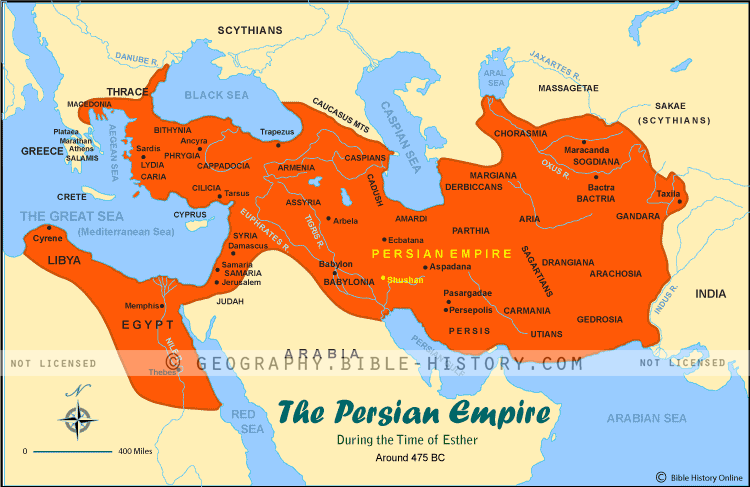
The great book of Esther begins by giving us a view of life in the palace of Persia, the political machine at work at that time and introduces us to the powerful world ruler, Xerxes in the Greek or Ahasuerus in Hebrew.  His father was Darius I, and his grandfather was Cyrus the Great; so he came from an illustrious family. Xerxes ruled over the Persian Empire from 486 to 465 B.C. The empire was divided into twenty “satrapies,” which in turn were subdivided into “provinces”; and the king was in absolute control.

Like most monarchs of that day, Xerxes was a proud man; and in this chapter, we see three evidences of his pride. (Even through Xerxes’s pride, God was still at work setting His plans in place.)

  1. Showing Off  (Est. 1:1-9)

Eastern rulers enjoyed hosting lavish banquets because each occasion gave them opportunity to impress their guests with their royal power and wealth. Three banquets are mentioned in this chapter: one for the key military and political officers of the empire (vv. 1-4); one for the men of Shushan (Susa in Greek), site of the king’s winter palace (vv. 5-8); and one for the women of Shushan (v. 9), presided over by Queen Vashti.

What was the purpose behind the banquet for the nobles and officials of the empire? Scripture doesn’t tell us, but secular history does. The Greek historian Herodotus (485-425 B.C.) may refer to these banquets in his History, where he states that Xerxes was conferring with his leaders about a possible invasion of Greece. Xerxes’ father, Darius I, had invaded Greece and been shamefully defeated at Marathon in 490. While preparing to return to Greece and get revenge, Darius had died (486 B.C.); and now his son felt compelled to avenge his father and expand his empire at the same time. Herodotus claims that Xerxes planned to invade all of Europe and “reduce the whole earth into one empire.”

According to Herodotus, the king’s words were these: “My intent is to throw a bridge over the Hellespont and march an army through Europe against Greece, that thereby I may obtain vengeance from the Athenians for the wrongs committed by them against the Persians and against my father.” The king’s uncle, Artabanus, strongly opposed the plan, but the king persisted and succeeded in convincing the princes and officers to follow him.

It was important that Xerxes impress his nobles and military leaders by showing off his wealth and power. When they saw the marble pillars, the gorgeous drapes hung from silver rings, the gold and silver couches on beautiful marble mosaic pavements, and the golden table service, what else could they do but submit to the king? Like the salesperson who takes you out to an exclusive restaurant for an expensive dinner, the king broke down their resistance. A proud man himself, he knew how to appeal to the pride in others.

Unfortunately, this ostentatious display of wealth couldn’t guarantee the Persians a military victory. In 480 B.C., the Persian navy was destroyed at Salamis, while the king sat on a throne “watching the battle; and in 479 B.C., the Persian army was defeated at Plataea. It ended Xerxes’ dream of a world empire. If ever a man should have learned the truth of Proverbs 16:18, it was Xerxes: “Pride goes before destruction, and a haughty spirit before a fall” (nkjv).

People in authority need to remember that all authority comes from God (Rom. 13:1) and that He alone is in complete control. Pharaoh had to learn that lesson in Egypt (Ex. 7:3-5); Nebuchadnezzar had to learn it in Babylon (Dan. 3-4); Belshazzar learned it at his blasphemous banquet (Dan. 5); Sennacherib learned it at the gates of Jerusalem (Isa. 36-37); and Herod Agrippa I learned it as he died, being eaten by worms (Acts 12:20-23). Every man or woman in a place of authority is second in command, for Jesus Christ is Lord of all.

  1. Drinking to Excess (Est. 1:10-12)

Scripture ignores these military matters because the writer’s purpose was to explain how Esther became queen. It was at the conclusion of the seven-day banquet that Xerxes, “in high spirits from wine” (Est. 1:10, niv), ordered his queen to display her beauty to the assembled guests; but she refused to obey. Her response, of course, was a triple offense on her part. Here was a woman challenging the authority of a man, a wife disobeying the orders of her husband, and a subject defying the command of the king. As a result, “the king became furious and burned with anger” (v. 12, niv).

As we look at the Book of Esther, we will discover that this mighty monarch could control everything but himself. His advisers easily influenced him; he made impetuous decisions that he later regretted; and when he didn’t get his own way, he became angry. Susceptible to flattery, he was master of a mighty empire but not master of himself. “He who is slow to anger is better than the mighty, and he who rules his spirit, than he who captures a city” Prov. 16:32. Xerxes built a great citadel at Shushan, but he couldn’t build his own character. “Whoever has no rule over his own spirit is like a city broken down, without walls” Proverbs 25:28 NKJV. The king could control neither his temper nor his thirst.

As for the anger that King Xerxes expressed toward his lovely queen, it was ignorant, childish, and completely uncalled for. Had the king been sober, he would never have asked his wife to display her beauties before his drunken leaders. His pride got the best of him; for if he couldn’t command his own wife, how could he ever command the Persian armies? Since Vashti had embarrassed the king before his own leaders, the king had to do something to save both his ego and his reputation.

Pride feeds anger, and as it grows, anger reinforces pride. “A quick-tempered man acts foolishly,” warned the writer of Proverbs 14:17, a text perfectly illustrated by King Xerxes. Instead of being angry at Vashti, the king should have been angry at himself for acting so foolishly.

  1.  Anger (Est. 1:13-22)

When the ego is pricked, it releases a powerful poison that makes people do all sorts of things they’d never do if they were humble and submitted to the Lord. Had Xerxes sobered up and thought the matter through, he would never have deposed his wife. After all, she showed more character than he did.

The Persian king had seven counselors who advised him in matters of state and had the right to approach his throne. They also knew well how to flatter the king to secure their positions and get from him what they wanted. The phrase “understood the times” (v. 13) suggests that they were astrologers who consulted the stars and used other forms of divination. Eastern monarchs in that day depended on such men to give them instructions in matters personal, governmental, and military. (See Dan. 1:20)

Concerned about the repercussions of Vashti’s disobedience, the king asked his seven counselors what he should do. The first thing they did was exaggerate the importance of the event: Vashti had done wrong not only to the king but also to the entire empire! Therefore, when the guests returned home, they would tell everybody that the queen was disobedient to her husband, and the consequences would be disastrous. The women in the empire would hold the men in contempt, and a general rebellion of wives against husbands and women against men would follow.

But was the situation really that serious? When Vashti refused to obey, I wonder how many princes and nobles at the banquet said among themselves, “Well, the king’s marriage is just like our marriages! His wife has a mind of her own, and it’s a good thing she does!” It’s doubtful that the king would have lost authority or stature throughout the empire had he shrugged his shoulders, smiled, and admitted that he’d done a foolish thing.

The seven wise men advised the king to depose Vashti and replace her with another queen. They promised that such an act would put fear in the hearts of all the women in the empire and generate more respect for their husbands. But would it? Are hearts changed because kings issue decrees or congresses and parliaments pass laws? How would the punishment of Vashti make the Persian women love their husbands more? Are love and respect qualities that can be generated in hearts by human fiat?

How could seven supposedly wise men be so calloused in their treatment of Vashti and so foolish in their evaluation of the women of the empire? How could they be so brutal as to use the authority of the law to destroy one woman and threaten the peace of every home in the empire? What a contrast to Paul’s counsel to husbands and wives in Ephesians 5:18-33!

Still motivated by anger and revenge, and seeking to heal his wounded pride, the king agreed to their advice and had Vashti deposed (Est. 1:19-21). He sent his couriers throughout the empire to declare the royal edict–an edict that was unnecessary, unenforceable, and unchangeable. King Xerxes was given to issuing edicts, and he didn’t always stop to think about what he was doing (3:9-12). It was another evidence of his pride.

The king didn’t immediately replace Vashti. Instead, he went off to invade Greece, where he met with humiliating defeat; and when he returned home, he sought solace in satisfying his sensual appetite by searching for a new queen and filling his harem with candidates. The women in his empire were not only to be subservient to the men, but they were also to be “sex objects” to give them pleasure.

The Gospel of Jesus Christ has helped to liberate and elevate women in society wherever it has been preached and obeyed throughout the world. “There is neither Jew nor Greek, there is neither bond nor free, there is neither male nor female: for you are all one in Christ Jesus” Gal. 3:28, NKJV. We still have a long way to go in our recognition of the importance of women in the church, but thanks partly to the influence of the Gospel, society has made progress in setting women free from cruel bondage and giving them wonderful opportunities for life and service.

As chapter one closes, the stage is now set for the entrance of Esther, the woman God would use to deliver His people.  God plans ahead.

www.Upwards.Church

Watch Messages: YouTube-Upwards Church

Facebook: Upwards Church


Additional Sources:
Warren W. Wiersbe, The Bible Exposition Commentary – History, (Colorado Springs, CO: Victor, 2003), WORDsearch CROSS e-book, 706-710.
Vernon McGee, Thru The Bible with J. Vernon McGee, (Nashville, TN: Thomas Nelson, 1983), WORDsearch CROSS e-book, Under: “ESTHER”.
Posted in Esther - God Remembers | Tagged , , , , , , , , , , , | Leave a comment