Getting to know Peter

Jesus’ first words to Simon Peter were “Come, follow me” (Mark 1:17). His last words to him were “Follow me” (John 21:22). Every step of the way between those two challenges, Peter never failed to follow, even though he often stumbled.

When Jesus entered Peter’s life, this plain fisherman became a new person with new goals and new priorities. He did not become a perfect person, however, and he never stopped being Simon Peter. We may wonder what Jesus saw in Simon that made him greet this potential disciple with a new name: Peter—the “rock.”  He was impulsive and often made mistakes, but when Jesus chose his followers, he wasn’t looking for perfect people; he was looking for real people, committed people.  He chose people who could be changed by his love, and then he sent them out to communicate that his acceptance was available to anyone—even to those who often fail.

We may wonder what Jesus sees in us when he calls us to follow him. But we know Jesus accepted Peter, and, in spite of his failures, Peter went on to do great things for God. Are we willing to keep following Jesus, even when we fail?

Peter (also called Simon and Cephas) was one of the 12 disciples chosen by Jesus (Mark 1:16-18; John 1:42) and, with James and John, was part of the inner group that Jesus singled out for special training and fellowship.

Peter was one of the first to recognize Jesus as the Messiah, God’s Son, and Jesus gave him a special leadership role in the church (Matthew 16:16-19; Luke 22:31, 32; John 21:15-19). Although during Jesus’ trial Peter denied knowing Jesus, Peter repented and became a great apostle.

Strengths and accomplishments

  • Became the recognized leader among Jesus’ disciples—one of the inner group of three
  • Was the first great voice of the gospel during and after Pentecost
  • Probably knew Mark and gave him information for the Gospel of Mark
  • Wrote 1 and 2 Peter

Weaknesses and mistakes

  • Often spoke without thinking; was brash and impulsive
  • During Jesus’ trial, denied three times that he even knew Jesus
  • Later found it hard to treat Gentile Christians as equals

Lessons from his life

  • Enthusiasm has to be backed up by faith and understanding, or it fails
  • God’s faithfulness can compensate for our greatest unfaithfulness
  • It is better to be a follower who sometimes fails than one who fails to follow

Vital statistics

  • Occupations: Fisherman, disciple
  • Relatives: Father: John. Brother: Andrew.
  • Contemporaries: Jesus, Pilate, Herod

Peter’s story is told in the Gospels and the book of Acts. He wrote the books of 1 and 2 Peter.

Join us for Stand Firm from 1 & 2 Peter

Darrell

www.Upwards.Church

Watch Messages: YouTube-Upwards Church

Facebook: Upwards Church

Sources:
Life Application Study Bible, (Wheaton, IL: Tyndale, 1988), WORDsearch CROSS e-book, 1603.
Life Application Study Bible, (Wheaton, IL: Tyndale, 1988), WORDsearch CROSS e-book, 2126.


Posted in Stand Firm - 1 & 2 Peter | Tagged , , , , , , | Leave a comment

Stand Firm – 1 & 2 Peter

Life is hard. We all struggle and suffer. As followers of Jesus we often feel like we live in a hostile environment toxic to our faith. This series from 1 and 2 Peter shows us how we can stand firm against hardship, persecution and false teaching. We can learn much from the letters of Peter about living for Christ in a difficult and threatening world.

Look forward to seeing you this weekend!

Darrell

www.Upwards.Church

Watch Messages: YouTube-Upwards Church

Facebook: Upwards Church

Posted in Stand Firm - 1 & 2 Peter | Tagged , , , , , , , , , | Leave a comment

Joy in Knowing Christ (Phil. 3: 4-11)

Do we go to heaven because of our race, social status or our parents?  Does our education, good works and religious observances mean that we are closer to God?  Some think so.  Paul explains that although he used to put confidence in these very things, but now his joy and confidence come from knowing Christ.

4 I could have confidence in myself if anyone could. If others have reason for confidence in their own efforts, I have even more!

SPIRITUAL CONFIDENCE IS NOT FOUND IN

  •  My Rituals

5 For I was circumcised when I was eight days old,

 Paul says “I was circumcised on the eight day, of the people of Israel.”  We have our own rituals today, sacraments, baptism, communion, catechism, etc.  Never confuse the symbol with the substance.  Rituals do not bring salvation only a relationship with Christ.

  • My Heritage

having been born into a pure-blooded Jewish family

Don’t trust in heritage. Have you ever heard anyone say, “Daddy’s a Christian, My mom was a believer, My uncle was a pastor? ”  You can get religion from your family but you can’t get Christ unless you accept him yourself.

  • My Social Status

that is a branch of the tribe of Benjamin.

Benjamin was a noble tribe Israel. Paul was named after the first king, Saul, who was a Benjamite.

  • My Traditions

So I am a real Jew if there ever was one!

No religious group or denomination has a copyright on truth or a patent on God.

  • My Religion

What’s more, I was a member of the Pharisees, who demand the strictest obedience to the Jewish law.

Don’t trust in religion.  Paul was a religious person.  Paul kept all the rules.  We think of the Pharisees as hypocrites but there were some genuine, sincere ones.  They were the spiritually elite of that age. They took the Ten Commandments and expanded them into 619 other commandments.  They were pros at religion.  Jesus has nothing to do with religion. Religion is man’s attempt to get to God.  Jesus Christ is God’s attempt to get to man.  That’s a relationship and that’s a big difference.

  • My Sincerity

6 And zealous? Yes, in fact, I harshly persecuted the church.

Maybe some of you think if your bad works are a minimum and are good works outnumber them then you will make it to heaven.  But God doesn’t grade on a curve.  He judges by a perfect standard — Jesus Christ.  To be good enough to get to God you’d have to be as good as God.

  • My Obedience (to the law)

And I obeyed the Jewish law so carefully that I was never accused of any fault.

Today we have people saying; “I read the Bible, I go to church…”The point is there is nothing wrong with any of these things. The problem is thinking that they give me points with God, and they don’t.

In all of the religious accomplishments Paul mentions in verse 4, God is not mentioned once.  You can be religious and not know Christ.  If you have religion and no relationship, you don’t have Christianity, you have “churchianity.”  The answer to your problems and America’s problems is not religion. It is a person, Jesus Christ.

MY CONFIDENCE IS FOUND IN…

  • Knowing Christ

 7 I once thought all these things were so very important, but now I consider them worthless because of what Christ has done. 8 Yes, everything else is worthless when compared with the priceless gain of knowing Christ Jesus my Lord.

  Paul says his number one goal in life is to know Christ better and better.  How well do you know Jesus Christ?  I know a lot of Christians who have been Christians, 5, 10, or more years and they really don’t know Jesus Christ well.  There is a big difference between knowing and knowing about.

Never stop growing and developing your relationship with Christ.  So many Christians stay too close to where they “got in” to the Christian life.  They haven’t grown one bit since they made that initial decision.

Paul says that his number one ambition in life is to know Christ at the end of his life.  He’s in jail in Rome.  He’s getting ready to die.  He knew Christ already, but he wanted to know Him even better.

  I have discarded everything else, counting it all as garbage, so that I may have Christ

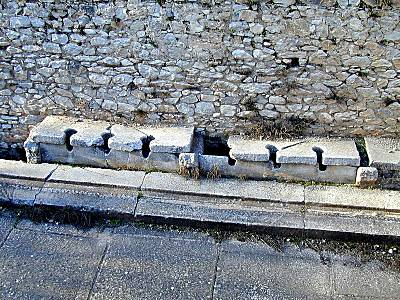
The translators here are being polite, delicate.  “Garbage” and “rubbish” are not the words.  The word in Greek is the word for “dung”, “manure”.

“Public bathrooms were not uncommon in ancient Roman cities.  This one is a good illustration for Paul’s reference to scubalon, or human waste.”  This latrine is where the dung goes.  Paul writes that  his religious and past experiences go better in the latrine that equating them to Christlikeness.

COMPARED TO CHRIST, EVERTHING ELSE IS…

  • Dung

Paul points out that life consists of trade-offs.  That’s an important lesson you must learn in life.  He said he gave up something in order to gain something else.  He gave up his religion in order to have a relationship.

What I got is worth more than everything I gave up.  You give up guilt and gain a clear conscious.  You give up worry and gain a power for living.  You give up frustration and lack of purpose in life and gain real meaning and purpose in life.  You give up going to hell and gain going to heaven.  You gave up trying to solve all your problems in your own power and gain having the resources of God to help solve your problems.  That’s a pretty good trade-off!

What are you afraid of giving up for God?  If you become a Christian, get really committed to Christ, really live for Jesus Christ, what are you afraid is going to change in your life that you don’t want to give up?  Whatever that is, that is the very thing that needs to be given up.

9 and become one with him. I no longer count on my own goodness or my ability to obey God’s law, but I trust Christ to save me. For God’s way of making us right with himself depends on faith. 10 As a result, I can really know Christ and experience the mighty power that raised him from the dead. I can learn what it means to suffer with him, sharing in his death, 11 so that, somehow, I can experience the resurrection from the dead!

Like Paul, I want to know Christ.  How about you?

Darrell

www.Upwards.Church

Watch Messages: YouTube-Upwards Church

Facebook: Upwards Church

Posted in Joy Full - Philippians | Tagged , , , , , , , , , | Leave a comment

Joyful not Complaining (Phil. 2:14-15)

14 Do everything without complaining or arguing,

What a great verse to teach our kids!  What a great verse for adults. What a great verse to memorize.


A man joined a remote monastery deep in the woods followed a rigid vow of silence.  Their vow could only be broken once a year.  That monk could speak only two words. He went in after one year of being there and to see the Abbot and said, “Bed Hard” 365 days later he got to speak again he went in to see the Abbot and said, “Food Bad” 365 days later he got to speak again he went in to see the Abbot and said, “I quit” The abbot said, “That doesn’t surprise me! You’ve done nothing but complain the whole time you’ve been here!”

Ever been around people who thought they were holy, mature believers but were actually just cantankerous? We only wish their complaints were two words! Cantankerous is not holy or mature but immature.  When our children argue and whine do we say, how mature you are!  No we say, grow up you brat!
Just like the two little boys who were standing outside the church as they watched a long-faced preacher arguing with a sourpuss member…Said one boy to the other, “Man, if that’s what 30 years of Christianity will do for you, I want out NOW!”

I know this sounds pretty basic but I believe that 90% of the problems facing the church would be solved if we would stop complaining get unified about reaching people for Christ.

Churches waste so much energy thinking and acting in ways that cut each other down and doubt each other and question each other – instead they need to rally to each other, helping and working together for the common purpose of loving God, loving people and sharing Jesus.

We all need to be reminded that complaining is not acceptable, not mature and not helpful.

Complaining translates from a word that describes a bad attitude which expresses itself in constant grumbling. The Israelites constantly grumbled in the wilderness, and God judged them for it (see Paul’s words in 1 Corinthians 10:1-5, 10).

The word for arguing has a legal connotation and may refer to the Philippian Christians going to civil courts to settle their differences, an action Paul condemned elsewhere (1 Corinthians 6:1-11). Their arguments may have stemmed from the Philippians’ pride in their achievements, which Paul denounced in 2:3. It was popular among the Aristotelian philosophers around Philippi to impress others with their accomplishments; the Christians were not to act that way.

Why are complaining and arguing so harmful? First, they are completely opposite of Christ’s attitude (2:5-8), which believers are to emulate. Second, they hurt Christ’s cause among unbelievers. If all that people know about a church is that its members constantly argue, complain, and gossip, they get a bad impression of Christ and the gospel. Unbelievers then feel justified in criticizing the Christians. Third, probably more churches have split from causes related to arguing and complaining than from heresy.

 15 so that you may become blameless and pure, children of God without fault in a crooked and depraved generation, in which you shine like stars in the universe as you hold out the word of life

Paul explained the importance of the believers’ actions—they needed to clean up their act in order to fulfill their mission of spreading the gospel. Paul’s advice for their “housecleaning” is summed up in two words.

First, the church ought to be blameless, meaning beyond reproach, incurring no justifiable criticism. This does not mean sinless perfection; instead, the church was to be beyond the criticism of the unbelieving world. Second, the church ought to be pure (also translated “innocent”). The Greek word akeraioi was used to describe wine that had not been diluted or metal that had no weakening alloys.

When a body of believers remains pure and blameless, the contrast with their culture is so stark that it is as if they shine like stars. They bring the light of truth into the darkness of depravity, as stars light up the darkness of the night. Indeed, Jesus told those who believe in him: “You are the light of the world. . . . Let your light shine before others, so that they may see your good works and give glory to your Father in heaven” (Matthew 5:14,)

  When I chose NOT to complain I will:

 Be appreciated for not causing trouble

This means that when you don’t complain, you make things so much easier. You are liked.  You may know that I coached soccer when Kaleb was young. My first year coaching the director told me I have a “trouble making mom” “Thanks for the heads up.”  I said.  We are all volunteers and its sad that someone who will not be involved but complains about those who are makes life difficult for everyone.  I loved and appreciated the parents that are supportive but when this mom comes up in conversation from others because of her reputation, many of us dreaded anything she may say.  Do you cause joy or dread by your behavior?  When we choose not to complain, we are appreciated.

  • Have Integrity

Non-complainers are people of integrity.

  • Truly represent God as his child

When we complain and argue we are not good children of God we are more like “BRATS OF GOD” or “children of the devil”

  • Stand out like a light in darkness

We are told to “shine like stars.” You may remember the song we learned as children “This little light of mine, I am going to shine.” But the truth is greater than that, we are not called to be “little lights” we are called to be “bold, blazing, life giving, STARS!!!

But one thing is for sure, “The Grumbling has got to go before the shining can start!” We don’t need to be shout or scream or make a scene we just need to shine. We do that by living a life free of complaining and disputing.
Our culture is so negative, so dark.  When I choose to not complain the contrast is obvious.  You will shine like a star in the middle of a dark night.  We will stand out as truly different to not be a complainer, to not be critical, to not be a put-down person, when you become that, you will shine like a star.

The name given to the brightest star in the night sky is Sirius, of the constellation Canis Major. The brightest star in the day sky is the sun. Paul drew a lesson from the night sky when he compared Christians to stars and society to the empty blackness of the universe. It is a bleak and barren skyscape at night, except for the light of stars. Christians are to live as lights in a dark world, shining witnesses to God’s truth.

Our lives should be characterized by moral purity, patience, and peacefulness, so that we will “shine like stars” in a dark and depraved world. A transformed life is an effective witness to the power of God’s Word. Are you shining brightly, or are you clouded by complaining and arguing? Let’s not let dissensions snuff out our light! Shine out for God.

Darrell

www.Upwards.Church

Watch Messages: YouTube-Upwards Church

Facebook: Upwards Church

Posted in Joy Full - Philippians | Tagged , , , , , , , , | Leave a comment