The Shelter of God’s Power – Psalm 95 Part 1

The same hands that hold the universe also hold you.

In today’s post we will look God’s power in Psalm 95. The context of Psalm 95 is worship. It shows us HOW to worship and WHY we should worship: God is a powerful creator, a sovereign king and a righteous judge.

First, what is worship? We get worship from the old English “worth-ship.” Worship is assigning ultimate value to something.  We all naturally do this. We can look at a group of cars in the parking lot and say, “that car is worth more than that car.” We can go into a clothing store and look at different types of clothes on the rack and think, “That one is worth more than that one.” We even do this with people.  There is a part of us that knows that others are judging us and placing a value on us by what we do and who we are. How many marriages struggle because one partner says to the other, “you not treating me with the value that I know I deserve?”

We evaluate worth and we assign worth.  Have you experienced that worth of something  can and will change over time?  Watching the TV shows Pawn Stars or Antique Road reveals that many people have something they took for granted, assumed had some value but later found out that it had WAY more value than they once thought.

There’s a story of a lady that had a brooch.  It had been given to her by her mom, and her mom before and it was passed down through the family for years. Most of the time she didn’t know where it was, but one day she found it tucked away in a drawer and thought, “I should get this appraised.” When she took it into a jeweler the jeweler began looking at it with his eye piece (magnifying glass).  As he was examining the color and the way the light was reflecting upon it, he suddenly gasped a deep breath and his eyepiece popped out; he couldn’t believe his eyes!  Why this reaction? He realized that this piece of jewelry was worth more than anything he had in the shop at that moment or anything he would ever have any shop at that moment. This piece of jewelry was priceless worth hundreds of millions of dollars. It must have once belonged to royalty.  The woman had no idea until now.

Would knowing that there were bidders ready to give millions of dollars have the power to change this woman’s life?

Many of us treat God like the way this woman treated the brooch. We say we have God, but He’s tucked away somewhere.  When we realize that God has more way value than we assumed; the realization has the power to change our lives. Every part of our lives: mentally, emotionally, spiritually and rationally.

Let’s dive into the Psalm:

1  Come, let us sing for joy to the LORD; let us shout aloud to the Rock of our salvation.
2  Let us come before him with thanksgiving and extol him with music and song.
3  For the LORD is the great God, the great King above all gods.

“Come” is a powerful Gospel invitation.  The invitation is free to us but cost God everything; by having to send Christ to die for us on the cross. Jesus also issues the same invitation, “Come to me, all you who are weary and burdened, and I will give you rest.”

In this passage we see HOW we should worship: “let us sing for joy,” “let us shout aloud.”

 As a kid I attended different churches: my dad’s side of the family was Lutheran, my mom’s parents attended a Presbyterian church, my best friend in elementary school was Methodist, my best friend in high school was Catholic and by 6th grade we attended the Baptist church near our home. If you are familiar with any of those denominations service’s in the 1970’s -90s they were reverent and reserved when it came to public worship.  I did not see a, “shout aloud” or much “singing with joy.”

I’m thankful that our Pentecostal brothers and sisters have influenced our worship styles  so that clapping, raising hands and expressing emotion is more accepted in worship services today.  This is more in line with what the Psalms teach us.  Worship should have emotion.  Love between people is not just an intellectual agreement that works out on paper.   We feel deeply about those we love and love them with emotion.

In times that I have looked at someone worshipping with emotion and thought, “why are they responding like that?” “Is there something wrong with them?” The better question would be, “Why am I not responding like that? Is there something wrong with me?”

Imagine if you were trapped inside of a burning building. Then fireman rushes in breaks down the door and carries you out on his shoulder.  When he sets you down would you not be filled with emotion? Our worship to God should have emotion! We have been saved from a burning building by Christ.

Verse 3, For the Lord is the great God the great king above all gods.” This is not saying that there are other gods.  It’s just acknowledging that any other god that we set up, God is greater, He is more powerful.  He is supreme or sovereign over any other god that we may set up.

We all assign ultimate value to something which then has power over us. We all worship.  Anthropologists confirm that throughout all history, all cultures in all places looked to a higher being or worship something.  We still do today even if its humanism, education, ourselves, money, power, position or relationships.   We we live for becomes what ultimately controls us.

I like the illustration the author Tim Keller gives referring to the first Harry Potter book. Harry finds a mirror, called the “Mirror of Erised.” (It’s desire spelled backwards). Harry looks into the mirror and he’s amazed because he sees his parents. This is amazing to him because his parents have been dead since he was a young child and he didn’t know his parents.  In the mirror Harry sees his parents loving him, hugging him and it touches his heart deeply.  He thinks this mirror is magic and he goes to find his friend Ron Weasley. When he shows the mirror to Ron, he expects Ron to see the same thing; but when Ron looks in the mirror, he says “Wow I’m a famous sports figure! I’m the Headmaster of the school!” They’re both confused about why they saw different things, so they go ask their mentor.  The mentor explained that the mirror shows each person their deepest desires.  He explains that they must put the mirror away or people would “waste away” in front of it.

What would you see when you look into the mirror?  What do I see?  I’ve seen the powerful football player, the sexy guy with nice clothes and car, the successful person with all that I need.  These are all images that shaped me powerfully but left me lacking, wasting away and looking for something more substantial, real and lasting.  I find more substance and power in God and his image of me, not one I craft myself.

If we worship God and assign to Him ultimate value; when we look in the mirror we will see ourselves fully loved, fully accepted,  fully at peace in the arms of a powerful, yet loving God.

God is supreme or sovereign over anything, anyone or any god.  We just need to see Him that way and live that way and it will change our lives.

In the next post we will see that God is also our Powerful Creator and our Righteous Judge.

Darrell
http://www.Upwards.Church


Posted in Storm Shelter- Psalms | Tagged , , , , , , | Leave a comment

Shelter of God’s Presence – Psalm 84

Despite living in one of the mostly densely populated cities in America, Lillian Alling felt completely and utterly alone. A Russian immigrant, the 25-year-old Alling was introverted and reserved, furthering her sense of isolation. In New York in the spring of 1927, Lillian Alling decided to return to her family in Russia. Because she had saved only $100 and would not accept lifts from strangers she would have to walk the 12,000 miles. Equipped with maps, a knapsack and an iron rod for protection, she passed through Chicago, Winnipeg, British Columbia, the Yukon and Alaska, arriving in Nome, the halfway mark for her epic journey, in July 1929. Soon after leaving Nome, she was seen approaching Cape Prince of Wales and that was the last time anyone on this continent is known to have seen or heard of her. She had apparently reached the Cape, as she had planned, obtained a boat and rowed across the 36 miles of Bering Strait to Siberia. That’s a real longing for home.

While none of us have walked that far to get home, we all know the feeling.  We take a trip away from home and as enter we enter the house we breathe out and say, “It’s good to be home.”

As a college freshman I could not wait to leave home for school, to be away from family and be independent; it’s what I desired for several years. The first weekend home, after a night in my old bed, several home cooked meals, and a mountain of laundry done, I think, “It’s good to be home.”

The Israelites experienced the same emotions every time they traveled to a special celebration in the Temple – it was good to be home again. That is the context of Psalm 84; on just such a trip the Psalmist thinks about being home with God. And that sentiment is consistent with each of us.  We long to be home in the presence of a loving God.

We all have places or experiences where God was very much alive to us. For Abraham it was Bethel. For Moses it was Mt. Sinai. For Jesus it was Gethsemane. For me it’s at church or camp or Bible study with people I love. For the Psalmist it was the Temple.

Verse 1:”How lovely is your dwelling place, LORD Almighty!” The place where God lives is beyond expression. It is difficult to understand the impression that the temple of Solomon made on the Hebrew worshiper. David proposed the temple and amassed the materials. It took seven years and six months to complete. God’s presence in the temple was overwhelming when it was first built. Following the resurrection and ascension of Jesus the focus shifted to a different dwelling of God.  The church met in homes, synagogues and later built buildings but in every case it is not so much the place that is important but Christ who was worshipped there. The value of any place lies in people and presence of God in that place. To be with God and in His presence, is a delight. There is no place like home.

That’s why the Psalmist continues, verse 2: “My soul yearns, even faints, for the courts of the LORD; my heart and my flesh cry out for the living God.”  The psalmist delights to be in God’s presence like a baby crying out for an unmet need.  While the primary reference here is to worship in the sanctuary, the desire is for the presence of God. That’s why John, in Revelation 21 & 22 ends his description of the new heaven and earth by describing the effects of the presence of God: no more death, sorrow, tears, there is no need for light of the sun, moon, or stars for God Himself will be with His people. That’s why John writes that the ultimate hope is that we will see God in Jesus face to face.

Verses 3-4: “Even the sparrow has found a home, and the swallow a nest for herself, where she may have her young—a place near your altar, LORD Almighty, my King and my God. Blessed are those who dwell in your house; they are ever praising you.” The sparrow, by Jesus admission, is worth little; yet it lives in the presence of God.  And so do we, we have a home in the presence of God.  And the swallow ever restless, never still, always flitting around has found a resting place. So have we! God is our Refuge; God is our Fortress; God is our Haven of Rest. We have perpetual contact with God. None of us is rejected. At home with God we are loved, accepted, valued, and cared for.

The Psalmist also says that to be at home with God is to experience his power. When we worship and praise God daily we become acutely aware of his presence and power. No matter where we are, no matter what our circumstances, our hearts are tied to home. A female moth of a rare species was placed in a room. Four miles away a male moth of the same species was released. In spite of smoke of the city, in spite of the distance, and in spite of the fact that the female was in a closed room, in a few hours the male moth was found beating its wings against the window of the room in which the female was confined! Tagged salmon released from Columbia River Point spend four years in the Pacific, then consistently return to the spots from which they departed thousands of miles away.

Knowing our homing nature, the Psalmist says, verse 5: “Blessed are those whose strength is in you, who have set their hearts on pilgrimage.” “Have set their hearts” is literally “have highways in their hearts.” Just as the fiery cloud and pillar were the highway map for Israel in the wilderness, so for us Jesus is the way. After Jesus had talked about leaving for heaven, Thomas said that they didn’t know where he was going and wondered how, then, they could know the way. Jesus replied “I am the way.”  Through Jesus the way is in our hearts. That’s why we are prepared for our pilgrimage.

Verses 6-7: “As they pass through the Valley of Baca, they make it a place of springs; the autumn rains also cover it with pools. They go from strength to strength, till each appears before God in Zion.” Our highways are traveled with strength. Difficult trials are inevitable. Elijah had his wilderness; Moses had his backside of the desert; Joseph had his prison; Daniel had his lion’s den; Job had his losses; Paul had his beatings; Jesus had his Gethsemane and his cross.

So we have our illnesses, our job turnovers, our personal losses, our broken relationships, our crumbled dreams. Yet those who live and walk in the power of God overcome and transform these trials. We muster strength through divine inner resources.  We go not from weakness to weakness or defeat to defeat but from strength to strength. On our earthly journey through life the further we go the weaker we get. Our vision dims, our hearing weakens and our steps falter. But on our spiritual pilgrimage we gain strength as the journey gets tougher.

I’m reminded of singer Steven Curtis Chapman. Just two months after the death of his 5-year-old daughter, Maria Sue, in a tragic accident at the family’s home, Chapman opened a concert with “Blessed Be Your Name.” “Blessed Be Your Name” was also the first song Chapman sang May 21, the day of Maria’s death, when he wasn’t sure he’d ever be able to sing again. Inspired by the story of Job, at one point the lyrics repeat, “He gives and takes away.” Chapman explained to the audience of nearly 5,000 “As I sang this song … it wasn’t a song, it was a cry, a scream, a prayer. I found an amazing comfort and peace that surpasses all understanding.”

That is why the Palmist continues that our hope is fueled by trust. Verses 8-9: “Hear my prayer, LORD God Almighty; listen to me, God of Jacob. Look on our shield, O God; look with favor on your anointed one.” In a healthy home the family members talk with one another. If Niki and I take a walk together we are not silent all the way figuring we must wait to get home to speak. We talk with each because we’re together. It is the same with living in the presence of God. We talk and pray with Him all along the way. We can pour out our hearts to Him, because we can trust Him. Whatever our situation today, God is saying “Talk with me. Let me work with you.” If we trust Him we can worry less.

The third insight of the Psalmist is that if we are living in God’s presence and power we will experience considerable encouragement of his provision. We long to be at home with God because He cares and provides for us.. Verse 10: “Better is one day in your courts than a thousand elsewhere; I would rather be a doorkeeper in the house of my God than dwell in the tents of the wicked.” We are encouraged by perspective. To be a door keeper, to have the lowest position in heaven, is greater than the highest position on earth. To be of service in the presence of God is the highest privilege of all – and God provides us with that opportunity every day.

The Psalmist adds, verse 11, that we are encouraged by plenty: “For the LORD God is a sun and shield; the LORD bestows favor and honor; no good thing does he withhold from those whose walk is blameless.” God the Sun, the source of life. God the Shield the protector from all that seeks to destroy life.  As we have accepted Jesus Christ as our Savior our name is in His Book of Life. We are secure.

www.Upwards.Church

Sources:
Life Application Bible notes, Special thanks to pastor Curry Pikkaart for his insights on this Psalm, Freling Foster, Tan, P. L. (1996). Encyclopedia of 7700 Illustrations: Signs of the Times. Garland, TX: Bible Communications, Inc. ,  David Harp – sermons.logos.com
Posted in Storm Shelter- Psalms | Tagged , , , , | Leave a comment

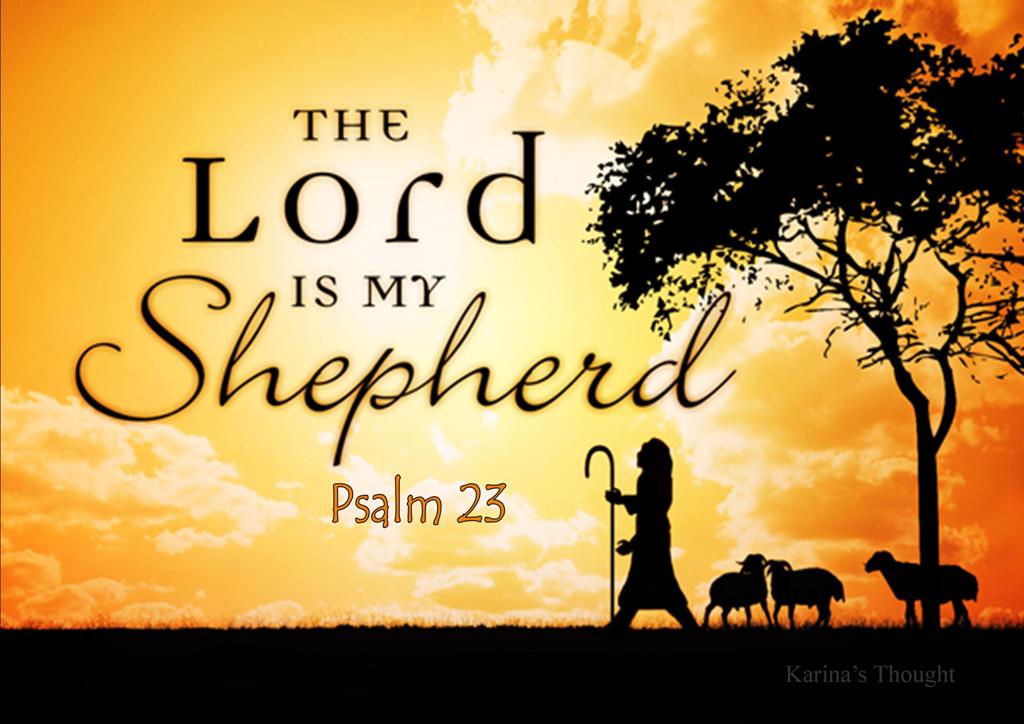
The Lord is My Shepherd – Psalm 23

Today we look at the most popular Old Testament passage.  This Psalm has been quoted in fox holes and in funerals. Presidents have used it to help a grieving nation; Lincoln read it during the Civil War and George Bush after 911. It’s only 6 verses; simple enough for kids to understand and yet a bottomless pit for theologians to discover. The 23rd Psalm has ministered to millions of believers. It is as timeless today as it was when written over 3000 years ago.

Do you like dogs? We do. We have three. Have you ever seen a dog that was mistreated in some way? One time it was cold outside and I saw this dog tied to a tree shivering, I thought to myself, “that person really shouldn’t own a dog!” Or have you seen that person and their dog has a little sweater, their nails done and they eat like a king or queen? Like Paris Hilton’s dog carried around a little purse always on her lap?   Which dog would you chose to be?

Each of us has a choice in who will care for us in this life. Satan would love nothing more than for you to be tied up to a tree shivering out in the cold. Or we can choose to let God guide us. Some will say, “I lead myself.” If I lead myself I tend wrap the rope around and around the tree and I choke myself! I’m not capable leading myself for long. I believe God does a better job!

Let’s look at verse 1 “The LORD is my shepherd.” Noticed how personal this is.  It’s not, “the lord is A shepherd, but MY shepherd. I think it’s great to insert your name where it says “my shepherd.” The Lord is Darrell’s Shepherd.

Notice also the use of all cap for LORD. The word used here is the word “Yahweh.” the Covenant name of God, the personal name of God. We first see this word used in Exodus 3 when Moses asked God through the burning bush, “who shall I say sent me?” “God replies, you say ‘I AM THAT I AM’ sent you.”  Fast forward to the New Testament in John 8:58, Jesus was having a discussion about who he was with the Pharisees and he says, “before Abraham was I AM.” Jesus claims to be Yahweh; A God that is knowable. He is the first and the last,”  He is the one who’s “the same yesterday today and forever,” so another way to look at this Psalm is to say “Jesus is my shepherd” and that would be very accurate!

The second part of verse 1 says, “I shall not be in want.” This is also translated, “I shall not be in need.” God is our Shepherd and will meet our needs (not to be confused with our greeds.)  Phillip Keller wrote a book called, “A Shepherd Looks at Psalm 23.” He was a Shepherd by trade born in Africa and later move to Canada. He writes that he would always take his sheep to the best pastures so that they could be fed and cared for. He tells of one particular sheep, a beautiful female. She would always tend to walk along the fence line looking out into another pasture; he also called her, “Ms. Gadabout.”  She never seemed to be content. I wonder how many of us as believers are like that? Always looking over the fence thinking that someone else’s life is better, or that someone else’s blessings are better or that the grass is greener? What type of reflection is that upon our shepherd who is guiding us and leading us exactly where he wants us to be?

In verse 2 it says, “He makes me lie down in green pastures, he leads me beside quiet waters.”  The main idea of these first two verses to me is that God wants to give us an enduring peace. I’ve been fascinated by the articles lately talking about how in our society today there are high levels of anxiety, depression, insomnia and suicide. Especially among young people, these issues are at all-time highs. I wonder how in a time where we have so much technology, so many medical advances, food and resources and comfort at our fingertips why is there such high stress, anxiety, depression and insomnia? Some propose different reasons, but I wonder how often do we trust those things instead of God? I know for me I’ve tried to find peace in the pantry (food or drink).  How many try to find peace in a pill or peace in a bottle, peace in a relationship?  I’ve discovered the only lasting peace is found in God.

In verse 3 it says, “you restore my soul.”  Sheep get “cast” meaning they eat something they shouldn’t eat and then it causes their bellies to swell up.  They then lie down and before long they’re lying on their back with their feet sticking up.  If they stay like this they will die.  The shepherd has to come along pick them up set them upright,  massage their swollen belly and help them to feel better.  This is also a picture of what God does for our hearts minds and souls when we follow him. That is why a day off is so important (like the Sabbath) a day to rest physically and mentally. But I also believe that we need to be restored spiritually by worshipping and attending church. This is how God restores our soul.

Verse 3 continues, he guides me in Paths of righteousness for his name’s sake.  This could also be translated, “he guides me down well-worn paths.” In other words God knows the paths that we need to go down and they are clear in His Word. How many times do we try to take another path and find ourselves in trouble? There are some fascinating stories out there about sheep.  One that comes to mind is from some Shepherds in turkey that gathered their flocks together to talk, and before they knew it one of the small sheep decided to go off the cliff and took 400 other sheep with it before the shepherd’s could run over there and stop the chaos!  How many times we see people taking other people astray, away from God’s principles and paths that are clearly outlined in His Word?  We may think a new path or teaching may be better for us but it will lead us to death and destruction.

Verse 4, “Even though I walk through the valley of the shadow of death…”  Can a shadow hurt you? When we walk with God even something as scary as death is only a shadow.  It reminds me of the story of a dad and his young daughter driving down the road with the windows open on a nice spring day. Suddenly a bee flies in, the little girl is terrified and begins to scream. She’s allergic to bees and a sting could be dangerous for her. The bee lands on the dashboard and the dad cups his hand over the bee and weights for the inevitable, the sting. After the bee stings he opens his hand and the bee flies out.  It’s buzzing around and the little girl screams again, “Oh Daddy the bee! The bee!” The dad says, “Honey he can’t hurt you now, and he opens his hand and reveals the stinger lodged in his hand.  And this is exactly what Jesus has done for us!  He’s taken the sting of death upon himself.

Shepherd’s would intentionally lead their sheep through dark valleys or crevices between cliff facings leading them from one pasture to another.  God also leads us through shadows and dark times in our lives. There’s a there’s an Arab proverb that says, “All sunshine and no rain makes for a desert.”  What does all rain make? A flood.  Plants and animals need both sun and rain.  Human beings also need times that are up and times that are down. God is the God of the hills and the valleys. God is there in the high times of our life and God is especially there in the low times of our life. Notice in verses 1 through 3 it says “he” or “his” five times referring to the Shepherd. In verse 4 he moves from talking ABOUT the shepherd to talking TO the shepherd!

It’s as if the dark times is when God becomes closest and most personal to us. It’s been said that, “God speaks to us in our pleasure but he shouts to us in our pain.” He is close to the brokenhearted. In dark times in scary times God is there.

It goes on to say,  “Your rod and your staff they comfort me.”  This is referring to the tools that the shepherd would use. The rod was for protection. It was generally a heavy stick that could be used as a club against the enemies of the Sheep. The rod wasn’t for the Sheep, but the enemies of the sheep.

How many times do I try to fight my own battles instead of letting God fight my battles for me? I’m reminded that the battle belongs to the Lord. That no weapon formed against me shall prosper!  If I start trying to defend myself against people who would accuse me or speak against me main. I find myself on the wrong path of trying to get even, or get vengeance and that’s not God’s path for me.

The staff was longer and had a cook at the top.  The end was used to guide the sheep, or prod the sheep when they needed to go on the right path. The crook was used to catch the sheep if he was going to go off of a cliff.

Verse 5,  “you prepare a table for me” is also translated,  “you prepare a banquet.” The Hebrew word is, “a king’s table.”  This is no TV table! What do you find on a king’s table?  Just goldfish and juice boxes? No, the king’s table would have the very best! This is a picture of God desiring to bless us in the presence of our enemies. How many times do I know that I’m blessed, but I’m slow to acknowledge my blessings come from God to others? I don’t want people to be jealous or envious. But I’ve found that God chooses to bless His people and he’ll do it in front of others!  I don’t have to be ashamed a God’s blessings.

You anoint my head with oil.” Now this is a term it’s not used very much in today’s language. In Old Testament times anointing was generally for kings, prophets and priests.  They were anointed with olive oil (poured on their head) signifying that they were set apart for a particular task or purpose. The truth is that God still anoints as His followers today! You have been set apart for a task and purpose. That’s why God has created you to be here on this planet. He has something for you to do and he sets you apart and anoints you to make a difference in your family! To make a difference at your work!  To help people, serve people, love people, encourage people!  You are on this planet at this time at this moment and you’ve been anointed by God to make a difference.

“And my cup overflows.”  this is also a picture of God’s abundance. God doesn’t just bless us a little bit. He often gives us so much and we need to see ourselves blessed in this way!  Each of us has been greatly blessed by God and we have an opportunity to either act like Eor or from Winnie the Pooh. “Oh woe is me. poor me!” Or we can act like Tigger and be jumping up and excited about all that God has done in our lives.

“Surely goodness and love will follow me all the days of my life.”  This is a promise: God’s blessings are not just for today, but every day for the rest of my life!  Then it leads us to the last part that says, “I will dwell in the house of the Lord forever.”  As this Psalm closes it again reminds me of Jesus.

Jesus is our Good Shepherd.  He leads us, He calls us, He protects us, He lays his life down for the sheep. In the Old Testament the Sheep died for the sins of the Shepherd (in the sacrificial system). In the New Testament Jesus Our Shepherd dies for the sins of the sheep. He conquered death, He rose again and he says, “Do not fear, in my father’s house are many mansions I go and prepare a place for you that where I am you may be also.”  We know that guides us through life through hard times and ultimately to him in heaven.

I’ll close with story about a group of people that were at a dinner party.  At this gathering was a famous play actor who had been in Broadway plays and a few movies. People were asking him to quote famous lines from plays or movies. As he did people would clap and cheer.  There was also a pastor there that night and he asked the play actor, “Do you know the 23rd Psalm?  He’d had a hard week and he wanted a little bit of encouragement. The play actor said, “Yes I do know the 23rd song and I will quote it under one condition. After I quote it, I would like you to quote it.”  The pastor agreed, so the play actor quoted the 23rd Psalm and everybody clapped and cheered. It was a pastor’s turn, (thinking about his hard week and the Lord with him) he quoted the 23rd Psalm and when he got done there wasn’t a dry eye in the place. Someone asked the play actor, “why when you quoted 23rd Psalm people clapped, but when he quoted the 23rd Psalm people cried.  (They were impressed by the play actor but they were moved by the pastor) The play actor said,  “I know the Psalm, he knows the shepherd.

Do you know the shepherd?

Darrell

www.Upwards.Church


Special thanks for the inspiration from Rick Warren for his series, Living the Goodness of God. https://www.oneplace.com/ministries/daily-hope/series/
And Skip Heitzig, Safe and Sound, https://www.oneplace.com/ministries/connect/listen/safe-and-sound-part-2-627968.html
Posted in Storm Shelter- Psalms | Tagged , , , , , , , , , , | Leave a comment

The Shelter of God’s Word – Psalm 1

A young man was learning to skydive and was so excited that he would get to do his first solo jump. Before his solo jump, he was given these instructions, “You’ve seen how this works, jump when you are told. Count to ten and pull the ripcord.  In the unlikely event that your chute doesn’t open pull the emergency ripcord.  When you get down, a truck will be there to take you back to the airfield.

The young man had these instructions memorized as climbed aboard the plane. The plane climbed to ten thousand feet and the skydivers began to jump. When he was told to jump, he jumped. He then counted to ten and pulled the ripcord. Nothing happened. His chute failed to open. So he pulled the emergency ripcord. Still nothing happened. No parachute. “Oh great” he thought, “And I suppose the truck won’t be there when I get down either!”

I know that we all have had days like that where nothing seems to go right! In Psalm 1 we will see that like a parachute is to a skydiver, God’s word is to His followers, a matter of life and death.

This Psalm is so practical, in a nut shell it shows us two groups of people, going down two separate paths leading to two distinct destinations. Which one will you be, the righteous or the wicked? Which path will you take the one of sin and scorn or the one of blessing and prosperity?  Which destination will be yours at judgement, the place of death or life?

When I first read this Psalm as a teenager it spoke volumes to me about the company I kept.  My friends determined the path and the person I would become.

Let’s look at it:  Blessed is the one who does not walk in step with the wicked
or stand in the way that sinners take
   or sit in the company of mockers,

Notice the pattern: walk, stand, sit.  As we walk with the wrong crowd we begin to be comfortable with it and to sit is to be entrenched their lifestyle. I’m sure that you had an experience or are living an experience like I did in 7th-9th grade.   I had some friends who got involved in drugs, they used drugs and then they begin to sell drugs.  We rode the bus together, played baseball and were in boy scouts together.  As I continued to walk with them what do you think happened to me?  You know the answer.  As I walked with them, I stood and did drugs with them too, how long before I would sit or be entrenched in that lifestyle and sell drugs too?  Because of Christ in my heart, His word in my mind and my parents and other godly influences in my life I was able to change my friends and go down a different path.

I experienced the wrong path and I’m sure you have too.  It’s great that God has an alternative path for us!

“Blessed (or happy) is the one whose… delight is in the law of the Lord,
    and who meditates on his law day and night.

God’s word puts us on the right path.   I like the word “delight” because it reminds me that Christianity is not a list of “do’s and don’ts.”  Walking with Christ is not what we are against its about what we are for.  We love Jesus, we love God’s word, we delight in what’s right.

Meditate” is not something the Buddhist or Eastern religions came up with.  It’s biblical.  It’s means in the Hebrew to “chew the cud.”  It’s a picture of a cow or sheep regurgitating what it ate for breakfast (gross I know) and then re-chewing it to get the most of it.  How do we meditate on God’ word?  Read it, think about it, talk about it, discuss it with others, memorize it, teach it to others and most importantly do it and live it.   That’s why church is so important.  We get to do all of the above together: messages, Connect groups, and kid’s classes and youth group.

Our families are also a great opportunity to meditate on God’s word.  We have Discussion Questions each week to go with each message on the outline to take home and discuss with your family. I love how God tells us in Deuteronomy 6: 6-7 that we can walk, stand and sit as go through God’s Word together.  These commandments that I give you today are to be on your hearts. 

Impress them on your children. Talk about them when you sit at home and when you walk along the road, when you lie down and when you get up.

Notice the three illustrations that blessing or happiness in verse 3.

That person is like a tree planted by streams of water,
    which yields its fruit in season
and whose leaf does not wither
whatever they do prospers.

Let’s consider each of these:

  1. Planted by streams of water.” (We have what we need.)

When I read this I think about the Cypress trees along the San Antonio Riverwalk.  Having grown up in San Antonio I love to go back there and walk along the river enjoying the shade, the beauty and the majesty of these trees. I can’t reach my arms around them they are so large. When I look up, they tower into the sky. Their roots are well established with their nobs or knees that pop up along the bank showing their grip.

These trees are a picture of stability, much like the life of Christ follower who lives by God’s word.  We are established. We have our needs met, we are satisfied, we are secure.  Contrast this with a leaf that is blowing down the sidewalk like verse 4 reminds us.

  1. Yields it Fruit” (Fruitful)

If we delight in the Word of God we will be a fruitful people Do you know a fruitful person? They are refreshing and nourishing to be around. You go away from them encouraged. You go away strengthened. Their words are healing and convicting and encouraging and deepening. Being around them is a blessing.

  1. Whose leaf does not wither” (Perseverance)

In life we will all experience storms, drought, high winds, sleet, cold and high heat.  We all face these hardships, but rooted in God’s word we can persevere.  We will not be blown by winds of cultural change.  We will hold on when life is hard because our foundation is not in people or money but God’s word.

  1. Whatever they do prospers” (Prosperity)

I’m reluctant to even mention prosperity because of the misunderstanding that has been given by some that following God leads to monetary wealth.  Part of God’s blessing could be monetary; Abraham, Isaac, Jacob, David and Job were all wealthy, but the best definition of prosperity is knowing and living for God.  Prosperity is long term as opposed to money that is short term.  Prosperity is hearing, “well done my good and faithful servant.”

As we close out this Psalm, I want to share with you something else that jumped out to me as I looked closer at the last two verses.   It’s about Jesus!

Therefore the wicked will not stand in the judgment,
nor sinners in the assembly of the righteous.

For the Lord watches over the way of the righteous,
but the way of the wicked leads to destruction.

What about Jesus? How does this psalm lead us to Christ?

The word righteous in verse 5 and 6 presses us forward to Christ as our righteousness.

Righteous and righteousness are major biblical words and doctrines listed over 1000 times in our bibles.

Let me share a few.

Jesus lived out righteousness: 

When Jesus asked John to baptize him, John objected saying, “no, you should baptize me” Jesus replied, “Let it be so now; it is proper for us to do this to fulfill all righteousness.” Then John consented. Matthew 3:15 (NIV)

Jesus said we should seek righteousness: 

Blessed are those who hunger and thirst for righteousness, for they will be filled. Matthew 5:6 (NIV)

 But seek first his kingdom and his righteousness, and all these things will be given to you as well. Matthew 6:33 (NIV)

Jesus says that we can’t earn righteousness by our good deeds:

 For I tell you that unless your righteousness surpasses that of the Pharisees and the teachers of the law, you will certainly not enter the kingdom of heaven. Matthew 5:20 (NIV)

Jesus says righteousness is about believing:

 For John came to you to show you the way of righteousness, and you did not believe him, but the tax collectors and the prostitutes did. And even after you saw this, you did not repent and believe him. Matthew 21:32 (NIV)

 Who is righteous? 

Paul writes,

 “There is no one righteous, not even one; Romans 3:10 (NIV)

How do we become righteous?

  • By faith

For in the gospel a righteousness from God is revealed, a righteousness that is by faith from first to last, just as it is written: “The righteous will live by faith.” Romans 1:17 (NIV)

  • In Jesus

This righteousness from God comes through faith in Jesus Christ to all who believe. Romans 3:22 (NIV)

 How does this apply to Psalm 1?  We were on the wrong path, walking with sinners, sitting with scorners, being blown away by the wind and heading for death and judgement.  Christ takes us, gives us new life by planting us by the streams of water; Him.  We find life, peace, fruitfulness, blessing only in Christ.

Thank you Jesus!

Darrell

www.Upwards.Church


Inspiration for this post is from:
Warren W. Wiersbe, The Bible Exposition Commentary – Wisdom and Poetry, (Colorado Springs, CO: Victor, 2004), WORDsearch CROSS e-book, 85-87.
Rod Mattoon, Mattoon’s Treasures – Treasures from Treasured Psalms, Volume 1, (Springfield, IL: Lincoln Land Baptist Church, n.d.), WORDsearch CROSS e-book, 4-19.
John Piper, Desiring God, Summer Psalms


Posted in Storm Shelter- Psalms | Tagged , , , , , , , , | Leave a comment