Deciding Who to Worship – 1 Kings 18

Above anything else in our lives, God wants to have all of our hearts, our worship, our focus, our adoration.  God wants to be number one and have all of our hearts.  In fact, the very first of the Ten Commandments God says, “You shall have no other gods before me.  When Jesus was questioned, what is the most important commandment, Jesus said, “Above all else, we are to love the Lord your God with all your heart, mind, soul, and strength.”  God wants all of our hearts, not just part of our hearts.  Because this is true, its a good reason, for Satan, the spiritual enemy, to try and hurt God.  To take the hearts of the people away from the one true God and try to get people to worship and serve false gods, is something that Satan’s been doing throughout history.  Putting false gods in the place of the one true God, it is called the sin of idolatry.

False gods promise what only the true God provides.  For example, money is a popular false god. What does money do?  Money promises what only God can provide.  Money says if you have enough money, you’ll be happy and secure.  That’s what many people believe about the false god of money.  But the reality is, once you get enough money and someone says, “You have cancer and you are going to die in thirty days,” you realize it doesn’t matter how much money you have.  It doesn’t make you secure.  It’s a false promise.  Money says if you have enough, you’ll be happy, but it doesn’t matter how money you have.  If one day you find you’ve lost one of your own children, there’s no amount of money that can buy your happiness in that moment.  It’s a false promise.  It’s a false god.  It promises something that it does not provide.

In the life of Elijah, many people were living idolatrous lives.  They were worshipping and serving false gods.    Elijah was called by God to confront a very evil king named King Ahab, who was married to the wicked woman, Jezebel.  Ahab was the seventh consecutive evil king.  Scripture says that he did more evil in the eyes of God than anyone before him, so he was the worst of the worst, and of all his long list of sins and wickedness, the worst thing that he did was, he continued turning the hearts of the people away from the one true God toward the false gods of Baal and Asherah.

Baal was the sun god, Asherah was a fertility goddess.  The people were no longer worshipping the one true God.  Instead, they were worshipping the false gods.  The false gods promised, “If you worship me, we’ll make your crops grow.  If you worship me, then you’ll have a better life.”  False gods promise what only the true God provides.

God raises up Elijah, who confronts the king, and basically says, “Because of your idolatry, God sent me to tell you it’s not going to rain until God tells me to pray and asks it to rain.”   It’s the worst thing you could imagine, and so God sends Elijah into a period of hiding and preparation.  Why?  Because king Ahab wanted him dead.  He said to everybody, “You find him, kill him on the spot.”  God takes Elijah to the place called the Karith Ravine.  Karith means the place of cutting, cutting down.  It’s a place of humbling, where God humbled him and developed him into even a stronger man of God.  God fed him by morning and evening, by ravens who flew in, would drop bread and meat, and then he was, had drink through the brook.  But one day, the brook dried up.  God called him to move on to a place known as Zarephath, where there was a widow, who God used to provide for him with just a little bit of oil and a little bit of flour that never miraculously ran dry.  One day, the widow’s son died.  This growing man of faith took the son up to the upper room, called out to God, and God raise this boy from the dead.  And we see the prophet developing into the man of God that God wants him to become.

Now, our last verse told us that he went into hiding.  We find out now, God wants him to go and confront the evil king, and here’s where we pick up the story.  We are about three years into the drought, and in I Kings 18:17-18, we see them together again.  Scripture says, “When Ahab saw Elijah, he said to him.  ‘Is that you, you troubler of Israel?’ ”  Now, the Hebrew word that’s translated as troubler can also be translated as snake, or viper.  In other words “Hey, you no good, low down snake.  I’m, it’s your fault all this is happening.  All these people are dying with this huge draught, because of you, Elijah.  Elijah says, “I’m not taking any of that from you.  He pops back toward the king, verse 18, and says, “No, I’ve not made trouble for Israel,” Elijah replied, “but you and your father’s family have.  You’ve abandoned the Lord’s command and you have followed the Baal’s.  You are committing the sin of idolatry.  You are putting false gods ahead of the one true God.  And Elijah was confronting the very popular idea that there are many gods.

Monotheism and polytheism.  What is Monotheism?  It’s the belief that there is one God.  As Christians, we are monotheistic in our beliefs.  Polytheism, though, is the belief that there are multiple gods, and Elijah was confronting a very polytheistic culture, where they would worship multiple gods.  Now, those of you who are Christ followers, you would say, “Well, we are monotheistic.  We believe in one true God.”  But even though we believe in one true God, many of us live what I would call polytheistic lives.  We believe in God, but in reality, we worship and serve many false gods.

Most people I know aren’t worshipping the false gods of Baal or Asherah.  In reality, the false gods today that people worship and serve are much more socially acceptable.  People worship the false god of material possessions.  A house, a car.  It could be your image, your look.  It could be your favorite sport.  It could be your career.  It could be your, your hobby.  It could be your children.  You say, “Well, how in the world could our children be a false god?”  When you elevate anything into the rightful place of the one true God and put anything on the throne of your life besides God, that is adultery, even something as good and important as your children.  So, that’s why I would ask the question to all of you today to identify Him.

What are the false gods that you serve?

I’ll tell you a few in my life.  I’m not proud of these, but one is, I’ve made building this church, the ministry, what I do, the number one most important thing in my life.  Serving the church is my calling.  But my calling can’t be above God and my love for Him.  I’ll do it in the name of God, but it becomes my god.  Grow the church.  Serve the church, improve the church, promote the church.  If I’m not careful it can become an idol in my life.  Another thing is that my family has been an idol to me.  Obviously, family is good and I should love my wife and my kids, my parents, my grandparents, cousins, aunts and uncles, but the truth is, I’ve put them at a too important place in my life sometimes, caring about what they think instead of what God thinks.  I could go on:   seeking too much comfort or ease, status through great vacations, my home,  clothes, vehicles, or maybe too much attention to my hobby of landscaping and buying plants.  What about you?  What gets most of your time, attention, money, effort, thoughts or dreams?

Be honest.  What are some of the false gods you’ve elevated and erected in the place of the one true God?  The sin of idolatry.  Sure, we’re monotheistic in our beliefs, but our practices are often very polytheistic.  So, Elijah, the prophet, steps into this polytheistic culture and he makes a very prophetic and very strong statement.

He looks at them as they are going back and forth, and he says with all the authority of God, he says, “People, it is time to quit wavering.  It’s time.  Quit wavering between the gods.  Quit going back and forth.

 Choose today to follow God

It’s time to quit wavering,” so what he does is, he basically says, “We are going to have a good old-fashioned showdown.”  Watch what he says to the king in verse 19-21.  He says to the king, “King, now summon the people from all over Israel to meet on Mount Carmel.  And bring the four hundred and fifty prophets of Baal and the four hundred prophets of Asherah, who eat at Jezebel’s table.”   May we pause for a moment and say, “That is one big honking table.”  ?  I just had to say it.  , verse 20.  “So Ahab sent word throughout all Israel, and he assembled the prophets on Mount Carmel.  Verse 21, here’s where Elijah gets in the people’s face.  “Elijah went before the people”, and he asked this piercing question.  He asked, “How long will you waver between two opinions?  How long will you waver?”  Then he says this, “If the Lord is God,” what do you do?  Say it out loud.  If the Lord is God, follow him.  But if Baal is God,” what do you do?  “Follow him.  But the people said nothing,” and he steps in and says, “How long will you do this?  If God is God, follow him.  If Baal is God, follow him,” and I can guarantee you.  If Elijah were here today, he’d say the same thing to us.  “Quit wavering!  We say, “God, keep me out of Hell and get me into Heaven, but I still want to do whatever I want.  Oh, God, hear my prayer and bless me, but I don’t want to obey your command.  Oh, God, I want all of Your good things, but don’t want to stop my bad things.” Quit wavering!  Quit being a Christian on Sunday and a heathen on Monday.  Quit claiming Christ and living like you don’t know him!  Quit wanting the benefits and being unwilling to sacrifice.  Just quit wavering!

Take a side.  In fact, I’m trying to conceptualize Elijah’s message to today.  And here’s what I honestly think he would say.

“If material possessions, if they’re really the most important thing, then quit just sort of accumulating them, but go for it!   Get into massive debt.  Steal, if you have to. If the greatest thing is accumulation, then everything should be justified, and stealing would be justified.  And don’t ever give again.  Don’t ever do anything generous! That would, then, diminish your ultimate goal of accumulating.  If material possessions, if that is truly God, then go for it.

If your image, if that’s truly God, then, then don’t just kind of do it.  get in the gym three hours a day.  Tan it, tweak it, tat it, puff it, tuck it, lift it, twist it, curl it, color it!  Just ignore the fact that you’re going to die one day.  Don’t even think about that.  That would totally disqualify the god of your appearance.  Buy whatever clothes you need and go for it.

Sexual pleasure?  If that’s your god, go for it.  Go for it. Look at porn, get addicted, get herpes, syphilis, aids.  Don’t let something as small as marriage hold you back.   If you are married and you’re not happy, have an affair.  If you like to play on both sides of the street, do whatever you want.  Go for it.  If that’s your god, go for it.

Your house, is that your god?  Quit doing one little room at a time.  Go into debt.  Hire the best … get that pool, patio and wine cellar.  If those things are your god, then quit playing around and go for it!”

*Wow, that’s why the prophets would often get killed, because their message was offensive!

BUT!  If Christ, the Son of God, is the one true God, then quit your wavering!  Serve Him with all of your hearts!  Don’t just claim Him and then live as if He doesn’t exist.  Serve Him!  I can, I can feel the Spirit of Elijah saying, “, quit wavering,” and I’m saying to our church, ‘Quit wavering.  How long will you waver between two opinions?” Love God with all your heart, soul, mind and strength!

So, what did he do?  He has a showdown, and he goes and says, “Get two bulls for me, one bull for you, one bull for me.  We are going to build a couple of altars, and we are going to sacrifice these.  And we’re going to call on your god, our God, and we’ll see who really is God.”  So, we’ll pick up the story and see what happens.

Verse 24, he says this.  “Then you call on the name of,” whom?  Help me out.  He says, “You call on the name of your god, and I will call on the name of the Lord. And the one who answers by,” what?  “The one who answers by fire,” who is he?  Scripture says, “—he is God, and then all the people said, ‘What you say is good.’ “

Verse 26, scripture says, “So they took the bull.  They prepared it.”  These are the prophets.  They, they prepared it, and, “Then they called on the name of Baal from morning till noon.”  And they’re dancing around, going, ‘O Baal, answer us!’ and they shouted. But,” the Bible says there was what?  The Bible says, “There was no response; no one answered. And so they danced around the altar that they had made.” 

 This was just a worship dance.  It, it was a full body, jumping up and down.  It was this twisting around.  It was this, this shouts of, of joy and shrieks to their false … and nothing happened.  Nobody dances like that today, do they?  Except if you are in a concert with your favorite band or you’re watching your favorite sports team and they score!  I’ve got to be honest.  I get fired up at a football game, I wish it were easier to get fired up like that at EVERY church service!  I don’t want to EVER be more excited about the Aggies than I am about Jesus!

They’re dancing, “Baal, send fire.”  Nothing happened.  I love this, Elijah starts teasing them,  this is funny.  This is a man of God, and he’s going to mess with them.  Here’s what he does.  Verse 27,At noon Elijah began to taunt them. ‘Why don’t you shout louder!  I don’t think he can hear you.  ?   Surely he is a god!  Perhaps he is deep in thought, or he’s busy, or he’s traveling.  Maybe he’s sleeping and somebody needs to go wake him up.”  What’s he doing?   He’s messing with them.  “I know he’s a god, but maybe he’s on vacation.  Maybe he’s taking a little siesta.  He’s got his milk and cookies.  He’s taking a little nap.”  Now, here’s what’s just funnier than ever.  When he says “maybe he’s busy” what he’s really saying is, look it up.  I studied Hebrew in seminary.  Look it up.  I’m not making this up.  What he’s really saying is, “Maybe he’s going to the bathroom.”  That’s funny!  That’s what he’s say … the most literal translation is, “Maybe he’s busy.  Maybe he’s relieving himself.”

As we read on, verse 28 through 35, what’d they do?  They shouted louder.  They danced around.  They went crazy.  They started to cut themselves, because that’s what they did.  And scripture says they shouted all day long.  Sadly though, many of us, we don’t dance for the false gods all day long, but many of us do it all lifetime long, our whole lifetime.  Dancing, praising, pursuing, serving, and worshipping the false gods that promise, but never deliver all lifetime long.

So finally, at the end of the day, they danced, cut themselves, nothing happened.  Elijah does this.  I Kings 18:36,At the time of the sacrifice, the prophet Elijah stepped forward and,” what did he do?  The Bible says he what?  He what?  He prayed:

Choose today to pray to God.

He didn’t dance, shout, cut himself, do everything he could to get God’s attention.  He prayed.  “O Lord, God of Abraham, Isaac, and Israel, let it be known today that you are God in Israel and that I am your servant and I have done all these things at your command.  Answer me, O Lord, answer me, so that these people will know, O Lord, that you are God, and that you are,” what?  “And that you are turning their hearts back again.”   Can you see the power and the beauty in those statements?  “Answer me, Oh, Lord.  Reveal yourself.  Show us who You are.  Let us see You.  Reveal Yourself by fire.  May we feel the heat of Your love.  Show us who You are.  Why?  So that You may turn the hearts of the people back again, because they used to know You.  They used to walk with You.  They, they used to serve You.  They used to worship You, but these false gods have taken Your place, Oh God.  Turn their hearts back again.”

And as I read that, I feel such passion for so many of you, because there are those of you, you walked with Him.  And then you walked away, and you put some false god or any combination of false gods on the throne of your life.  And today, God is trying to reveal Himself to you.  Why?  So you can turn your hearts back to Him again.  And there are those of you, that’s why you’re here, because God has been working.  Why?  So you can turn your hearts back to Him again.  That’s why you are here.  Turn your hearts back to Him, whoever has God revealed yourself by fire.

He prays and verse 38, watch what happens. “Then the fire of the Lord,”   Imagine that.  A lightning rod of fire from Heaven fell, and here’s what scripture says.  “It burned up the sacrifice and the wood and the stones and the soil, and it licked up all the water around that the false prophets had poured on it.  It licked up the water, and when all the people saw this, they fell prostrate and cried, “The Lord, he is God!  The Lord, he is God!”

Choose today to worship God.

Today, don’t wait until you see God and its too late! They were terrified!  There is a day when we see God for who He really is and we will be terrified. And that would be my prayer for our church, that we would so see Him for who He is that all the false gods would fall far away in comparison to the one true God, and our hearts would be turned back to Him and we would say, “Lord, He is God.  He, He is God!”  Not on the Day of Judgment but today.

 Why didn’t God do that today?  Why doesn’t God show Himself like that?  I question I have asked but I realized in so much of an infinitely more beautiful way, just how God showed Himself when He left Heaven, became one of us in the person of His Son, Jesus, and lived a perfect and sinless life so that He, so that He could die for us on a cross and be raised again, so we could know Him.  And when you do know Him through Christ, then all the false gods just seem to fall away.

The Spirit of Elijah, (the Holy Spirit) would say to us today:  Choose to Follow God, don’t waiver, Choose to Pray to God, don’t hurt yourself or others to get your way, Choose to Worship God, and God alone.  If you know God for who He is, you will never be tempted to serve these false gods, because the one true God is so much greater!

www.Upwards.Church

Message Audio/Video and Outline: https://upwards.church/leander-campus/watch-now-message-videos

Watch Messages: YouTube-Upwards Church

Facebook: Upwards Church

Read Along Daily Bible Reading: YouVersion (https://www.bible.com/organizations/370f8a6e-16bc-464f-8c43-0b7623fd2952)

Posted in Elijah & Elisha - A Tale of Two Prophets | Tagged , , , , , , , | 1 Comment

Mount Carmel – 1 Kings 18

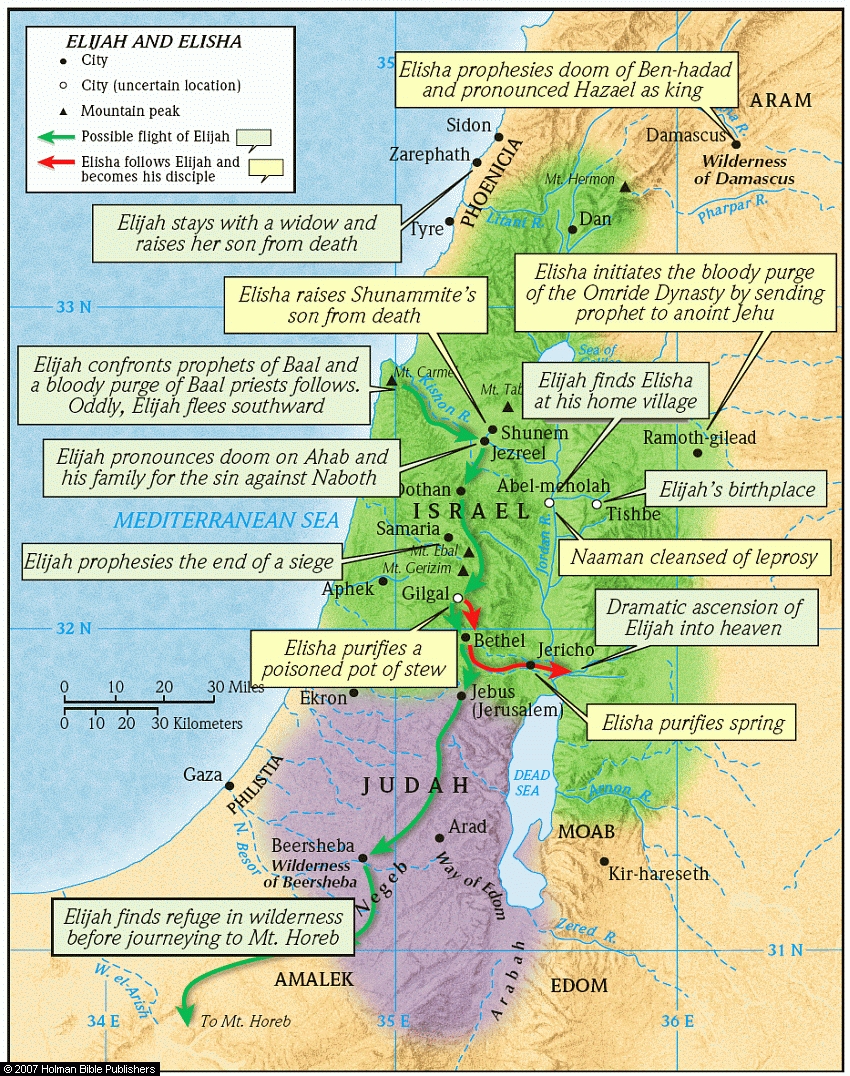
Rather than being a single mountain, Mount Carmel is actually a high, wooded mountain ridge. In the Bible, Mount Carmel is best known as the site of the prophet Elijah’s dramatic showdown with 850 pagan prophets.

Carmel means “vineyard,” “orchard,” or “garden” and reflects the fertile beauty of Mount Carmel’s picturesque slopes. The mountainous ridge starts on the Mediterranean coast in the northwest part of Israel at the south shore of the Bay of Acre. From there, the range runs southeast down to the plain of Dothan. Running along the northeast side of the ridge is the Valley of Jezreel. At its highest point, Mount Carmel reaches over 1,700 feet above sea level.

Most notably, Mount Carmel is the scene of a spectacular head-to-head confrontation between the false prophets of Baal and Asherah and the One True God of Israel. The episode takes place during one of Israel’s worst times of crisis under King Ahab. To please his wife, Jezebel, Ahab set up an altar to Baal at the top of Mount Carmel. Baal, the favorite deity of Jezebel, was reputed to be the god of rain and vegetation.

In 1 Kings 17:1–24, Elijah the Tishbite enters the story as an emissary of the Lord. The prophet confronts Ahab and predicts a drought in response to Ahab and Jezebel’s unholy devotion to Baal. When the end of the drought neared, to prove that the Lord God was the only true God, Elijah proposes a contest. All of Israel was summoned to Mount Carmel to witness the confrontation between Elijah and the false prophets of Baal and Asherah (1 Kings 18:19). The match would show whose god was able to send fire from heaven to consume their offerings. The prophets of Baal prayed all day and cut themselves violently to get Baal’s attention, but no one answered (verses 28–29).

By evening it was Elijah’s turn. He rebuilt the ruined altar of God that existed on Mount Carmel. He set the offering on top of the wood and then drenched the whole thing with water and prayed aloud: “LORD, the God of Abraham, Isaac and Israel, let it be known today that you are God in Israel and that I am your servant and have done all these things at your command. Answer me, LORD, answer me, so these people will know that you, LORD, are God, and that you are turning their hearts back again” (1 Kings 18:36–37). God answered with a spectacular display of fire from heaven, consuming the offering, licking up the sodden wood as well as every drop of water that had been poured over the altar. Even the rocks of the altar were consumed. The people fell on their faces, proclaiming, “The Lord, he is God; the Lord, he is God” (1 Kings 18:39). Elijah then ordered the people to execute the 850 false prophets according to the Mosaic Law (Deuteronomy 13).

It seems that the prophet Elisha later used Mount Carmel as a home base (2 Kings 4:25). From ancient times, Mount Carmel has been regarded as a holy place and a symbol of beauty and fertility. In the tribal divisions, Mount Carmel was part of the territory of (western) Manasseh. Like the region of upper Galilee, Mount Carmel received plentiful rainfall in biblical times, producing lush, beautiful forests and rich grasslands on the lower slopes suitable for grazing. Isaiah associates God’s glorious restoration of redeemed humanity with the “splendor of Carmel” (Isaiah 35:2). Solomon compares the head of his beloved with the beauty and nobility of Mount Carmel (Song of Solomon 7:5).

Hope to see you Sunday for the message on 1 Kings 18!

www.Upwards.Church

Message Audio/Video and Outline: https://upwards.church/leander-campus/watch-now-message-videos

Watch Messages: YouTube-Upwards Church

Facebook: Upwards Church

Read Along Daily Bible Reading: YouVersion (https://www.bible.com/organizations/370f8a6e-16bc-464f-8c43-0b7623fd2952)

Sources: Got Questions, Britannica.
Posted in Elijah & Elisha - A Tale of Two Prophets | Tagged , , , , , | Leave a comment

Becoming a Godly Person – 1 Kings 17

We’re starting a new series on what some would consider one of greatest men of God recorded in all of scripture.  His name is Elijah.  He was like a rock star to the Hebrew people.  James 5:17 reminds us, “Elijah was a man JUST LIKE US.”

Let me give you the context of the time period.  When Elijah was alive, the Northern Kingdom had experienced seven consecutive evil kings, spanning about a hundred year time period.  Now, let me just let this sink in for a minute.

This was a time in which Elijah lived.  In fact, there was a very evil king named Ahab, who was married to a wicked woman named Jezebel, some say the most wicked woman who had ever lived.  And under their reign, the Bible says that “Ahab did more evil in the eyes of God than any of those before him.”

During these times of idolatry, when these evil kings would turn peoples’ hearts away from God and would turn them to the false gods, the god of Baal and the god of Asherah, and people would often sacrifice their children to these false gods.  They would go into the temples and engage in sexual activities with prostitutes and call it worship.  The scripture says under Ahab’s reign, he was more evil than anyone before him.  This is a very dark, dark time of corruption.  We’re talking about major scandals, tremendous idol worship, and God said, “Enough is enough!”  Interestingly, though, God didn’t raise up an army to take a stand against the evil king.  Instead, God does what God often does, and that is, He raised up one person to take a stand, one man.  And I would argue that in today’s world, God may want to do something very similar where you live.  God may raise up one teenage girl to take a stand in her class against all others for sexual purity.  God may raise up a young business leader to take a stand for integrity in a business that’s lacking integrity.   God often raises up one person to make a big difference.

Elijah’s name means,  “The Lord is my God.”  And  immediately, when God raises up this prophet to stand down the king, by his very name alone, he’s making the testimony, “The Lord God is the one true God.”  Let’s pick up the story.  The first time we see Elijah in all of scripture, verse 1 of I Kings, chapter 17.  At the very beginning of this story, we don’t have hardly any background on the prophet.  We simply know him as where he’s from.  That’s how he is identified.  Like “Darrell is from San Antonio TX. ” Verse 1, “Now Elijah the Tishbite, from Tishbe in Gilead,” he’s identified with where he’s from.  That will change soon.  “He said to King Ahab, ‘As the LORD, the God of Israel, lives, whom I serve,’ “ and you can see he’s going straight toward these false gods.  “The Lord who lives, whom I serve,” he says, “there will be neither be dew nor rain in the next few years except at my word.”  Now, if this was a movie, the music would go, “bum bum bum!,” because what just said was one of the most strategic, prophetic judgments against the land that you could imagine.  He said, “For the next months and years, no rain and no dew.

This would have been an economic shutdown.  In this agriculturally driven economy, no rain shut everything down.  In our world, it would mean you can’t get gas at the gas stations.  The banks are not only lending money, but you can’t get your own money out.  You won’t have electricity at your home.  Life as you know it just ended.  There will be people starving death.  Unemployment will reach record highs.  People are going to be dying all over the place, and  this man of God stands down this evil king and says, “No more rain.” The battle is on.  The man of God stands strong.  Let’s see him fight.”  But instead, God does something different.  He takes Elijah into a season of hiding.  God takes Elijah away, so He can do so much more in him.  Why?  Because there’s so much more God wants to do through him.  And we are going to watch as God shapes this man in a very deep season of preparation. Like Elijah,

GOD IS DOING SOMETHING IN ME SO HE CAN DO SOMETHING THROUGH ME

Many of you, will identify with the preparatory work that God takes Elijah through.  Three seasons of preparations;

  • The first one: ISOLATED PAIN

God takes him through what we will call a season of isolated pain, where he is very alone.    Verses 2 and 3, we pick this up.  Verse 1, he says, “No more rain.”  Verse 2, “Then,” immediately after that, the Bible says, “The word of the LORD came to Elijah: ‘Leave here, turn eastward and hide in the Kerith Ravine, east of Jordan.’ “   This word in the Hebrew, Kerith, it means, “cut off,” or it means “cut down.”  It means to be cut off from the source, to be cut off from the blessings, or very literally, it means to cut down like you would chop down a tree.  And you could almost sense what God is, is saying here.  It’s as if God is going to say, “I’m going to take you through a season of breaking.  I’m going to cut you down.  I’m going to humble you.  I’m going to teach you to be totally dependent on Me, and I’m going to humble you privately before I use you publicly.  I’m going to do something in you that’s very, very deep, so later on, you can do more than you ever thought possible.  I’m going to take you down privately, so I can use you publicly.”  A lot of times, people are in what I call the Kerith Ravine.  They’re in a season of pain.  They’re going, “Where is God?  Where is God?” and the reality is, oftentimes God is right there doing a deep work in you.

Some of you, you’re there.  You’re there, and you could be there on purpose.  You’re in the Karith Ravine.  You’re in that period … Elijah was there for months, all alone, nobody to talk to.  No one understood the Karith Ravine, where God was breaking him.  A. W. Tozier, the great writer, said this, “It’s doubtful that God can bless a man greatly until He’s hurt him deeply. ”  Those of you who are in the Karith Ravine, be encouraged.  The more that God breaks you, the more that God is preparing you — the isolated pain, the season of the Karith Ravine.

The second thing that we see God take Elijah through as He’s shaping him, molding him into a man of God in power, as He takes him through a season of what we would call:  TOTAL DEPENDENCE

Total and complete dependence, where Elijah cannot depend on anything at all but God, and God alone.  Verses 4, 5, and 6 says this.  God says, “Elijah, you will drink from the brook that I have ordered the ravens to feed you there.  So he did what the LORD had told him. He went to the Kerith Ravine, east of Jordan, and stayed there.  The ravens brought him bread and meat in the morning, and bread and meat in the evening, and he drank from the brook.”

We’ve got God’s Heavenly catering service.  These birds go out and find bread and meat, and every morning and every evening, they deliver them straight to the prophet.  What was God doing?  God was very clearly and very distinctly saying that no matter what, and for always, “I will be faithful.  You can count on Me to provide for you.”

Many of you right now, you are in a season where there was something you used to trust in for your security, and it’s been taken away.  And you don’t have anything else to trust in, but the giver life and giver of all good things.  And you are having to learn that when everything else that you used to believe in fades away, God will forever and always be faithful to you.

A single mom knew this well.  She would pray every day, very loudly in her apartment.  She would pray to God and worship Him for His provision, and she lived next door to an atheist, who hated hearing her prayers through the very thin walls.  And she would worship God, and the atheist would come over and say, “Lady, you’re a fool.  There is no God.”  And one week, there was more month left than money, and she was crying out to God, “Oh, God, you’ve always provided for me.  You’ve always been faithful.  I know You’ll come through again.  Oh, God, please provide food for my children.”  And the atheist had had enough, and so he immediately went to the grocery store, bought several bags of food, brought it back over to the woman’s apartment, put it right on the front of her door, knocked on the door, ran and hid in his apartment.  She came out.  She saw the food, “Oh, God in Heaven, You’re so good.  Thank You so much.  Oh, it’s so amazing!”  And he jumped out and said, “You fool!  There is no God.  God didn’t do that.  I did it just to prove to you that there is no God,” and she worshipped God all the more.  “Thank You!  Oooh, God, You provided for my needs, and You made the devil pay the bills!”

Forever and always, God says, “I will be your provider.  When you can’t depend on what you used to be able to depend on, I will deliver what you need.”  Here’s the cool thing about it is, God didn’t give him two days worth of food.  God didn’t give him a weeks’ worth of food.  God didn’t give him a three-month supply.  What did God give him?  Enough for the day, enough for the day.  Some of you, you are going to learn that right now.  You are in a season where you’re hurting and you’re alone and you’re afraid, but guess what?  God delivers enough for the day.  You, you’re uncomfortable, and you’re afraid, but God says, “I will be your comfort for today.”  You don’t have much, but God says, “I will be your provision for today.  You feel very weak, but God says, “I will be your strength for today.”  Your friends leave you, but God says, “I will be your friend for the day.  I may not bring more than you need, but I will bring exactly what you need.  I will be your daily bread.”  And Elijah learns to depend on God for that day.  God is teaching him.  He’s breaking him.  He’s cutting him.  He’s humbling him.  He’s teaching him total dependence.  When he, when he has no ability to provide for himself, God is teaching him, “I will always be your provider.”

And the third thing that God does is, God takes him through a season of what we can call:  COMPLETE OBEDIENCE

 There’s isolated pain.  There’s total dependence, and then, there’s a season of complete obedience.  Verses 7, 8, and 9, the story starts to break down.  “What is God doing?  He told me to go do this, and now, it, it’s all changing.  What’s going on, God?”  Verse 7, the Bible says, “Some time later,” what happened?  Help me out.   “Some time later, the brook dried up because there had been no rain in the land.  Then the word of the LORD came to him:  “Go at once to Zarephath of Sidon and stay there.”  Now, let’s put ourselves in the prophet’s place.  It’s been months that he’s been by this ravine, and it’s been feeding him daily water.  And God told him to go there, and then the brook dries up, and God says to move on.  In my mind, I’m starting to think, “ Okay God, where are You?  What’s the purpose of being here?  You, gave me water from the brook.  Now, the water dries up.  Did I do something wrong?  You’re telling me to go on.  Did I miss You the first time?  Am I hearing You, God?  I don’t quite understand.  The brook dried up.  Why would the source of what used to feed me dry up?”  And he’s going to learn that the same God who gives water can take water away, because often, God may cause the brook to dry up to give us the courage to leave where we are and to go where we are supposed to be.

You may think,  “Oh, my brook is drying up.  I used to be able to trust in my job, but I’m not so sure I can trust in my job, anymore.  I used to have this nest egg.  I had a 401K.  Now, it’s a 201K.   My brook’s drying up.  I used to be able to trust, and I had all these good friends and then, boom, they turned on me and my friendship brook is drying up.

You’ve heard it said, “God guides by what He provides,” and He does.  But, I believe, God also often guides by what He does NOT provide.  God, the same God who gives water, may cause the brook to dry up to give us the courage to take a step of total obedience.

God says to the prophet Elijah, “Go to the Karith Ravine.”  “Huh?  Why there?”  “And be fed by the ravens.”  “What?”  And the brook dried up.  “Huh?”

Eventually God causes him to go into the region of Sidon. He moves, and then he travels across a barren land.  And he comes to Zarephath,  and sees a widow, who God says is going to provide for him.  And so he humbles himself, and he says, “Mam, I’m really thirsty.  Could, could you give me some water to drink and maybe a little snack, ‘cause I’m kind of hungry?”  And the widow looks at him and goes, “Are you, are you the only guy that doesn’t know, it hasn’t rained!  We’re dying.  There’s a draught here.  I’m a widow.  I’ve got one son.  He’s back at the hut.  I came out here to get some sticks.  I’m going to go make the last meal.  I’ve got a little bit of flour left, and I’ve got a little oil in the jug.  That’s all I’ve got left, enough for one last meal.  We are going to eat, and then we are going to die.”  And because of what God is doing in Elijah’s life, he says, “No, you’re not.”  And he looks at an impossible situation and speaks faith into it.  And he says, “The flour that you have will not run out.  And the jar of oil will not run dry.  Go back and bake me some bread.”  And she does, and they ate the bread, and the flour did not run out and the oil did not run dry.  And, and, and they, they ate, and they ate for weeks and months.  God again, supernaturally provided for Elijah in his unconditional obedience to God.  Then one day, tragedy struck, and the son died mysteriously.  The widow is crushed, as you would expect, and said, “Is this God’s judgment on me because I turned against the one true god, to these false gods?  Elijah, did you come here so this would happen?”  And Elijah, because of all that had happened, because God was shaping him, did something that to our knowledge had never happened before in history.  There’s no record of this in the Bible.  He takes a dead boy, carries him up to the upper room, puts his body on top of him, looks up to Heaven and says, “God, I’m asking You to do it,” and God raises a dead boy to life.

Why did this happen?  Because God took him to the Karith Ravine, where he was cut down.  God took him to a season of total dependence, where he couldn’t depend on anything at all but God, and God alone.  Then, God dried up the brook, so that he would leave where he was, to go to where God ultimately wanted him, so once again, He could perform a miracle and raise the dead back to life.  God used the hard things to shape him into a true man of God.  Next week we’ll see, as God gives him the faith and courage for one man to stand down four hundred and fifty false prophets, and asks God to send fire from Heaven to prove God’s goodness.  Why could Elijah have such faith?  Because he had been through the Karith Ravine, depending on God, obeying God.

Some of you right now, you are in a season of, of deep pain, and God may just say, “I’m doing something in you, because one day, I’m going to do more through you.”  Verse 1, Elijah was described as Elijah the Tishbite.  He was known with where’s he’s from.  Twenty-three verses later, he’s not known for where he’s from, but instead, for Whom he’s from.  And look at how the story changes.  Verse 24, the end of the story.  “The woman, He’d just raised her son.  She, she says to Elijah, “Wow!  Now I know that you are a,” what?  “Now I know you are, you are a man of God and the word of the Lord from your mouth is truth.”  God may allow you to go through the Karith Ravine, so one day, someone could look at you, say, “Now, I know.  I see it.  I see it.  I see. You are a man or woman of God.  Now, I see it.  You are child of God.  Now, I see it.  You are a man of God.” And, I’ll tell you right now, I praise God for all the pain and all the shaping experienced, and all the hurt, and all the brokenness, and all the supernatural provision, and all the unconditional obedience, because I pray that when people look at me they wouldn’t say, “Oh, there’s Darrell , that guy from San Antonio.”  But instead, they say, “Oh, there’s Darrell.  He’s not perfect, but we know he is becoming a godly person.”  In becoming a godly person, God will do something in you before he does something through you.

www.Upwards.Church

Message Audio/Video and Outline: https://upwards.church/leander-campus/watch-now-message-videos

Watch Messages: YouTube-Upwards Church

Facebook: Upwards Church

Read Along Daily Bible Reading: YouVersion (https://www.bible.com/organizations/370f8a6e-16bc-464f-8c43-0b7623fd2952)


Posted in Elijah & Elisha - A Tale of Two Prophets | Tagged , , , , , , , , | 2 Comments

Elijah & Elisha – A Tale of Two Prophets

You’re invited to our new series:  Elijah & Elisha, A Tale of Two Prophets!

Description:

Elijah and Elisha’s lives teach us the importance of faith, obedience, worship, prayer and mentoring. They also demonstrate the power of servant leadership, humility, and empathy, highlighting the need to serve others rather than seeking service for oneself. Their lives emphasize for us, the importance of taking up the mantle of faith and living out one’s calling authentically.

 Dates     Title                              Scripture                                    Events

May 18 – Becoming a Godly Person (1 Kings 17)

May 25 – Deciding Who to Worship (1 Kings 18)

June 1 – Dealing with Depression (1 Kings 19)

June 8 – Facing Change (2 Kings 2)                                  l
June 15– Seeking Help from God (2 Kings 5)                         Father’s Day

June 22 – Trusting God for the Future (2 Kings 4)

Elijah:

The prophet Elijah is one of the most interesting and colorful people in the Bible, and God used him during an important time in Israel’s history to oppose a wicked king and bring revival to the land. Elijah’s ministry marked the beginning of the end of Baal worship in Israel. Elijah’s life was filled with turmoil. At times he was bold and decisive, and at other times fearful and tentative. He alternately demonstrates victory and defeat, followed by recovery. Elijah knew both the power of God and the depths of depression.

Elijah, a prophet of God whose name means “my God is the Lord,” came from Tishbeh in Gilead, but nothing is known of his family or birth. We first meet Elijah in 1 Kings 17:1 when he suddenly appears to challenge Ahab, an evil king who ruled the northern kingdom from 874 to 853 BC. Elijah prophesies a drought to come upon the whole land as consequence for Ahab’s evil (1 Kings 17:1–7). Warned by God, Elijah hides near the brook of Cherith where he is fed by ravens. As the drought and famine in the land deepen, Elijah meets with a widow in a neighboring country, and, through her obedience to Elijah’s request, God provides food enough for Elijah, the woman, and her son. Miraculously, the widow’s barrel of flour and jar of oil never run out (1 Kings 17:8–16). The lesson for the believer is that, if we walk in fellowship with the Lord and obey Him, we will be open to His will. And when we are in God’s will, He fulfills all of our needs, and His mercy to us never runs short.

We next see Elijah as the central character in a face-off with the prophets of the false god Baal on Mount Carmel (1 Kings 18:17-40). The prophets of Baal call upon their god all day long to rain fire from heaven to no avail. Then Elijah builds an altar of stones, digs a ditch around it, puts the sacrifice on the top of wood and calls for water to be poured over his sacrifice three times. Elijah calls upon God, and God sends fire down from heaven, burns the sacrifice, the wood, and the stones and licks up the water in the ditch. God proved He was more powerful than false gods. It was then that Elijah and the people killed all of the false prophets of Baal, in compliance with God’s command in Deuteronomy 13:5.

After the great victory over the false prophets, rain once again fell on the land (1 Kings 18:41-46). However, in spite of victory, Elijah entered a period of wavering faith and depression (1 Kings 19:1-18). Ahab had told his wife, Jezebel, of God’s display of power. Rather than turn to God, Jezebel vowed to kill Elijah. Hearing of this, Elijah fled to the wilderness, where he prayed for God to take his life. But God refreshed Elijah with food, drink, and sleep instead. Then Elijah took a forty-day journey to Mount Horeb. There Elijah hid in a cave, still feeling sorry for himself and even confessing his belief that he alone was left of the prophets of God. It is then that the LORD instructed Elijah to stand on the mountain as the LORD passed by. There was a great wind, an earthquake, and then fire, but God was not in any of those. Then came a still, small voice in which Elijah heard God and understood Him. God gave Elijah instructions for what to do next, including anointing Elisha to take his place as prophet and assuring Elijah that there were still 7,000 in Israel who had not bowed to Baal. Elijah obeyed God’s commands. Elisha became Elijah’s assistant for some time, and the two continued to deal with Ahab and Jezebel, as well as Ahab’s son and successor, Ahaziah. Rather than die a natural death, Elijah was taken up to heaven in a whirlwind (2 Kings 2:1-11).

John the Baptist’s ministry was marked by “the spirit and power of Elijah” (Luke 1:17), fulfilling the prophecy of Malachi 4:5–6. James uses Elijah as an example of prayer in James 5:17–18. He says that Elijah “was a human being, even as we are,” yet he prayed that it would not rain, and it did not. Then he prayed that it would rain, and it did. The power of prayer is in God, not in our own human nature.

As was true for Elijah, when we focus on the tumult of life in this world, we can get our eyes off of the LORD and become discouraged. God does display Himself in mighty works of power and judgment such as wind, fire, and earthquakes. But He also relates with us intimately and personally, such as in the quiet whisper. God meets our physical needs, encourages us to examine our own thoughts and behaviors, instructs us in how to proceed, and assures us that we are not alone. When we are attentive to God’s voice and walking in obedience to His Word, we can find encouragement, victory, and reward. Elijah struggled with typical human frailties, yet he was used mightily of God. It may not be through such obviously miraculous displays of might, but, if we are yielded to Him, God can use us powerfully for His kingdom purposes, too.

Elisha: 

Elisha, whose name means “God is salvation,” was the successor of Elijah in the office of the prophet in Israel (1 Kings 19:1619–212 Kings 5:8). He was called to follow Elijah in 1 Kings 19:19, and he spent the next several years as the prophet’s protégé, until Elijah was taken into heaven. At that time, Elisha began his ministry, which lasted about 60 years, spanning the reigns of kings JehoramJehuJehoahaz, and Joash.

The initial call of Elisha is instructive. After a mighty display of God’s power against the prophets of Baal and a return of the rain after a long drought, Queen Jezebel sought Elijah’s life. Afraid, the prophet fled. He was refreshed by an angel and prepared for a forty-day journey to Mount Horeb. There, Elijah confessed that he believed himself to be the only faithful prophet remaining. God told Elijah to go back home, anoint Hazael king of Aram, Jehu king of Israel, and Elisha to succeed him as prophet. God said, “Jehu will put to death any who escape the sword of Hazael, and Elisha will put to death any who escape the sword of Jehu” (1 Kings 19:17). He also reassured Elijah that there were 7,000 remaining who had not bowed to Baal.

Elijah obeyed God’s word and found Elisha, who was plowing with a pair of oxen at the time. Elijah put his cloak around Elisha—a sign that Elijah’s responsibilities would fall on Elisha, and Elisha left his oxen and ran after the prophet. Elisha asked only to say goodbye to his family and then would return to Elijah. Elisha went back, slaughtered his oxen and burnt his equipment, gave the meat to the people, then followed Elijah as his servant. Elisha responded to the call immediately. He completely removed himself from his former life—essentially hosting a celebration and leaving himself no option to return to his oxen. Not only did Elisha leave his former life, he became a servant in his new life (1 Kings 19:21).

Elisha seemed to love Elijah like he would a father. He refused to leave Elijah before Elijah was taken into heaven, despite Elijah’s telling Elisha to remain behind. Elijah permitted Elisha to stay with him, and he asked what he could do for his protégé before he left. Elisha requested a double portion of Elijah’s spirit. This was not a greedy request but rather one indicating that Elisha wanted to be considered as Elijah’s son. Elijah told Elisha that, if he saw Elijah when he was taken, then the double portion would be Elisha’s. Elisha did, indeed, see the chariot of fire and horses of fire that separated the men, and he saw Elijah taken to heaven in a whirlwind. Elisha picked up Elijah’s cloak and walked to the Jordan River. Elisha struck the water with the cloak, and it divided, just as it had done for Elijah. The other prophets who witnessed this recognized that Elijah’s spirit now rested on Elisha. As God had decreed, Elisha would now be His prophet to the people (2 Kings 2:1–18).

As God had told Elijah on the mountain, it was during Elisha’s ministry that organized Baal worship was eradicated (2 Kings 10:28). In his ministry Elisha traveled widely and served as an adviser to kings, a companion of the common people, and a friend of both Israelites and foreigners.

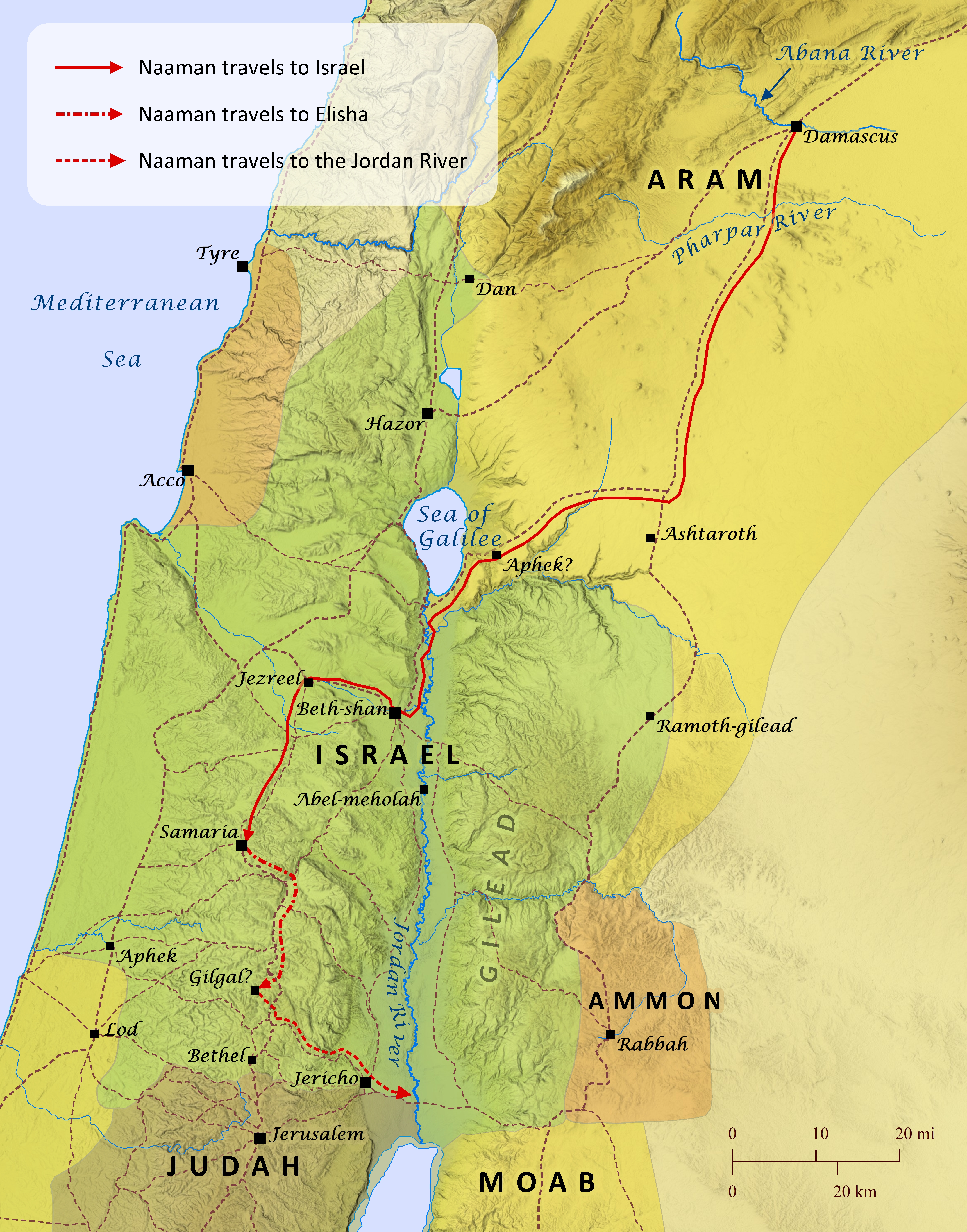
There are many well-known accounts of Elisha’s service as prophet. He healed the waters of Jericho (2 Kings 2:19–21) and was jeered by youths upon whom he called a curse resulting in their death by mauling bears (2 Kings 2:23–25). He multiplied a widow’s oil (2 Kings 4:1–7). He prophesied a son for a wealthy Shunammite family who hosted him and later resurrected that same son (2 Kings 4:8–37). Elisha also removed poison from a pot of stew (2 Kings 4:38–41) and multiplied twenty barley loaves to feed one hundred men (2 Kings 4:42–44). He cured Naaman of leprosy (2 Kings 5) and made a borrowed ax head float (2 Kings 6:1–7). The miracles Elisha performed are, for the most part, acts of helpfulness and blessing. Others strongly resemble some of the miracles of Christ, such as the multiplying of food (Matthew 16:9–10) and the healing of lepers (Luke 17:11–19).

Elisha offered counsel to the king of Israel. One incident tells of Elisha warning the king about the king of Aram’s movements. When the king of Aram found out it was Elisha foiling his plans, he sought to capture the prophet. When Elisha’s servant, Gehazi, saw the Arameans that had come against them, he was afraid. But Elisha told him not to be afraid because “those who are with us are more than those who are with them.’ And Elisha prayed, ‘Open his eyes, Lord, so that he may see.’ Then the Lord opened the servant’s eyes, and he looked and saw the hills full of horses and chariots of fire all around Elisha” (2 Kings 6:16–17). One cannot help but recall how Elisha had seen similar chariots of fire when Elijah was taken to heaven. Elisha then prayed for the Arameans to be struck with blindness. Elisha led them to Samaria, the capital of Israel, before asking the Lord to open their eyes. The king of Israel wondered if he should kill the captives, but Elisha counseled him to prepare food for them instead. When they were finished with the feast, the Aramians returned to their master, and Aram ceased raiding Israel. Elisha also prophesied other events of national and international importance regarding Israel and Syria.

King Jehoash, or Joash, was reigning at the time of Elisha’s death. The king visited Elisha while the prophet was ill and wept over him. Elisha instructed Jehoash to get a bow and arrows and shoot them out the window. When Jehoash did so, Elisha told him this was God’s arrow of victory over Aram. Elisha then told the king to strike the ground with the arrows, but Jehoash stopped after only three times. Elisha was angered. Had Jehoash struck the ground five or six times, he would have completely destroyed Aram but would now only defeat them three times (2 Kings 13:14–19).

Of Elisha’s death, 2 Kings 13:20 simply says, “Elisha died and was buried.” But the passage goes on to talk about Moabite raiders who came to Israel every spring: “Once while some Israelites were burying a man, suddenly they saw a band of raiders; so they threw the man’s body into Elisha’s tomb. When the body touched Elisha’s bones, the man came to life and stood up on his feet” (2 Kings 13:21). It seems that God chose to demonstrate His power through the prophet even after his death.

Jesus spoke of Elisha in Luke 4:27. The people had rejected Jesus in Nazareth and He told them that “no prophet is accepted in his hometown” (Luke 4:24). Jesus said there were many lepers in Israel in Elisha’s time, yet only Naaman, a Syrian, was cured.

A study of the life of Elisha will reveal the prophet’s humility (2 Kings 2:93:11), his obvious love for the people of Israel (2 Kings 8:11—12), and his faithfulness in a lifelong ministry. Elisha was obedient to God’s call, following Elijah eagerly and faithfully. Elisha clearly believed God and trusted Him. Elisha sought after God, and through him God worked powerfully.

www.Upwards.Church

Message Audio/Video and Outline: https://upwards.church/leander-campus/watch-now-message-videos

Watch Messages: YouTube-Upwards Church

Facebook: Upwards Church

Read Along Daily Bible Reading: YouVersion (https://www.bible.com/organizations/370f8a6e-16bc-464f-8c43-0b7623fd2952)

Sources: https://www.gotquestions.org/life-Elijah.html

Posted in Elijah & Elisha - A Tale of Two Prophets | Tagged , , , , , , , | 2 Comments