Christ Revealed – Revelation 1 Commentary

The book of Revelation unveils Christ’s full identity and God’s plan for the end of the world, and it focuses on Jesus Christ, his second coming, his victory over evil, and the establishment of his kingdom. As you read and study Revelation, don’t focus so much on the timetable of the events or the details of John’s imagery that you miss the main message—the infinite love, power, and justice of the Lord Jesus Christ.

1:1 The revelation of Jesus Christ, which God gave him to show his servants what must soon take place. He made it known by sending his angel to his servant John.NIV The word “revelation” is the Greek word apokalupsis, from which the word “apocalypse” is derived. A “revelation” exposes what was formerly hidden or secret. The revelation recorded in this book will show God’s servants (the believers) what must soon take place. That information had been formerly veiled but would now be disclosed.

A particular style of ancient literature was called “apocalyptic.” Many Jewish apocalyptic works existed at the time Revelation was written. Written to describe the end of the world and God’s final victory over evil, these works usually featured spectacular and mysterious imagery as well as hidden secrets that would be revealed. These Jewish works were largely pessimistic, for there was not much hope for the present. Such literature was often written under the name of an ancient hero.

The book of Revelation is apocalyptic but is different in several ways:

  • It names John as the author rather than an ancient hero.
  • It denounces evil and exhorts people to high Christian standards.
  • It offers hope rather than gloom.

John was not a psychic attempting to predict the future; he was a prophet of God describing what God had shown him (this book is called “the prophecy,” 1:3). Specifically, the apocalyptic literature in Scripture (Daniel 10-12; Mark 13; and the book of Revelation) includes fantastic imagery to remind the readers of their constant supernatural battle with evil.

Readers need to understand some characteristics of apocalyptic literature in the Bible. First, the Bible’s apocalyptic sections are revelations from God. Revelation is God’s giving his people a peek into the future. Second, apocalyptic literature emphasizes God’s supernatural acts. Revelation highlights God’s power by focusing on the end times, when God will interrupt human history and defeat evil once and for all. Third, apocalyptic literature is symbolic. It attempts to describe supernatural actions with graphic symbols of real events, things, or traits. For example, Christ is described in Revelation 5:6 as having “seven horns and seven eyes.” The number seven represents perfection. A horn symbolizes power. So “seven horns” speak of Jesus’ extraordinary power, and “seven eyes” speak of his ability to see all things.

This book is the revelation of (mediated by) Jesus Christ. God gave the revelation of his plan to Jesus Christ (see also John 1:18; 5:19-23; 12:49; 17:8). Jesus Christ, in turn, sent his angel, who revealed it to his servant John (see also 22:16). The angel will explain various scenes to John, acting as a guide. Angels are referred to sixty-seven times in Revelation. They are highly significant in this book; we see them worshiping God, revealing his Word, and carrying out his judgments. (For more on angels, see the commentary on 5:11-12.)

John, the servant, then passed the message along to the churches—God’s servants. God’s people are described as “servants” in Revelation (see, for example, 2:20; 7:3; 22:3). The word is used elsewhere in the New Testament to describe believers.

The phrase “what must soon take place” means imminence—it would happen “soon.” This seems odd to today’s readers because 1,900 years have passed since the time this was proclaimed. We must remember that in apocalyptic literature the future is imminent, without concern for intervening time. Recall the words of 2 Peter 3:8, “A day is like a thousand years to the Lord, and a thousand years is like a day” (nlt). God is timeless. In God’s eyes the future is just around the corner, even though it may seem far away to us. No one knows when these events will happen, so believers should live at all times as though Christ will come in the next moment.

According to tradition, John, the author, was the only one of Jesus’ original twelve disciples who was still alive at this time (that is, if the date of a.d. 90-95 is accepted; see the Introduction). John wrote the Gospel of John and the letters of 1, 2, and 3 John. John’s Gospel and letters show the great God of love, while the thunder of God’s justice bursts from the pages of Revelation. John wrote Revelation in exile on the island of Patmos in the Aegean Sea, sent there by the Romans as punishment for his witness about Jesus Christ.

Jesus gave his message to John in a vision, allowing him to see and record certain future events so that they could be an encouragement to all believers. The vision includes many signs and symbols that convey the essence of what is to happen. What John saw, in most cases, was indescribable, so he used illustrations to show what it was like. Readers of this symbolic language don’t have to understand every detail—John himself didn’t. Instead, we must realize that John’s imagery reveals that Christ is indeed the glorious and victorious Lord of all. Some of Revelation’s original readers were being severely persecuted because of their faith. The awesome and sometimes frightening pictures of Jesus’ ultimate victory over evil were intended to encourage them to persevere.

Jesus is the ruler of the universe! He will come to this earth in victory. For believers, this is Good News. For unbelievers, it’s a sober call to repent of their evil ways and prepare for Christ’s return. The same God who controlled the past, and who will be in control in the future, still controls the present—even if it seems as though evil is winning. This world is an illusion; the real world is the spiritual world. God is allowing evil to triumph for a time, but evil is ultimately doomed. The primary point of the book of Revelation is that God is sovereign. He has already determined the end of history. The secondary point is that Satan’s rebellion is futile. Although Satan is the ultimate foe of God and God’s people, he has already lost.

1:2 John faithfully reported the word of God and the testimony of Jesus Christ—everything he saw.NLT John saw the vision and then faithfully reported . . . everything he saw. He saw the word of God and the testimony of Jesus Christ. Revelation, according to John, is God’s Word—not simply John’s narration of what he saw. It is an eternal message. The testimony “of” Jesus Christ could also be translated “from” Jesus Christ. The words of this book describe the promises and actions of God that have come true through Jesus. Revelation, as difficult as it may be to understand, should not be neglected. It should be read and studied, for it is the Word of God and the testimony of Christ to all believers, from the first century to today.

1:3 Blessed is the one who reads aloud the words of the prophecy, and blessed are those who hear and who keep what is written in it; for the time is near.NRSV “Blessed” means “God blesses those who” or “God’s blessing is upon.” This promise sets John’s writing apart from other Jewish apocalyptic literature and points out that these words were inspired by God. This is the first of seven beatitudes in Revelation (see also 14:13; 16:15; 19:9; 20:6; 22:7, 14). See the chart at 14:13.

Who is blessed? The one who reads aloud the words of the prophecy. The public reading of Scripture was common in Jewish heritage (see, for example, Nehemiah 8:2-3; Luke 4:16; Acts 13:15). Christians also read Scripture aloud in public because copies of the Gospels and the letters of the apostles were not available to every believer. Someone—usually a scribe or someone trained in writing and reading texts—would be chosen to read aloud portions of the text. Later, the office of “reader” became a position in the church.

Scripture reading was an important event. In addition to the reader, blessed also are those who hear and who keep what is written. This echoes Jesus’ words in Luke 11:28: “Blessed are those who hear the word of God and keep it” (nkjv). “Hear” and “keep” are important terms and major themes of the book. Used together, they mean “to persevere in faithful obedience.” The blessed ones are those who come to church to hear God’s Word and then keep (obey) it so that it changes their lives (Ephesians 4:13).

Revelation is a book of prophecy that is both prediction (foretelling future events) and proclamation (preaching about who God is and what he will do). Prophecy is more than telling the future. Behind the predictions are important principles about God’s character and promises. These words will bless the hearers because through them they can get to know God better and be able to trust him more completely. The words are more than just predictions of the future; they include moral instruction that the listeners were to “hear” and “keep.”

The phrase “the time is near” is like the phrase “what must soon take place” in 1:1 and refers to imminence. Believers must be ready for Christ’s second coming. The Last Judgment and the establishment of God’s kingdom are certainly near. No one knows when these events will occur, so all believers must be prepared. They will happen quickly, with no second chance to change minds or sides.

 LIFE APPLICATION – INSPIRING WORDS
The typical news reports—filled with violence, scandal, and political haggling—are depressing, and we may wonder where the world is heading. God’s plan for the future, however, provides inspiration and encouragement because we know he will intervene in history to conquer evil. John encourages churches to read this book aloud so everyone can hear it, apply it (“keep what is written in it”), and be assured of the fact that God will triumph.

JOHN’S GREETINGS AND PRAISE TO GOD / 1:4-8

John began to address the recipients of this letter, a letter that would be sent along the roads through the various cities with the churches to whom John was writing. After this brief greeting comes a doxology of praise to God.

1:4-5a This letter is from John to the seven churches in the province of Asia. Grace and peace from the one who is, who always was, and who is still to come; from the sevenfold Spirit before his throne; and from Jesus Christ, who is the faithful witness to these things, the first to rise from the dead, and the commander of all the rulers of the world.NLT Jesus told John to write to seven churches that knew and trusted John and had read his earlier letters (see 1:9, 11). These were literal churches in literal cities. The letter was addressed so that it could be read and passed on in a systematic fashion, following the main Roman road clockwise around the province of Asia (now called Turkey).

These were not the only churches in Asia at the time. For example, Troas (Acts 20:5ff), Colosse (Colossians 1:2), and Hierapolis (Colossians 4:13) also had churches. Why did the Lord direct John to write to these seven in particular? It is possible that the number seven, as with the other sevens in the book, signifies completeness. While the seven churches were actual churches, they also represented all churches throughout the ages.

Grace and peace were standard greetings in the ancient world. “Grace” was the Greek greeting (charis); “peace” was the Hebrew greeting (shalom). The early church took these two greetings and used them together as a way of declaring that God had given these realities to his people.

The Trinity—the Father (the one who is, who always was, and who is still to come), the Holy Spirit (the sevenfold Spirit), and the Son (Jesus Christ)—is the source of all truth (John 14:6-17; 1 John 2:27; Revelation 19:11).

All of time is encompassed in the Father—he is, was, and will be. This title is used only in Revelation (see also 11:17; 16:5). God is eternally present and therefore able to help his people in any age, in any situation. Note that the present tense is first, stressing that the God of the Old Testament and the God of the future is still in control of the present, even though it doesn’t seem like it. The pressures and stresses that the early Christians faced made the truth of God’s control over all history that much more meaningful.

The “sevenfold Spirit” has been identified by some to mean the seven angelic beings or messengers for the churches (see a further discussion at 1:20). Others have interpreted this to refer to those angels that accompany Christ at his return (Luke 9:26; 1 Timothy 5:21). But the reference to the Trinity here gives more weight to the interpretation that the sevenfold Spirit is the Holy Spirit. The “sevenfold Spirit” refers to the fullness of the Holy Spirit. The number seven is used throughout Revelation to symbolize completeness and perfection (see also 3:1; 4:5; 5:6). This also pictures the sevenfold ministry of the Holy Spirit as recorded in Isaiah 11:2 and the seven lamps in Zechariah, which also describe the Holy Spirit (Zechariah 4:1-10).

Jesus is seen in all his sovereignty. He is the faithful witness of the truth from God, who sent him to earth to die for sins. Both Jesus and the believers are called “witnesses.” The word “martyr” comes from the Greek word for witness. Jesus was a “witness” as the first to die. This would have comforted believers who were suffering for their faith. Those who would die for their faith in Christ, the martyrs, would “witness” through their deaths. Jesus Christ is the preeminent “faithful witness” because he died and because he was the first to rise from the dead (see also Colossians 1:18). Christ’s resurrection assures the same for all the believers. He shows us all how to stand firm for the faith even when faced with persecution. Others had risen from the dead—people whom the prophets, Jesus, and the apostles had brought back to life during their ministries—but later those people had died again. Jesus was the first to rise from the dead in an imperishable body (1 Corinthians 15:20), never to die again. He is the firstborn from the dead.

Jesus is also portrayed as the commander of all the rulers of the world—an all-powerful King, victorious in battle, glorious in peace. Satan had tried to tempt Jesus with an offer of ruling all the nations of the world if Jesus would bow and worship him (Matthew 4:8-9). Jesus refused and, through obedience to God through death on the cross, gained ultimate leadership. Psalm 89:27 says, “I will make him my firstborn son, the mightiest king on earth” (nlt). Jesus was not just a humble earthly teacher; he is the glorious God. When he returns, he will be recognized for who he really is. Then, “at the name of Jesus every knee will bow, in heaven and on earth and under the earth, and every tongue will confess that Jesus Christ is Lord, to the glory of God the Father” (Philippians 2:10-11 nlt).

 LIFE APPLICATION – WORDS OF TRUTH
We live in a day of conflicting claims for various religions (they can’t all be true), and the desire to be tolerant of all others (if it’s true for you, it’s true). Yet how do we as Christians determine what we believe? We regard Jesus Christ as our faithful witness (1:4-5). He is the only religious leader who has risen from the dead.
So when you read John’s description of the vision, keep in mind that his words are not just good advice; they are truth from the King of kings. Don’t just read his words for their interesting and amazing portrayal of the future. Let the truth about Christ penetrate your life, deepen your faith in him, and strengthen your commitment to follow him—no matter what the cost.

1:5b-6 To him who loves us and has freed us from our sins by his blood, and has made us to be a kingdom and priests to serve his God and Father—to him be glory and power for ever and ever! Amen.NIV This doxology concludes the prologue to this book. John was writing to believers experiencing persecution; yet he assured them that Jesus not only continuously cared for and loved them but also had set them free, no matter how they might feel. Jesus had set them free from their sins by his blood, that is, through his death on the cross. Through that blood, he had made his people to be a kingdom and priests to serve his God and Father. Israel had been called to be “a kingdom of priests, [a] holy nation” (Exodus 19:6 nlt). This saying describes the Christians as the continuation of the Old Testament people of God—his kingdom and priests (see also Hebrews 13:15; 1 Peter 2:5, 9). Together believers make up a kingdom of which Christ is their King; individually they are priests because each has direct access to God because of the sacrifice of Christ on the cross. Their whole purpose, of course, is to serve God.

The doxology ends with words of praise: to him be glory and power for ever and ever! “Amen” means “let it be so.”

1:7 Look! He comes with the clouds of heaven. And everyone will see him—even those who pierced him. And all the nations of the earth will weep because of him. Yes! Amen!NLT Jesus will indeed have “glory and power for ever and ever” (1:6 niv)—the

 LIFE APPLICATION – STAR WITNESS
Many hesitate to witness about their faith in Christ because they don’t think the change in their lives has been spectacular enough. But you qualify as a witness for Jesus because of what he has done for you, not because of what you have done for him. Christ is seen through the whole book of Revelation as the Lamb who was slain. He demonstrated his great love by setting his people free from their sins through his death on the cross (“freed us from our sins by his blood”), guaranteeing them a place in his kingdom, and making them priests to administer God’s love to others. The fact that the all-powerful God has offered eternal life to you is nothing short of spectacular. Testify about his wonderful gift!

book of Revelation describes that day when he will return to earth. That Jesus will come with the clouds of heaven summarizes the message of Revelation. When Jesus ascended into heaven, “he was taken up into the sky . . . and he disappeared into a cloud” (Acts 1:9 nlt; see also Luke 24:50-51). An angel had told the astonished disciples, “Jesus has been taken away from you into heaven. And someday, just as you saw him go, he will return” (Acts 1:11 nlt). The imagery of coming in the clouds is probably a military picture, alluding to the clouds of dust kicked up by the war chariots, the ultimate war machines in ancient times. When Christ is pictured this way, he is coming as the ultimate Victor and conquering King (see also Daniel 7:13).

Jesus’ second coming will be visible and victorious. Everyone will see him arrive (Mark 13:26), and they will know it is Jesus. When Christ returns, he will conquer evil and will judge all people according to their deeds (Revelation 20:11-15).

Even those who pierced him will see him. “Those who pierced him” could refer to the Roman soldiers who pierced Jesus’ side as he hung on the cross, but it probably refers to the Jews who were responsible for his death (see Acts 2:22-23; 3:14-15). John saw Jesus’ death with his own eyes, and he never forgot the horror of it (see John 19:34-35). Zechariah had written, “Then I will pour out a spirit of grace and prayer on the family of David and on all the people of Jerusalem. They will look on me whom they have pierced and mourn for him as for an only son. They will grieve bitterly for him as for a firstborn son who has died” (Zechariah 12:10 nlt). In Zechariah the twelve tribes mourned because of their sin. Here, however, all people across the ages who have rejected Christ have themselves “pierced” him through their indifference to his sacrifice on their behalf. All the nations of the earth—both Jews and Gentiles—will weep because of him. They will mourn because they know they will be facing God and his judgment and will be destroyed.

1:8 “I am the Alpha and the Omega,” says the Lord God, “who is, and who was, and who is to come, the Almighty.”NIV Alpha and Omega are the first and last letters of the Greek alphabet. The Lord God is the beginning and the end. God the Father is the eternal Lord and Ruler of the past, present, and future (see also 4:8; Isaiah 44:6; 48:12-15). God is sovereign over history and is in control of everything.

The one who is, and who was, and who is to come is also described in 1:4, the Lord God, who controls present, past, and future.

The phrase “the Almighty” comes out of the Old Testament and conveys military imagery, referring to God as a mighty warrior.

The military imagery helped the people in the churches to whom this book was written understand that they had the ultimate Warrior fighting on their side. God rules over all. God is an infinite circle whose center is everywhere and whose circumference is nowhere.

Augustine of Hippo


THE VISION OF CHRIST / 1:9-20

John again gave his name as the author of the letter and described his whereabouts and why he was there. Next he explained his commissioning to write this letter to the churches. Then he described his vision of the exalted Christ, leaving no mistake as to Christ’s true identity. The vision has much in common with Isaiah 6 and Ezekiel 1.

I am John, your brother. In Jesus we are partners in suffering and in the Kingdom and in patient endurance. I was exiled to the island of Patmos for preaching the word of God and speaking about Jesus.NLT John had been one of Jesus’ twelve disciples. Although John was an apostle and an elder of the church, he described himself as their brother in Christ because he and the persecuted believers were partners in suffering, partners in God’s coming Kingdom, and partners in patient endurance of their suffering. They were partners in suffering for Christ, as persecution against believers began to escalate at the end of the century. They shared in God’s kingdom because, as believers, they were already its citizens. As believers faced persecution, they were awaiting the arrival of God’s coming kingdom.

The Christian church was facing severe persecution. Almost all believers were socially, politically, or economically suffering because of this Empire-wide persecution, and some were even being killed for their faith. The word “Kingdom” is surrounded by “suffering” and “patient endurance.” Although the North American churches are not facing the kind of oppression John referred to here, two-thirds of all Christians in the world face persecution today.

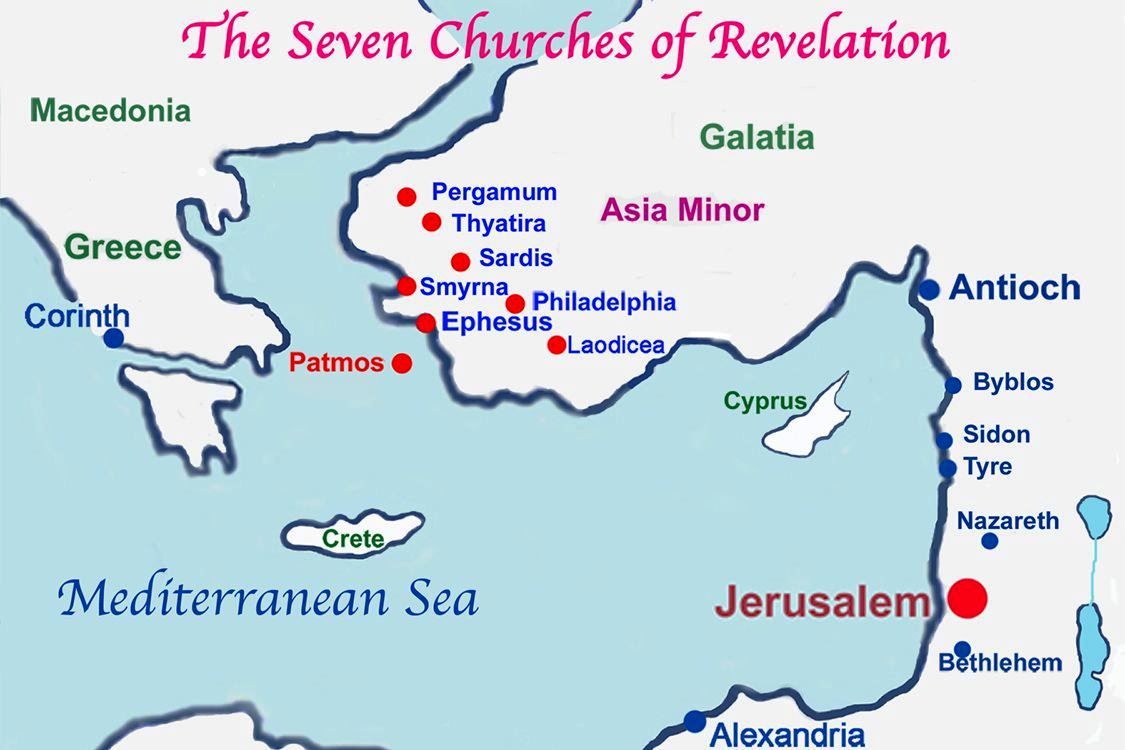
John had paid for his faithfulness to the message of Jesus by being exiled to the island of Patmos, a small rocky island about ten miles long and six miles wide in the Aegean Sea, about fifty miles offshore from the city of Ephesus on the Asia Minor seacoast (see map). The Romans used Patmos for banishing political prisoners. John, like Paul, was caught in a time when Rome turned against Christianity. There are two possible dates for Revelation. One is under the reign of Nero in the mid-60s, toward the time when Paul and Peter were both martyred. The other date is the mid-90s, when John was at the end of his life and the ruler was Domitian, a man who was far more anti-Christian than even Nero. Domitian issued an edict (under threat of death) demanding that all peoples in the Empire worship the reigning emperor. The date of the 90s is more likely. Eusebius wrote that John was exiled to the island by the emperor Domitian in a.d. 95 and released about eighteen months later.

John was exiled for preaching the word of God and speaking about Jesus. Although John was away from the churches and unable to travel, his exile did not stop what God would do through John, nor did it stop God’s message from getting to his churches.

 LIFE APPLICATION – HE WHO HESITATES
John described himself as a partner in suffering (1:9). Early Christians faced imprisonment, economic injustice, slanderous accusations by Jews, and attacks from government soldiers or mobs. We may not face persecution for our faith as the early Christians did, but even with our freedom, few of us have the courage to share God’s Word with others. If we hesitate to share our faith during easy times, how will we do it during times of persecution?

1:10-11 On the Lord’s Day I was in the Spirit, and I heard behind me a loud voice like a trumpet, which said: “Write on a scroll what you see and send it to the seven churches: to Ephesus, Smyrna, Pergamum, Thyatira, Sardis, Philadelphia and Laodicea.”NIV On the Lord’s Day (Sunday), John was in the Spirit, which refers to a visionary experience given to John by the Holy Spirit. There are four “in-the-Spirit” passages in Revelation, which probably refer to the actual visions John received (see 4:2; 17:3; 21:10; see also Ezekiel 3:12, 14; 37:1; Acts 10:10; 11:5; 22:17). This is the first.

In this vision John heard . . . a loud voice like a trumpet. The trumpet heralds the return of Christ (1 Corinthians 15; 1 Thessalonians 4). The voice commands John to write on a scroll everything he would see in the visions. John’s record then became this book, which he would send to the seven churches. The names of these churches are presented, as noted earlier, in a circular fashion, following the Roman road from one church to the next—starting at the church in the port city of Ephesus. Presumably, this letter was taken from John on Patmos by a messenger who crossed the water and landed at Ephesus, where he began his route. The contents of specific messages to these churches are in chapters 2 and 3.

1:12-14 When I turned to see who was speaking to me, I saw seven gold lampstands. And standing in the middle of the lampstands was the Son of Man. He was wearing a long robe with a gold sash across his chest. His head and his hair were white like wool, as white as snow. And his eyes were bright like flames of fire.NLT The seven gold lampstands are the seven churches in Asia to whom this letter is addressed (Revelation 1:11, 20). (See also Zechariah 4:1-10 for his vision of seven lamps.) Jesus, the Son of Man, stands among them. No matter what the churches face, Jesus is in control and protects them with his all-encompassing love and reassuring power. Through his Spirit, Jesus is still among the churches today. When a church faces persecution, it should remember Christ’s deep love and compassion. When a church is wracked by internal strife and conflict, it should remember Christ’s concern for purity and his intolerance of sin. Jesus is sovereign over the church.

The title “Son of Man” occurs many times in the New Testament in reference to Jesus as the Messiah. John recognized Jesus because he had lived with him for three years and had seen him both as the Galilean preacher and as the glorified Son of God at the Transfiguration (Matthew 17:1-8). Here Jesus appears as the mighty Son of Man.

The long robe pictures Jesus as a leader. The gold sash across his chest reveals him as the high priest who goes into God’s presence to obtain forgiveness of sin for those who have believed in him. In the first century, wearing a sash, especially across the chest, indicated leadership and authority. Hebrews 2:17 identifies Jesus as the final high priest. His glowing white hair indicates his wisdom and divine nature (see also Daniel 7:9). His blazing eyes symbolize judgment of all evil (see Daniel 10:6) and deep insight, not only over the churches and the believers but over the entire course of history (see also 2:18; 19:12).

1:15 His feet were like bronze glowing in a furnace, and his voice was like the sound of rushing waters.NIV The feet like bronze picture an exalted person with great power (also from Daniel). Bronze usually symbolized the might of Rome—bronze shields and breastplates were used by the Roman army. In addition, the altar of burnt offering was covered with bronze (Exodus 38:1-7). Again, this is a picture of an all-powerful Victor. The description of glowing metal used to describe this Son of Man is also found in Ezekiel 1:13, 27; 8:2; and Daniel 10:6.

The voice like rushing waters (see also 19:6) evokes the image of a huge waterfall roaring over a high cliff. Thus, the voice is powerful and awesome. When this man speaks with authority, nothing else can be heard.

 LIFE APPLICATION  – TO SEE JESUS
Revelation will probably challenge and change your mental picture of Jesus Christ. That is its purpose—to reveal Jesus Christ. What forms your impression of Jesus right now—famous paintings, movies, Sunday school art? To what degree do you picture Jesus with gold sash and snow white, woolly hair? Do his eyes flash fire and his feet glow like bronze? When you imagine Jesus speaking to you, does his voice sound like a trumpet or rushing waters? Reevaluate the way you think of Jesus as you read and study Revelation. Allow his awesome presence to transform your life.

1:16 He held seven stars in his right hand, and a sharp two-edged sword came from his mouth. And his face was as bright as the sun in all its brilliance.NLT In his right hand, Christ holds seven stars, explained in 1:20 as “the angels of the seven churches,” referring to the seven churches, listed in 1:11, to whom this letter is addressed. That Christ is holding the stars implies his protection of these churches as he walks among them.

There are two swords in Revelation. Chapter 19 has the “great sword.” The sword here is the sharp two-edged sword. This type of sword, invented by the Romans, represents invincible might. Only two to two and a half feet long, these swords were quite possibly the greatest military invention of the ancient world. Previously, swords were about three feet long and made of an inferior metal. They could not be sharp on both edges because the metal wasn’t strong enough. The double-edged sword was lighter and sharp on both edges. With the older swords, fighting was done by drawing back and hacking, but when the Romans used their double-edged swords, they could slice and cut both ways. These swords gave such a great advantage in hand-to-hand combat that the Roman army was called “the short swords.” It made them virtually invincible.

This sharp two-edged sword is coming from Jesus’ mouth, symbolizing the power and force of his message. Jesus’ words of judgment are as sharp as swords; he is completely invincible (2:16; 19:15, 21; Isaiah 49:2; Ephesians 6:17; Hebrews 4:12).

His face was as bright as the sun in all its brilliance. This shining brilliance probably describes Christ’s entire being. The same sort of picture is described in the Transfiguration, an event that John himself had witnessed (10:1; Matthew 17:2).

1:17-18 When I saw him, I fell at his feet as though dead. Then he placed his right hand on me and said: “Do not be afraid. I am the First and the Last. I am the Living One; I was dead, and behold I am alive for ever and ever! And I hold the keys of death and Hades.”NIV John’s response to the awesome sight of the glorious Son of Man was to fall at his feet as though dead. Most likely this was not a trance; rather, it was in response to having seen a spectacular vision. (Other such responses are recorded in Joshua 5:14; Ezekiel 1:28; Daniel 8:17; 10:8-9; Matthew 17:6; and Acts 26:14.)

The message given by this glorious figure—Christ—is the same one that had been given to the women at the tomb (Matthew 28:5): “Do not be afraid.” Jesus had also told his followers not to be afraid when he had walked over to them across the water (Matthew 14:27) and when the three who had witnessed his Transfiguration had fallen terrified to the ground (Matthew 17:7). For those who believe, there is no need to fear. This Christ is the First and the Last—essentially the same as the Alpha and the Omega in 1:8. In Isaiah 44:6, God says, “I am the First and the Last; there is no other God” (nlt). Christ is the Living One—not a dead idol but alive and always with his people, every moment, in control of all things. He is the same one who was resurrected. He was dead; that is, he experienced physical death on the cross. But now he is alive for ever and ever. Because Jesus rose from the dead, he can promise the same for his people.

Jesus holds the keys of death and Hades, which give him complete control over that domain. Keys open doors, thus revealing what is behind them. In ancient days the key holders had high status in the community. Christ alone has absolute authority over people’s lives and deaths—and even when they are raised from the dead. He alone can free people from the ultimate enemy, death. He alone can say who will die and who will live, because he has the keys. The word “Hades” is the Greek word for the underworld, the realm of the dead; a different word describes “hell,” the place of torment. Hades is the word used in the New Testament for “Sheol”—the Old Testament word describing the place of the dead. The word “Hades” occurs here, in 20:13-14, and in Matthew 16:18. Believers need not fear death and Hades, because Christ holds the keys to both (see Luke 16:23).

 LIFE APPLICATION – NO FEAR
Jesus told John not to be afraid (1:17). As the Roman government stepped up its persecution of Christians, John must have wondered if the church could survive and stand against the fearful opposition. But Jesus appeared in glory and splendor, touched John with his right hand as if commissioning him, and reassured him that he and his fellow believers had access to God’s strength to face these trials. Believers and churches of any age who face difficult problems should remember that the power available to John and the early church is also available to them (see 1 John 4:4). Because Christ has such wonderful power, we need not fear death or judgment.

1:19 “Write down what you have seen—both the things that are now happening and the things that will happen later.”NLT The command to write down what John had seen is repeated (see also 1:11). The phrase “what you have seen” is a general statement referring to both the things that are now happening and the things that will happen later. The vision that will unfold in the following chapters will include present and future events intertwined—events that both are and will be. Every future revelation has relevance for the present—the churches to whom this letter was written. The revelation also applies to churches and believers even today, two thousand years later.

1:20 “The mystery of the seven stars that you saw in my right hand and of the seven golden lampstands is this: The seven stars are the angels of the seven churches, and the seven lampstands are the seven churches.”NIV Christ first reveals to John the mystery of the seven stars that he was holding in his right hand (1:16). In the New Testament, the word “mystery” describes something formerly hidden but now revealed. Christ explains that the seven stars are the angels of the seven churches. But just who are the “angels of the seven churches”? Because the Greek word angeloi can mean angels or messengers, some believe that they are angels designated to guard the churches; others believe that they are elders or pastors of the churches. The case for angels as the correct interpretation comes from the fact that every other use of “angels” in Revelation refers to heavenly beings. However, because the seven letters in Revelation 2-3 contain reprimands against the messengers, and angels are not ever considered to be heads of churches, it is doubtful that these angels are heavenly messengers. If these are earthly leaders or messengers, they are accountable to God for the churches they represent.

The seven golden lampstands among which Christ had been standing (1:13) represent the seven churches to whom this letter would be circulated (1:11). The churches may have been facing difficulties and persecution, but they must never forget that Christ was standing among them, totally in control.

www.Upwards.Church

Watch Messages: YouTube-Upwards Church

Facebook: Upwards Church

Source: Bruce B. Barton et al., Life Application Bible Commentary – Revelation, (Wheaton, IL: Tyndale, 2000), WORDsearch CROSS e-book, 1-15.
Posted in Revelation | Tagged , , , , , , , , , , | Leave a comment

Revelation Introduction and Invitation

You’re invited to join us for our new series through the book of Revelation!

Series Description: The book of Revelation was written because God wants us to know what the future holds.  For Christians, the prophetic truths within this book provide hope, reassurance, and discernment for what’s ahead.  For unbelievers, Revelation is plea to receive salvation that Jesus gives while there is time. Our seven-week series calls believers to confidently trust in Jesus’s victory in the midst of the challenges and struggles of the world today.

  Dates                      Titles (Scriptures)                                 Events

Oct. 23 – Christ Revealed (Rev 1)

Oct 30 –   Heaven’s Open Door (Rev 4-5)                               Trunk or Treat


Nov. 6 – The Tribulation Judgements (Rev 6, 8-9)                 Communion 

Nov. 13 – The Witnesses (Rev 7 & 11)

Nov. 20 –The Dragon & Beasts (Rev 12-13)

Nov. 27 –Christ the Victor (Rev 19-20)                                   Thanksgiving Weekend

 Dec. 4 – All Things New (Rev 21-22)                           

Introduction: 

With tiny wrinkles and cries, he entered the world and, wrapped in strips of cloth, took his first nap on a bed of straw. Subject to time and to parents, he grew to manhood in Roman-occupied Judea, his gentle hands becoming strong and calloused in Joseph’s woodworking shop. As a man, he walked through the countryside and city, touching individuals, preaching to crowds, and training 12 men to carry on his work. At every step he was hounded by those seeking to rid the world of his influence.

Finally, falsely accused and tried, he was condemned to a disgraceful execution by foreign hands. And he died—spat upon, cursed, pierced by nails, and hung heavenward for all to deride. Jesus, the God-man, gave his life completely so that all might live.

At God’s appointed time, the risen and ascended Lord Jesus will burst onto the world scene. Then everyone will know that Jesus is Lord of the universe! Those who love him will rejoice, greeting their Savior with hearts overflowing into songs of praise. But his enemies will be filled with fear. Allied with Satan, the enemies of Christ will marshal their legions against Christ and his armies. But who can withstand God’s wrath? Christ will win the battle and reign victorious forever! Jesus, the humble suffering servant, is also the powerful, conquering King and Judge.

Revelation is a book of hope. John, the beloved apostle and eyewitness of Jesus, proclaimed that the victorious Lord would surely return to vindicate the righteous and judge the wicked. But Revelation is also a book of warning. Things were not as they should have been in the churches, so Christ called the members to commit themselves to live in righteousness.

Although Jesus gave this revelation of himself to John nearly 2,000 years ago, it still stands as a comfort and challenge to God’s people today. We can take heart as we understand John’s vision of hope: Christ will return to rescue his people and settle accounts with all who defy him.

John begins this book by explaining how he received this revelation from God (1:1-20). He then records specific messages from Jesus to the seven churches in Asia (2:1-3:22). Suddenly, the scene shifts as a mosaic of dramatic and majestic images bursts into view before John’s eyes. This series of visions portrays the future rise of evil, culminating in the Antichrist (4:1-18:24). Then follows John’s recounting of the triumph of the King over all kings, the wedding of the Lamb, the final judgment, and the coming of the new Jerusalem (19:1-22:5). Revelation concludes with the promise of Christ’s soon return (22:6-21), and John breathes a prayer that has been echoed by Christians through the centuries: “Amen! Come, Lord Jesus!” (22:20).

As we read the book of Revelation, let’s marvel with John at the wondrous panorama of God’s revealed plan. Listen as Christ warns the churches, and root out any sin that blocks your relationship with him. Be full of hope, knowing that God is in control, Christ’s victory is assured, and all who trust him will be saved.

Vital Statistics

Purpose: To reveal the full identity of Christ and to give warning and hope to believers

Author: The apostle John

Original Audience: The seven churches in Asia and all believers everywhere

Date Written: Approximately A.D. 95 from Patmos

Setting: Most scholars believe that the seven churches of Asia to whom John writes were experiencing the persecution that took place under Emperor Domitian (A.D. 90-95). It seems that the Roman authorities had exiled John to the island of Patmos (off the coast of Asia). John, who had been an eyewitness of the incarnate Christ, had a vision of the glorified Christ. God also revealed to John what would take place in the future—judgment and the ultimate triumph of God over evil.

Key Verse: “God blesses the one who reads the words of this prophecy to the church, and he blesses all who listen to its message and obey what it says, for the time is near” (1:3).

Key People: John, Jesus

Key Places: Patmos, the seven churches, the new Jerusalem

Special Features: Revelation is written in “apocalyptic” form—a type of Jewish literature that uses symbolic imagery to communicate hope (in the ultimate triumph of God) to those in the midst of persecution. The events are ordered according to literary, rather than strictly chronological, patterns.

The Blueprint

  1. LETTERS TO THE CHURCHES (1:1-3:22)
    The vision John received opens with instructions for him to write to seven churches. He both commends them for their strengths and warns them about their flaws. Each letter was directed to a church then in existence but also speaks to conditions in the church throughout history. Both in the church and in our individual lives, we must constantly fight against the temptation to become loveless, immoral, lenient, compromising, lifeless, or casual about our faith. The letters make it clear how our Lord feels about these qualities.
  2. MESSAGE FOR THE CHURCH (4:1-22:21)
    1. Worshiping God in heaven
    2. Opening the seven seals
    3. Sounding the seven trumpets
    4. Observing the great conflict
    5. Pouring out the seven plagues
    6. Seizing the final victory
    7. Making all things new

This revelation is both a warning to Christians who have grown apathetic and an encouragement to those who are faithfully enduring the struggles in this world. It reassures us that good will triumph over evil, gives us hope as we face difficult times, and gives guidance when we are wavering in our faith. Christ’s message to the church is a message of hope for all believers in every generation.

MEGATHEMES
THEME EXPLANATION IMPORTANCE
God’s Sovereignty God is sovereign. He is greater than any power in the universe. God is not to be compared with any leader, government, or religion. He controls history for the purpose of uniting true believers in loving fellowship with him. Though Satan’s power may temporarily increase, we are not to be led astray. God is all-powerful. He is in control. He will bring his true family safely into eternal life. Because he cares for us, we can trust him with our very life.
Christ’s Return Christ came to earth as a “Lamb,” the symbol of his perfect sacrifice for our sin. He will return as the triumphant “Lion,” the rightful ruler and conqueror. He will defeat Satan, settle accounts with all those who reject him, and bring his faithful people into eternity. Assurance of Christ’s return gives suffering Christians the strength to endure. We can look forward to his return as king and judge. Since no one knows the time when he will appear, we must be ready at all times by keeping our faith strong.
God’s Faithful People John wrote to encourage the church to resist the demands to worship the Roman emperor. He warns all God’s faithful people to be devoted only to Christ. Revelation identifies who the faithful people are and what they should be doing until Christ returns. You can take your place in the ranks of God’s faithful people by believing in Christ. Victory is sure for those who resist temptation and make loyalty to Christ their top priority.
Judgment One day God’s anger toward sin will be fully and completely unleashed. Satan will be defeated with all of his agents. False religion will be destroyed. God will reward the faithful with eternal life, but all who refuse to believe in him will face eternal punishment. Evil and injustice will not prevail forever. God’s final judgment will put an end to these. We need to be certain of our commitment to Jesus if we want to escape this great final judgment. No one who rejects Christ will escape God’s punishment.
Hope One day God will create a new heaven and a new earth. All believers will live with him forever in perfect peace and security. Those who have already died will be raised to life. These promises for the future bring us hope. Our great hope is that what Christ promises will come true. When we have confidence in our final destination, we can follow Christ with unwavering dedication no matter what we must face. We can be encouraged by hoping in Christ’s return.


www.Upwards.Church

Watch Messages: YouTube-Upwards Church

Facebook: Upwards Church

Source:  Life Application Study Bible, (Wheaton, IL: Tyndale, 1988), WORDsearch CROSS e-book, 2165-2166.

Posted in Revelation | Tagged , , , , , | Leave a comment

The Handwriting on the Wall – Daniel 5 (Living Humbly)

Have you ever wondered where clichés originate, where we got phrases like: “Sleep tight and don’t let the bed bugs bite?  I’ve found that answering that kind of question can be very interesting, and I’ll use this popular night-time farewell as an example. “Sleep tight and don’t let the bed bugs bite,” started in the 18th century, before the invention of box springs. Back then unless you were very wealthy your bedroom would have been furnished with a straw-filled mattress and it was laid across a “net” of ropes. These ropes would stretch with use which meant they had to be tightened every once in a while or the heaviest part of your body would end up touching the floor. So back then if you were to get a good night’s rest it was important to “sleep tight” and with a straw filled mattress, warnings about biting bed bugs was very appropriate as well.

Here’s another one: “lock, stock, and barrel” is a synonym for totality. We say things like, “I bought the whole estate, lock, stock, and barrel.” This cliché also came from the 18th century and was used to refer to a fully assembled musket which was made up of three MAIN parts: a lock, a stock, and a barrel. Here’s another example. We say we “bury the hatchet” when we have decided to make amends with someone, and this popular phrase came from the American Indians who would literally bury a hatchet, whenever they were smoking the peace pipe with another tribe.

As we delve into the next portion of our study of the book of Daniel we find the origin of another popular cliché: “The handwriting is on the wall.” We use that phrase to refer to something that is obvious, ominous and imminent.

In college football I have heard this statement recently about a coach who lost several games in a row, “handwriting on the wall.”

Enough about football, let’s look at Daniel chapter 5 and see when this popular phrase was first coined. To give you the context of our study, thirty years have passed since the end of chapter 4, when Nebuchadnezzar finally lost his pride, gave up his worship of false gods and committed to praise and serve the one true God. He ruled seven more years after making that all-important decision, so basic math tells us, it’s been twenty-three years since he died, and unfortunately his religious reforms died with him. Nebuchadnezzar’s son-in-law, Nabonidus comes to the throne. Nabonidus spent most of his reign away from Babylon, attempting to secure the borders and strengthen the weakening empire so he appointed his son, Belshazzar as co-rule…and left him in charge of the famous double-walled capital city. Unfortunately Belshazzar received none of the benefits of his grandfather’s hard-learned spiritual truths. In fact, about the only trait he picked up was Nebuchadnezzar’s discarded pride, and because of that his heart was not at all responsive to the Spirit of God.

We’ll see that in Daniel 5 Nebuchadnezzar is referred to as Belshazzar’s father, but in that culture the word “father” was used interchangeably with “Grand-father” or even “great-grandfather.” Pretty much any male ancestor could be called your “father.”

For a long time there was absolutely no historical record of Belshazzar and this became the basis for many liberal attacks on the authenticity of the book of Daniel. But in 1854 an archeologist named J. G. Taylor was exploring some ruins in southern Iraq for the British Museum and he came across several small cylinders. One of them contained a prayer for the long life and good health of Nabonidus, king of Babylon and for his eldest son Belshazzar.

This find squelched these liberal attacks and helped prove the authenticity of this book of the Bible. It’s just one more example of the fact that the Bible becomes more and not less reliable as time passes. ver and over again archeological finds like this have affirmed the reliability of God’s written Word.

As the 5th chapter opens the empire of the Medes and the Persians, the “silver empire” foretold in Nebuchadnezzar’s first dream six decades earlier, is growing in power. Heroditus, the Greek historian, says that in an attempt to end this threat to his kingdom once and for all King Nabonidus took the armies of Babylon out to fight against Darius, the king of the Medes and the Persians.Nabonidus was defeated and fled so Darius and his hordes advanced, capturing every outpost until the city of Babylon alone remained. They arrived and laid siege to the city but Belshazzar thinks, “Who’s afraid of the big, bad Persians?! I’ve got plenty of water! Why the Euphrates flows right through town. And I’ve got tons of grain stored, enough to feed the population twenty years, so we can just wait them out.” This is a prideful attitude when you’re surrounded by a formidable enemy.

He thought his city was impregnable. It had impressive double walls and fortifications.  Belshazzar shouldn’t have been so proud and self-confident. He should have embraced the truth in the stories his grandfather must have told him…because as Daniel 2:21 says, “God changes times and seasons; He sets up kings and deposes them…” As we’ll see when we get a little further into this 5th chapter, Belshazzar’s grandfather experiences with God were well-known. So, Belshazzar knew about his grandfather’s first dream and of Daniel’s interpretation. He had been warned of the coming “silver kingdom” that God said would destroy his empire. He’d no doubt heard Nebuchadnezzar share his personal testimony of his decision to humble himself and worship God, a lesson he had learned the hard way by living like an animal for seven years or more. But Belshazzar and his predecessors had foolishly ignored all that God-given knowledge. They had refused to bow the knee to the one and only Most High God. By the way, I think our study of this book should remind us of this truth as well. , the main truth that the Book of Daniel was intended to convey is that God is completely sovereign. God, not you and me, not government, God is in charge. As Psalm 33:10-11 says, “The Lord foils the plans of the nations; He thwarts the purposes of the peoples. But the plans of the Lord stand firm forever, the purposes of His heart through all generations.”

To both show his lack of fear of the armies that were encamped all around them, and to boost the morale of those in his government, Belshazzar threw a party, a huge one. He invited a thousand nobles and broke protocol by telling them to bring their wives and concubines as well. Archeologists tell us that this party was held on the night of October 12, 539 B.C. They have also unearthed the banquet hall where this party was held. Follow along now as I read verses 1-4 and as you do note a verb that appears five times, a verb that tells us the “theme” or purpose of Belshazzar’s little get together. “King Belshazzar gave a great banquet for a thousand of his nobles and DRANK wine with them. While Belshazzar was DRINKING his wine, he gave orders to bring in the gold and silver goblets that Nebuchadnezzar his father had taken from the temple in Jerusalem, so that the king and his nobles, his wives and his concubines might DRINK from them. So they brought in the gold goblets that had been taken from the temple of God in Jerusalem, and the king and his nobles, his wives and his concubines DRANK from them. As they DRANK the wine, they praised the gods of gold and silver, of bronze, iron, wood and stone.”

Can we see what this repeated verb is?  It’s the verb for DRINK, and that was the main activity on October 12, 539B.C. in that banquet room. But that’s not all they did. , it was considered improper for women to come to banquets. So the fact that wives and concubines were invited tells us hunger and thirst weren’t the only appetites this banquet was intended to satisfy. In fact, it was more of an orgy than a banquet. , the writer, Daniel, is using fairly restrained language, but he’s making it clear that Belshazzar is giving free reign to any appetite his guests wanted to indulge…with him setting the tone with his own perverse behavior at the head table. since habitually indulging ANY appetite gets boring after a while, Belshazzar and his guests got tired of their orgy…so he decided to push the envelope and get even more bold.

This should remind us of a very important fact, sin is never static. It always follows the law of diminishing returns. The path of sin always leads downhill. One sin always leads to a worse sin, which leads to an even worse sin and so on. I think this downward spiral is what James was referring to when he wrote: “Each one is tempted when, by his own evil desire, he is dragged away and enticed. Then, after desire has conceived, it gives birth to sin; and sin, when it is full-grown, gives birth to death.” (James 1:14-15)

We see this downward spiral in verse 2 where Belshazzar gave orders to get the goblets that Nebuchadnezzar had obtained 65 years earlier when he conquered Jerusalem. They were abnormally valuable and more than that they were considered sacred objects. They had never been used for anything other than the worship of the God of Israel, the God we worship in this room every Sunday.

Belshazzar decides it would be entertaining, it might take a little of the boredom factor away if he would take these vessels, which were the expression of devotion and holiness for an exiled people, and use them to mock their God.

Belshazzar had pride and our pride will cause us to do the same thing,

 1. Pride causes us to Treat the Holy as Unholy

Let’s understand exactly what we mean by calling something, “holy.” The word literally means, “set apart for a special purpose.” 2nd Chronicles 7:16 says, that God Himself had consecrated Solomon’s temple and everything in it which included these goblets. He had declared them holy. He had said they were set aside exclusively for His purposes. These weren’t just any goblets, these belonged to God and were to be used only for worship in His temple.

Belshazzar knew these were God’s goblets. He knew it was wrong to used them. In fact, that’s why he wanted to used them, he thought it would be fun to take something that was God’s, something set apart for His worship, takes something holy and treat it as unholy.

In a very real sense we do the same thing. , as Christians, we too are God’s holy vessels, set apart for His purposes. In the New Testament we are repeatedly referred to as God’s SAINTS, His “Holy ones.” 2nd Corinthians 1:21-22 says, God has anointed us, set His seal of ownership on us.” do we always live your life in a way that is reflective of God’s ownership? Do we always live according to His will? Let’s ask ourselves this question: Am I treating myself as God’s holy vessel? Or, am I using my life for unholy things?  Satan has no greater agenda than attempting to desecrate what God consecrates. He wants to do with us what Belshazzar did with those goblets. he wants us to take what God has declared holy and set apart, and use it for unholy behavior.  How are we doing in this area? Does our life look consecrated to God? The Message paraphrase of 2nd Timothy 2:20-21 puts it well when it says, “In a well-furnished kitchen there are not only crystal goblets and silver platters, but waste cans and compost buckets, some containers used to serve fine meals, others to take out the garbage. Become the kind of container God can use to present any and every kind of gift to his guests for their blessing.”

In my mind as soon as the goblets were distributed Belshazzar called for a toast, perhaps to the “impregnable” walls of his city. But then, as soon as he and his guests brought those holy vessels to their unholy lips for the first time something amazing happened. A hand appeared in midair and the finger began to write on the wall. This was God’s hand, think about that! We have heard of the “unseen hand of God…” but with their own eyes Belshazzar and his guests beheld the seen hand of God. Look at verses 5-6: “Suddenly the fingers of a human hand appeared and wrote on the plaster of the wall, near the lampstand in the royal palace. The king watched the hand as it wrote. His face turned pale and he was so frightened that his knees knocked together and his legs gave way.”

I think this shows that God’s finger is a very fearful thing.

We see it referred to numerous times in the Bible. It was the finger of God that defeated the Egyptians when Pharaoh refused to let the people go. In Exodus 8:19 “…the magicians said to Pharaoh, ‘This is the finger of God.’ But Pharaoh’s heart was hard and he would not listen.” It was also the finger of God that wrote the holy law for Israel on tablets of stone. Exodus 31:18 says, When the LORD finished speaking to Moses on Mount Sinai, He gave him the two tablets of the Testimony, the tablets of stone inscribed by the finger of God.” In Luke 11:20 Jesus said, “I drive out demons by the finger of God.”

On October 12, 539B.C. the finger of God wrote a terrifying message on the plaster wall of that Babylonian ballroom, a message that contained His judgement. In essence, the Most High God turned that ballroom into a courtroom and declared the king guilty.

Belshazzar was understandably terrified. Daniel tells us that his knees literally knocked and at this point history repeated itself as for the third time a Babylonian ruler called on his wise men to interpret something. And, for the third time they failed in this task and for the third time Daniel was called in.

Belshazzar surely had heard of Daniel, but long ago he had pushed that name out of his mind. So when his wise men failed to interpret the words God had written on the wall, Belshazzar and his nobles continued to cry out and moan in fear. In fact, their cries were so loud that Nicrotis, the last surviving wife of Nebuchadnezzar, and Belshazzar’s grandmother heard. Think of her as the elderly Queen mother of Babylon. Queen Nicrotis would have known of Daniel’s skill. After all, he had seen or heard of all the events of chapters 1-4. Perhaps she was a friend of Daniel. She may have even been a God-follower like her husband. In my mind she was, and had refused to debase herself by attending this “banquet.” In any case, she knew Daniel’s qualifications and told her grandson to call him in. Look at verses 10-16:

“The queen, hearing the voices of the king and his nobles, came into the banquet hall. ‘O king, live forever!’ she said. ‘Don’t be alarmed! Don’t look so pale! There is a man in your kingdom who has the spirit of the holy gods in him. In the time of your [grand]father he was found to have insight and intelligence and wisdom like that of the gods. King Nebuchadnezzar…appointed him chief of the magicians, enchanters, astrologers and diviners. This man Daniel, whom the king called Belteshazzar, was found to have a keen mind and knowledge and understanding, and also the ability to interpret dreams, explain riddles and solve difficult problems. Call for Daniel, and he will tell you what the writing means.’ So Daniel was brought before the king, and the king said to him, ‘Are you Daniel, one of the exiles my father the king brought from Judah? I have heard that the spirit of the gods is in you and that you have insight, intelligence and outstanding wisdom. The wise men and enchanters were brought before me to read this writing and tell me what it means, but they could not explain it. Now I have heard that you are able to give interpretations and to solve difficult problems. If you can read this writing and tell me what it means, you will be clothed in purple and have a gold chain placed around your neck, and you will be made the third highest ruler in the kingdom.”

Note that Belshazzar could only offer Daniel the place of 3rd highest in the kingdom…because he is 2nd. Remember, his father Nabonidus was numero uno. By this time Daniel is in his 80’s. I has been decades since he was called to advise a king. He was probably living in some sort of Babylonian retirement home. I imagine his hair is gray, but gray hair is not a sign of decrepitude in the Bible. In fact it is prized. Proverbs 16:31 says, “Gray hair is a crown of splendor.” Even today, gray hair is often associated with great wisdom.

After decades of retirement, this discarded, old prophet is once again brought forward to advise a Babylonian ruler and as he surveys this banquet hall he sees what has been going on. He sees the scantily clad women. He sees the behavioral results of wine that flowed like the Euphrates itself. And then his eyes land on those GOBLETS, the holy vessels from the temple in Jerusalem. He probably hasn’t seen them since he was a boy. But he knows what they are. He knows their purpose. He knows that God had set them apart for a special HOLY purpose…and so in disgust he says, “I’ll interpret the writing. But you can keep your gifts. You can’t buy your way out of your sin, Belshazzar. God’s judgement is coming and all the gold in your treasury won’t stop it.”

Notice verses 18-31. Daniel says,

“O king, the Most High God gave your father Nebuchadnezzar sovereignty and greatness and glory and splendor. Because of the high position he gave him, all the peoples and nations and men of every language dreaded and feared him. Those the king wanted to put to death, he put to death; those he wanted to spare, he spared; those he wanted to promote, he promoted; and those he wanted to humble, he humbled. But when his heart became arrogant and hardened with pride, he was deposed from his royal throne and stripped of his glory. He was driven away from people and given the mind of an animal; he lived with the wild donkeys and ate grass like cattle; and his body was drenched with the dew of heaven, until he acknowledged that the Most High God is sovereign over the kingdoms of men and sets over them anyone he wishes. But you his [grand]son, O Belshazzar, have not humbled yourself, though YOU KNEW all this. Instead, you have set yourself up against the Lord of heaven. You had the goblets from his temple brought to you, and you and your nobles, your wives and your concubines drank wine from them. You praised the gods of silver and gold, of bronze, iron, wood and stone, which cannot see or hear or understand. But you did not honor the God who holds in His hand your life and all your ways. Therefore He sent the hand that wrote the inscription. This is the inscription that was written: Mene , Mene , Tekel , Parsin. This is what these words mean: Mene: God has numbered the days of your reign and brought it to an end. Tekel: You have been weighed on the scales and found wanting. Peres: Your kingdom is divided and given to the Medes and Persians.”

Let’s review what has happened. Daniel reminded Belshazzar of what pride had cost his grandfather. He reminded him of Nebuchadnezzar’s “animal years…”and of his decision to worship the One True God. But Daniel also reminded Belshazzar that this was not news to him. He knew all this, but in pride he had ignored it. He had chosen to show disrespect and dishonor to the Most High God. Listen once again to Daniel’s words? “You, O Belshazzar have not humbled yourself, even though you knew all this. Instead you have set yourself up as the Lord of heaven.”

  1. Pride must be Transplanted with Humility

This is one of the most arresting phrases in the Bible…and Daniel says it to Belshazzar, “YOU KNEW.” , it was bad enough that Belshazzar did the wicked things he did, but what made it worse was he KNEW better. , he had no excuse! God had given him a front-row seat to all that had happened to Nebuchadnezzar. Belshazzar KNEW that about the dreams and their interpretations. He KNEW about the fiery furnace. He had HEARD his grandfather’s testimony. He KNEW Who God was and what He demanded and STILL he chose to do all he did.

But before you judge Belshazzar admit it, you and I sin in the same way! We avoid responsibility for KNOWING the truth because we want to do what we want to do.

We have the Bible, we have God’s Spirit living in us. We know better, but we still sin in commission and omission every day. We do what we want to do and don’t do what we don’t want to do all the time. We avoid thinking about, reading about, talking about, dwelling on, looking at that which might convict us, cause us pain, or call us to change. Think about it, is there any area in our life where we know better, but we’re closing our eyes?

Maybe you’re a mom or a dad and you’ve been making work too much of an idol.  You know your kids need you. You know they long to spend time with you but you avoid thinking about that reality. You’re closing your eyes to that truth, but you know, you know.

Maybe you have a problem with your anger. You use words that drip with sarcasm and contempt and you avoid the hurt look in the eyes of your spouse or co-worker because you know you are doing wrong.

Maybe you have a neighbor in need. And you know you could help them, but to do that would mean giving of yourself, giving up time to do what you want to do and so you ignore them. you know better, but you still selfishly look the other way.

Maybe you’re not spending your money in ways that please god, you know you should make Him Lord of your finances but you don’t.

If you are convicted in any way by this part of our scripture, don’t close your eyes. Don’t pull a Belshazar. Don’t ignore what you know. Humble yourself before God and follow His leading. Remember, God has given us free will so we are responsible for acting on what we know.

 3. Pride will Terminate and Destroy Us

Belshazzar seemed unmoved by Daniel’s admonishing. He even insisted on giving him his reward. He put the purple robe on his shoulders and the gold chains around his neck. He honored Daniel but not his God. He went right back to his revelry, blind to the fact that, to use another cliche, “the party was over.” One of the greatest empires in existence was about to crumble in a single night. For two years now the army of the Medes and the Persians has had workers upstream digging a canal to change the course of the river, dumping the water into a swamp. And on this night it was finally finished. They opened it’s sluice gates and the water level of the Euphrates dropped such that their troops could easily enter under the sluice gates. They literally marched right into that “impregnable” city. The Babylonians surrendered without a fight and the only one they killed was Belshazzar himself. All others were spared, which explains how Daniel lived to serve God another day.

There is another way that you and I are like Belshazzar and here it is:

Everyone reading this has been weighed in the scales and found wanting.

If we were to somehow put our lives on one side of the scales of righteousness none of us would come up to God’s Holy standard. As Romans 3:23 says, “All have sinned and fallen short of the glory of God. None of us measure up! Romans 3:10-12 gets even more specific when it says, “There is no one righteous, not even one; there is no one who understands, no one who seeks God. All have turned away, they have together become worthless; there is no one who does good, not even one.”

So we have all been weighed in the scales and found wanting.

All of us fall short and ignore God, all of us disobey Him. God could write on the “wall of your life” and mine: Tekel…You have been weighed in the scales and found wanting.” And because this is true, if it weren’t for Jesus, we would all be horribly lost, but Jesus came, just as Daniel prophesied. To use another cliche, He came to give us a “clean slate.” He came to die on the cross, and in so doing wash away our sins. Listen to how Colossians 2:14 puts it: “Jesus forgave us all our sins having blotted out all the ways we broke God’s Law (all the handwriting on the wall) and He took it way nailing it to the cross.”

Aren’t you glad Jesus did that? Aren’t you thankful for the blood of Christ that cleanses us from all sin, the blood that washes the list of our sins away?!  Let’s humble ourselves and accept His gift of salvation today.

www.Upwards.Church

Watch Messages: YouTube-Upwards Church

Facebook: Upwards Church

Posted in Daniel - In the Fire | Tagged , , , , , , , , , , | Leave a comment

In the Fire – Daniel 3

In today’s scripture we find one of most well-known biblical stories, Shadrach, Meshach, Abednego and the Fiery Furnace.   In the last post we learned in chapter 2 all about Nebuchadnezzar and his dream. 2600 years ago, this powerful ruler of most of the known world had a recurring dream of a statue of a man with a head made of gold, then a chest and arms of silver, a belly and mid-section made of bronze, with legs of iron and toes made of a mixture of iron and clay.  In the dream this statue is just standing there minding it’s business when a stone comes flying through the air and when it hits the entire statue is reduced to dust. Daniel told Nebuchadnezzar that the golden head of this statue represented him and the Babylonian Empire. The other metals represented other empires that would come after his. And as verse 44 says, the rock represented God’s coming kingdom,“…a kingdom that will never be destroyed nor will it be left to another people.”

When he heard all this, Nebuchadnezzar fell on his face before Daniel. He praised Daniel’s God, our God,the one true God.  Nebuchadnezzar seemed to be on the verge of giving up his idols. He even promoted Daniel,and his three friends Shadrach, Meshack, and Abednego. Verse 48 says, Then the king placed Daniel in a high position and lavished many gifts on him. He made him ruler over the entire province of Babylon and placed him in charge of all its wise men. Moreover, at Daniel’s request, the king appointed Shadrach, Meschach, and Abednego administrators over the province of Babylon.”

Sixteen years have passed since that day. As the curtain opens on chapter 3 Nebuchadnezzar is in the 18th year of his reign. And in all these years since his dream none of the prophecies from Daniel’s interpretation have come true. There has been no “silver” kingdom…no “bronze” kingdom…no “iron” kingdom. And there has been absolutely no sign whatsoever of a magical flying stone. So,pumped up with a renewed sense of invincibility,the king thumbs his nose at God and builds a massive idol out on the plains of Dura to be a glittering symbol of his “sovereign” rule. As you can see in this illustration, it was massive,over eight stories tall,and not just the head but the entire towering image was overlaid in gold. Nebuchadnezzar had apparently decided, “No kingdom, natural or supernatural, is going to crush my statue…or my empire. After all, why should my kingdom be succeeded by others? Why shouldn’t this great ‘golden’ Babylon I have built last forever?” So he built this massive statue not to reflect his dream,but his desires.

Once the monument to his ego was completed, verse 2 says he,“…sent word to assemble the satraps, the prefects, and the governors, the counselors, the treasurers, the judges, the magistrates and all the rulers of the provinces…to come to the dedication of the image that Nebuchadnezzar the king had set up.” This assemblage of powerful people from all levels of society represented every ethnic group and religion under Nebuchadnezzar’s authority,and it was a very diverse grouping. Remember, Nebuchadnezzar had conquered lots of nations and people groups and he had brought the best representatives of each culture to serve him in Babylon. In his commentary on this text Swindoll writes, “As the king surveyed the colorful crowd milling around the base of the statue, the morning sun flashed brilliantly off the polished gold, practically blinding the eyes of the onlookers. When the moment was right, Nebuchadnezzar signaled for quiet, and according to verses 4-6, the herald proclaimed the royal decree: “This is what you are commanded to do, O peoples, nations and men of every language: As soon as you hear the sound of the horn, flute, zither, lyre, harp, pipes and all kinds of MUSIC, you must fall down and worship the image of gold that King Nebuchadnezzar has set up. Whoever does not fall down and worship will immediately be thrown into a blazing furnace.”

So, apparently there was a furnace near the statue, perhaps it is the same one Nebuchadnezzar’s workers used to shape his towering golden image. verse 7 says that as soon as the throngs of people who came to this dedication,as soon as they heard music, they fell on the ground and began to worship the golden image. The Hebrew literally says, “…as soon as they were hearing, they were falling.”  It was a race to see who hit the ground first. No one wanted to face those flames! But then through the idol-worshiping crowd, there was a ripple of noise that grew until everyone lifted their heads to see. The music stopped and nobody looked at the statue anymore. They were looking at the front of the throng where Shadrach, Meshack, and Abednego, three of the highest ranking officials in the country were still standing. , in the midst of a groveling nation, in an act that looked like either monumental courage or suicidal folly, these three refused to bend the knee to Nebuchadnezzar’s golden statue.

They refused to bow their heads,and no one had any doubt about what would happen next, because everyone knew these Jewish men had powerful enemies. We meet them in verse 8 where it says, “At this time some astrologers came forward and denounced the Jews.” The word “denounced” here literally means “to eat the pieces of them.” It could be translated slandering” because it was intended to convey intense hostility. In short, if words could kill,these words would,because that’s actually what the astrologers hoped would happen!

Think of it. For the past 16 years these wise men had been forced to follow the authority of these three young Jews which means they had been nursing their grudge for a long time. To them this is their chance to finally bring these three down, so they immediately charged them with treason. You can almost feel their eagerness to do so as you read verses 8-12:

8 But some of the astrologers went to the king and informed on the Jews….10 You issued a decree requiring all the people to bow down and worship the gold statue…12 But there are some Jews—Shadrach, Meshach, and Abednego—whom you have put in charge of the province of Babylon. They pay no attention to you, Your Majesty. They refuse to serve your gods and do not worship the gold statue you have set up.”

We wonder where was Daniel in all of this? Some say he was on business elsewhere…that the king had sent him to some far away part of his kingdom but I it could be the answer is in Daniel 2:48-49, that says Daniel “…remained at the royal court…”  He may have been at his post in the city doing his assigned job,but back to the situation out on the plains of Dura. As if he can’t quite believe anyone would dare defy his orders, the king gives Shadrach, Meshach, and Abednego one more chance…he gives them one more shot to pledge their allegiance to the golden image but not without reiterating the punishment if they still refuse. Look at verses 13-15:

13 Then Nebuchadnezzar flew into a rage and ordered that Shadrach, Meshach, and Abednego be brought before him. When they were brought in, 14 Nebuchadnezzar said to them, “Is it true, Shadrach, Meshach, and Abednego, that you refuse to serve my gods or to worship the gold statue I have set up? 15 I will give you one more chance to bow down and worship the statue… But if you refuse, you will be thrown immediately into the blazing furnace. And then what god will be able to rescue you from my power?”

What kind of people were Shadrach, Meschach, and Abednego? How could they do this, what made them able to stand up when everyone else bowed?” What can we learn from them?

  1. When Convictions are Tested, Refuse to Compromise

Like Daniel, as God-followers, they had deeply held beliefs, especially when it came to idol worship. They knew God’s commandments from Exodus 20 where it plainly says, “Do not worship any other gods beside Me….Do not make for yourself an idol in the form of anything…Do not bow down and worship them, for I the Lord your God, am a jealous God punishing the children for the sin of the fathers to the third and fourth generation and those who hate Me, but showing love to a thousand generations of those who love Me and keep My commandments.” (Exodus 20:3-6) So understand. These three young men knew the Scriptures.

They knew what they believed and, more importantly they believed what they knew, so deeply that they were willing to lay their lives on the line. Let me put it this way, they held to their convictions so firmly that they would literally rather “burn than turn.”

This reminds me of an incident from the life of  Martin Niemoeller, a well-known German hero of the first world war. During the 2nd world war Niemoeller again displayed heroic bravery as he spent time in prisons and concentration camps because of his firm opposition to Adolph Hitler. Hitler realized that if Niemoeller could be persuaded to join his cause then, due to his popularity, much opposition to the Nazi movement would collapse. So he sent a former friend of Niemoeller’s to visit him, a friend who supported the Nazis. Seeing Niemoeller in his prison cell, the onetime friend asked, “Martin, Martin! Why are you here?” And Niemoeller replied, “My friend, my friend! Why are you NOT here?” Like these three Jewish youth, Niemoeller had convictions based on his understanding of God’s Word, convictions that were dearer to him than life itself. These convictions enabled him to stand up to Adolph Hitler just as the convictions of Shadrach, Meshach, and Abednego enabled them to stand up to Nebuchadnezzar.

Most of us will not be faced with a choice between compromise or execution like these three. But the issue is the same regardless of the penalty.

Many of us fail in the Christian life because we are not willing to pay even the price of a loss of popularity or loneliness or ridicule or economic hardship. Ortberg calls this “furnace avoidance.” And ,only those who have enough conviction to be willing to pay the price, even if the price is death itself, only these people make a real difference in this world.

How firmly do we hold to our convictions? Do we believe what we know? Does the decision-making part of our brain follow the guidance of God’s written Word such that it knows that there is a right and a wrong? Or have we programmed our brain according to the world’s standards? Will we refuse to compromise even when threatened? We’ll never be able to say brave words like these three young men did, and we’ll never make any real difference in this world until we become people of Christian conviction.


Look back at the question Nebuchadnezzar asks in verse 15. He says, “What god will be able to deliver you from my hand if you refuse to bow to my statue?” This is a rhetorical question, but much to his surprise, these three men don’t treat his inquiry as a rhetorical question at all.  In verse 16: Shadrach, Meshach and Abednego replied to the king, ‘O Nebuchadnezzar, we do not need to defend ourselves before you in this matter. If we are thrown into the blazing furnace, the God we serve is able to save us from it, and He will rescue us from your hand, O king.”  What a statement of remarkable faith. What did they say? Our God is able to save us from the furnace. He is able to rescue us from danger. He is able to deliver us from even your hand, O king. Our God is able.” Did these three have confidence in God or what?! In essence they said, Nebuchadnezzar, you ask what god will be able to rescue us from your hand, here’s your answer: Ours can! Ours IS able!”

Another reason these three men could be so brave and bold in the face of this particular “worst case scenario” is because they knew they served the only TRUE God, the God Who IS ABLE to do “…exceedingly, abundantly above all that they could ask or think.” (Ephesians 3:20) These three men knew that as Jeremiah says, “Nothing is to hard for God.” (Jeremiah 32:17) In short, they were absolutely certain that God had the ability, the power, to deliver them from this fiery dilemma. When everyone else bowed, they were able to stand up and say these words because of their unshakable confidence in God.

  1. When in Trouble, Remember God is Able

I don’t know if it’s possible for followers of God to spend too much time reflecting on stories that teach this vital truth so it bears repeating: The God we serve, the God we worship, our God is able!
We know that there is nothing God cannot do. God can do anything!

  • He is able to reconcile broken marriages.
  • The God we serve is able to liberate people from addiction.
  • The God we serve is able to heal damaged bodies
  • …and able to forgive the darkest sin.
  • The God we serve is able to provide for the greatest need,
  • …able to guide with supernatural wisdom,
  • …able to inspire spiritual gifting beyond human ability in unbelievable ways,
  • …able to soften the hardest heart,
  • …able to bring the farthest runaway prodigal rebel back home.

 He is able! And these three young men believed that in the depths of their being. They could refuse to bow, they could stand up in the face of this worst-case scenario because they were men of Godly conviction who embraced complete confidence in God.

Their commitment made Nebuchadnezzar furious. He burned with rage, and as a reflection of that he ordered the furnace to be heated seven times hotter than usual. He ordered them bound and thrown in the fire and the fire was so hot that it killed the soldiers who threw them in. Imagine what it must have been like! The three feel themselves tumbling into the flames. They wait for the searing pain, the numbness, for the smoke inhalation that would suffocate their lungs, but none of that happens. They aren’t even warm! There are no burns, no smoke. They realize that they don’t feel any different, except they are no longer bound. But the best part is they discover they are not alone in the furnace. And they weren’t alone in this realization.   Look at verse 24: “Then King Nebuchadnezzar leaped to his feet in amazement. He asks his advisors, ‘Weren’t there three men that we tied up and threw into the fire?’ Look I see FOUR men walking around in the fire, unbound, and unharmed and the fourth looks like The Son of God.” Nebuchadnezzar was correct because this was a pre-incarnation of God’s only Son, Jesus Himself. Shadrach, Meshach and Abednego met Him hundreds of years before anyone else. Think of it. They came to this place on the Plain of Dura intending to withhold worship and they ended up worshiping as they never had in their lives, at the feet of the Son of God!! I love how Ortberg puts it. He says, “Sometimes God saves us from the furnace but many times He saves us in the furnace.” And these three young men had the confidence in God that allowed them to experience this truth first hand.

 3. When in the Fire,  Reveal Jesus

In Christian circles we talk a lot about being FULLY devoted followers of Jesus, but I wonder, is our “full” devotion from one day to the next, is it contingent on just getting from Jesus what we want? What about when He doesn’t answer our prayers the way we want? Are we like these three and other truly committed believers? Are we like Esther who showed her “no-holes barred” commitment to God by saying, I will go to the king even though it is against the law and if I perish I perish?” Are we like Job who said of our God, “Though He slay me, yet will I trust Him?” ,how much REAL confidence do you have in our Heavenly Father? Are you like so many believers who say they have faith, but it’s an “if faith?” You know, they pray, If you do this, I’ll have faith in You God…If you help me pass this test…if you help me find the money to pay my bills…if the doctor’s diagnosis is good…”
“If faith” is not really faith. If there’s an “IF” in your commitment to God, it’s not true commitment, because it shows your relationship with God has no depth.

I believe that we never really get as close to God as we need to be, we never truly meet with Jesus, until we embrace the confident faith these three had. So, no matter what worst case scenario we are facing.  I’ll challenge us to pray, God…even if You do not do this or that, I will trust You and Your perspective on my life. Even if that co-worker continues to be so difficult…I’m going to keep on being Your servant…even if You don’t reward me financially I’m going to trust You…even if I have to go through health problems…I’ve already decided that no matter what comes I’m going to trust You…trust that in all things You work for my good.”  When times are tough, people really see Jesus in us.

Just as the iron ore goes through the refining fire and comes out clean and pure and genuine so does our faith. Actually, there may be something questionable about a faith that never walks through the fire. An army going through basic training is not yet ready for battle. Not until soldiers face the battle, and have been under fire, do they consider themselves proven, hardened, worthy. A ship’s builder cannot prove that the vessel is sturdily built as long as it stays in dry dock. Its hull must get wet; it must endure a storm to demonstrate genuine seaworthiness. The same is true of our faith. When we hold fast to belief in Christ in spite of the fiery furnace experiences of life, then we demonstrate the genuineness of our faith and Christ becomes more visible to others.

Jesus was seen, not only from the flames, but also in the flames. A reminder that if we want to experience Jesus, we should expect Him when life gets hot.

Darrell

www.Upwards.Church

Watch Messages: YouTube-Upwards Church

Facebook: Upwards Church


Posted in Daniel - In the Fire | Tagged , , , , , , , , , , , , , , , | Leave a comment