
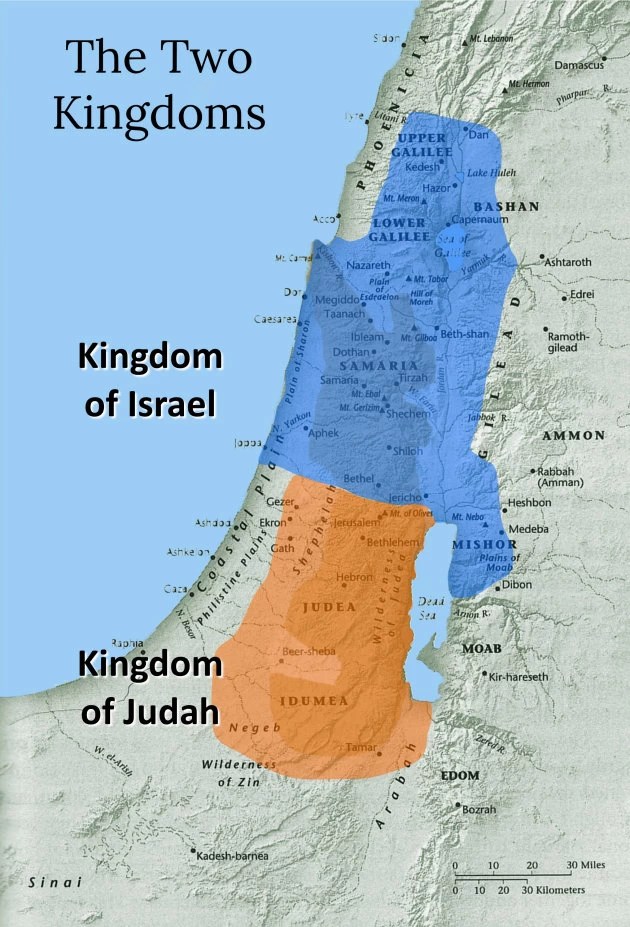
 As we move on from Solomon, we enter a period of Israel’s history called the Divided Kingdom or Israel (North) and Judah (South)
In Judah there were a few good kings and many evil ones. The writer of Chronicles faithfully records their achievements and failures, noting how each king measured up to God’s standard for success. Clearly a good king obeyed God’s laws, eliminated the places of idol worship, and made no alliances with other nations. Judah’s good kings include Asa, Jehoshaphat, Uzziah, Hezekiah, and Josiah. Our series will focus on the good kings, the first being Asa, whose name means “healer.” Here’s the first of the good 8 kings of the 19 kings of Judah.
 “Asa his son reigned in his place. In his days the land was quiet for 10 years.” Asa is going to reign 41 years. The first 10 years are times of peace. “Asa,” verse 2, “did what was good and right in the eyes of the Lord his God.”
14:1–6 Asa’s reign was marked by peace because he “did what was pleasing and good in the sight of the LORD his God.” This refrain is often repeated in Chronicles—obedience to God leads to peace with God and others. In the case of Judah’s kings, obedience to God led to national peace, just as God had promised centuries earlier. In our case, obedience may not always bring peace with our enemies, but it will bring peace with God and complete peace in his future Kingdom. Obeying God is the first step on the path to peace.
“And he removed the altars of the foreign gods and the high places. He broke down the sacred pillars–” those would be the wooden Asherah poles– “and cut down the wooden images.” Those would be poles to Baal. Now, just a little bit about Baal worship. It’s nature worship. It’s the worship of the environment, Mother Nature. All good things come from Mother Nature.
 But they ascribed to Baal certain properties of fertility. And so they would worship Baal and Asherah sexually. It was believed that Asherah was the consort of Baal. And so Asherah was worshipped with a pole. Whenever a carved pole was placed and it was used to burn incense upon and was a place of worship.
But Asa, he’s a reformer, “he removed the altars of the foreign gods, the high places, broke down the sacred pillars, cut down the wooden images. He commanded Judah to seek the Lord God of their fathers, and to observe the law and the commandment.” Notice in that verse the relationship between seeking God and following his word.
14:3–5 Simply attending worship services is not enough to secure God’s peace. Like Asa, we must it also actively remove anything that is offensive to God. Becoming more active in church attendance or doing good deeds will still leave us in turmoil if we have failed to eliminate sinful practices from our lives. We should continually ask God to help us remove any source of temptation from our lives.
Also, if we’re going to seek God, it is hand in hand with following the written revelation, the Word of God, what God has commanded in his scripture. “So seek the Lord God of their fathers, to observe the law and the commandment. He also removed the high places and the incense altars from all the cities of Judah. The kingdom was quiet under him. And he built fortified cities in Judah, for the land had rest, he had no war in those years because the Lord had given him rest.
Therefore he said to Judah, ‘Let us build these cities and make walls around them, towers, gates, and bars while the land is yet before us, because we have sought the Lord our God. We have sought Him, and He has given us rest on every side.’ So they built and they prospered.”
 14:7 Judah had peace with all her neighbors. Times of peace are not just for resting. They allow us to prepare for times of trouble. King Asa recognized the period of peace as the right time to build his defenses—the moment of attack would be too late. It is also difficult to withstand spiritual attack unless defenses are prepared beforehand. Decisions about how to face temptation must be made with cool heads long before we feel the heat of temptation. Build your defenses now before temptation strikes
“And Asa had an army of 300,000 men from Judah who carried shields and spears, and from Benjamin 280,000 men who carried shields and drew bows, and all were mighty men of valor.
 Asa’s Tested By God
Then Zerah the Ethiopian,” or the Kushite, he is sometimes called in translation. Kush included Ethiopia, part of Egypt, lower Egypt, as well as Sudan.
So Zerah was a Kushite and in control of those areas. And they “came out against them with an army of a million men and 300,000 chariots.”
This is a large army! Asa is outnumbered 2 to 1!
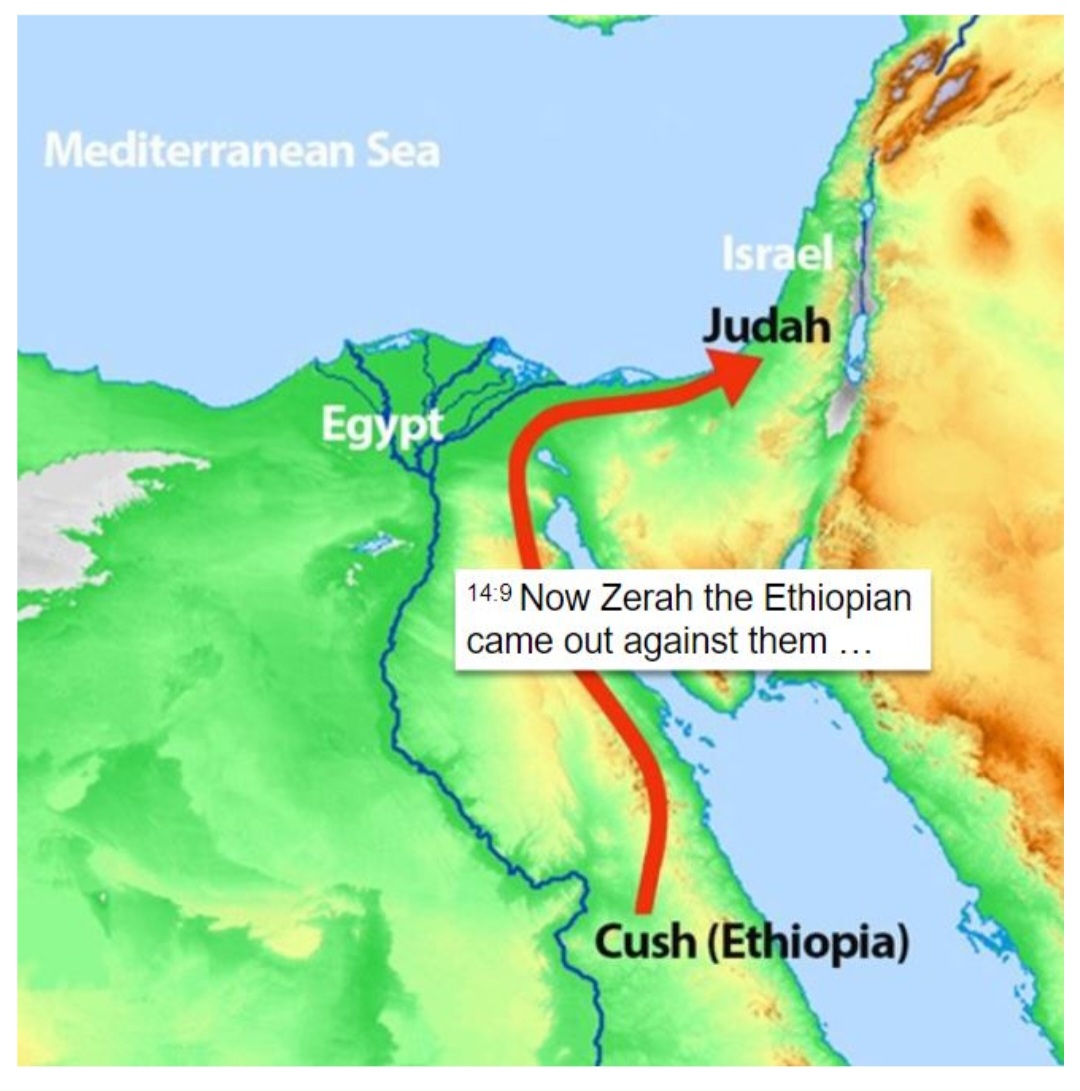 Chariots are like tanks. “And he came to Mareshah. Asa went out against him and set up troops in battle array in the Valley of Zarephath at Mareshah.” This is 25 miles southwest of Jerusalem.
And here it is, I love this. “And Asa cried out to the Lord his God and said…‘”
“‘Lord it is nothing for You to help, whether with many or with those who have no power, help us, O Lord our God, for we rest on You, and in Your name we go against this multitude. O Lord, you are God. Do not let man prevail against You!'”
The Kushites, the Ethiopians, the scripture tells us, were men of tall stature and fleet of foot, or they were fast on their feet. They were runners. They were tall. They were agile. They could run. They were a million of them. Difficulty must always be measured by the capacity of the agent that is doing the work.
And Asa recognizes this is impossible for me. 300,000, 500,000, if you could take Judah and Benjamin, 550,000 men against a million of these Ethiopians? No way. But size and number mean nothing to God. God is not dependent on that. And if you know anything of the history of Israel, both biblically and extra-biblically even up to modern times, that has been proven to be true over and over and over again.
And I love this in verse 11. “O Lord our God, for we rest on you.” We just don’t rest in you, we rest on you. We’re leaning hard, man. We’re pressing in. We’re just laying completely on you. You have to carry us is the idea. “And in Your name, we go against this multitude. O Lord, You are our God. Do not let man prevail against you.”
In other words, Lord, we’re going to fight this battle, but we trust that you’re with us and we just pray that your will be done. Don’t let man prevail. You do your thing. I’m leaving the results with God. This is a good example on the purpose of prayer. The purpose of prayer is not for us to get your will done in heaven, but to get God’s will done on Earth.
The purpose of prayer is for us to line yourself up with the purposes of God and see that happen. And that may mean he answers our prayer. That might mean he comes through and he heals us. It might mean he doesn’t heal you, so that you have to depend and find that “in your weakness, he is strong.” But the purpose of prayer is to get God’s will done.
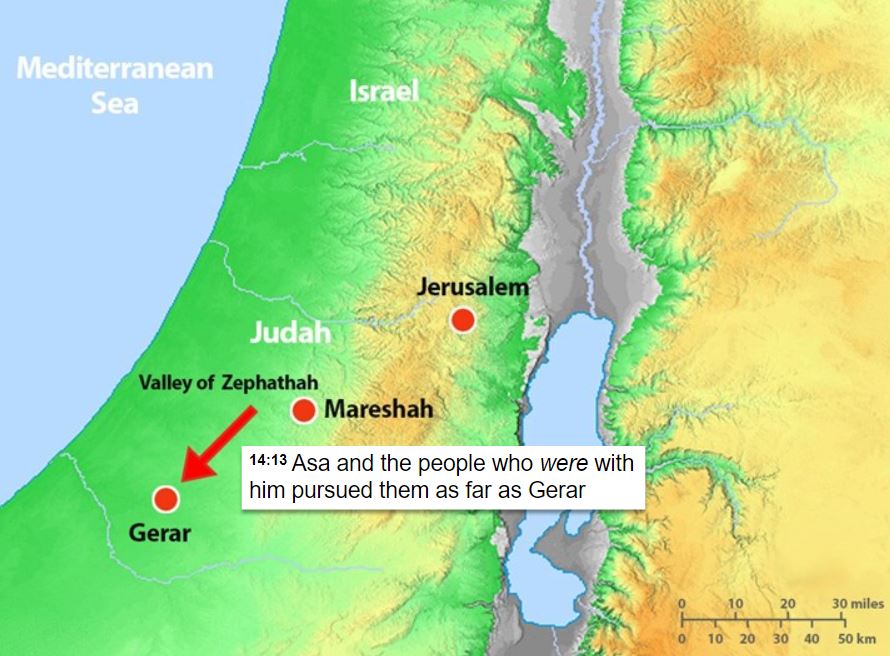 And Asa says as much, “Do not let man prevail against you.” Let your will be done. “So the Lord struck the Ethiopians before Asa and Judah, and the Ethiopians fled. And Asa and the people who were with him pursued them to Gerar.” Gerar is down at the Gaza Strip, down in the southwestern corner of the land.
“So the Ethiopians were overthrown, and they could not recover, for they were broken before the Lord and His army. And they carried away very much spoil. Then they defeated all the cities around Gerar, for the fear of the Lord came upon them. And they plundered all the cities, for there was exceedingly much spoil in them. They also attacked the livestock enclosures, and carried off sheep and camels in abundance, and returned to Jerusalem.”
14:11 If you are facing battles you feel you can’t possibly win, don’t give up. In the face of a vast horde of enemy soldiers, Asa prayed for God’s help, recognizing his powerlessness against such a mighty army. The secret of victory is first to admit the futility of unaided human effort and then to trust God to save. His power works best through those who recognize their limitations (2 Corinthians 12:9). It is those who think they can do it all on their own who are in the greatest danger.
15:1, 2 Asa wisely welcomed people who had a close relationship with God, and he listened to their messages. Azariah gave the armies an important warning and encouraged them to stay close to God.
Keep in contact with people who are filled with God’s Spirit, and you will learn God’s counsel. Spend regular time in discussion and prayer with those who can help explain and apply God’s message.
15:3 Azariah said that Israel, the northern kingdom, was “without the true God.” Eight kings reigned in Israel during the 41-year rule of Asa in Judah, and all eight were evil. Jeroboam, the first ruler of Israel, began this wicked trend by setting up idols and expelling God’s priests (11:13–15). Azariah used Israel’s problems as an example of the evil that would come to the people of Judah if they turned away from God as their northern brothers and sisters had.
15:7 Azariah encouraged the men of Judah to keep up the good work, “for your work will be rewarded.”
This is an inspiration for us, too. Recognition and reward are great motivators that have two dimensions: (1) The temporal dimension. Living by God’s standards may result in acclaim here on earth. (2) The eternal dimension. Permanent recognition and reward will be given in the next life. Don’t be discouraged if you feel your faith in God is going unrewarded here on earth. The best rewards are not in this life but in the life to come.
Message Audio/Video and Outline: https://upwards.church/leander-campus/watch-now-message-videos
Watch Messages: YouTube-Upwards Church
Read Along Daily Bible Reading: You Version


Pingback: Boldness in God’s Work – 2 Chronicles 17-20 – Jehoshaphat | Upwards Church