Joy In Relationships – Philippians 1

Sometimes we feel bound and chained by our circumstances.  When my kids are giving me trouble, I feel frustrated, when Niki and I are at odds I feel down, when our church is not doing like I think it should be doing, I feel like a failure.  Watch the news and see natural disasters, death, rape, and carnage and get even more depressed.  Can you relate to letting the things around you get you down?   The book of Philippians, which is about experiencing hope and joy regardless of our experiences.

When Paul penned this letter he had already been imprisoned for two years at Caesarea and now is being held a prisoner in Rome. He is writing this letter from prison.  Paul did not have everything go his way before deciding to enjoy life.  He had survived a disastrous shipwreck while being transported to Rome. He has been deserted by most of his friends. Other Christian leaders are using Paul’s circumstances to advance themselves. He is facing possible execution at any time. He is awaiting his trial before Caesar for the trumped up charges of disturbing the peace.  It does not sound like a situation that would lend itself to the writing of a cheerful letter, does it? Yet, there is no book of the Bible that speaks more of joy and hope than Paul’s letter to the Philippians.

On a personal note, this is one of my favorite books in the bible, which contains my favorite verse in it. In high school when I began reading my bible on my own, I found the little book of Philippians with only 4 chapters to be so meaningful.  Every time I would come back to it, it was full of verses that screamed out to me “Memorize me”! “Meditate on me!” “Apply me to your life!”  I have verses memorized from each chapter & I hope you can too!

Perhaps you’ve had a quick read through Philippians, or perhaps you’ve latched on to some key verses that have greatly impacted you or perhaps you have never encountered the powerful spiritual truth in this letter. However, much exposure you’ve had to it – I pray that God will use this study to bring lasting change to your everyday experience, and that you will experience for yourself the power for change found in this book.

This first few verses has to do with people in our lives.

 What was it about the people of Philippi that allowed Paul to be joyful and have hope?
First, he was thankful that he had happy memories of the people.

  •  Remember The Good Times With People In My Life

3 I thank my God every time I remember you. 4 In all my prayers for all of you, I always pray with joy

Paul wrote, “I like to remember the good times with you!” He chose to focus on the good times they had and remember the positive experiences.  What do you remember about people, the good experiences or the bad experiences?

Paul says that he has happy memories of his time with this church. Does that mean that there were no sad times, no times of difficulty? Of course not! (Read Paul’s hard times in Philippi in Acts 16)

When Paul said this, he had not had a relaxing vacation in Philippi. Acts 16 tells us the background of this story.  When he went to Philippi he was arrested, stripped beaten with rods (ouch!) in public, humiliated, thrown in prison and put in stocks.  Stocks were also a humiliating and painful position to be put in. While in prison there was an earthquake.  He was run out of town.  Paul had by anyone’s measurement horrific experience in Philippi; it would have ranked among the worst in anyone’s book. Yet he says, when I think of you I remember the good things.  “I thank God every time I remember you.”  Paul could have dwelt on the negative.  He could have remembered the painful memories.  He chose not to remember the painful and he focused on the things he could be grateful for.

Maybe a parent, partner, co-worker, relative or friend has in your past hurt you and you’re still holding onto that hurt.  As a result you can’t enjoy them today.  You’re still focusing on the bad and the negative.  Be grateful for the good in people.  Pleasant memories are a choice.  I can choose what I’m going to remember about the past.

Am I saying to deny the hurts and excuse the weaknesses in other people? No. That is not healthy either.  But focus on the good, the pleasant and choose to emphasize those instead of the negative, and unpleasant.

  • I can dwell on the bad or I can dwell on the good; it’s my choice.


  • Recall The Ways People Have Helped Me

 Who has been helpful to you? Definitely your parents! Studies reveal it takes over a  million dollars to raise a child – your parents did that for you! Teachers, think of the time spent for you to learn to read, write and count. There’s a pretty long list beyond that: someone at work, a friend, a husband or wife.  Maybe they didn’t do anything really spectacular, like give you a million dollars but time and time again, when they had every opportunity to walk out on you, or hit you they didn’t. They hung in there.  They have been with you day in and day out. When you were going through the crisis, the change in careers, when you were just being a jerk — they stayed with you.  You ought to appreciate that!  They haven’t left and they’ve had plenty of good reasons.  It will revolutionize your world if you will stop thinking people owe you and start thanking people who help you!

Paul remembered all the things the Philippians did and called them his partners.  Did you know it takes many people to pull things off, especially in ministry? People were reached for Christ and the Philippians had a part.

5 because of your partnership in the gospel from the first day until now,

Partnership, I want to focus on that word for a moment. We are reaching people for Christ at our church.   Every one that is doing anything here, even if you think it’s small, from cleaning, to helping with the children, to working in the yard – it makes a difference! You are partners in those decisions for Christ, you are partners in what God is doing, and you are partners in eternity.

7bFor whether I am in chains or defending and confirming the gospel, all of you share in God’s grace with me.

I want to remind you about the make-up of the church at Philippi. Like our church, it was made up of people who outside of the church had little in common. The church at Philippi was a Gentile church, because all of the names associated with it are Gentile names, and no Old Testament passages are quoted in the book. There was the local jailor and his family (Acts 16:25-34), a slave girl who had been delivered from demon possession (Acts 16:16-18) and a businesswoman named Lydia (Acts 16:14-15). Apparently, there was little to bind them together by worldly standards, but they had one important thing in common, their love for the Lord and involvement in His church.

In Paul’s day the world was filled with barriers that separated people, just as it is today, barriers of race, wealth, education and culture. But within the fellowship of the gospel none of these things mattered. They simply loved one another and the world marveled at this.
*Like our church here we have Longhorns, Aggies, Red Raiders and others but what matters most is we are all on the same team, Jesus’ team!

We may have money or not have money, we may be blue-collar, white collar or have ring around the collar but we ALL HAVE THE SAME JESUS, THE SAME FAITH AND THE SAME PURPOSE –  “Love God, Love People Share Jesus.” That is our purpose and we partner together to fulfill it.

  • Learn To Appreciate The Growth In People

Do you have any unfinished projects around your house?  How about any unfinished projects at work?  Most of us do.  Do you realize that you are in the hands of a loving God who is at work in your life? STILL…  You may feel like an unfinished project but God will complete it. And please know this takes time!!

6 Being confident of this, that he who began a good work in you will carry it on to completion until the day of Christ Jesus.  This is our memory verse.


Paul believed in God’s power to change the human personality.  Paul believed that no person was hopeless.  He never gave up on people.  This is a great promise of God.  Claim it for your kids, for your mate, for yourself.

It is God who originates it. It is God who carries out the His work in us. It is God who will complete it. Our hope does not rest in anything we have or will do, but in the fact that Christ lives in us and through us.

Paul is talking about faith.  Faith is expecting the best from other people.  There’s tremendous power in faith.

The common mistake is we tend to judge people on the basis of how far they have to go rather than how far they have come. 

Paul looked at people’s future and not just at their past.  He looked at their potential and was patient with their progress.

Paul looks at the people in Philippi & he says, “I see great potential there. I see God working in you, & He is ready to complete his work.”

We need to be patient with people’s progress.  To enjoy people we must allow for growth and for development.  Paul could say, “I’m not the man I used to be, thank God.  But also, thank God, I’m not the man I’m going to be.  I’m growing and changing.”

In my marriage, if I want to enjoy our marriage, I’ve got to learn to enjoy Niki  right now while allowing for growth and development.  The same is true of all marriages.  By the time they meet your conditions you will have still another condition for them to meet.  We’ve got to learn to enjoy them where they are right now.  Parents, if we’re going to learn to enjoy our kids, we’ve got to learn to enjoy them in the process, while they’re growing because there is no such thing as a perfect kid.  And there’s no such thing as a perfect adult.  If you demand perfection of the people in your life in order to enjoy them, we’re going to be miserable for the rest of your life.  Nobody’s perfect.

  •  If I wait for perfection in people before I am happy with them, I will remain unhappy.

To enjoy people, you’ve got to enjoy them in the process, not when they’ve arrived.

 Develop A Deep Concern and Care For People

7a It is right for me to feel this way about all of you, since I have you in my heart8 God can testify how I long for all of you with the affection of Christ Jesus.
“If people are not on your heart they will be on your nerves.” Rick Warren

 The reason so many marriages are crumbling is that mates are reacting to each other from their mind rather than their heart. When your wife says, “I feel down” listen to her; it’s legitimate.  When your husband says, “I don’t feel this is the right thing we ought to do.” Listen to him.  Listening and loving from the heart hears the hurt behind the words.

Heart love begins with understanding, knowing why they feel that way.  Why does the guy at work act like such a jerk?  Maybe you don’t know the background he grew up in.  Maybe he’s tons better than he used to be ten years ago.  Hear the hurt, look for the problems, know what makes your mate tick.  You cannot love someone you don’t understand.  Understanding them makes it easy (or easier).  You need to understand the moods of the people closest around you, why they act the way they do.  If you care, you’ll be aware.

If heart love begins with understanding, how do you get understanding?  By asking questions and then listening.  The most common complain I hear from people is lack of understanding. What a comfort it is to know that someone fully understand you.

How do you love those people that even when you do understand them, they are unlovable?  V. 8:  “God can testify how I long for all of you with the affection of Christ Jesus.”  In Greek the word “affection” is the word for “intestines”.  King James translates this “bowels”.  In Greek society, the Greeks thought that the seat of the emotions was in your stomach, your liver, and your internal organs.

Paul would say, “I’ve got a deep internal or gut love for you.”  That is not a natural kind of love.  It is a supernatural kind of love and that’s why Paul said it’s not from himself, but it’s the affection of Christ Jesus.  Human love wears out and dries up and dies on the vine.  This happens to everybody.  The only kind of love that lasts and lasts in spite of heartache and difficulty in tough circumstances is God’s love — the affection of Jesus Christ.  That’s the only kind of love that lasts.

 In order to have a deep concern and care for people you have to stay plugged into Jesus Christ.  He will give you the ability to care when your care is gone, he will give you concern when your concern is gone.

For example let say you are at home. I know this is a stretch; but your spouse is on your nerves not on your heart.  I know, I know, not likely but just pretend! What do you do?  You pray, “Jesus help me to love my spouse, give me your love, mine is gone!  I am feeling like I hate their guts but I want to love them.” The same scenario could be played out five minutes later with your kids, or the next day with a co-worker. We need to realize our limitations and plug into the “affection of Jesus Christ.”

Life is too short to not enjoy the people in your life.  If you don’t learn to enjoy the people that God has placed around you in your life you will be miserable.  As Paul begins this great book about joy and hope he starts off talking about people. People will rob your joy unless you learn how to respond to them the way Jesus did.

  • Pray for People in Positive Ways

I want to challenge us to a new level spiritually.  Instead of griping about someone, pray about him or her to God!  Instead of complaining about them, try praying for them.  This is what we see makes a difference in Paul’s attitude. We are even to pray about our enemies. We will see Paul do this and we know Jesus did.  Prayer is a key to joy and hope.

Prayer will do at least two things:  it will change your attitude (for the better) and it will change the person. Positive praying is much more powerful than positive thinking.

  • People may ignore my opinions, reject my feelings and refuse to listen to me but they are powerless against my prayers.

9 And this is my prayer: that your love may abound more and more in knowledge and depth of insight, 10 so that you may be able to discern what is best and may be pure and blameless until the day of Christ, 11 filled with the fruit of righteousness that comes through Jesus Christ–to the glory and praise of God.

There is an entire message right here in these few verses about what Paul prayed for, what these things mean and so on. I am not even going to get into this but when you say to somebody, “I’ll pray for you”, what do you say in prayer? What do you pray?  “God, bless them?”  That’s so general.  Look how specific this prayer is of Paul’s.  I have a list of how to pray for people based on the prayers of Paul it and it is amazing to me how specific he is. You could study the prayers of Paul to see how to pray for people but you could also just be aware of how general we can be and the challenge to you is to be specific when you pray for people.  I know we can be REAL specific about what bugs us about people.  Why not be specific about how God can work in their life?

And lastly the glue that holds all of this together is…

  • Trust Jesus in Everything
  • Jesus and God are used 13 times in these 11 verses.

You can’t read this and not see how much Paul depends on Jesus; he uses his name with every sentence.  Have you ever known someone who repeats phases?  Paul repeats JESUS like this, not in an annoying way or a thoughtless way but in a way that we see Jesus is what gives Paul the strength the joy, the purpose and reason for living. We can see that…

The key to joy is a relationship with Jesus Christ

  • I am a Servant of Jesus Christ (1a)
  • I am in Jesus (1b)
  • I have Grace from Jesus (2a)
  • I have Peace from Jesus (2b)
  • I am Thankful to God (3)
  • Jesus Began a Good Work in me (6a)
  • Jesus Will Complete the Good Work in me (6b)
  • God can Support me (8a)
  • I can Love with the Affection of Jesus (8b)
  • I have a Righteousness from Jesus (11a)
  • I can give Praises to God (11b)

I hope these are personal to you as well.  This is what Jesus is or can become to you.

Darrell

www.Upwards.Church

Watch Messages: YouTube-Upwards Church
Facebook: Upwards Church


Posted in Joy Full - Philippians | Tagged , , , , , , , , , , | Leave a comment

Philippians Introduction

Joy is the theme of the book of Philippians! Here’s the background and historical events surrounding this great New Testament book.

AUTHOR:  Paul: apostle of Christ, courageous missionary, gifted teacher, articulate apologist, and Christian statesman.

In approximately a.d. 46, the believers in Antioch commissioned Barnabas and Paul to take the gospel to both Jews and Gentiles in other lands (Acts 13:1-3). Stops on this first missionary journey included Paphos (on Cyprus), Perga, Attalia, Pisidian Antioch, Iconium, Lystra, and Derbe (Acts 13:4-14:28). When word came to Jerusalem of the ministry among the Gentiles, a controversy arose over whether non-Jewish converts had to be circumcised and had to obey the law of Moses (Acts 15:1). So Paul and Barnabas, along with other believers, were sent to Jerusalem to see the apostles and elders in order to settle the dispute (Acts 15:2-4). After hearing their testimony, the Jerusalem Council affirmed the ministry to the Gentiles (Acts 15:12-35).

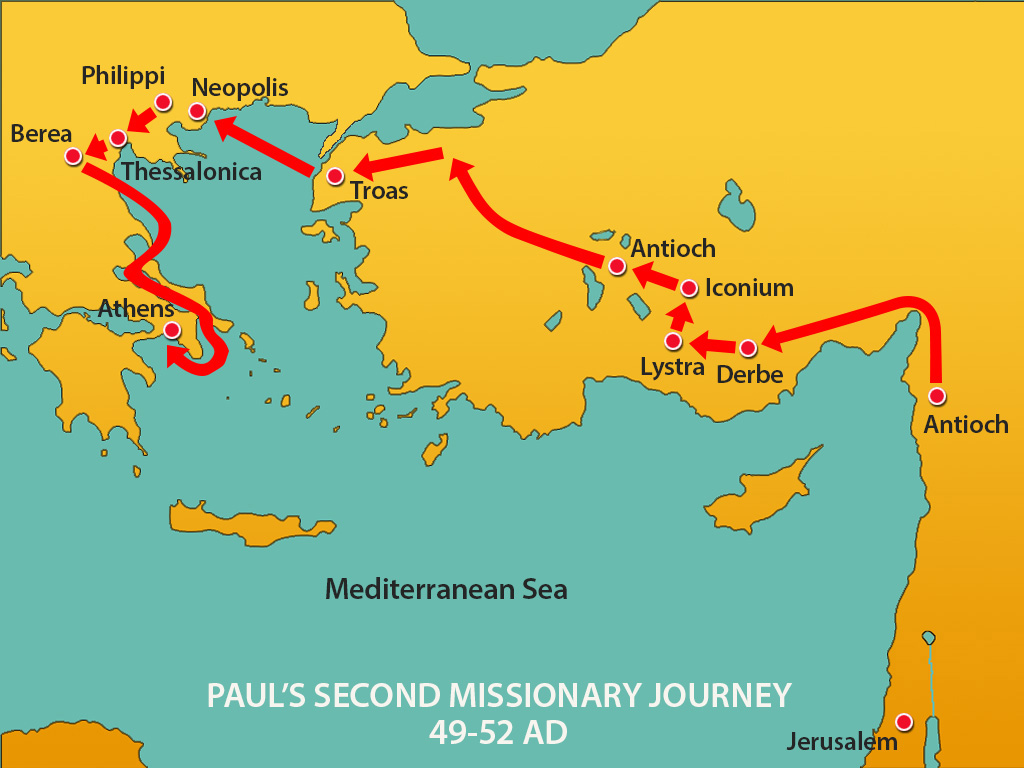
1b 2nd Missionary JourneyA few months later, in approximately a.d. 50, Paul and Barnabas discussed a second trip, to visit the churches they had established on their first missionary journey (Acts 15:36). But because of a disagreement over Mark, they went separate ways: Barnabas and Mark sailed for Cyprus, while Paul and Silas went through Syria and Cilicia (Acts 15:37-41). On this trip, Paul and Silas visited the believers at Derbe, Lystra, and Iconium. Then, passing through the region of Phrygia and Galatia, they journeyed to Troas. There, through a vision, God told Paul to travel to Macedonia (Acts 16:1-10). Obeying the Holy Spirit, Paul and Silas sailed to Samothrace and then to Neapolis. From there they traveled to Philippi, where they ministered for several days (Acts 16:11-40). Upon leaving Philippi, Paul and Silas traveled through Amphipolis and Apollonia to Thessalonica. Next they went to Berea, and then to Athens and Corinth, where they stayed for some time (Acts 17:1-18:18). Leaving Macedonia, they traveled to Ephesus. Then they sailed to Caesarea and made their way back to Antioch.

SETTING

Written from prison in Rome in approximately a.d. 61 Paul wanted to get to Rome (Acts 19:21), not only to teach and fellowship with the believers there (Romans 1:8-13), but also because Rome stood as the center of the civilized world. It was a strategic city for the spread of the gospel. To reach the Roman Empire, the gospel had to reach Rome.

In God’s sovereign plan, Paul did sail to Rome, but not as a prominent citizen, missionary statesman, or even itinerant preacher. He arrived, rather, as a prisoner, in chains (Acts 28:11-16). Even as a prisoner, however, Paul was free to teach, preach, and write (Acts 28:17-31). During these years of house arrest, Paul wrote what have come to be known as the “Prison Epistles”—Ephesians, Philippians, Colossians, and Philemon.

It is clear that Paul was a Roman prisoner when he wrote this letter because of his words in 1:12-17. He wrote of being “in chains” (1:13, 17) and of being a witness for Christ to the “whole palace guard” (1:13 niv).

Some have surmised that Paul wrote this letter to the Philippians during his imprisonment in Caesarea (Acts 23:23-26:32). After all, Paul was imprisoned there for about two years (a.d. 57-59), interrupted by hearings before Felix, Festus, and Agrippa. He would have had the freedom and the time to write. The uncertain and menacing situation in Caesarea seems to fit Paul’s indication that death was an imminent possibility (1:20-23, 30; 2:17). And references to a “palace guard” (niv) or “praetorian guard” (rsv) could fit this location.

AUDIENCE :  The believers in Philippi

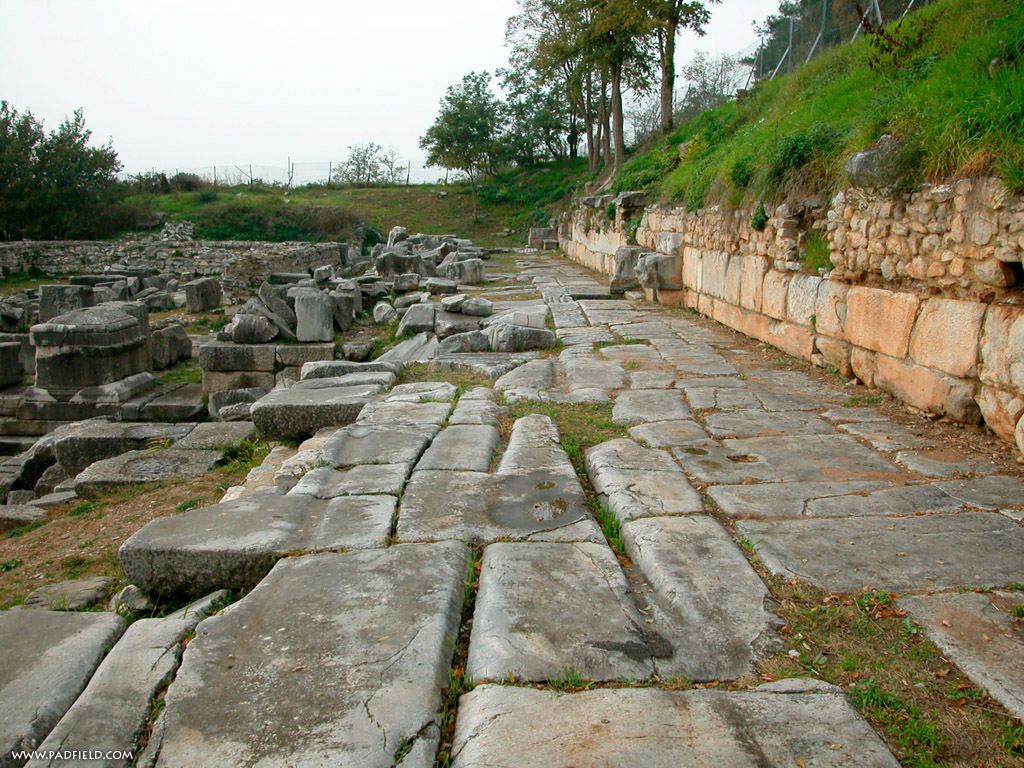
3b Excavations of PhilippiThe Macedonian (northern Greece today) city of Philippi was named after Philip of Macedon (the father of Alexander the Great). Surrounded by mountains and close to the sea, Philippi became a strategic city in the Greek empire. In 167 b.c. it became part of the Roman Empire, but it did not achieve real importance until after 31 b.c. when Octavian defeated Antony at the battle of Actium. After that decisive battle, Philippi received a number of Italian colonists who had favored Antony and had been dispossessed of their property. The colony was then renamed Colonia Iulia Philippensis to honor Julius Caesar. Later, in 27 b.c., when Octavian was designated Augustus, the colony’s name was changed again to Colonia Augusta Iulia (Victrix) Philippensium, equating the cause of Augustus with that of Caesar. At that time, Philippi was given the right to the Law of Italy together with many rights and privileges, including immunity from taxation. The residents of Philippi were very conscious and proud of their Roman citizenship and heritage (see Acts 16:20-21). Philippi also boasted a fine school of medicine.

2b Egnatian WayPaul visited Philippi on his second missionary journey, in a.d. 51, about ten years previous to this letter. By the time of Paul’s visit, Philippi had become a thriving commercial center because of its strategic location as the first city on the Egnatian Way, an important ancient highway linking the Aegean and Adriatic Seas. Travelers to Rome would cross the Adriatic and then continue up to Rome on the Appian Way. Thus, Philippi was the gateway to the East. Although thoroughly colonized by the Romans after 31 b.c., Philippi was still more Greek in culture than Roman. Luke refers to Philippi as “a Roman colony and the leading city of that district of Macedonia” (Acts 16:12 niv). Although Philippi was not the capital city of the region (subprovince of Macedonia), it certainly was the “leading city.” Luke’s statement also reflects civic pride in his hometown.

The church at Philippi in ancient Macedonia was the first European church founded by Paul. Thus, it represents the first major penetration of the gospel into Gentile territory (see Philippians 4:14-15).

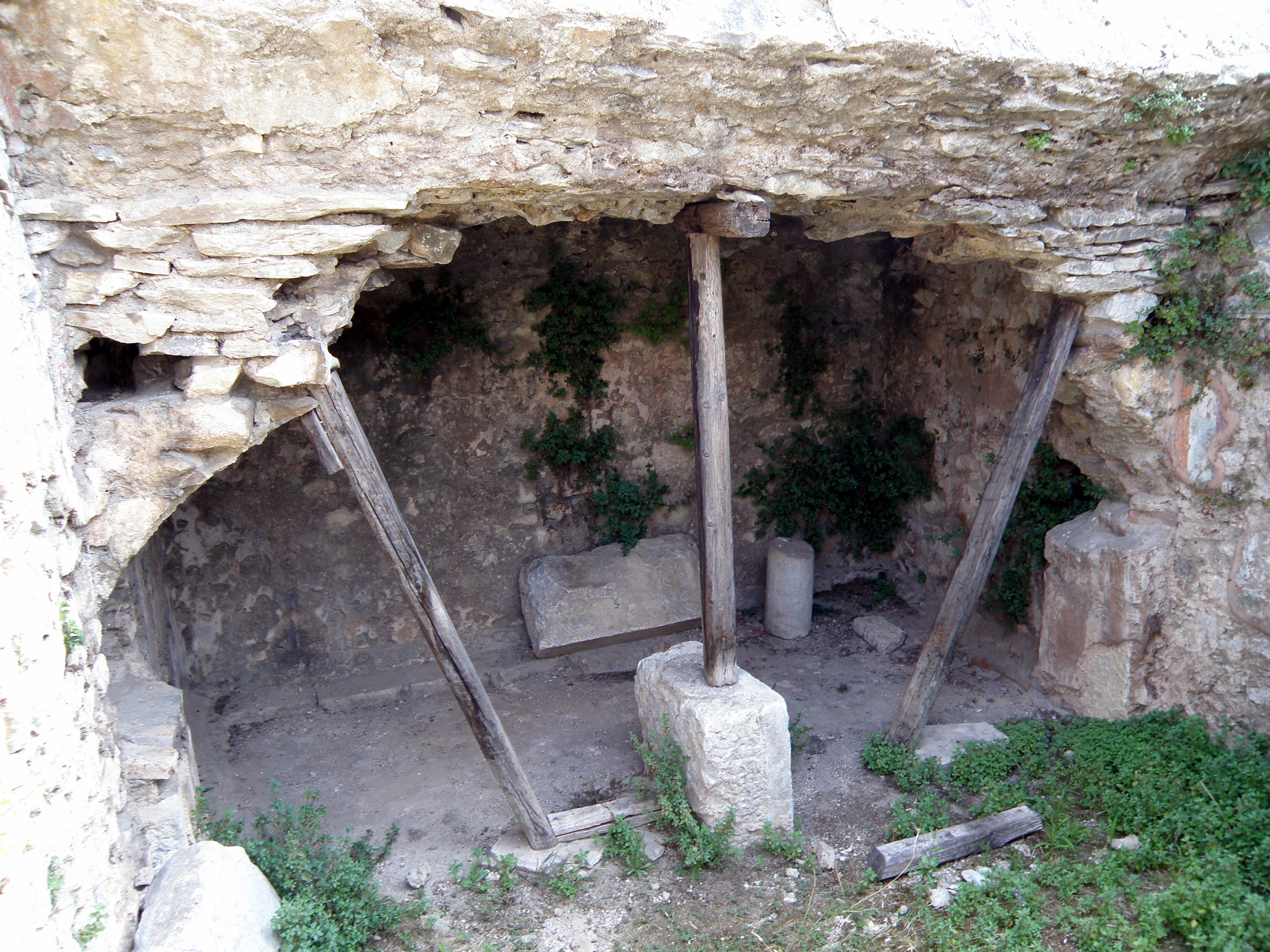
Acts 16:9-40 tells how the church began. 5b Gangitus RiverIn every city, Paul and his party would go to the synagogue to share the gospel with the Jews. So on their first Sabbath in Philippi, Paul and Silas probably looked for a synagogue. Instead, they found a group of women who had gathered outside the city on the banks of a river. The fact that Philippi had no synagogue indicates that there were few Jews in that city. Therefore, from its inception, the church at Philippi consisted mainly of Gentiles. Acts 16:14-34 tells of two of the first converts in Philippi: Lydia, a businesswoman who may have been a Jew or a Jewish proselyte; and a Roman jailer. The response of these three provided clear demonstration that God’s Good News was for all classes, sexes, races, and nationalities.

OLYMPUS DIGITAL CAMERA

OLYMPUS DIGITAL CAMERA

Luke also mentions that when Lydia responded to Paul’s message, so did the members of her household (Acts 16:15). The same was true for the jailer—his family responded with him (Acts 16:34). No other specific converts are mentioned in this account in Acts, but the chapter concludes with: “After leaving the prison they [Paul and Silas] went to Lydia’s home; and when they had seen and encouraged the brothers and sisters, they departed” (Acts 16:40 nrsv). “Brothers and sisters” seems to indicate that a small but vital group of believers had been forged. Clement, Euodia, and Syntyche may have been won to Christ during this time (see 4:2-3).

When Paul and Silas departed from Philippi, they left Luke there, in his hometown, to carry on the ministry. A few years later, at the end of his third missionary trip, Paul visited Philippi prior to spending the winter in Corinth. When Paul wrote this epistle, the church in Philippi was thriving, and he felt very close to the believers there.

OCCASION AND PURPOSE FOR WRITING

To thank the Philippians for their gift and to strengthen the believers in their faith

This is a very personal epistle. It is obvious from Paul’s opening comments that he enjoyed a close friendship with the Philippian believers: “I thank my God every time I remember you. In all my prayers for all of you, I always pray with joy because of your partnership in the gospel from the first day until now” (1:3-5 niv). During their visit to Philippi, Paul and Silas had witnessed immediate and dramatic response to their message. And despite the fact that they were attacked and imprisoned, they had seen the church begin and then grow into a strong core of believers (Acts 16:40). During the course of Paul’s ministry, the Philippian believers had continually come to his assistance through their gifts (4:15-18). At this time, nearly ten years later, the Philippians had again sent a gift to Paul to help him in his time of need: “I rejoice greatly in the Lord that at last you have renewed your concern for me. . . . It was good of you to share in my troubles” (4:10, 14 niv). Perhaps their donated funds were helping to pay for the rented house to which Paul was confined (Acts 28:30). In response to this gift and to their relationship over the years, Paul wrote to express his deep appreciation for their love, faithfulness, and generosity.

Paul also took the opportunity of this letter to deal with important issues in the church. He had heard of divisive rivalry and selfish ambition (2:3-4), so he gave strong counsel and even named names (4:2). Paul knew that the Judaizers could be a problem, so he gave clear instructions to avoid those men (3:2-3). He also warned of those who would go to the opposite extreme and live totally without the law or any personal discipline (3:17-19). None of these issues were full-blown problems that were threatening the life of the church, but Paul knew their destructive pattern. So he warned his beloved Christian brothers and sisters, encouraging and challenging them to continue to stand strong and united and to live for Christ (1:27; 4:1, 4-9).

Paul’s sensitivity to the needs at Philippi stands as a great example. He didn’t wait for a crisis; instead, he confronted potential problems early, before they could fester and infect the whole body. When we see a fellow believer begin to struggle or stray, we should follow Paul’s example and lovingly confront that person, urging him or her to stay on track.

MESSAGE

Joy (1:3-6, 12-26; 2:1-4, 17-18; 3:1; 4:4-13). Although Paul had suffered much for the cause of Christ and was writing this letter as a prisoner of Rome, still he was filled with joy because of what God had done for him, because of his hope in God’s plan for the future, and because of the faithfulness of the Philippian believers. Paul knew that his beloved brothers and sisters in Christ would be tempted and tested, so he urged them to stay strong in their faith, to be content, and to “rejoice in the Lord always” (4:4 niv). Regardless of the circumstances, believers can have profound contentment, serenity, and peace. This joy comes from knowing Christ personally, depending on his strength, and trusting in his plan for our lives.

Importance for Today. Far from content, people today truly believe that they need every new product, toy, or appliance. Or they think that they will find happiness and personal fulfillment through relationships, travel, adventure, or something else. Thus, most people are discontent and continually seeking meaning and peace. But true, lasting contentment comes only through knowing Christ. With sins forgiven, our future secure, and our lives in God’s control, we can be content . . . and have joy. Yes, we can have joy, even in hardship. Joy does not come from outward circumstances but from inward strength.

In addition to discontent, Paul highlights other joy stealers: selfish ambition (1:17; 2:3), complaining and arguing (2:14), self-centeredness (2:21), hedonism (3:18-19), anxiety (4:6), and bad thoughts (4:8). What steals your joy?

Rely on Christ within you to give you joy, not on what you own, who you know, or what you experience.

Humility (1:15-18; 2:5-11; 3:7-14). If anyone had the right to boast, it was Paul. Yet he continued to lay aside personal ambition and glory in order to know Christ (3:7-11) and to glorify him (3:12-14). Paul knew that Jesus had left glory to come to earth in order to live as a man and to die on the cross. Paul held up Jesus as the example to follow, urging the Philippians to humble themselves as Christ had done.

Jesus showed true humility when he laid aside his rights and privileges as God to become a human being (2:5-11). He poured out his life to pay the penalty that we deserve. Laying aside self-interest is essential to being Christlike.

Importance for Today. We naturally worry about ourselves first, making sure that we are comfortable and that we get the credit and glory we deserve. But as Christ’s representatives, we should live as he would. This means putting others first and renouncing personal recognition. It also means serving others and looking out for their best interests. When we give up our self-interest, we can serve the Lord with joy, love, and kindness. True humility is a by-product of seeing ourselves from Christ’s perspective and recognizing that we are nothing without him.

What can you do to see yourself and the world from Christ’s point of view? What can you do to give your life for others?

Self-Sacrifice (1:15-26; 2:4, 17, 25-30; 3:7-14; 4:14-19). Christ suffered and died so that all who believe might have eternal life. Following Christ’s example, with courage and faithfulness, Paul sacrificed himself for the ministry, taking every chance to tell others God’s Good News, preaching and teaching even while in prison. For Paul, living meant opportunities for serving the Lord, but dying would mean going to live with the Lord (1:20-24). So Paul lived with his goal always before him, motivating him to forget the past and press on to win the prize (3:13-14).

Importance for Today. “Sacrifice” seems like a dirty word these days. Instead, people want to indulge themselves and do everything they can to have a comfortable and easy life. Unfortunately, this cultural attitude can carry into the church. For example, many believers are more concerned about not having padded pews than the fact that people are headed for hell. But reaching people for Christ, helping those in need, and changing our world will involve personal sacrifice. Christ gives us the power to do that. We must follow the example of Jesus and of godly leaders like Paul who demonstrate self-denying concern for others.

What will it take—what sacrifices will you have to make—for you to be an effective witness for Christ in your neighborhood? at work? What will it take for your church to make a difference for Christ in your community?

Unity (1:15-18, 27-30; 2:1-4, 14-16; 4:2-3). In every church, in every generation, controversial issues, personality conflicts, and other divisive issues arise. The tendency toward arguments and division intensifies during hard times, when people can turn against each other. Although the church at Philippi was strong, it was not immune to these problems and, in fact, had experienced some internal conflicts. Paul encouraged the Philippians to get along, agree with one another, stop complaining, and work together.

Importance for Today. Christians should contend against their common enemy—Satan and his work in the world—and not against each other. We need all our resources, focus, and energy for the battle. When we are unified in love, Christ works through us, and we can make a difference for him. We need to keep before us the ideals of teamwork, consideration of others, and unselfishness.

What tends to break your unity with other believers? What issues threaten to divide your church? Keep your focus on Christ and his mission in the world; don’t be sidetracked by petty jealousies, competition, hurt feelings, or minor irritations. Work together with your brothers and sisters in Christ to make a difference in the world.

Christian Living (1:6, 9-11, 21-29; 2:12-13; 3:12-21; 4:4-13). Paul could not stay in Philippi, teaching the new believers, encouraging them to live for Christ, and holding them accountable. When he was with the Philippians, they were careful to obey the Lord (2:12) because they were aware of Paul’s powerful example and strong encouragement. But now, in his absence, they should be even more careful to live the Christian life (work out their own salvation—2:12). They could be confident that God was with them and in them, changing them from the inside out (2:13). Certainly God would complete his good work in them (1:6).

Paul also explained the steps these believers could take to live for Christ: be unified with other Christians (1:27-30), remember Christ’s work on the cross (2:5-11), rejoice in God’s work for them and in them (3:1), keep focused on the goal (3:12-14), guard their thoughts (4:8-9), be content with what they have (4:10-13), and help those in need (4:14-19).

Importance for Today. In this day of media evangelists, celebrity Bible teachers, and articulate preachers, it can be easy to depend on others for our spiritual nourishment and motivation. Yet the Christian life always depends on the relationship an individual believer has with the Lord Jesus. Instead of relying on others for our “faith,” we must depend on Christ and the Holy Spirit working within us. And instead of expecting growth to happen because we have a strong Christian environment, we must keep our focus on Christ, discipline ourselves to pray and to read the Bible, and apply God’s Word to our lives.

On whom do you depend for your motivation to live for Christ? Where do you find your spiritual nourishment? Christian living depends on Christ living in you and you then living in obedience to him.

For more about the series, Joy Full go here:

www.Upwards.Church

Watch Messages: YouTube-Upwards Church

Facebook: Upwards Church

Sources:  Life Application Bible, Life Application Bible Commentary,
Posted in Joy Full - Philippians | Tagged , , , , , , , , | Leave a comment

Joy Full Invitation


Has life got you down?  Are you in a place you don’t want to be?  Join us and find joy in your troubled time.  Sitting in a dark Roman prison cell, Paul writes of hope and joy.  We’ll discover solid biblical principles from the New Testament book of Philippians to help us: Pray with Joy, Share with Joy, Grow with Joy, Live with Joy, and Give with Joy. No matter where you are, you can be Joy-Full.

Join us this weekend!

Darrell

www.Upwards.Church

Watch Messages: YouTube-Upwards Church
Facebook: Upwards Church

Posted in Joy Full - Philippians | Tagged , , , , , , , , | Leave a comment

What do I do with my Anger towards God? – Jonah 4

Have you been angry lately?  I have.  Anger is a natural God given emotion.  It’s okay to be angry, what matters is what we do with our anger.

In today’s passage Jonah was angry, but not at things or even people, he was mad at God.

In the last post we see that Jonah delivered God’s message to the people of Nineveh. They responded by repenting of their wicked lifestyle and by putting their faith in God, one of the great revivals in history! If the story had ended here, Jonah would be one of the greatest prophets. But the story of Jonah DOESN’T end here because this is not just a story about God’s love for the wicked Assyrians. It is also a story of His grace and love for an angry, pouting prophet.

As chapter 4 begins, Jonah is not at all happy that the Assyrians have repented and turned to God.  The story is not over because God’s work was not complete. The people of Nineveh were doing fine at this point—but not Jonah. He still needed work.

God is not satisfied with mere compliance to His will…which is apparently what He got from Jonah in chapter 3. What God wanted was for Jonah to value what He valued.

As we look at Jonah 4,

We see that Jonah is mad at God.  Jonah then proceeded to prove that old statement that says, Man is angriest when he is the most wrong because he blew his top at God. He blamed Him for his own rebellious flight to Tarshish. He even threw scripture in God’s face quoting Exodus 35:6-7 but instead of using this familiar text to praise God, Jonah angrily uses it to complain and accuse. He says in essence, I left home because I knew You would do this, Lord! I knew that you were a gracious and compassionate God, slow to get angry and filled with unfailing love. I knew how easily You could cancel your plans for destroying these people!

Now, look closely at verse 4 which is God’s GENTLE response to Jonah’s tantrum. If I were God, I may have said something like, You want to see some fire and brimstone? Okay…here…enjoy! But, thankfully, God is not that way. The Lord has a LONG FUSE where we are concerned. The verse Jonah sarcastically quoted is something Moses had written down some 500 years earlier when he was up on the top of Mt. Sinai conferring with God. You may remember that the people had thrown a party characterized by drunkenness and immorality.

These people whom God had just delivered from bondage in Egypt expressed their thanks to their Heavenly Father by worshiping an idol of a golden calf. When God told Moses what was going on Moses came down from the mountain and angrily shattered the original copy of The Ten Commandments. God was ALSO angry and wanted to destroy the people…but in answer to Moses’ pleading on the people’s behalf, God reconsidered. He even promised to give Moses a new copy of the Ten Commandments. God took him back to the top of Mount Sinai, and before God began dictating these moral imperatives a second time, Exodus 34 says that He passed in front of Moses proclaiming,

The Lord…the compassionate and gracious God, is slow to anger, abounding in love and faithfulness.

Like any parent, God DOES get angry. But He puts up with a great deal before reaching His boiling point. He is PATIENT with us.

When I was about 10 years old through 15 years old I was active in the boy scouts.  And I remember the seemingly limitless composure of our leaders, Mr. Murry, Mr Whorton seemed to be the most PATIENT men I have ever met.  As we botched up setting up our tents, building campfires, raw breakfast over a smokey fires, not tying the right knots and just plain being filthy and awkward, I know we must have frustrated them at times, but they was soooo patient with us. Why? Because they knew we were just boys.  They didn’t expect us to be more than we could be.

And God is patient with us for the same reason. As Psalm 103:14 says, …He knows how we are formed, He remembers that we are but dust. As our compassionate Creator, God understands our tenuous nature and factors in our frailty when He weighs His responses to us…which is why instead of a rebuke of fire and brimstone, God patiently asked Jonah a question: Is it right for you to be angry?   The word that God uses for angry literally means “to burn” so what God really said, was, Jonah, do you have any valid reason to be so hot under the collar?  Jonah’s only response at that point was to stomp off up into the hills where he could have a clear view of the city of Nineveh.

Understand, this is the second time Jonah has fled his area of ministry. He fled to Tarshish in chapter one rather than do what God wanted him to do and now he head for the hills when he should have been helping the newly repentant Ninevites to learn more about the God Who had so lovingly spared their city.

When Jonah reached an elevation where he was high enough to see all of Nineveh proper he built himself a little lean-to using some leafy branches…something to shield himself from the severe desert heat, which was pretty much a necessity because the average temperature in that region was between 110 and 120 degrees Fahrenheit. In other words, it was not a good place to allow yourself to get hot under the collar!

Jonah got as comfortable as he could and then he proceeded to sit there and look down on the Ninevites, thinking, “Just watch God! They are going to go back to their wicked ways…You’ll see! You can never trust a Ninevite. Once a Ninevite, always a Ninevite. I’m going to sit here until they slip and then force You to admit that You were wrong about these pagans! You’ll see that I am justified in my anger at what You have done!”

In other words Jonah trained his eyes on the Ninevites when he should have been examining himself. Like many of us, he was more concerned with the speck in his neighbor’s eye than he was about the log in his own eye!

As the day dragged on the leaves on the branches of his shelter dried up and began to fall off. And because of this Jonah began to get very hot. Perhaps adding to his discomfort were the sounds of the Ninevites in the city below continuing to mourn and pray to God in repentance! At this point verse 6 says that God caused a vine to grow up and provide shade for Jonah, to ease his discomfort.  The Hebrew here literally says, to deliver him from his evil which means that even this vine was just a tool in God’s hands to free Jonah from his sinful attitude.

Verse 6 also says that, Jonah was very happy about the appearance of this vine. In fact it is the only time in the entire book that this grumpy prophet is happy about anything. Maybe his mood improved so because he thought this shady vine was an indication that God was coming over to his side. But, God was not done. He interceded once more and performed another miracle. This time instead of summoning a huge sea creature, He called forth a tiny worm to eat the root of the vine, causing it to wilt and ruin Jonah’s shelter. Then He threw another storm at Jonah. This time it is a desert windstorm known a Sirocco.  When these winds blow in the temperature rises dramatically, and the humidity drops quickly. It’s like being inside a convection oven. The Septuagint accurately translates this sudden wind as “a scorcher.” It is almost as if God says, Okay, Jonah if you’re so up on being hot under the collar, here’s a little help. Then, as Jonah’s frustration builds, God said, Do you have a right to be angry about the vine?

Jonah angrily retorted, Yes, I do…even angry enough to die!

At this point God has Jonah where He wants him. God has used this vine and worm and wind as tools to show Jonah the absurdity of his demeanor to help him understand his own confused heart…to help Jonah realize that he is so full of self-pity that he has no pity left over for the repentant Ninevites. When the vine withered Jonah’s temper flared again and so God said in essence, You are angry about this plant that is pretty much here today and gone tomorrow but Nineveh has more than 120,000 children. If you can be concerned about something as trivial as a plant, should I not be allowed to be concerned about something as important as these people—not to mention their livestock?

It is in an awkward silence like this that the book of Jonah ends. God had the first word in this story and now He has the last word as well. Jonah doesn’t reply. He couldn’t because by now even he could now see how off base he has been. God got through to old Jonah in the end. In fact I believe he wrote this no-holes-barred autobiographical book and ended this way to show his repentance. One of Michelangelo’s paintings on the walls of the Sistine Chapel is called The Prophets and the Apostles…because in it he attempted to capture the faces of the great heroes of the Bible. Art critics say that of all the faces Michelangelo illustrated in this work, none had a more radiant countenance than Jonah. He painted old Jonah this way because he was convinced that Jonah did see his sin and change. Michelangelo believed that Jonah became a communicator of grace to his own nation through writing his book and his continued preaching as a prophet of God.

If we were honest with ourselves, I think we’d have to admit that there is a little Jonah in all of us.  As Jimmy Draper has said, “Our concern should not be whether a man can live inside a fish, but whether the spirit of Jonah lives inside of us.”

At one time or other in our life each of us have rebelled against God just like Jonah did. We have refused to do things God has told us to do. We have done things He told us not to do. We have also had our own priorities mixed up. Like Jonah we have frequently been more concerned about our own physical comfort than about God’s purposes. And, as Jonah did in this last chapter, many of us have also willfully fanned the flames of anger…even anger that is directed at God Himself. This is because anger is possible in any relationship—even a relationship with our Creator. The closer you are to someone—the more passionate you feel about each other—the more likely you are to get mad at each other.

Maybe you are mad at God due to the seeming unfairness of life. Or maybe you have loved ones or friends….good, God-serving people, who have suffered in life. Perhaps you had children who have endured great pain or even died prematurely. Like Jonah, many of us have at times had misplaced expectations of what God ought to do, and when He didn’t do what we thought He should, we got mad. So the question is not, SHOULD we get mad at God? The question is, What should we do with our anger? How should we handle it?

The idea of getting mad at God is enough to make some people feel very uncomfortable. Many feel that somehow it is not right to be angry at God…the very idea seems blasphemous. Others are afraid to admit their angry feelings because they are intimidated by what they hear from some Christians. They’re given the impression that being angry toward God is the unforgivable sin.

They’re told, “Look, no matter what happens, just thank God and keep praising Him and keep a smile on your face at all times, because God has a wonderful plan for your life and He doesn’t need you second guessing it.”  In other words, if you don’t feel like smiling at God—fake it.

On the one hand, we have the fact that at times in life many of us are angry at God and on the other hand we have the fact that many people think it’s totally unacceptable to be angry at God. So what’s the natural result? The result is that people paper over their emotions. When they experience anger because they feel like God’s being unfair or silent or unresponsive, they stuff that emotion down deep and paste a phony smile on their face. And yet that just aggravates problem, because when you bury your anger, you bury it ALIVE. It doesn’t go away; inevitably, it crawls out in other forms.

Think about it in terms of your relationship with your spouse. If you’re angry at something he or she did and you don’t deal with the anger, what happens? Communications stops, doesn’t it? Because we don’t like talking to people we’re mad at. We give them the silent treatment—we withdraw. And, eventually if nothing is done we begin to feel distant from our spouse. Well, the same is true in your relationship with God.

So ask yourself a very important question: Could the reason you have stopped praying and reading the Bible or enjoying worship be due to your unexpressed anger at God over some perceived injustice or unfairness?

Maybe you secretly blame Him because you married a man who said he was a Christian and he ended up to be abusive or he walked out on you. Maybe you harbor a lingering resentment because your parents divorced when you were a youngster or a loved one suffered and died, and God didn’t stop it. Maybe you’ve accused, convicted, and sentenced God because you feel He has let you down at a crucial time. You blame God because you think if He really cared, He’d do something about it.

One thing we can learn from Jonah is that it’s okay to express our honest emotions to God, even when we’re angry. Actually, it can even be advisable. As theologian Dr. Gilbert Bilezikian has said, God is a big boy. He can handle your anger. It won’t threaten Him or diminish Him or embarrass Him, and, really, it won’t even surprise Him, since as Psalm 44:21 says, He already knows the secrets of our hearts. When we’re dealing with the pain and confusion and frustration over the difficulties and seeming unfairness of life, God understands. He knows we’re people with messy emotions who live in a messy world.  He created us. He sent His son to live among us. I’m not saying God deserves our anger. I’m not saying He’s done something wrong or is somehow at fault or that our anger is justified. I’m just saying He understands our anger. He understands when our pain causes us to be unreasonable and accusatory and confused. And like a true friend, He wants us to bring it to Him and talk it out. God is compassionate, not condemning. So we should feel free to be honest in our relationship with Him even to the point of being painfully honest.

The Bible records that this is what the heroes of the faith did. Listen to the angry words of Moses in Exodus 5: 22 -23: O Lord, why have You brought trouble upon these people? Is this why You sent me? Ever since I went to Pharaoh to speak in Your name, he has brought trouble upon these people, and You have not rescued Your people at all! God’s spokesman, Jeremiah, actually accused God of deceiving him and said his life had become so unbearable that he wished he had never been born. And King David didn’t shy away from venting his frustration toward God either. Listen to the way Psalm 13 begins: How long, O Lord? Will You forget me forever? How long will You hide Your face from me? How long must I wrestle with my thoughts and every day have sorrow in my heart? How long will my enemy triumph over me? Look on me and answer, O Lord my God!

Do you see? These men were honest. They expressed their real feelings to God instead of pasting on a superficial smile. And guess what? God didn’t destroy them for it! On the contrary, He included their angry words in the Bible for us to read and gain confidence that we, too, will find God compassionate and gracious, slow to anger, and abounding in loving kindness.

Darrell

www.Upwards.Church

Watch Messages: YouTube-Upwards Church

Facebook: Upwards Church

Posted in Runaway- Jonah | Tagged , , , , , , , , | 3 Comments