
 Greetings From Paul / 1:1–2
Paul wrote to the believers in Ephesus and the surrounding churches to give them in-depth teaching about how to nurture and maintain the unity of the church. He wanted to put this important information in written form because he was in prison for preaching the gospel and could not visit the churches himself. Paul apparently received reports that the Ephesian church held up well against false teachers. However, perhaps the love, care, and unity Paul had called for were lacking. Thus, this letter speaks much of love and unity and the out-workings of these in relationships in the home and in the church. Paul knew that such teaching was needed not only in Ephesus but in every church—again pointing to the probable circular nature of this letter. Indeed Paul’s words applied in Ephesus and in all the Asian churches—and they apply to our churches today.
1:1 Paul was a Jew from the tribe of Benjamin. He was raised as a strict Pharisee (Philippians 3:5), grew up in Tarsus, and was educated under a well-known teacher, Gamaliel (Acts 22:3). However, he was also a Roman citizen, a fact that he used to great advantage at times (Acts 22:27–29). Out of this diverse background, God formed and called a valuable servant, using every aspect of Paul’s upbringing to further the gospel. He was not one of the original twelve disciples (later called apostles), but the risen Christ Jesus confronted him on the road to Damascus and called him to be an apostle (Acts 9:3–19). The apostles’ mission was to be God’s representatives: They were envoys, messengers, delegates, directly under the authority of Christ Jesus. They had authority to set up and supervise churches and to discipline them if necessary, which Paul did on all three of his missionary journeys and after his release from this first imprisonment in Rome. God chose Paul for special work, saying that Paul would be his “chosen instrument to take my message to the Gentiles and to kings, as well as to the people of Israel” (Acts 9:15). Paul did not seek this apostleship; instead, God had chosen him.
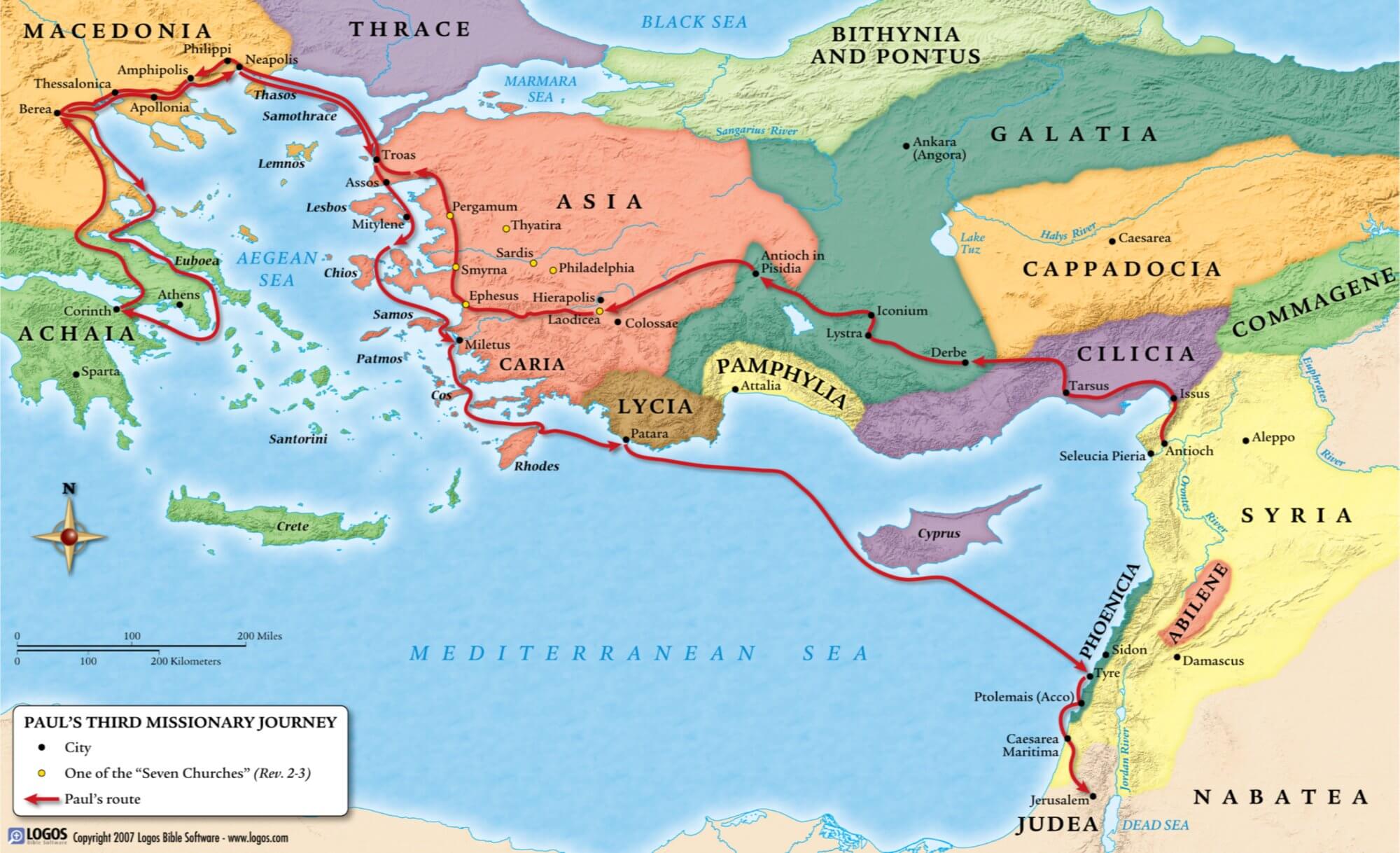
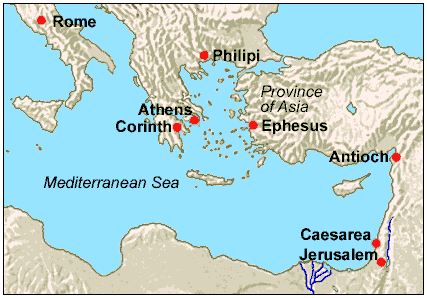
Paul wrote this letter to the Ephesian believers—God’s holy people in Ephesus, the faithful followers of Christ Jesus. The words “in Ephesus” are not present in the three earliest manuscripts. Therefore, this was very likely a circular letter, meaning the name of each local church would be filled in as the letter circulated from church to church. Ephesus, the leading church in the region of Asia Minor, was probably the first destination for this epistle. Paul mentioned no particular problems or local situations, and he offered no personal greetings as he might have done if this letter were intended for the Ephesian church alone. (For more about Ephesus, see the Audience section in the Introduction.)
Clearly, Paul had a deep love for the church in Ephesus. His last words to the Ephesian elders focused on two items: (1) warning them about false teachers (Acts 20:29–31), and (2) exhorting them to show love and care toward one another (Acts 20:35).
1:2 Grace means God’s undeserved favor. It is through God’s kindness alone that anyone can become acceptable to God. Peace refers to the peace that Christ established between believers and God through his death on the cross. True peace is available only in Christ (John 14:27).
Paul used “grace and peace” as a standard greeting in all of his letters. He wanted his readers to experience God’s grace and peace in their daily living. Only God our Father and Jesus Christ our Lord can grant such wonderful gifts. By mentioning Jesus Christ along with God, Paul was pointing to Jesus as a full person of the Godhead. He recognized Jesus’ deity and lordship over all of creation. Both God the Father and Jesus Christ the Lord are coequal in providing the resources of grace and peace.
Spiritual Blessings / 1:3–14
Here begins a lengthy passage that praises God for what he has done for us in Jesus Christ. Paul, writing in Greek, wrote one long sentence from 1:3 to 1:14 (which is not reflected in English). It forms the longest sentence ever found in ancient Greek. In this sentence, Paul introduced most of the themes he develops in this epistle. This complex sentence is very difficult to analyze. Paul heaped praise upon praise, one thought leading into another, which then would remind him of another. This section forms a blessing, in Hebrew called a berakah, frequently used in Jewish liturgy. It is a eulogy for God and for all the blessings he gives his people.
1:3 Paul first praised God, saying that all believers praise God. God alone is worthy of praise and worship. He is the Father of our Lord Jesus Christ. Because believers belong to Christ, God has blessed us. The verb “blessed” occurs hundreds of times in the Old Testament, revealing that God enjoys blessing his people. Here Paul used the past tense (“has blessed”), indicating that this prospering of believers had already occurred—even from eternity past. God has blessed us by allowing us to receive the benefits of Christ’s redemption (1:7) and resurrection (1:19–20). God blessed us through Christ’s death on the cross on our behalf.
Because by faith we belong to Christ, we have every spiritual blessing—that is, every benefit of knowing God and everything we need to grow spiritually. These are spiritual blessings, not material ones. Because God has already blessed believers, we need not ask for these blessings but simply accept them and apply them to our lives. Because we have an intimate relationship with Christ, we can enjoy these blessings now and will enjoy them for eternity.
The phrase heavenly realms occurs five times in this letter (1:3, 20; 2:6; 3:10; 6:12) and refers to the sphere beyond the material world—the place of spiritual activity where the ultimate conflict between good and evil takes place. This conflict continues but has already been won by Christ’s death and resurrection. This is the realm in which the spiritual blessings were secured for us and then given to us. Our blessings come from heaven, where Christ now lives (1:20), and Christ’s gift of the Holy Spirit, the source of all spiritual blessings, came as a result of his ascension to heaven (4:8). Paul was making the point that these blessings are spiritual and not material; thus, they are eternal and not temporal.
1:4 That God chose us forms the basis of the doctrine of election—defined as God’s choice of an individual or group for a specific purpose or destiny. The doctrine of election teaches that we are saved only because of God’s grace and mercy; as believers we are not saved by our own merit. It focuses on God’s purpose or will (1:5, 9, 11), not on ours. God does not save us because we deserve it but because he graciously and freely gives salvation. We did not influence God’s decision to save us; he saved us according to his plan. Thus, we may not take credit for our salvation or take pride in our wise choice.
The doctrine of election runs through the Bible, beginning with God’s choosing Abraham’s descendants as his special people. Although the Jews were chosen as special recipients and emissaries of God’s grace, their opportunity to participate in that plan arrived with the coming of Christ, their promised Messiah. But many didn’t recognize Christ and so rejected him. God’s “chosen” and elected people are now, also Christians, the body of Christ, the church—all who believe on, accept, and receive Jesus Christ as Messiah, Savior, and Lord. Jesus himself called his followers “the chosen ones” (see Matthew 24:22, 24, 31; Mark 13:20, 22, 27).
God chose his people before he made the world. The mystery of salvation originated in the timeless mind of God (2 Thessalonians 2:13; 2 Timothy 1:9). Before God created anything, his plan was in place to give eternal salvation to those who would believe on his Son. Before God created people, he knew sin would occur, he knew a penalty would have to be paid, and he knew that he himself (in his Son) would pay it.
Election is in Christ because of his sacrifice on our behalf. We have blessings and election only because of what Christ has done for us. Election is done for a specific purpose—that we would be holy and without fault in his eyes. What God began in eternity past will be completed in eternity future. God’s purpose in choosing us was that we would live changed lives during our remaining time on earth. To be “holy” means to be set apart for God in order to reflect his nature. God chose us, and when we belong to him through Jesus Christ, God looks at us as though we had never sinned. Our appropriate responses are love, worship, and service—in thankfulness for his wonderful grace. We must never take our privileged status as a license for sin.
1:5 In his infinite love, God chose to adopt us as his own children. People were created to have fellowship with God (Genesis 1:26), but because of their sin, they forfeited that fellowship. Through Jesus’ sacrifice, God brought us back into his family and made us heirs along with Jesus (Romans 8:17). God did not do this as an emergency measure after sin engulfed creation; instead, this has been his unchanging plan from the beginning. Under Roman law, adopted children had the same rights and privileges as biological children. Even if they had been slaves, adopted children became full heirs in their new family. Paul used this term to show the strength and permanence of believers’ relationship to God. This adoption occurs through Jesus Christ, for only his sacrifice on our behalf enables us to receive what God intended for us.
1:6 God’s goal in the election of believers was that they would praise him. Therefore, the ultimate purpose of believers’ lives is to praise God because of his wonderful kindness. Without it, we would have no hope, and our lives would be nothing more than a few years on earth. Instead, we have purpose for living and hope of eternal life. His kindness was poured out on us. It was a free gift, not something we could earn or deserve. God’s favor to us is realized by our union with his dearly loved Son. We could say that God’s love for his only Son motivated him to have many more sons—each of whom would be like his Son (Romans 8:28–30) by being in his Son and by being conformed to his image.
1:7 All people are enslaved to sin, but God, so rich in kindness, purchased our freedom through the blood of his Son. Jesus paid the price to redeem us, to buy our freedom from sin. The purchase price was his blood. To speak of Jesus’ blood was an important first-century way of speaking of Christ’s death. Our freedom was costly—Jesus paid the price with his life. Through his death, Jesus released us from slavery and our sins are forgiven. When we believe, an exchange takes place. We give Christ our sins, and he gives us freedom and forgiveness. Our sin was poured into Christ at his crucifixion. His righteousness was poured into us at our conversion. God’s forgiveness means that he no longer even remembers believers’ past sins. We are completely forgiven. Jesus became the final and ultimate sacrifice for sin. Instead of an unblemished lamb slain on the altar, the perfect Lamb of God was slain on the cross, a sinless sacrifice so that our sins could be forgiven once and for all.
1:8 God’s kindness is showered on believers. When God gives, he gives abundantly and extravagantly. In the phrase with all wisdom and understanding, the word “wisdom” is the ability to see life from God’s perspective. Proverbs 9:10 teaches that the fear (respect and honor) of the Lord is the beginning of wisdom. The word “understanding” could also be translated “insight,” referring to the ability to discern the right action to take in any given situation. Wisdom and understanding are given to believers for them to know God’s will.
1:9 Paul had been praising God’s wonderful kindness in 1:7–8. Thoughts of kindness led Paul to praise God for the entire plan of salvation. God had purposed to offer salvation to humanity “before he made the world” (1:4). How this would happen had not been revealed (made clear, understood) until the death and resurrection of Jesus Christ.
What God “revealed” was his plan to bring people (both Jews and Gentiles) back into fellowship with himself through their faith in Christ and then to keep them with him for all eternity. Paul called this the secret plan which was centered on Christ. The word “secret” has two meanings in Hellenistic Greek. One meaning referred to something known to only a select few. The word described heathen religions or “mystery religions” with their secret rites and practices. As used in the Septuagint (a Greek version of the Jewish Old Testament writings), a second meaning of the word describes what God reveals (as in Daniel 2:19). The Jews used the word to describe some secret plan that God would reveal at the end of the age. In the New Testament, the word refers to a truth formerly hidden but now made known to people—in this case, to us, meaning all believers. As with our being chosen (1:4), so the revelation of the secret plan of salvation is according to God’s good pleasure.
1:10 The Greek word oikonomia (translated bring everything together) refers to the management of a household or estate. In this context, it refers to large-scale management, as in administration or economy. In God’s timing, God brings everything together under the authority of Christ. With his first coming, Christ completed part of this mystery, but there are promises yet to be fulfilled. The mystery of salvation does not end with a person’s acceptance of Jesus Christ—God promises a glorious future in a glorious Kingdom (see Revelation 21–22). This time is unknown to everyone but God.
God is planning a universal reconciliation—all of creation will be reinstated to its rightful owner and creator. Just as Christ administered God’s plan of redemption by carrying it out as a human on this earth, so he will ultimately be in charge of everything in heaven and on earth. All of creation (spiritual and material) will be brought back under one head.
Sin holds people in bondage. That fact is clearly established throughout Paul’s letters. Sin has also caused all creation to fall from the perfect state in which God created it. The world physically decays and experiences conflict so that it cannot fulfill its intended purpose. One day God will liberate and transform all creation. Until then, it waits in eager expectation for the right time. Christ provided the means for this restoration. When the time arrives, all of creation (meaning every created thing and being) will be as God created it to be—perfect, eternal, and fulfilling its intended function to praise God.
This verse does not teach that God will eventually save everyone, although many would like to believe this. The doctrine of Universalism, as this belief is called, seems to make God a little easier to understand and a little less harsh on sinners. In the end, every knee will bow, but for some, it will be too late. Christ will bring those elected and saved, and all creation with them, to be united under him in this glorious Kingdom. Those who have refused to believe (whether Jews or Gentiles) will face the consequences of their unbelief (Matthew 25:31–46).
1:11 Up until this verse, Paul was speaking to Jews and Gentiles alike. In 2:11, Paul made a distinction between the backgrounds of the Jewish believers and Gentile believers. In verses 11–14, however, he identified the two separate groups with the pronouns he used. The wording in these verses includes both the first person (we, our) and the second person (you). The word “we” refers specifically to Jewish believers (Paul being one of them). While it is true that believing Jews and Gentiles alike will receive God’s blessings, the Jews were called first (Romans 1:16); they were chosen. Christ will be the Head of all things (1:10), including a body of believers made up of Jews (“we”) and Gentiles (“you,” 1:13).
The Jews were chosen from the beginning and had received an inheritance from God that would ultimately be accomplished in Jesus Christ (born into the nation of Israel) and finalized at the end of time. God chose the Jews to be the people through whom the rest of the world could find salvation. But this did not mean that the entire Jewish nation would be saved; only those who receive Jesus Christ as their Messiah and Savior will receive God’s blessings (see Romans 9–11). When God offered salvation to the Gentiles, he did not exclude the Jews. God’s Kingdom will include all Jews and Gentiles who have accepted the offer of salvation. Both Jews and Gentiles will also make up the group that does not believe and so receives God’s punishment. The inclusion of Jewish believers in salvation was the plan of God, for all things happen just as he decided long ago. In the same way that God planned for Israel to be the elect nation, he planned for the spiritual Israelites, the believers in Christ, to be an eternal gift to himself. As a refrain carried through from 1:5 and 1:9, Paul repeated that everything is under God’s sovereign control. The words reinforce the certainty of these events. Because God controls everything, he will carry out his plan according to his purpose and will, bringing it to completion in his time.
1:12 The word we refers to Jewish believers—those who recognized their promised Messiah. The Jews were the first to trust in Christ. This could mean that ages before the arrival of Christ, the Jews had set their hope on their coming Messiah (see Acts 28:20), or it could mean that the Jews were the first to believe in Christ because the gospel was preached first to them (see, for example, John 1:11; 8:30; Acts 1:8; 3:26; 13:45–46).
1:13 Because the word “we” in 1:12 most likely refers to Jews, the words you also refer to Gentile believers who were identified as Christ’s own along with the Jewish believers. The believers, both Jews and Gentiles, heard the truth (see also Colossians 1:5; 2 Timothy 2:15; James 1:18), also called the Good News. These people believed and were given the Holy Spirit. God marks his people as his own through the presence of the Holy Spirit in their lives. The Holy Spirit fills us with a sense of God’s love (Romans 5:5), assures us that God has adopted us as his children (Romans 8:15–16), and helps us to manifest our Christlikeness. The Spirit is a once-and-for-all identification that gives us continued assurance that we are God’s children, entitled to his riches and goodness, now as well as in eternity.
The Holy Spirit had been promised in the Old Testament (Isaiah 32:15; 44:3; Joel 2:28;) and was promised by Jesus to his disciples (John 14:16–17, 25–26; 15:26; 16:7–15; Acts 1:4–5; 2:38–39). After Christ returned to heaven, he would be spiritually present everywhere through the Holy Spirit. The Holy Spirit came so that God would be within his followers after Christ returned to heaven. At Pentecost (Acts 2) the Holy Spirit came upon all who believed in Jesus. Believers received the Holy Spirit when they received Jesus Christ. The transformation that the Holy Spirit makes in a believer’s life (as described in Galatians 5:22–23) undeniably marks God’s presence in and ownership of that life.
1:14 The word guarantee was used in ancient times to describe a down payment, promising that the buyer would complete the transaction and pay the full amount. The guarantee was binding. In the same way, the Holy Spirit is God’s guarantee that he will give us everything he promised. He is the first payment of all the treasures that will be ours because he has purchased us to be his own people. The presence of the Holy Spirit in us demonstrates the genuineness of our faith, proves that we are God’s children, and secures eternal life for us. His power works in us to transform us now, and what we experience now is a taste of the total change we will experience in eternity.
As a final ringing note echoing 1:6 (praising God) and 1:12 (praising Jesus Christ), Paul declared that the Holy Spirit’s presence in believers is one more reason for us to praise our glorious God.
Paul’s Prayer for Spiritual Wisdom / 1:15–23
As verses 3–14 are one long sentence in the Greek, so are verses 15–23. As verses 3–14 are an extended eulogy, verses 15–23 are an extended thanksgiving. Verses 15–16 are the thanksgiving proper; verses 17–19 are an intercessory prayer; verses 20–23 are a confession of praise for God’s power.
1:15–17 After describing the glorious blessings given to believers (1:3–14), thoughts of the great promises of God led Paul to give praise and to pray for the church—the people chosen to receive those blessings. The phrase ever since I first heard of your strong faith in the Lord Jesus could mean that Paul had heard a good report of the Ephesians’ growth in the faith. It could also be a way of including the believers in the surrounding churches. Paul knew the Ephesian church well but not all the surrounding churches. Yet he may have heard a positive report of all the churches in the area, and thus he could thank God for their faith and remember them in his prayers.
Paul never stopped thanking God for these believers. That Paul prayed for them constantly demonstrates personal attention. Paul was truly a prayer warrior—remembering the churches in his personal prayers: for example, the Romans (Romans 1:9), the Philippians (Philippians 1:3–4), the Colossians (Colossians 1:3–4), and the Thessalonians (1 Thessalonians 1:2–3). Paul kept asking on behalf of these believers that God would give them spiritual wisdom and understanding. The Holy Spirit gives “wisdom” (see also 1:8)—the ability to see life from God’s perspective, to have discernment. He also gives “understanding,” which refers to enlightened understanding in their knowledge of God and the mysteries of divine truth. (See 1 Corinthians 2:14, 16 and Colossians 1:9.)
1:18 For the Jew, the heart was the core of personality, the total inner person, the center of thought and moral judgment. The imagery of hearts flooded with light pictures an ability to see the reality of our wonderful future. Believers look forward to a glorious inheritance (Colossians 1:5) as well as blessings in this present world (1:19; Colossians 1:27) because of an action by God in the past (those he called).
1:19–21 Paul prayed that the believers would begin to understand the incredible greatness of God’s power on behalf of those who believe him. Because of his power, believers know that:
- God is on their side, ready to help them meet each and every obstacle
- God’s power is never stagnant or out of commission—it is always actively working on their behalf
- God is always fighting against the forces of evil on believers’ behalf
- no human strength or spiritual power from the evil world (not even Satan himself) can deter or change God’s inherent power.
Only God’s power can change weak human beings into strong believers who are willing to sacrifice everything for the God who loves them. After impressively describing the completeness of God’s power, Paul pointed out three instances of God’s power: (1) he raised Christ from the dead, (2) he seated Christ in the place of honor in the heavenly realms, and (3) he is far above any ruler or authority. Christ has no equal and no rival. He is supreme over all other beings. These words ought to encourage believers, because the higher the honor of Christ, the Head, the higher the honor of his people.
1:22–23 Paul probably had a psalm in mind as he wrote these words. This alludes to Psalm 8:6, a kingly messianic psalm describing sovereign power and enthronement. Christ is the obvious application for the verse. Just as the psalm writer described people as having dominion on earth, so Paul described Christ as having authority over all of creation—all things (1 Corinthians 15:20–28). The church receives the benefit of his universal headship because the church is his body. Paul used the analogy elsewhere when he wrote about the interrelationships of believers in the church (Romans 12:4–5; 1 Corinthians 12:22–27; Colossians 1:18–19). This passage focuses on Christ as the head of that body, the church (see also 4:4, 12, 16; 5:30). The church is not a building (or all the church buildings on earth)—it includes all believers in a living, growing, moving, working organism deriving existence and power from Christ. The church obeys Christ’s commands to carry out his work in the world.
All believers, as part of Christ’s body, are filled by Christ who fills everything everywhere with his presence. Christ fills all things with himself and with his blessings, bringing all believers to the state of obedience and praise for which God created them (as in 1:10; 4:10, 13, 16). The church is being filled with and by Christ, who fills all things totally. Thus, Christ, who is the fullness of God (Colossians 1:19), finds full expression in the church.
By Christ’s resurrection and exaltation, he is head over all things for the church. Christ fills the church and then uses the gifts he bestows to fulfill his mission—revealing himself to the world and drawing people to himself by that witness. The image of the body shows the church’s unity. Each member is involved with all the others as they go about doing Christ’s work on earth. We should not attempt to work, serve, or worship on our own. We need the entire body.[1]
Message Audio/Video and Outline: https://upwards.church/leander-campus/watch-now-message-videos
Watch Messages: YouTube-Upwards Church
Read Along Daily Bible Reading: YouVersion (https://www.bible.com/organizations/370f8a6e-16bc-464f-8c43-0b7623fd2952)
Source: [1] Bruce Barton et al., Life Application New Testament Commentary (Wheaton, IL: Tyndale, 2001), 804–809.


 Upwards Church