Evidence of a Global Flood – Genesis 6-9

I am about to cover the earth with a flood that will destroy every living thing that breathes.” Genesis 6:17

17 For forty days the floodwaters grew deeper…19 Finally, the water covered even the highest mountains on the earth, 20 rising more than twenty-two feet[b] above the highest peaks.” Genesis 7:17-20

There have been two massive, cataclysmic events in our past. One is the creation of the heavens and the earth that was performed by God in six literal twenty-four hour days. It was created fully mature but the second event was the great flood. Great cataclysmic event. The first, creation, took six days; the flood lasted 371 days, approximately. Creation gave us the first earth, the flood gave us what we would call the second earth, the earth we now see, live in, and enjoy. Genesis 6 and 7 describe the flood as a global flood, not a local flood. There are certain things that are phenomena in our natural world that I believe can only be explained by a flood.

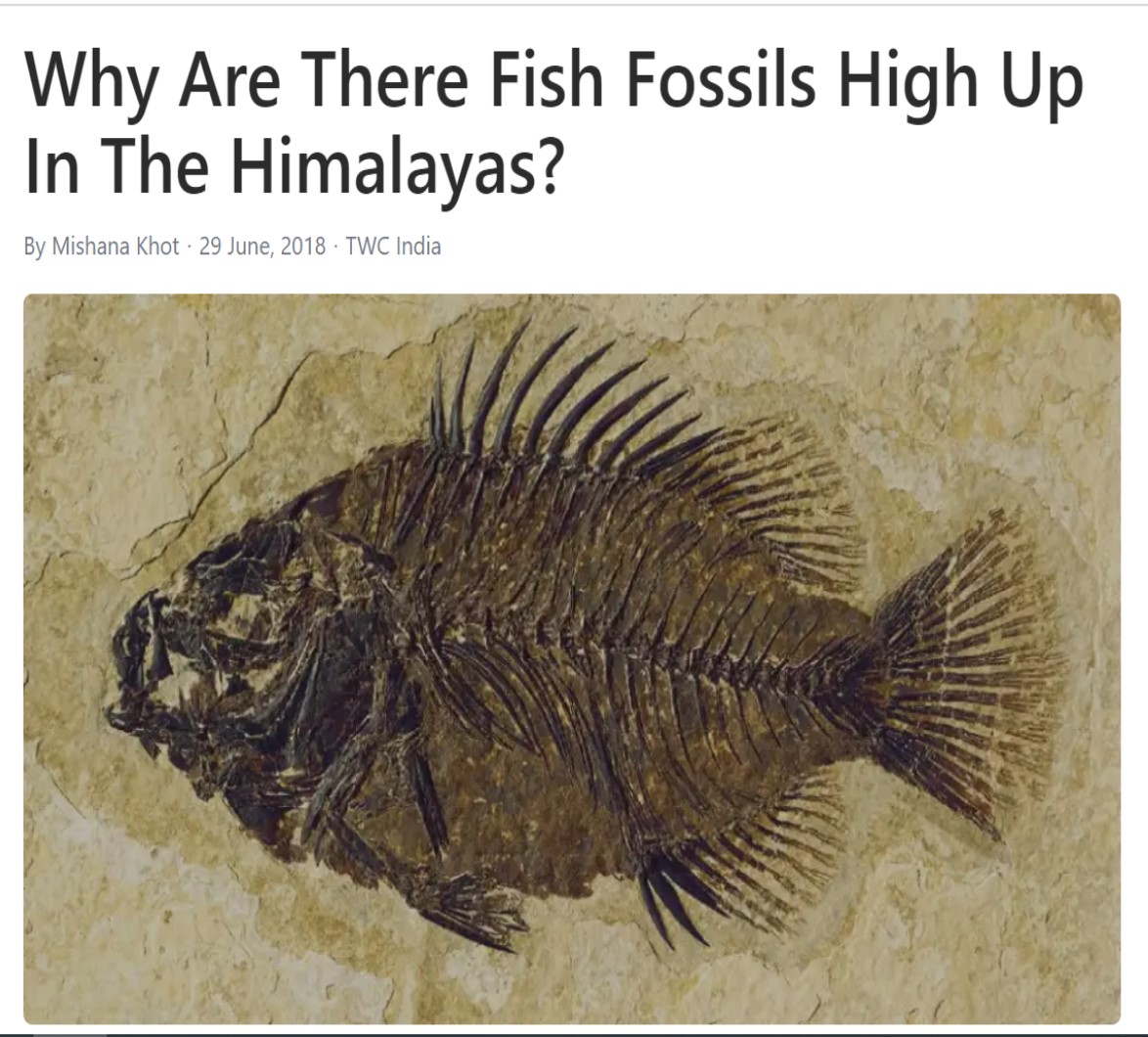
  1. The fossil record and worldwide fossil fuels are evidence of a universal flood. There are water-laid layers of sediment forming coal, and coal is found all over the earth in every continent, even at the North Pole and the South Pole. And atop those layers, and in between those layers, are fossils. Interesting fossils. Sea life fossils are found on the highest mountains. In Michigan they have fossilized whales. In Ohio they’ve discovered fossilized sharks. In Wyoming they’ve discovered fossilized fish at over 7,000 feet above sea level. Fish 7,000 feet above sea level.   Fossils are formed by being buried rapidly. Some are so rapid that they were eating or mating.   The image of the turtles mating and nine other fossils like it suggest a rapid burial.
    There’s a great sediment layer out in Nebraska—Agate Springs, Nebraska—that houses over 9,000 animal remains. In the fossil record there are certain fossils that are out of order, even that transect the strata. There are tree trunks or mammal fossils embedded vertically through supposedly long-developing strata. The establishment say that these layers were put down over millions of years, but hey have difficulty explaining the presence of those fossils that transect these layers.

Also some recent discovery of fossils have been found with skin. And more shocking soft tissues were found in the bones of a T-Rex and soft tissue in the horn of a Triceratops creating questions of the ages of these fossils.

  1. The existence of great inland seas, great canyons and mountains. In different continents of the world there are great inland seas, China has them, India has them. We, in America, have them—our great basin. The shoreline is apparent; it can be seen. It was at one time a vast saltwater inland sea that got there somehow. It is since receded and all that’s left is a little body of water known as the Great Salt Lake and the Bonneville salt flats. But at one time, the great basin was covered in water.
    “All the underground waters erupted from the earth.”  These “fountains of the deep” bursting forth would change the earth in many ways.  It may have separated continents, created large canyons, rifts, ocean trenches, pushing the mountains higher. A lot of things that are observable on the earth are explained by a worldwide flood.
  2. Flood Accounts In the history of mankind, in over 270 nations or tribes, you have flood stories. It’s not just a biblical story. You have that record in virtually every part of the world. In South America, Brazil, Bolivia, different tribes, different Indians, those in Africa, the Aborigines in Australia, all the way back to the Gilgamesh epic or the Babylonian flood epic, which is probably the most famous and the closest to the biblical narrative. But there are 270 plus records of a worldwide flood that have existed through time. “Eighty-eight percent of those flood narratives say that there was a favored family that was spared. Seventy percent say that survival was by means of a boat. Ninety-five percent say the sole cause of this great catastrophe was a flood. Sixty-six percent of these flood narratives say that it was because of man’s wickedness. Seventy-seven percent declare that animals were also saved. Fifty-seven percent say the survivors ended up on a mountain. Many of them used the form of Noah’s name, like the Hawaiian legend about Nu-uh. Many of these flood narratives speak of birds being sent out. Many of them speak about a rainbow. And many of them say that eight people were saved.”
    Flood accounts are embedded in the history and anthropology in the psyche, of mankind. This was such an impressive event that the story was told and re-told from its source, and we are about to read the source. Then it varied as it went out and it was re-told; elements were added to it or subtracted from it.
  3. Mount Arat AnomalyThen the ark rested in the seventh month, the seventeenth day of the month, on the mountains of Ararat.” There is a mountain range in the Soviet Armenia border of Turkey area called the Mountains of Ararat. Could the ark be there? There’s enough evidence throughout history that the CIA has labled this phenomenon as the Mt Ararat Anomoly. In 275 B.C. a Chaldean priest, a Babylonian historian, wrote that the ark of Noah was on Mount Ararat and people in his day were taking pieces of the pitch and making amulets out of it.Josephus, the Jewish historian, who writes after Jesus, said that the ark was there and that people were taking bits of it, making relics out of it. Theophilus of Antioch, 180 A.D. said that the ark, in certain places in the mountain range, was visible from a lower elevation. In the early 1900’s, some Russian aviators were flying over the area and they took pictures of it. They discovered it; they even got the czar of Russia interested in finding the ark of Noah, but the Russian Revolution broke out and interest was quickly lost. Back in the 90’s, I remember CBS did a special on Noah’s Ark and had photographs, etcetera. And this thing gets resurrected every few years. We don’t exactly know what it is, but we know something is up here, it can be photographed, I’ve seen pictures of it, We know that something is there that oddly looks like a large box or boat. And it’s covered in ice.

We have pretty clear evidence of a worldwide flood, both in the written record of nations as well as in the natural phenomena that is on the earth.

Below are links of some of the pictures with articles written by people trying to explain this.  I think the global  flood mentioned in Genesis 6-8 also explains it.  Also Answers in Genesis, Creation.com and Is Genesis History are all excellent sites to learn more!

Darrell

https://creation.com/fossilized-mating-turtles

https://answersingenesis.org/noahs-ark/noahs-ark-found/noahs-ark-mount-ararat/

https://isgenesishistory.com/

https://www.theatlantic.com/science/archive/2017/08/a-dinosaur-so-well-preserved-it-looks-like-a-statue/535782/

https://www.usatoday.com/story/news/world/2022/09/13/complete-dinosaur-skeleton-skin-mummy/10369447002/

https://www.smithsonianmag.com/science-nature/dinosaur-shocker-115306469/

https://weather.com/en-IN/india/news/news/2018-06-29-fish-fossil-himalayas


www.Upwards.Church

Watch Messages: YouTube-Upwards Church

Facebook: Upwards Church

Posted in Genesis - The Beginning | Tagged , , , , , , , , , | 2 Comments

Noah – Genesis 6

Except for the increase in violence and crime, the times were pretty good. People were “eating and drinking, marrying and giving in marriage” (Matt. 24:38), and life was going on as usual. When friends met at the market or at wedding feasts, they laughed about Noah and his family “Imagine building that big boat on dry land!” or discussed Methuselah, the world’s oldest man (“He’ll die one of these days, mark my word!”), or talked about Enoch, the man who suddenly disappeared (“Strangest thing I ever heard!”).

Methuselah was Noah’s grandfather, and Noah knew that when he died, nothing stood in the way of God’s judgment falling on a wicked world. For over a century, Noah had been warning people about the coming judgment, but only his own family had believed him and trusted the Lord.

Then Methuselah died and things began to happen. One day, Noah and his family entered their “boat” and the rains came. (“It can’t go on forever,” people said. “It’ll stop one of these days.”) But it rained for forty days and forty nights, and subterranean explosions discharged more water on the earth. Even after the rain stopped, the water continued to rise; and within five months, the whole earth was under water and everything that breathed was dead. Everything, that is, except Noah and his family, the eight people everybody laughed at.

What kind of a person was Noah? He was the kind of person you and I should be and can be as we live in our world today.

A believing man who walked with God (Gen. 6:9-13)

“But Noah found grace in the eyes of the Lord” (v. 8) introduces the third of the “generation” statements in Genesis: “These are the generations of Noah” (v. 9). Noah wasn’t a minor character in the story of redemption; he’s mentioned eighty times in nine different books of the Bible.

Noah was a righteous man (v. 9; 7:1). This is the first time the word “righteous” is used in the Bible, but Noah’s righteousness is also mentioned in other places (Ezek. 14:14, 20; Heb. 11:7; 2 Peter 2:5). Noah’s righteousness didn’t come from his good works; his good works came because of his righteousness. Like Abraham, his righteousness was God’s gift in response to his personal faith. Both Abraham and Noah believed God’s Word “and it was counted to [them] for righteousness” (Gen. 15:6; see Heb. 11:7; Rom. 4:9ff; Gal. 3:1ff).

The only righteousness God will accept is the righteousness of Jesus Christ, His Son (2 Cor. 5:21); and the only way people can receive that righteousness is by admitting their sins and trusting Jesus Christ to save them (Rom. 3:19-30; Gal. 2:16). Noah must have learned this important truth from his father Lamech (Gen. 5:28-29), who learned it from his father Methuselah, who learned it from his father Enoch. How important it is to teach our children and grandchildren how to trust the Lord!

Noah was a blameless man (v. 9). If “righteous” describes Noah’s standing before God, then “blameless” describes his conduct before people. “Blameless” doesn’t mean “sinless,” because nobody but Jesus Christ ever lived a sinless life on this earth (1 Peter 2:21-22). The word means “having integrity, whole, unblemished.” It was used to describe the animals acceptable to God for sacrifice (Ex. 12:5; Lev. 1:3, 10). Noah’s conduct was such that his neighbors couldn’t find fault with him (Phil. 2:12-16).

The person who is right before God through faith in Christ ought to lead a life that is right before people, for “faith without works is dead” (James 2:14ff). Paul warned about “unruly and vain talkers and deceivers…who profess that they know God, but in works they deny Him” (Titus 1:10, 16). Noah wasn’t that kind of person.

Noah was a man who walked with God (Gen. 6:9). His great-grandfather Enoch had “walked with God” and was suddenly taken to heaven and rescued from the impending judgment of the Flood (5:24). Noah walked with God and was taken safely through the judgment. Enoch modeled a godly way of life for Methuselah. Methuselah must have passed it along to his son Lamech who shared it with his son Noah. How wonderful it is when generation after generation in one family is faithful to the Lord, especially at a time in history when violence and corruption are the normal way of life.

The life of faith and obedience is compared to a “walk” because this life begins with one step: trusting Jesus Christ as Lord and Savior. This step of faith leads to a daily walk, a step at time, as the Lord directs us. He commands us to “walk in love” (Eph. 5:2), “walk as children of light” (v. 8), “walk in the Spirit” (Gal. 5:16, 25), and “walk circumspectly [carefully]” (Eph. 5:15). A step at a time, a day at a time, we walk with the Lord; and He guides us into His will and blesses us with His wisdom and strength.

Noah was an obedient man (Gen. 6:22; 7:5,16). One of the major messages in Scripture is that we must not only hear God’s Word but we must also obey it (James 1:22-25). Because Noah was obedient to the Lord, his “house” wasn’t destroyed when the storm came (Matt. 7:24-27). It wasn’t easy for Noah and his family to obey the Lord, because the rest of the population was disobeying God and rebelling against His will. According to Enoch, they were ungodly people committing ungodly deeds in ungodly ways and speaking ungodly words against the Lord God (Jude 15).

Whether it has to do with sexual abstinence, using alcohol and drugs, or joining gangs and breaking the law, we hear a great deal today about “peer pressure.” It’s the excuse for all kinds of illegal and immoral behavior, from cheating on your income tax to cheating on your spouse. But anybody who has ever developed godly character has had to fight against peer pressure, including Noah and his family, Abraham and his family, Moses in Egypt (Heb. 11:24-26), and Daniel and his friends in Babylon (Dan. 1). Resisting peer pressure means not only saying a determined no to people but also a dedicated yes to the Lord (Rom. 12:1-2).

Most people know that Noah built an ark. What they may not know is that he also built a godly character and a godly family. Had it not been for Noah’s godly family, Abraham wouldn’t have been born; and without Abraham, would there have been a Jewish nation, the Bible, and the Savior?

A faithful man who worked for God (Gen. 6:14-22)

The secret of the Lord is with them that fear Him; and He will show them His covenant” (Ps. 25:15). When you walk with God, He speaks to you through His Word and tells you what you need to know and to do. Christians are more than just servants who do His will; we’re also His friends who know His plans (John 15:14-15). God’s plan involved three responsibilities for Noah and his family.

Building an ark (vv. 14-17). God told Noah what his task was: to build a wooden vessel that would survive the waters of the Flood and keep Noah and his family safe. If the cubit mentioned was the standard cubit of eighteen inches, then the vessel was 450 feet long, 75 feet wide, and 45 feet high. It had three decks, one door, and a series of small windows eighteen inches high right under the roof, providing light and ventilation. The three decks were divided into compartments (Gen. 6:14) where the various animals would be kept and where Noah and his family would live.

This vessel was designed for flotation, not navigation. It was a huge wooden box that could float on the water and keep the contents safe and dry. Dr. Henry Morris calculated that the ark was large enough to hold the contents of over 500 livestock railroad cars, providing space for about 125,000 animals. Of course, many of the animals would be very small and not need much space; and when it came to the large animals, Noah no doubt collected younger and smaller representatives. There was plenty of room in the vessel for food for both humans and animals (v. 21), and the insects and creeping things would have no problem finding places to live on the ark.

Trusting God’s covenant (v. 18). This is the first use of the word “covenant” in the Bible. The word appears often in Scripture because the covenant concept is an important part of God’s great plan of redemption. (God would explain His covenant to Noah after he left the ark; 8:20-9:17.) A covenant is an agreement that involves obligations and benefits for the parties involved. In some of the covenants, God alone is the “covenant party” and makes unconditional promises to His people. But there were also covenants that required His people to fulfill certain conditions before God could bless them.

God’s words in 6:13-21 were addressed specifically to Noah, but God also included Noah’s family in the covenant (v. 18). Noah didn’t become a father until he was 500 years old (5:32), and he entered the ark when he was 600 (7:6); so his three sons were still “young” as far as pre-Flood ages were concerned. Ham was the youngest son (9:24) and Japheth was the eldest (10:21), and all three boys were married (7:13).

The fact that God had covenanted to care for Noah and his family gave them the peace and confidence they needed as they prepared the ark and then lived in it for over a year. God is faithful to keep His promises, and as God’s covenant people, the eight believers had nothing to fear.

Gathering the animals (vv. 19-22). God not only wanted humans to be preserved from destruction but also every kind of creature that would be drowned by the waters of the Flood. But how was Noah to gather such a large number of animals, birds, and creeping things? God would cause these creatures to come to Noah (v. 20; 7:8, 15) and Noah would take them into the ark (6:19). This included not only pairs of unclean animals who would be able to reproduce after the Flood, but also seven pairs of clean animals, some of whom would be used for sacrifices (8:20; 9:3). Noah and his family not only learned about the faithfulness of God, but they also saw the sovereignty of God in action.

In His sovereign power, God brought the animals to Noah and his sons and controlled them so that they did His bidding. However, this magnificent demonstration of God’s power didn’t touch the hearts of his neighbors, and they perished in the Flood. The birds, beasts, and creeping things knew their Creator’s voice and obeyed Him, but people made in the image of God refused to heed God’s call. Centuries later, God would say through His servant Isaiah, “The ox knows his master, the donkey his owner’s manger, but Israel does not know, my people do not understand” (Isa. 1:3, niv).

During all of this important activity, Noah was serving the Lord and bearing witness to a sinful world. For 120 years (Gen. 6:3), God was long-suffering toward the violent and rebellious people; but they ignored His message and lost their opportunity for salvation.

Today things haven’t changed much. Each day thousands of people are warned of God’s inevitable judgment, yet most of them don’t really believe it will happen. Don’t expect people to welcome or accept your message of God’s coming judgment on sin. Those who don’t believe in God will deny his judgment and try to get you to deny God as well. But remember God’s promise to Noah to keep him safe. This can inspire you to trust God for deliverance in the judgment that is sure to come.

www.Upwards.Church

Watch Messages: YouTube-Upwards Church

Facebook: Upwards Church

Sources:

Warren W. Wiersbe, The Bible Exposition Commentary – Pentateuch, (Colorado Springs, CO: Victor, 2001), WORDsearch CROSS e-book, 60-64.

Life Application Study Bible, (Wheaton, IL: Tyndale, 1988), WORDsearch CROSS e-book, 92-93.

Posted in Genesis - The Beginning | Tagged , , , , , , , , , , , | Leave a comment

Cain, Abel & More Problems – Genesis 4

“All the world’s a stage, and all the men and women merely players,” wrote Shakespeare. “They all have their exits and their entrances, and one man in his time plays many parts.”

Remember those familiar words from English Literature? Shakespeare was right: we have many roles to play in life as from time to time we relate to various people and confront different circumstances. The important thing is that we let God write the script, choose the cast, and direct the action. If we disregard Him and try to produce the drama ourselves, the story will have a tragic ending. That’s what ruined Cain, the first human baby born on the stage of Planet Earth: He ignored God’s script, “did his own thing,” and made a mess out of it. Genesis 4 focuses the spotlight on Cain; he’s mentioned thirteen times, and seven times Abel is identified as “his [Cain’s] brother.” As you consider Cain’s life and some of the roles he played, you will better understand how important it is for us to know God and do His will.

The brother (Gen. 4:1-2a)

God commanded our first parents to “be fruitful, and multiply, and fill the earth” Gen. 1:28, and they obeyed this mandate (5:4). While it’s true that the building of a family isn’t the only purpose for marriage, and not every marriage is blessed with children, it’s also true that children are a precious gift from God (33:5; 48:9; Ps. 127:3) and should be welcomed with joy. The Jewish people in the Old Testament and the Christians in the first century church would be appalled at today’s abortion statistics and the philosophies of the people who produce them.

The name “Cain” sounds like the Hebrew word for “acquired.” Eve praised God for helping her through her first pregnancy. After all, this was a new experience for her and she had no doctor or obstetrical nurse to assist her. Her second pregnancy brought Abel into the world. His name means “breath” and is the word translated “vanity” at least thirty-eight times in Ecclesiastes. Cain’s name reminds us that life comes from God, while Abel’s name tells us that life is brief.

Genesis is a “family book” and has a good deal to say about brothers. Being the firstborn son, Cain was special; but because of his sin, he lost everything and Seth took his place (Gen. 4:25). Ishmael was Abraham’s firstborn, but God bypassed him and chose Isaac. Esau was Isaac’s firstborn son, but he was rejected for Jacob; and Jacob’s firstborn son Reuben was replaced by Joseph’s two sons (49:3-4; 1 Chron. 5:1-2). In fact, God even rearranged the birth order of Joseph’s sons (Gen. 48:8-22). Throughout Old Testament history, God’s sovereignty is displayed in His choices of those who receive His blessing, for all that we receive is because of God’s grace.

Sibling rivalry among brothers is another theme in Genesis. Ishmael persecuted Isaac; Jacob left home so Esau couldn’t kill him; and Joseph’s brothers intended to kill him but decided to sell him as a slave. When sin entered the human race, it gave us dysfunctional and fractured families, and only the Lord can put families together again.

The worker (Gen. 4:2b)

As his sons grew older, Adam put them to work in the fields; and it became evident over the years that each boy had his own interests and skills. Cain became a farmer and Abel became a shepherd, the first of many shepherds found in the Bible, including Abraham, Isaac, Jacob and his sons, Moses, and David.

Adam certainly taught his sons why they worked: it was a part of God’s creation mandate and they were colaborers with God (1:26-31). Work isn’t a punishment from God because of sin, for Adam had work to do in the Garden before he and his wife yielded to Satan’s temptation. The biblical approach to work is that we are privileged to cooperate with God by using His creation gifts for the good of people and the glory of God. (See Col. 3:22-23; 1 Thes. 4:11-12; Ecc. 9:10.)

Work in the will of God isn’t a curse; it’s a blessing. “Six days you shall labor and do all your work” (Ex. 20:9, nkjv) was as much a part of God’s Law for Israel as His command to rest on the Sabbath Day. The Bible has nothing good to say about idleness or about the idle people who expect others to provide for them (2 Thes. 3:6-15). Before He began His public ministry, Jesus labored as a carpenter (Mark 6:3); and when he wasn’t traveling or preaching, the Apostle Paul worked as a tentmaker (Acts 18:1-3).

As Christians, we don’t work simply to pay our bills and provide for our needs. We work because it’s God’s ordained way for us to serve Him and others and thereby glorify God in our lives (1 Cor. 10:31). We don’t work just to make a living; we work to make a life, to develop our God-given abilities, and seek to increase the quality and quantity of our labor. Martin Luther told the dairymaids that they could milk cows to the glory of God, and Theodore Roosevelt said that “the best prize that life offers is the chance to work hard at work worth doing.” Perhaps the boys asked their father why their work was so difficult, and Adam had to explain that God had cursed the ground because of his own disobedience. “In the sweat of your face you shall eat bread” was God’s sentence (Gen. 3:17-19, nkjv), and there was no escape. But this question gave Adam the opportunity to remind his sons of God’s promise of a Redeemer and a day when creation would be set free from the bondage of sin (v. 15).

The worshiper (Gen. 4:3-7)

Adam and Eve had learned to worship God during those wonderful days in the Garden before sin had brought its curse to their lives and to the ground. Certainly they taught their children about the Lord and the importance of worshiping Him. Workers need to be worshipers or they may become idolaters, focusing on the gifts and not the Giver, and forgetting that God gives the power to work and gain wealth (Deut. 8:10-20).

When God clothed Adam and Eve with the skins of animals (Gen. 3:21), perhaps He taught them about sacrifices and the shedding of blood; and they would have passed this truth along to their children. True worship is something we must learn from God Himself, for He alone has the right to lay down the rules for approaching Him and pleasing Him in worship.

God accepted Abel and his sacrifice, but He rejected Cain and his sacrifice. Cain wasn’t rejected because of his offering, but his offering was rejected because of Cain: his heart wasn’t right with God. It was “by faith” that Abel offered a more acceptable sacrifice than Cain (Heb. 11:4), which means that he had faith in God and was right with God.

In later years, the Law of Moses prescribed offerings of grain and fruit (Lev. 2; Deut. 26:1-11), so we have reason to believe that such sacrifices were acceptable from the beginning. But even had Cain brought animal sacrifices and shed their blood, they wouldn’t have been accepted by God because of the state of Cain’s heart. Abel brought the best that he had and truly sought to please God; but Cain didn’t have that attitude of faith. “Behold, to obey is better than sacrifice, and to heed than the fat of rams” 1 Sam. 15:22; and see Isa. 1:11-13; Hosea 6:6; Micah 6:6-8; Mark 12:28-34).

The fact that people attend religious meetings and participate in church activities is no proof that they’re true believers. It’s possible to have “a form of godliness” but never experience its saving power 2 Tim. 3:5. “These people come near to Me with their mouth and honor Me with their lips, but their hearts are far from Me” Isa. 29:13; Matt. 15:8. The most costly sacrifices apart from the submission of the heart can never make the worshiper right before God (Ps. 51:16-17). “The way of Cain” (Jude 11) is the way of self-will and unbelief.

When God rejected his offering, Cain became very angry. (The Hebrew word implies that he was “burning with anger.”) God spoke to him personally and tried to lead him back to the way of faith, but Cain resisted. It’s just like the Lord to give us another opportunity to obey Him, and it’s just like stubborn sinners to refuse His gracious help.

The Lord warned Cain that temptation was like a fierce beast crouching at the door of his life, and he had better not open the door. It’s dangerous to carry grudges and harbor bitter feelings in our hearts, because all of this can be used by Satan to lead us into temptation and sin. This is what Paul meant when he wrote “neither give place to the devil” (Eph. 4:27). If we aren’t careful, we can tempt ourselves and bring about our own ruin.

The murderer (Gen. 4:8-10)

We can’t separate our relationship with God from our relationship with our brothers and sisters. (That includes our natural brothers and sisters as well as our brothers and sisters in the Lord.) An unforgiving spirit, such as possessed Cain, hinders worship and destroys our fellowship with God and God’s people (Matt. 5:21-26; 6:14-16). It’s better that we interrupt. our worship and get right with a brother than to pollute our sacrifice because we have a bad spirit within.

Murder (v. 8). Anger is a powerful emotion that can lead to violence and even murder. Jesus taught that anger in the heart is the moral equivalent of murder with the hands (Matt. 5:21-26). Every year angry drivers cause accidents that kill 28,000 people on the U.S. highways, and angry people who have been fired from their jobs have killed hundreds of innocent people. Had Cain heeded God’s warning and accepted His gracious invitation (Gen. 4:7), he would never have become a murderer.

How soon after his worship was rejected did Cain entice his brother away from home and kill him? Was it on the same day, or did he brood over the matter a few days? He probably murdered his brother in his heart many times before he actually committed the deed. He was envious of his brother because of his relationship with God (1 John 3:12), and yet Cain was unwilling to get right with God. When we hate others, it’s a sign we’re not walking in the light (2:9-11) and that we don’t have God’s love in our hearts (3:10-16).

Lying (vv. 9-10). Cain was a child of the devil (1 John 3:12), which means he was a murderer and a liar (John 8:44). He lied to his brother when he enticed him to the place where he killed him. He lied to himself in thinking that he could do such an evil deed and get away with it. Cain even tried to lie to God and cover up his wicked deeds!

There’s a definite parallel between God’s dealings with Cain in Genesis 4 and His dealings with Adam and Eve in chapter 3. In both instances, the Lord asked questions, not to get information (for He knows everything) but to give the culprits opportunity to tell the truth and confess their sins. In both instances, the sinners were evasive and tried to cover up what they had done, but both times God brought their sins out into the light and they had to admit their guilt.

Adam and Eve had run to hide when they heard God’s voice (v. 8), but God heard Abel’s voice crying from the ground and Cain couldn’t hide. The shedding of innocent blood pollutes the land (Num. 35:30-34) and that blood cries out for justice (Job 16:18; Isa. 26:21; Rev. 6:9-10). Adam and Eve were expelled from the Garden, and Cain became a rejected wanderer in the earth.

The more you think about Cain’s sin, the more heinous it becomes. The murder wasn’t motivated by sudden passion; it was carefully premeditated. Cain didn’t kill a stranger in defense; he murdered his own brother out of envy and hatred. Furthermore, Cain did it after being at the altar to worship God and in spite of God’s warning and promise. Finally, once the horrible deed was done, Cain took it all very lightly and tried to lie his way out of it.

The wanderer (Gen. 4:11-15)

A vagabond has no home; a fugitive is running from home; a stranger is away from home; but a pilgrim is heading home. “I have set before you life and death, blessing and cursing; therefore, choose life” (Deut. 30:19). Cain made the wrong choice, and instead of being a pilgrim in life, he became a stranger and a fugitive, wandering the land.

God’s curse (v. 12). Jehovah had cursed the serpent (3:14) and the ground (v. 17), but He had not cursed Adam and Eve. However, He did curse their son Cain, who was a child of the devil (the serpent). Cain had defiled the ground with his brother’s blood, and now the ground wouldn’t work for him. If Adam toiled and struggled day after day, he would get a harvest (vv. 17-19); but for Cain, there would never be fruit from his labors. So, he couldn’t continue as a farmer. All he could do was wander from place to place and eke out a living.

Cain’s regrets (vv. 13-14). Cain never repented of his sins; his words reveal only remorse and regret. He didn’t say, “My guilt is more than I can bear.” He was concerned only with his punishment, not with his character. If he wandered from place to place, he would be in danger; but if he stayed in one place, he would starve. The earth had turned against him, God had turned against him, and people would turn against him. Anybody Cain met would be a relative who might want to avenge Abel’s murder. What could he do?

By hating and murdering his brother and refusing to repent, Cain created for himself an intolerable life. He opened the door to temptation (4:7) and closed the door on his family, God, and his future. No matter where he lived or what he did, Cain would always be a restless man for whom there was no remedy.

God’s mercy (v. 15). God did a strange thing: He put a mark on Cain that would protect him from the assaults of people who wanted to kill him. We don’t know what this mark was or why people would recognize it as God’s protective seal; but it worked. This was purely an act of mercy on God’s part.

Why would God allow a diabolical murderer like Cain to go free? In His mercy, God doesn’t give us what we do deserve; and in His grace, He gives us what we don’t deserve. That’s the nature of God. God spared Cain’s life, but that wasn’t the end of the story. Eventually Cain died and “after this the judgment” (Heb. 9:27). The entire civilization that he built was destroyed in the Flood, and the record of his life is left in Holy Scripture as a warning to anybody who pretends to worship, plays with sin, and doesn’t take temptation seriously. “The way of Cain” (Jude 11) is not the narrow way that leads to life (Matt. 7:13-14).

The builder (Gen. 4:16-24)

God kept His Word and protected Cain as he wandered. One day he found a place that seemed right for him to settle down, and he decided to build a city. The earth wouldn’t yield its strength to Cain’s labor as a farmer, but Cain could labor and build on the earth and succeed. However, Cain never ceased to be a fugitive, for the name of the land where he settled means “wandering.” His citizenship wasn’t in heaven (Phil. 3:20-21), nor did he have any hope to reach the heavenly city (Heb. 11:9-16). The only heaven Cain knew was his city on earth.

Was Cain a married man before he wandered from Eden, or did he find a wife during his travels? Did he tell her he had murdered his brother? We don’t know, but surely he had to explain the mark God had put on him. It was normal for Cain to seek a wife; for he not only wanted to build a city, but he also wanted to build a family. How else could his name be remembered but in his descendants? Cain didn’t know that his name and foul deeds would be written in the Word of God for everybody to read.

Cain’s wife bore him a son whom he named Enoch, which is related to the Hebrew word for “consecrated.” Cain named his city after his son, but we aren’t told to whom or to what the city was consecrated. Six generations of Cain’s descendants are named (Gen. 4:17-22), some of whom were famous.

Lamech was the first bigamist; he was also a boastful man and a killer. Why or how the young man wounded him, we don’t know; but why should a young man be killed because he caused a wound? Lamech’s mentioning of Cain’s protection (v. 24) indicates that Cain’s story was passed from generation to generation. It also suggests that Lamech thought that God’s protection extended to him as well. If God would avenge a murderer like Cain, then surely He would avenge Lamech for “protecting himself.” Note that Lamech wants God’s protection, but he doesn’t mention God’s name.

The people in the city of Enoch had varied occupations. Some followed Jabal and took care of livestock (v. 20). Others learned from Jabal’s brother Jubal and devoted themselves to making and playing musical instruments (v. 21). The followers of Tubal-Cain were metalworkers (v. 22), which suggests the manufacture of farm implements, building tools, and personal weapons. Cain lived in a society that was rich in culture as well as in industry and food production. In the city of Enoch, they had everything but God.

When you put Cain’s family tree next to that of Seth (chap. 5), you can’t help but notice the similarity in names. You have Enoch and Enosh (v. 6) and Enoch (v. 18), Mehujael and Mahalael (v. 12), Methushael and Methuselah (v. 21), and Lamech and Lamech (v. 25). Cain’s Lamech has three sons (Jabal, Jubal, and Tubal-Cain), and Noah has three sons (Shem, Ham, and Japheth).

What does this similarity in names mean? Perhaps it’s God’s way of telling us that the godless line of Cain (which is still with us) does its best to imitate the godly line of Seth. After all, Satan is the counterfeiter. He can imitate the names of the true believers, but he can’t produce the believers. There’s an Enoch in both genealogies, but Cain’s Enoch didn’t walk with God and one day disappear and go to heaven! (v. 24) “What’s in a name?” Nothing, if you don’t know and belong to the Lord!

But the tragedy is that these two lines—the ungodly line of Cain and the godly line of Seth—came together and merged (6:1-2). The wall of separation came down, and this eventually created the wicked society whose sins brought on the judgment of the Flood. Lamech’s brand of violence spread (vv. 5, 11-12), and by the time of the Flood, only eight people believed God’s warning and acted upon it by faith. The rest were destroyed.

Cain’s family tree ends with the family of Lamech (4:19-24), an arrogant murderer whose three sons manufactured things for this world. Seth’s line ends with Noah (“rest”) whose three sons gave the world a new beginning after the Flood. The world of that day probably admired Cain’s achievements; God wiped them off the face of the earth.

And the world is passing away, and the lust of it; but he who does the will of God abides forever” 1 John 2:17, nkjv.

www.Upwards.Church

Watch Messages: YouTube-Upwards Church

Facebook: Upwards Church

Source: Warren W. Wiersbe, The Bible Exposition Commentary – Pentateuch, (Colorado Springs, CO: Victor, 2001), WORDsearch CROSS e-book, 60-64.

Posted in Genesis - The Beginning | Tagged , , , , , , , , | Leave a comment

The Beginning of Problems – Genesis 3

We come to Chapter 3 of Genesis with a heightened sense of anticipation. Big changes occur and this is vital information for us all.  Here is the ultimate explanation for the problems we see and experience in the world.   Here we have the answer to the eternal “Why” that arises in our hearts in times of tragedy or sorrow. Here is the explanation for over a hundred centuries of human heartache, misery, torture, blood, sweat, and tears. Here is the reason for the powerful fascination for all things forbidden. Here is the only reasonable answer for the existence of these things in the world today.

Remove  the teaching of this chapter in history and the story of humanity becomes impossible to understand or to explain. The most striking thing about this chapter is that we find ourselves here. You can’t read through this story without feeling that you have lived it yourself, because, of course, you have. This account of the temptation and the fall is reproduced in our lives many times a day. We have all heard the voice of the Tempter. We have all felt the drawing of sin. We know the pangs of guilt that follow. In that sense there is no chapter in the Bible that is more up to date and more pertinent to our own situation than this third chapter of Genesis.

The first person we meet in this account is not Adam or Eve, but the Tempter. Up till now in the story of Genesis we have had only two people brought before us, but suddenly now we are introduced to the Tempter.  The account of the temptation follows, revealing to us the strategy which the Tempter uses — that which he used in the Garden and which he still employs with everyone today.

3:1 Disguised as a shrewd serpent, Satan came to tempt Eve. At one time, Satan had been a glorious angel. But in pride, he rebelled against God and was cast out of heaven. As a created being, Satan has definite limitations. Although he is trying to tempt everyone away from God, he will not be the final victor. In 3:14, 15, God promises that Satan will be crushed by one of the woman’s offspring, the Messiah.

3:1-6 Why does Satan tempt us? Temptation is Satan’s invitation to give in to his kind of life and give up on God’s kind of life. Satan tempted Eve and succeeded in getting her to sin. Ever since then, he’s been busy getting people to sin. He even tempted Jesus (Matthew 4:1-11). But Jesus did not sin!

How could Eve have resisted temptation? By following the same guidelines we can follow. First, we must realize that being tempted is not a sin. We have not sinned until we give in to the temptation. Then, to resist temptation, we must(1) pray for strength to resist, (2) run, sometimes literally, and (3) say no when confronted with what we know is wrong. James 1:12 tells of the blessings and rewards for those who don’t give in when tempted.

3:1-6 The serpent, Satan, tempted Eve by getting her to doubt God’s goodness. He implied that God was strict, stingy, and selfish for not wanting Eve to share his knowledge of good and evil. Satan made Eve forget all that God had given her and, instead, focus on what God had forbidden. We fall into trouble, too, when we dwell on what God forbids rather than on the countless blessings and promises God has given us. The next time you are feeling sorry for yourself and what you don’t have, consider all you do have and thank God. Then your doubts won’t lead you into sin.

3:5 Adam and Eve got what they wanted: an intimate knowledge of both good and evil. But they got it by doing evil, and the results were disastrous. Sometimes we have the illusion that freedom is doing anything we want. But God says that true freedom comes from obedience and knowing what not to do. The restrictions he gives us are for our good, helping us avoid evil. We have the freedom to walk in front of a speeding car, but we don’t need to be hit to realize it would be foolish to do so. Don’t listen to Satan’s temptations. You don’t have to do evil to gain more experience and learn more about life.

3:5 Satan used a sincere motive to tempt Eve: “You will be like God.” It wasn’t wrong of Eve to want to be like God. To become more like God is humanity’s highest goal. It is what we are supposed to do. But Satan misled Eve concerning the right way to accomplish this goal. He told her that she could become more like God by defying God’s authority, by taking God’s place and deciding for herself what was best for her life. In effect, he told her to become her own god.

But to become like God is not the same as trying to become God. Rather, it is to reflect his characteristics and to recognize his authority over your life. Like Eve, we often have a worthy goal but try to achieve it in the wrong way. We act like a political candidate who pays off an election judge to be “voted” into office. When he does this, serving the people is no longer his highest goal.

Self-exaltation leads to rebellion against God. As soon as we begin to leave God out of our plans, we are placing ourselves above him. This is exactly what Satan wants us to do.

3:6 Satan tried to make Eve think that sin is good, pleasant, and desirable. A knowledge of both good and evil seemed harmless to her. People usually choose wrong things because they have become convinced that those things are good, at least for themselves. Our sins do not always appear ugly to us, and the pleasant sins are the hardest to avoid. So prepare yourself for the attractive temptations that may come your way. We cannot always prevent temptation, but there is always a way of escape (1 Corinthians 10:13). Use God’s Word and God’s people to help you stand against it.

3:6, 7 Notice what Eve did: She looked, she took, she ate, and she gave. The battle is often lost at the first look. Temptation often begins by simply seeing something you want. Are you struggling with temptation because you have not learned that looking is the first step toward sin? You would win over temptation more often if you followed Paul’s advice to run from those things that produce evil thoughts (2 Timothy 2:22).

3:6, 7 One of the realities of sin is that its effects spread. After Eve sinned, she involved Adam in her wrongdoing. When we do something wrong, often we try to relieve our guilt by involving someone else. Like toxic waste spilled in a river, sin swiftly spreads. Recognize and confess your sin to God before you are tempted to pollute those around you.

3:7, 8 After sinning, Adam and Eve felt guilt and embarrassment over their nakedness. Their guilty feelings made them try to hide from God. A guilty conscience is a warning signal God placed inside you that goes off when you’ve done wrong. The worst step you can take is to eliminate the guilty feelings without eliminating the cause. That would be like using a painkiller but not treating the disease. Be glad those guilty feelings are there. They make you aware of your sin so you can ask God’s forgiveness and then correct your wrongdoing.

3:8 The thought of two humans covered with fig leaves trying to hide from the all-seeing, all-knowing God is humorous. How could they be so silly as to think they could actually hide? Yet we do the same, acting as though God doesn’t know what we’re doing. Have the courage to share all you do and think with him. And don’t try to hide—it can’t be done. Honesty will strengthen your relationship with God.

Satan’s Plan Against Us
Doubt Makes you question God’s Word and his goodness
Discouragement Makes you look at your problems rather than at God
Diversion Makes the wrong things seem attractive so that you will want them more than the right things
Defeat Makes you feel like a failure so that you don’t even try
Delay Makes you put off doing something so that it never gets done

3:8, 9 These verses show God’s desire to have fellowship with us. They also show why we are afraid to have fellowship with him. Adam and Eve hid from God when they heard him approaching. God wanted to be with them, but because of their sin, they were afraid to show themselves. Sin had broken their close relationship with God, just as it has broken ours. But Jesus Christ, God’s Son, opens the way for us to renew our fellowship with him. God longs to be with us. He actively offers us his unconditional love. Our natural response is fear because we feel we can’t live up to his standards. But understanding that he loves us, regardless of our faults, can help remove that dread.

3:11-13 Adam and Eve failed to heed God’s warning recorded in 2:16,17. They did not understand the reasons for his command, so they chose to act in another way that looked better to them. All of God’s commands are for our own good, but we may not always understand the reasons behind them. People who trust God will obey because God asks them to, whether or not they understand why God commands it.

3:11-13 When God asked Adam about his sin, Adam blamed Eve. Then Eve blamed the serpent. How easy it is to excuse our sins by blaming someone else or circumstances. But God knows the truth, and he holds each of us responsible for what we do (see 3:14-19). Admit your wrong attitudes and actions and apologize to God. Don’t try to get away with sin by blaming someone else.

3:14ff Adam and Eve chose their course of action (disobedience), and then God chose his. As a holy God, he could respond only in a way consistent with his perfect moral nature. He could not allow sin to go unchecked; he had to punish it. If the consequences of Adam and Eve’s sin seem extreme, remember that their sin set in motion the world’s tendency toward disobeying God. That is why we sin today: Every human being ever born, with the exception of Jesus, has inherited the sinful nature of Adam and Eve (Romans 5:12-21). Adam and Eve’s punishment reflects how seriously God views sin of any kind.

3:14-19 Adam and Eve learned by painful experience that because God is holy and hates sin, he must punish sinners. The rest of the book of Genesis recounts painful stories of lives ruined as a result of the Fall. Disobedience is sin, and it breaks our fellowship with God. But, fortunately, when we disobey, God is willing to forgive us and to restore our relationship with him.

3:15 Satan is our enemy. He will do anything he can to get us to follow his evil, deadly path. The phrase “you will strike his heel” refers to Satan’s repeated attempts to defeat Christ during his life on earth. “He will strike your head” foreshadows Satan’s defeat when Christ rose from the dead. A strike on the heel is not deadly, but a blow to the head is. Already God was revealing his plan to defeat Satan and offer salvation to the world through his Son, Jesus Christ.

3:17-19 Adam and Eve’s disobedience and fall from God’s gracious presence affected all creation, including the environment. Years ago people thought nothing of polluting streams with chemical wastes and garbage. This seemed so insignificant, so small. Now we know that just two or three parts per million of certain chemicals can damage human health. Sin in our lives is similar to pollution in streams. Even small amounts are deadly.

3:22-24 Life in the Garden of Eden was like living in heaven. Everything was perfect, and if Adam and Eve had obeyed God, they could have lived there forever. But after disobeying, Adam and Eve no longer deserved paradise, and God told them to leave. If they had continued to live in the garden and eat from the tree of life, they would have lived forever. But eternal life in a state of sin would mean forever trying to hide from God. Like Adam and Eve, all of us have sinned and are separated from fellowship with God. We do not have to stay separated, however. God is preparing a new earth as an eternal paradise for his people (see Revelation 21-22).

3:24 This is how Adam and Eve broke their relationship with God: (1) They became convinced their way was better than God’s; (2) they became self-conscious and hid; (3) they tried to excuse and defend themselves. To build a relationship with God we must reverse those steps: (1) We must drop our excuses and self-defenses; (2) we must stop trying to hide from God; (3) we must become convinced that God’s way is better than our way.

www.Upwards.Church

Watch Messages: YouTube-Upwards Church

Facebook: Upwards Church

Sources: http://www.raystedman.org/old-testament/genesis

Life Application Study Bible

Posted in Genesis - The Beginning | Tagged , , , , , , , , , | 2 Comments